Category Archives: 24th New Jersey Infantry

1862: William H. Carr to Lizzie Brick

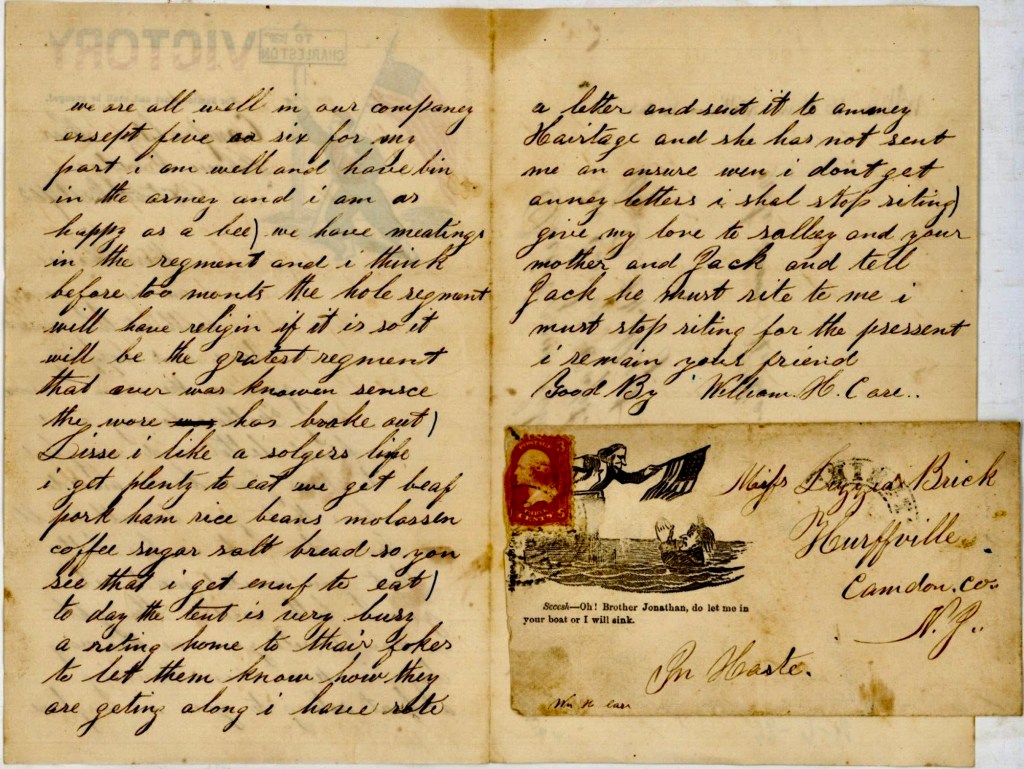
The following letter was written by William H. Carr who served in Co. D, 24th New Jersey Infantry—a nine months’ regiment. On Sept. 28, 1862, the regiment was equipped with Belgian rifles and other necessary accouterments for service, and on Tuesday, the 30th, broke camp and departed for Washington, going by steamer to Philadelphia and thence by rail. It was brigaded with the 28th N. J. and 128th Pa. regiments, under the colonel of the former, acting Brig.-Gen. Abercrombie having command of the division, which occupied the extreme right of the brigade on the Leesburg road. It was afterward permanently brigaded with the 4th and 8th Ohio, 14th Ind., 7th Va., and 28th N. J. regiments under the charge of Brig.-Gen. Kimball, in French’s division, Couch’s corps. It participated in the fighting at Fredericksburg, and the loss of the regiment, which behaved admirably throughout, was severe, amounting in all to 160.

According to regimental records, William survived the war. He was mustered out of the service at Beverly, New Jersey, on 29 June 1863. William wrote the letter to Lizzie Brick (1845-1919) who married John C. Thompson (1838-1911) in 1864 and resided in Hurffville, Gloucester county, New Jersey.

View from heights above the Chain Bridge, showing the ruins of a brick chimney (courtesy of Library of Congress).  The remnants of the brick industrial building are visible below, to the right of the Chain Bridge.

Transcription

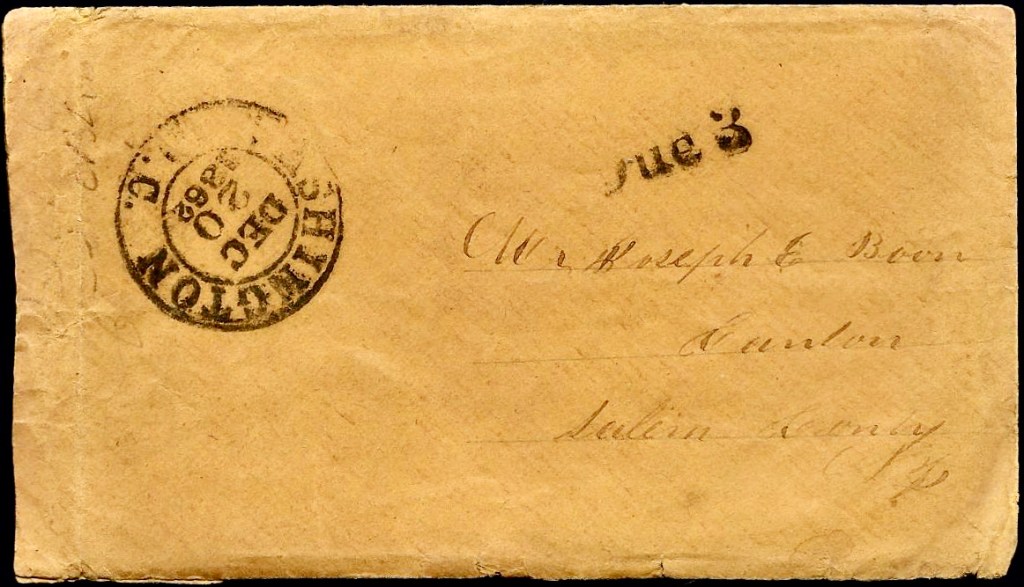
Addressed to Miss Lizzie Brick, Hurffville. Camden county, New Jersey

Camp Oldon near Chain Bridge
October 21st 1862

Miss Lizzie,

I am enjoying good health at this present time and hoping you are the same. I received my Father’s loving and kind letter and was glad to hear from home and to hear that you are all well. Mr. Watson wrote on his letter that you wanted me to write you a letter and I thought I would write you one this very day. I have been thinking about writing to you a long time.

We are all well in our company except five or six. For my part, I am well and have been in the army and I am as happy as a bee. We have meetings in the regiment and I think before two months the whole regiment will have religion. It it is so, it will be the greatest regiment that ever was known since the war has broke out.

Lizzie, I like a soldier’s life. I get plenty to eat. We get beef, pork, ham, rice, beans, molasses, coffee, sugar, soft bread. So you see that i get enough to eat. Today the tent is very busy a writing home to their folks to let them know how they are getting along. I have wrote a letter and sent it to Anney Hairtage and she has not sent me an answer. When I don’t get any letters, I shall stop writing. Give my love to Sally and your mother and Jack and tell Jack he must write to me. I must stop writing for the present. I remain your friend. Goodbye. — William H. Carr

Direct your letter to William H. Carr in care of Capt. Ward, Co. D, 24th Regt. N. J. Vols., Washington D. C. Write soon

1863: John Hawn Boon to Edward Boon

The following letters were written by John Hawn Boon (1842-1890), the son of Joseph Boon (1808-1850) and Ann Hawn (1811-1898). John enlisted as a private in Co. A, 24th New Jersey Infantry, and served from 30 August 1862 to 29 June 1863—a total of 9 months and 29 days. Muster records sometime record his name as “Boone.”

In the 1860 US Census, 18 year-old John was enumerated in Allowaystown, Salem County, New Jersey, working as an “apprentice farmer” for Ercurius Ayres, his father having passed away ten years earlier. By the 1870 US Census, John was married to Sarah E. Allen (1841-1922) and was farming for himself on Lower Alloways Creek in Salem county.

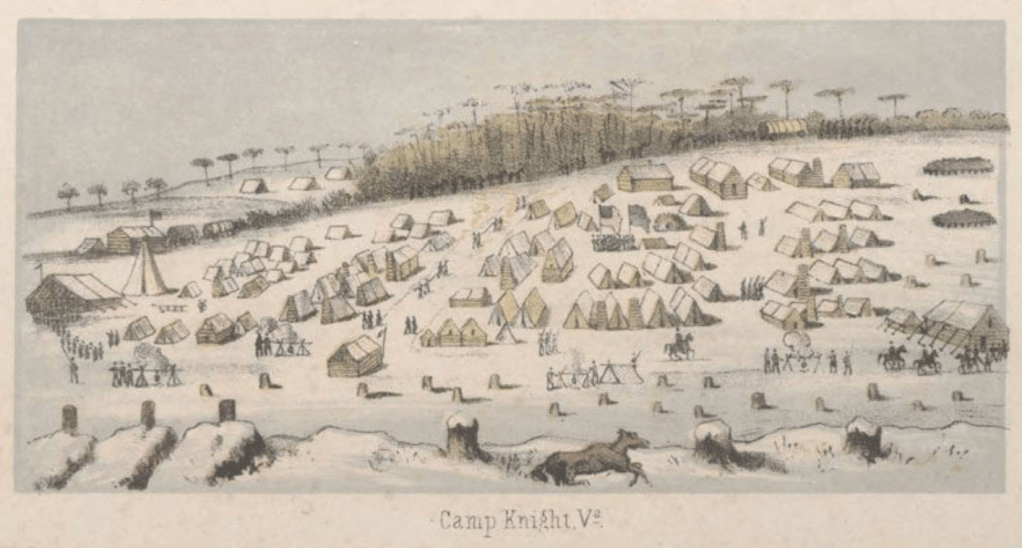
The service record for the 24th New Jersey claims they were at Camp Ingham on East Capital Hill till October 14. At Camp Nixon near Chain Bridge till October 18. Picketing Leesburg Road and fatigue duty at Forts Ethan Allen and Marcy till October 25. At Camp Cumberland till December 1. March to Falmouth, Va., December 1-9. Battle of Fredericksburg, Va., December 12-15. At Camp Knight till January, 1863. At Camp Robertson till April 27.  Chancellorsville Campaign April 27-May 6. Battle of Chancellorsville May 1-5. Mustered out at Beverly, N. J., June 29, 1863. During the service 3 Officers and 46 Enlisted men were killed and mortally wounded and 53 Enlisted men by disease.

Camp Knight, Virginia

[Note: This letter is from the personal collection of Greg Herr and was transcribed and published on Spared & Shared by express consent.]

Letter 1

Camp Knight
December 20, 1862

Dear brother and sister,

I thought as long as you would not write to me, I would write to you and it will be with pleasure that write too. But it would be more pleasure for me to get a letter from you.

Well, brother, we have had a big fight in Fredericksburg but I was not in it. I was sick with the lung fever but I am better. But if I had been well, I would [have] been in it too. I hope that this letter will find you all well, and in good spirits, for I am.

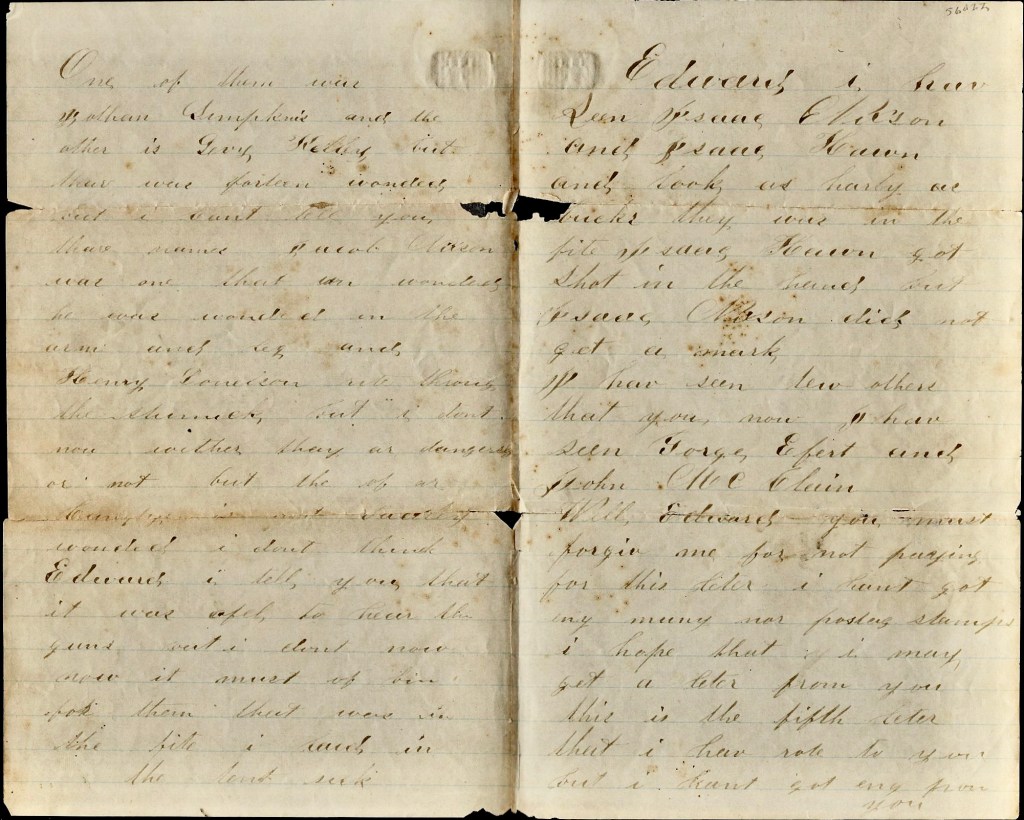
Well, Edward, there was two men killed in our company. One of them was Jonathan Simpkins and the other was Levy Kelley. But there were fourteen wounded but I can’t tell you their names. Jacob Nixon was one that was wounded. He was wounded in the arm and leg, and Henry Donaldson right through the stomach, but I don’t know whether they are dangerous or not. But the rest of our company is not severely wounded, I don’t think.

Edward, I tell you that it was awful to hear the guns. But I don’t know how it must of been for them that were in the fight. I laid in the tent sick.

Edward, I have seen Isaac Nixon and Isaac Hawn and [they] look as hardy as bricks. There was in the fight. Isaac Hawn got shot in the hand but Isaac Nixson did not get a mark. I have seen a few others that you know. I have seen George Efert and John McClain.

Well, Edward, you must forgive me for not paying for this letter. I han’t got any money nor postage stamps. I hope that I may get a letter from you. This is the fifth letter that I have wrote to you but I han’t got any from you. Well, I must stop writing for it is time that the letter is in the office.

Direct your letter to Washington D. C., the 24th [N. J. ] Regiment, Company A, in care of Capt. [Howard] Bassett, the Army of the Potomac. No more at present. So goodbye. Please write soon.

— John H. Boon

to Edward Boon


Letter 2

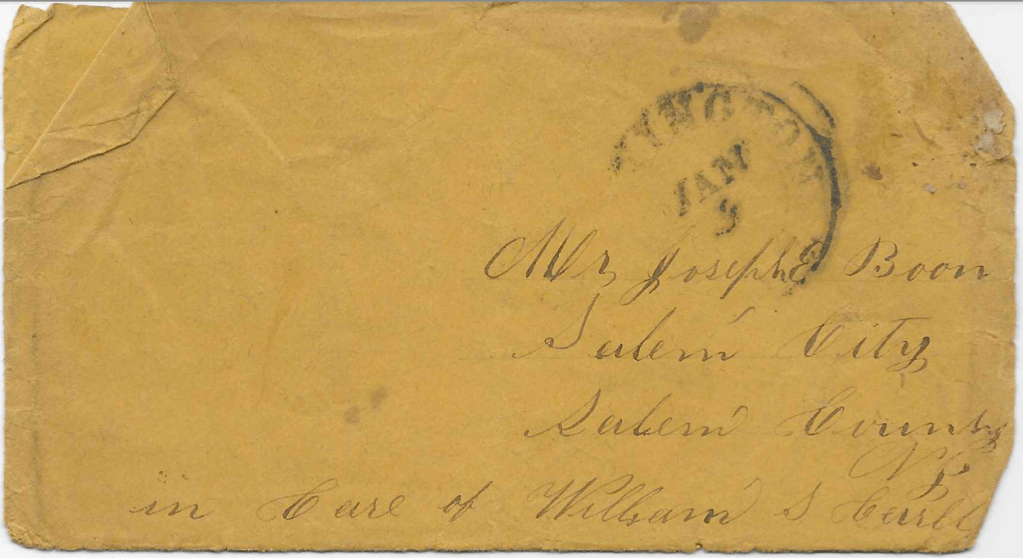
This envelope was directed to Joseph E. Boone (1840-1912) of Salem City, Salem county, New Jersey

Camp Knight
February 5, 1863

Dear brother and sister,

I received your letter night before last and I was glad to hear from you. Your letter found me in good health and this letter leaves me in good health and I hope it will find you and your family enjoying the same blessing.

Dear brother, this is a very stormy day, I tell you. It’s snowing here very hard and it is very cold. But I expect that it is colder at home than it is here. I am sitting in my tent with my shoes off and got my feet covered up with the blanket and I am quite comfortable. But this afternoon at two o’clock I have to go out on picket and that is a bad job, I tell you. Most every time that I am on picket, it storms. But I have got a pair of boots and they come up to my knees. I paid 8 dollars for them. It is cold, cold, stormy weather and in comes the old folks a drinking, but everything is lovely, “Oh the bridle and the saddle hangs on the shelf, and if you want any more, sing it yourself.” 1

Do you know the reason that I write with a pencil? If you don’t know, I will tell you. Well, the reason is the paper is so soft that I can’t write on it with a pen. So now you know the reason.

I got paid off the other day, twenty-six dollars, but I did not send any of it home nor I don’t lay out to.

Edward, I want you to tell me whether you get my letters or not. I would put postage stamps on them but I can’t get them. They are as scarce as hen teeth out here so you will have to pay for them. I would send some money home to get some stamps but I am afraid you won’t get the letter. So I think it better to not send any. So I guess that I will bring my letter to a close. I still remain your affectionate brother, — John H. Boon

to Edward Boon

Please write soon. Goodbye.


1 This line is from a popular folk song sometimes under the title, “Pompey is Dead and Laid in his Grave.”