Category Archives: 24th North Carolina Infantry

1863: Sidney T. Dixon to Thompson H. Dixon

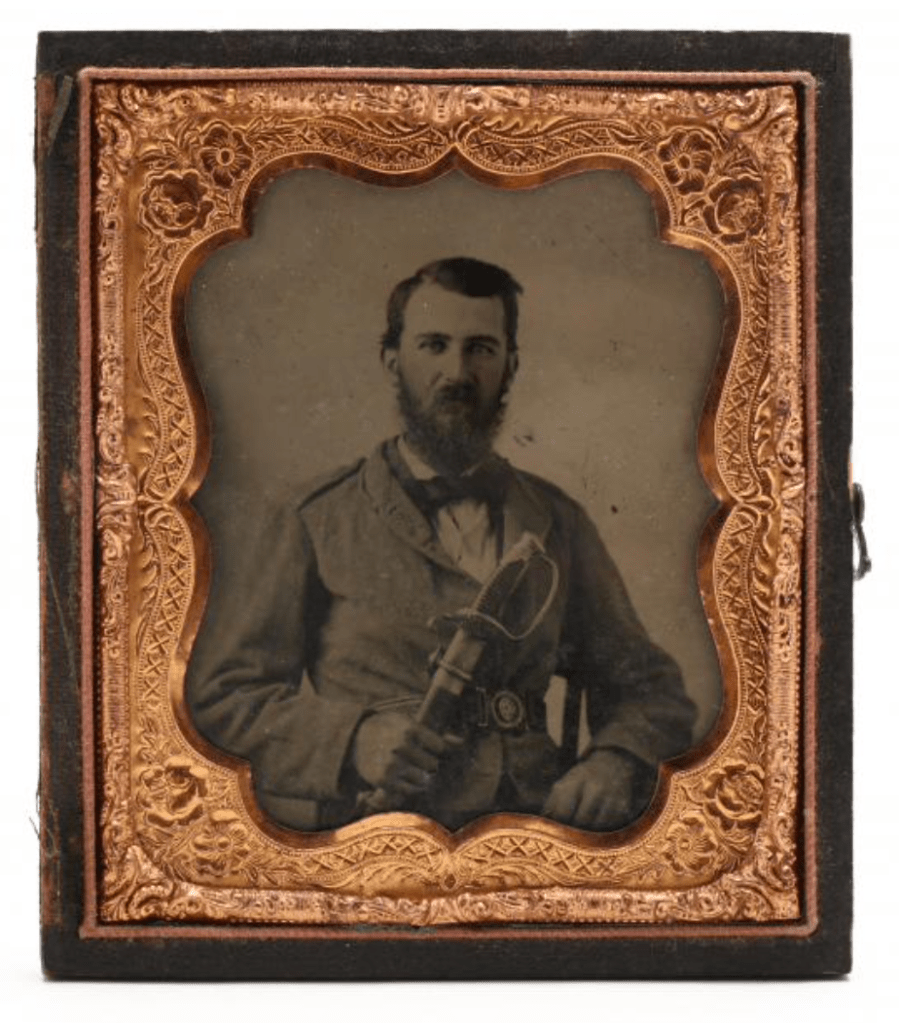
I could not find an image of William in uniform but here is one of Pvt. William B, Wheless of Co K, 24th North Carolina Infantry (Louis A. Wheless Collection)

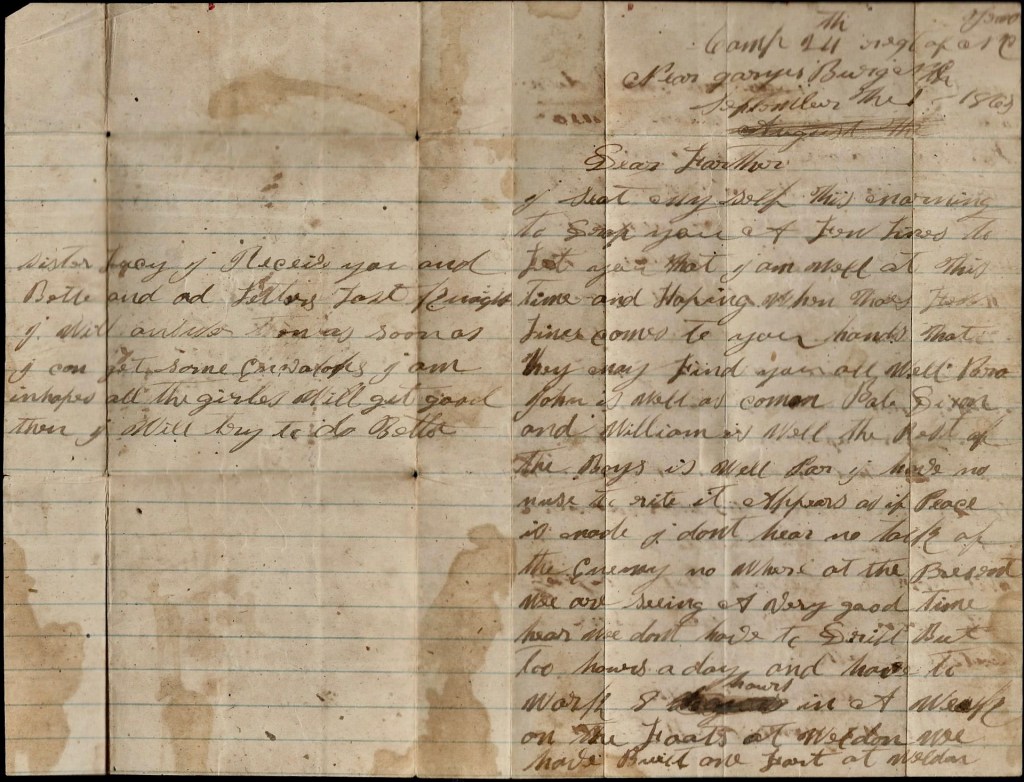
The following letter was written by Pvt. Sidney T. Dixon (1840-1864) of Co. H, 24th North Carolina Infantry (formerly the 14th North Carolina Infantry). According to muster records, Sidney enlisted on 1 March 1862 for the duration of the war. He seems to have been present with the regiment most of the time until 21 May 1864 when he died at Chester Station from wounds received at Bermuda Hundred.

Sidney and his brother John C. Dixon (b. 1841)—who served in the same company, were the only sons of Thompson H. Dixon (1805-Bef1900) and Elizabeth Lucy Walters (1814-Bef1900) of Allensville, Person county, North Carolina. John Dixon enlisted in June 1861 (when the regiment was the 14th N. C.) and served until 28 February 1865 when he finally deserted. The other Dixon boys mentioned in the letter were probably cousins.

By the time of Sidney’s death in 1864, the regiment had seen action in the Seven Days Battles, the Maryland Campaign, the Battle of Fredericksburg, and the action around New Berne and Plymouth in North Carolina. Specifics are lacking as to where Sidney was wounded but it was likely in the Battle of Drewry’s Bluff in mid-May, 1864.

Transcription

Addressed to Mr. T. H. Dixon, Allensville P. O., Person county, North Carolina

Camp 24th Regt. of N. C.
Near Garysburg, North Carolina
September 1st 1863

Dear Father,

I seat myself this morning to drop you a few lines to let you [know] that I am well at this time and hoping when these few lines comes to hand, that they may find you all well. Bro. John is well as common. Bob Dixon and William is well. The rest of the boys is well.

Par, I have no news to write. It appears as if peace is made. I don’t hear no talk of the enemy no where at the present.

We are seeing a very good time here. We don’t have to drill but two hours a day and have to work 8 hours in a week on the forts at Weldon. We have built one fort at Weldon and got another one most done. We have very cool weather here for the season.

Par, let as many hold up for Old Holden 1 as will, but don’t you never let no such a set turn you to be a Holdenite for there is not a smart man in our army that would take up for him. It is true, there is a great many that hold up for him, but what sort of men are they? They are ones that has been a disadvantage to us ever since the war commenced.

So as I have no more to write, I will come to a close by saying write soon. As ever your son until death, — Sidney T. Dixon

To Mr. Thompson H. Dixon

Sister Lucy, I received yours and Bette’s letters last night. I will answer them as soon as I can get some envelopes. I am in hopes all the girls will get good. Then I will try and do better.

1 “Old Holden” is a reference to William Woods Holden (1818-1892)—a newspaper editor who used the press to criticize the Confederate government and by 1862, to rally support for a peace movement in North Carolina. He ran for the Governor’s seat in 1862 but failed.
1862: Bedford Brown to Mary (Simpson) Brown

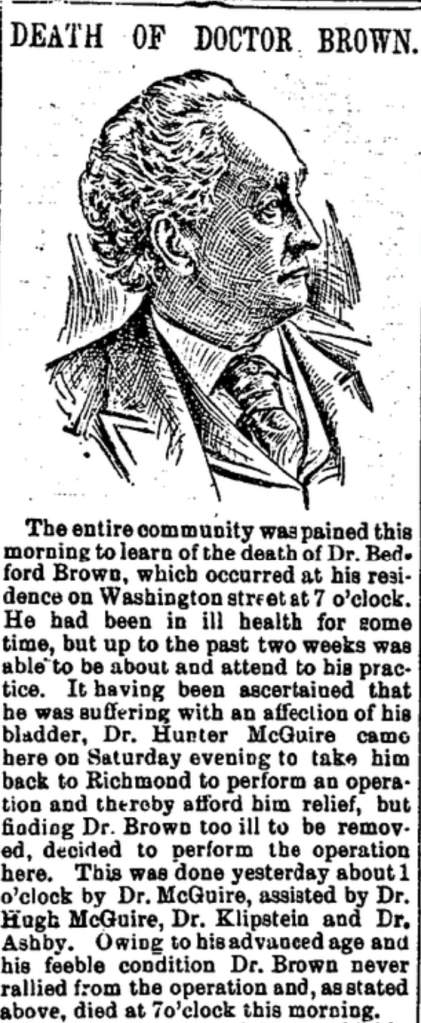
Though it is only signed “Bedford,” I feel certain this letter was written by 39 year-old Dr. Bedford Brown (1823-1897) of Caswell, North Carolina. Brown grew up on the Rose Hill Plantation, the son of US Senator and planter Bedford Brown (Sr.) (1795-1870) of Caswell county, North Carolina—a leader in the “States Rights” faction of the southern Democratic party and a close personal friend of Andrew Jackson. Sen. Brown was very much his own man, and stood toe to toe with John C. Calhoun on the floor of the Senate when their opinions differed. He has been eulogized as a man that was “true to his convictions in all with an idea that all white men were free and equal and though little lower than the angels perhaps were crowned with glory and honor from above.” [The Times (Richmond, Va), 14 Sep 1897, emphasis added]

I could not find an image of Bedford wearing his uniform but here is William R. Hughes who was a surgeon in the 31st North Carolina. He’s wearing a short military jacket and a NC Belt Plate.

Young Bedford was tutored by the same schoolmaster as Robert E. Lee. At age 21, he was sent to Lexington, Kentucky, to read medicine with Dr. Benjamin Dudley, graduated at Transylvania University, and also from Jefferson College in Philadelphia in 1854. He was married to Mary Elizabeth Simpson (1827-1907) in 1852 and by the time this letter was written in 1862, the couple had at least four children, though only two were still living. After practicing medicine in Albemarle and Fauquier counties, Dr. Brown went back to his father’s plantation but when the war began, he offered his services as a surgeon in the 24th North Carolina Regiment and was assigned to Floyd’s Brigade, serving in West Virginia. Then he was assigned to “Gen. Gustavus Smith’s staff and later surgeon of Daniel’s Brigade. He served under Gen. Lee and Gen. Stonewall Jackson as well, and during the latter part of the war had to leave the service though he was long inspector of camps and hospitals in North Carolina and thereabouts.” After the war he settled and opened a practice in Alexandria, Virginia.

This letter was written just after Lee’s Army of Northern Virginia—including Brown’s former regiment, the 24th North Carolina—had been turned back at Antietam and were being driven back (some would say allowed to retreat) “with thousands of sick, wounded & broken down men straggling” into Virginia. In his letter, Brown acknowledges his wife’s plea for him to consider taking advantage of the Exemption Bill which came to be called the controversial “Twenty-Slave Law.” Brown reminds her that the Bill was not yet a law (it passed the Confederate Congress on 11 October 1862) but does not hint further whether he would consider exempting himself. We know from his service record that he did not.

See also: Bedford Brown tar Healer

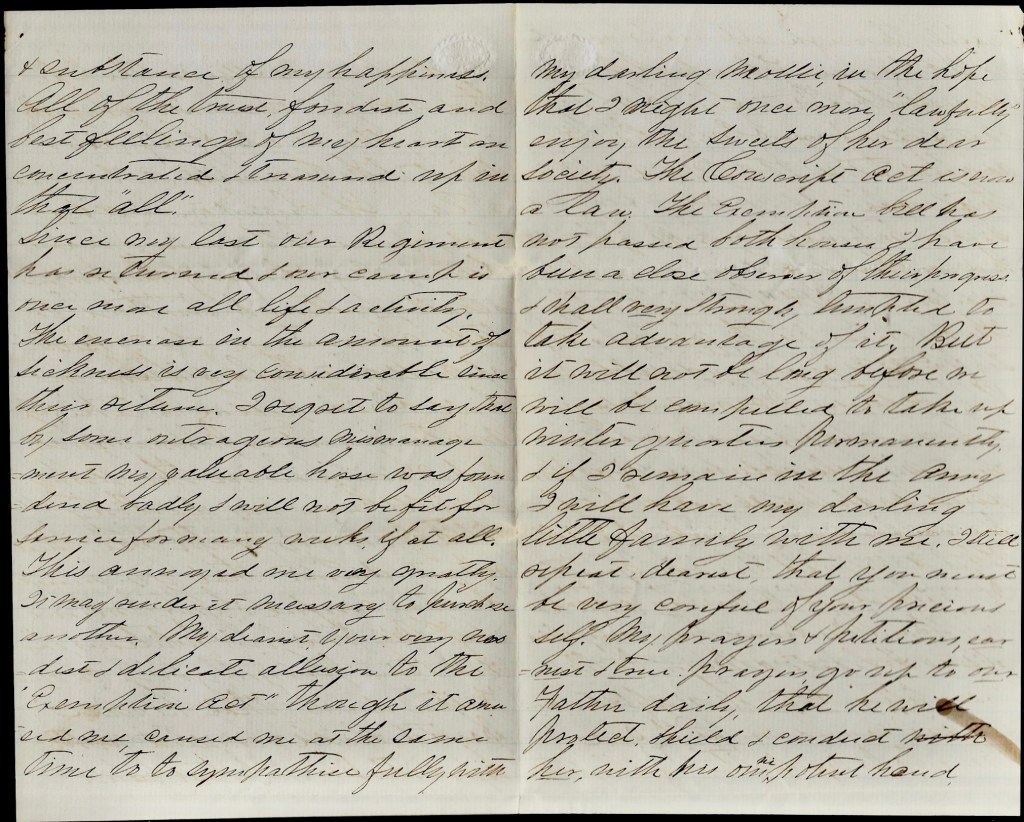
Transcription

Near Drury’s Bluff
September 27th 1862

My own sweet & precious wife,

Your very dear & treasured letter of the 23rd inst. came to me promptly last night. Your letters, dearest one, are very precious to me. Their tone, style & expressions remind me so much of her who is so fondly treasured by me. Indeed, my own sweet Mollie, your tender & loving letter afford me exquisite pleasure. They make my heart leap and bound with delightful emotions of sympathetic love and fondness. The the happy, very happy information that “All” were well. That “All” means really “All.” It is in truth all to me. It is the all with which my fond & devoted heart is snapped up with. It is the very sum and substance of my happiness. All of the trust, fondest and best feelings of my heart are concentrated & treasured up in that “all.”

Since my last, our regiment has returned & our camp is once more all life & activity. The evenness in the amount of sickness is very considerable since their return. I regret to say that by some outrageous mismanagement, my valuable horse was foundered badly and will not be fit for service for many weeks, if at all. This annoyed me very greatly. It may render it necessary to purchase another.

My dearest, your very [n____dist] & delicate allusion to the “Exemption Act”—though it amused me—caused me at the same time to sympathize fully with my darling Mollie, in the hope that I might once more “lawfully” enjoy the sweets of her dear society. The Conscript Act is now a law. The Exemption Bill has not passed both houses. I have been a close observer of their progress & shall [be] very strongly tempted to take advantage of it, but it will not be long before we will be compelled to take up winter quarters permanently & if I remain in the army, I will have my darling little family with me. I still repeat, dearest, that you must be very careful of your precious self. My prayers and petitions, earnest & true prayers go up to our Father daily, that He will protect, shield, and conduct her with His omnipotent hand safely through all her trials, who is the treasure of my heart, & preserve her to me in future.

I was surprised to learn of the death of my old friend B. Guinn. As you say, I fear that he was taken away badly prepared to meet his maker.

One of our officers heard a rumor in Richmond this morning that our army was falling back from the Potomac. There is no doubt that our army is in a suffering condition. There being thousands of sick, wounded & broken down men straggling—our Northern Virginia in a starving condition. Now dearest one, may our Father manifestly spare thee to me, preserve our little darlings to us. Kiss them for me. My love to all at Pa’s. Respects to Miss N.

Ever dearest, your true & loving husband, — Bedford

1861: William Nicholas Rose to Benjamin Bryan Rose

I could not find an image of William in uniform but here is one of Pvt. William B, Wheless of Co K, 24th North Carolina Infantry (Louis A. Wheless Collection)

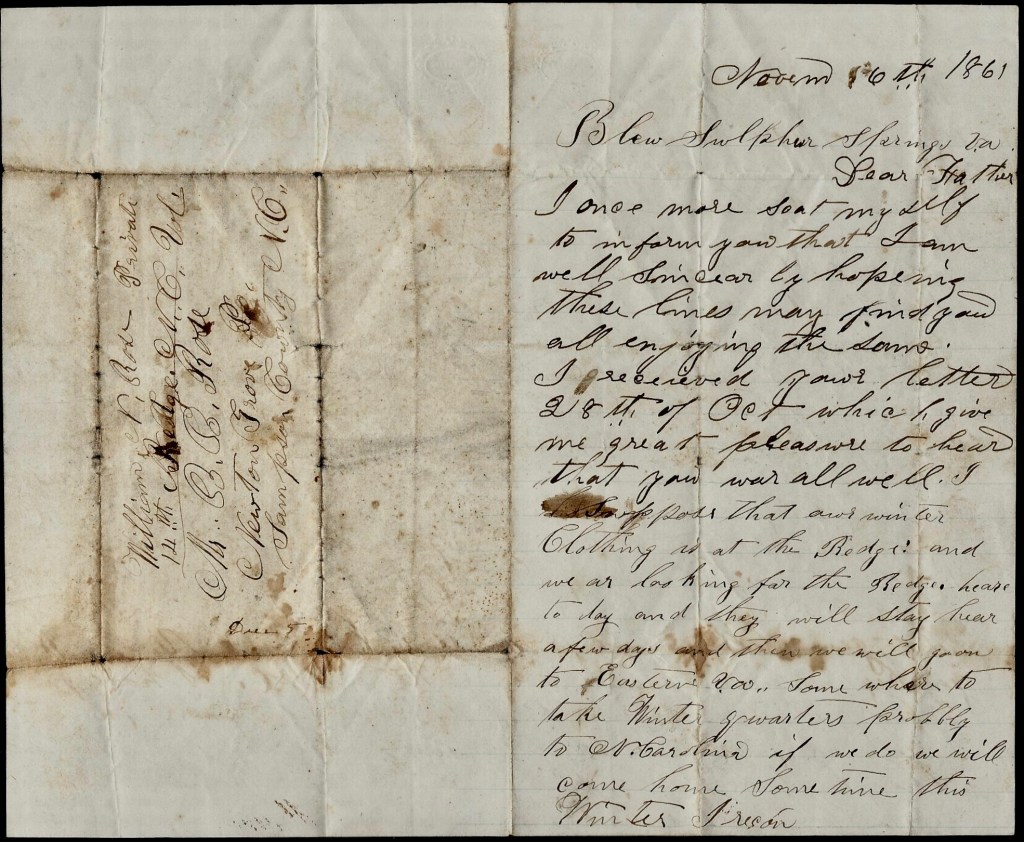
This letter was written by 19 year-old William Nicholas Rose (1842-1915), the eldest son of Benjamin Bryan Rose (1817-1880) and Elizabeth (“Betsy”) Eldridge (1819-1872) of Newton Grove—about halfway between Goldsboro and Fayetteville—in Sampson county, North Carolina. In his old age, friends referred to William as “Squire Bill.”

William enlisted in May 1861 as a corporal in Co. E (the “Lone Star Boys”), 24th North Carolina Infantry (Formerly 14th North Carolina Infantry Vols.). He was promoted to 5th Sergeant of his company in February 1863. By July 1864, he had risen in rank to 1st Sergeant. He was taken prisoner near Petersburg, Virginia, on 27 March 1865 and was released from the Point Lookout, Maryland, prison on 19 June 1865. According to prison records, William was described as standing 5 feet 6 inches tall with light brown hair and gray eyes.

Transcription

Addressed to Mr. B. B. Rose, Newton Grove, Sampson county, North Carolina

Below Sulphur Springs, Virginia
November 6th 1861

Dear Father,

I once more seat myself to inform you that I am well [and] sincerely hoping these lines may find you all enjoying the same. I received your letter 28th of October which give me great pleasure to hear that you were all well. I suppose that our winter clothing is at the regiment at we are looking for the regiment here today and they will stay here a few days and then we will go on to Eastern Virginia somewhere to take winter quarters—probably to N. Carolina. If we do, we will come home sometime thins winter I reckon.

We have a great deal of sickness yet though a great many of the worse cases have died. Col. [William John] Clarke‘s brother died on Sunday morning last. Also John E. Thompson and Lovitt [B.] Grantham of our company has died. We have lost 12 men out of our company. No more dangerously sick in our company.

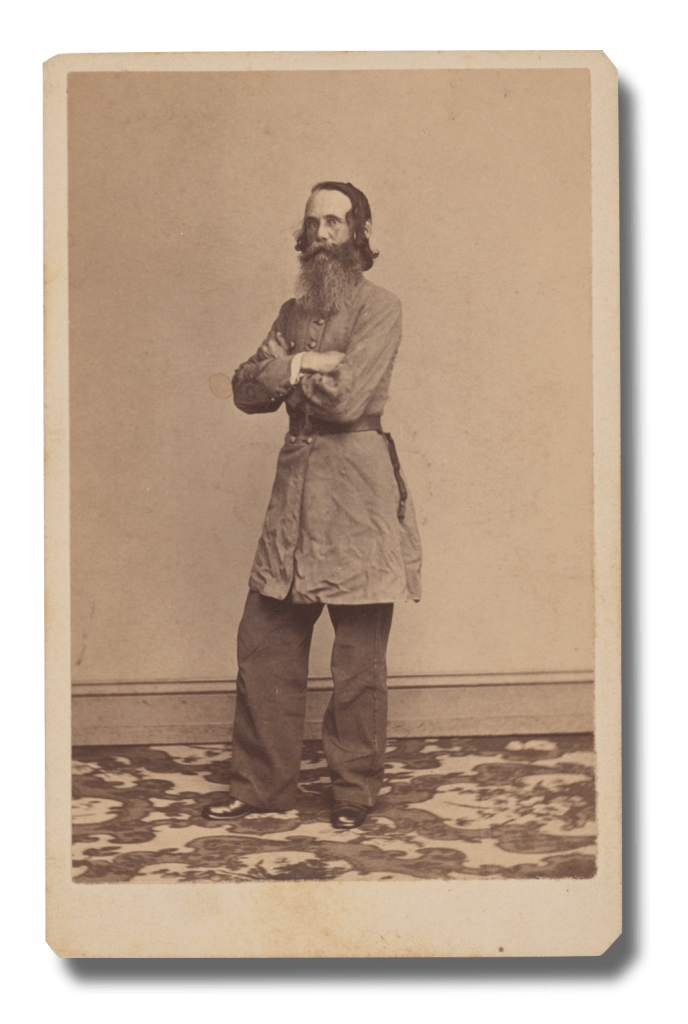
Col. William John Clarke of 24th North Carolina Infantry. Clarke was wounded on 15 May 1864 at Drewry’s Bluff and captured on 5 February 1865 at Dinwiddie Court House. He was imprisoned at Old Capitol Prison and Fort Delaware.

I have no news of importance to write you—only General Floyd has had a fight at Cotton Hill. 1 I did not hear how many was killed though I heard that Gen. Floyd took 500 Yankees which I expect is so. I have not seen Quint Sina. I received your last letter though I hear from him very often. He has ha the mumps but has got well. I am still waiting on the sick yet.

Tell Uncle Ira to write to me as I can’t get the chance to write to him. Tell Uncle Avery to write also. So you must write yourself as often as you can. I hope I will be remembered by you all. Nothing more at present—only your loving son until death, — William N. Rose

You will please direct your letters to Lewisburg, Va. in care of Col. Clarke, 14th Regiment N. C. Vol. I have got the worst pen you ever saw.

To my father, B. B. Rose by William N. Rose


1 See Siege of Cotton Hill, Virginia, 30 October to 7 November 1861.