The following letter was written by 43 year-old Silas Pardee (1820-1894) while serving in Co. I, 25th Connecticut Infantry—a nine-months regiment that served from mid-November 1862 until late August 1863.
Silas was married to Mary Brocket in 1844. The couple were divorced in February 1880—the cause for divorce attributed to intemperance on his part. In this letter to his 12 year-old daughter Estelle, Silas defends the reputation of a soldier named Josiah but I don’t believe he was in the same company as Silas. There are family references to “Fanny” so I suspect that Josiah was a relative but I haven’t established the relationship.
Transcription
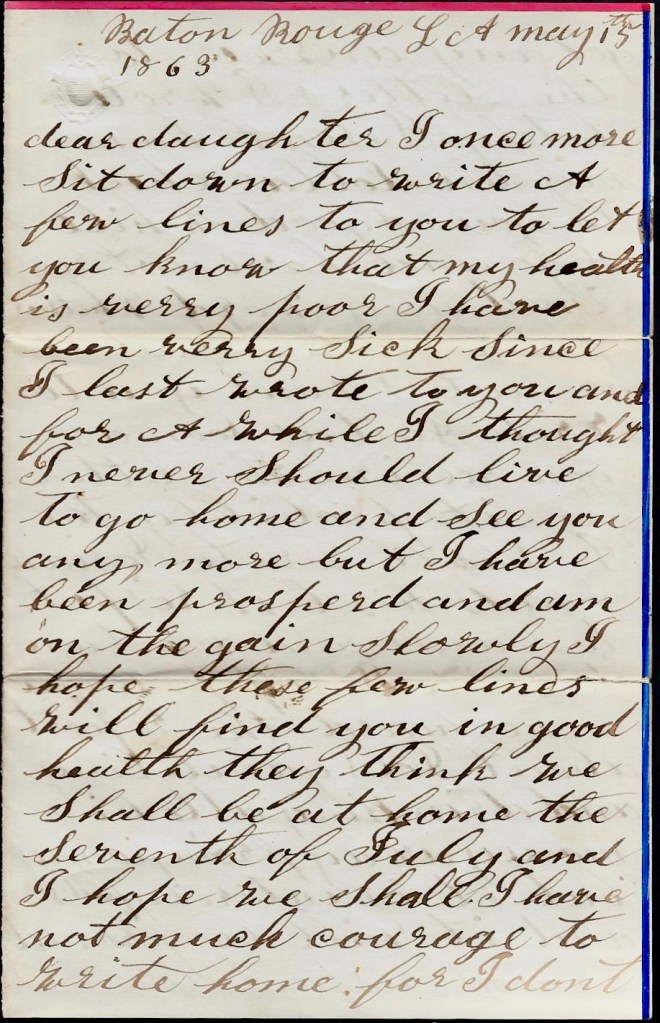
Baton Rouge, Louisiana May 15th 1863
Dear Daughter,
I once more sit down to write a few lines to you to let you know that my health is very poor. I have been very sick since I last wrote to you and for a while I thought I never should live to go home and see you anymore. But I have been prospered and am on the gain slowly. I hope these few lines will find you in good health. They think we shall be home the 7th of July and I hope we shall.
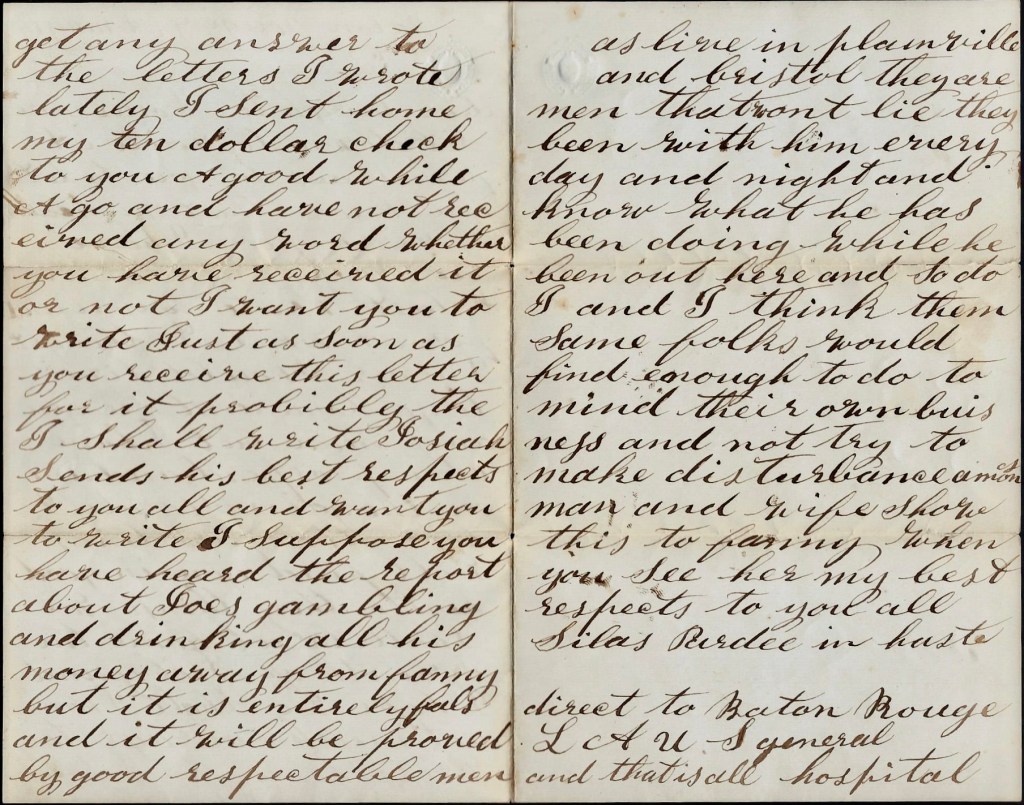
I have not much courage to write home for I don’t get any answer to the letters I wrote lately. I sent home my ten dollar check to you a good while ago and have not received any word whether you have received it or not. I want you to write just as soon as you receive it for it’s probably the [last] I shall write.
Josiah sends his best respects to you all and wants you to write. I suppose you have heard the report about Joe’s gambling and drinking all is money away from Fanny, but it is entirely false and it will be proved by good respectable men as live in Plainville and Bristol. They are men that won’t lie. They have been with him every day and night and know what he has been doing while he has been out here and so do I, and I think them same folks would find enough to do to mind their own business and not try to make disturbance among a man and his wife. Show this to Fanny when you see her, My best respects to you all. — Silas Pardee
In haste. Direct to Baton Rouge, La., US General Hospital, and that is all.
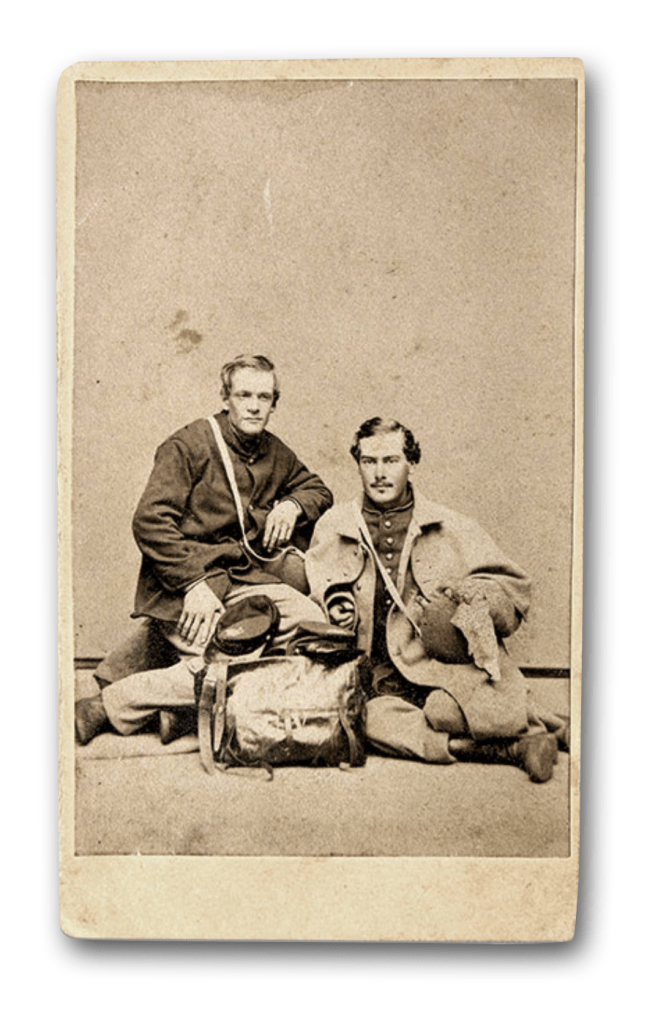
Lucien M. Royce (at left) enlisted in the 25th Connecticut in August 1862. In November 1863, he joined the US Navy serving as ships steward on the USS Acacia. (Buck Zaidel Collection)
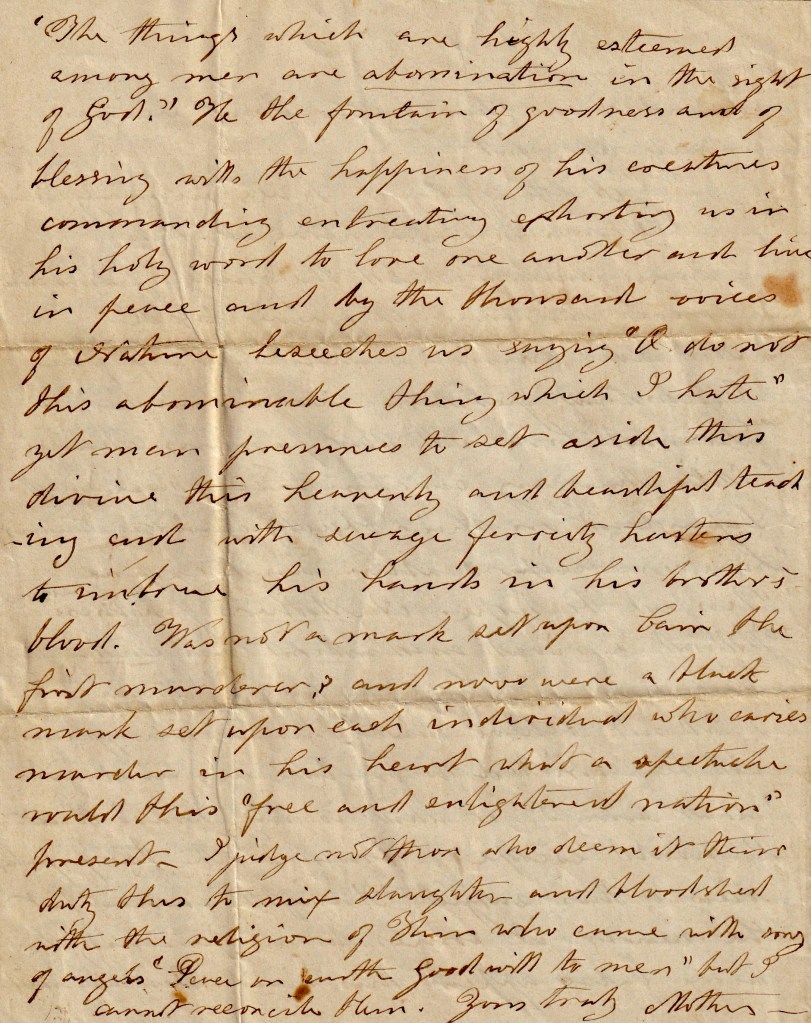
This letter was penned by Sarah Elizabeth (Atwater) Royce (1807-1887), the wife of shoemaker Enos Royce (1803-1874) of Bristol, Hartford county, Connecticut. She wrote the letter to her son Lucien Merriam Royce (1838-1907).
In her letter, Sarah despairs that her son Hubert Dana Royce (1842-1914) has stated his intention of enlisting in the army despite her repeated attempts to talk him out of it, feeling that war is against the teachings of her religion. She even goes so far as to warn him that if he carries through with his determination to enlist, it will most certainly send her to a lunatic asylum or the grave. Sarah mentions a neighbor family named Yale who had a son named Frank already in the service. This would have been Orlando Franklin (“Frank”) Yale who enlisted in the 9th Connecticut Infantry. Frank’s father William Yale was a machinist and his older brother Henry was a carpenter. The Yale family lived immediately next door to the Royce family.
Sarah’s letter was datelined on 1 December 1861 from “Brookside” which I suspect is the name given the family homestead rather than a city or town. According to state military records, Hubert did indeed enlist, as he threatened, on 3 December 1861 in the 12th Connecticut Infantry. Fortunately he survived the war (as did his mother), mustering out of the service on a disability on 24 August 1863. Hubert’s older brother Lucien also enlisted, joining the 25th Connecticut Infantry in August 1862.
It should be noted when Hubert enlisted, he did so under the alias name of Hubert D. Rice, not Royce.
[This letter is from the private collection of Richard Weiner and is published on Spared & Shared by express consent.]
Transcription
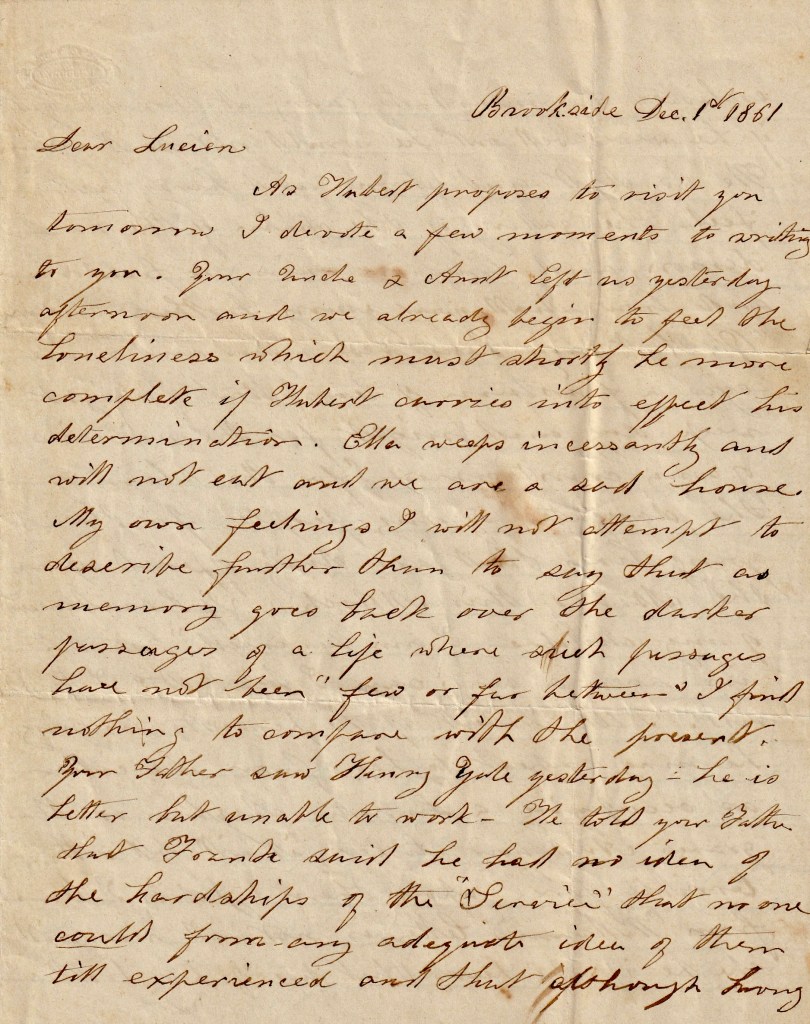
Brookside December 1st 1861
Dear Lucien,
As Hubert proposes to visit you tomorrow, I devote a few moments to writing to you. Your Uncle and Aunt left us yesterday afternoon and we already begin to feel the loneliness which must shortly be more complete if Hubert carries into effect his determination. Ella 1 weeps incessantly and will not eat and we are a sad house. My own feelings I will not attempt to describe further than to say that as memory goes back over the darker passages of a life where such passages have not been “few or far between,” I find nothing to compare with the present.
Your Father saw Henry Yale [Gale?] yesterday. He is better but unable to work. He told your Father that Frank said he had no idea of the hardships of the “Service” that no one could from any adequate idea of them till experienced and that although long enlisted, he meant to carry it through, yet if he were well out, he would not do it again. He is so stout and strong and hardly yet feels the galling of the chain of the war demon, and longs un vain for freedom. And how shall your young brother endure? “Oh that my head were waters and mine eyes a fountain of tears that I might weep day and night” for the miseries of my countrymen, “for the slain of the daughter of my people,” for the young lives that are daily offered upon the altar of this Moloch.
If I am bereaved of my children, I am bereaved, but Oh! in such a way. Can I bear it? I think not. I tell Hubert if he persists in going, he may expect to hear from me either as occupying a Lunatic Asylum or the grave. And your sisters; it will fall with terrible force upon them. John, I learn from William’s letter is not well nor will she if she hears that two of her brothers instead of one has gone. True, we have yourself left, but
“A doting parent lives in many lives Though many a nerve she feels From child to child the quick affections spread, Forever wondering yet forever fixed, Nor does division weaken, nor the force Of constant operation e’er exhaust Parental love. All other passions change With changing circumstances: rise or fall, Dependant on their object; claim returns; Live on reciprocation and expire Unfed by hope. A Mother’s fondness reigns What a rival and without an end.” [Lines from the Drama of Moses in the Bullrushes]
Another image of Lucien M. Royce of the 25th Connecticut Infantry, taken in September 1862. (Connecticut Historical Society)
But I will yet hope as long as I may. I will not believe that this terrible affliction will be permitted to overtake us and yet, “what am I or what is my house” that I should escape. Could I take the popular view of this subject, I might endure, but the nearer it comes to me personally, the more false appears this view. Rest assured “the things which are highly esteemed among men are abomination in the sight of God.” He the fountain of goodness and of blessing wills the happiness of his creatures commanding, entreating, exhorting us in His holy word to love one another and live in peace and by the thousand voices of Nature, beseeches us saying, “Oh, do not this abominable thing which I hate.” Yes men presumes to set aside this divine, this heavenly and beautiful teaching and with savage ferocity hastens to imbue his hands in his brother’s blood. Was not a mark set upon Cain, the first murderer? And now were a black mark set upon each individual who carries murder in his heart, what a spectacle would this “free and enlightened nation” present.
I judge not those who deem it their duty thus to mix slaughter and bloodshed with the religion of Him who came with song of angels. “Peace on earth, good will to men,” but I cannot reconcile Him.
Yours truly, — Mother
1 I assumed Ella was short for Ellen when I initially searched for this family but it turns out her name was Elmira Elizabeth Royce (1844-1927) and they called her “Ella” for short.




 Spared & Shared 23