The following letters were written by Pvt. Alonzo Jackson (1837-1863) of Georgetown, Illinois, who enlisted in Co. A, 25th Illinois Infantry on 4 August 1861 to serve three years. When he was mustered into the regiment at St. Louis on 4 August 1864, he was described as a 5’8″ single farmer who had light hair and blue eyes. Though he enlisted for three years, Alonzo did not live long enough to serve out his term. He died on 20 September 1863 from wounds received in the fighting at Chickamauga.
Alonzo wrote this letter to his Uncle Henderson Cook of Georgetown, Vermilion county, Illinois. He datelined the letter from the regiment’s encampment near Murfreesboro and although he wrote 1862, he meant to date it 1863.
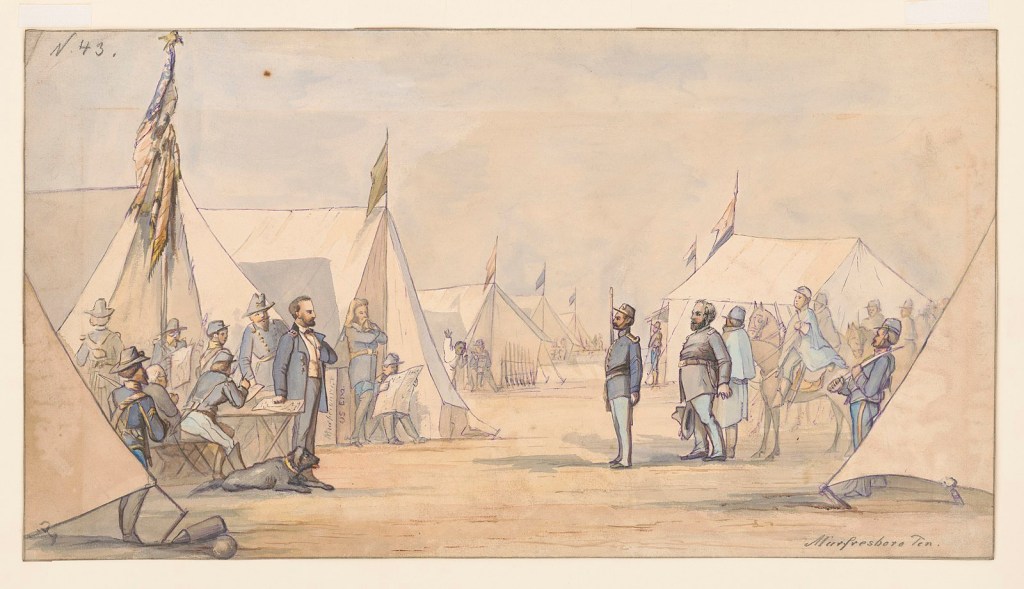
Gen. Rosecrans’ headquarters near Murfreesboro in early 1863
[Note : These letters are from the Sic Parvis Magna, Gratias Jesu Collection and remain in private hands. They were made available expressly for transcription and publication on Spared & Shared.]
Transcription
In Camp near Murfreesboro, Tennessee February 26th 1862 [1863]
Dear Uncle and Aunt,
As I have but few correspondents and letter reading is one of my best enjoyments, I wish to add you to my list. I am at present enjoying good health and my spirits are good notwithstanding it rains nearly every day and we are in the mud up to our eyes (when we fall down). Company A are generally well although we have but few men we consider ourselves equal to any one company Uncle Sam has in his employ and no exception to numbers. Colonel [James S.] McClelland considered us the best at skirmishing and General [William E.] Woodruff said we were as good as he ever saw.
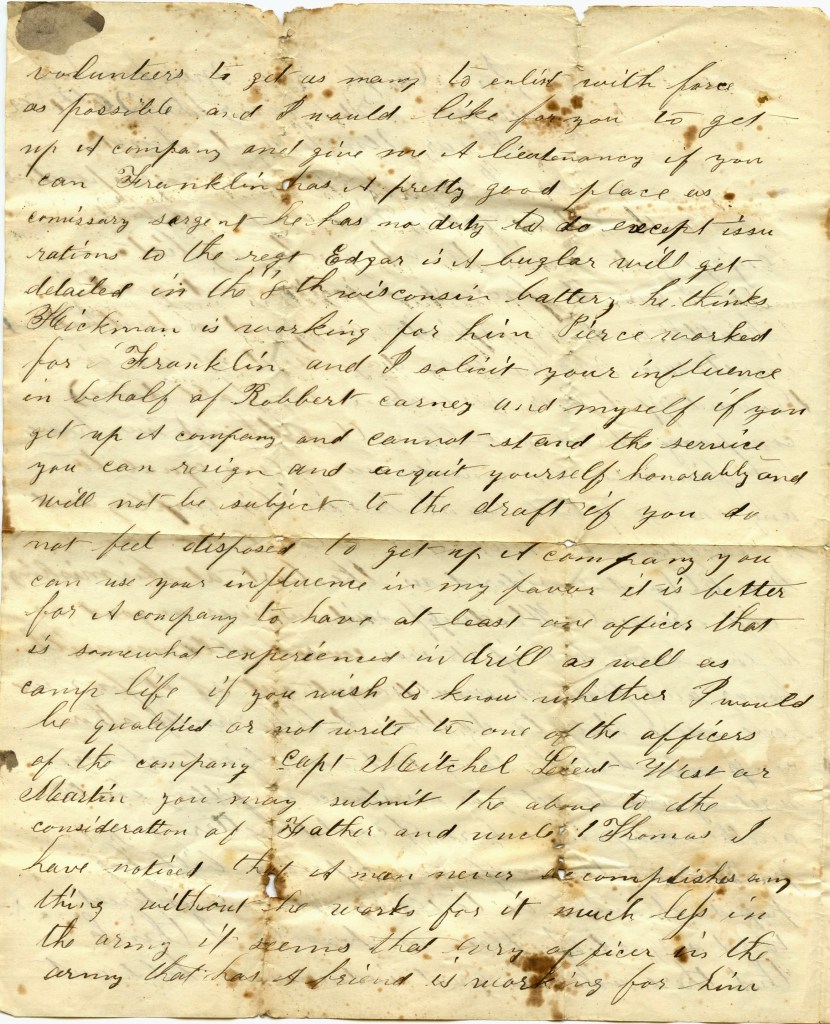
But if it was covered all over with honor and praise, I would want out of it for we have more duty to do than I like unless other companies did the same and one object of my writing was to get your assistance in getting into another company where I could better my position. As the [1863] Conscription Bill has passed, it will be to every man’s interest to get as good a place as possible. I think that there will be great inducements held out to volunteers to get as many to enlist with force as possible and I wouyld like for you to get up a company and give me a Lieutenancy if you can. Franklin has a pretty good place as Commissary Sergeant. He has no duty to do except issue rations to the regiment. Edgar is a bugler [and] will get detailed to the 8th Wisconsin Battery, he thinks. Hickman is working for him. Pierce worked for Franklin and I solicit your influence in behalf of Robert Carney and myself.
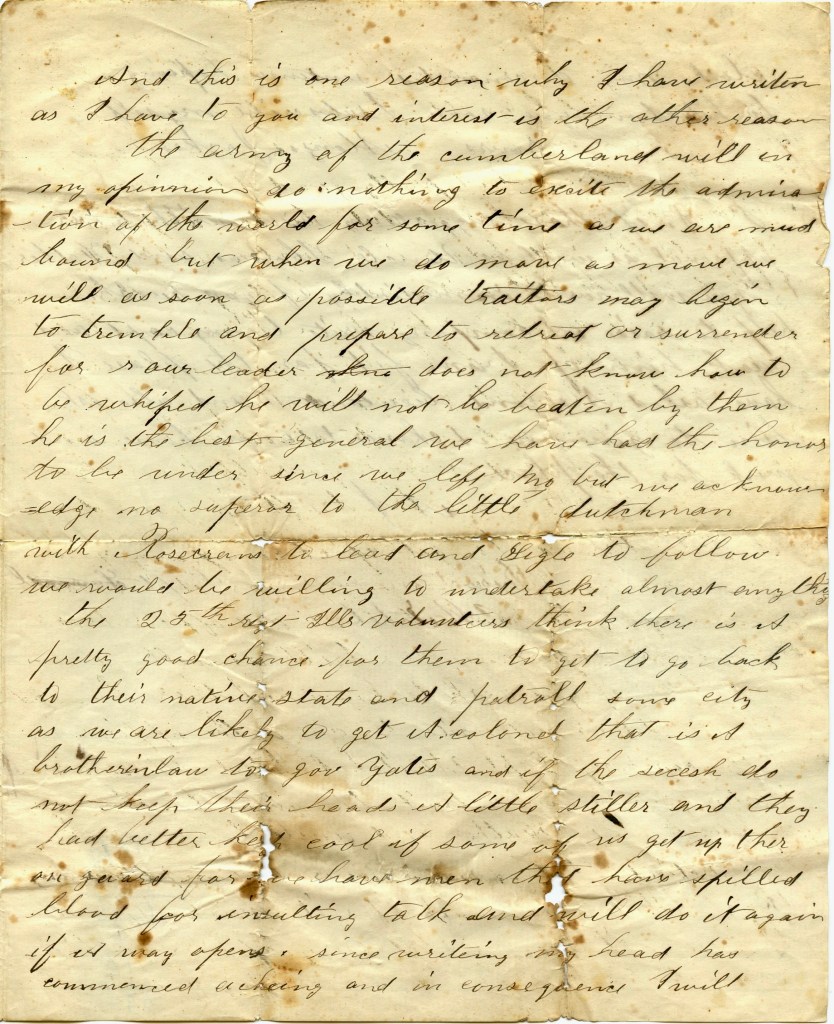
If you get up a company and cannot stand the service, you can resign and acquit yourself honorably and will not be subject to the draft. If you do not feel disposed to get up a company, you can use your influence in my favor. It is better for a company to have at least one officer that is somewhat experienced in drill as well as camp life. If you wish to know whether I would be qualified or not, write to one of the officers of the company—Capt. [Samuel] Mitchell, Lieut. [Theodore] West, or [Achilles] Martin. You may submit the above to the consideration of Father and Uncle Thomas. I have noticed that a man never accomplishes anything without he works for it much less in the army. It seems that every officer in the army that has a friend is working for him. And this is one reason why I have written as I have to you and interest is the other reason.
The Army of the Cumberland will, in my opinion, do nothing to excite the admiration of the world for some time as we are mud bound but when we do move—as move we will as soon as possible—traitors may begin to tremble and prepare to retreat or surrender for our leader does not know how to be whipped. He will not be beaten by them. He is the best General we have had the honor to be under since we left Missouri. But we acknowledge no superior to the Little Dutchman. With Rosecrans to lead and Sigel to follow, we would be willing to undertake almost anything.
The 25th Regt. Illinois Volunteers think there is a pretty good chance for them to get to go back to their native state and patrol some city as we are likely to get a colonel that is a brother-in-law to Gov. [Richard] Yates and if the secesh do not keep their heads a little stiller, and they had better keep cool if some of us get up there on guard, for we have men that have spilled blood for insulting talk and will do it again if a way opens.
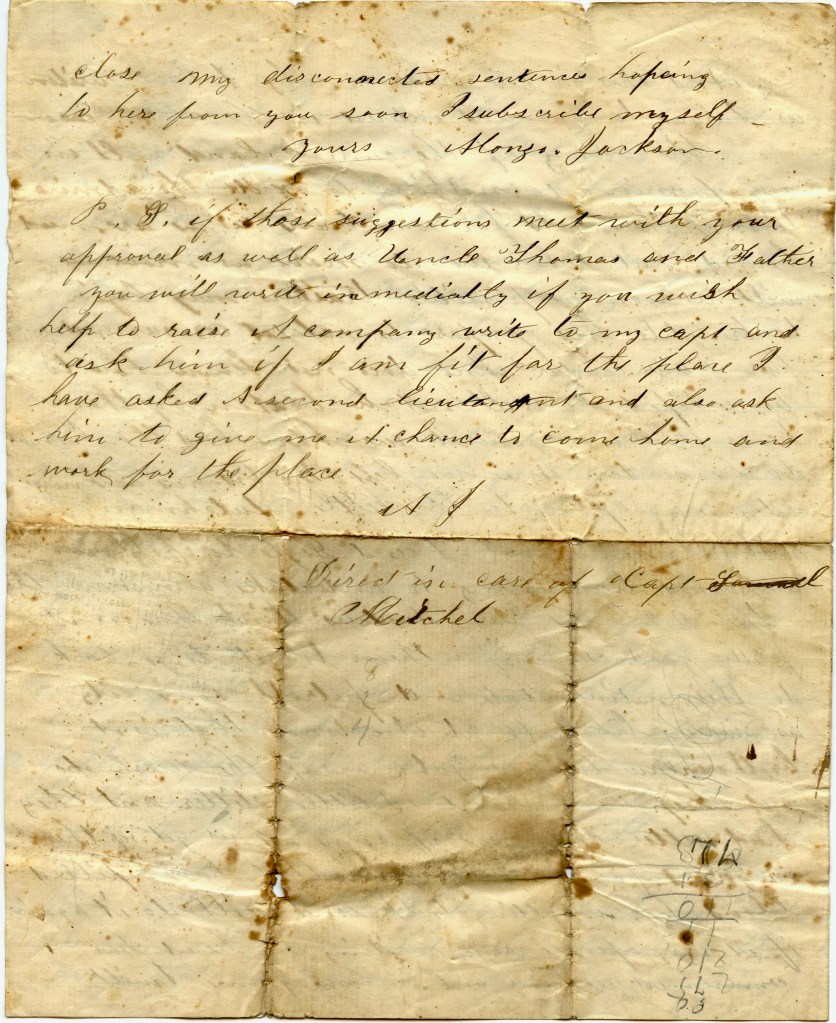
Since writing my head has commenced aching and inconsequence I will close my disconnected sentences hoping to hear from you soon. I subscribe myself yours, — Alonzo Jackson
P. S. If those suggestions meet with your approval as well as Uncle Thomas and Father, you will write immediately if you wish help to raise a company. Write to my captain and ask him if I am fit for the place. I have asked a 2nd Lieutenant and also asked him to give me a chance to come home and work for the place. Direct to care of Capt. Mitchell
The following letters were written by Pvt. Edward Jackson (1841-1863) of Co. A, 25th Illinois Infantry who enlisted at the age of 20 on 1 June 1861 to serve three years. When he was mustered into the regiment at St. Louis on 4 August 1864, he was described as a 5’6″ single farmer who had dark hair and hazel eyes. Though he enlisted for three years, Edgar did not live long enough to serve out his term. He died on 25 November 1863 from wounds received in the fighting at Missionary Ridge.
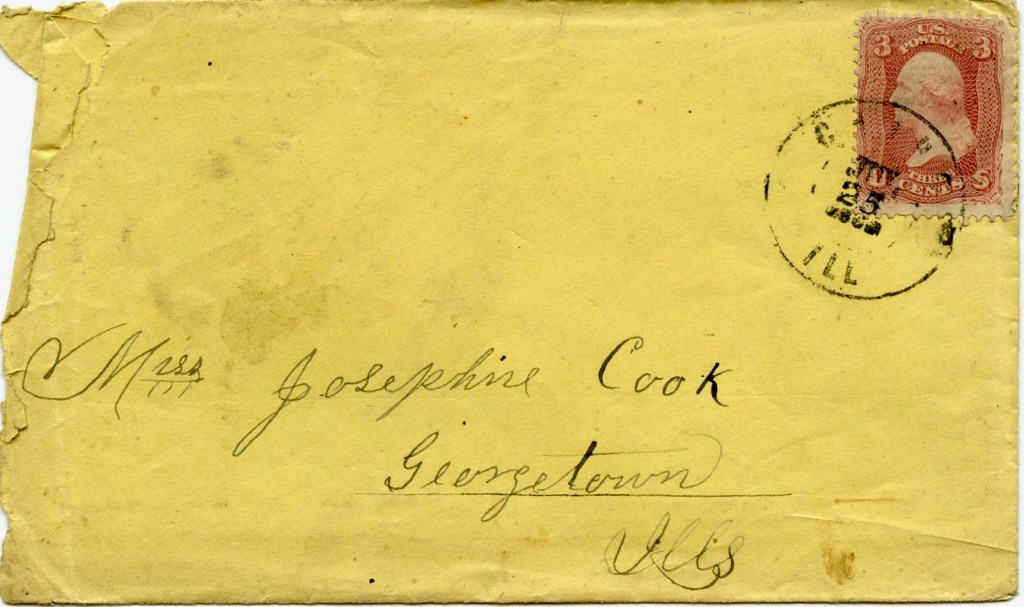
Edgar wrote all of the letters to his cousin, Josephine Cook (1847-1924), the daughter of Henderson and Lucinda (Trout) Cook of Georgetown, Vermilion county, Illinois.
[Note : These letters are from the Sic Parvis Magna, Gratias Jesu Collection and remain in private hands. They were made available expressly for transcription and publication on Spared & Shared.]
Letter 1
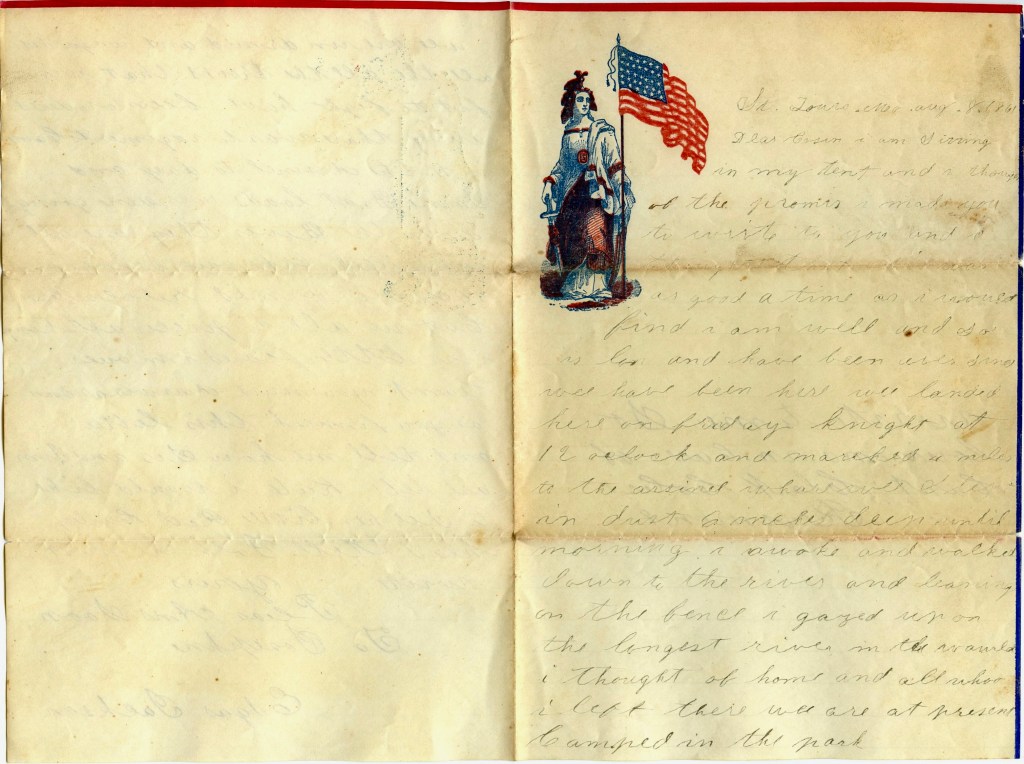
St. Louis, Missouri August 8, 1861
Dear Cousin,
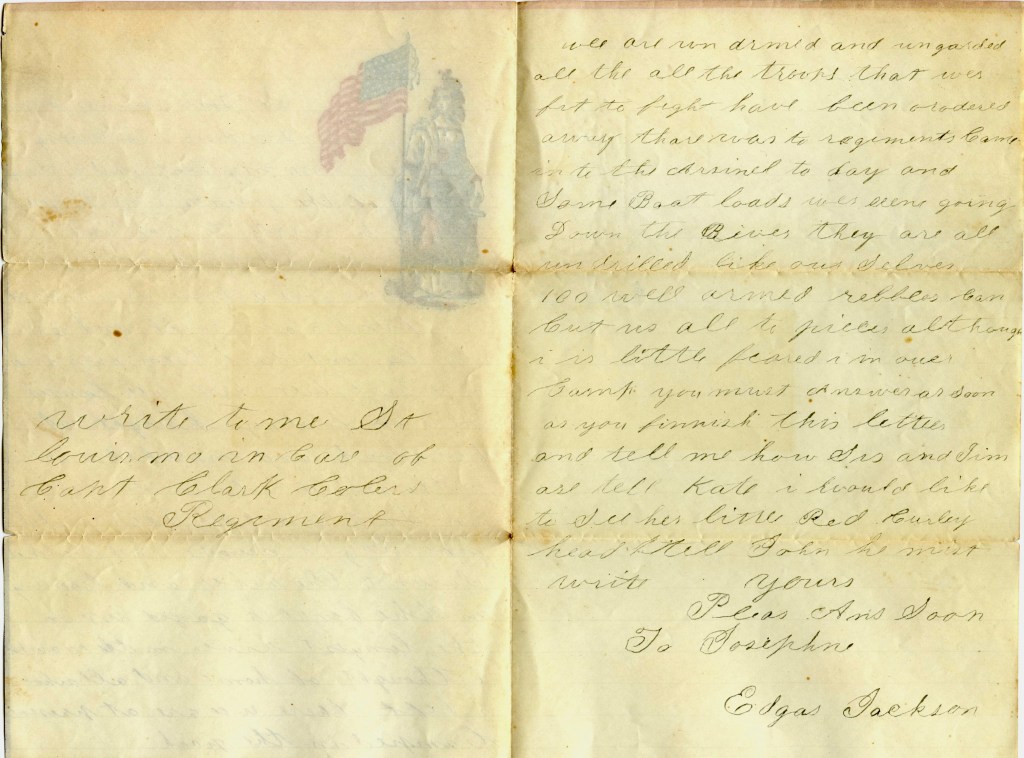
I am sitting in my tent and I thought of the promise I made you to write to you and I thought that it was as good a time as I would find. I am well and so is Ben [Cook] and have been ever since we have been her. We landed here on Friday night at 12 o’clock and marched 4 miles to the Arsenal where we slept in dust six inches deep until morning, awoke, and walked down to the river and leaning on the fence, I gazed upon the longest river in the world. I thought of home and all who I left there. We are at present camped in the park.
We are unarmed and unguarded. All the troops that was fit to fight have been ordered away. There was two regiments came into the Arsenal today and some boatloads were going down the river. They are all undrilled like ourselves. 100 well-armed rebels can cut us all to pieces although I is little feared in our camp.
You must answer as soon as you finish this letter and tell me how Sis and Jim are. Tell Kate I would like to see her little red curly headed little John. He must write. Yours. Please answer soon. — Edgar Jackson
To Josephine
Write to me [at] St. Louis, Mo. , in care of Capt. Clark, [William N.] Coler’s Regiment.
Letter 2
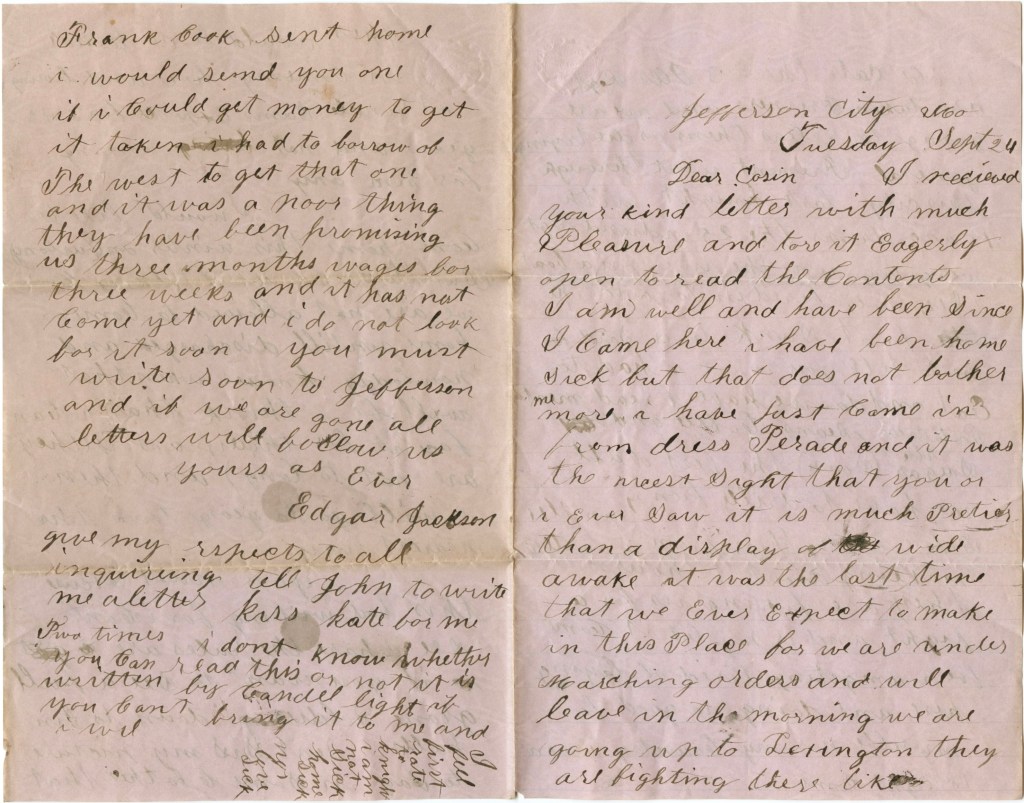
Jefferson City, Mo. Tuesday, September 24th 1861
Dear Cousin,
I received your kind letter with much pleasure and tore it eagerly open to read the contents. I am well and have been since I came here. I have been homesick but that does not bother me more.
I have just come in from Dress Parade and it was the nicest sight that you or I ever saw. It is much prettier than a display of Wide Awake [marchers]. It was the last time that we ever expect to make in this place for we are under marching orders and will leave in the morning. We are going up to Lexington. They are fighting there like wildcats. The 23rd Illinois Regiment are taken prisoners and we are going to release them or die trying. General Frémont went through this city last night with 10,000 troops. The 25th Indiana Regiment were going up the river on a boat. They were fired into and the boat sunk.
You said for me to tell you what I had to eat and do. We have bread, meat, potatoes, beans, coffee, and rice, sugar. Soup the best of all. We have to drill from 7 till 11 before noon. Then from 2 until 6, making about 8 hours. They are fixing us for a fight and I say, let it come for I am getting tired of laying here and doing no good for myself nor my country. I want to fight some. There would be no honor in coming here and living at Uncle Sam’s expense for two or three years and not warring for him any.
I would like to come home this winter on furlough but there is no use of talking for we are not allowed to come home until discharged and nobody knows when that will be. I think that I can face it for three years if they are not too long and then I will got to Georgetown the nearest way.
You must excuse this bad writing for I can’t see where the rules are. If you want to see a full grown soldier, go down to Jim Hall’s. I sent Sis my picture today in some clothes that Frank Cook sent home. I would send you one if I could get money to get it taken. I had to borrow of [Lt.] Theodore West to get that one and it was a poor thing. They have been promising us three months wages for three weeks and it has not come yet and I do not look for it soon. You must write soon to Jefferson and if we are gone, all letters will follow us.
Yours as ever, — Edgar Jackson
Give my respects to all inquiring. Tell John to write me a letter. Kiss Kate for me two times. I don’t know whether you can read this or not. It is written by candle light. If you can’t, bring it to me and I will. I feel first rate tonight. I am not sick, homesick, nor lovesick.
Letter 3
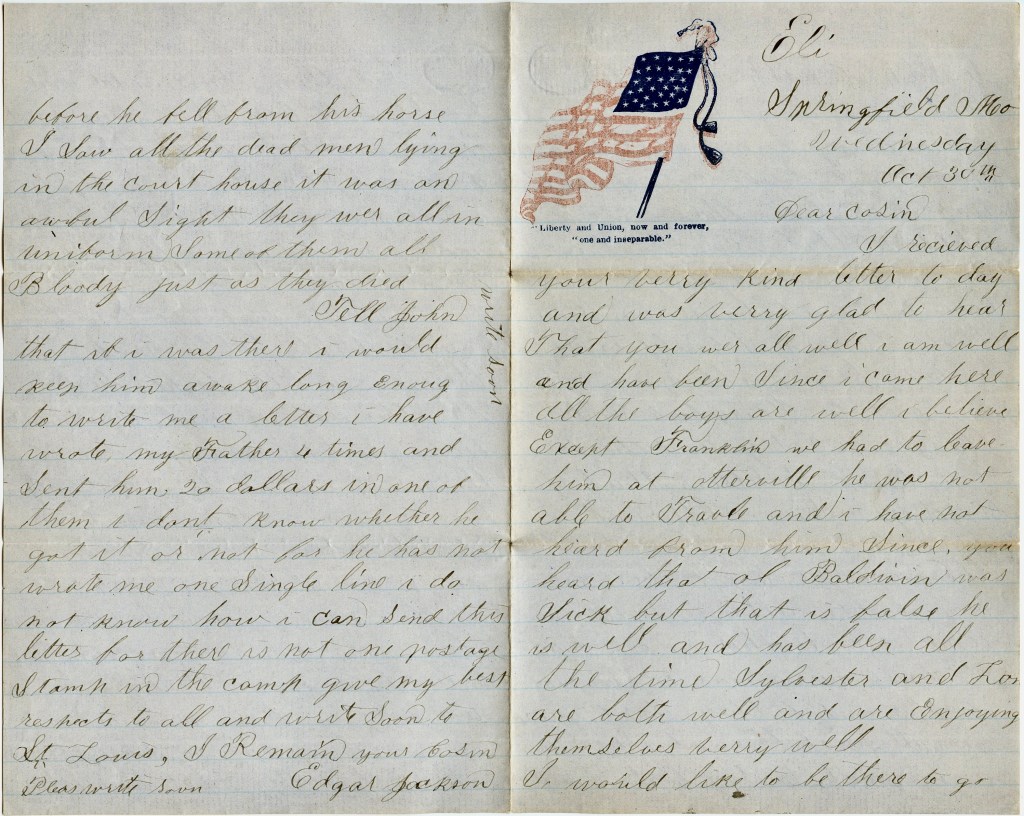
Springfield, Missouri Wednesday, October 30th 1861
Dear Cousin.
I received your very kind letter today and was very glad to hear that you were all well. I am well and have been since I came here. All the boys are well, I believe, except Franklin. We had to leave him at Otterville. He was not able to travel and I have not heard from him since.
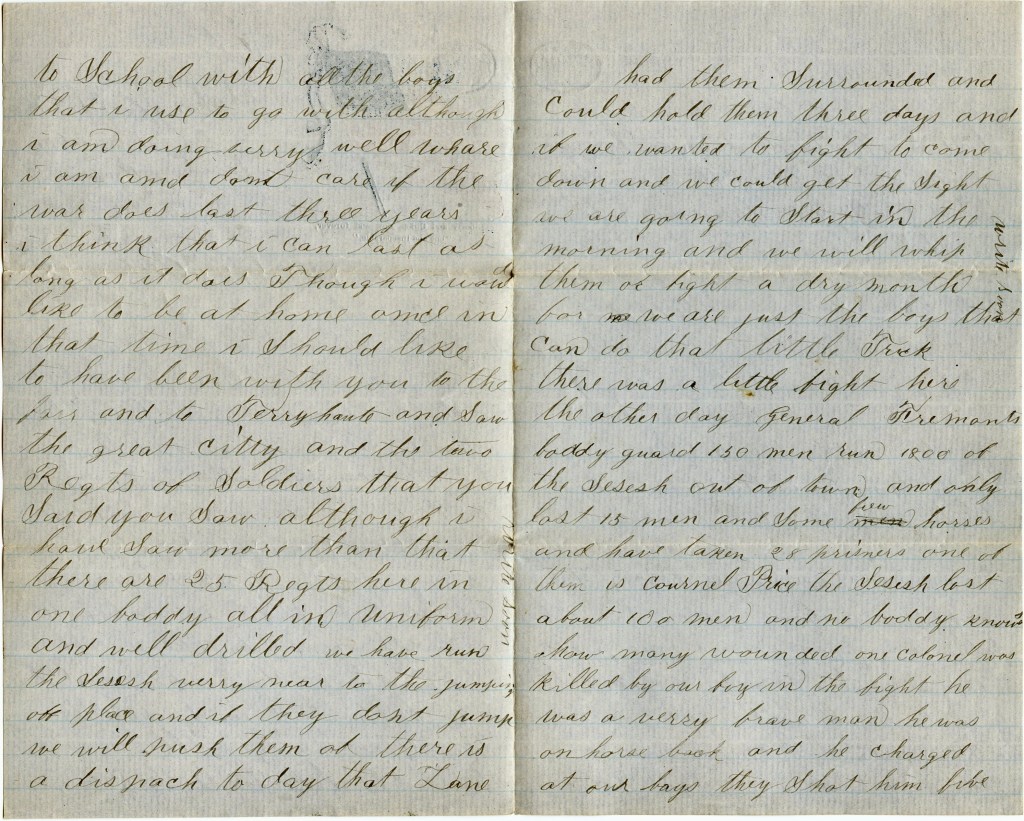
You heard that Old Baldwin was sick but that is false. He is well and has been all the time. Sylvester and Tom are both well and are enjoying themselves very well. I would like to be there to go to school with all the boys that I use to go with although I am doing very well where I am and don’t care if the war does last three years. I think that I can last as long as it does though I would like to be at home once in that time.
I should like to have been with you to the fair and to Terre Haute and saw the great city and the two regiments of soldiers that you said you saw although I have saw more than that. There are 25 regiments here in one body all in uniform and well drilled. We have run the secesh very near to the jumping off place and if they don’t jump, we will push them off. There is a dispatch today that Lane had them surrounded and could hold them three days and if we wanted to fight to come down and we could get the sight. We are going to start in the morning and we will whip them or fight a dry month for we are just the boys that can do that little trick.
There was a little fight here the other day. General Frémont’s body guard 150 men run 1800 of the secesh out of town and only lost 15 men and some few horses and have taken 28 prisoners. One of them is Colonel Price. The secesh lost about 100 men and nobody knows how man wounded. One colonel was killed by our boy in the fight. He was a very brave man. He was on horseback and he charged at our boys. They shot him five times before he fell from his horse. I saw all the dead men lying in the Court House. it was an awful sight. They were all in uniform—some of them all bloody just as they died.
Tell John that if I was there, I would keep him awake long enough to write me a letter. I have wrote my Father four times and sent him 20 dollars in one of them, I don’t know whether he got it or not for he has not wrote me one single line. I do not know how I can send this letter for there is not one postage stamp in the camp. Give my best respects to all and write soon to St. Louis. I remain your cousin, — Edgar Jackson
Please write soon.
Letter 4
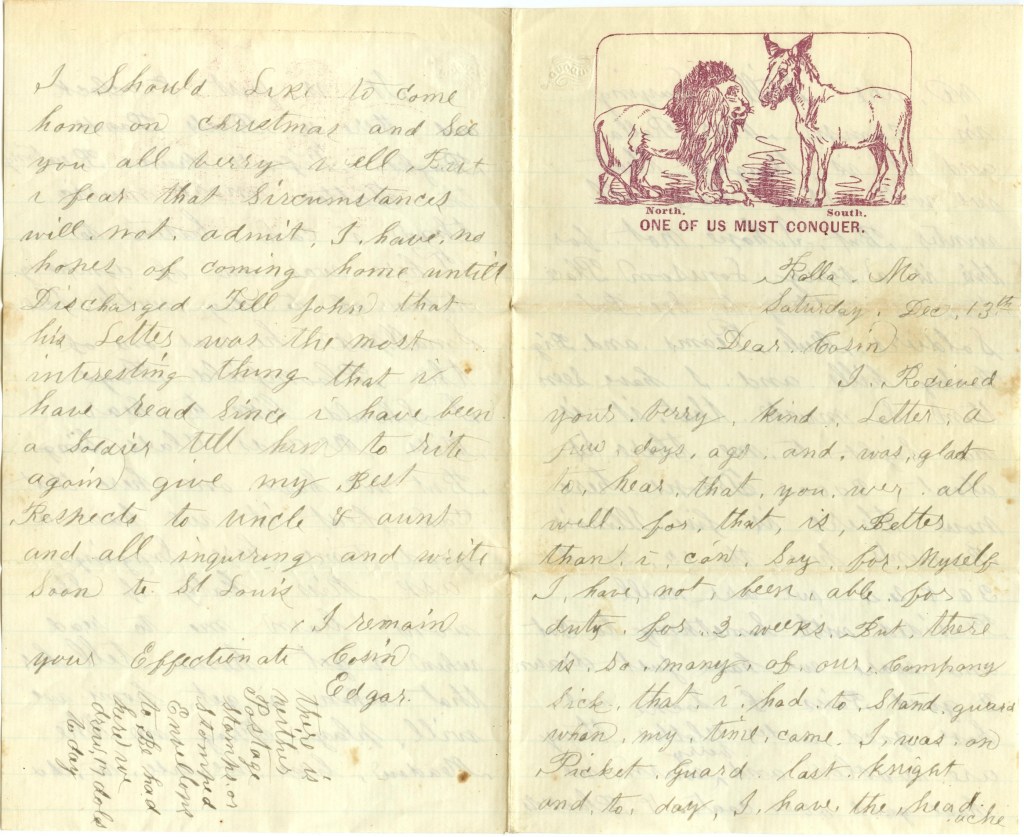
Rolla, Missouri Saturday, December 13th 1861
Dear Cousin,
I received you very kind letter a few days ago and was glad to hear that you were all well for that is better than I can say for myself. I have not been able for duty for two weeks but there is so many of our company sick that I had to stand guard when my time came. I was on picket guard last night and today. I have the headache.
We are still laying in camp near Rolla and it is thought that we will stay here all winter but I hope not for this is a very lonesome place. There is nothing to see but soldiers, mule teams, and big rocky hills and I have seen them so much that it is no sight to me. There is about 20,000 troops here now. There is five Illinois regiments here—the 13th, 25th, 35th, 36th, and 44th. We are well provided with something to eat and wear. We have just drawn two good pairs of socks. We have good under clothes. They are woolen and very warm. We have good overcoats & blankets.
It is just 8 o’clock and there is brass bands, bugles, fifes, and drums beating the Tattoo—more music than I can listen to. There was one of [our] company taken off today with the smallpox. He was one of the Bloomfield boys.
I should like to hear Miss McCord’s class sing but we have one here that can beat it. We have a good time here singing. Ask Miss Katy if she won’t learn me to read when I get home. Tell her that when I get home we will play frog in the meadow like we use to do. I should like to come home on Christmas and see you all very well but I fear that circumstances will not admit. I have no hopes of coming home until discharged.
Tell John that his letter was the most interesting thing that I have read since I have been a soldier. Tell him to write again. Give my best respects to Uncle and Aunt and all inquiring and write soon to St. Louis.
I remain your affectionate cousin, — Edgar
There is neither postage stamps or stamped envelopes to be had here. We drew 17 dollars today.
Letter 5
Rolla, Missouri Wednesday night, January 21st 1862
Dear Cousin.
By reason of not having heard one word from you for a long time, I seat myself to write you the 2nd letter and hope you will soon write to me and let me know how you are all getting along.
My health is very good and the health of our company is better than when last I wrote to you. Alonzo [Jackson] is not well nor has not been for near a month and I fear that if he has to stay in camp here all winter, it will go very hard with him although I have no fears of myself for I am still hardy and rugged as ever and you well know that I use to be so at all times.
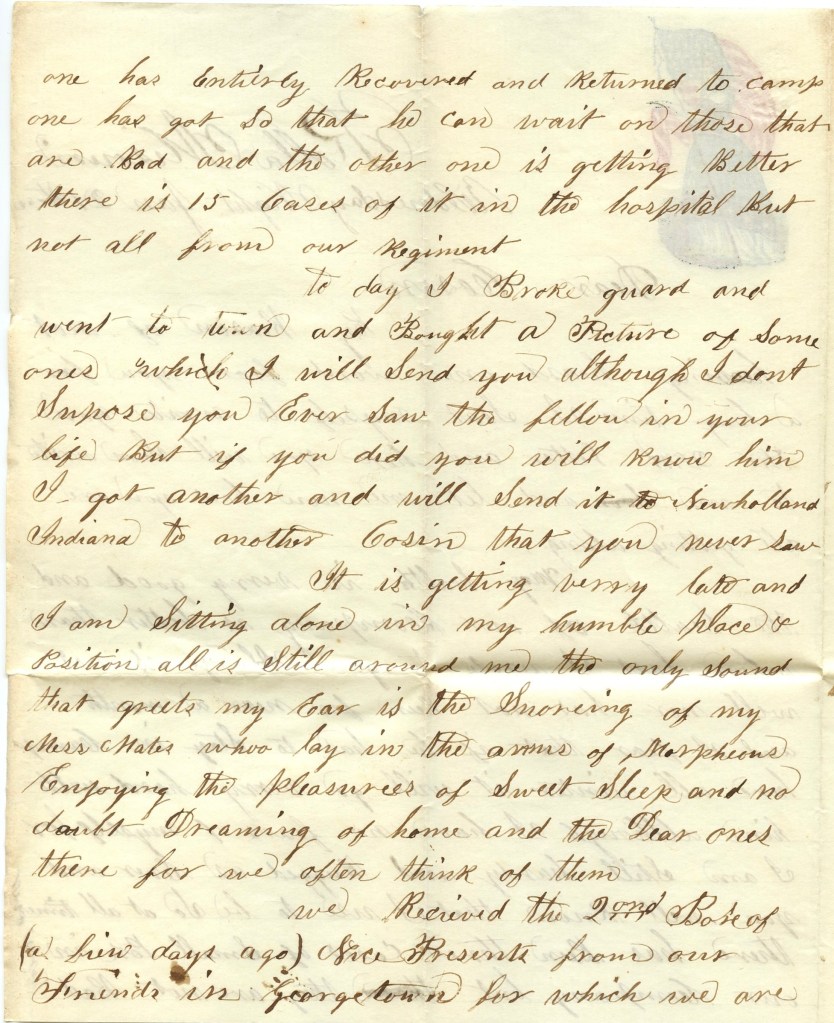
There has been three cases of smallpox in our company but they are not bad. One has entirely recovered and returned to camp. One has got so that he can wait on those that are bad and the other one is getting better. There is 15 cases of it in the hospital but not all from our regiment.
Today I broke guard and went to town and bought a picture of someones which I will send you although I don’t suppose you ever saw the fellow in your life but if you did, you will know him. I got another and will send it to New Holland, Indiana, to another cousin that you never saw.
It is getting very late and I am sitting alone in my humble place & position. All is still around me. The only sound that greets my ear is the snoring of my mess mates who lay in the arms of Morpheus enjoying the pleasures of sweet sleep and no doubt dreaming of home and the dear ones there for we often think of them.
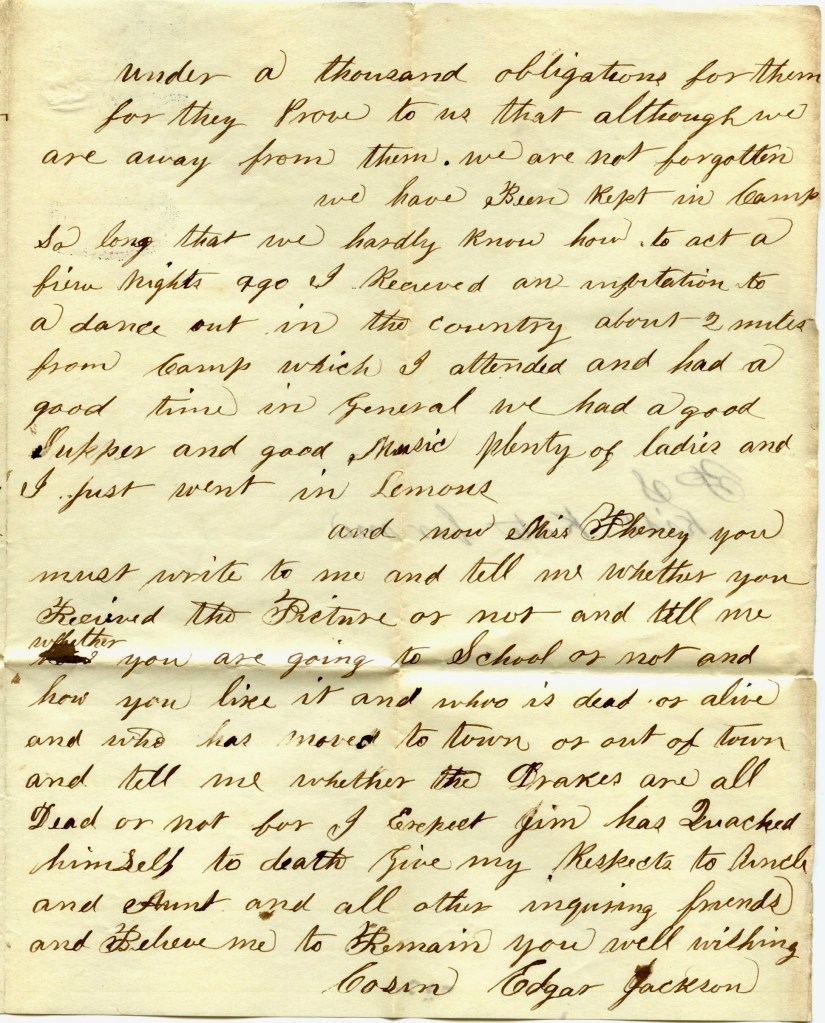
We received (a few days ago) the 2nd box of nice presents from our friends in Georgetown for which we are under a thousand obligations for them for they prove to us that although we are away from them, we are not forgotten. We have been kept in camp so long that we hardly know how to act. A few nights ago I received an invitation to a dance out in the country about two miles from camp which I attended and had a good time in general. We had a good supper and good music, plenty of ladies, and I just went in lemons.
And now, Miss Pheney, you must write to me and tell me whether you received the picture or not and tell me whether you are going to school or not and how you like it. And who is dead and live, and who has moved to town or out of town, and tell me whether the Drakes are all dead or not for I expect Jim has quacked himself to death.
Give my respects to Uncle and Aunt and all other inquiring friends and believe me to remain your well wishing cousin, — Edgar Jackson
P. S. Kiss Kate for me.
Letter 6
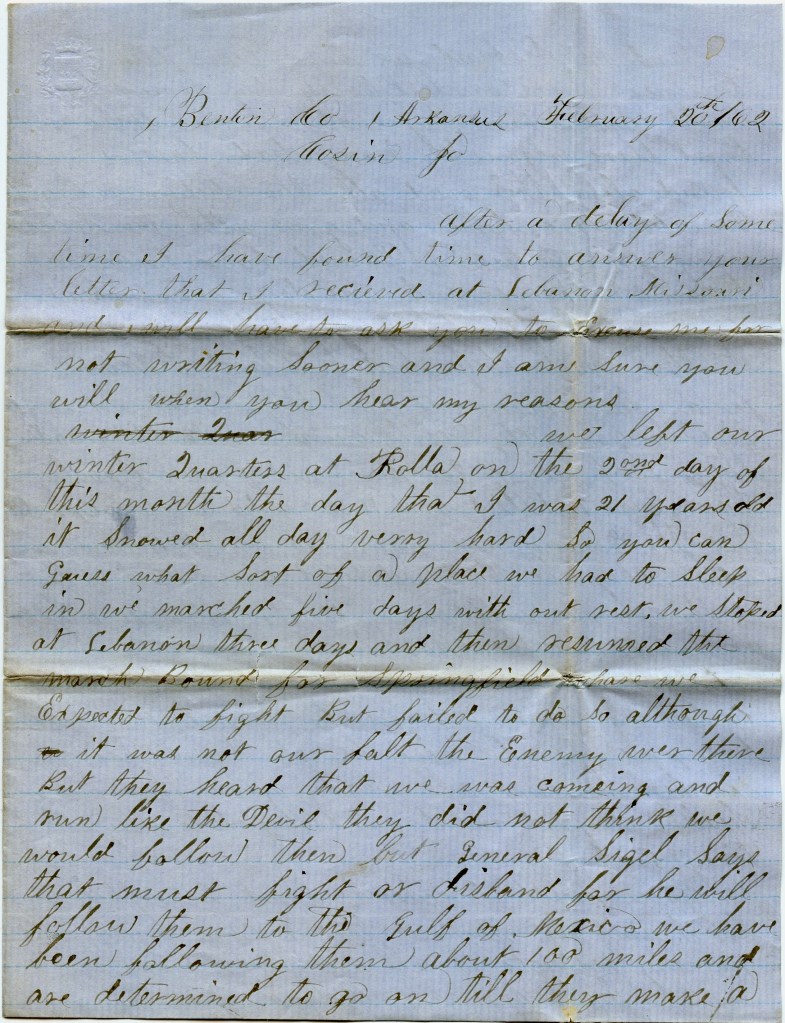
Benton county, Arkansas February 20th 1862
Cousin Jo,
After a delay of some time I have found time to answer your letter that I received at Lebanon, Missouri, and I will have to ask you to excuse me for not writing sooner and I am sure you will when you hear my reasons.
We left our winter quarters at Rolla on the 2nd day of this month—the day that I was 21 years old. It snowed all day very hard so you can guess what sort of a place we had to sleep in. We marched five days without rest. We stopped at Lebanon three days and then resumed the march bound for Springfield where we expected to fight but failed to do so although it was not our fault. The enemy were there but they heard that we was coming and run like the Devil. They did not think we would follow them but General Sigel says they must fight or disband for he will follow them to the Gulf of Mexico. We have been following them about 100 miles and are determined to go on till they make a stand or disband.
We have been taking prisoners more or less every day. Some days we would find where they had broken their guns, burnt their wagons, & many dead horses were found along the road. All the citizens have deserted their homes and gone with the secesh army for protection (damned poor protection, I think). They are only one day’s march ahead of us.
Our cavalry engaged them yesterday at this camp. They had a bloody skirmish for a few moments but they would not stand fire. The cowardly Devils run into the woods. They lost about 30 men and of our cavalry, there were 9 killed and 11 wounded. It is reported that the enemy are waiting at Cross Hollows where they are fortified and reinforced. If that is the case, we will move to the attack tonight or soon in the morning.
Alonzo [Jackson] was sick and could not come with us. He was left at Rolla. I expect that he will be at home soon if he has not already gone there. But my health is good and I am satisfied to stay in Dixie Land.
You must excuse a short letter this time for I am so nervous that I can hardly write. Give my respects to all and answer soon. Ever yours, — Edgar Jackson
P. S. Those stamps you sent me were very acceptable for we could not get them at Rolla. Franklin and Sylvester [Cook] are both well.
Letter 7
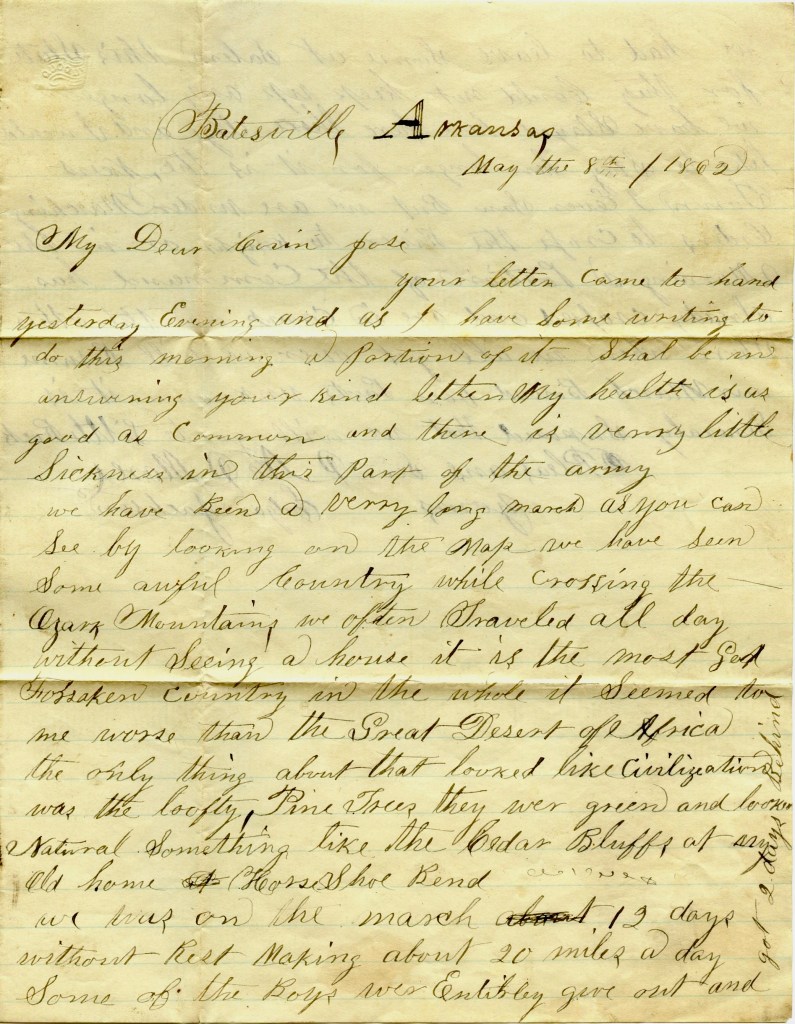
Batesville, Arkansas May the 8th 1862
My dear cousin Jose,
Your letter came to hand yesterday evening and as I have some writing to do this morning, a portion of it shall be in answering your kind letter. My health is as goos as common and there is very little sickness in this part of the army.
We have been [on] a very long march as you can see by looking on the map, We have seen some awful country while crossing the Ozark Mountains. We often traveled all day without seeing a house. It is the most Godforsaken country in the whole [world]. It seemed to me worse than the Great Desert of Africa. The only thing about that looked like civilization was the lofty pine trees. They were green and looked natural—something like the Cedar Bluffs at my old home at Horseshoe Bend.
We was on the march 12 days without rest making about twenty miles a day. Some of the boys were entirely give out and got two days behind. We had to leave some at Salem, this state, for they could not keep up any longer. We have stayed here three days and I would like to stay here longer for it is the nicest town I ever saw but we are under marching orders to cross the river tonight or in the morning. A portion of the command has already crossed and we are camp on the other shore. When we all get over, we will resume our march bound for parts unknown. It is generally supposed that we will go to Little Rock.
Please answer soon. No more. Yours, — Edgar Jackson
Letter 8
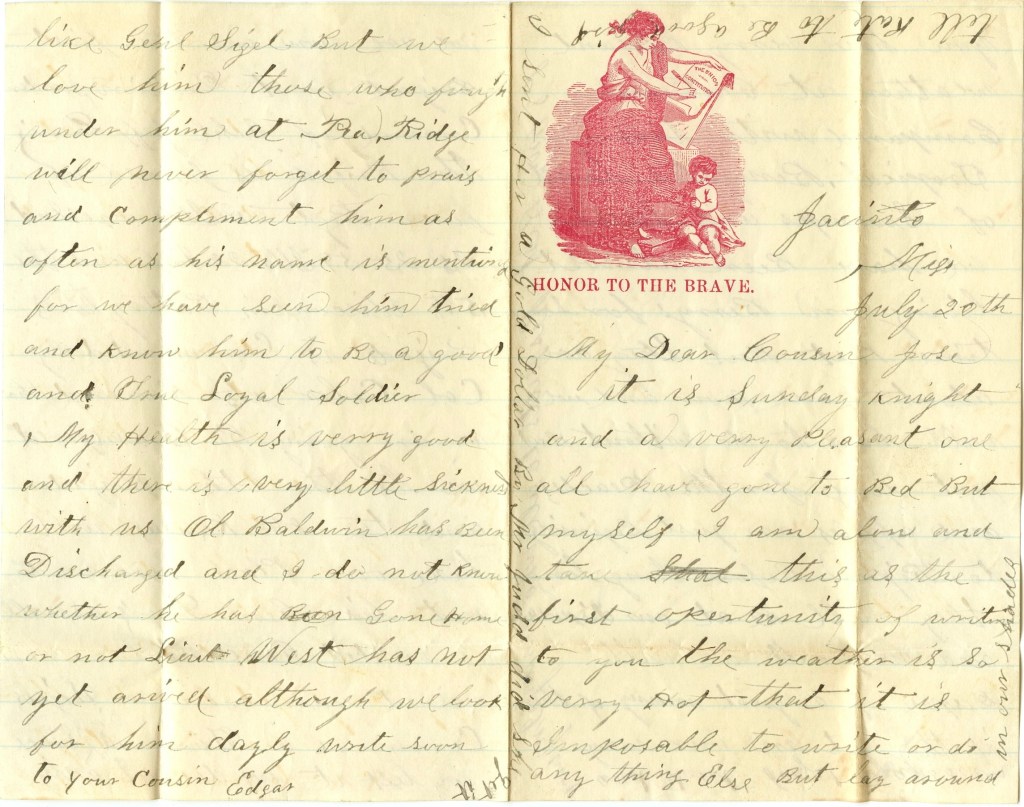
Jacinto, Mississippi July 20th [1862]
My dear cousin Jose,
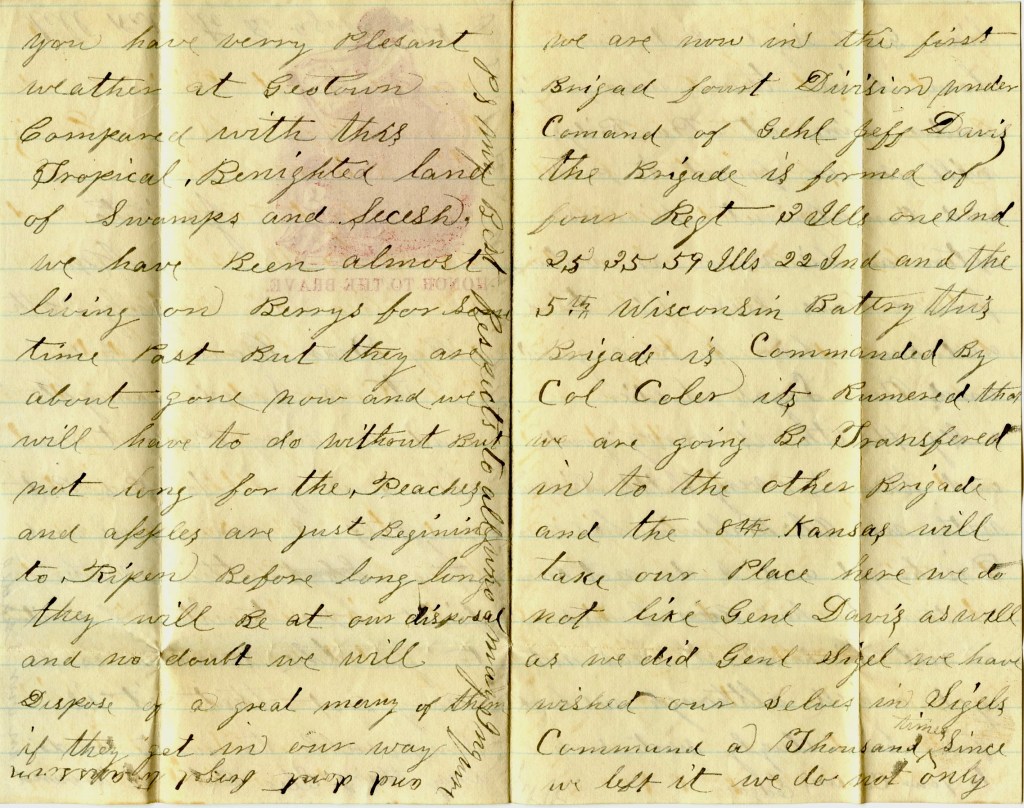
It is Sunday night and a very pleasant one. All have gone to bed but myself. I am along and this is the first opportunity of writing to you. The weather is so very hot that it is impossible to write or do anything else but lay around. You have very pleasant weather at Georgetown compared with this tropical, benighted land of swamps and secesh. We have been almost living on berries for some time past but they are about gone now and we will have to do without but not long for the peaches and apples are just beginning to ripen. Before long they will be at our disposal and no doubt we will dispose of a great many of them if they get in our way.
We are now in the 1st Brigade, 4th Division under command of Gen. Jeff Davis. The Brigade is formed of four regiments—three Illinois and one Indiana—25th, 35th, 59th Illinois and 22nd Indiana, and the 5th Wisconsin Battery. This brigade is commanded by Col. Coler. It’s rumored that we are going to be transferred into the other brigade and the 8th Kansas will take our place here. We do not like Gen. Davis as well as we did Gen. Sigel. We have wished ourselves in Sigel’s command a thousand times since we left it. We do not only like Gen. Sigel but we love him. Those who fought under him at Pea Ridge will never forget to praise and compliment him as often as his name is mentioned for we have seen him tried and know him to be a good and true loyal soldier.
My health is very good and there is very little sickness with us. Old Baldwin has been discharged and I do not know whether he has gone home or not. Lieut. [Theodore] West has not yet arrived although we look for him daily. Write soon to your cousin, — Edgar
Letter 9
Editor’s Note: This and the next letter were datelined from Benton Barracks and though Edgar does not state in his letter why he is away from his regiment and in St, Louis, we learn from a comrade’s letter that Edgar was taken prisoner in the Battle of Stones River and was paroled almost immediately to be held out of action by the Union army until he was officially exchanged. There was a Camp of Parole established at Benton Barracks for this purpose.
Benton Barracks St. Louis, Missouri August 5th 1863
Dear cousin Jose,
I wrote you a letter some time ago but never received any answer to it. I am now going to write you another and beg you to condescend to write me once more . Sorry to say I cannot write you anything of importance or interest. My health is good although I am not stout and rugged as I use to be with my regiment.
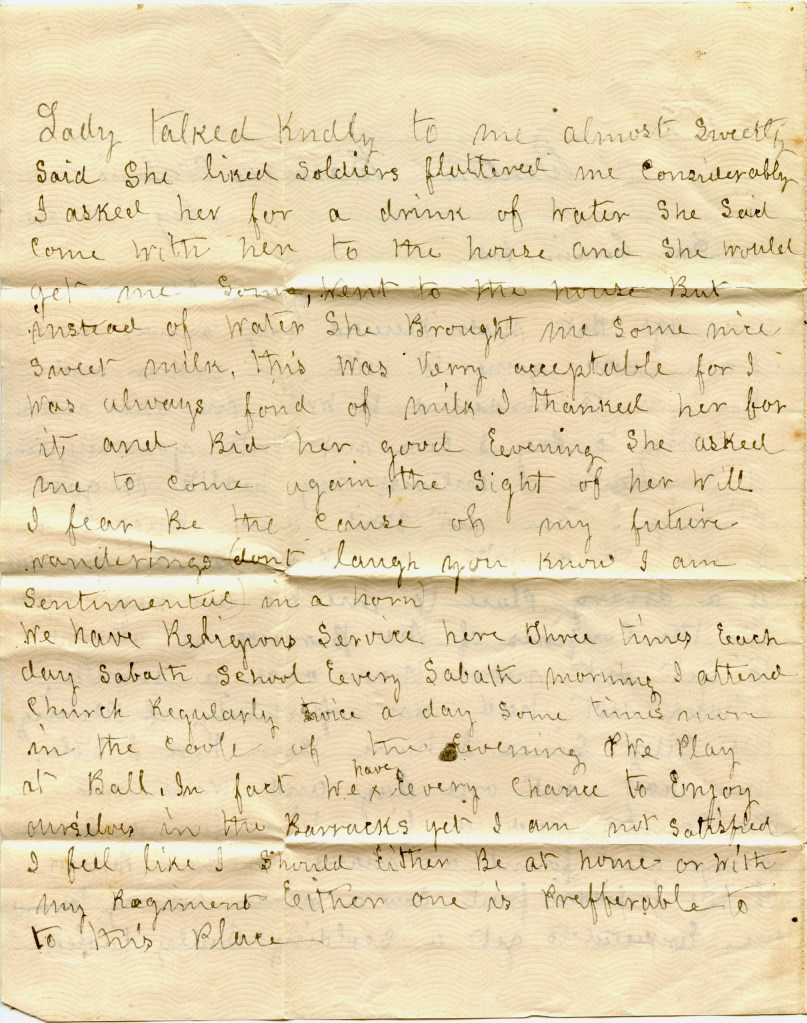
Benton Barracks is a dreary place to me, We are kept close in the confines of the barracks, not allowed to get out more than once a month. I have not had an opportunity of visiting the city since I have been here. I stole my way out one day and went into the country. Had a fine time. Found some berries. Also found a man’s orchard and partook of the forbidden fruit. Saw a woman coming toward me and expected to get a scolding [but I was] badly fooled. The lady talked kindly to me—almost sweetly. Said she liked soldiers—flattered me considerably. I asked her for a drink of water. She said come with her to the house and she would get me some. Went to the house but instead of water she brought me some nice sweet milk. This was very acceptable for I was always fond of milk. I thanked her for it and bid her good evening. She asked me to come again. The sight of her will, I fear, be the cause of my future wanderings (don’t laugh—you know I am sentimental in a horn).
We have religious service here three times each day, Sabbath School every Sabbath morning. I attend church regularly twice a day—sometimes more. In the cool of the evening we play at ball. In fact, we have every chance to enjoy ourselves in the barracks, yet I am not satisfied. I feel like I should either be at home or with my regiment. Either one is preferable to this place.
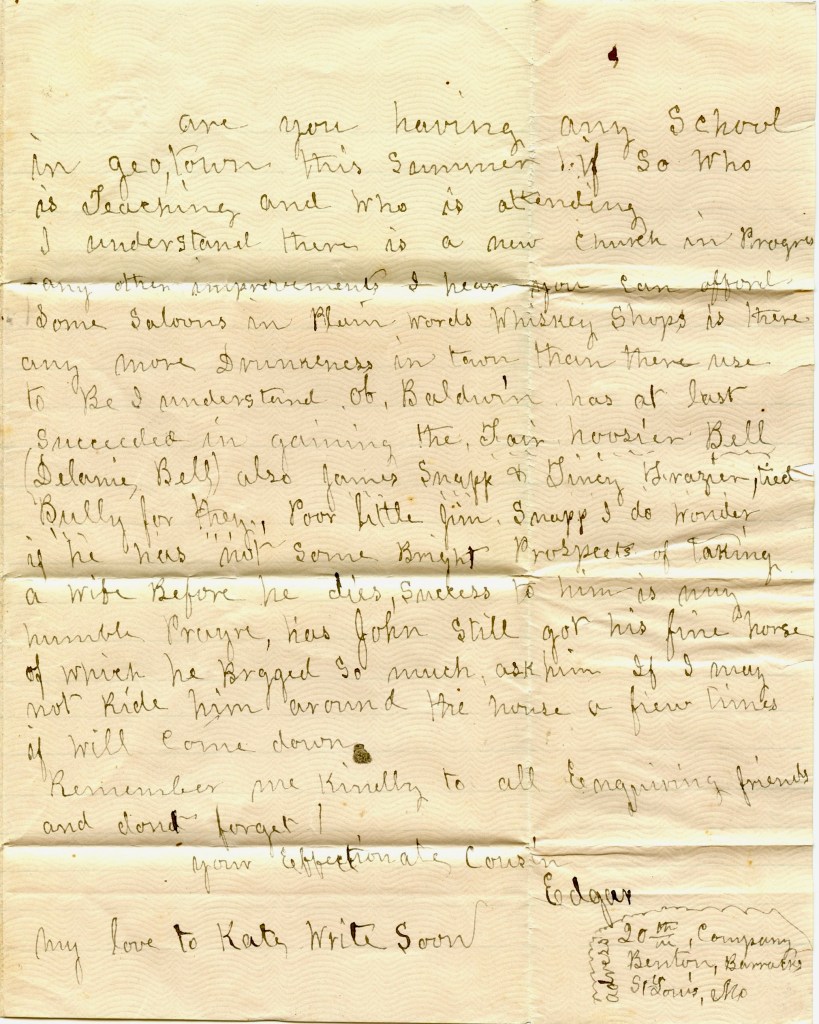
Are you having any school in Georgetown this summer? If so, who is teaching and who is attending? I understand there is a new church in progress. Any other improvements? I hear you can afford some saloons—in plain words, whiskey shops. Is there any more drunkenness in town than there use to be? I understand Old Baldwin has at last succeeded in gaining the fair Hoosier belle (Delanie Bell). Also James Snapp and Tiney Frazier tied. Bully for they! Poor little Jim Snapp. I do wonder if he has not some bright prospects if taking a wife before he dies. Success to him is my humble prayer. Has John still got his fine horse of which he bragged so much? Ask him if I may not ride him around the house a few times if I will come down.
Remember me kindly to all enquiring friends and don’t forget your affectionate cousin, — Edgar
My love to Katy. Write soon.
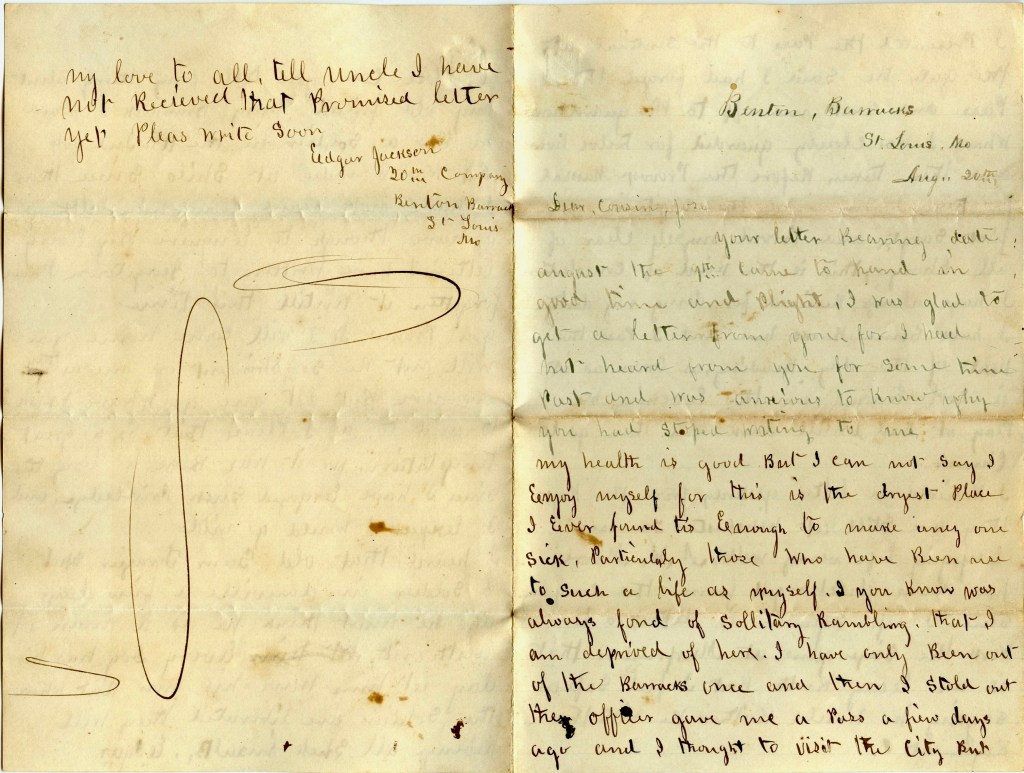
Edgar [Jackson] 20th Company Benton Barracks, St. Louis, Mo.
Letter 10
Benton Barracks St. Louis, Mo. August 20th 1863
Dear cousin Josephine,
Your letter bearing date August 10th came to hand in good time and plight. I was glad to get a letter from you for I had not heard from you for some time past and was anxious to know why you had stopped writing to me.
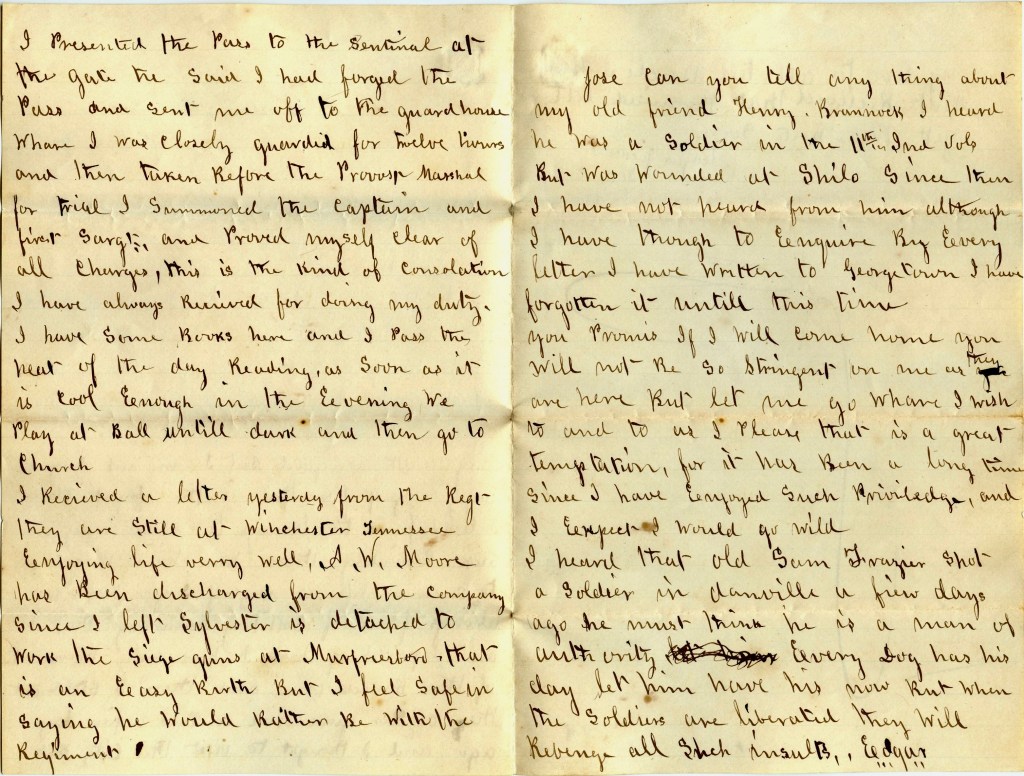
My heath is good but I cannot say I enjoy myself for this is the driest place I ever found. Tis enough to make anyone sick, particularly those who have been use to such a life as myself. I, you know, was always fond of solitary rambling that I am deprived of here. I have only been out of the barracks once and then I stold out. The officers have me a pass a few days ago and I thought to visit the city but I presented the pass to the sentinel at the gate [and] he said I had forged the pass and sent me to the guard house where I was closely guarded for twelve hours and then taken before the Provost Marshal for trial. I summoned the captain and first sergeant and proved myself clear of all charges. This is the kind of consolation I have always received for doing my duty. I have some books here and I pass the heat of the day reading. As soon as it is cool enough in the evening, we play at ball until sundown and then go to church.
I received a letter yesterday from the regiment. They are still at Winchester, Tennessee, enjoying life very well. A. W. Moore has been discharged from the company since I left. Sylvester is detached to work the siege guns at Murfreesboro. That is an easy berth but I feel safe in sating he would rather be with the regiment.
Jose, can you tell anything about my old friend Henry Brannock? I heard he was a soldier in the 11th Indiana Volunteers but was wounded at Shiloh. Since then I have not heard from him although I have written to Georgetown. I have forgotten it until this time.
You promise if I will come home you will not be so stringent on me as they are here but let me go where I wish to and to do as I please? That is a great temptation for it has been a long time since I have enjoyed such privileges and I expect I would go wild.
I heard that old Sam Frazier shot a soldier in Danville a few days ago. He must think he is a many of authority. Every dog has his day. Let him have his now but when the soldiers are liberated, they will revenge all such insults. — Edgar
My love to all. Tell Uncle I have not received that promised letter yet. Please write soon. — Edgar Jackson, 20th Company, Benton Barracks, St. Louis
Letter 11
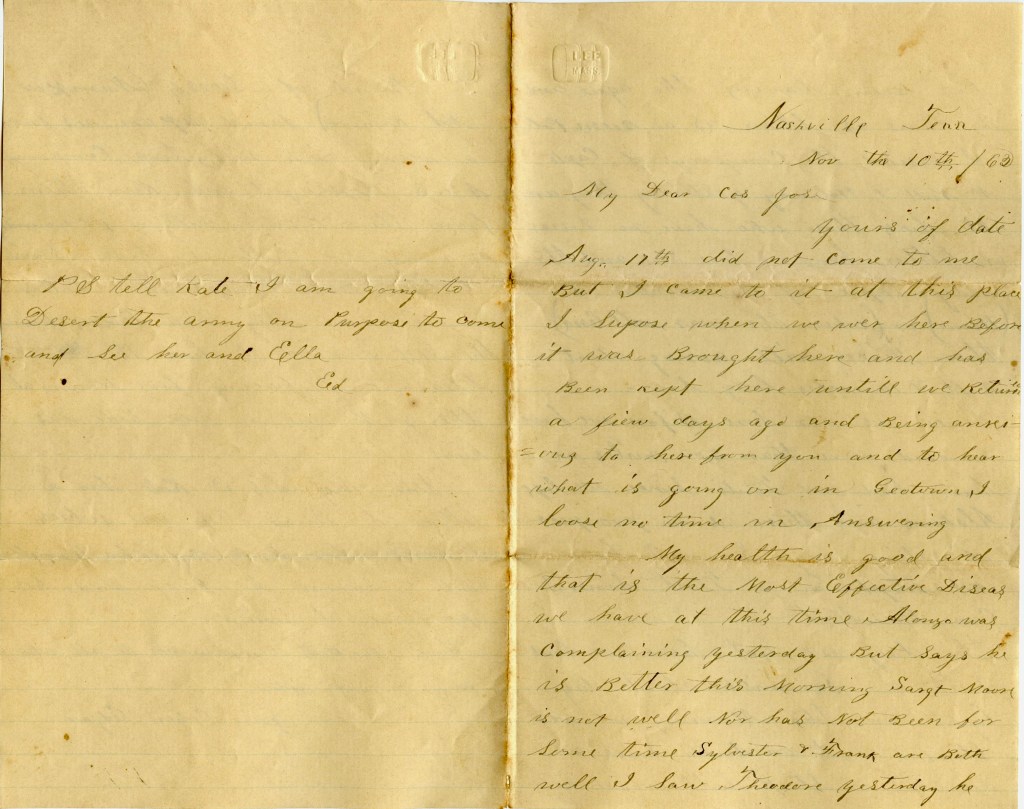
Nashville, Tennessee November 10th 1863
My dear cousin Jose,
Yours of date August 17 did not come to me but I came to it at this place. I suppose when we were here before it was brought here and has been kept here until we returned a few days ago and being anxious to hear what is going on in Georgetown, I lose no time in answering.
My health is good and that is the most effective disease we have at this time. Alonzo was complaining yesterday but says he is better this morning. Sergt. [Samuel] Moore is not well nor has not been for some time. Sylvester and Frank are both well. I saw Theodore yesterday. He has been having the ague and he looks as slim as a bean pole.
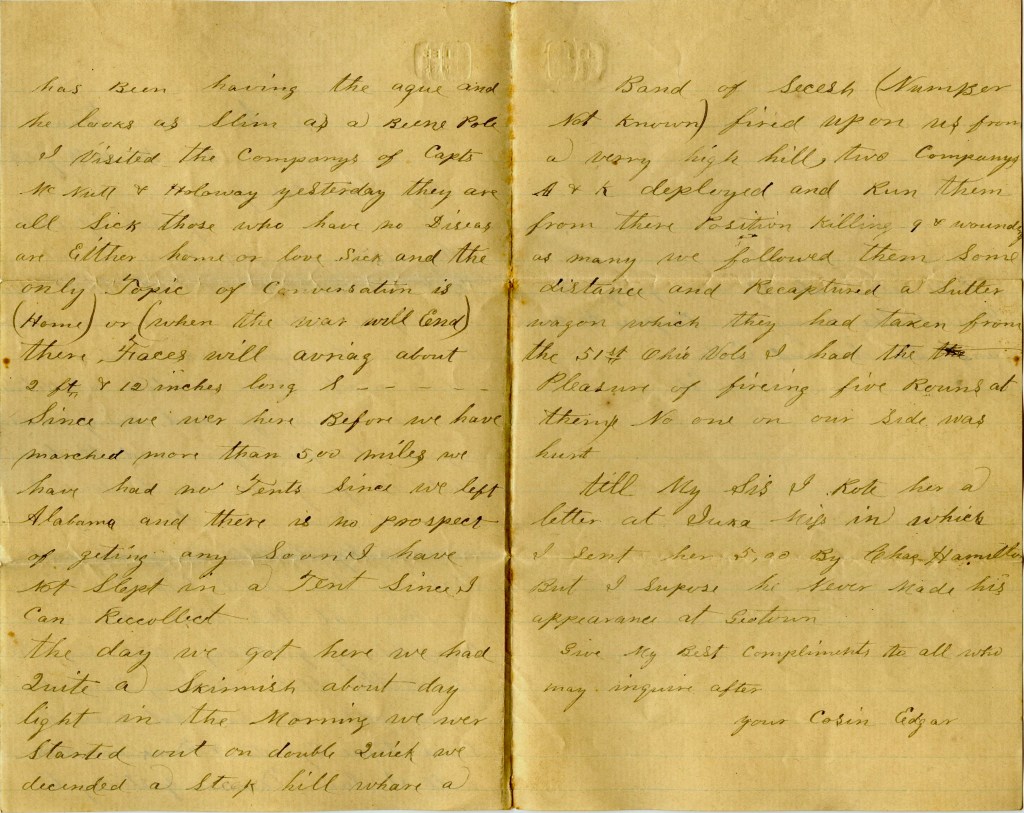
I visited the companies of Captains McNutt and Holloway yesterday. They are all sick. Those who have no disease are either home[sick] or lovesick and the only topic of conversation is home or when the war will end. Their faces will average about two feet & 12 inches long.
Since we were here before, we have marched more than 500 miles. We have had no tents since we left Alabama and there is no prospect of getting any soon. I have not slept in a tent since I can recollect.
The day we got here we had quite a skirmish about daylight in the morning. We were started out on double quick. We descended a steep hill where a band of secesh (number unknown) fired upon us from a very high hill. Two companies—A & K—were deployed and run them from the position, killing and wounding as many. We followed them some distance and recaptured a sutler wagon which they had taken from the 51st Ohio Volunteers. I had the pleasure of firing five rounds at them. No one on our side was hurt.
Tell my Sis I wrote her a letter at Iuka, Mississippi, in which I sent her $5 by Charles Hamilton. But I suppose he never made his appearance at Georgetown. Give my best compliments to all who may enquire after your cousin, — Edgar
P. S. Tell Kate I am going to desert the army on purpose to come and see her and Ella. — Ed
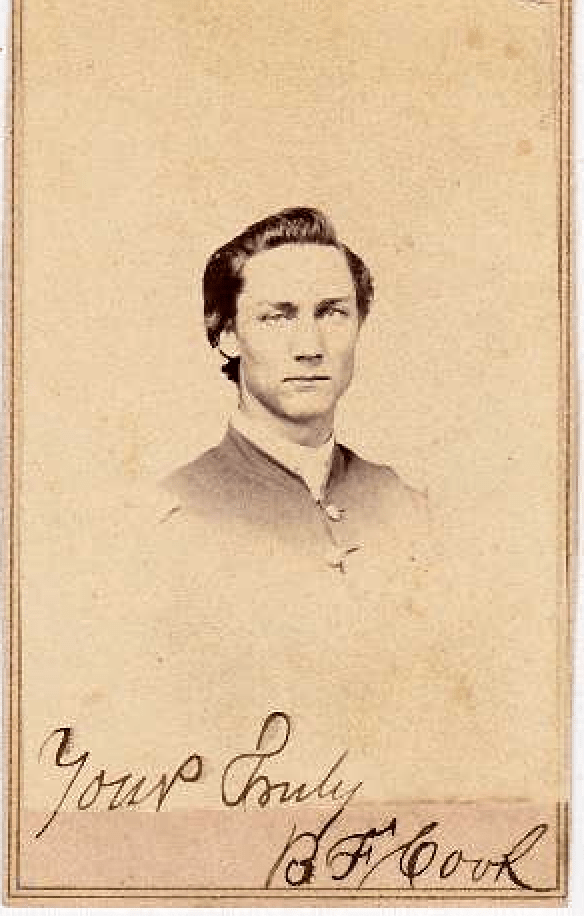
The following letters were written by Pvt. Benjamin Franklin (“Frank”) Cook (1841-1924) of Co. A, 25th Illinois Volunteers. His muster records inform us that he was a single, 20 year-old farmer with dark hair and blue eyes from Georgetown, Vermilion county, Illinois and that he towered over his comrades at 6 foot 3 inches tall. He entered the service on 1 June 1861 and remained with them until 19 August 1863 when he transferred into the 1st USCT at Winchester, Tennessee.
Frank’s parents were Enos Cook and Malinda Harris of Vermilion county, Illinois. He wrote the letter to his cousin, Josephine Cook (1847-1924), the daughter of Henderson Cook and Lucinda Trout of Georgetown, Vermilion county, Illinois.
Frank’s second letter mentions briefly the Battle of Pea Ridge that was fought on 7-8 March 1862 near Elkhorn Tavern in Arkansas. “Many of our bravest men fell, ” he told his cousin, adding, “I saw the noble-hearted soldiers laying upon the battlefield with their heads and arms shot off, weltering in their blood. Upon the Rebel side the slaughter was tremendous.”
The first four letters in this collection were written while Frank served in the 25th Illinois Infantry; the last four letters were written after he had transferred out of the regiment to accept a commission as a lieutenant in Co. E, 12th United Stated Colored Troops (USCT).
[Note : These letters are from the Sic Parvis Magna, Gratias Jesu Collection and remain in private hands. They were made available expressly for transcription and publication on Spared & Shared.]
Letter 1
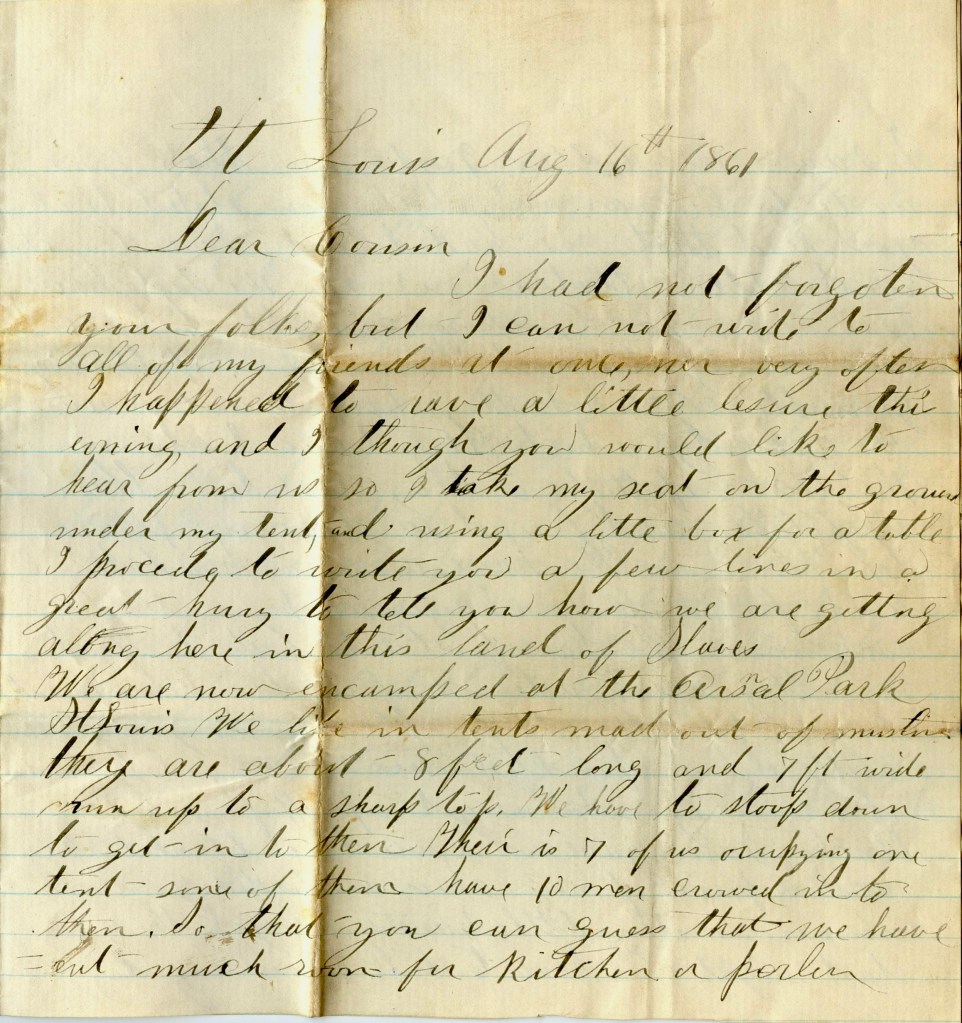
St. Louis [Missouri] August 16th 1861
Dear Cousin,
I had not forgotten your folks but I cannot write to all my friends at once, nor very often. I happened to have a little leisure [time] this evening and I thought you would like to hear from us so I take my seat on the ground under my tent and using a little box for a table, I proceed to write you a few lines in a great hurry to tell you how we are getting along here in this land of slaves.
We are now encamped at the Arsenal Park, St. Louis. We live in tents made out of muslin. They are about 8 feet long and 7 feet wide and run up to a sharp top. We have to stoop down to get into them. There is seven of us occupying one tent. Some of them have 10 men crowded into them so that you can guess that we haven’t much room for kitchen or parlor.
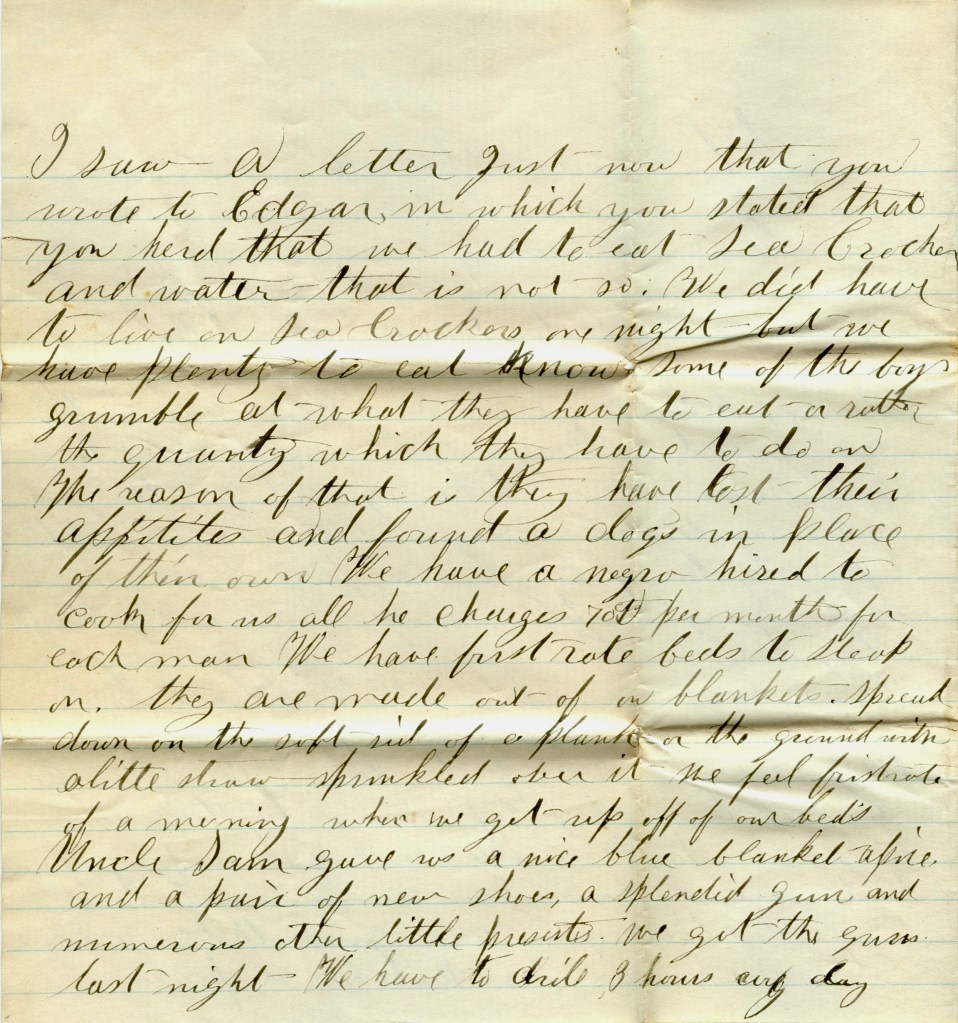
I saw a letter just now that you wrote to Edgar [Jackson] in which you stated that you heard that we had to eat sea crackers and water. That is not so. We did have to live on sea crackers one night but we have plenty to eat now. Some of the boys grumble at what they have to eat or rather the quantity which they have to do on. The reason of that is they have lost their appetites and found a dogs in place of their own. We have a negro hired to cook for us all. He charges 70 cents per month for each man. We have first rate beds to sleep on. They are made out of our blankets spread down on the soft side of a plank or the ground with a little straw sprinkled over it. We feel first rate of a morning when we get up off of our beds.
Uncle Sam gave us a nice blue blanket apiece and a pair of new shoes, a splendid gun, and numerous other little presents. We got the guns last night. We have to drill three hours each day and stand on guard once in a while. I was on guard last night. Sylvester [Cook] is on today. This is the hardest work that we have to do. Maybe you would like to know what we do when we are not on duty? Well we can’t do much of anything the most of the time for there is so much noise all around us. Some of the boys are playing cards. Others are singing, some doing one thing and one another. Sometimes they have prayer meeting. Sometimes a dance. There are plenty of fiddlers in the regiment. Of Sundays we have preaching. But I can’t tell you anymore at present.
Tell John to be a good boy. Tell Uncle Thomas’s folks that I wish them all well but can’t write to them at present. I remain your affectionate cousin, — B. F. Cook
Write
Dear Uncle, I thought perhaps that in addition to what ideas you might gather from Josephine’s letter I would give you a few from yesterday’s proceedings which might be interesting to you. Yesterday morning St, Louis was put under martial law. Last night we expected a muss. Consequently our regiment was armed and the guards were doubled. I was on guard at the arsenal on the south wall next to the river. During the day there was 7,000 troops passed up the rive to St. Louis where they took the cars as we supposed for Springfield in the state. There was three prisoners brought ito the Arsenal yesterday. You must excuse this horrible writing for therer are two boys waiting for the paper that I write with. Tell father that I received his letter and was very grateful for the change and will answer as soon as I can. Yours, — B. F. Cook
Letter 2
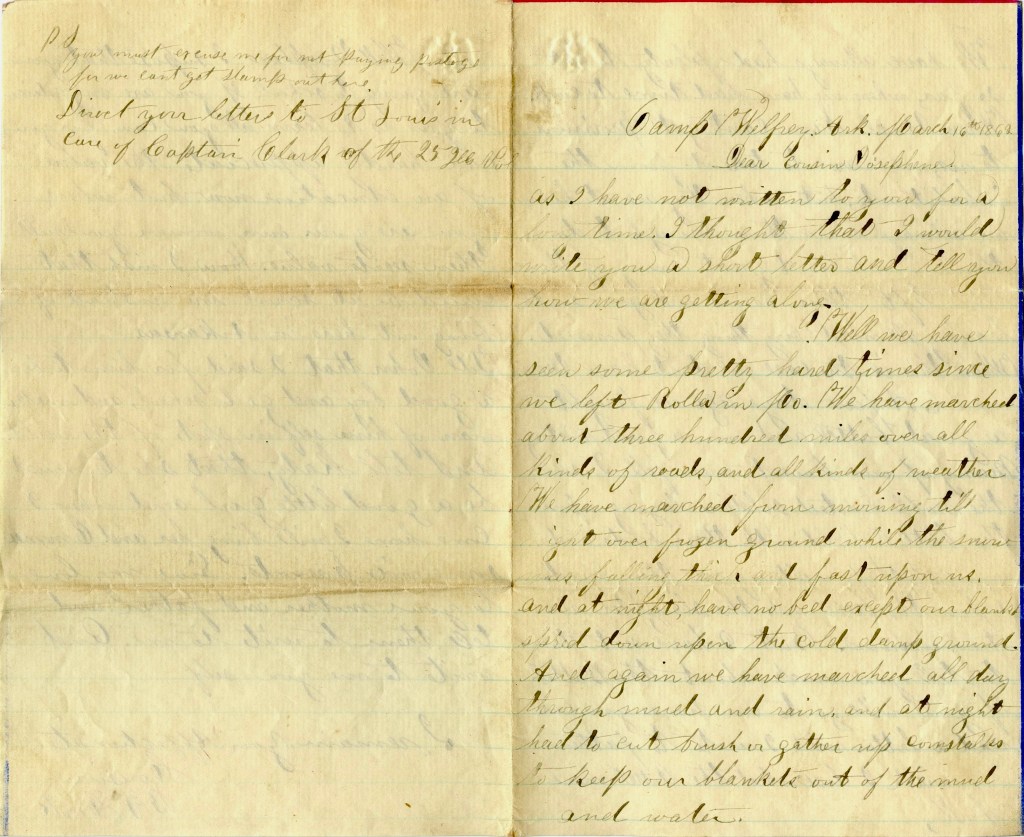
Camp Welfrey, Arkansas March 16th 1862
Dear Cousin Josephine,
As I have not written to you for a long time, I thought that I would write you a short letter and tell you how we are getting along. Well we have seen some pretty hard times since we left Rolla in Missouri. We have marched about three hundred miles over all kinds of road and all kinds of weather. We have marched from morning till night over frozen ground while the snow was falling thick and fast upon us, and at night have no bed except our blankets spread down upon the cold, damp ground. And again we have marched all day through mud and rain, and at night had to cut brush or gather up cornstalks to keep our blankets out of the mud.
We have always had plenty to eat so far when we have had time to cook. When Uncle Sam can’t get provisions to us, we have to take it from the inhabitants, but when they are at home we always leave them enough to do them a while. A great many of them have left their homes and gone south leaving almost everything they possessed. When this is the case, we don’t leave them much.
A few days ago we fought a great battle and won a great victory. Many of our bravest men fell. I saw the noble-hearted soldiers laying upon the battlefield with their heads and arms shot off, weltering in their blood. Upon the Rebel side the slaughter was tremendous. But I have not time to tell you much about the battle. If you will go to our house, you can read a letter which I wrote to father in which I described the battle more fully.
Well, Josephine, I suppose that you are going to school. If you are, my advice to you is to learn all you can for you can hardly appreciate the value of an education now but when you are your own woman, you will then see its value. How I wish that I could be at school now instead of being out here in Arkansas.
Tell John that I said for him to be a good boy and go to school and make a man of himself in spite of the world. And tell Katy that she must be a good girl and when I come home, I will bring her and Emma some nice presents. Give my love to your mother and father and tell them to write to me. And write to me yourself.
I remain your affectionate cousin, — B. F. Cook
P. S. You must forgive me for not paying postage for we can’t get stamps out here. Direct your letters to St. Louis in care of Captain Clark of the 25th Illinois Volunteers.
Letter 3
Nashville, Tennessee November 17th 1862
Dear Cousin Josephine,
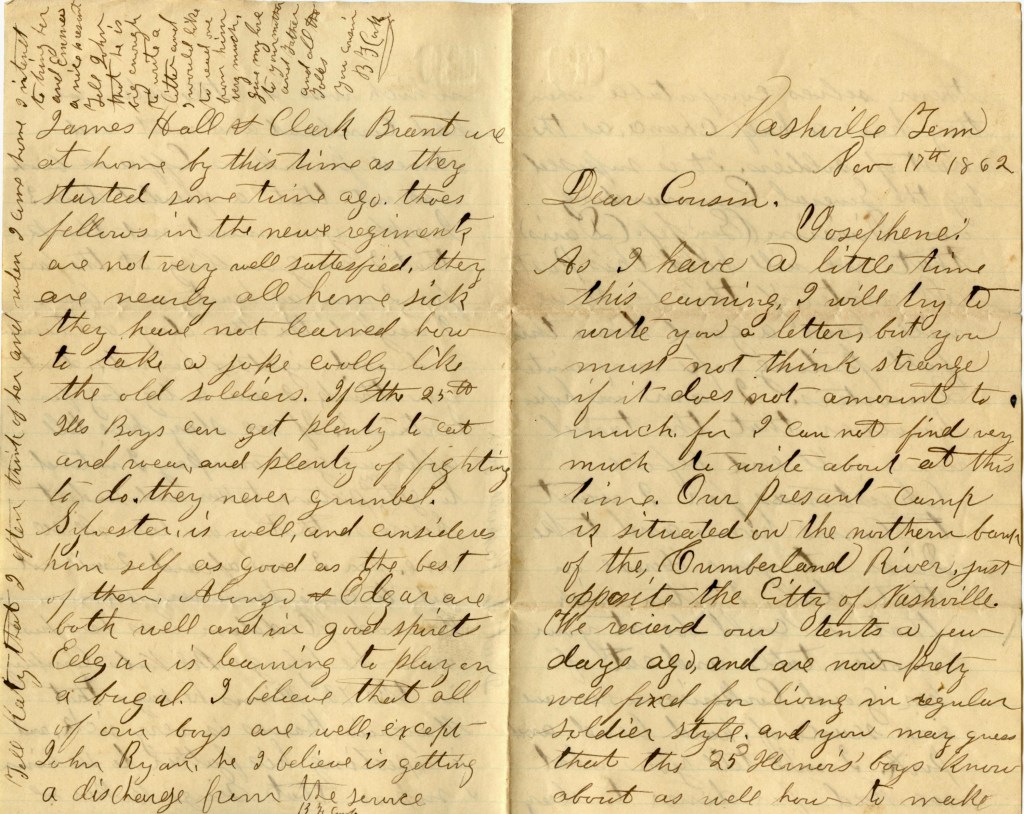
As I have a little time this evening, I will try to write you a letter, but you must not think strange if it does not amount to much for I cannot find very much to write about at this time. Our present camp is situated on the northern bank of the Cumberland river, just opposite the City of Nashville. We received our tents a few days ago and are now pretty well fixed for living in regular soldier style and you may guess that the 25th Illinois boys know about as well how to make themselves comfortable when they have a half chance as the most of soldiers.
It is supposed by the General Commanding our Division (Gen. Jeff C. Davis) that we will hold this post all winter. If this be so, we will have a good time this fall putting up our winter quarters. I am in hopes, however, that the tarnel war will end before Christmas for I want to come home and take dinner at your house on that day. I often wish that I could be at your mother’s table and eat of her good cookeries when we are scarce of hard bread and pork. I will tell you what we had for dinner today which was a little extra. We had cornbread and meat and stewed pumpkins. Coffee bean. Was not that a splendid dinner?
Josephine, you must not think that I am grumbling at the fare for I am as hearty as a bear. I weighed the other day one hundred and eighty pounds. Don’t you think I am a “big boy” for certain? If we stay here till after we get our pay, I intend to get my picture taken and send it home so that you can all see me for I am afraid I will not get to come home very soon.
Elwood Hadden was here just now. He belongs to McNutt’s Company in the 73rd Illinois. He says that Marquis Hawes is very sick and is expecting his father to see him. I suppose that George Baker, James Hall, and Clark Brant are at home by this time as they started some time ago. Those fellows in the new regiments are not very well satisfied. They are nearly all homesick. They have not learned how to take a joke cooly like the old soldiers. If the 25th Illinois boys can get plenty to eat and wear, and plenty of fighting to do, they never grumble.
Sylvestor [Cook] is well and considers himself as good as the best of them. Alonzo and Edgar [Jackson] is learning to play on a bugle. I believe that all of our boys are well except John Ryan. He I believe is getting a discharge from the service.
Tell Katy that I often think of her and when I come home I intend to bring her and Emma a nice present. Tell John that he is big enough to write a letter and I would like to read one from him very much. Give my love to your mother and father and all the folks. Your cousin, — B. F. Cook
Letter 4
[Nashville, Tennessee] [December 1862]
Sunday night
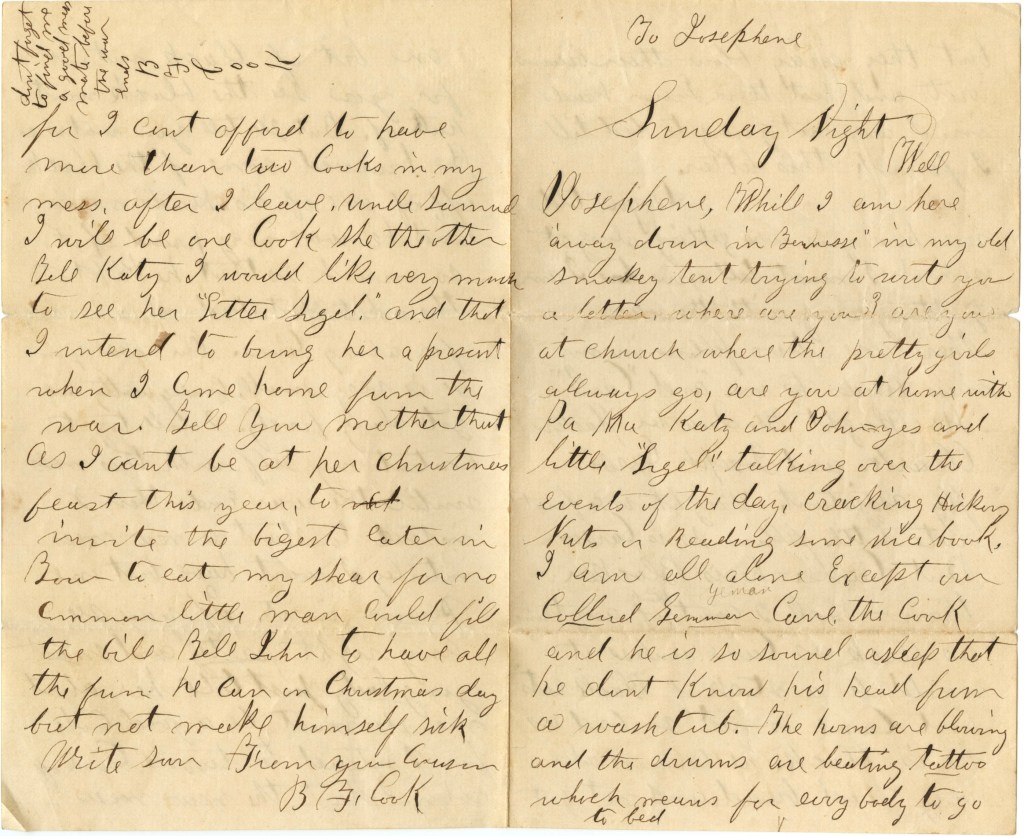
Well JOsephine, while I am here “away down in Tennessee” in my old smoky tent trying to write you a letter, where are you? Are you at church where the pretty girls always go? Are you at home with Pa, Ma, Katy and Johnny and little “Sigel” talking over the events of the day, cravking hickory nuts or reading some nice book? I am all alone except our colored [ ] Cane, the cook, and he is so sound asleep that he don’t know his head from a washtub. The horns are blowing and the drums are beating Tattoo which means for everybody to go to bed. But they may blow their brains out and beat their drum heads in. I am not going to bed till I finish this letter.
As you told me how you was getting along at school, I must tell you how I am getting along with the war. There are two fellows in my mess besies me and “Cane”—the quartermaster’s clerk, and Joseph Carson, my assistant. Wright is a first rate little fellow. So is Carson. But Cane—he is blacker than—well, I can’t think of anything as black as “Cane” unless it would be a stack of “black cats.” But Cane is not so bad as he is black. He can make very good bread and not get one bit of black into it for you see the black won’t rub off. But I’ll tell you what is so. He burned some of the black off of one of his hands one day and he was very proud of it, So much so that he kept it—the white spot—tied up in a rag for a long time. Our mess, you see, is very small. Consequently we get along finely. I will try to content myself with this mess until the war ends. Then I intend to start a new mess entirely. I won’t have but one person in it. If you see any right pretty and smart young lady, just tell her about me. She must be a good cook for I intend to turn Cane off when I start the new mess for I can’t afford to have more than two cooks in my mess after I leave Uncle Sam. I will be one cook; she the other.
Tell Katy I would like very much to see her “Little Sigel” and that I intend to bring her a present when I come home from the war. Tell your mother that as I can’t be at her Christmas feast this year, to invite the biggest eater in yours to eat my share for no common little man could fill the bill. Tell John to have all the fun he can on Christmas day but not make himself sick.
Write soon. From your cousin, — B. F. Cook
Letter 5
Murfreesboro, Tennessee February 9th 1863
Dear cousin Josephine,
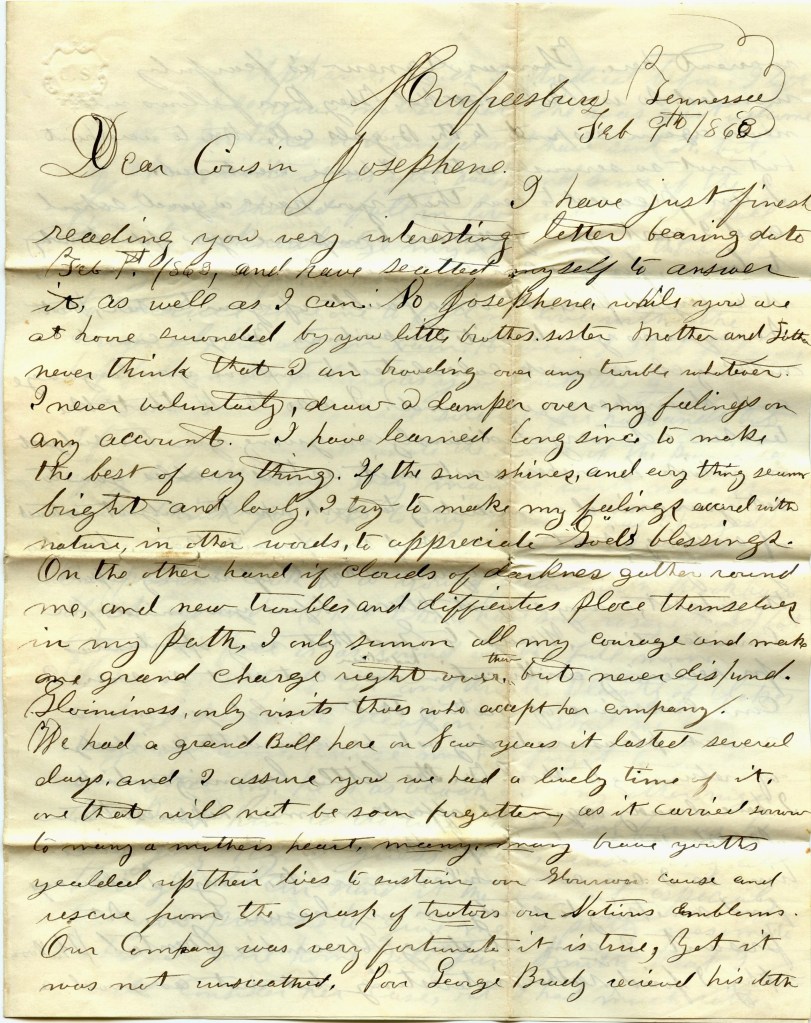
I have just finished reading your very interesting letter bearing date February 1st 1863 and have seated myself to answer it as well as I can. So,Josephine, while you are at home surrounded by your little brother, sister, Mother and Father, never think that I am traveling over any trouble whatever. I never voluntarily draw a damper over my feelings on any account. I have learned long since to make the best of everything. If the sun shines and everything seems bright and lovely, I try to make my feelings accord with nature. In other words, to appreciate God’s blessings. On the other hand, if clouds of darkness gather round me, and new troubles and difficulties place themselves in my path, I only summon all my courage and make one grand charge right over them but never despond. Gloominess only visits those who accept her company.
We had a grand ball here on New Years. It lasted several days and I assure you, we had a lively time of it—one that will not be soon forgotten as it carried sorrow to many a mother’s heart. Many, many have youths yielded up their lives to sutain our glorious cause and rescue from the grasp of traitors our Nation’s emblems.
Our company was very fortunate, it is true. Yet it was not unscathed. Poor George Brady received his death warrant here. Thomas Agnew is fearfully wounded. So is Mike Beckel. They—poor fellows—will never again respond to the bugle’s call. Other too were hurt but not so seriously as those I have mentioned.
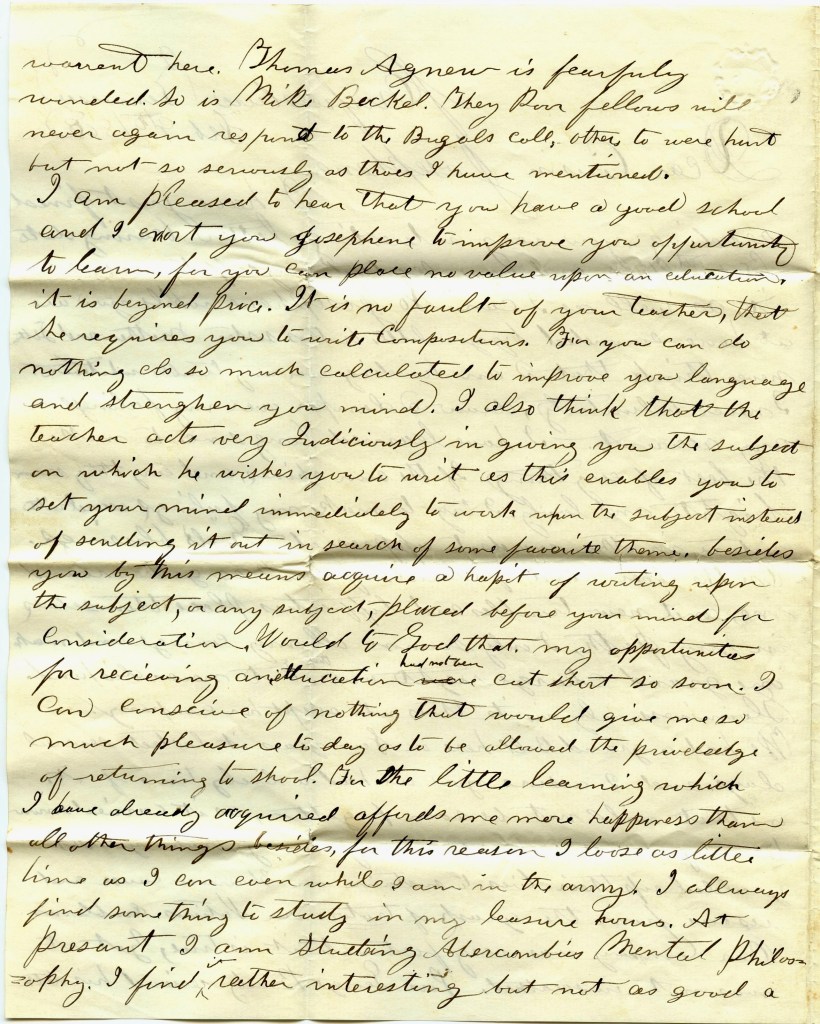
I am pleased to hear that you have a good school and I exhort you, Josephine, to improve your opportunity to learn, for you can place no value upon an education. It is beyond price. It is no fault of your teacher that he requires you to write compositions for you can do nothing else so much calculated to improve your language and strengthen your mind. I also think that the teacher acts very judiciously in giving you the subject on which he wishes you to write as this enables you to set your mind immediately to work upon the subject instead of sending it out in search of some favorite theme. Besides, you by this means acquire a habit of writing upon the subject, or any subject, placed before your mind for consideration. Would to God that my opportunities for receiving an education had not been cut short so soon. I can conceive of nothing that would give me so much pleasure today as to be allowed the privilege of returning to school for the little learning which I had already acquired affords me more happiness than all other things. Besides, for htis reason, I lose as little time as I can even while I am in the army. I always find something to study in my leisure hours. At present, I am studying Abercrombie’s Mental Philosophy. I find it rather interesting but not as good a work as Upham’s which I studied before I left home.
Tell your mother that she was quite welcome to the picture or I would not have sent it, but if she exhibits it as you said and some of the fair ones should fall in love with it, I shall have to acknowledge myself under a thousand obligations for I have spent no little pains to induce someone to fall in love with the original, but all in vain. However, I shall feel more hopeful in the future as you think the girls are all determined to have soldiers for husbands. But I fear you underestimate the value of promising young lads at home. They may be worth more than you think for.
As to my mess, it has changed some since I wrote you before. Old Cane has left us. Our present cook is a young fellow with black hair, black eyes, and (I had like to have said rosy cheeks) fat cheeks—his face is as round as the full moon. We have plenty to eat and drink. Plenty of clothes and good beds to sleep on. In short, we have a huge old time. Excuse me, I forgot to mention our other boy. He is as black as any other nigger. We keep him to do chores and sing for us. He is a jolly Nig. I guess that considering all things, I can stand it the war out—especially as you promise to give me a pretty mess mate when I come home.
Tell Jane Smith that I will consider her case, but I had much rather here from her personally as I would be much better enabled to judge how smart she is by her correspondence. As to her qualities as a cook, I shall have to judge afterwards. Helen Yapp—bless her little picture. Tell her that she shall have a man and a soldier too if I have to search the whole army over to find one that will please her fairly. Tell her to write ,e another nice letter like the one that she and Sarah Thompson wrote me a long time ago and I will tell here about the bravest of the brave boys that fought at Murfreesboro.
Sylvester [Cook] is well as ever, and is out after the butternuts now. He was gone when your father’s letter came to camp so I opened and read it for him. Edgar [Jackson] is in camp. He was taken prisoner at the Battle of Stones River and was paroled. Consequently he cannot go out against the Rebs until he is exchanged. Alonzo is out with the company. Wm. Hesler was here but did not get to see George as he was with the company also. He started home day before yesterday.
The weather is very warm here today. Spring will be here in a few more weeks. I hear this minute a bird singing his songs of spring. Dinner is ready and I have run short for ideas so that I will have to cease writing for the present. This leaves me well and hearty. Give my love to all enquiring friends. I remain your affectionate cousin, — B. F. Cook
Letter 6
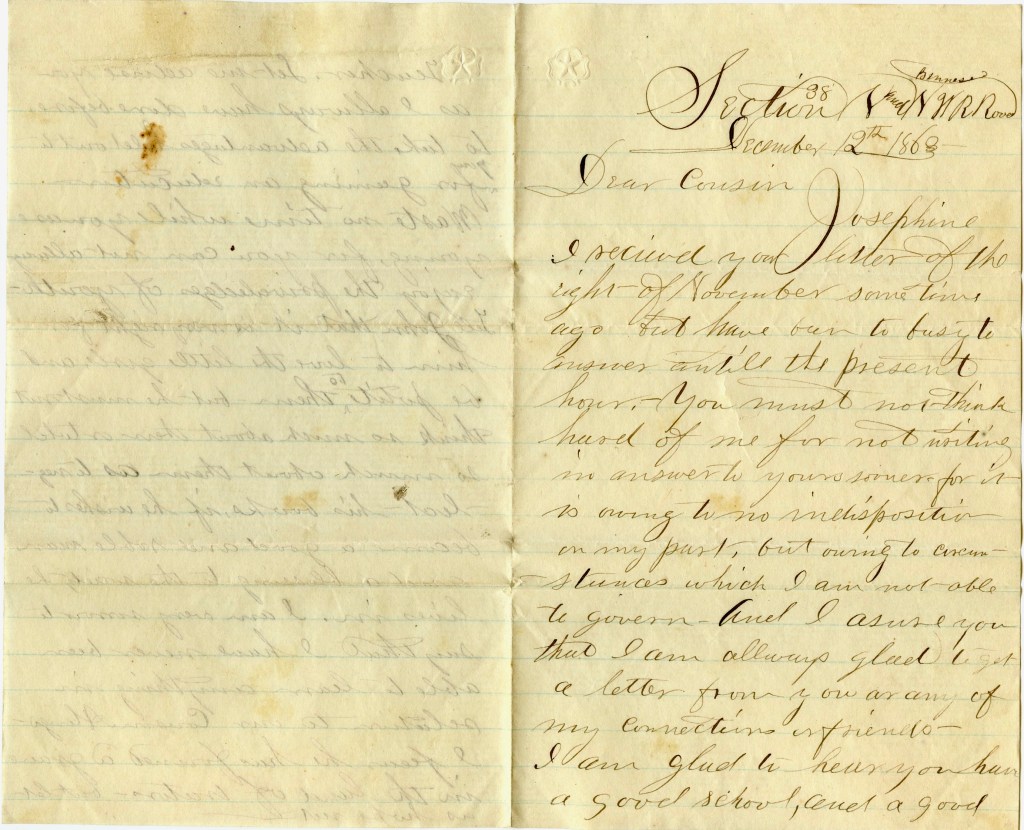
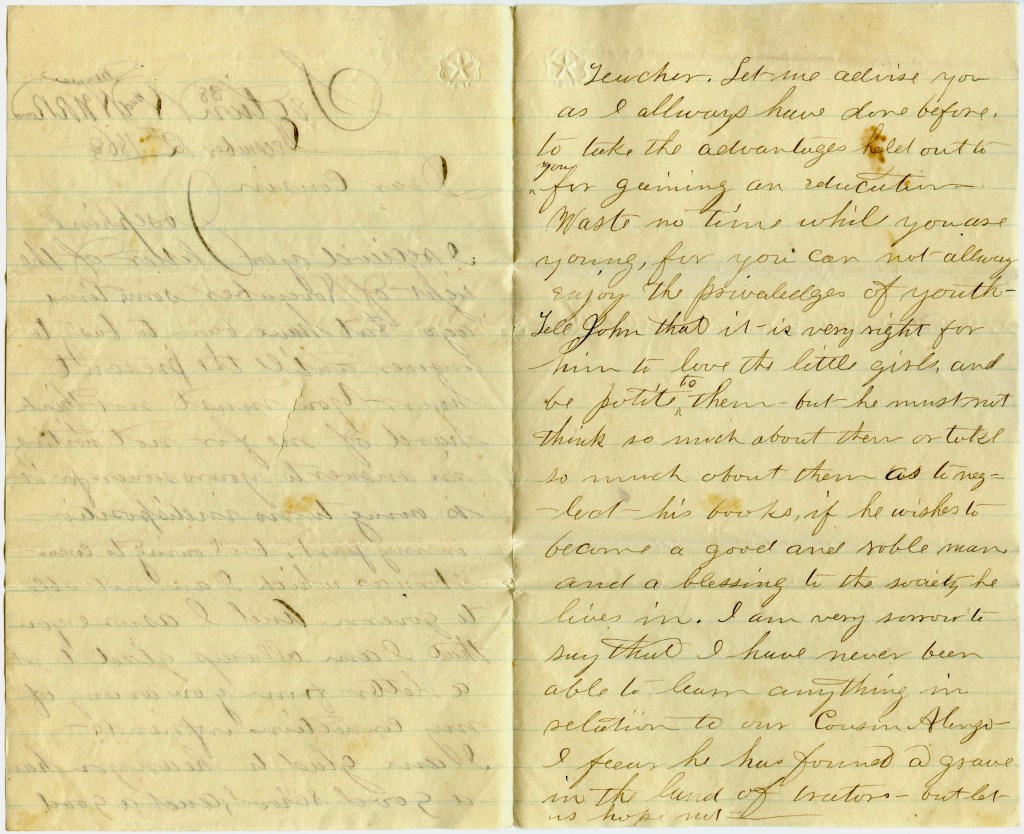
Section 38, N & NW [Nashville & Northwestern] Railroad 1 December 12th 1863
Dear Cousin Josephine,
I received your letter of the eighth of November some time ago but have been to busy to answer until the present hour. You must not think hard of me for not writing in answer to yours sooner for it is owing to no indisposition on my part, but owing to circumstances which I am not able to govern. And I assure you that I am always glad to get a letter from you or any of my connections or friends.
I am glad to hear you have a good school and a good teacher. Let me advise you as I always have done before, to take the advantage held out to you for gaining an education. Waste no time while you are young, for you cannot always enjoy the privileges of youth. Tell John that it is very right for him to love the little girls, and be polite to them. But he must not think so much about them or talk so much about them as to neglect his books if he wishes to become a good and noble man and a blessing to the society he lives in.
I am sorry to say that I have never been able to learn anything in relation to our cousin Alonzo. I fear he has found a grave in the land of traitors. But let us hope not. [– Frank]
1 Construction on the Nashville & Northwestern Railroad began in the fall of 1863, supervised by the 1st Michigan Engineers. Several thousand conscripted African Americans made up the bulk of the work force. Companies of the 12th and 13th United States Colored Infantries guarded the laborers from raids by Confederate troops and guerillas. Steamboats carried supplies up the Tennessee River to Johnsonville. The Nashville and Northwestern then carried the supplies to Nashville, where they were shipped to Gen. William T. Sherman’s army in Georgia.
Letter 7
Camp 12th US Colored Troops Section 53 N&NW Railroad February 4th 1864
Dear Cousin Josephine,
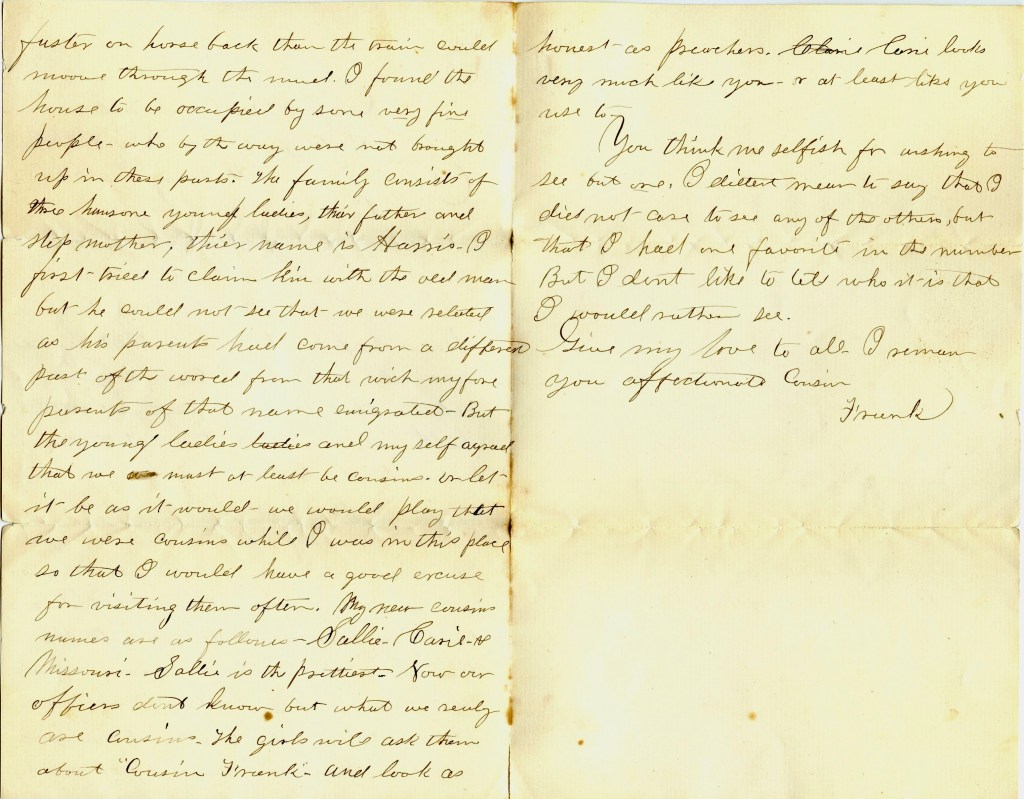
I have received your kind letter of the 26th of January. Am happy to know that you are all well and can say in return that I never enjoyed better health in my life than at the present time. And besides, am having a good share of fun. As I have not time to write much this time, I will just tell you about some new cousins I have found from the station with the train loaded with provisions a few days ago. I stopped at a house near the road in order to allow the wagons to get ahead as I could travel much faster on horseback than the train could move through the mud. I found the house to be occupied by some very fine people who by the way were not brought up in these parts. The family consists of three handsome young ladies, their father and step mother. Their name is Harris. I first tried to claim kin with the old man but he could not see that we were related as his parents had come from a different part of the world from that which my fore parents of that name emigrated. But the young ladies and myself agreed that we must at least be cousins or let it be as it would, we would play that we were cousins while I was in this place so that I would have a good excuse for visiting them often. My near cousins names are as follows—Sallie, Carrie, and Missouri. Sallie is the prettiest. Now our officers don’t know but what we really are cousins. The girls will ask them about “Cousin Frank” and look as honest as preachers. Carrie looks very much like you or at least like you use to.
You think me selfish for wishing to see but one? I didn’t mean to say that I did not care to see any of the others but that I had one favorite in the number. But I don’t like to tell who it is that I would rather see. Give my love to all, I remain your affectionate cousin, — Frank
Letter 8
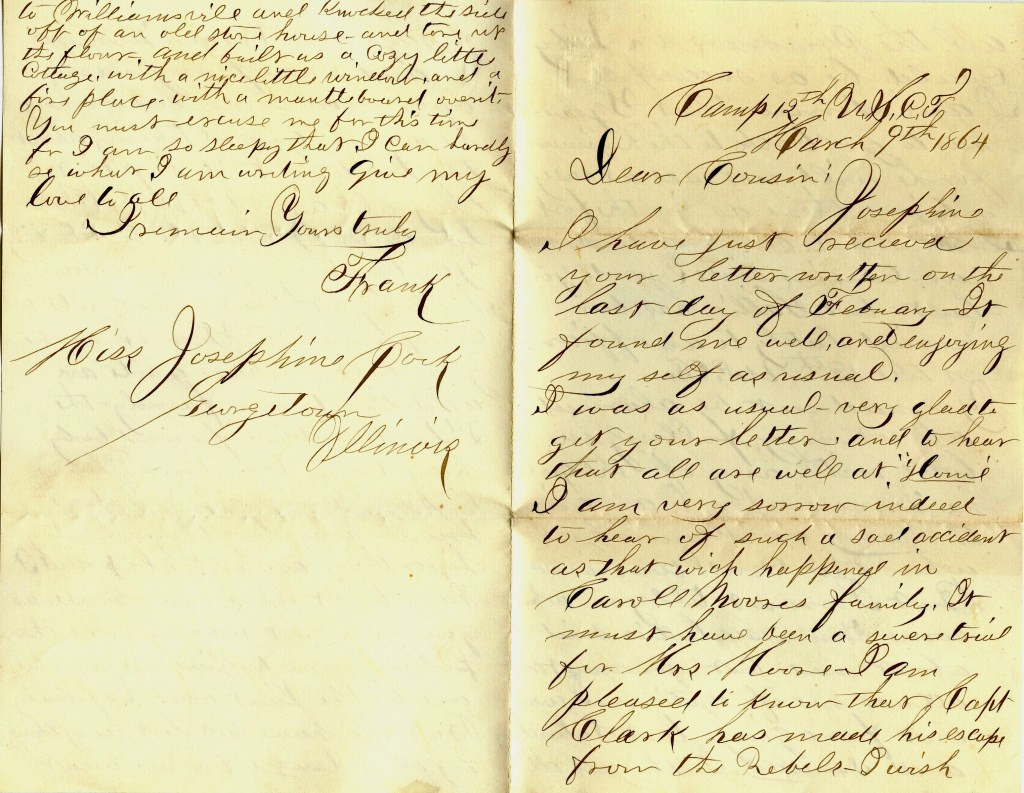
Camp 12th U.S.C.T. March 9th 1864
Dear cousin Josephine,
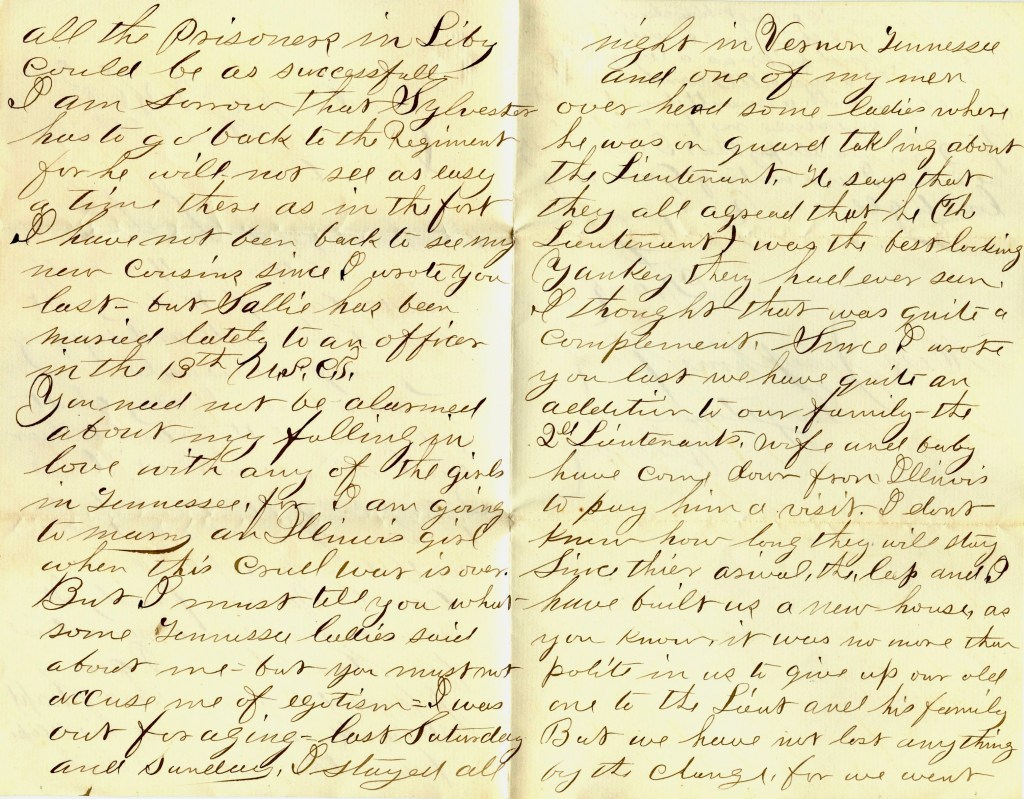
I have just received your letter written on the last day of February. It found me well and enjoying myself as usual. I was as usual very glad to get your letter and to hear that all are well at home. I am very sorry indeed to hear of such a sad accident as that which happened in Caroll Moore’s family. It must have been a severe trial for Mrs. Moore. I am pleased to know that Capt. Clark has made his escape from the rebels. I wish all the prisoners in Libby could be as successful. 1 I am sorry that Sylvester [Cook] has to go back to the regiment for he will not see as easy a time there as in the fort. I have not been back to see my new cousins since I wrote you last, but Sallie has been married lately to an officer in the 13th U. S. C. T.
You need not be alarmed about my falling in love with any of the girls in Tennessee for I am going to marry and Illinois girl when this cruel war is over. But I must tell you what some Tennessee ladies said about me—but you must not accuse me of egotism. I was out foraging last Saturday and Sunday. I stayed all night in Vernon, Tennessee and one of my men overheard some ladies when he was on guard talking about the Lieutenant. He says that they all agreed that he (the Lieutenant) was the best looking Yankee they had ever seen. I thought that was quite a compliment. Since I wrote you last, we have quite an addition to our family. The 2nd Lieutenant’s wife and baby have come down from Illinois to pay him a visit. I don’t know how long they will stay. Since their arrival, the Capt. and I have built us a new house, as you know it was no more than polite in us to give up our old one to the Lieutenant and his family. But we have not lost anything by the change (for we went to Williamsville and knocked the side off of an old store house and tore up the floor and built us a cozy little cottage with a nice little window and a fireplace with a mantle board over it.
You must excuse me for this time for I am so sleepy that I can hardly see what I am writing. Give my love to all. I remain yours truly, — Frank
1 I believe Frank is referring to Capt. Terrence Clark of the 79th Illinois Infantry who was captured at the Battle of Chickamauga in September 1863 and taken to Libby Prison in Richmond, Virginia. He arrived at Libby Prison on 29 September. By 25 October he and others had hatched a plan to tunnel out of Libby Prison. See Tunnel Escape.
Letter 9
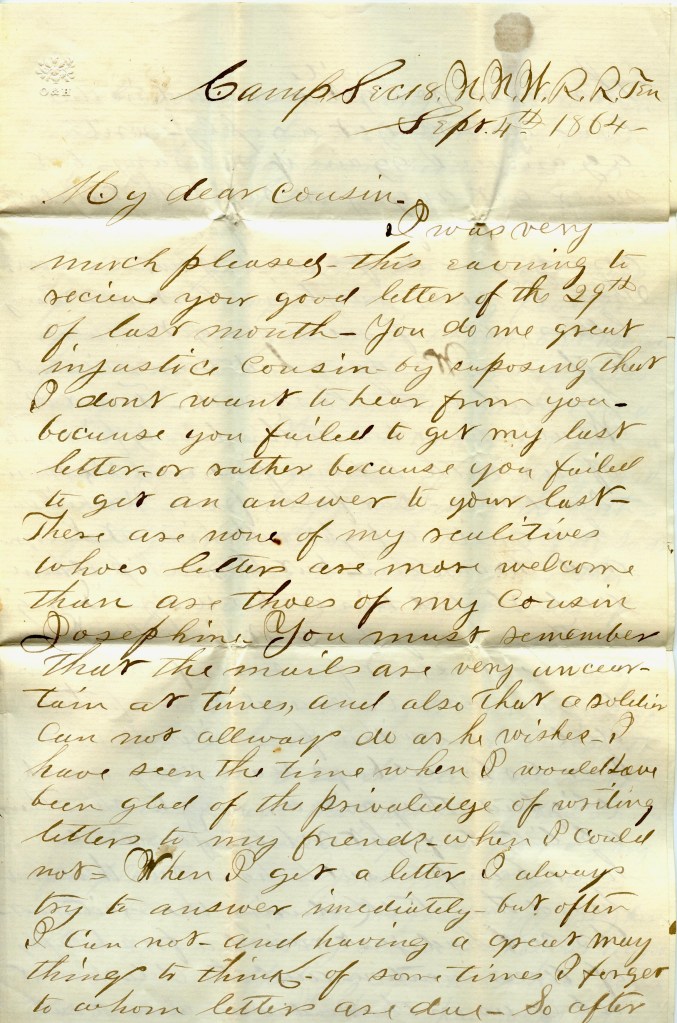
Camp Section 18, N. N. W. R. Tennessee September 4, 1864
My dear cousin.
I was very much pleased this evening to receive your good letter of the 29th of last month. You do me great injustice cousin by supposing that I don’t want to hear from you because you failed to get my last letter, or rather because you failed to get an answer to your last. There are none of my relatives whose letters are more welcome than are those of my cousin Josephine. You must remember that the mails are very uncertain at times, and also that a soldier cannot always do as he wishes. I have seen the time when I would have been glad of the privilege of writing letters to my friends when I could not. When I get a letter I always try to answer immediately but often I cannot, and having a great many things to think of, sometimes I forget to whom letters are due. So after this when you write to me and in due time do not get a reply, write again and again if necessary, but never get angry or suppose that I don’t care to hear from you for then you wrong yourself and your cousin. There is never any time lost in writing letters even if we never get answers to them.
We have had some excitement here within the last week. Forrest and Wheeler have been within twenty-five miles of us with between five and six thousand men. Our forces from Nashville had quite a fight with him at Lavergne and Franklin but they whipped him and started him on his way to “Dixie” with a heavy force at his heels. We were on the lookout for some of the raiders to give us a call and some of them did come within four miles of us. Our colored boys seem very much slighted. They are anxious to show their ability to fight rebels. You would have been pleased to have seen them and heard them talk during the excitement. As we had just received a fresh supply of ammunition and the detachment above us on the road was almost out, it became necessary for us to loan them a few boxes until their came up. When they were being carried from the fort and placed in the wagon, the boys gathered around and watched the transfer with as visible signs of sorrow depicteds on every feature of their rough and black, but honest faces as though they were witnessing the burial of their nearest and best friend. What a contrast between these sable defenders of the flag and the cursed Copperheads of the North and their brethren—the rebels of the South. These blacks are willing to throw their lives, if necessary, into the clutches of death to save a government from dissolution that has ever been anything but a blessing to them as a people, while the rebels, north and south, are anxious to see the destruction of the government that has always been a source of the greatest blessings ever enjoyed by any people.
You must excuse these blots for its in fault of my pen. Strange as it may seem, we haven’t a good pen in our shebang. We will have some soon, however. We have had very hot weather here for the last few days. Fruit is in great abundance here—peaches especially are splendid. I was astonished at the prices of articles with you. We buy all the articles you mentioned except dry goods fully as cheap as you do. We have bought potatoes at $1.50 per bushel. I can’t tell when I will come home. Don’t look for me till you see me coming. Tell Aunt Lucinda that I would like very much indeed to be at the barbecue of her pig but I don’t know whether I will have the privilege or not. Mrs. Lieut. D. G. Cooke has gone home. She concluded she could not make it convenient to go by Georgetown. The Lieutenant expects her back soon. I have nothing more of interest to write. I believe so I will close. Give my love to Pa, Ma, Johnny and Katy and the baby, and reserve a portion for yourself. Write often as convenient and I wil answer. Tell all the friends to write. I am your affectionate cousin, — B. F. Cook
Please don’t show this to anyone. It is so blotted I am ashamed of it. — Frank
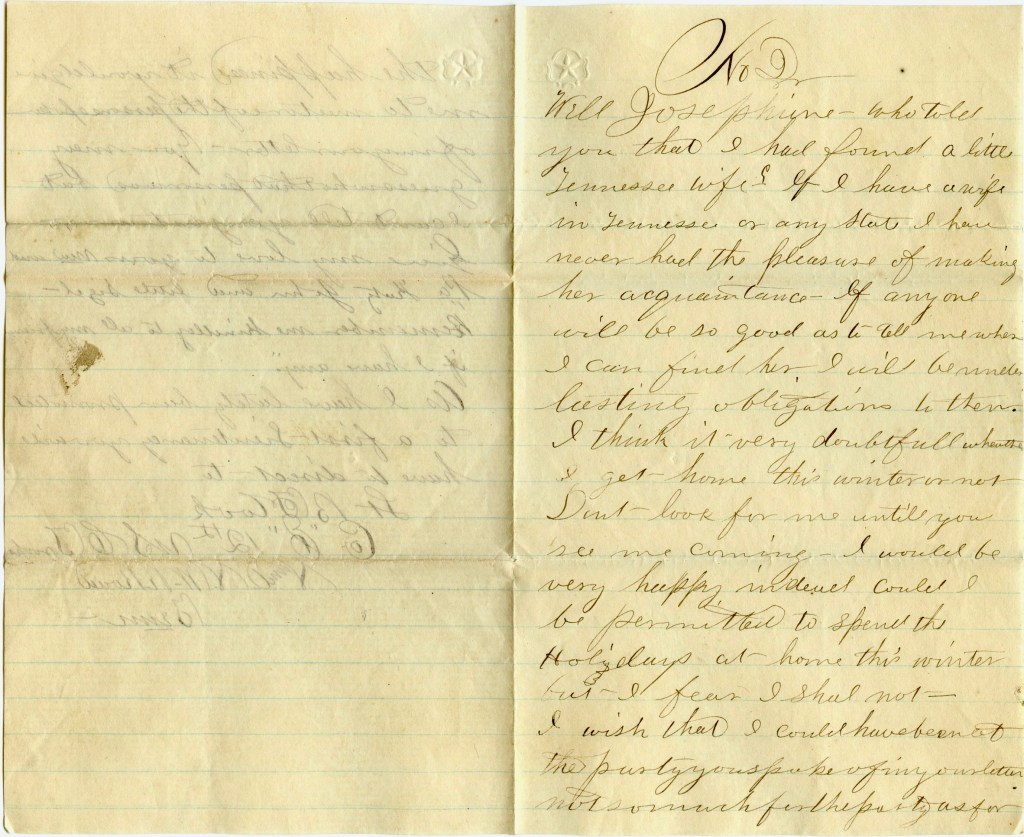
No. 2
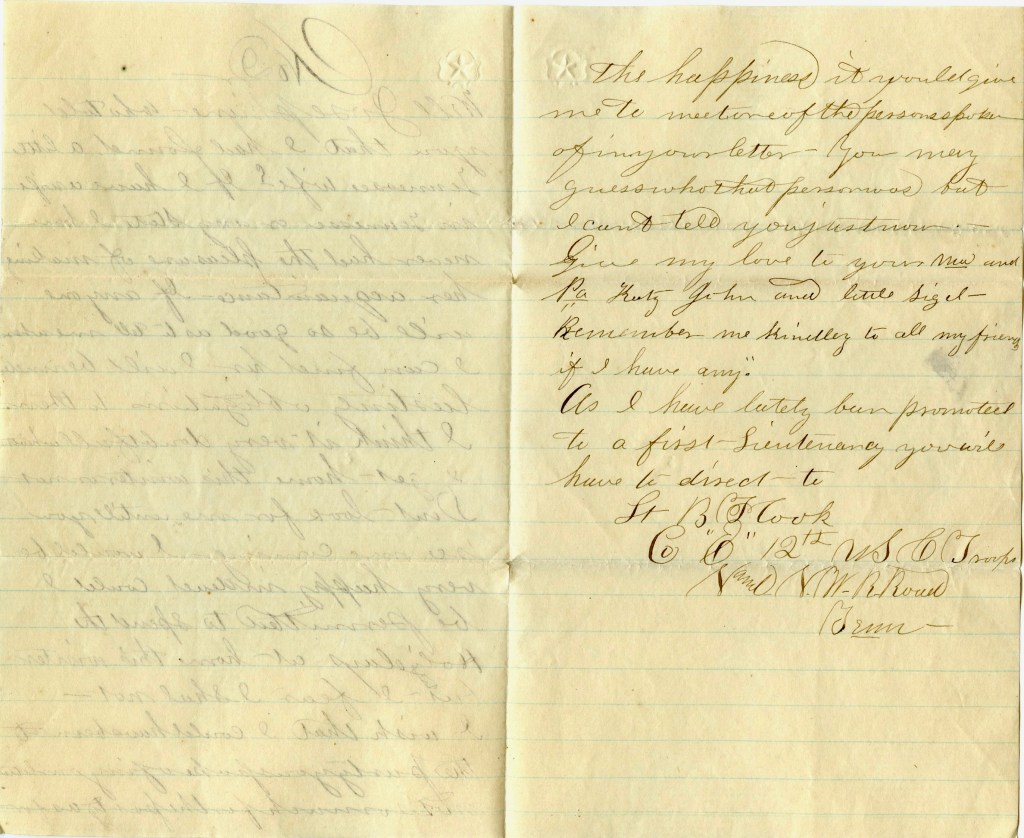
Well, Josephine, who told you that I had found a little Tennessee wife? If I have a wife in Tennessee, or any other state, I have never had the pleasure of making her acquaintance. If anyone will be so good as to tell me where I can find her, I will be under lasting obligations to them. I think it very doubtful whether I get home this winter or not. Don’t look for me until you see me coming. I would be very happy indeed could I be permitted to spend the Holidays at home this winter but I fear I shall not. I wish that I could have been at the party you spoke of in your letter. Not so much for the part as for the happiness it would give me to meet one of the persons spoke of in your letter. You may guess who that person was but I can’t tell you just now.
Give my love to your Ma and Pa, Katy, John and little Sigel. Remember me kindly to all my friends if I have any.
As I have lately been promoted to a 1st Lieutenancy, you will have to direct to Lt. B. F. Cook, Co. E, 12th USC Troops, N & N W Railroad, Tennessee
I could not find an image of Garret but here is Joseph W. Bullington of Co. F, 25th Illinois Infantry. Like Garret, he was killed in the fighting before Atlanta in 1864. (David Hann Collection)
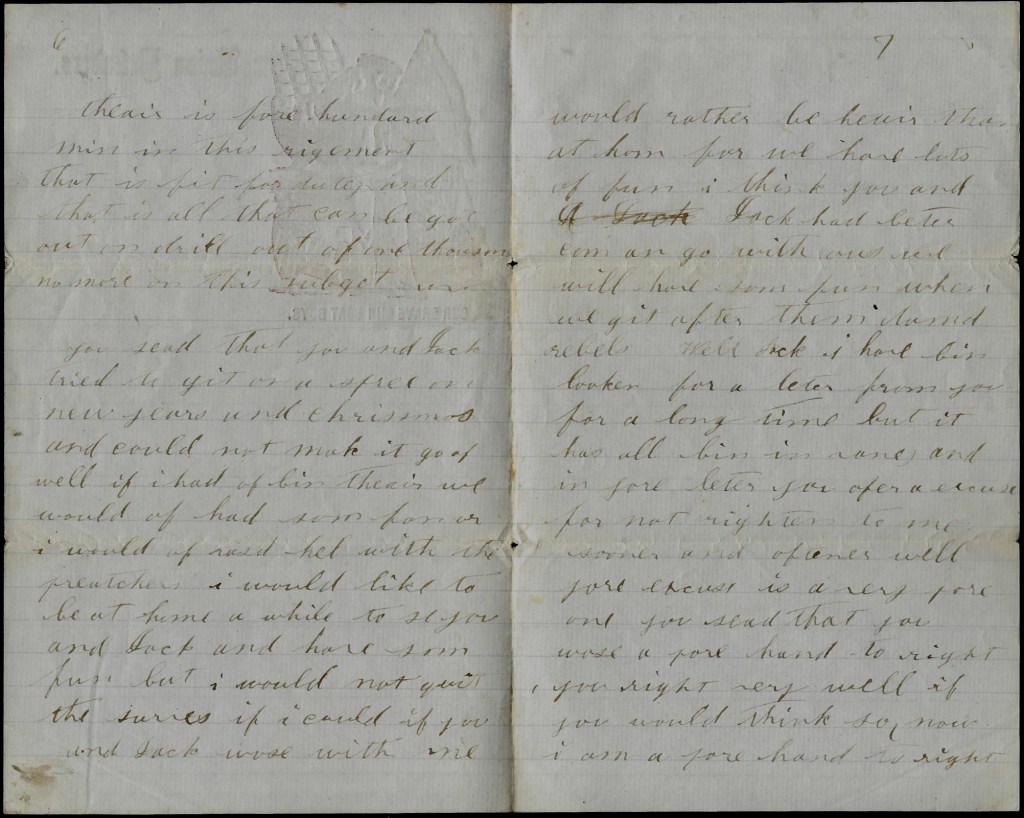
The following letter was written by Pvt. Garret Moore (1838-1865) of Co. C, 25th Illinois Infantry. Garret was the orphaned son of Garret Moore (18xx-1838) and Catherine Bailey (18xx-Bef1850) of Champaign county, Illinois. He had some older siblings but he was raised by others. In the 1850 US Census he was enumerated in the household of the Alexander Argo family. In the 1860 US Census, he was enumerated in the household of the James Swearingen family.
Garret enlisted on 4 August 1861 at Homer, Illinois, and was with his regiment in Rolla, Missouri, from mid-November 1861 until early February 1862 when they embarked on the campaign that would eventually lead to their first engagement—the Battle of Pea Ridge in northern Arkansas. Garret was seriously wounded at Kennesaw Mountain on 23 June 1864 and died of his wounds a week later at Chattanooga, Tennessee. His muster records indicate he stood 5′ 9″ tall, with brown hair and hazel eyes.
Transcription
Rolla, Missouri January 5, 1862
My old friend Achley,
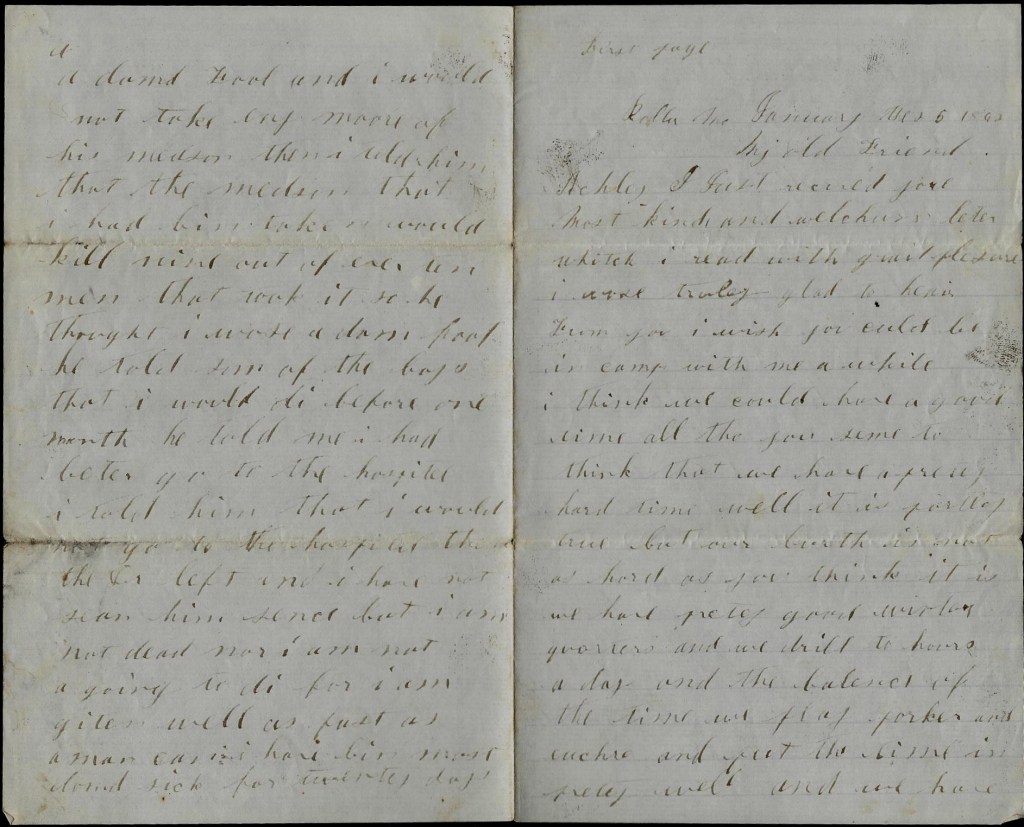
I just received your most kind and welcome letter which I read with great pleasure. I was truly glad to hear from you. I wish you could be in camp with me awhile. I think we could have a good time although you seem to think that we have a pretty hard time. Well, it is partly true, but our berth is not as hard as you think it is. We have pretty good winter quarters and we drill two hours a day and the balance of the time we play poker and euchre and put the time in pretty well and we have plenty to eat—such as it is.
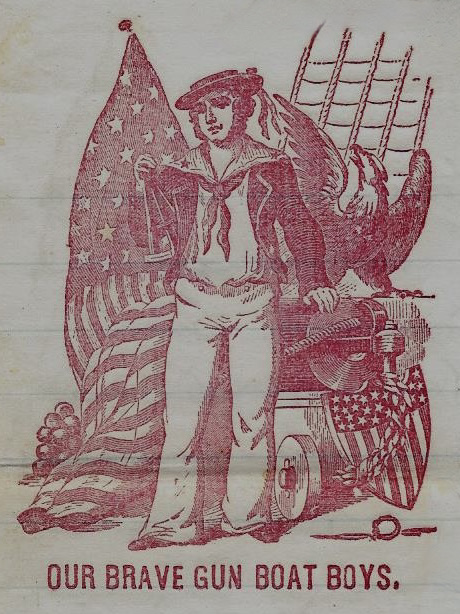
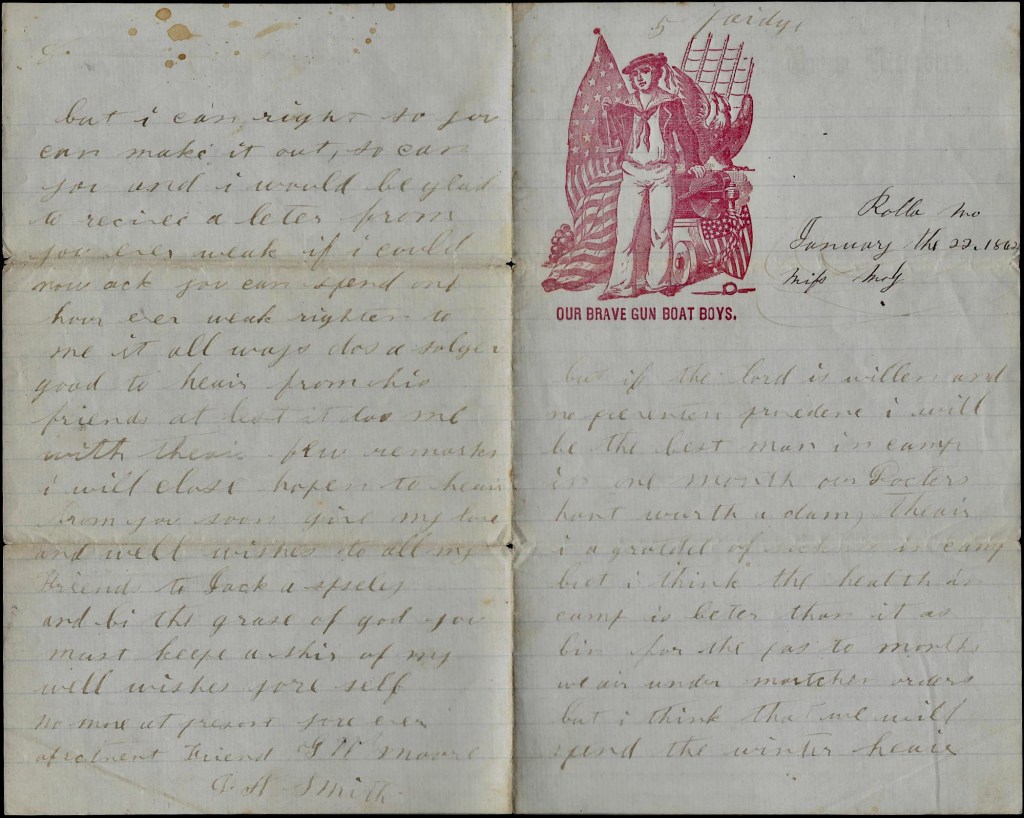
The patriotic image on Garret’s stationery
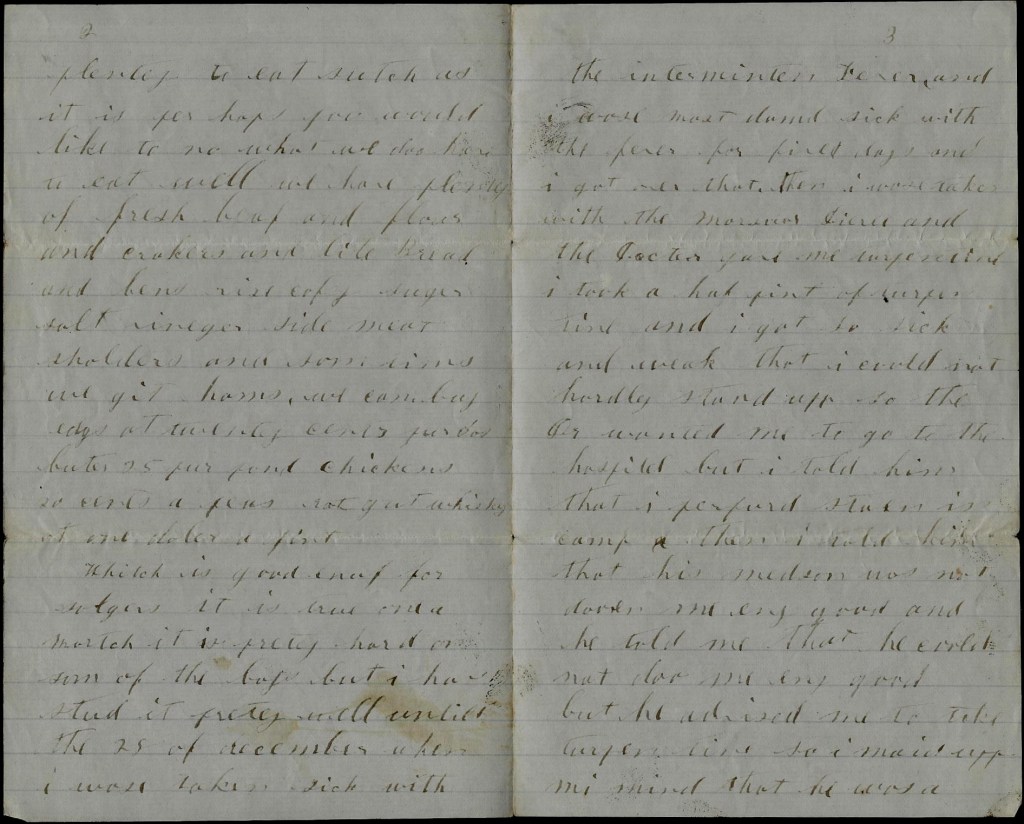
Perhaps you would like to know what we do here to eat. Well, we have plenty of fresh beef and flour and crackers and light bread and beans, rice, coffee, sugar, salt, vinegar, side meat shoulders and sometimes we get hams. We can buy eggs at twenty cents per dozen, butter 25 per pound, chickens 20 cents apiece, rot gut whiskey at one dollar per pint which is good enough for soldiers.
It is true [that] on a march, it is pretty hard on some of the boys but I have stood it pretty well until the 28th of December when I was taken sick with the intermittent fever and I was most down sick with the fever for five days and I got over that. Then I was taken with the m____ diarrhea and the doctor gave me turpentine. 1 I took a half pint of turpentine and I got so sick and weak that I could not hardly stand up so the Dr. wanted me to go to the hospital but I told him that I preferred staying in camp. Then I told him that his medicine was not doing me any good and he told me that he could not do me any good but he advised me to take turpentine so I made up my mind that he was a damned fool and I would not take any more of his medicine. Then I told him that the medicine that I had been taking would kill nine out of every ten men that took it so he thought I was a damn fool. He told some of the boys that I would die before one month. He told me I had better go to the hospital. I told him that I would not go to the hospital. Then the doctor left and I have not seen him since but I am not dead nor I am not a going to die for I am getting well as fast as a man can. I have been most down sick for twenty days but if the Lord is willing and no preventing Providence, I will be the best man in camp in one month. Our doctors hain’t worth a damn. There is a great deal of sickness in camp but I think the health in camp is better than it has been for the past two months.
We are under marching orders but I think that we will spend the winter here. There is four hundred men in this regiment that is fit for duty and that is all that can be got out on drill out of one thousand. no more on this subject now.
You said that you and Jack tried to get on a spree on New Years and Christmas and could not make it go off. Well, if I had of been there, we would of had some fun or I would of raised hell with the preachers. I would like to be at home awhile to see you and Jack and have some fun but I would not quit the service if I could, If you and Jack were with me, I would rather be here than at home for we have lots of fun. I think you and Jack had better come and go with us. We will have some fun when we get after them damned rebels.
Well, Jack, I have been looking for a letter from you for a long time but it has all been in vain and in your letter you offer an excuse for not writing to me sooner and oftener. Well, your excuse is a very poor one. You said that you was a poor hand to write. You write very well if you would think so. Now I am a poor hand to write but I can write so you can make it out. So can you, and I would be glad to receive a letter from you every week if I could. Now, Ach, you can spend one hour every week writing to me. It always does a soldier good to hear from his friends—at least it does me.
With these few remarks, I will close hoping to hear from you soon. Give my love and well wishes to all my friends, to Jack [ ] and by the grace of God you must keep a share of my well wishes for yourself. No more at present. Your ever affectionate friend, — G. W. Moore
— to J. A. Smith
1 Civil War soldiers often complained that the treatment surgeons prescribed for diseases was worse than the disease itself. Most soldiers, like Garret, refused to go to hospitals for fear they would never come out alive. Oil of turpentine was often prescribed by physicians for the treatment of typhoid fever during the Civil War. Turpentine oil-soaked rags were also used to wrap wounded to stop the spread of gangrene. It was used less commonly, I think, for the treatment of diarrhea as it only induced bloody vomiting, dehydrating the body further and compounding the problem. Large doses probably resulted in liver damage.[See Oil of Turpentine: Sheet Anchor of 19th Century Therapeutics by Vincent J. Cirillo, January 2021]






















 Spared & Shared 23