The following letter was written by Jairus T. Hammond (1839-1901), the son of Thomas Hammond (1799-1875) and Permelia Reynolds (1803-1891) of Wendell, Franklin county, Massachusetts.
Jairus was a 22 year-old mechanic when he enlisted on 12 October 1861 as a private in Co. K, 26th Massachusetts Infantry. He served nearly four years in the regiment, mustering out on 26 August 1865 at Savannah, Georgia.
Transcription
Addressed to Mr. Stillman H. Putnam, Wendell Depot, Massachusetts
Headquarters Middle Military Division Winchester, [Virginia] January 9th 1865
Dear Sister,
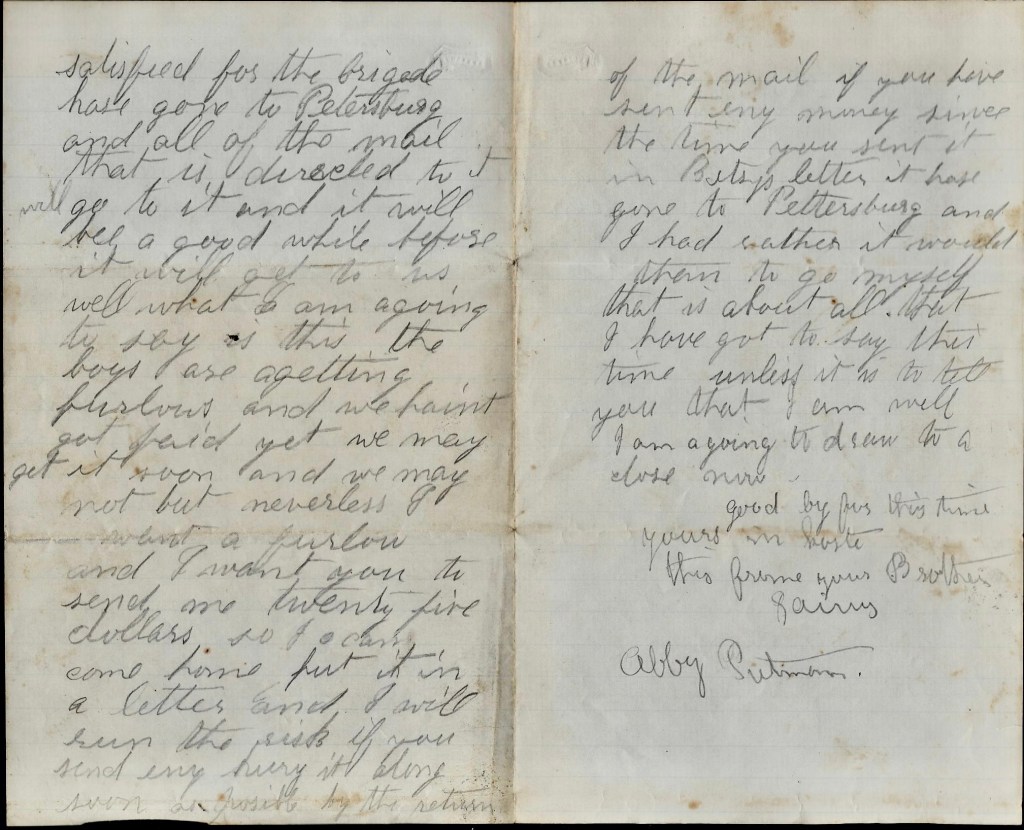
I am going to write a letter tonight that is short and sweet and I will tell you at once what I want the next time any of you write to me. You direct your letters a little different. Direct to the 36th Massachusetts Battalion, Provost Guard Headquarters, Middle Military Division. We are detached from our brigade and division and I am satisfied for the brigade has gone to Petersburg and all of the mail that is directed to it will go to it and it will be a good while before it will get to us.
Well, what I am a going to say is this. The boys are a getting furloughs and we hain’t got paid yet. We may get it soon and we may not, but nevertheless, I want a furlough and I want you to send me twenty-five dollars so I can come home. Put it in a letter and I will run the risk. If you send any, hurry it along soon as possible by the return of the mail, If you have sent any money since the time you sent it in Betsy’s letter, it has gone to Petersburg and I had rather it would than to go myself. That is about all that I have got to say this time unless it is to tell you that I am well.
I am going to draw to a close now. Goodbye for this time. Yours in haste. This from your brother, — Jairus
To Abby Putnam
Directions
Jairus T. Hammond Company B, 26th Mass. Battalion Provost Guard Headquarters Middle Military Division
I could not find an image of George but here is one of Jonas Shattuck who also served in the 26th Massachusetts. (Cowan’s Auctions)
The following letters were written by George Varnum Hildreth (1837-1915), the son of Moses P. Hildreth (1800-1879) and Eliza Ann Murdock (1809-1892) of Chelmsford, Middlesex county, Massachusetts. George was married to Mary J. Wentworth (1840-1931) in June 1857 and had one daughter, Estella, age 3, when he enlisted in September 1861 to serve in Co. E, 26th Massachusetts Infantry. George served 1 year and 7 days before he was mustered out of the regiment with a discharge for disability at New Orleans. After he was discharged from the service, George took up residence in Nashua, New Hampshire, where he worked as a carpenter.
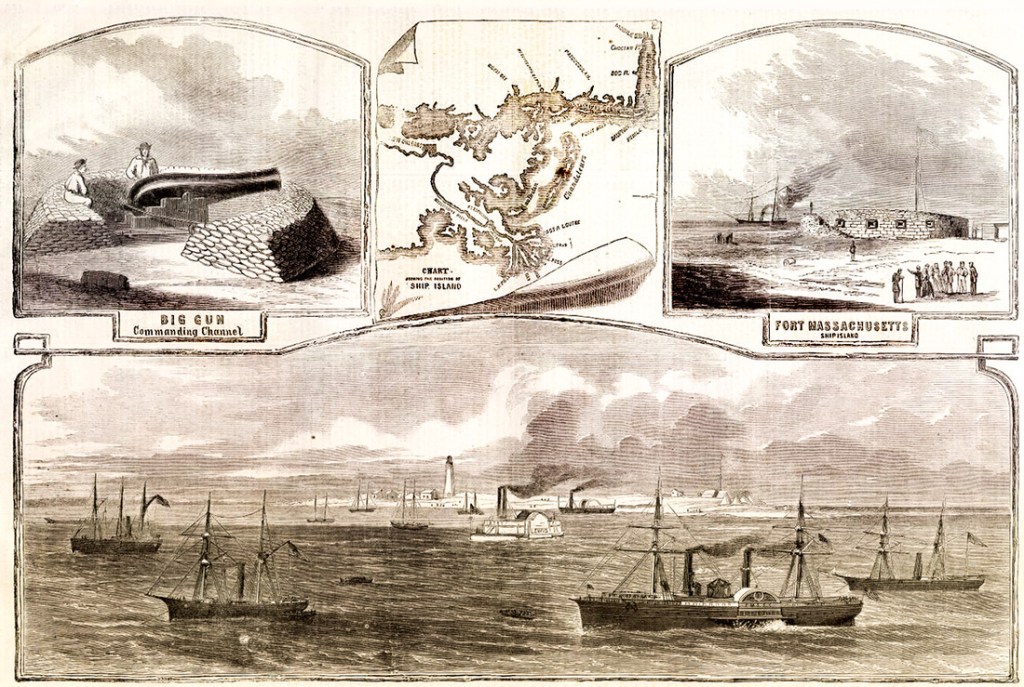
The first two letters were written from Ship Island which served as a staging area for Gen. Butler’s expedition against New Orleans in the spring of 1862. Shortly thereafter, the island became a prison camp for Union soldiers guilty of crimes in New Orleans and civilian detainees. Later in the war, the facility was expanded to accommodate Confederate prisoners of war captured in the Union attempt to take Mobile, and more than forty-two hundred Confederate prisoners were held there by the end of the war. Finally, the Union Navy built machine shops to repair and refit ships from the blockading fleet.
Twenty-seven Union infantry regiments, six batteries of light artillery, and a battalion of cavalry saw service on Ship Island during the Civil War. Union troop strength peaked in April 1862, when more than fifteen thousand men assembled for the final assault on New Orleans. After the city fell, the Union garrison on Ship Island was reduced to one regiment of infantry, the 13th Maine.
Scenes of Ship Island
Letter 1
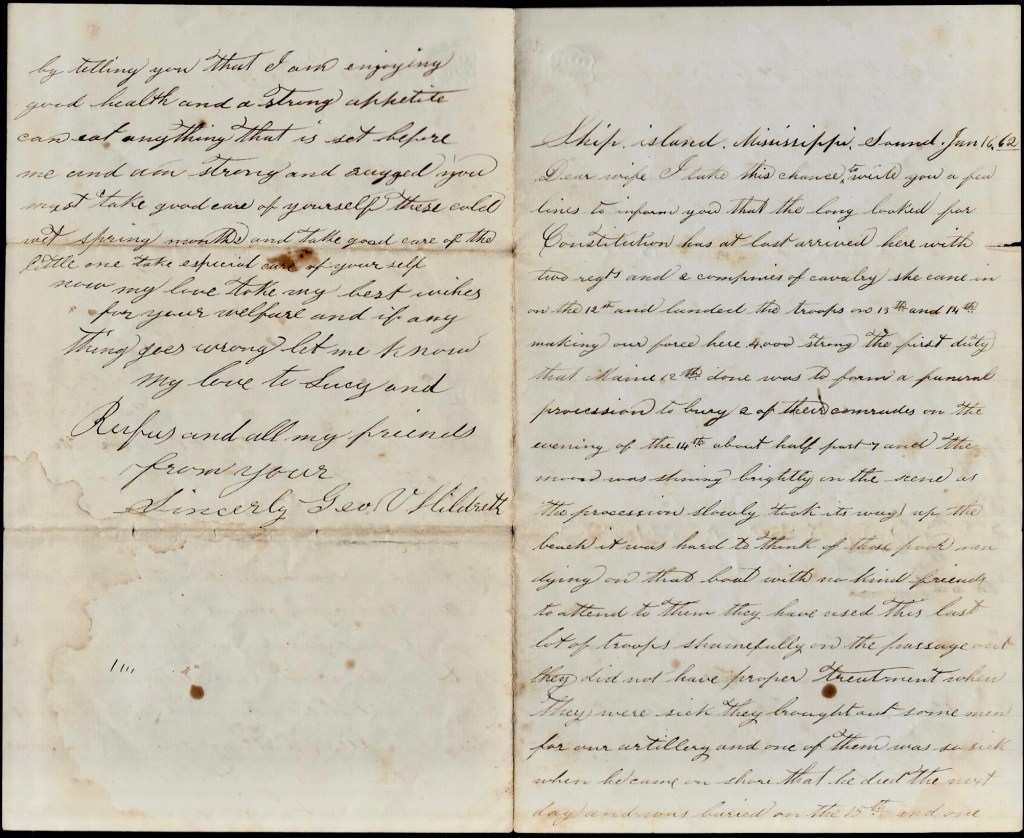
Ship Island, Mississippi Sound January 16, 1862
Dear Wife,
I take this chance to write you a few lines to inform you that the long looked for Constitution has at last arrived here with two regiments and a company of cavalry. 1 She came in on the 12th and landed the troops on 13th and 14th making our force here 4,000 strong. The first duty that the Maine 12th done was to form a funeral procession to bury two of their comrades on the evening of the 14th about half past 7, and the moon was shining brightly on the scene as the procession slowly took its way up the beach. It was hard to think of these poor men dying on that boat with no kind friends to attend to them.
They have used this last lot of troops shamefully on the passage out. They did not have proper treatment when they were sick. They brought out some men for our artillery and one of them was so sick when he came on shore that he died the next day and was buried on the 15th and one died on the 15th and will be buried today at 3 o’clock. He belongs to the Mounted Rangers. He was married—a wife and one child. He lived at No. 8, Lee Street, Lowell.
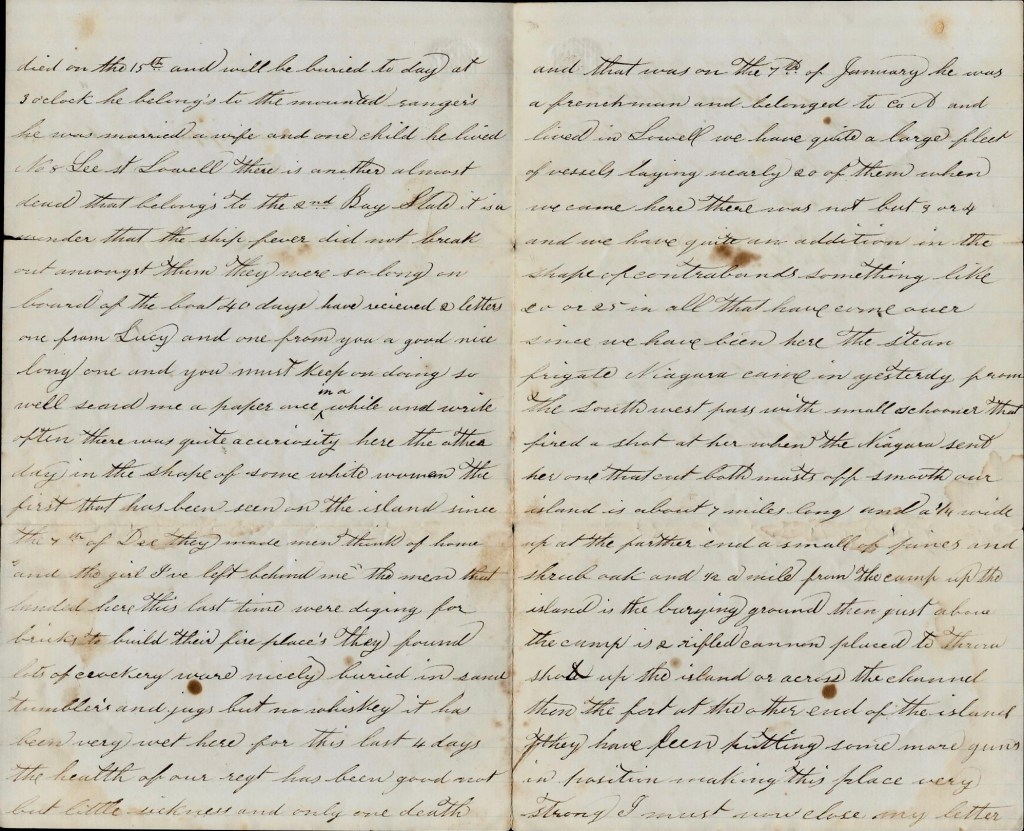
There is another almost dead that belongs to the 2nd Bay State. It is a wonder that the ship fever did not break out amongst them—they were so long on board of the boat—40 days.
I have received two letters. One from Lucy and one from you—a good nice long one. And you must keep on doing so well. Send me a paper once in awhile and write often.
There was quite a curiosity here the other day in the shape of a some white women—the first that has been seen on the island since the 7th of December, Thy made men think of home and “the girl I’ve left behind me.” The men that landed here this time were digging for bricks to build their fireplaces. They found lots of crockery ware nicely buried in sand—tumblers and jugs but no whiskey.
It has been wet here for these last four days. The health of our regiment has been good. Not but little sickness and only one death and that was on the 7th of January. He was a Frenchman and belonged to Co. A and lived in Lowell.
We have quite a large fleet of vessels laying [here]—nearly 20 of them. When we came here there was not but 3 or 4. And we have quite an addition in the shape of contrabands. Something like 20 or 25 in all that have come over since we have been here.
The steam frigate Niagara came in yesterday from the Southwest Pass with a small schooner that fired a shot at her when the Niagara sent her one that cut both masts off smooth.
Our island is about 7 miles long and a quarter wide. Up at the farther end is a small [cluster] of pines and scrub oak and half a mile from the camp up the island is the burying ground. Then just above the camp is a rifled cannon placed to throw shot up the island or across the channel. Then [at] the fort at the other end of the island, they have been putting some more guns in position and making this place very strong.
I must now close my letter by telling you that I am enjoying good health and a strong appetite. Can eat anything that is set before me and am strong and rugged. You must take good care of yourself these cold, wet, spring months and take care of the little one. Take especial care of yourself, Now my love, take my best wishes for your welfare and if anything goes wrong, let me know. My love to [my siblings] Lucy and Rufus and all my friends. From your sincerely, — George V. Hildreth
1 The SS Constitution was the same vessel that delivered the 9th Connecticut and 26th Massachusetts to Ship Island—the first of 27 Union infantry regiments to see service on Ship Island during the Civil War. When they were delivered to Ship Island on 2 December 1861 and caught their first glimpse of the desolate island, the boys of the 26th were not impressed. “What a hell of a place to send 2000 men 300 miles,” remarked their Quartermaster.
Letter 2
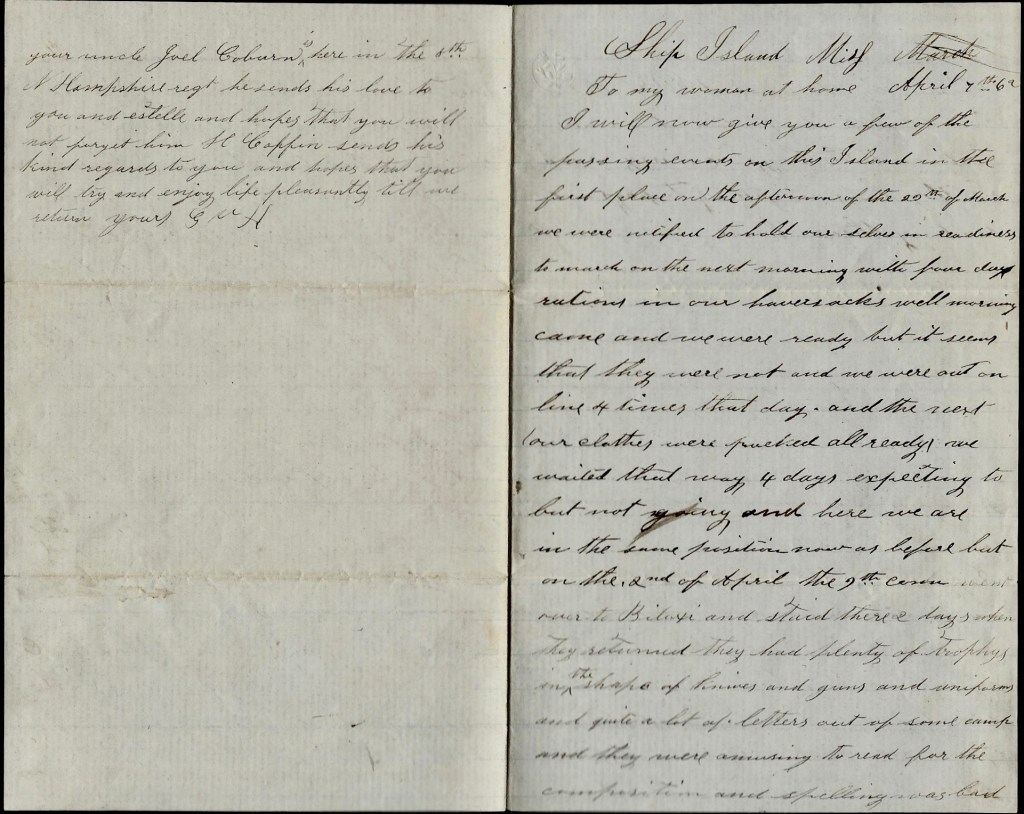
Ship Island, Mississippi April 7, 1862
To my woman at home,
I will now give you a few of the passing events on this Island. In the first place, on the afternoon of the 22nd of March, we were notified to hold ourselves in readiness to march on the next morning with four days rations in our haversacks. Well, morning came and we were ready but it seems that they were not and we were out on line four times that day and the next (our clothes were packed already). We waited that way four days expecting to, but not going, and here we are in the same position now as before.
But on the 2nd of April, the 9th Connecticut went over to Biloxi and staid there two days when they returned. 1 They had plenty of trophies in the shape of knives and guns and uniforms and quite a lot of letters out of some camp and they were amusing to read for the composition and spelling was bad. And our gunboats took a nice river steamer by the name of D. C. Walls loaded with turpentine. It is a nice boat and the boys are merry as can be. The boys are getting trophies and send them home but we shall probably be sent where we can get plenty of these things or they will get us.
Col. Edward Franc Jones, 26th Massachusetts Infantry (LOC)
Gen. Butler and Col. Jones have gone today off somewhere to see what they can do about moving us for we have not elbow room here now and more are coming. They will jam us into the sea if they keep on coming for two ships came in here the 4th. One was the Great Republic—the largest merchant ship in the merchant service.
Last Saturday there was five men drowned when in bathing. They have recovered four bodies and they were buried Sunday. The principal sickness here is typhoid fver, rheumatism, and colds. It is very warm here by spells. Saturday it was very warm and the thermometer stood at 102. That is about as warm as you generally find it at home in the summer.
Now for sights. The best sight was a white woman—wife [Eliza (Cushing) Fearing] of the Colonel [Hawkes Fearing, Jr.] of the 8th New Hampshire Regiment.
I did not intend to write till after we had made a move but Dutton was going home so that I thought it best to send by him. They are going to send home all that are unfit for duty. There is some 70 or 80 going out of this regiment and about 90 out of the 30th [Mass.].
Give my love to all and remember me ever the same and write often and take good care of yourself and to the little ones take good care. I remain sincerely yours, — G. V. Hildredth, Co. E, 26th Mass. Vol.
Your uncle Joel Coburn is here in the 8th New Hampshire Regt. He sends his love to you and Estelle and hopes that you will not forget him. H. Chapin sends his kind regards to you and hopes that you will try and enjoy life pleasantly till we return. Yours, — G. V. H.
1 Under a flag of truce, Gen. Butler had arranged to deliver a 4 year-old girl who had been rescued from a sinking schooner returned to New Orleans by way of Biloxi. Butler’s chief of staff delivered the girl to Biloxi without incident but in leaving Biloxi the small schooner stuck on a sandbar and in this vulnerable state, local southern-sympathizing rogue citizens fired on the Union men which enraged Gen. Butler when he learned of it after the schooner finally extricated itself and returned to Ship Island. To retaliate, Butler sent the 9th Connecticut over to Biloxi to teach them a lesson on 2 April 1862. They also went to the camp of the 3rd Mississippi at Pass Christian and skirmished. The details of this incident are beautifully written in a piece by Marty Brazil appearing in the Hancock County Historical Society Newsletter entitled, “Battle of Pass Christian—Bedsheet Surrender.”
Letter 3
Fort Saint Philip May 8, 1862
Dear Wife,
I write a few lines to let you know that I am well and that we have moved from Ship Island. we started the 15th of April on the steamer Mississippi. We went up the Mississippi river as far as the mortar fleet and saw the fight between the fleet and Fort Jackson and Fort St. Philip. After staying several days we went down the river and up the bay on the east side and landed at the quarantine station 5 miles above the forts the 28th of April. The forts surrendered on this day. A rebel ironclad gunboat laying there was fired at by our boats, The magazine was blown up [and] pieces of iron and timber are scattered in every direction.
The 30th of April, the 26th [Mass.] Regiment went into Forts St. Philip and Jackson. Fort Jackson is tore all to pieces inside. Fort St. Philip is not so badly damaged. There is plenty of work here for us to do and we get something to eat most of the time as good as can be expected by a soldier.
I received your letters and papers last Tuesday. The things you sent have come safe.
New Orleans has surrendered and the fleet has gone up the river to meet Commodore Foote. I think we shall stay here till we are sent home and have seen all the fighting we shall. The other regiments are up to New Orleans. Send Frank Leslie’s Harpers Weekly papers. Write often as you can. We expect to get home by the 4th of July and hope to anyway.
Direct to Co. E, 26th Reg. Mass. Volunteers, Fort St. Philip
I could not find a photograph of Daniel Worthley but here’s an early-war ambrotype of a Massachusetts man. (Dan Binder Collection)
This letter was written by Private Daniel Edward Worthley (1836-1913) of Co. I of the 26th Massachusetts Infantry. This regiment was organized in the fall of 1861 and spent the first three years of the war in the Department of the Gulf. In July 1864, they were transferred to the Army of the Shenandoah and were on the Bermuda Hundred front from mid-July to the 1st of August when they were sent to the valley to participate in Sheridan’s Valley Campaign. They would see some serious fighting in the day’s ahead—at Third Winchester, Fisher’s Hill, and Cedar Creek. After the last named battle, Worthley and 44 other men of the 26th Massachusetts were captured while guarding a forage train at Newton, Virginia. He was exchanged in February 1865 and mustered out at Savannah.
Daniel was the son of Luke Worthley (1809-1878) and Elizabeth Poor (1810-1891) of Andover, Essex county, Massachusetts. He mustered out of the regiment in August 1865. Daniel’s siblings included Phebe Marian Worthley (1836-1913), Lewis T. Worthley (1842-1924), Abbie R. Worthley (1844-1901), and Luke Worthley (1849-1901).
You see by the above that we are at last in Old Virginia. We started from New Orleans on the 11th instant & arrived here today. We had a pretty fair voyage—some rainy towards the end of it.
I suppose that I may have not got letters sent to me lately for two of the New Orlean mail steamers have been lost. The Locust Point was sunk off the coast of New Jersey and the Electric Spark captured by the rebels steamer Florida off the coast of North Carolina. I think I can get a reply to my letters in about 5 or 6 days now. That will be quite pleasant & I want you to write immediately. I have not heard whether you have got the money that I sent by Express.
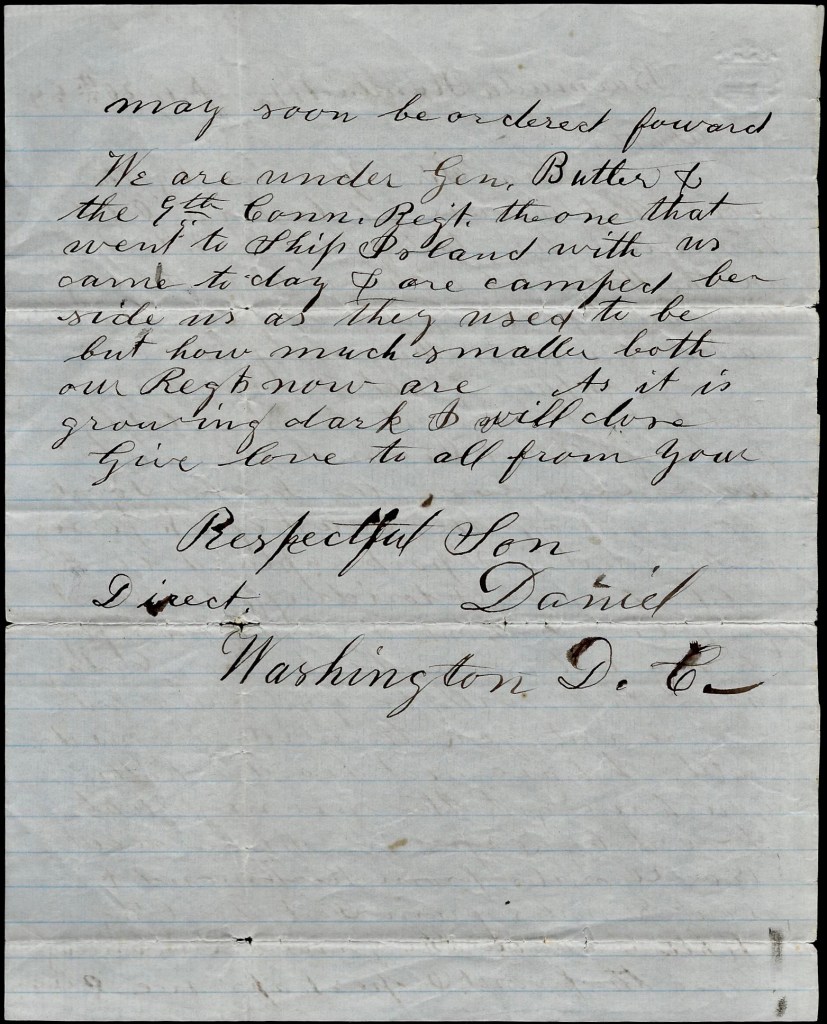
We are about 15 or 20 miles from Richmond & about 8 miles from Fort Darling. While I write, the guns are booming along the front & perhaps we may soon be ordered forward.
We are under Gen. Butler & the 9th Connecticut Regiment—the one that went to Ship Island with us 1—came today & are camped beside us as they used to be. But how much smaller both our regiments now are. As it is growing dark, I will close. Give love to all. From your respectful son, — Daniel
Direct to Washington D. C.
1 The 9th Connecticut and the 26th Massachusetts were the first of twenty-seven Union infantry regiments to see service on Ship Island during the Civil War. They sailed together aboard the SS Constitution in late November 1861 and reached Ship Island on 2 December 1861.







 Spared & Shared 23