
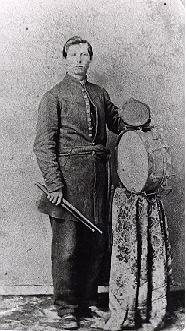
The following letter was written by Samuel Elmore Hull (1842-1917), the son of Samuel Hull (1805-1892) and Cherissa Wilcox (1807-1872) of Waldo, Marion county, Ohio. Eighteen year-old Samuel enlisted on 26 July 1861 as a musician in Co. C, 26th Ohio Volunteer Infantry (OVI). He mustered out of the regiment in October 1865 as the Band Leader but along the way it appears that he was reassigned to duty as a teamster.
Soon after organizing, the 26th traveled to the Upper Kanawha Valley in western Virginia (modern-day West Virginia), where the organization performed scouting duties. In late January 1862, officials transferred the 26th from the Department of West Virginia to the Department of the Ohio in the war’s Western Theater. Upon reaching Louisville, Kentucky authorities brigaded the regiment with the 15th, 17th, and 50th Regiments Indiana Infantry. Serving as part of the Army of the Ohio, the brigade moved to Nashville, Tennessee in March 1862, before traveling to Savannah, Tennessee in early April 1862. On April 6, 1862, the Battle of Shiloh erupted at Pittsburg Landing, Tennessee, eleven miles from Savannah. The 26th marched for the battlefield, traveling through thick swampland, but failed to arrive in time to participate in the engagement, which culminated in a Union victory on April 7. The regiment remained at Pittsburg Landing for several weeks, before embarking upon the Union’s advance against Corinth, Mississippi. Beginning on April 29, 1862, the Northerners besieged the city’s Confederate garrison and finally occupied Corinth on May 30, 1862. The 26th was one of the first Union regiments to enter the city.
Samuel wrote the letter to James Frey Wintermute (1823-1896) whom he addressed as “dear friend” though he was twenty years his senior and worked as merchant in Licking, Muskingum county, Ohio. It may be that Samuel had worked for Wintermute prior to the Civil War.

Transcription
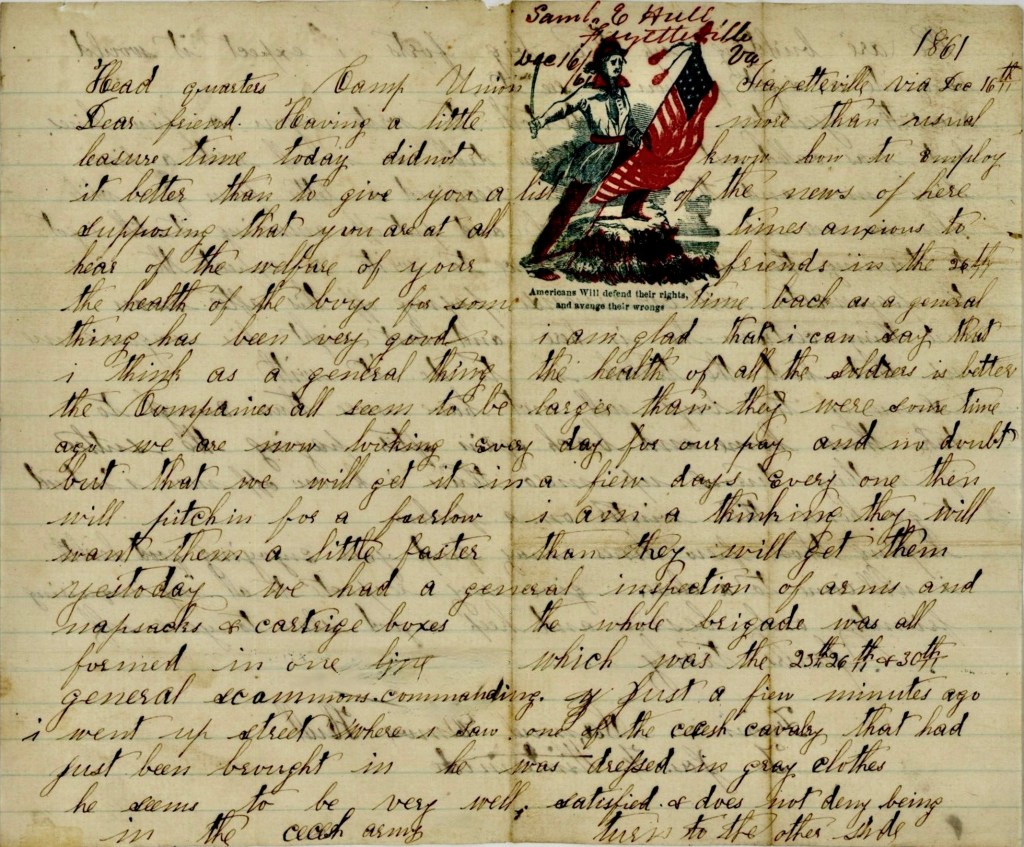
Headquarters, Camp Union
Fayetteville, Va.
December 16, 1861
Dear friend,
Having a little more than usual leisure time today, did not know how to employ it better than to give you a list of the news here supposing that you are at all times anxious to hear of the welfare of your friends in the 26th [Ohio Infantry]. The health of the boys for some time back as a general thing has been very good. I am glad that I can say that I think as a general thing the health of all the soldiers is better. The companies all seem to be larger than they were some time ago. We are now looking every day for our pay and no doubt but that we will get it in a few days. Everyone then will pitch in for a furlough. I am a thinking they will want them a little faster than they will get them.
Yesterday we had a general inspection of arms and knapsacks and cartridge boxes. the whole brigade was all formed in one line which was the 23rd, 26th, and 30th. General Scammons 1 commanding. Just a few minutes ago, I went up street where I saw one of the secesh cavalry that had just been brought in. He was dressed in gray clothes. He seems to be very well satisfied & does not deny being in the secesh army.
We are building up three big forts. I expect it would be quite a sight for you to see it.
December 17th. Yesterday I undertook to write you a few lines but was called out on battalion drill so I will write a few lines more and then close. I received a letter from you while we were up at Camp Sewell and put off answering it until I got to teaming. Then I had no chance to write. I expect the paymaster will commence paying off this afternoon. One thing certain, he is here and last night his wagon came up that had the truck in to do it with. Some of the boys will not have more than enough to take them home and back again after paying the sutler. If nothing turns up more than I know of now, I intend to go home this winter on a furlough.
Hoping these few lines may find you enjoying good health, I will come to a close. Give my respects to all my enquiring friends, only be sure and keep a good share to yourself. Yours truly. From Samuel Elmore Hull
To James F. Wintermute
1 Eliakim Parker Scammon: At the outbreak of the Civil War, he offered his services to the governor of Ohio, who gave him command of the 23rd Ohio, later dubbed the “President’s Regiment,” as among the men of the regiment were future presidents Rutherford B. Hayes and William McKinley. As part of the Kanawha Division, named for its operations in the mountains of Western Virginia, Scammon led the regiment well, finding success at the Battle of Carnifex Ferry. In late 1861, Scammon was assigned to command the 1st brigade in the Kanawha Division, which was incorporated into the IX Corps of the Army of the Potomac in early September 1862. Scammon’s men were engaged heavily at Fox’s Gap on South Mountain, where corps commander Jesse Reno was killed. Jacob Cox, commander of the Kanawha Division, replaced him, leaving Scammon in command of the division. He led the division at Antietam, seeing only minor combat but fighting well. He was appointed to brigadier general in October 1862 and returned with the Kanawha Division to the region of their namesake. On February 3, 1864, Scammon was asleep on a steamboat on the Kanawha River when it was raided by Confederate guerillas. He was held as a prisoner of war for six months, during which time his health deteriorated. To restore his health, he was sent to South Carolina where he commanded the Northern District in the Department of the South. Yet after only two weeks, he was captured again. He was only in captivity for five days before being exchanged, after which he was assigned to command the District of Florida for the rest of the war.


 Spared & Shared 23