Category Archives: 2nd Connecticut Heavy Artillery

1863: George Earl Judson to his Sister

Sgt. George Earl Judson, 2nd Connecticut Heavy Artillery

The following letter was written by George Earl Judson (1843-1864) who enlisted on 15 August 1862 in Co. I (“Woodbury Company”) of the 19th Connecticut Volunteer Infantry Regiment. The regiment was organized and mustered at Camp Dutton, outside of Litchfield, departing by train for Washington, DC on September 5th and assigned to the defenses of Alexandria, Virginia after their arrival. They spent the fall of 1862 on picket and patrol duty in the city until January 1863, when the 19th was reassigned to the outer ring of forts and redoubts defending Alexandria. Judson was promoted to corporal on July 16th and in November, the regiment was redesignated as the 2nd Connecticut Heavy Artillery. Judson was made acting sergeant in Co. I in January 1864 and was officially promoted to that rank on February 15th. In May, the regiment was called into the field to serve again as infantry in the 6th Army Corps during Grant’s Virginia Campaign. It fought with valor at Cold Harbor, Petersburg, and Winchester and suffered heavy casualties. On 19 October 1864 at Cedar Creek the regiment suffered a loss of 38 killed in 96 wounded; among the latter was Sergeant Judson, who received a gunshot wound in the left hip. He was eventually sent to the General Hospital at Patterson Hill in Baltimore, Maryland, where he died in late October from his wound.

George was the son of Capt. Ransom Judson (1797-1854) and Lucy Tuttle (1801-1885) of Southbury, New Haven county, Connecticut.

T R A N S C R I P T I O N

Redoubt D near Fort Lyon, Va.
July 12, 1863

Dear Sister,

It is Sunday and another inspection is through with. While I am down here sitting in my cloth house writing to you, I suppose you will be at church sitting up there in the gallery listening to a sermon from Parson Smith, or perhaps singing some of the good old tunes that I used to know, and which I have not forgotten. I should like to sing a few of them with you this evening after tea, but it is so far up there, I fear I should not get bak in time for dress parade so I think it will not be best for me to come. Our chaplain preached to us last Sunday in the bomb proof but today we have had no preaching.

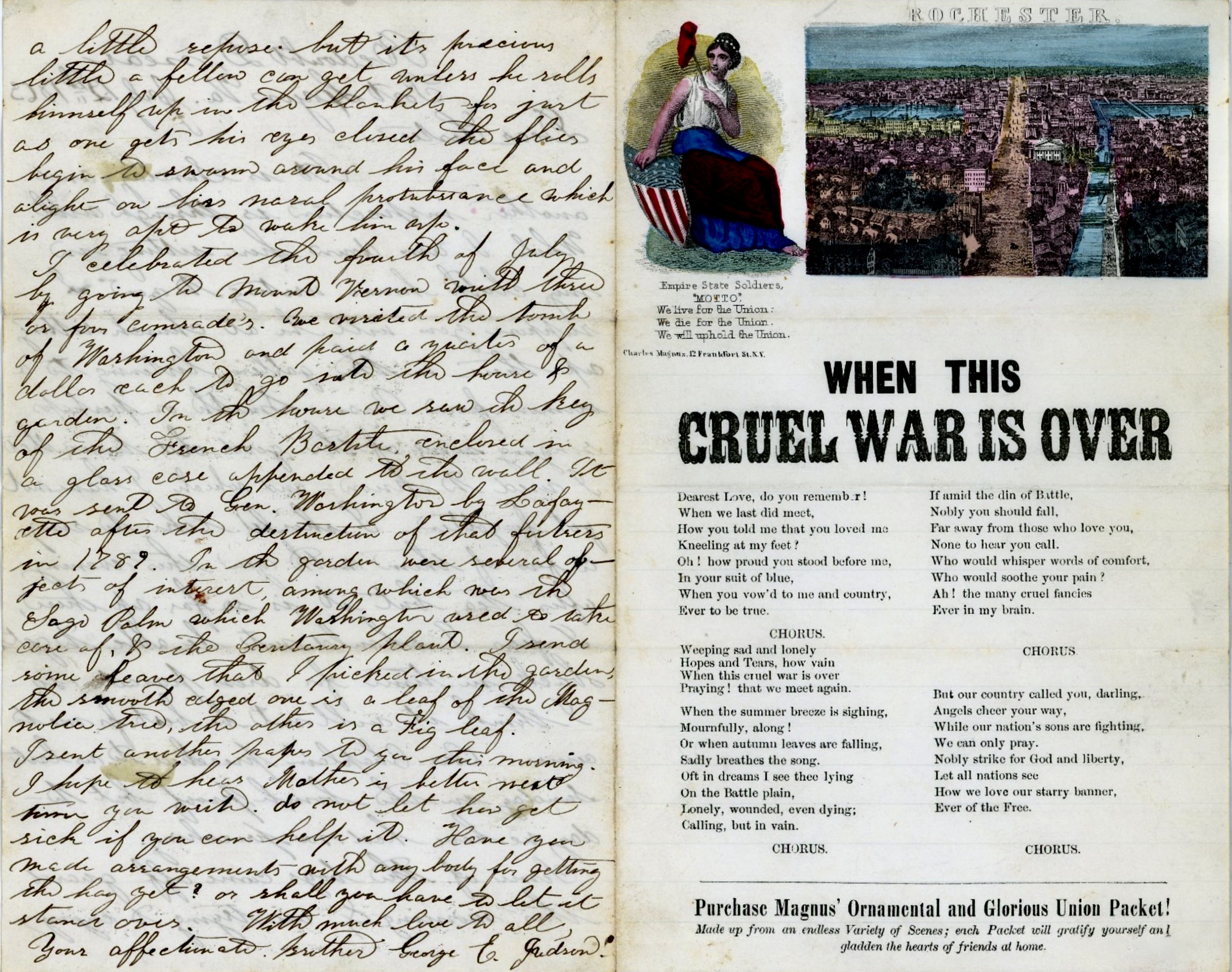
Some of the boys come off guard this morning & are trying to enjoy a little repose but its precious little a fellow can get unless he rolls himself up in the blankets for just as one gets his eyes closed, the flies begin to swarm around his face and alight on his nasal protuberance which is very apt to wake him up.

I celebrated the fourth of July by going to Mount Vernon with three or four comrades. We visited the tomb of Washington and paid a quarter of a dollar each to go into the house & garden. In the house we saw the key of the French Bastille enclosed in a glass case appended to the wall. It was sent to Gen. Washington by Lafayette after the destruction of that fortress in 1789. In the garden were several objects of interest, among which was the Sago Palm which Washington used to take care of, & the Petanary [?] plant. I send some leaves that I picked in the garden. The smooth edged one is a leaf of the Magnolia tree. The other is a fig leaf.

I sent another paper to you this morning. I hope to hear Mother is better next time you write. Do not let her get sick if you can help it. Have you made arrangements with anybody for getting the hay yet? or shall you have to let it stand over? With much love to all. Your affectionate brother, — George E. Judson

1862: Theodore Frelinghuysen Vaill to a Friend

1st Lieutenant & Adjutant Theodore F. Vaill

In 1868, Theodore Frelinghuysen Vaill (1832-1875) published the regimental history of the 2nd Connecticut Volunteer Heavy Artillery which was originally organized as the 19th Connecticut Volunteer Infantry. He served with the regiment as a private from 1862 to September 1863 when he was made a sergeant. He was promoted in March 1864 to 1st Lieutenant as Adjutant. He was mustered out of service on 18 August 1865 at Fort Ethan Allen in Washington D. C.

Theodore was the son of Rev. Herman Landon Vaill (1794-1870) and Flora Gold (1799-1883) of Litchfield, Connecticut. His siblings included Catharine Harriet Gold Vaill (1824-1898), Charles Benjamin Vaill (1826-1881), Elizabeth Sedgwick Vaill (1828-1909), Abbie Everest Vaill (1829-1897), George Lyman Vaill (1831-1833), Sarah Hopkins Vaill (1834-1862), Clarissa Champlin Vaill (b. 1836), Joseph Herman Vaill (1837-1915), Julia Maria Vaill (1839-1912), and Mary Woolsey Vaill (1842-1871).

Theodore was an 1858 graduate of Union College. He married Alice Mercy Dudley (1842-1920) after the war, published the afore-mentioned regimental history, and served as the editor of the Winsted Herald until his premature death in 1875 at the age of 43. He is buried in the Winsted Old Burying Ground in Winsted, Litchfield county, Connecticut.

Theodore was wounded in the fighting at Fort Fisher—a mere flesh wound in the left hip by a “cast iron ball from spherical case shot.”

“The map on the first page, please present with my regards to your sister [ ]. I have marked the position of our cap with a black dot.”

Transcription

Camp near Alexandria [Virginia]
Saturday evening, October 11th 1862

My dear friend William,

I received a letter from you some time ago but have failed to reply before this because I was expecting & hoping to see you down here very soon. But the Rev. Mr. Wainwright & Ed Sedgwick came without you and I have heard from them & in other ways that you were not well enough to come and probably would not be well enough to come in some time. I am sorry it is so, but still, if you are not perfectly well you ought by no means to come. Our company are all well and the regiment is so far a healthy regiment—no one having died. No one being discharged sick so far as I know.

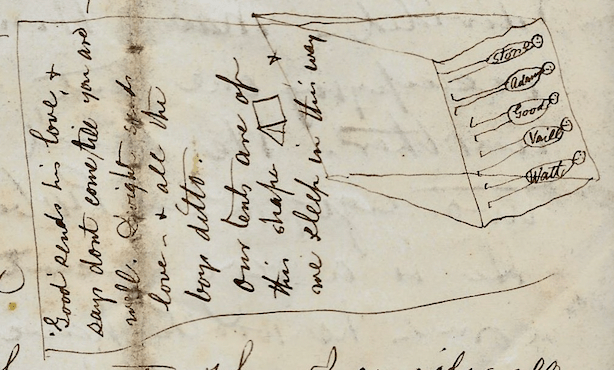
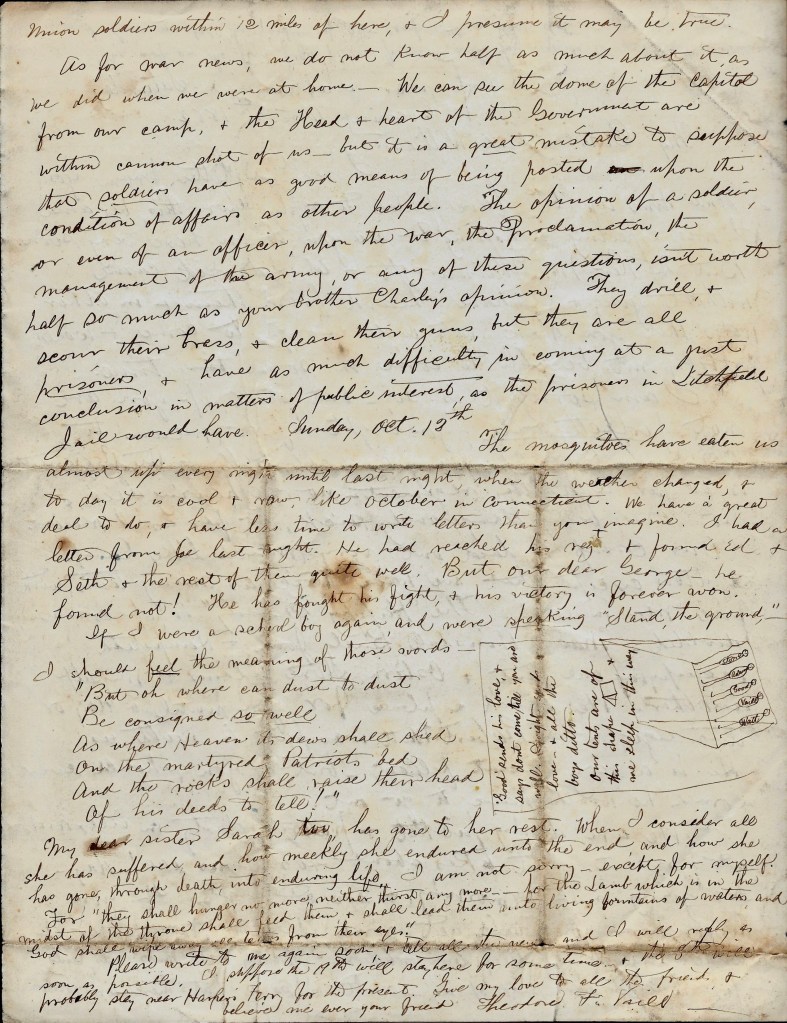
Our camp is laid out very much like Camp Dutton, except that we have twice as many tents, with five men in each. The “Happy Family” is, of course, divided—Mason, Hinsdale, Buel, Jones & Hempstead occupying one tent, & Osborn, Stone, Adams & myself another. We saved a place for you until a day or two ago, when Robert Watt was put in with us. He is a very decent fellow, but if you should ever come he would have to go out.

We are doing picket & patrol duty in Alexandria at present. It takes about 400 of us each day—200 going in the morning and 200 at night. If you were here you would get some idea of the number of soldiers engaged in putting down rebellion. Nothing but tents, tents, tents for miles on every side of us. It is said that there are 100,000 Union soldiers within 12 miles & I presume it may be true.

As for war news, we do not know half about it as we did when we were at home. We can see the dome of the capitol from our camp & the head & heart of the Government are within cannon shot of us. But it is a great mistake to suppose that soldiers have as good means of being posted upon the condition of affairs as other people. The opinion of a soldier or even of an officer, upon the war, the [Emancipation] Proclamation, the management of the army, or any of these questions, isn’t worth half so much as your brother Charley’s opinion. They drill & scour their brass & clean their guns, but they are all prisoners & have as much difficulty in coming at a just conclusion in matters of public interest as the prisoners in Litchfield Jail would have.

Sunday, Oct. 12th The mosquitoes have eaten us almost up every night until last night when the weather changed, & today it is cool and raw—like October in Connecticut. We have a great deal to do & have less time to write letters than you imagine. I had a letter from Joe last night. He had reached his regiment & found Ed & Seth & the rest of them quite well. But our dear George he found not! He has fought his fight and his victory is forever won. If I were a school boy again and were speaking “Stand the ground” I should feel the meaning of those words. But oh! where can dust to dust be consigned so well, as where Heaven its dews shall shed, on the martyred Patriots bed, and the rocks shall raise their head of his deeds to tell!”

My dear sister Sarah, too, has gone to her rest. When I consider all she has suffered and how meekly she endured unto the end, and how she has gone through death into enduring life. I’m not sorry—except for myself. For “they shall hunger no more, neither thirst any more—for the Lamb which is in the midst of the throne shall feed them and shall lead them unto living fountains of water and God shall wipe away tears from their eyes.”

Please write to me again soon & tell all recent news and I will reply, as soon as possible. I suppose the 19th will stay here for some time & probably stay near Harper’s Ferry for the present. Give my love to all the friends & believe me every your friend, — Theodore F. Vaill

P.S. “Good” sends his love & says don’t come till you are well. Wright sends love & all the boys ditto Our tents are of this shape, & we sleep in this way.(Sketch follows)