These letters were written by Daniel Markham (1837-1910), the son of Uriah Markham (1803-1848) and Elizabeth Adams (1803-18xx) of Brown county, Ohio. Daniel and his brother, Archibald (“Archie”) H. Markham (1835-1911), both served in Co. H, 2nd Illinois Cavalry.
Daniel wrote all of these letters to his cousin, Sarah Annette Markham (b. 1840), the daughter of Horace Marcum (b. 1791) of Knox county, Illinois.
Transcription
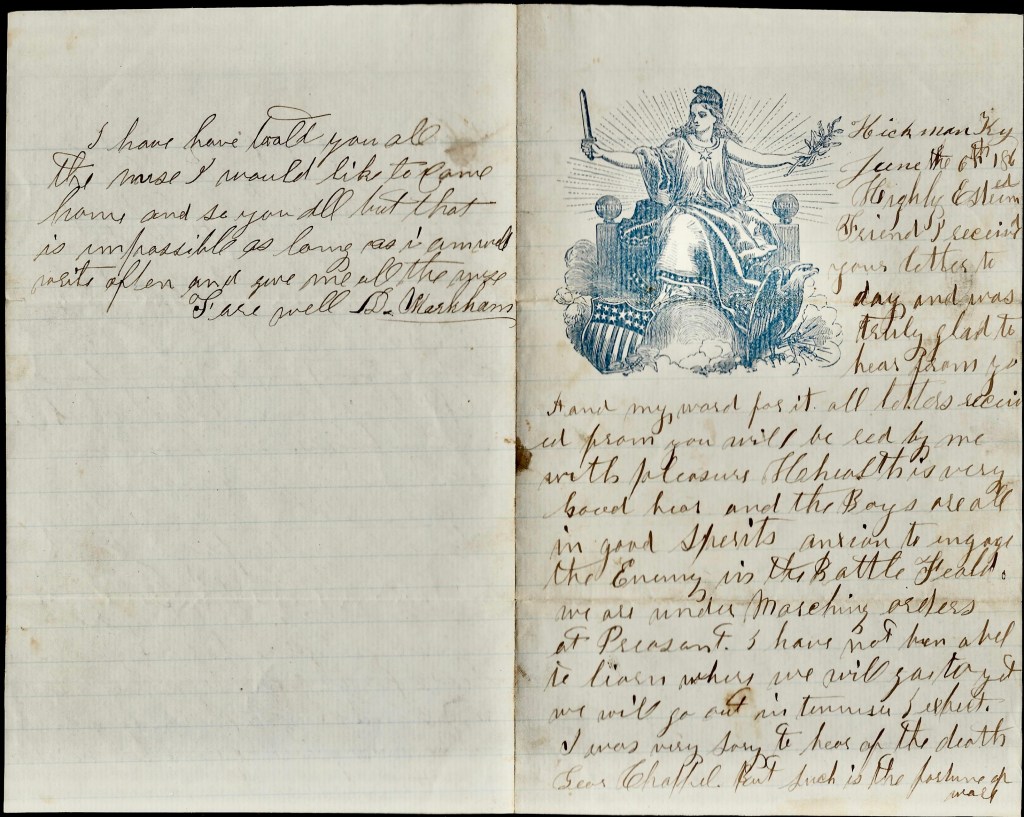
Patriotic Letterhead on stationery used by Markham
Hickman , Kentucky June 6, 1862
Highly Esteemed Friend,
I received your letter today and was truly glad to hear from you and [you have] my word for it, all letters received from you will be read by me with pleasure. My health is very good here and the boys are all in good spirits, anxious to engage the enemy in the battlefield. We are under marching orders at present. I have not been able to learn where we will go to yet. We will go out in Tennessee I expect. I was very sorry to hear of the death of George Chappel. But such is the fortune of many.
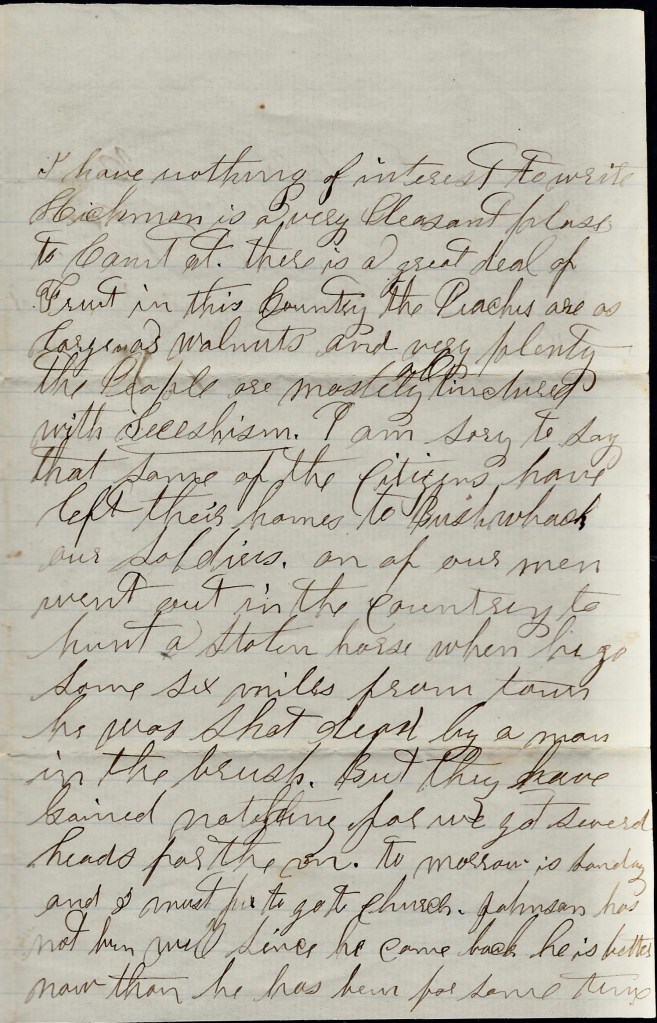
I have nothing of interest to write. Hickman is a very pleasant place to camp at. There is a great deal of fruit in this country. The peaches are as large as walnuts and very plenty. The people are mostly tinctured with seceshism. I am sorry to say that some of the citizens have left their homes to bushwhack our soldiers. One of our men went out in the country to hunt a stolen horse. When he had gone some six miles from town, he was shot dead by a man in the brush. But they have gained nothing for we got several heads for the one.
Tomorrow is Sunday and I must go to church. Johnson has not been well since he came back. He is better now than he has been for some time. I have told you all the news. I would like to come home and see you all but that is impossible as long as I am well. Write often and give me all the news. Farewell, — D. Markham
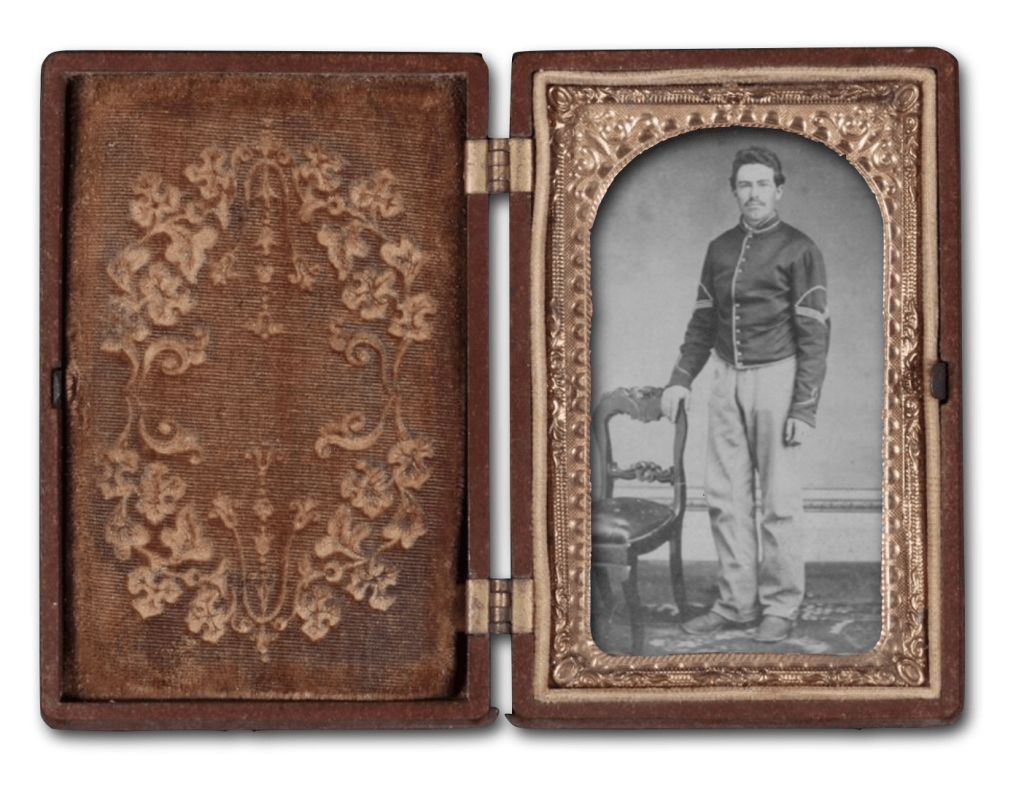
I could not find an image of Asa but here is a CDV of William Ulrich who also served in Co. A, 2nd Illinois Cavalry (Cowan’s Auctions)
The following letter was written by 19 year-old Asa W. Gillet (1842-1891) who enlisted at White Rock, Illinois, as a private in Co. A, 2nd Illinois Cavalry on 4 September 1861. Asa reenlisted after three years and on 25 June 1865 he was transferred to Co. E as a corporal. He mustered out of the regiment at San Antonio, Texas, on 22 November 1865.
In the 1850 Us Census, 10 year-old Asa was enumerated in his parents home in Chagrin Falls, Cuyahoga county, Ohio, with his older sister Savilla and three younger siblings. His parents were John Gillet (b. 1812) and Lucy Wheeler (1819-1851). In 1860, the family was still living in Chagrin Falls but Asa’s father had remarried and there were additional younger siblings.
After the war, Asa returned to Cuyahoga county, Ohio, where he found employment as a canal boatman. He was married to Minerva C. Hawkins (1845-1908) in 1869. In 1890, the Gillett’s were living in Tuscarawas county Ohio.
Transcription
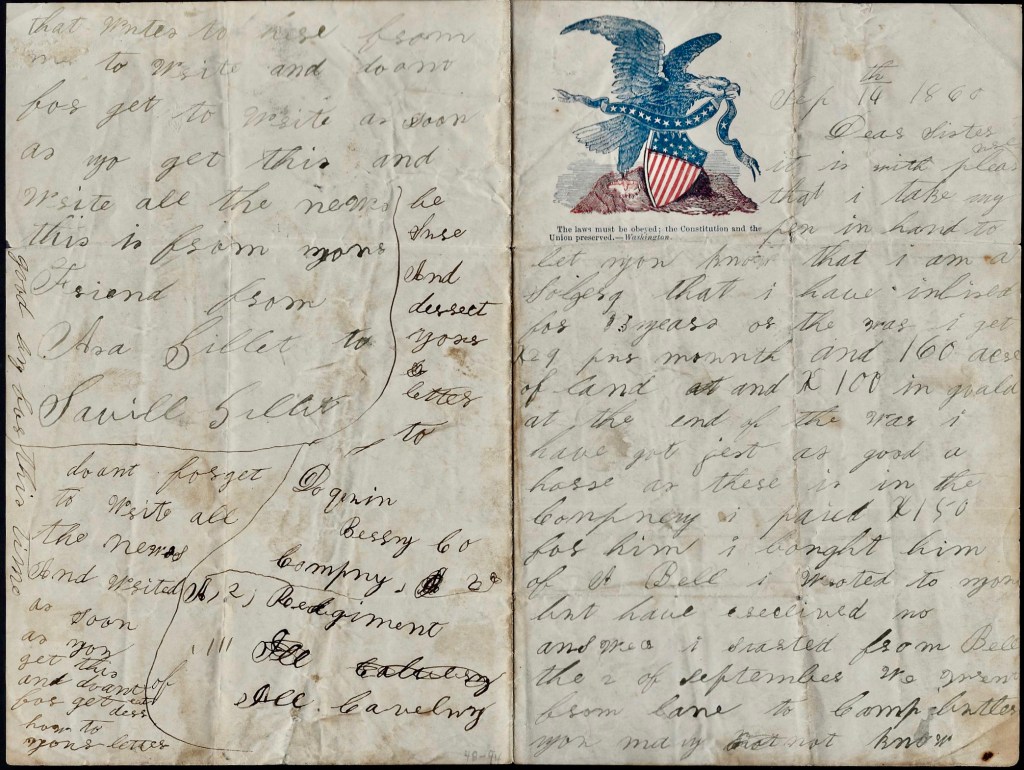
[Duquoin, Perry county, Illinois] September 14, 1860 [should be 1861]
Dear Sister,
It is with pleasure that I take my pen in hand to let you know that I am a soldier—that I have enlisted for 3 years or the war. I get $28 per month and 160 acres of land and $100 in gold at the end of the war. 1 I have just as good a horse as there is in the company. I paid $150 for him. I bought him off A. Bell.
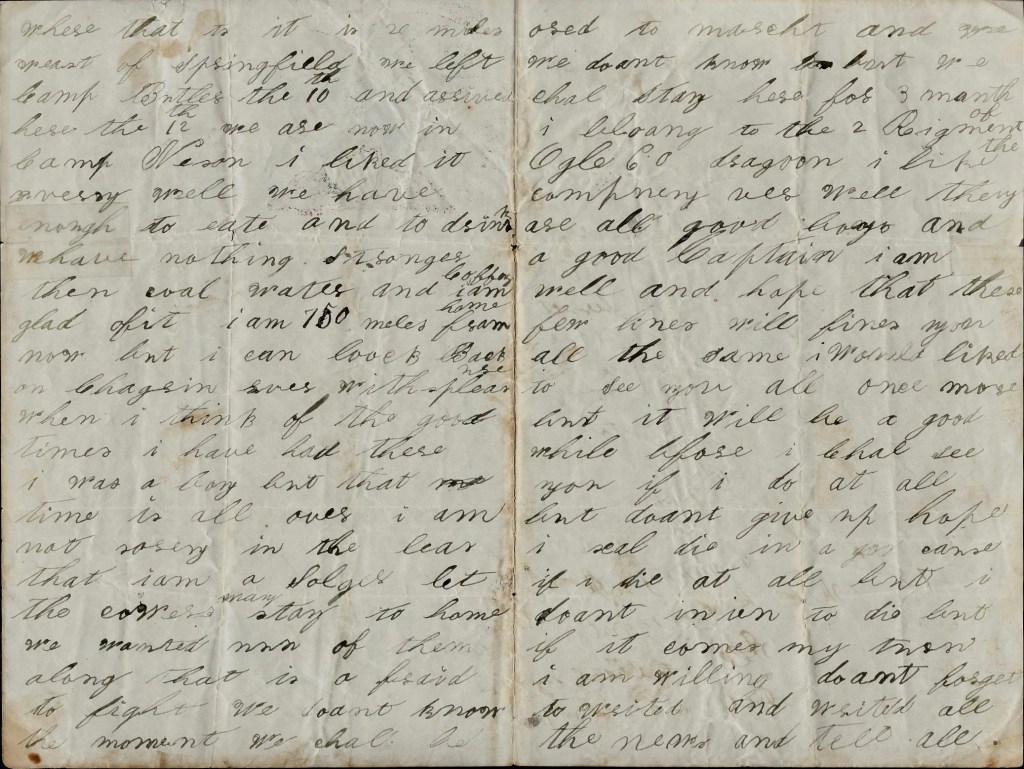
I wrote to you [before] but have received no answer. I started from Bell’s the 2nd of September. We went from Lane [Ogle county] to Camp Butler. You may not know where that is. It is 20 miles west of Springfield. We left Camp Butler the 10th and arrived here the 12th. We are now in Camp Nelson. I like it very well. We have enough to eat and to drink. We have nothing stronger that cold water and coffee. I am glad of it,
I am 750 miles from home now but I can look back on Chagrin [Falls] ever with pleasure when I think of the good times I have had there [when] I was a boy but that time is all over. I am not sorry in the least that I am a soldier. Let the cowards stay to home. We want none of them along that is afraid to fight. We don’t know the moment we shall be ordered to march and we don’t know but we shall stay here for three months.
I belong to the 2nd Regiment of Ogle County Dragoons. I like the company very well. They are all good boys and a good Captain. 2 I am well and hope that these few lines will find you all the same. I would like to see you all once more but it will be a good while before I shall see you, if I do at all. But don’t give up hope. I shall die in a good cause if I die at all but I don’t intend to die. But if it comes my turn, I am willing. Don’t forget to write and write all the news and tell all from home to write and do not forget to write as soon as you get this. This is from your friend, —Asa Gillet
To Saville Gillet
Be sure and direct your letter to Duquoin, Perry Co., Company A, 2nd Regiment, Illinois Cavalry
1 These promises of pay and land seem inflated to me. The 1862 Homestead Act allowed for anyone to get 160 acres of government land and gave priority to Civil War veterans. Veterans were also allowed additional land, up to another 160 acres, but one had to live on the land for 5 years and make improvements. Since this letter pre-dated the passage of the Homestead Act, it isn’t clear to me how this promise was made to Asa. The $29 per month included the government allowance for the feeding and care of the horses.
2 The Captain of Co. A, 2nd Illinois Cavalry was John R. Hotaling of Lane (now Rochelle), Illinois.
I could not find an image of William but here is one of James F. Wilson who also served as a Quartermaster Sergeant in the 2nd Illinois Cavalry. James was in Co. G.(Photo Sleuth)
This letter was written by William Gover Gilpin (1836-1862) who enlisted on 5 August 1861 at Quincy, Illinois, to serve in Co. L, 2nd Illinois Cavalry. William was the quartermaster sergeant of his company. He died of “Camp Fever” on 29 September 1861 at Island No. 10. The following letter written to his mother was found in the the Pension’s Office Records. It was penned less than three weeks before his death.
William was the son of Samuel P. Gilpin (1801-1849) and Rachel Gover (1803-1871) of Baltimore, Maryland. William’s father died of cholera at Quincy, Illinois, in May 1849. The Gilpin were Quakers and members of the Baltimore Monthly Meeting of Friends (Stony Brook). Samuel and Rachel’s children included: James S. Gilpin, b. 1822, Joseph Bernard Gilpin (1825-1878); Edward Canby Gilpin (1829-1908); Thomas Harris Gilpin, b. 1831; William Gover Gilpin, b. 1836; and Albert Gallatin Gilpin (1838-1893). In the 1860 US Census, William was enumerated in Ellington, Adams county, Illinois, where he earned his living as a florist. Ten years earlier, the family was enumerated in Baltimore’s 16th Ward, Rachel being the head of the household, her husband having died the year previous.
William mentions his older brother, Joseph B. Gilpin who enlisted in April 1862 to serve as a Captain in the U. S. Commissary Department (Paymaster). He remained in the service until 13 March 1866. In the 1860 US Census, Joe was enumerated in Quincy, Illinois, where he was employed as a land agent. William also mentions his older brother Edward and a younger brother—Albert—who apparently threatened to join the Confederate army. If he did, I can find no record of it.
Rachel filed for a mother’s pension from her home in Sandy Springs, Montgomery county, Maryland. She offered this letter to the Pension’s Office as evidence that her son sent her money and that she relied on it to sustain her.
Transcription
Island No. 10, Tennessee September 10, 1862
Dear Mother,
It has been some time since I heard from you & cannot imagine why some of you don’t write oftener. We have no news worthy of note transpiring around here save the chasing & bagging of guerrilla bands.
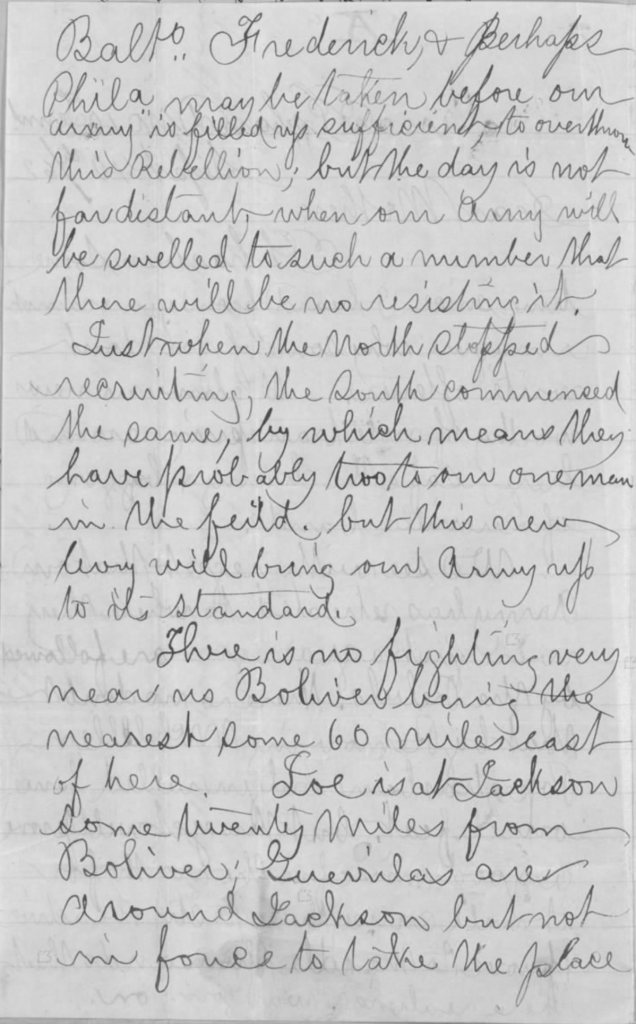
We see with regret that our army has retreated to where they were just a year ago and are followed by the Rebels. There is no doubt that by removing McClellan, Pope has been outgeneraled, hence our defeat. But this yet will prove a good move for the North for it will cause them to stir & be active & prove to the idle thousands that there really is a war going on. Baltimore, Frederick, & perhaps Philadelphia may be taken before our army is filled up sufficient to overthrow this rebellion. But the day is not far distant when our army will be swelled to such a number that there will be no resisting it. Just when the North stopped recruiting, the South commenced the same, by which means they have probably two to our one man in the field. But this new levy will bring our Army up to its standard.
There is no fighting very near us, Bolivar being the nearest some 60 miles east of here. [Brother] Joe is at Jackson some twenty miles from Bolivar. Guerrillas are around Jackson but not in force to take the place. Matters are quiet generally on the river. The health of our camp is very good. My health still continues good, or better than ever in fact. The weather is splendid.
Our folks in Louden are again feeling the terrors of war, & those in Sandy Spring will no doubt feel the same.
You must remain perfectly quiet where you are for this will be but a raid in Maryland that cannot last but a few days & they will again be driven South. Stay where you are & take it as cool as you can. 1
I suppose ere this Albert has joined the Southern Army. Let him go if he wants but I assure you he will yet regret leaving this—the best government that ever existed—to join the Negro Government of a day.
Have not heard from Quincy for some time but all were well when last heard from. Ed’s folks were also well. Hope you will write often. I enclose you $15 all I can spared now. will send more soon. With much love in haste, I close and remain your son, — Wm.
1 William is referring, of course, to Lee’s Maryland Campaign that culminated in the Battle of Antietam.






 Spared & Shared 23