Category Archives: 2nd Massachusetts Infantry

1861: 2nd Massachusetts Infantry Soldier to his Parents

The following partial letter is missing the signature page and there is no accompanying envelope to aid us in confirming his identity. The date and camp location make it certain he was in the 2nd Massachusetts Infantry and friends from West Boyleston mentioned in the letter suggest the possibility that he was from Co. C where the company was recruited, but I can’t be certain of this.

Though he is not identified, the letter remains interesting for the description of the punishment meted out to a civilian huckster who undoubtedly refused to keep his distance from Camp Andrews while the regiment was in training. The “poor fellow” was made to wear a “barrel shirt” and marched around the camp at the point of a bayonet to the delight of the whole regiment.

The letter was written on patriotic stationery “Ellsworth’s Last Letter.”

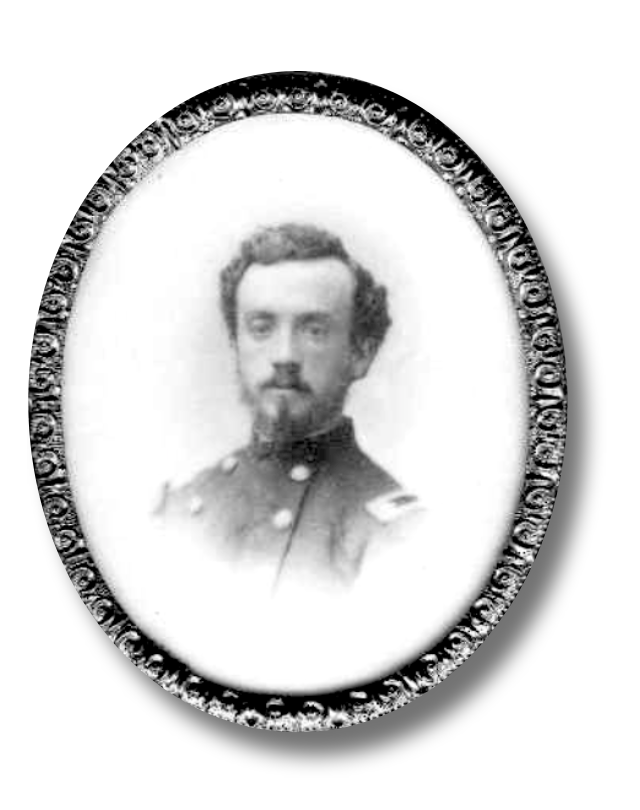
Officers of the 2nd Massachusetts Infantry at Camp Andrew in 1861

T R A N S C R I P T I O N

Camp Andrews
June 30, 1861

Dear Parents,

I thought you would like to hear from me and as there was nothing for me to do do for a few hours, I knew my time could not be better occupied than by scratching a few lines to you that would be acceptable. We have just parted with our friends Ford Laflin & Morrow. The parting is not without regret. You cannot tell how pleasant it is to us to see those that so lately bound themselves with us to serve God and those to to that have mourned with us over their sins & have found the pearl of great price. Can I ever forget the time when my rejoicing came, when light first beamed into my soul? I think not.

I received another present from you and one from Cousin Lizzie and Sammy. They sent me some paper or a package—one of Benjamin Russell’s putting up—and Lizzie wrote me a letter. You may thank Aunt Anna for those apples for me and tell her I shall remember the giver.

Well, I have not much more time to write now for am on guard & have to run every few moments & shall have to go on again in a little while.

Monday, July 1st. Well, I have got off of guard & have done my Washington & mending this forenoon and now am ready to finish this. Mr. Ezra Newton & Jery Shepard [of West Boyleston] were here this forenoon but could not get on the field. I did not have a chance to talk with them any but I spoke with them [briefly].

I see by the morning Journal that we are to go Thursday or Friday. I think it can be relied on for we are preparing every day.

We had a very comical show here yesterday. There was an old rum seller just outside of the lines selling rum. The Officer of the Day took him, thrust his head through a barrel, & marched him all over the field & off again with a guard each side of him & one charginf bayonets close to his neck. The drummers and fifers played a Quick March & the whole regiment were spectators. I rather pitied the poor fellow. You can imagine how a man would look walking round inside of a barrel with nothing but his head and legs out.

Civil War soldiers receiving “Barrel Shirt Punishment”

Evening. You will no doubt see the account of the presentation of a flag to our regiment this afternoon. There was a large number of ladies present. I presume there was from three to five hundred present in all….[rest of letter is missing]

1863: James Milton Alden to Alonzo Hall Quint

Charles H. Bickford (1841-1863) was 22 years old when he was killed at the Battle of Chancellorsville on 3 May 1863 while serving in Co. B, 2nd Massachusetts Infantry. Charles was the son of Josiah Bickford (1821-1866) and Sylvia Jane Gleason (1821-Bef1860). As noted in the letter, Charles and his sister Georgianna Bickford (1852-1931) were living with their uncle, James Milton Alden (1808-1896), the husband of Anna Bickford (1810-1890), in Boston’s 1st Ward at the time of the 1860 US Census. Georgianna would later marry Cassius C. Hunt (1844-1914) in 1873.

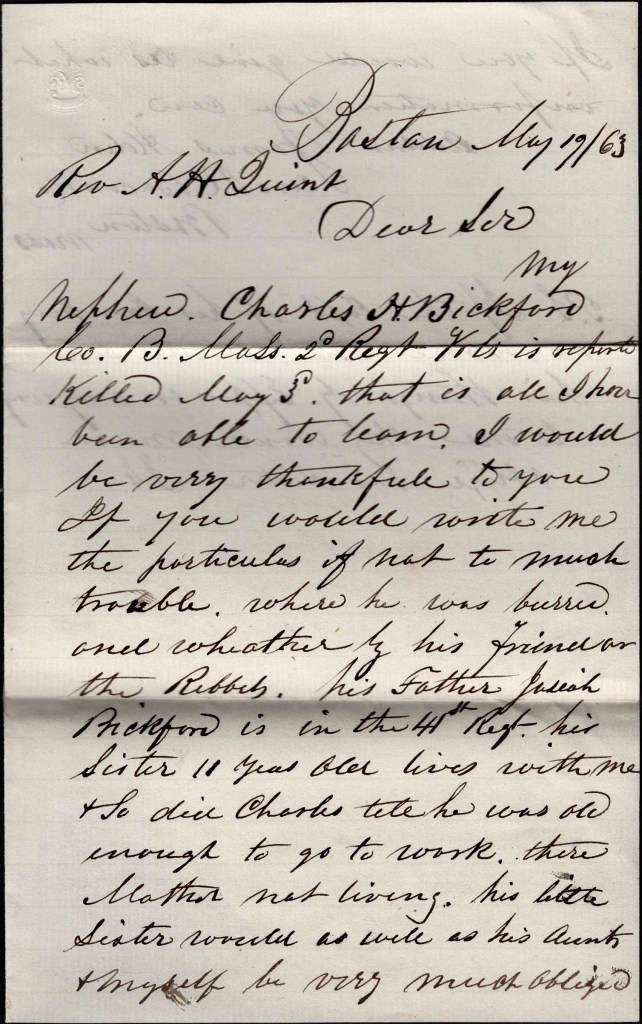
James Alden wrote the letter to the chaplain of the 2nd Massachusetts Infantry, Rev. Alonzo Hall Quint, seeking particulars on Charles’ death at Chancellorsville and where he might be buried.

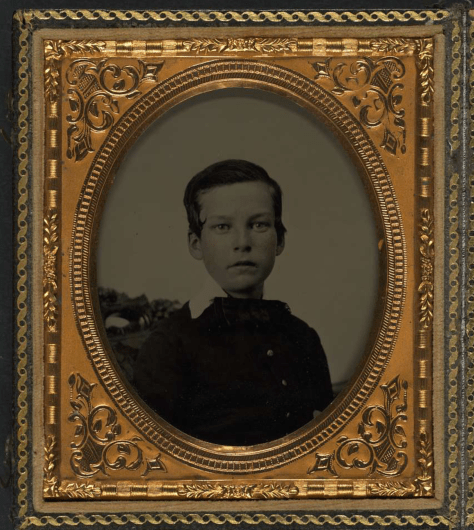
I could not find an image of Charles H. Bickford in uniform but here is one of him when he was a young man. The picture was possessed by his sister Georgianna and is now in the Library of Congress.

Transcription

Rev. A. H. Quint, Chaplain, 2nd Mass. Regt., Stafford Court House, via Washington D. C.

Boston [Massachusetts]
May 19, 1863

Rev. A. H. Quint
Dear sir,

My nephew Charles H. B. Bickford, Co. B, Massachusetts 2nd Regiment, is reported killed May 3rd. That is all I have been able to learn. I would be very thankful to you if you would write me the particulars if not too much trouble, where he was buried and whether by his friends or the Rebels. His father, Josiah Bickford is in the 41st Regiment. His sister, 11 years old, lives with me & so did Charles till he was old enough to go to work. Their mother not living, his little sister would as well as his aunts and myself be very much obliged if you would give us what information you can.

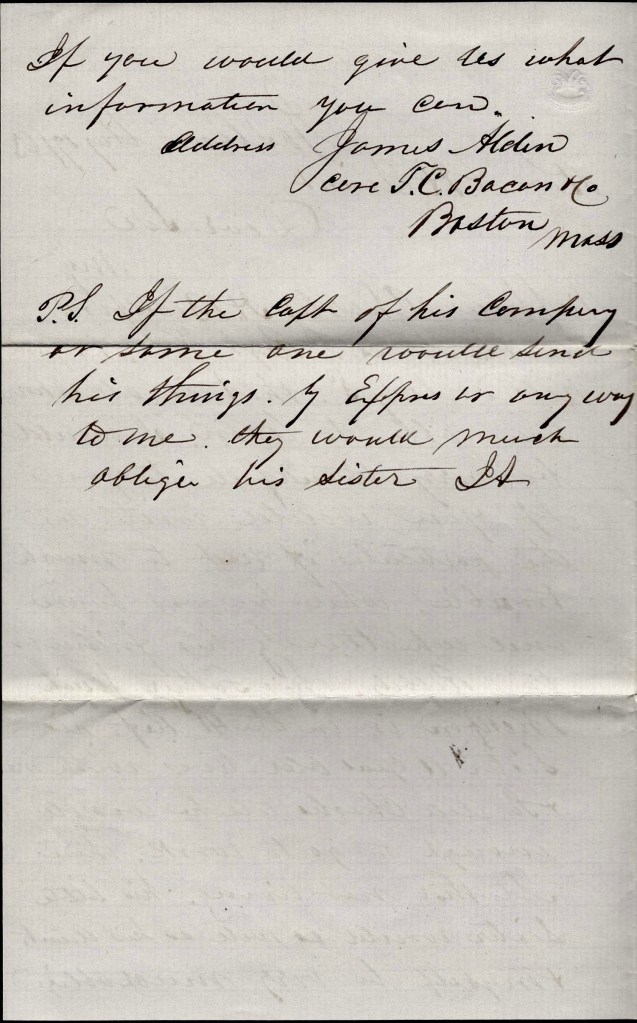
Address James Alden, care of T. C. Bacon & Co., Boston, Massachusetts

P. S. If the Captain of his company or someone would send his things by Express or any way to me, they would much oblige his sister. — J. A.

1862: John Holmes Newcomb to his Brother

John Holmes Newcomb, Co. E, 2nd Mass. Vols.

The following letter was written by John Holmes Newcomb (1838-1883), the son of Foster Newcomb (1789-1869) and Fanny Collins (1799-1878) of Enfield, Massachusetts. John wrote the letter to his brother, unidentified, but most likely Leander Witherell Newcomb (1833-1908) who was next closest to his own age.

John enlisted in Co. E, 2nd Massachusetts Volunteers on 25 May 1861 for three years. He was seriously wounded in the Battle of Cedar Mountain on 9 August 1862 and was in the hospital many months before he was discharged for disability in late March 1863. The wound was a 1 oz bullet in his right thigh that was not removed. This wound ultimately was the cause of his death. When discharged from service March 9, 1863, he held the rank of sergeant, but through an error the discharge papers read “private.”

The 2nd Massachusetts was trained at Camp Andrew in West Roxbury, Massachusetts. Roughly half the regiment was mustered in on May 18, 1861 and the remainder on May 25, 1861 for a term of three years. The regiment saw extensive combat as part of the Army of the Potomac. The regiment spent the winter of 1861-62 guarding the upper Potomac River and Frederick, Maryland. The camp depicted in the lithograph was located on the Baltimore Pike four miles east of Frederick, Maryland, where they were for three months. This image is one of a group of 23 hand-colored lithographs of Union encampments produced by Rosenthal’s Lithograph of Philadelphia between 1861 and 1865.  Armed with a pass that provided him full access to the camps of the Army of the Potomac, Max Rosenthal’s pencil sketches provided the basis for this encampment series, a subset from over 150 prints of Civil War battle and camp scenes published by the Rosenthal brothers.

To read other letters by members of the 2nd Massachusetts transcribed and published on Spared & Shared, see:

Amos Perley Burnham, Co. C, 2nd Massachusetts (2 Letters)
William Foster Morgan, Co. C, 2nd Massachusetts (5 Letters)
David J. Orne, Co. D, 2nd Massachusetts (1 Letter)
Malcom G. Kittredge, Co. G, 2nd Massachusetts (1 Letter)
William Nutt, Co. I, 2nd Massachusetts (1 Letter)
Horace F. Nason, Co. I, 2nd Massachusetts (1 Letter)
Everett Wilson Pattison, Co. I, 2nd Massachusetts (1 Letter)
William Edward Perkins, Co. I, 2nd Massachusetts (1 Letter)
William Edward Perkins, Co. I. 2nd Massachusetts (1 Letter)
George H. Willis, Co. I, 2nd Massachusetts (1 Letter)
Moses Webber, Co. K, 2nd Massachusetts (2 Letters)

Transcription

Camp of the 2nd Massachusetts Regiment
[February 1862]

Dear Brother,

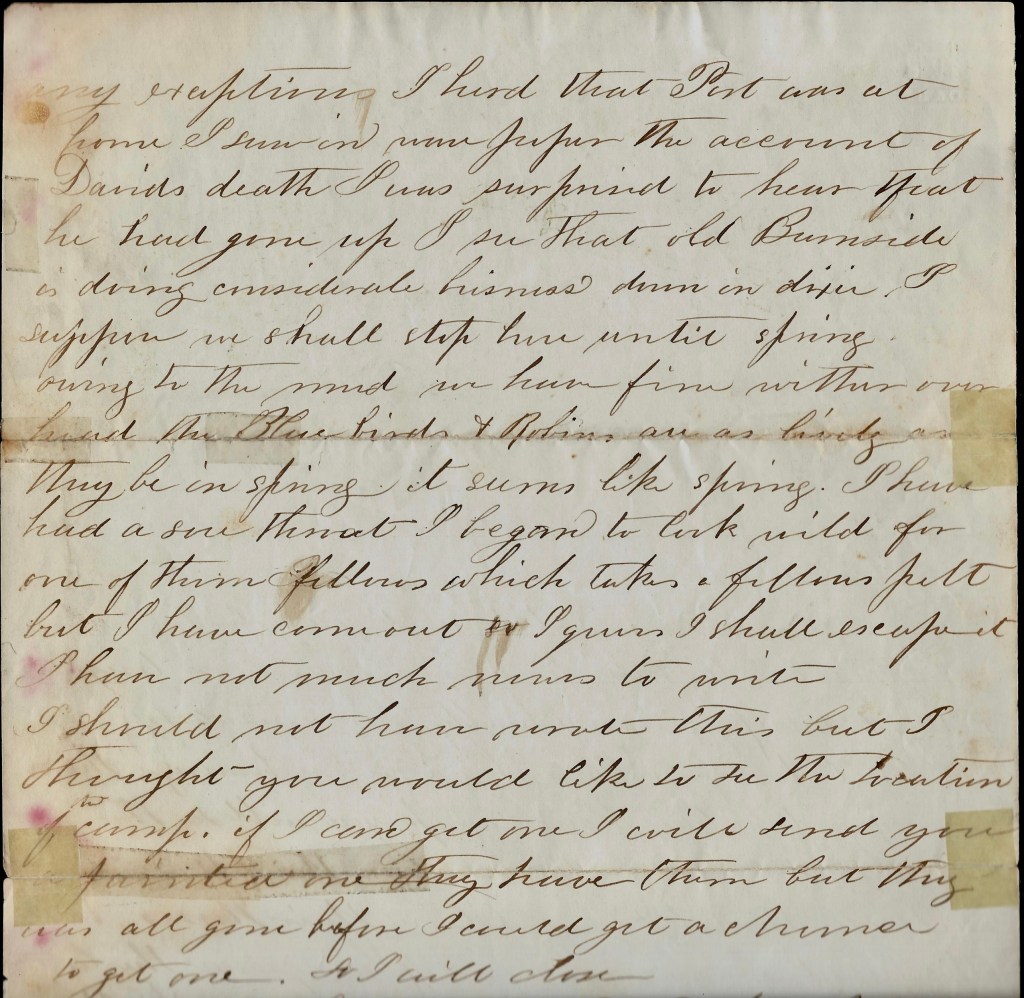
As I want to send you a picture of our camp I will write you a few lines. I am tough and rugged. The regiment is very healthy now considering the wet damp weather which we are having. This is a very good picture of our camp. You will see the band tent & also the band. On the left you will see the Colonel & Lieut. Colonel on their horses & the guard marching off to fire off their guns. The long tent on the left is the officers’ mess tent. This picture was taken from the road so you can’t see the colonel’s tent very plain but, however, it shows some. The picture will do enough to look at but come to be here in reality, it ain’t quite so funny. Mud is two feet deep without any exceptions.

I heard that Put was at home. I saw in newspaper the account of David’s death. I was surprised to hear that he had gone up.

I see that old Burnside is doing considerable business down in Dixie. I suppose we shall stop here until spring owing to the mud. We have fine weather over head. The blue birds and robins are as lively as they be in spring. It seems like spring.

I have had a sore throat. I began to look wild for one of them fellows which takes a fellow’s pelt but I have come out so I guess I shall escape it. I have not much news to write. I should not have wrote this but I thought you would like to see the location of the camp. If I can get one, I will send you a painted oner. They have them but they was all gone before I could get a chance to get one. So I will close.

From your brother, — John Newcomb

Write when you get ready.

1864: William Edward Perkins to his Sister

This poignant letter was written by a previously unidentified soldier who signed his name “Ned,” a nickname for Edward, Edwin, or Edmund. There was very little content in the letter that might lead us to his identity though he told us he had passed through “every fight from Cedar Mountain to Resaca with scarcely a scratch.” While this narrowed down the hunt somewhat by eliminating all regiments that did not claim these as their first and last battles to the date of the letter, it unfortunately still included many regiments, including the 102nd New York, the 109th Pennsylvania, the 79th New York, the 2nd Massachusetts, the 46th Pennsylvania, the 66th Ohio, the 27th Indiana, and probably several others.

Dr. William Nichols, Jr.

The best clue in the letter was the reference to Dr. Nichols whom I believed was William Nichols, Jr. (1840-1899), as asst. surgeon from Boston who was commissioned in the 2nd Massachusetts in May 1863. William was an 1862 Graduate of the Harvard Medical School.

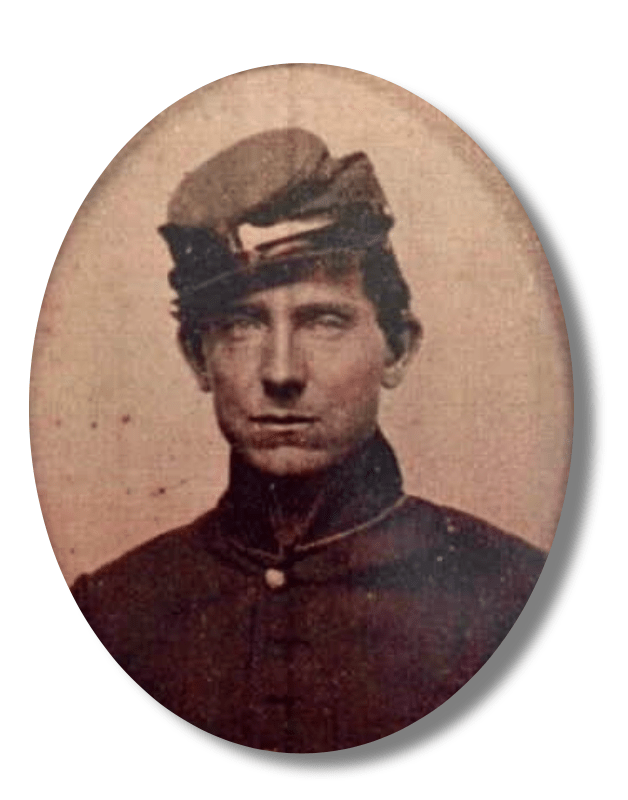
I finally checked my own archive of previously transcribed letters and found that I have a “Ned” who fits the profile of this author. I’m reasonably confident the letter was written by William Edward Perkins (1838-1879), the son of a Boston merchant. William served with the Forty-fourth and Second Massachusetts Infantry regiments. At the time this letter was written he was an officer in Co. I, 2nd Massachusetts Infantry.

See also—1863: William Edward Perkins to his Mother

Transcription

Breastworks five miles south of Marietta [Ga.]
June 23, 1864

Dear Sister,

Dr. Nichols tells me that the statement which I ran in the papers of Charlie’s death is confirmed. I have been thinking how strange it is that two whose future lives seemed so bright & promised so much usefulness should be taken while I who have had no future have been through every fight from Cedar Mountain to Resaca with scarcely a scratch.

The two Charlies seem to me like a bright dream of the past. There seemed to be so little of evil in them that I cannot think of them as I do of others who have started through life with me & been taken away by death.

Please write soon, — Ned