The following letter was written by George Workman (1844-Aft1910) who emigrated from Ireland in 1859 and enlisted on 30 January 1862 at Colebrook, New Hampshire, to serve as a recruit in Co. F, 2nd New Hampshire Infantry. According to muster rolls, George deserted from the service in March 1863. In the 1900 US Census, George was enumerated as a teamster and boarding with the Willey family in Manchester, Hillsborough, New Hampshire. He may very well have been the same George Workman enumerated as an inmate of the Alms House in Coos County, New Hampshire, in 1910.
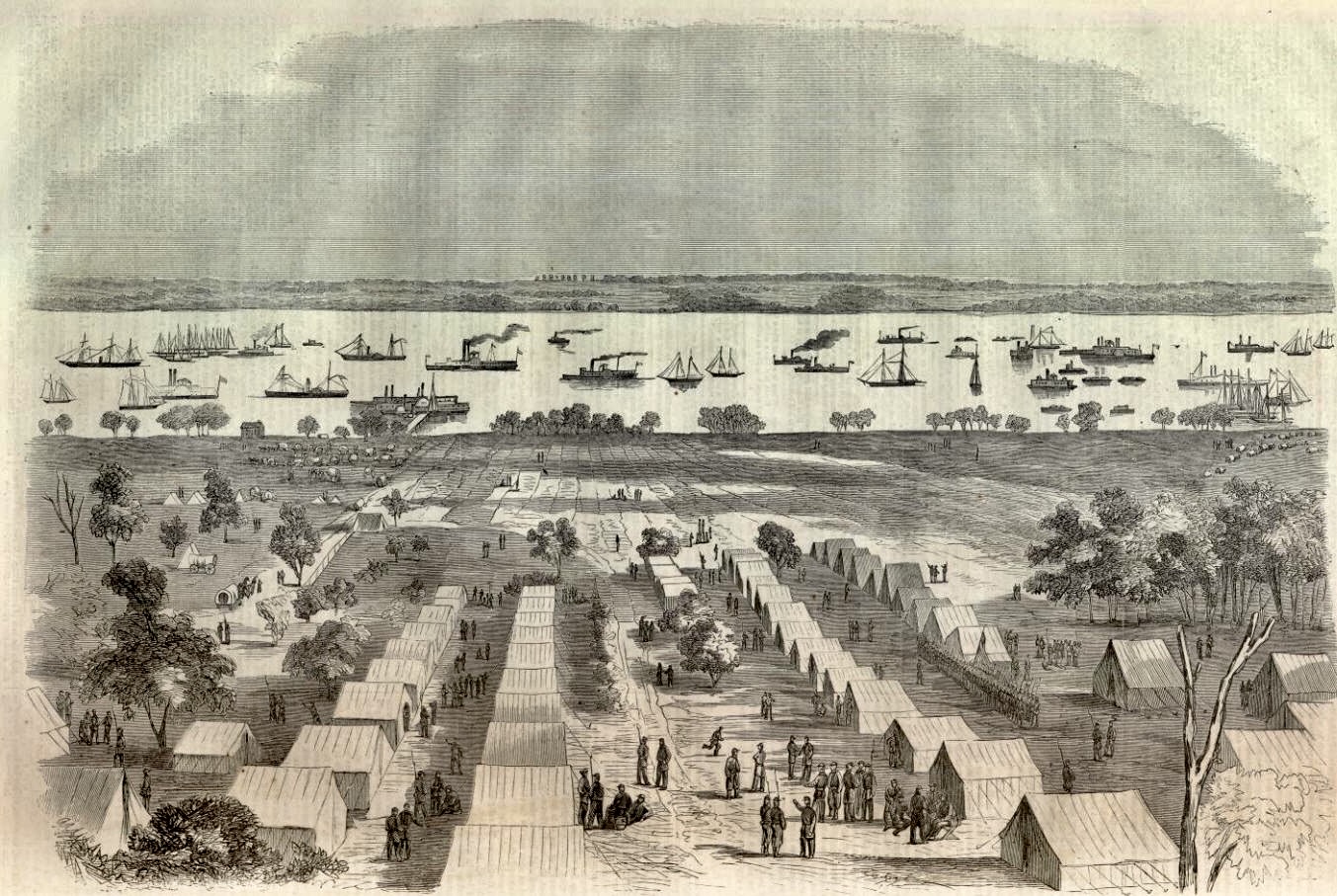
The Army of the Potomac’s encampment at Harrison’s Landing.
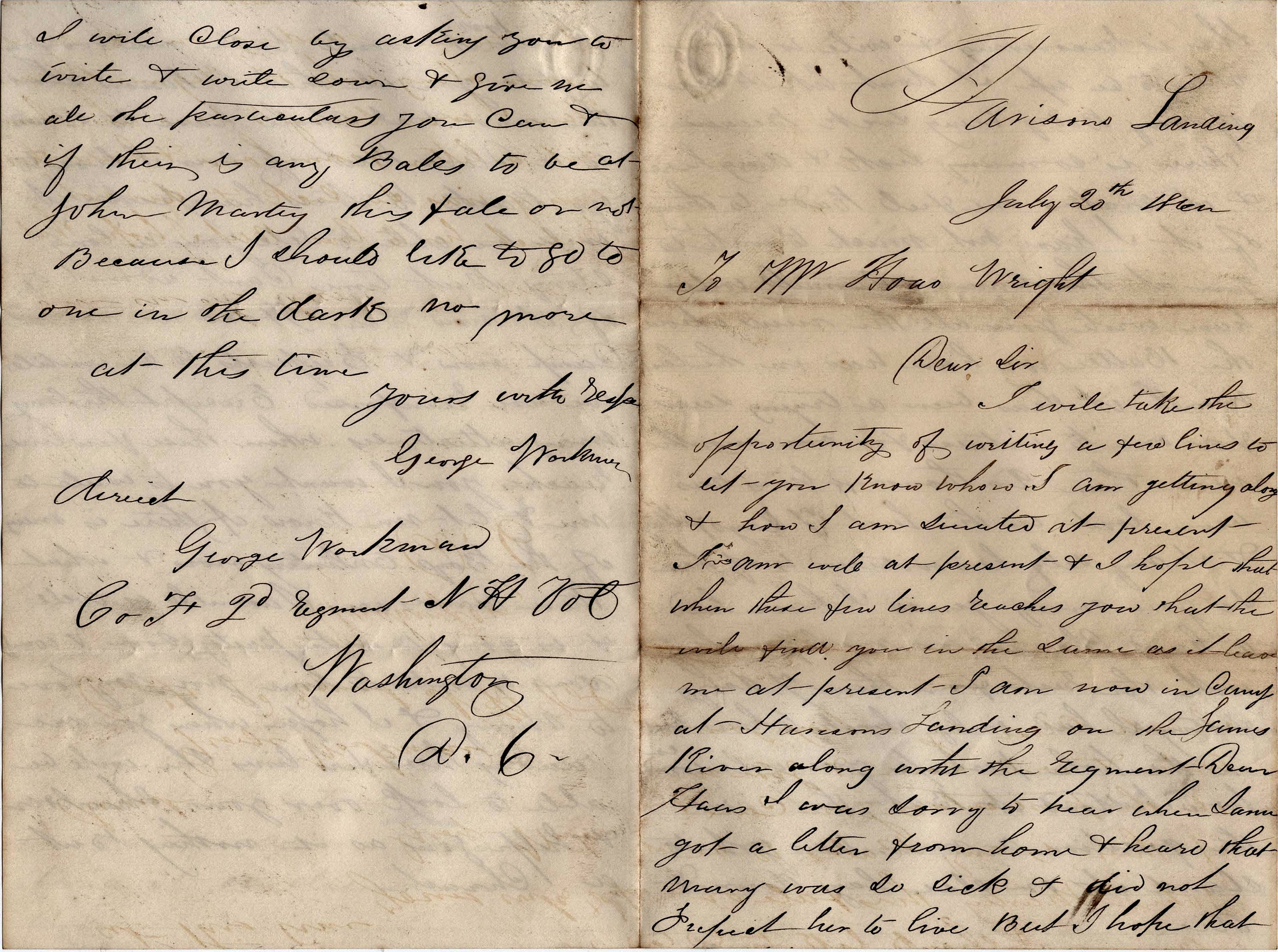
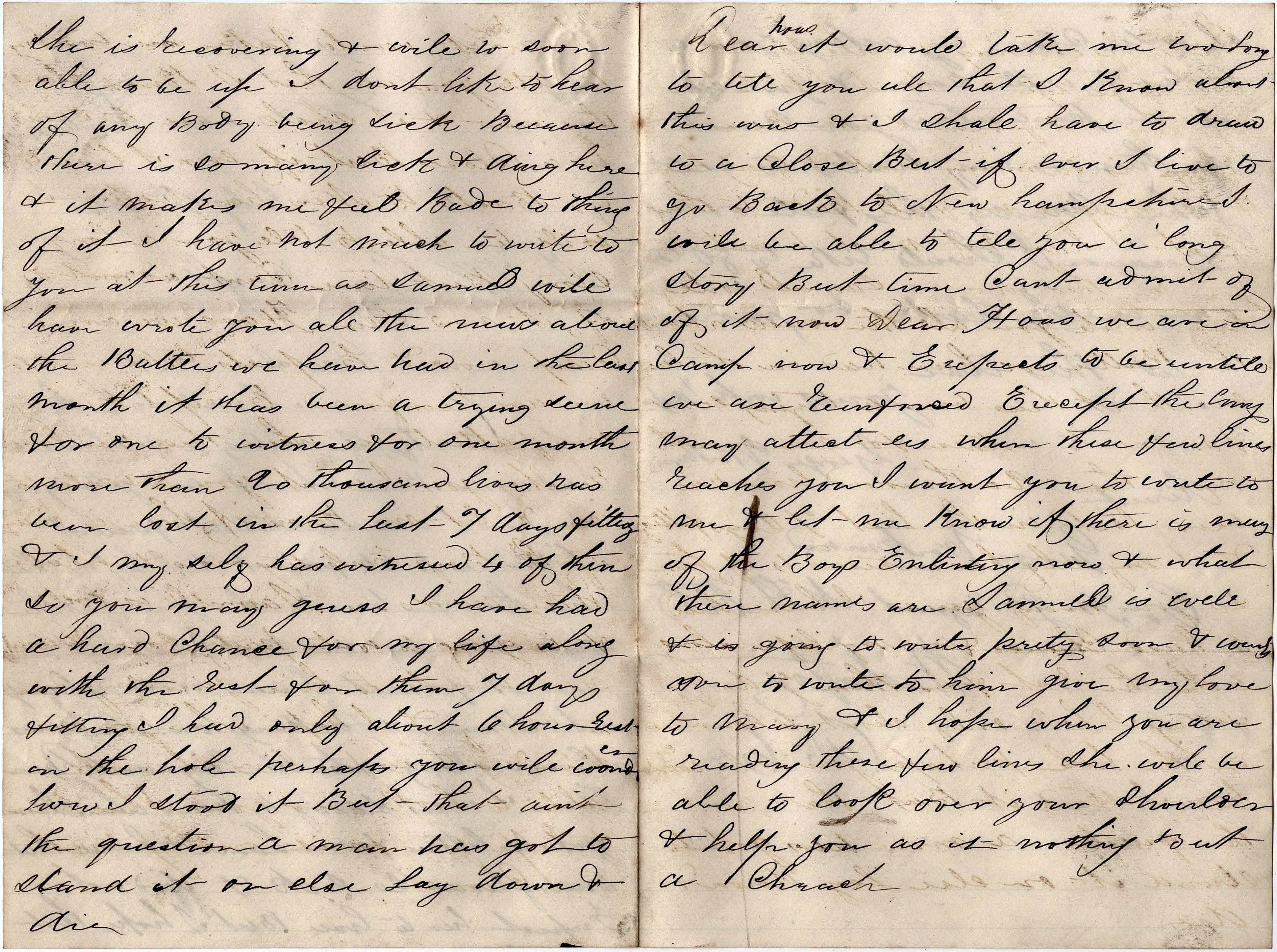
T R A N S C R I P T I O N
Harrison’s Landing July 20, 1862
To Mr. Haas Wright,
Dear sir, I will take the opportunity of writing a few lines to let you know how I am getting along and how I am situated at present. I am well at present & I hope that when these few lines reaches you that they will find you in the same as it leaves me at present. I am now in camp at Harrison’s Landing on the James River along with the regiment.
Dear Haas, I was sorry to hear when Samuel got a letter from home & heard that Mary was so sick & did not expect her to live. But I hope that she is recovering & is soon able to be up. I don’t like to hear of anybody being sick because there is so many sick and dying here and it makes me feel bad to think of it.
I have not much to write to you at this time as Samuel will have wrote you all the news about the battles we have had in the last month. It has been a trying scene for one to witness, for [in] one month more than 20 thousand lives has been lost in the last seven day fights & I myself has witnessed four of them 1 so you may guess I have had a hard chance for my life along with the rest. For them 7 days [of] fighting, I had only about 6 hours rest in the whole. Perhaps you will wonder how I stood it, but that ain’t the question. A man has got to stand it or else lay down and die.
Dear Haas, it would take me too long to tell you all that I know about this war & I shall have to draw to a close, but if ever I live to go back to New Hampshire, I will be able to tell you a long story. But time can’t admit of it now.
Dear Haas, we are in camp now & expect to be until we are reinforced, except the enemy may attack us. When these few lines reaches you, I want you to write to me and let me know if there is any of the boys enlisting now and what their names are. Samuel is well and is going to write pretty soon & wants you to write to him. Give my love to Mary and I hope when you are reading these few lines, she will be able to look over your shoulder and help you as it nothing but a crutch.
I will close by asking you to write and write soon & give me all the particulars you can. And if there is any balls to be at John Martey this fall or not because I should like to go to one in the dark. No more at this time. Yours with respect, — George Workman
Direct [to] George Workman, Co. Founder, 2nd Regiment N. H. Vol., Washington D. C.
1 The 2nd New Hampshire Infantry were engaged in four of the Seven Days Battles. These included the Battle of Oak Grove on June 25th, the Battle of Savage Station on June 29th, the Battle of Glendale on June 30th, and the Battle of Malvern Hill on 1 July 1862.
Regrettably I have been unable to attribute this letter to a particular soldier known only as “John.” We know that he was from Peterborough, Hillsboro county, New Hampshire, and that he was in the service during the Peninsular Campaign of 1862 when he assisted a friend in Co. G, 2nd New Hampshire Infantry badly wounded in the Battle of Williamsburg. He is presumed to have been in that same regiment at the time but this is uncertain.
He wrote this letter from “camp near Richmond” (not Petersburg) so my hunch is that he was in a regiment in Butler’s Army of the James (AOJ) where they had been building redoubts north of the James River for the past several weeks. In fact, the letter was dated on 15 June 1864, the very day that the Army of the Potomac (AOP) launched its first wave of attacks on Petersburg later in the day.
The author’s location suggests to me that he was not a member of the 2nd New Hampshire, if he ever was, since the remaining members of that regiment were part of the AOP and were within a week of being discharged at the end of their term of service. Those that were still with the army were then on Provost Guard duty and not in the forward entrenchments. There were 70 original members who reenlisted but they remained in the AOP.
The New Hampshire regiments serving in the AOJ in 1864 included the 3rd, 6th, 12th and 13th but none of these regiments participated in the Battle of Williamsburg. It may have been that John served in the 2nd New Hampshire early in the war, was discharged for some cause and then reenlisted in another regiment but no such person could be identified on the roster of Co. G.
I have attempted to track down the author’s regiment by tracing the history of the 16th Massachusetts that he mentioned had recently been added to their brigade. Further, he says they had been posted at Fortress Monroe and seen no prior action. This is odd because that regiment had a long history of service and been in many battles. The only possible explanation for this is they were new recruits to that regiment but even if this were the case, the 16th Massachusetts was in the AOP, not the AOJ. It may be that John had the name of the regiment wrong as the only Joe Clark I could find serving in that regiment was killed at the 2nd Battle of Bull Run.
I have made efforts to ascertain the identity of the author by examining his familial connections, particularly his mother and sister, to whom he addressed the letter, but these attempts have proven unfruitful. The correspondence suggests that Mrs. James B. Tubbs was his mother, married to a jeweler residing in Peterborough. Her full name was Justina M. Tubbs (notably, her maiden name coincided with her husband’s) and their marriage took place in 1847 when she was 20 years old. It is possible that she had a prior marriage or gave birth to 2 children outside of wedlock; however, the genealogical records remain silent regarding this delicate matter.
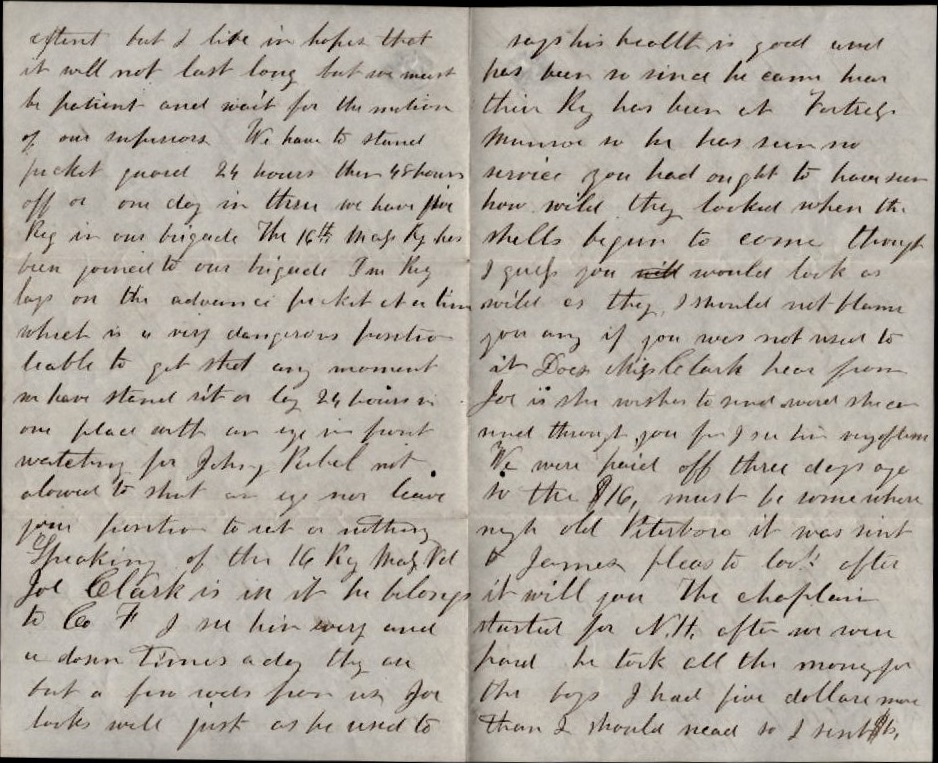
T R A N S C R I P T I O N
Camp near Richmond June 15th 1864
Dear Mother,
It is the sacred Sabbath—a day for rest but no rest is there for us. We know no Sabbath here. This pleasant morning the rebels are firing shells at our camp. A number have passed over and some have struck in the midst of us but no one is hurt as yet in our regiment. One shell exploded and took one man’s arm off and wounded three men. Some of our boys are out at work in the redoubt today getting ready for the final strike, this being a very important position so we have to very vigilant on guard or on fatigue duty. We are getting the bitter of a soldier’s life to its fullest extent but I live in hopes that it will not last long. But we must be patient and wait for the motion of our superiors.
We have to stand picket guard 24 hours, then 48 hours off, or one day in three. We have five regiments in our Brigade [now]. The 16th Mass. Regt. has been joined to our brigade. Our regiment lays on the advance picket at a time which is a very dangerous position liable to get shot any moment. We have [to] stand, sit, or lay 24 hours in one place with an eye in front watching for Johnny Rebel, not allowed to shut an eye nor leave your position to rest or nothing.
Speaking of the 16th Regt. Mass. Volunteers, Joe Clark is in it. He belongs to Co. F. I see him every and a dozen times a day. They are but a few rods from us. Joe looks well—just as he used to. Says his health is good and has been so since he came here. Their regiment has been at Fortress Monroe so he has seen no service. You had ought to have seen how wild they looked when the shells begun to come through. I guess you would look as wild as they. I should not blame you any if you was not used to it. Does Miss Clark hear from Joe? If she wishes to send word, she can send through you for I see him very often.
We were paid off three days ago so the $16 must be somewhere nigh Old Peterboro. It was sent to James. Please to look after it, will you? The chaplain started for New Hampshire after we were paid. He took all the money for the boys. I had five dollars more than I should need so I sent $5 by him directed to Mrs. J[ames] B. Tubbs. It will be left at the bank subject to your order, the same as the money was I sent by [ ]. I thought I would send it to you for I did not know where Mr. Tubbs would be. Please to let me know when the money gets home.
Oh! how I wish I could be with it and stop in and surprise you a little. Perhaps you have seen Dan Gould if he has got home. Please go and see him for me, won’t you? Dan was one of my best friends. Ask him if he remembers what he said to me when I was cutting his knapsack off of him. He looked up to me and said, “Well John, my fighting is done for the present, isn’t it?” 1
You must write to me as often as you can. A letter is very acceptable in this region and a letter from mother or sister is worth two others. Yours truly. Sister, remember brother, — John.
1 Daniel Walton Gould (1838-1916) of Peterborough, New Hampshire. Dan was the son of Gilman and Mersilvia (Walton) Gould. He was educated in the public schools of his native town and spent three years in the law office of R. B. Hatch there. At the outbreak of the civil war he enlisted at Peterborough in Co. G of the 2nd New Hampshire Infantry, and was mustered into service at Portsmouth on June 16, 1861. He was first under fire at Bull Run. In the battle of Williamsburg, in May, 1862, he was wounded twice, once in the leg, where he carried the bullet all his life, and in the left arm, which it was necessary to amputate. After the war he returned to Peterborough, where he served as town clerk and in 1872-73 was a member of the New Hampshire legislature. In 1874 he was appointed to a clerkship in the United States Treasury Department at Washington. He moved to Chelsea in 1876, when he was appointed inspector of customs at the Boston custom house. He served as an alderman in Chelsea for several terms.
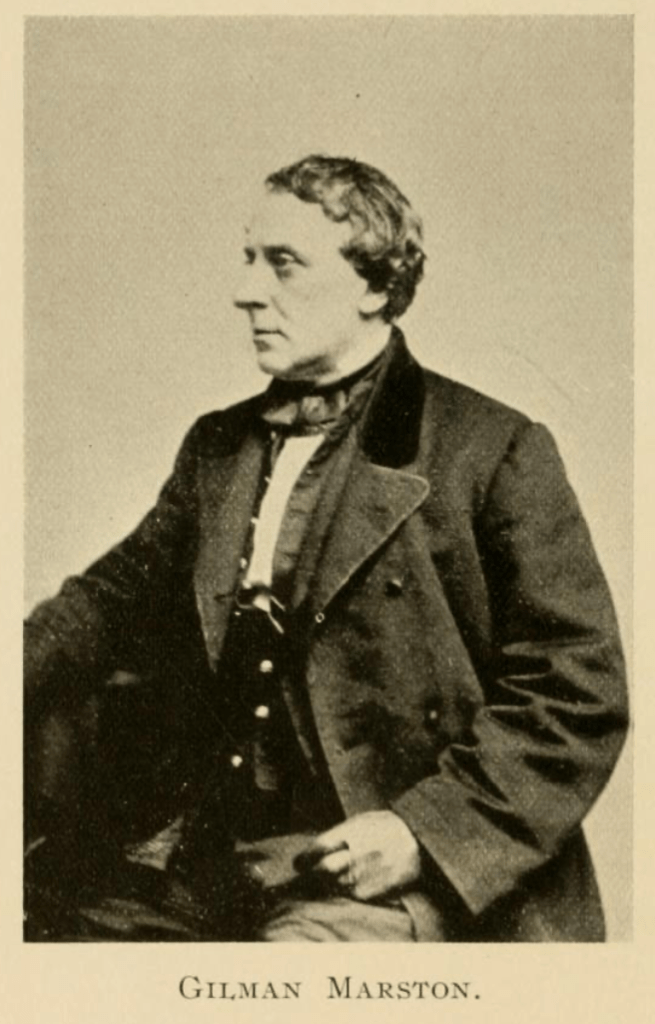
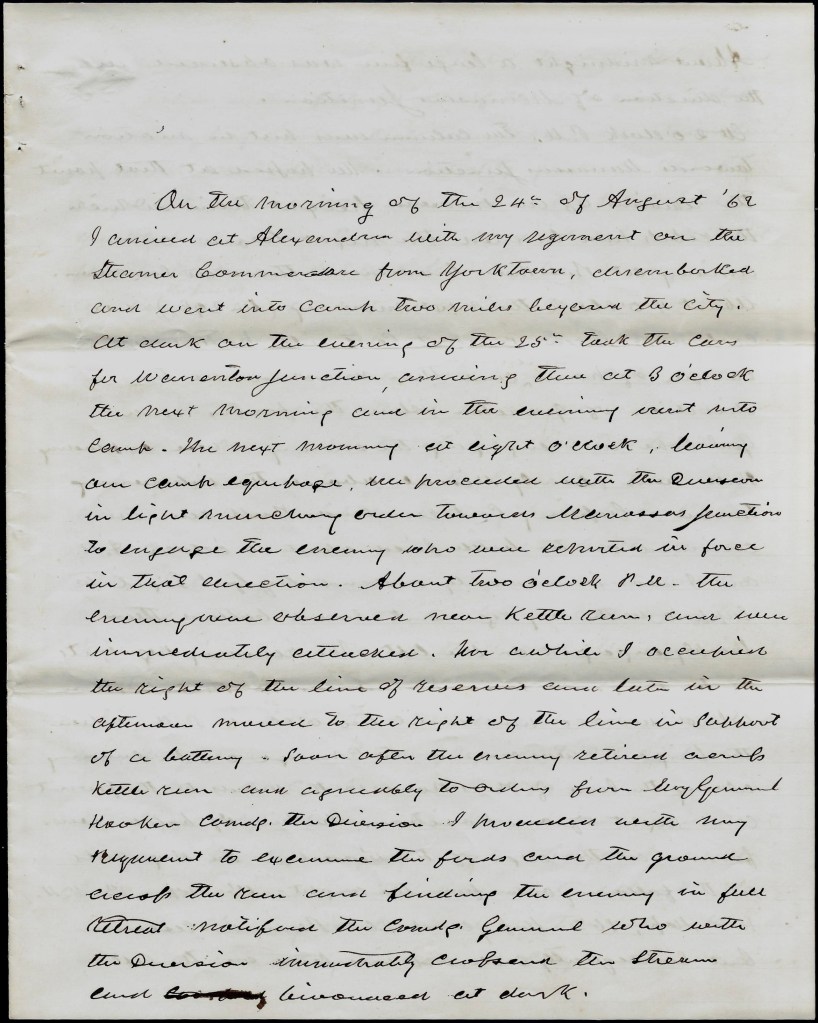
Though unsigned, the following appears to be Col. Gilman Marston’s after action report chronicling the movements of the 2nd New Hampshire Regiment in the days leading up to and including the Battle of Second Manassas. The report also includes an appendix listing all of the known casualties of the regiment broken down by company and notes individual acts of courage.
For a good synopsis of the role played by the 2nd New Hampshire in the 2nd Battle of Manassas, readers are referred to the excellent article by William E. Welsh entitled “Grover’s Savage Attack at the Battle of Second Manassas” published on the Warfare History Network.
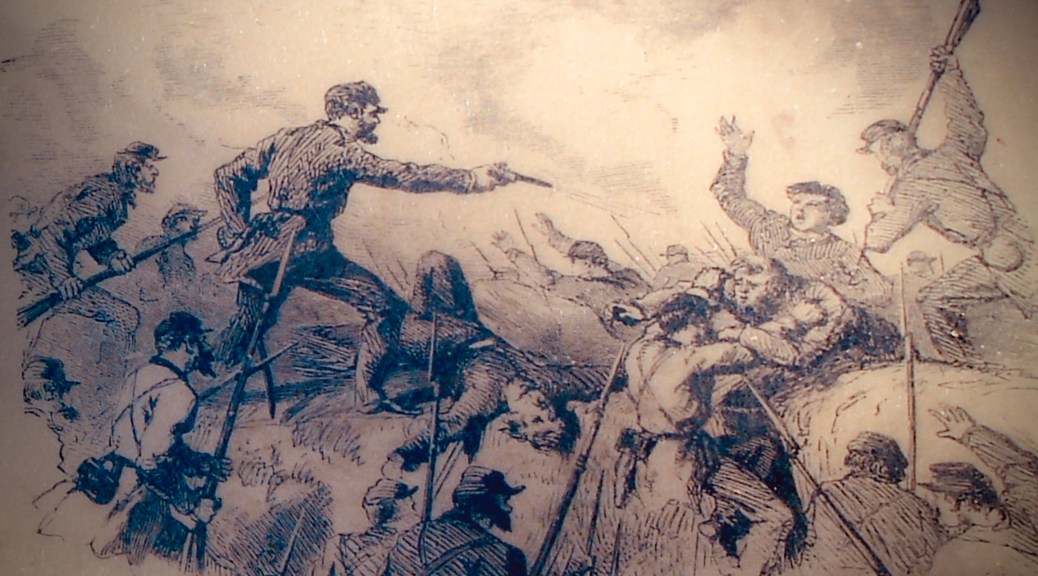
The image in the banner of this post is displayed on the Historical Marker placed at the location of Grover’s Bayonet Charge on 29 August 1862 which states: “Grover’s troops waited for the Rebels to fire, then charged up the ten-foot embankment. With no time to reload, Confederates were caught hugging the rear slope. The charging Federals stabbed with bayonets, crushed skulls with musket butts, and broke through the next line of defenders. Their success was almost suicidal; no one reinforced Grover’s advance. As Georgians and South Carolinians rushed to close the gap, the isolated Federals had to fall back over the ground they had won, back through a lethal crossfire. In twenty minutes General Grover’s Brigade lost 487 men—a third of his command.”
Transcription
On the morning of the 24th of August, ’62, I arrived at Alexandria with my regiment on the Steamer Commodore from Yorktown, disembarked, and went into camp two miles beyond the city. At dark on the evening of the 25th, took the cars for Warrenton Junction, arriving there at 3 o’clock the next morning and in the evening went into camp. The next morning at eight o’clock, leaving our camp equipage, we proceeded with the Division in light marching order towards Manassas Junction to engage the enemy who were reported in force in that direction.
About two o’clock P.M. the enemy were observed near Kettle Run, and were immediately attacked. For a while I occupied the right of the line of reserves and late in the afternoon moved to the right of the line in support of a battery. Soon after the enemy retired across Kettle Run, and agreeably to orders from Maj. General Hooker, Commanding the Division, I proceeded with my Regiment to examine the fords and the ground across the run and, finding the enemy in full retreat, notified the Commanding General who with the Division immediately crossed the stream and bivouacked at dark.
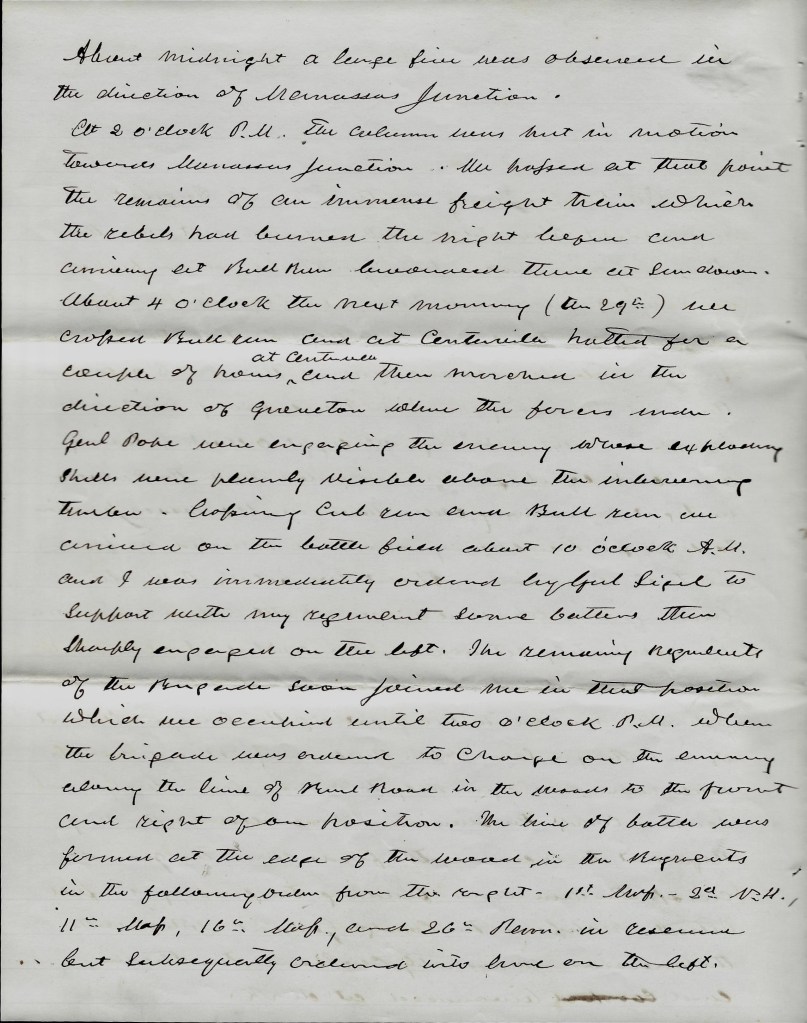
About midnight a large fire was observed in the direction of Manassas Junction.
At 2 o’clock p.m. the column was put in motion towards Manassas Junction. We passed at that point the remains of an immense freight train which the rebels had burned the night before and arriving at Bull Run, bivouacked there at sundown. About 4 o’clock the next morning (the 29th), we crossed Bull Run and at Centerville halted for a couple of hours at Centreville, and then marched in the direction of Groveton where the forces under Gen. Pope were engaging the enemy whose exploding shells were plainly visible above the intervening timber. Crossing Cub Run and Bull Run, we arrived on the battlefield about 10 o’clock a.m. and I was immediately ordered by Gen. Sigel to support with my regiment some batteries then sharply engaged on the left. The remaining regiments of the Brigade soon joined me in that position which we occupied until two o’clock p.m. when the brigade was ordered to charge on the enemy along the line of railroad in the woods to the front and right of our position. The line of battle was formed at the edge of the wood, the regiments in the following order from the right—1st Mass, 2nd N.H., 11th Mass, 16th Mass, and 26 Penn in reserve, but subsequently ordered into line on the left.
The Brigade advanced in this order through the wood and when within fifty yards of the railroad where the enemy lay concealed we received their fire. The order was immediately given to charge bayonets which was done and the rebel line quickly broke and those that remained alive scattered [&] fled to the rear. A second line of the enemy soon reached the field which, at not more than 70 yards distant, killed and wounded a large number, but the men were soon rallied and drove the enemy until the fire of a third line was received which compelled the brigade to retire. At this time the enemy opened fire with canister from a battery on our left. Falling back to the open ground, we reformed our line of battle, and, after holding our position for about one hour, retired under cover of our batteries occupying the high ground in rear of the wood through which we had charged.
The loss in killed wounded and missing was very severe. In my regiment 311 enlisted men and 21 commissioned officers went into the fight of whom 122 did not return. In this engagement the bayonet was freely used and with excellent effect pursuing without attempting to use the bayonet in defense.
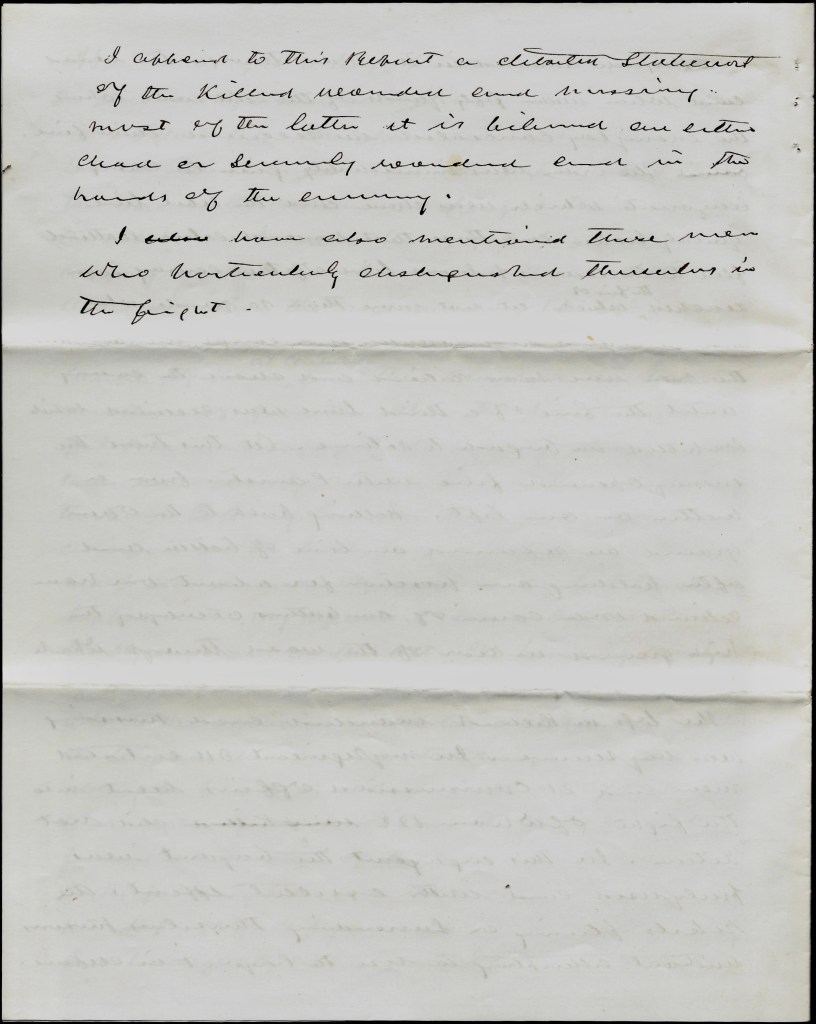
I append to this report a detailed statement of the killed, wounded and missing. Most of the latter it is believed are either dead or severely wounded and in the hands of the enemy. I have also mentioned those men who distinguished themselves in the fight.
Wm A. Haywood—killed Gardner W. Turner—killed or is supposed wounded & left on the field Wm. Dunton—wounded in face, severely Elwin Young—wounded, shot through the body Albert G. Stone—wounded, thigh fractured Wm H. Preckle—wounded in leg Allen B. Heyward—wounded in thigh Geo. Stevens—wounded in shoulder Geo Ruffin—wounded in hand
Lieut. Converse fired 8 rounds. A.R. Walker took a prisoner. Geo. Ruffle took two prisoners & got wounded bringing them out. Prisoners got away. John H. Bronill brought out a prisoner. O. S. Adams and Gardner Turner each killed a man with the bayonet. Many of the 1st & 2nd line threw away their guns and ran.
Capt. Joshua F. Littlefield—wounded right thigh & arm. Died Sept. DeWitt C. Sanborn—killed Johnson N. Danforth—wounded; since died Geo. W. Ladd—wounded; since died James E. Edgerley—missing; supposed dead John C. Rand—missing; supposed dead Lieut. W. W. Ballard—wounded in head Lieut. John D. Cooper—wounded, shot through the body Sergt. Geo F Carter—wounded, thigh fractured Corp. Isaac W. Walton—wounded, in ankle severely Pvt. Hiram Cutter—wounded, in foot; brought out a prisoner Pvt. John Danforth—wounded in leg Pvt John H. Nichols—wounded in thigh Pvt. Charles H. Worth—wounded in arm, severely; bayonetted the rebel Pvt. Joseph E. Chapman—wounded through head Pvt. Asa Folsom—wounded in arm Pvt. John Hanson—wounded in neck
Wm Carlton brought out two prisoners; on Wednesday previous Algeron Chan had sun stroke and died.
1st Sergt F. O. Robinson—killed Pvt. Charles L. Tabor—wounded both legs Pvt. John B. Stevens—wounded hand severely Pvt. Wm. Sidney—wounded, shot through body Pvt. Charles McGauflin—wounded, shot through body Pvt. Geo W. McKennon—wounded, foot Pvt. Cornelius Hastings—wounded, leg Pvt. Charles R. Farnham—wounded, leg Pvt. Wm. Fitzgerald—wounded, head Pvt. John Fift—wounded, head Pvt. George Clement—wounded, arm Pvt. J. W. Bignold—wounded, leg Pvt. John Cushing—wounded, abdomen
Enemy fired canister down R.R. from left. All of this company went over the R R but those who got hit before reaching it. Hagen Davis, Jr. took & brought off a prisoner. J. W. Bignold killed a rebel with his bayonet. John Chase being attacked by two rebels, shot one & knocked the other down with his musket. Capt. Carr fired 5 rounds
Pvt. John Osborn—killed Pvt. Charles C. Saunders—killed without doubt, fell & left on the field Pvt. Mark D. Merrill—wounded, since died Pvt. Charles P. Roberts—wounded, wrist Lieut. Geo. W. Roberts—wounded, wrist Pvt. Eben LeGrow—wounded, neck and leg Pvt. Ezra C. Goodwin—wounded, hand Pvt. Geo H. Scranton—wounded, arm Pvt. Orwell J. Davis—wounded, side Pvt. Thos. J. Mahoney—wounded, wrist and thigh
This company took two prisoners—one of 35th Ga (he was in front line on R.R.); the other of 45th Va. in 2nd line. He complained that the 1st line boke & run through & broke the 2nd line. The Va. prisoners admitted there were 3 brigades of Ewell’s Div. Supported by Hill’s Div.
Co. E.—1 officer, 12 muskets
Sergt. Hirsen F. Durgin—killed Pvt. John B. Mussey—missing, supposed killed Pvt. Daniel G. Smith—wounded, on sick list on field, supposed dead Pvt. Henry M. Gordon—wounded, leg Pvt. William C. Bean—wounded, throat Pvt. Paul C. Morgan—wounded, elbow Pvt. George W. Phelps—wounded, hand Corp. Alcott Stover—wounded, in leg severely
Daniel F. Smith was running for a rebel when he was shot. John F. Dudley killed a rebel with his bayonet.
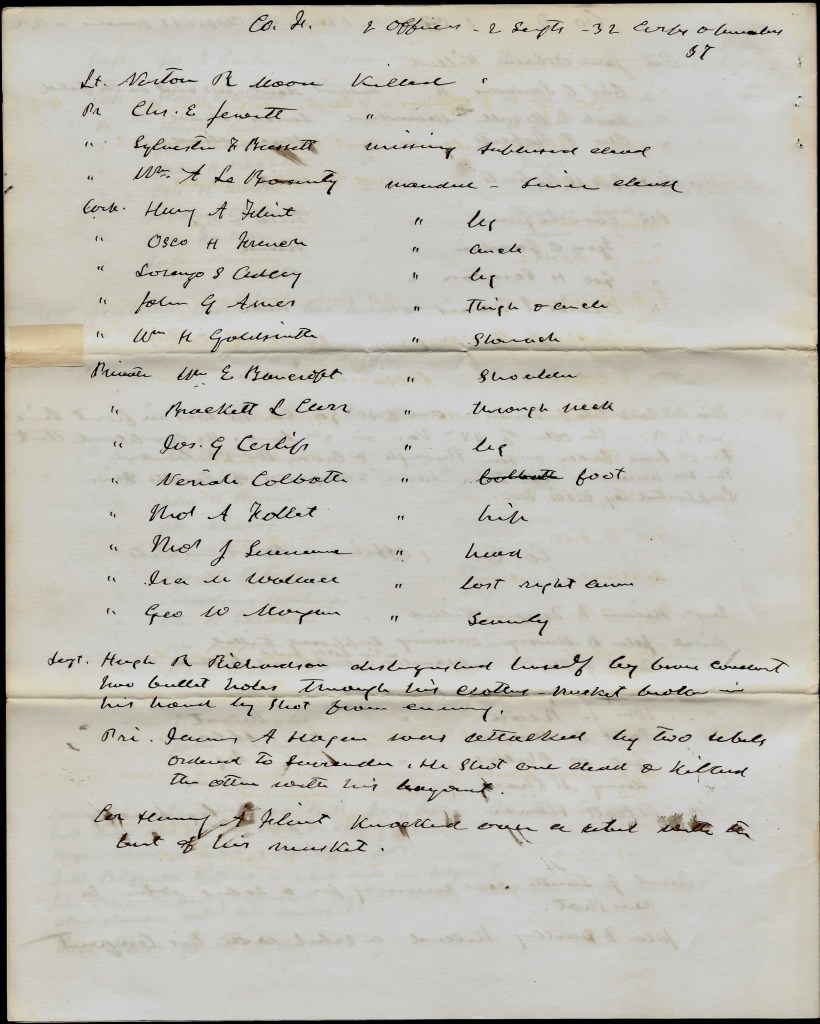
Lt. Norton R. Moore—killed Pvt. Charles E. Jewett—killed Pvt. Sylvester F. Bassett—missing, supposed dead Pvt. Wm. A. LeBosinty—wounded Corp. Henry A. Flint—wounded, leg Corp. Osco H. French—wounded, ankle Corp. Lorenzo S. Adley—wounded, leg Corp. John G. Ames—wounded, thigh and ankle Corp. Wm. H. Goldsmith—wounded, shoulder Pvt. Wm. E. Bancroft—wounded, shoulder Pvt. Brackett L. Carr—wounded, shoulder Pvt. Jos. G. Cerliss—wounded, leg Pvt. Veriate Colboten—wounded, foot Pvt. A. Follet—wounded, hip Pvt. J Semmes—wounded, head Pvt. Ira M. Wallace—wounded, lost right arm Pvt. Geo W. Morgan—wounded severely
Sergt. Hugh R. Richardson distinguished himself by brave conduct two bullet holes through his clothes, musket broke in his hand by shot from enemy. Pvt. James A Hagen was attacked by two rebels, ordered to surrender. He shot one dead & killed the other with his bayonet. Corp. Henry A. Flint knocked over a rebel with the butt of his musket.
Lieut. Sylvester Rogers—killed, shot through stomach Pvt. Charles P. Phillips—killed. shot through head Pvt. Harvey H. Winn—killed, shot through head Pvt. Charles O. Collister—killed, shot through head Pvt. A.S. Hutchinson—killed, shot twice, head and body, also in leg Pvt. Marcus J. Hall—wounded, since dead Pvt. Wm D. Coffin—supposed shot and killed Lieut. David Steel—wounded, right arm Corp. E. G. Sturkey—wounded, thigh fractured Pvt. Timothy N. Hutchinson—wounded, right arm Pvt. George D. Felt—wounded, in groin Pvt. Michael A. Dillon—wounded, through lungs Pvt. Thomas O’Brien—wounded, right arm Pvt. Charles Holt—wounded, face severely
Alex McRobie brought out a prisoner. John Hagen was attacked by two, shot one bayoneted the other. Asum attacked by one whom he bayoneted. Corp. Dascomb was the last to leave the woods. John B. Roule bayoneted one man & brought out a prisoner.
Pvt. John S. Rolf—missing, supposed killed Pvt. John B. Buntin—missing, supposed killed Lieut. John F. Holman—wounded, thigh fractured Lieut. H. D. F. Young—wounded, arm slightly Sergt. Andrew G. Bracy—wounded Corp. John B. Reed—wounded, knee Pvt. Lyman F. Parish, wounded, thigh Pvt. Charles H. Smith—wounded, neck Corp. John L. Davis—wounded, leg Pvt. Sam’l Poor—wounded, head Pvt. George Beny—wounded, ankle Pvt. Henry Bowman—wounded, head
Sergt. Silver had his gun shattered in his hand. Corp. Hanson had two guns shattered in his hands. Corp. Reed had his gun stock shattered. P. Sexton same. Pr. James H. Andrews shot a rebel who opposed him.
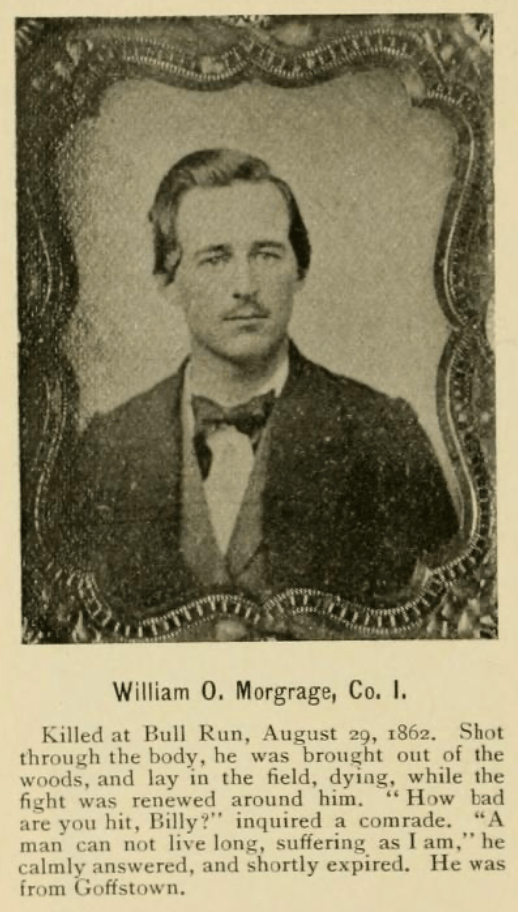
Pvt. Wm. O. Mortgage—killed Pvt. Wm. F. Wright—wounded, since dead Corp. Charles H. Smiley—missing, supposed dead Lieut. Geo. W. Gordon—wounded, in head Corp. James M. House—wounded, thigh Pvt. Eugene G. Haswell—wounded, neck Pvt. Lyman A. Dickey—wounded, hand severely Pvt. Allain R. Simmons—wounded, leg fractured Pvt. Rand—wounded, thigh fractured Pvt. Jos. H. Gleason—wounded, ear Pvt. Martin A. Haynes—wounded, face
Cor. John E. Ogden killed one with bayonet. All went over R.R. most of them twice. Enemy first seen by this co. at R.R. 1st line broken by our fire, 2nd by bayonet. Jas. Lanoy brought out two prisoners & Charles F. Pariot one. Corp. James M. House took two prisoners—one was shot at the same time with the corporal. Levi H. Sleeper Jr. was attacked by three rebels. He bayoneted one, knocked another down with his musket & was then forced to retire.
Pvt. Henry Walker—killed Pvt. Henry Wilson—killed Pvt. Jere Mahony—supposed killed Pvt. John Moore—wounded, in groin Pvt. James T. Gamman—wounded, both thighs fractured Pvt. Wm. H. Goodson—wounded, foot Pvt. Warren L Stebbins—wounded, in hand Pvt. Alex Steward—wounded, in head Pvt. Geo Johnston—wounded, in leg Pvt. Charles Robinson—wounded, in face
The whole company went over the Railroad. Mahoney and Al ab Manson were seen by Lt. Sides to use the bayonet. Lt. Sides thinks there were two lines of the enemy beyond the R.R. besides the skirmishers on the western side who were pretty thick. The 1st line broke and the fire of the 2nd line somewhat broke us. Our men were engaged with the 2nd line. Whitney Dunbar shot down the color bearer. Co. K took 4 or 5 prisoners. Thinks 25 prisoners were taken between the right & the colors. The enemy’s colors were 20 ft. in front of R.R.—a large splendid flag—and line of rebels on the R.R. & 3rd line on opposite side. The 1st line was a strong line of skirmishers. It was the 2nd line we broke with the bayonet.
DOCKET Casualties of 2nd Reg N.H. Vol. at Bull Run 29th & 30th Aug. 1862
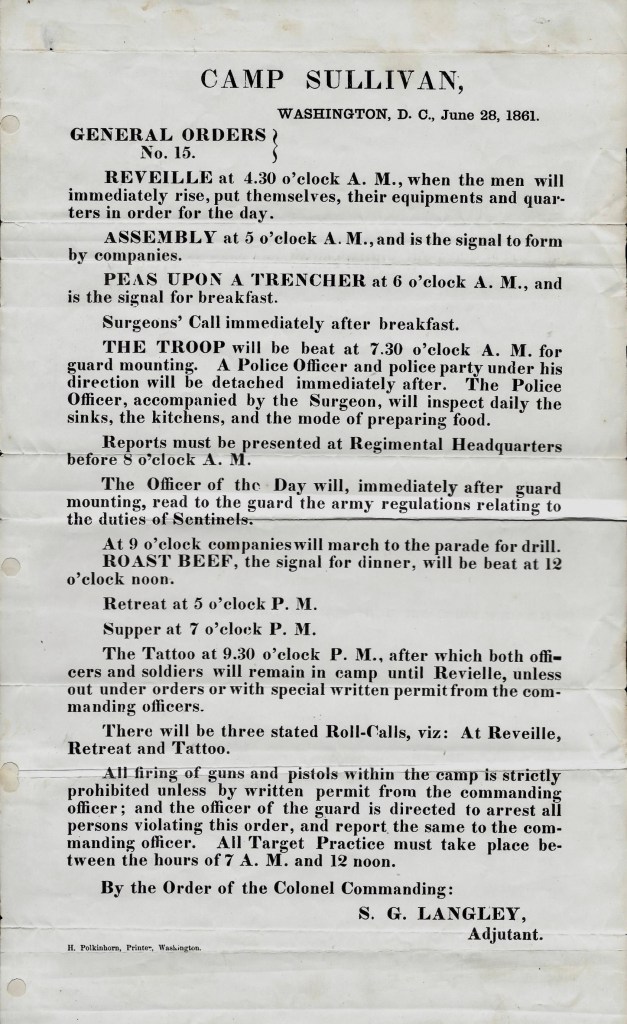
One can image the following General Orders being read to the troops of the 2nd New Hampshire Infantry following dress parade and subsequently posted near regimental headquarters. It prescribed the camp regulations and order of the day for Camp Sullivan by its commander, Colonel Gilman Marston. At the time these General Orders were issued, the regiment had not long been in its camp which was located in the vicinity of Glenwood Cemetery, west of North Capitol Street in the District of Columbia. They were bivouacked there from 23 June to 16 July 1861 before participating in the Battle of 1st Bull Run.
Over the years I have transcribed the following letters by members of the 2nd New Hampshire Infantry: Abiel Walker Colby, Co. B, 2nd New Hampshire (1 Letter) James Webster Carr, Co. C, 2nd New Hampshire (6 Letters) Isaiah Foy Haines, Co. E, 2nd New Hampshire (1 Letter) Francis D. Bacon, Co. F, 2nd New Hampshire (1 Letter) Charles Edwin Jewett, Co. F, 2nd New Hampshire (22 Letters) [Jewett’s Letter 3 has a good description of Camp Sullivan] Hugh R. Richardson, Co. F, 2nd New Hampshire (1 Letter) Simeon Clark Buck, Co. G. 2nd New Hampshire (1 Letter) Alexander Lyle, Co. G, 2nd New Hampshire (10 Letters)
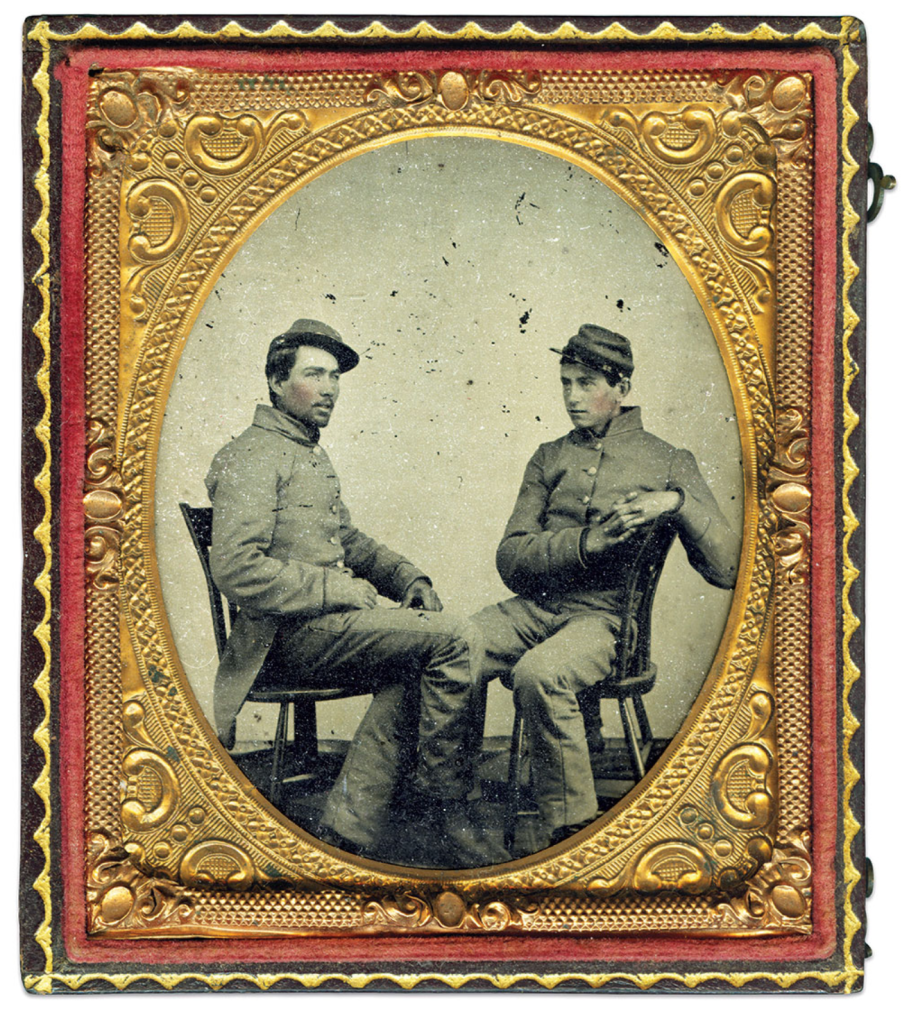
These unidentified privates wear the gray dress uniform provided for both the 1st or 2nd New Hampshire infantries by the state quartermaster in May 1861. The man at left is clearly seated to show his “spike-tail” coat to best advantage. Their chasseur-pattern caps had red bands, and high standing collars and closed cuffs were trimmed with narrow red cord. Trousers were plain gray. Sixth-plate ruby ambrotype by an anonymous photographer. [Ron Field Collection, Military Images]
CAMP SULLIVAN,
WASHINGTON, D. C., June 28, 1861.
GENERAL ORDERS
No. 15
REVEILLE at 4.30 o’clock A. M., when the men will immediately rise, put themselves, their equipments and quarters in order for the day.
ASSEMBLY at 5 o’clock A. M., and is the signal to form by companies.
PEAS UPON A TRENCHER at 6 o’clock A. M., and is the signal for breakfast.
Surgeons’ Call immediately after breakfast.
THE TROOP will be beat at 7.30 o’clock A. M. for guard mounting. A Police Officer and police party under his direction will be detached immediately after. The Police Officer, accompanied by the Surgeon, will inspect daily the sinks, the kitchens, and the mode of preparing food.
Reports must be presented at Regimental Headquarters before 8 o’clock A. M.
The Officer of the Day will, immediately after guard mounting, read to the guard the army regulations relating to the duties of Sentinels.
At 9 o’clock, companies will march to the parade for drill. ROAST BEEF—the signal for dinner—will be beat at 12 o’clock noon.
Retreat at 5 o’clock P. M.
Supper at 7 o’clock P. M.
The Tattoo at 9.30 o’clock P. M., after which both officers and soldiers will remain in camp until Reveille, unless out under orders or with special written permit from the commanding officers.
There will be three stated Roll-Calls, viz: At Reveille, Retreat and Tattoo.
All firing of guns and pistols within the camp is strictly prohibited unless by written permit from the commanding officer; and the officer of the guard is directed to arrest all persons violating this order, and report the same to the commanding officer. All Target Practice must take place be tween the hours of 7 A. M. and 12 noon.
By the Order of the Colonel Commanding: 1
S[amuel] G. LANGLEY, Adjutant.
H. Polkinhorn, Printer, Washington.
Gilman Marston
1 “The 2nd New Hampshire was originally organized as a three-month regiment. The Abbot Guards of Manchester, one of the first companies to be raised in New Hampshire, had gone to Concord as part of the 1st New Hampshire. On May 1, 1861, the company marched forty-five miles to Portsmouth to join the 2nd New Hampshire under the command of Colonel Thomas Prescott Pierce. Pierce, then serving as the U.S. Postmaster of Manchester, New Hampshire, had served with the 9th U.S. Infantry during the Mexican War and had seen action at Contreras and Churubusco. By May 10, 979 men, all enlisted for three months, had arrived at camp and were being “drilled, disciplined and made acquainted with the duties pertaining to a soldier’s life.” When the U.S. War Department ordered the governor not to send any more three-month men, the regiment was re- organized, between May 31 and June 8, as a three-year unit. With this change in the unit’s status, Colonel Pierce resigned on June 4, 1861. The unit’s new colonel, Gilman Marston, was a graduate of Dartmouth and Harvard. He had served as a member of the New Hampshire House of Representatives (1845-1849) and as a delegate to the state constitutional convention in 1850. He had been elected as a Republican to the Thirty-sixth U.S. Congress (and would be re-elected to the Thirty-seventh Congress and serve until March 3, 1863). Marston and the 1,046 officers and men of the 2nd New Hampshire were mustered into federal service on June 10 at Portsmouth.” Col. Marston was in command of the 2nd New Hampshire Infantry at the Battle of 1st Bull Run where his arm was shattered but he refused amputation and survived.[“We drop a comrade’s tear” by Karlton D. Smith]
Posted Regulations for Camp Sullivan, 2nd New Hampshire Infantry, 28 June 1861










 Spared & Shared 23