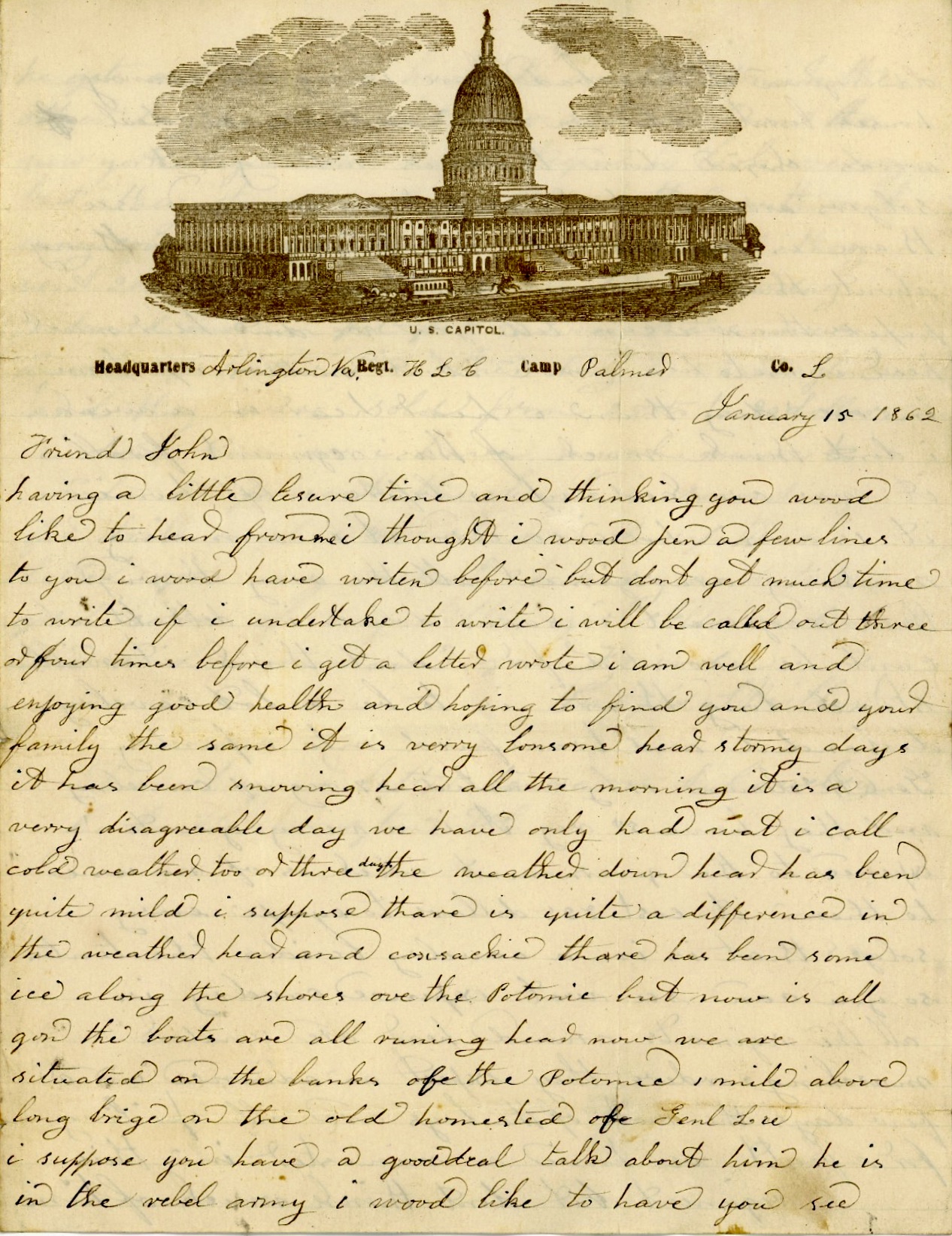
This letter was written by Winfield S. Miller, a 23 year-old blacksmith from Hudson, Columbia county, New York, who was the son of Samuel and Elizabeth Miller. He enlisted September 17, 1861, at Hudson; mustered in as corporal, Company L, 2nd New York Cavalry (a.k.a. Harris Light Cavalry) on September 25, 1861 to serve three years; transferred to Company A, August 29, 1864; and mustered out, to date November 6, 1864, with detachment, at New York City.
I believe he wrote the letter to John Miller (1832-1906) of Coxsackie, Greene county, New York whose 1860 household included Ella Miller (b. 1859).
T R A N S C R I P T I O N
Arlington, Va. Harris Light Cavalry Camp Palmer, Co. L January 15, 1862
Friend John,
Having a little leisure time and thinking you would like to hear from me, I thought I would pen a few lines to you. I would have written before but don’t get much time to write. If I undertake to write, I will be called out three or four times before I get a letter wrote. I am well and enjoying good health and hoping to find you and your family the same. It is very lonesome here stormy days. It has been snowing here all the morning. It is a very disagreeable day. We have had what I call cold weather two or three days. The weather down here has been quite mild. I suppose there is quite a difference in the weather here and Coxsackie. There has been some ice along the shores of the Potomac but now is all gone. The boats are all running here now.
We are situated on the banks of the Potomac 1 mile above Long Bridge on the old homestead of Gen. Lee. I suppose you hear a good deal talk about him. He is in the rebel army. I would like to have you see Old Virginia. It looks very bad. There is a great many houses burnt and torn down and a great deal of woods chopped down. There is nothing but soldiers around here as far as we can see. There is no use of me saying anything about the war. You can read more in the papers than I can tell you. We don’t hear much here. I use to hear more about matters up home in one day than I hear here in a week.
I don’t think much of this regiment for all it was cracked up so before I left home. It is a one horse concern. It is a money making arrangement all the way through. This regiment is 80,000 dollars in debt that can’t be accounted for. I don’t think it will stand long. There is to be a lot of cavalry disbanded and transferred into infantry. Gen. McClellan only wanted 27 regiments of cavalry and they have 52 regiments which is of no use to them. It cost 225 dollars to equip every soldier that is in the cavalry besides the tents so you can see what expense cavalry is.
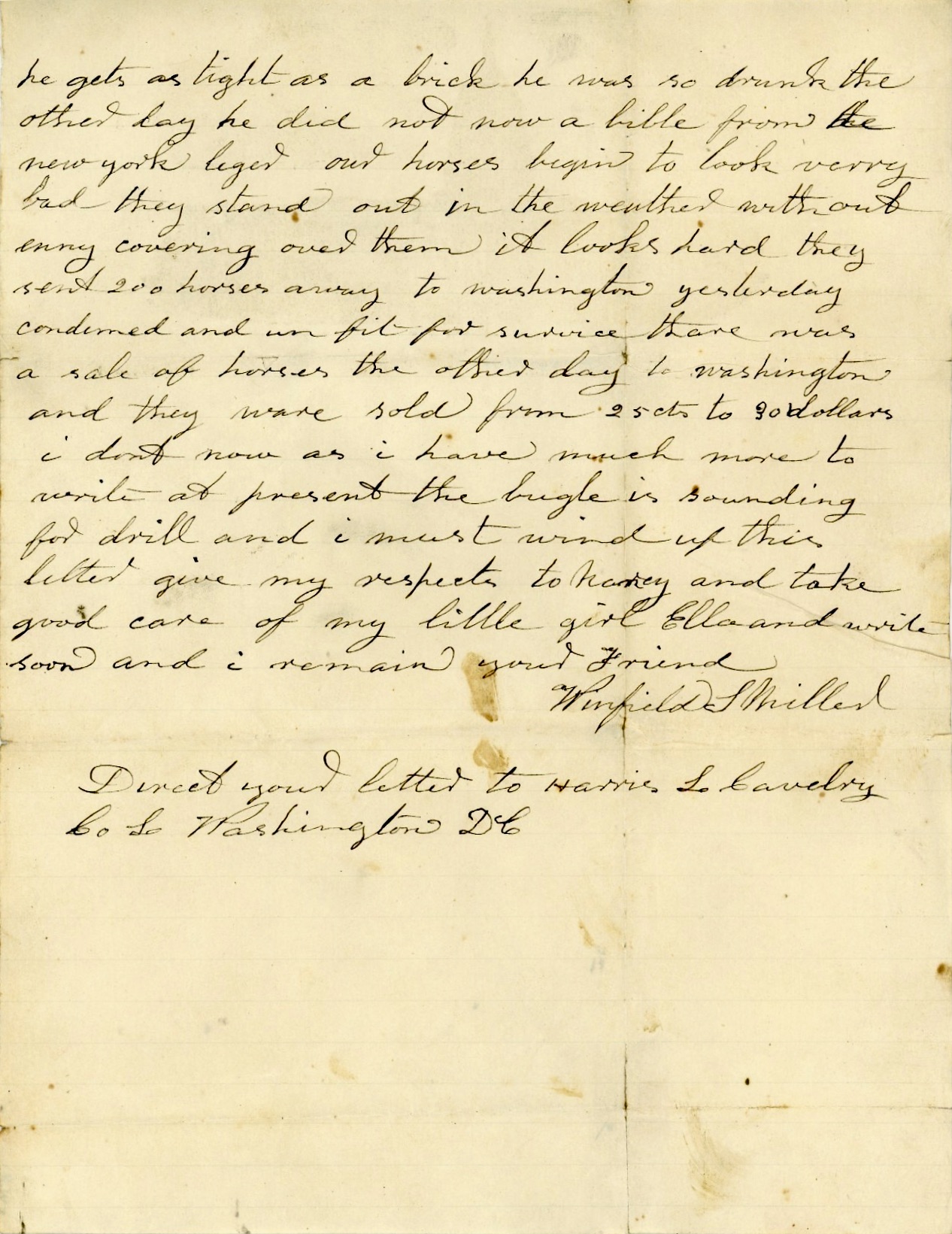
All the regiments around here are under marching orders. They expect an advance in a few days. The most of the boys are all spoiling for a fight. We have a minister [Joshua B. Davis] in this regiment but don’t think much of him. He gets as tight as a brick. He was so drunk the other day he did not know a Bible from the New York Ledger.
Our horses begin to look very bad. They stand out in the weather without any covering over them. It looks hard. They sent 200 horses away to Washington yesterday condemned and unfit for service. There was a sale of horses the other day to Washington and they were sold from 25 cents to 30 dollars. I don’t know as I have much more to write at present. The bugle is sounding for drill and I must wind up this letter. Give my respects to Nancy and take good care of my little girl Ella and write soon and I remain your friend, — Winfield S. Miller
Direct your letter to Harris Light Cavalry, Co. L, Washington D. C.
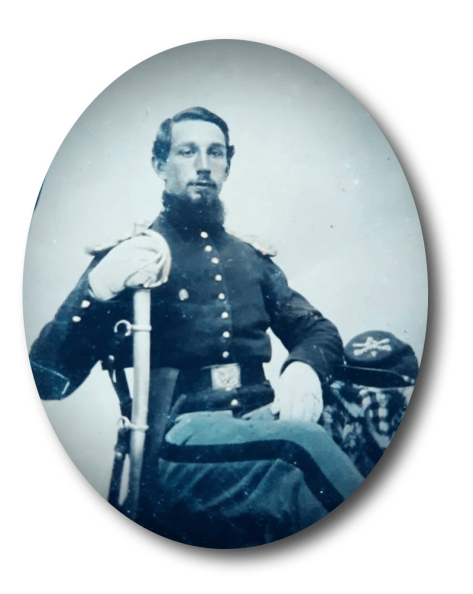
I could not find an image of Wallace but here is one of William A. Wood of Co. A, 2nd New York Cavalry (Jim Jezorski Collection)
The following letter was written by 24 year-old Wallace A. Bishop (1837-1862) of Co. D, 2nd New York Cavalry. He died of disease, November 28, 1862, near Warrrenton, Va. An obituary notice for him claims that “the deceased was a young man of fine talents and much promise; and in the summer of 1861 was a student in the law office of S. W. Kellogg in this place [Waterbury, CT]. Immediately after the battle of Bull Run, without waiting for a regiment to be formed in this State, he sought the first opportunity to give his services to his country, by volunteering with Captain, then Lieutenant, Marcus Coon in the squadron of Harris Light Cavalry, raised in this State under Major Mallory of Watertown. He did his duty as a patriot and a soldier in all places and won the praises of his officers by his strict performance of duty and devotion to his country’s cause. At the time Gen. Burnside marched from Warrenton to Fredericksburg in November last, Sergeant Bishop was left behind in a farm house, being too sick with fever to be removed. The rebels took possession of the place and from that time, his friends have been in utter ignorance in regard to his fate, yet hoping almost against hope that he might yet be restored to them, A short time since, his company made a foraging expedition to the place and on enquiry, found that he died suddenly after a partial recovery, and after being paroled by the rebels, at the house where he was left. The writer of this knew him well, and knew his generous and self-sacrificing traits of character; and it is no vain or unmeaning eulogy to say that one of the noblest young men from this neighborhood, who has fallen in the great struggle for a Nation’s life, was Wallace A. Bishop.”
Wallace was the son of William R. Bishop (1806-1883) and Augusta Maria Sheldon (1812-1897). Wallace had an older brother named Hobart H. Bishop (1836-1865) who also died in the war. He was a sergeant in Co. L, 1st Connecticut Cavalry. He died at his father’s house in Plymouth on New Year’s Day, 1865, after his release from Andersonville Prison where he had been confined many months which broke his health. The letter was probably written to Mary A. Bishop (1839-1906).
T R A N S C R I P T I O N
Camp Sussex Washington D. C. October 3rd 1861
My dear sister,
Your letter of the 27th ult. came last evening. It was the first letter I had received since leaving Scarsdale and the second since leaving home. To say I was rejoiced to get it would convey no adequate idea of the pleasure it gave. I have written ten times and think it rather saucy that four-fifth of my conversations should remain unanswered. Only three of the letters, two to Mother and one to you, were sent home. I am very sorry that the family letter miscarried. I have received a paper from Father for which I am greatly obliged. J. B.(I suppose it means Joel Blakeslee) has sent me a paper also. I wish you would thank him if you have an opportunity.
But I suppose you would like to hear of the camp. And to begin with I will give you the calls that you may have an idea approaching adequate of our daily duties and of the little time we have to devote to our correspondents and ourself. At 6 a.m. reveille, watering call 6.30, stable call 7, breakfast 7.30, guard mounting and sick call 8, drill no horse 9 to 12, watering 12.15 p.m. to 12.30, takes an hour, dinner 1 drill to horse 2 to 4, drill to sabre 4 to 5, retreat 5, watering 5.30, stable 6, supper 7, non-commissioned officers recitation 7.30, commissioned officers recitation 8.30, tattoo 9, taps or lights out 9.30. Add to this time taken after retreat for duty impossible to perform in it, appointed seasons and for fatigue work necessary to our comfort, and for housekeeping and for burnishing arms and for the thousand and one little things that spring up unexpectedly during every hour of duty free and you can see that a cavalry man’s place is no sinecure.
One squadron of the regiment has moved since I wrote you and there is talk of our following them shortly but we place no reliance upon it. they have gone, I believe, where they can combine instruction with experience but I apprehend that the proportions of the the former will be very large in the mixture. As no doubt you have inferred, I have my horse and with the exception of my revolver (here but not given), my arms. The former is medium sized handsome bay which on the trot, gallop, or run is a match for anything that sports legs. I call him Rocker and sit him so easily. My sabre is a light, keen blade and I think I shall become as adept in its [ ]. I can already handle it well.
I am living like a prince just now for in addition to Uncle Sam’s fodder, Charlie Lewis—one of my boys who has just received a box from home—permitted me with cake of various kinds, cheese, butter, pickles &c. ad infinitum and I occasionally go beyond the lines to get persimmons and grapes of which goodies there are quantities in the forest all around. I have just returned from one of these rambles (my nag is slightly distempered and I’m off drill) upon which I fell in with a slave who gave me a drink of whiskey—villainous stuff—and very much valuable information. After quite a talk I asked him how much his master paid for him and was so startled by the train of thought that the question evoked that I turned and told [ ] that it was for the first time such humiliation [ ] my life. He said he was born in the place [ ]… I can whip Old Rheumatism with both hands or any other man … Love to all, your affectionate brother, — Wallace A. Bishop
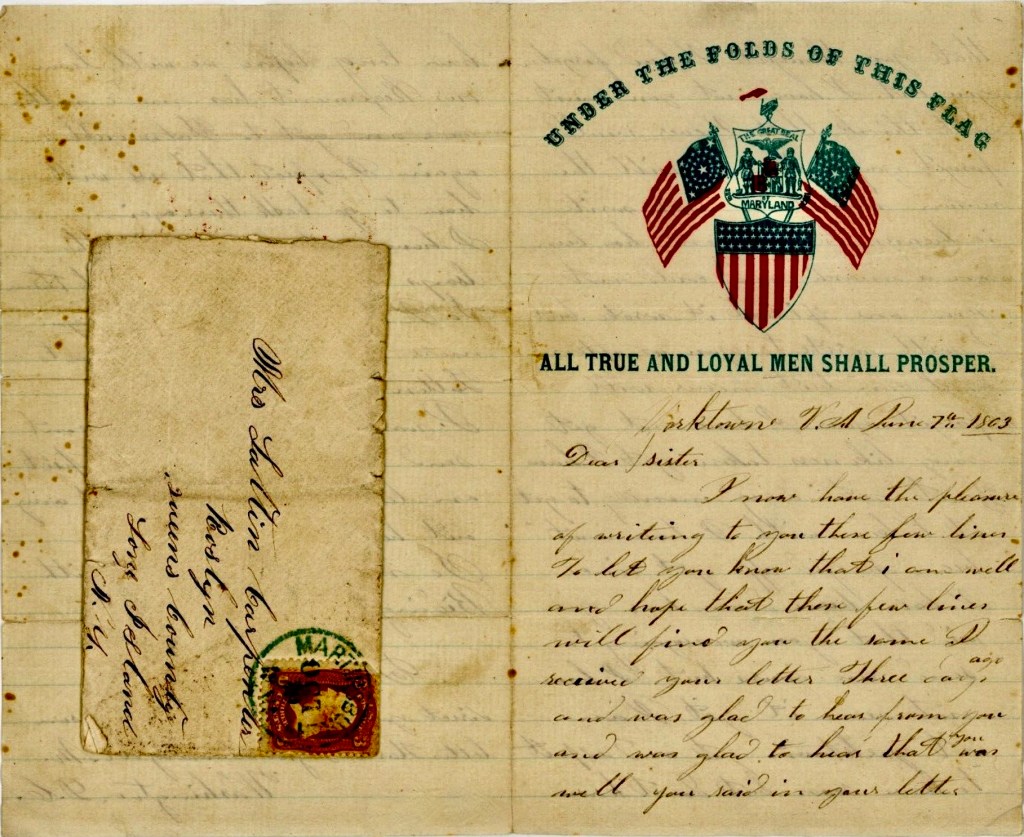
The following letter was written by George William Dickinson (1843-1933) of Co. M, 2nd New York (“Harris Light”) Cavalry. George enlisted in August 1861 at NYC to serve three years. He was subsequently transferred to Co. A (no date) and finally mustered out of the service while on detachment in June 1865 at Alexandria, Virginia.
The following information was posted on a website called Civil War Quilts: George was son of Elbert Dickinson (1814-1874) and Susan Dove (1816-1892) of Queens, New York. Several stories about George’s war experiences survive in newspaper articles but any follow up leads to dead ends. He was either wounded at Hanover Court House or Bull Run, captured at Pawmunkey River towards the end of the war when he was held ten days in Libby Prison in Richmond, Virginia. George was married in the summer of 1862 to Sarah Marie Carpenter (1843-1933), both age 19. Within a month, her husband was off to war, shortly to be shot in the lungs. The bullet worked its way out to become a souvenir but he suffered periodic hemorrhages the rest of his long life, which he attributed to the wound. Twentieth-century newspaper articles and old Civil War veterans may have been confused about places and dates, exaggerating scars and exploits. Sarah’s parents were Jackson and Sarah Craft Carpenter of Sea Cliff on Long Island’s Northern shore, families descended from mid-18th-century settlers. She and George had four children, two boys John & Daniel, and two girls Annie Conrad Abbott and Susan Dickinson Conrad. Towards the end of the 20th century, George obtained a job as caretaker at an estate owned by Charles M. Pratt, a Standard Oil heir who built a family compound and gardens in Glen Cove a few miles east of Oyster Bay.
George wrote the letter to his sister, Caroline Matilda (Dickinson) Carpenter (1845-1885), the wife of Latting Carpenter of Rosyln, Queens county, New York. The couple were married in March 1863.
Transcription
Addressed to Mrs. Lattin Carpenter, Roslyn, Queens county, Long Island, New York
Yorktown, Virginia June 7th 1863
Dear sister,
I now have the pleasure of writing to you these few lines to let you know that I am well and hope that these few lines will find you the same. I received your letter three days ago and was glad to hear that you was well. You said in your letter that you thought I had forgotten you but I have not. You must not think that I ever would forget you for I never will. The reason why I did not write is because the regiment has been on a march and I could not send one if I had it wrote, but I will write to you as often as I can. But I never will forget you.
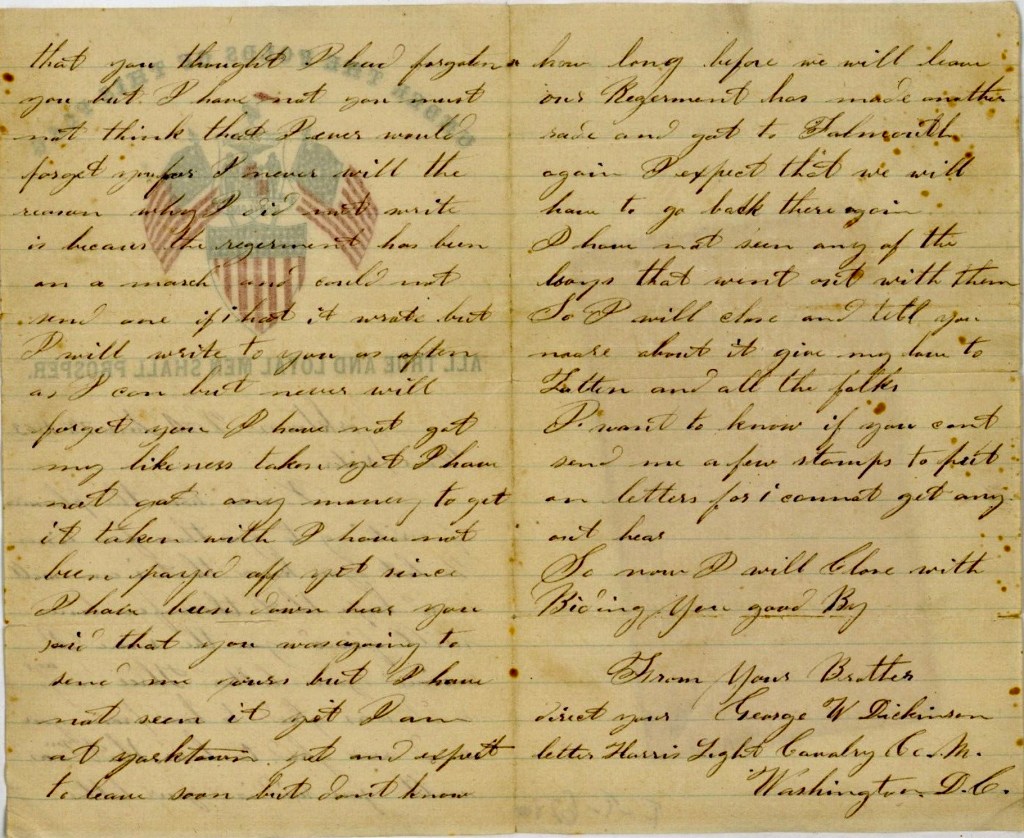
I have not got my likeness taken yet. I have not got any money to get it taken with. I have not been paid off yet since I have been down here. You said that you was a going to send me yours but I have not seen it yet.
I am at Yorktown yet and expect to leave soon but don’t know how long before we will leave. Our regiment has made another raid and got to Falmouth again and I expect that we will have to go back there again. I have not seen any of the boys that went out with them. So I will close and tell you no more about it.
Give my love to Father and all the folks. I want to know if you can’t send me a few stamps to put on letters for I cannot get any out here. So now I will close with bidding you goodbye.
From your brother. Direct your letter to George W. Dickinson, Harris Light Cavalry, Co. M, Washington D. C.
The following letters were written by Rollin E. Maranville (1836-1862) who enlisted at the age of 24 on 21 August 1861 at Fairhaven to serve as a private in Co. F, 2nd New York Cavalry, unofficially known as the “Harris Light Cavalry.” He was appointed a corporal sometime prior to his death on 13 September 1862, at the General Hospital in Alexandria, Virginia ofwounds received 29 August 1862 in the Second Battle of Bull Run. His grave marker in East Poultney, Rutland county, Vermont states that he served as “Color Sergeant” of Harris Light Cavalry and “lost leg at Bull Run.” He was the son of Merit Lily DeMaranville and Mary Ann Reed.
After leaving New York during September and October, the regiment served with McDowell’s Division of the Army of the Potomac from the latter month, on duty in the defenses of Washington, D.C. It was transferred to the Third Division of the First Corps of the Army of the Potomac in March 1862, and in May briefly became part of King’s Division of the Department of the Rappahannock. The 2nd New York Volunteer Cavalry formed part of the Cavalry Brigade of the Second Division of the Third Corps of the Army of Virginia (temporarily redesignated from the First Corps) from June.
Letter 1
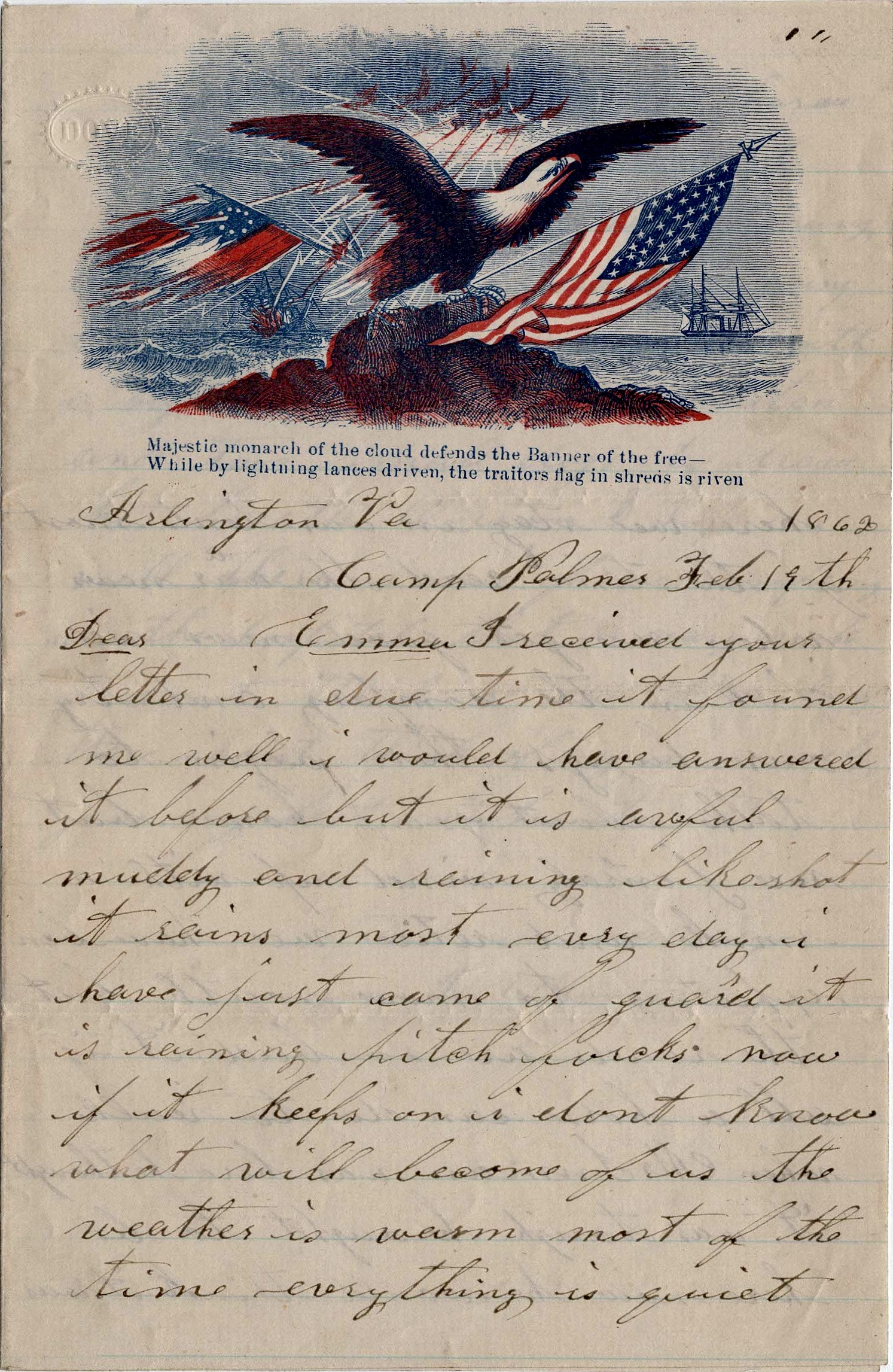
Camp Palmer Arlington, Virginia February 19, 1862
Dear Emma,
I received your letter in due time. It found me well. I would have answered it before but it is awful muddy and raining like shot. It rains most every day.
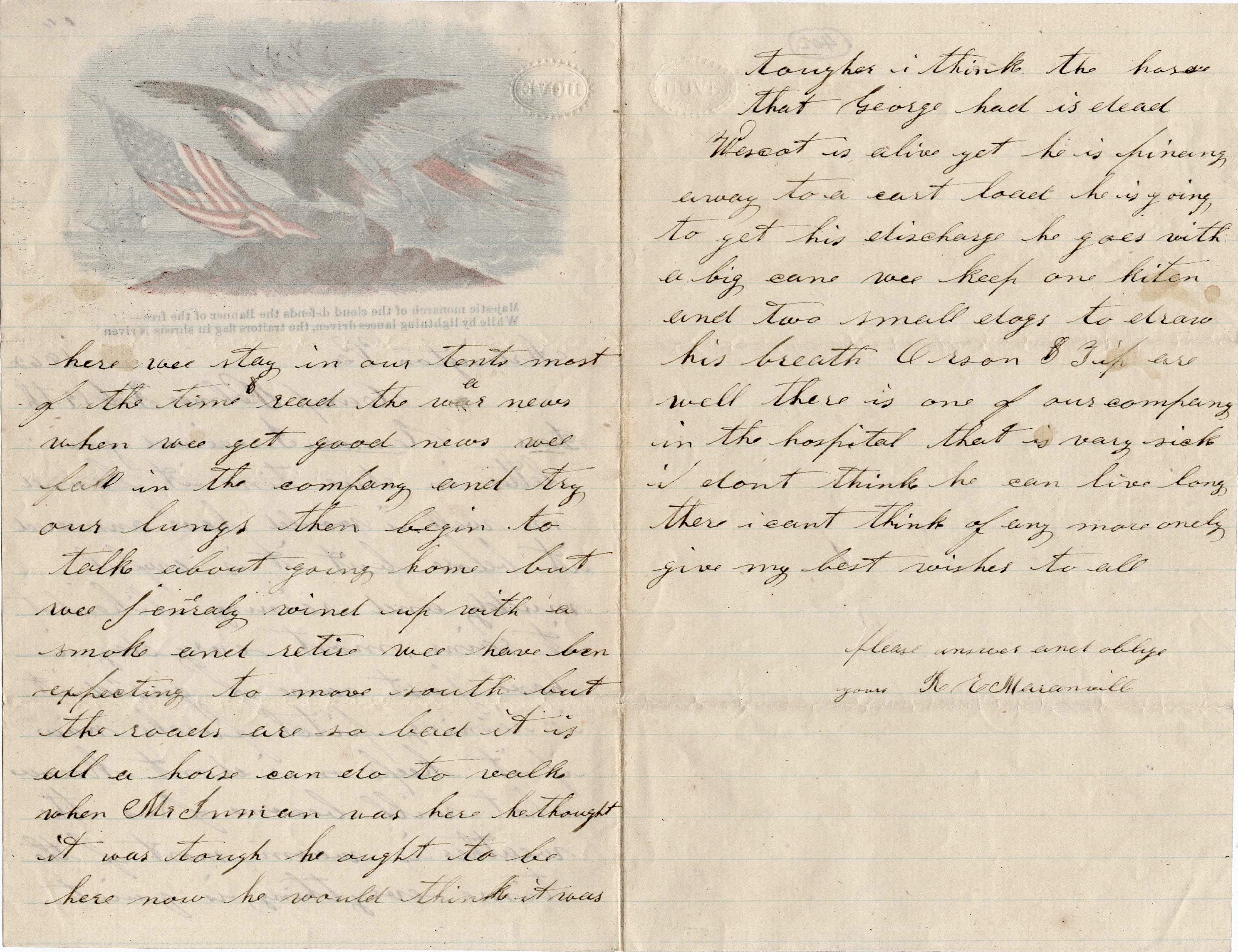
I have just come off guard, It is raining pitch forks now. If it keeps on, I don’t know what will become of us. The weather is warm most of the time. Everything is quiet here. We stay in our tents most of the time & read the war news. When we get good news, we fall in the company and try our lungs. Then begin to talk about going home. But we generally wind up with a smoke and retire.
We have been expecting to move south but the roads are so bad it is all a horse can do to walk. When Mr. Inman was here, he thought it was tough. He ought to be here now. He would think it was tougher.
I think the horse that George had is dead. Wescott is alive yet. He is pining away to cart load. He is going to get his discharge. He goes with a big cane. We keep one kitten and two small dogs to draw his breath. Orson & Tip are well. There is one of our company in the hospital that is very sick. I don’t think he can live long.
There, I can’t think of any more—only give my best wishes to all. Please answer and oblige yours, — R. E. Maranville
Letter 2
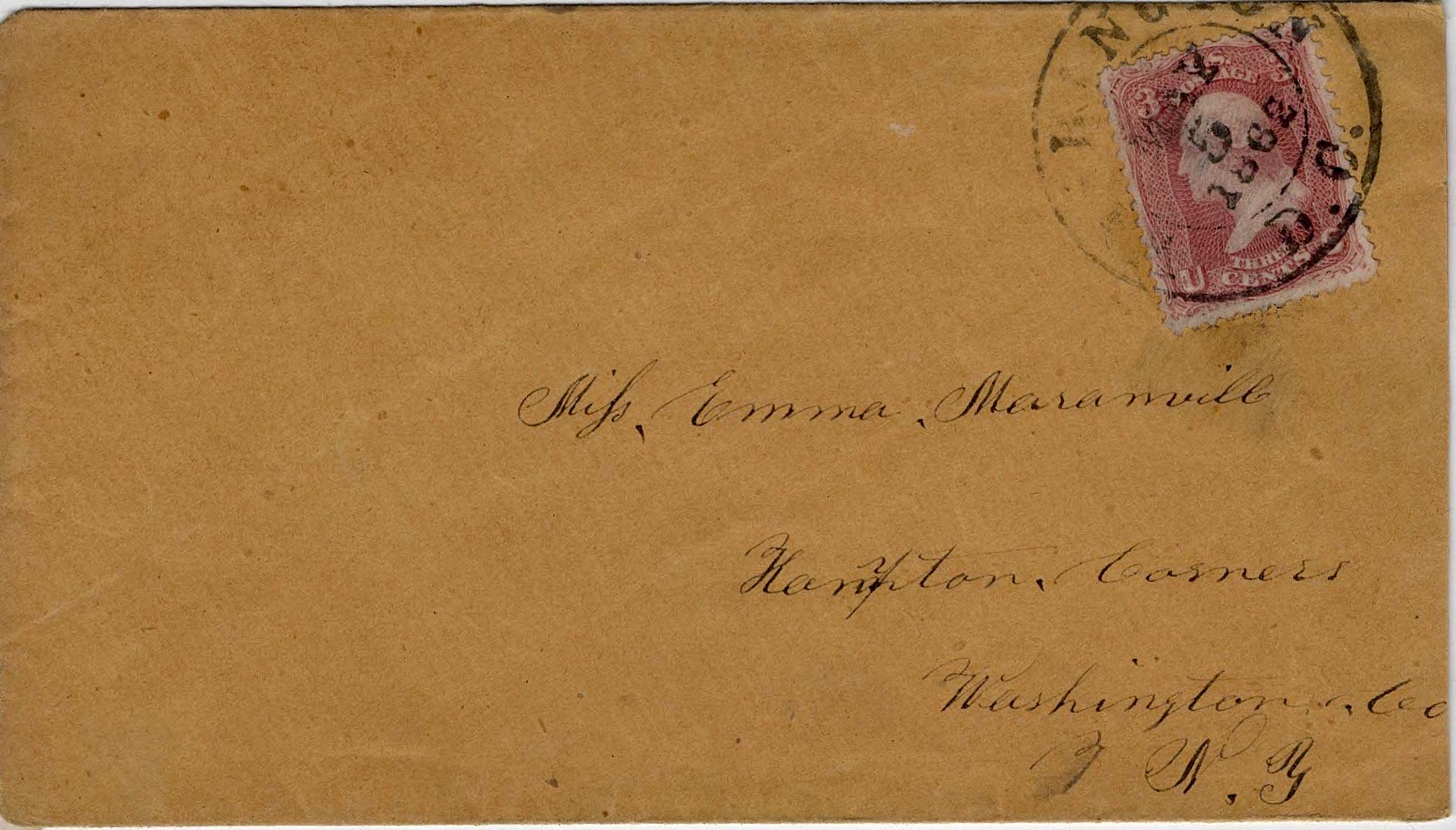
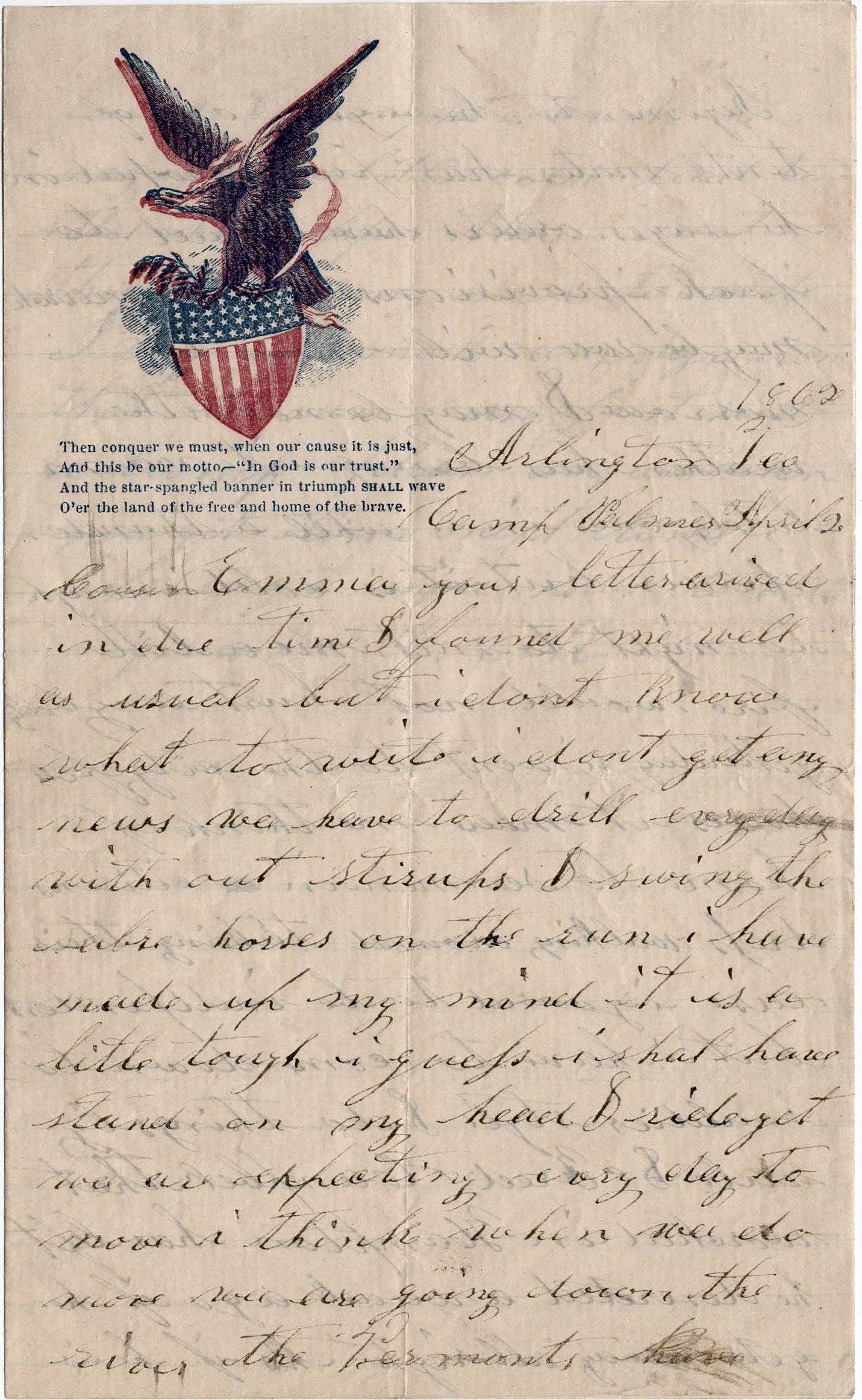
Camp Palmer Arlington, Virginia April 2, 1862
Cousin Emma,
Your letter arrived in due time. It found me well as usual but I don’t know what to write. I don’t get any news. We have to drill every day without stirrups & swing the saber, horses on the run. I have made up my mind it is a little tough. I guess I shall have to stand on my head & ride yet.
We are expecting every day to move. I think when we do move, we are going down the river. The Vermont Regiments have gone on.
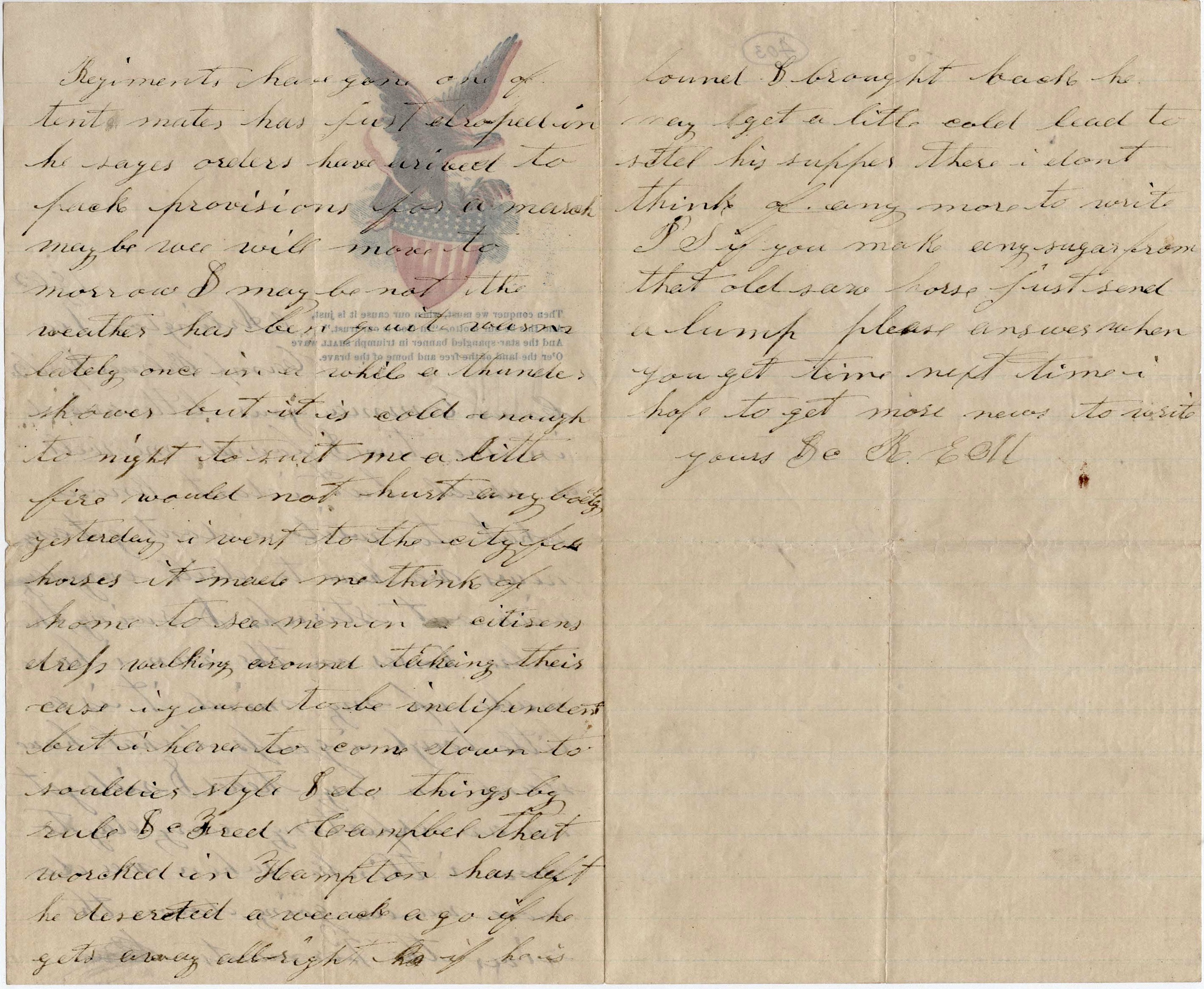
One of my tent mates has just dropped in. He says orders have arrived to pack provisions for a march, Maybe we will move tomorrow and maybe not. The weather has been quite warm lately. Once in a while a thundershower but it is cold enough tonight to suit me. A little fire would not hurt anybody.
Yesterday I went to the city for horses. It made me think of home to see men in citizen’s dress walking around taking their ease, enjoying [?] to be independent. But I have to come down to soldier’s style. I do things by rule, &c. Fred Campbell that worked in Hampton has left. He deserted a week ago, if he gets away all right. If he is found and brought back, he may get a little cold lead to settle his supper.
There, I don’t think of any more to write.
P. S. If you make any sugar from that old saw horse, just send a lump. Please answer when you get time. Next time I hope to get more news to write. Yours &c., — R. E. M.
Letter 3
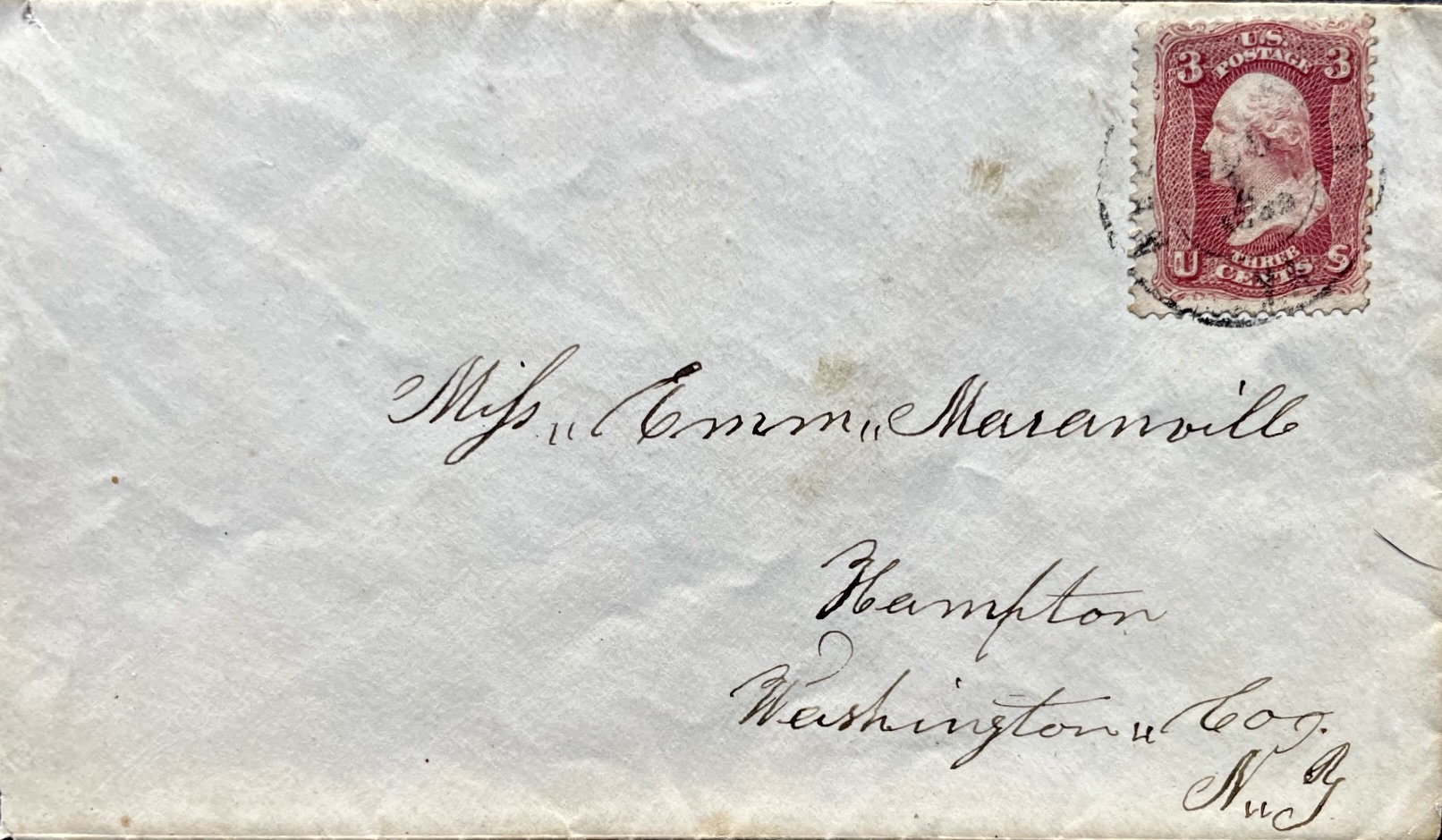
Addressed to Miss Emma Maranville, Hampton Corners, Washington county, New York
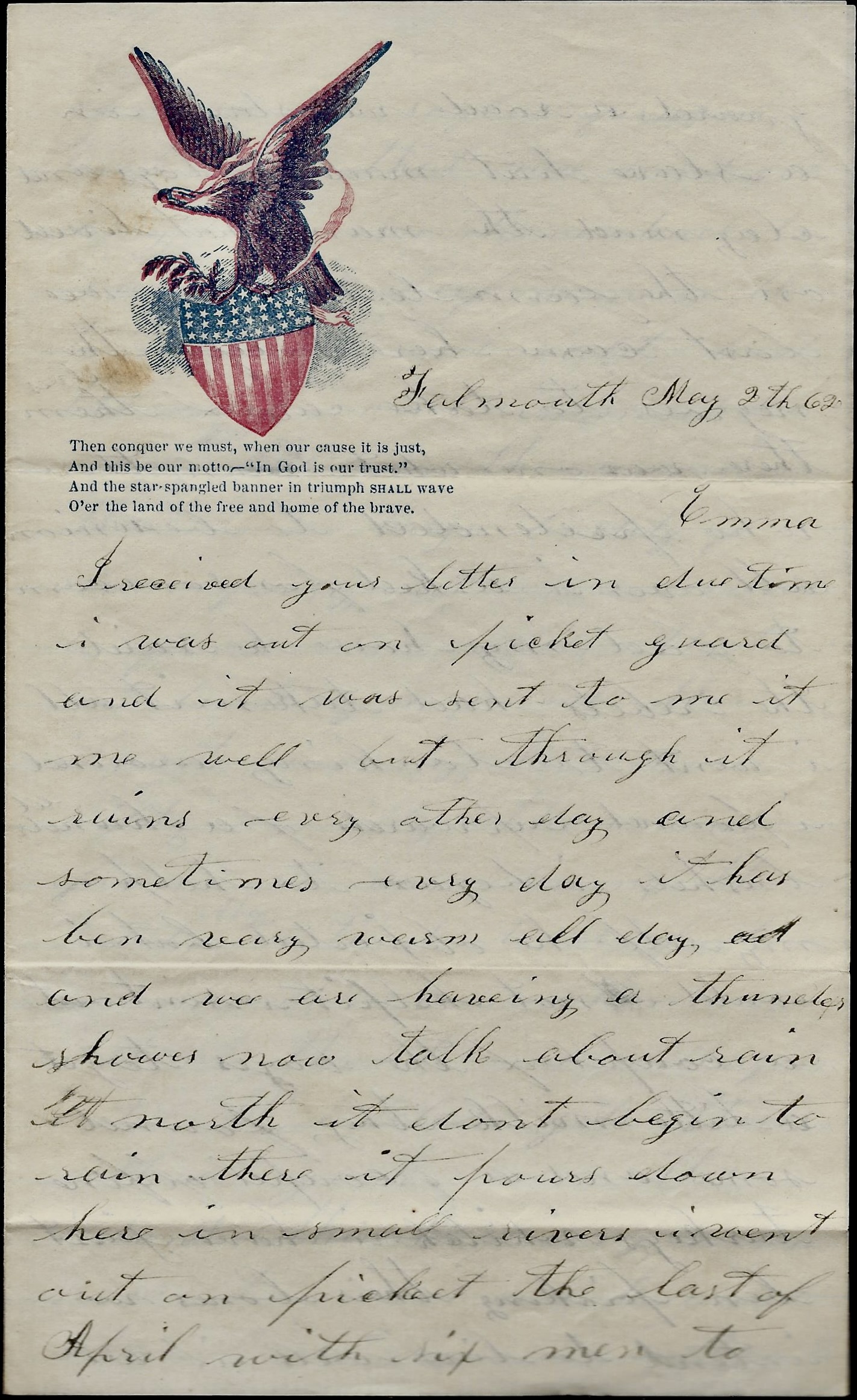
Falmouth, [Virginia] May 2nd 1862
Emma,
I received your letter in due time. I was out on picket guard and it was sent to me. It [found] me well but [soaked] through. It rains every other day and sometimes every day. It has been very warm all day and we are having a thunder shower now. Talk about rain [in the] North. It don’t begin to rain there. It pours down here in small rivers.
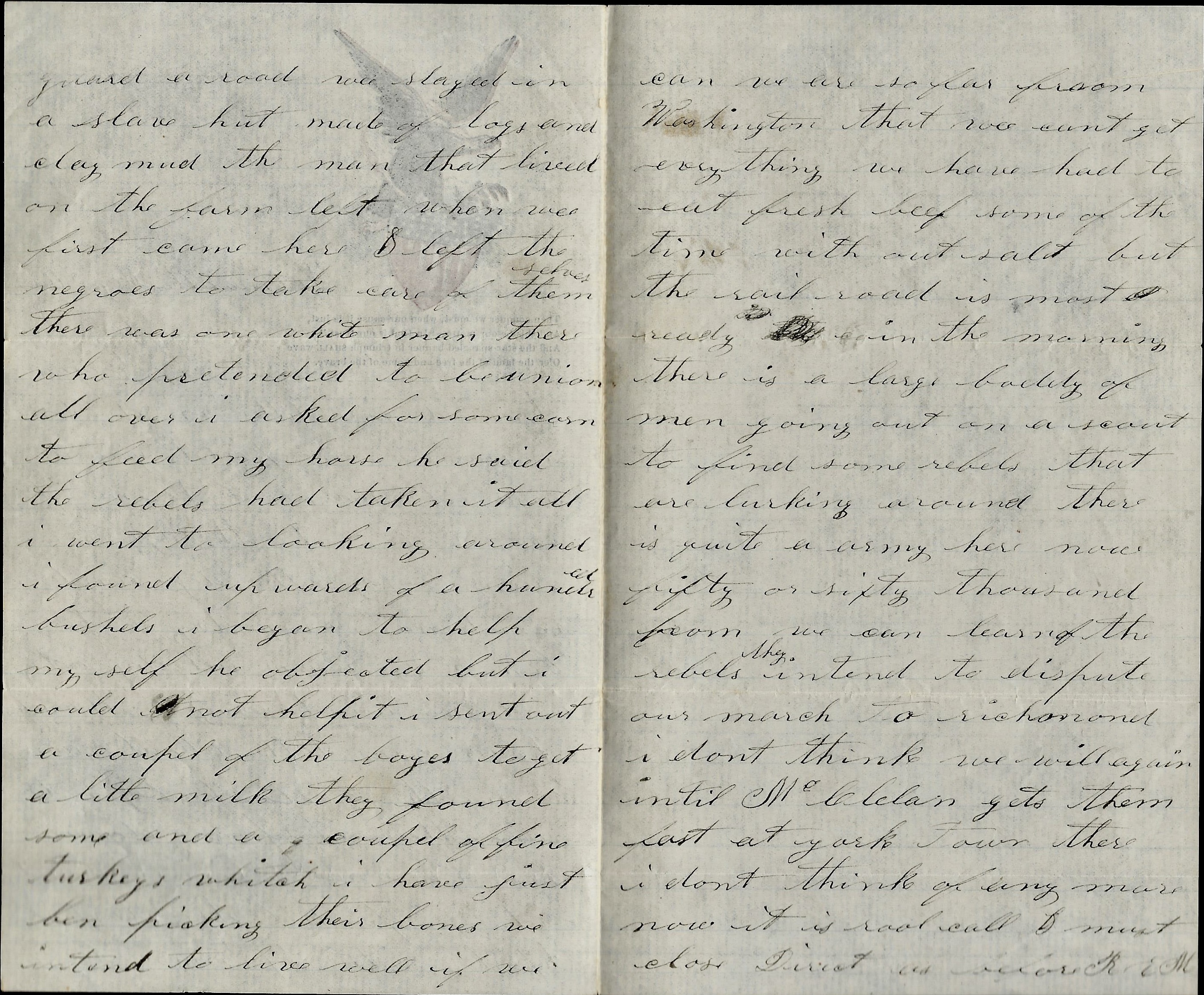
I went out on picket the last of April with six men to guard a road. We stayed in a slave hut made of logs and clay mud. The man that lived on the farm left when we first came here & left the negroes to take care of themselves. There was one white man there who pretended to be Union all over. I asked for some corn to feed my horse. He said the rebels had taken it all [but when] I went to looking around, I found upwards of a hundred bushels. I began to help myself. He objected but I could not help it. I sent out a couple of the boys to get a little milk. They found some and a couple of fine turkeys which I have just been picking their bones. We intend to live well if we can. We are so far from Washington that we can’t get everything. We have had to eat fresh beef some of the time without salt but the railroad is [al]most ready.
In the morning there is a large body of men going out on a scout to find some rebels that are lurking around. There is quite an army here now—fifty or sixty thousand from [what] we can learn of the rebels. They intend to dispute our march to Richmond. I don’t think we will [see them] again until McClellan gets them fast at Yorktown there.
I don’t think of anymore now. It is roll call & must close. Direct as before. — R. E. M.
Letter 4
[Note: This letter is from the private collection of Greg Herr and was offered for transcription and publication on Spared & Shared by express consent.]
Addressed to Miss Emma Maranville, Hampton, Washington county, New York
Falmouth, [Virginia] June 28, 1862
Emma,
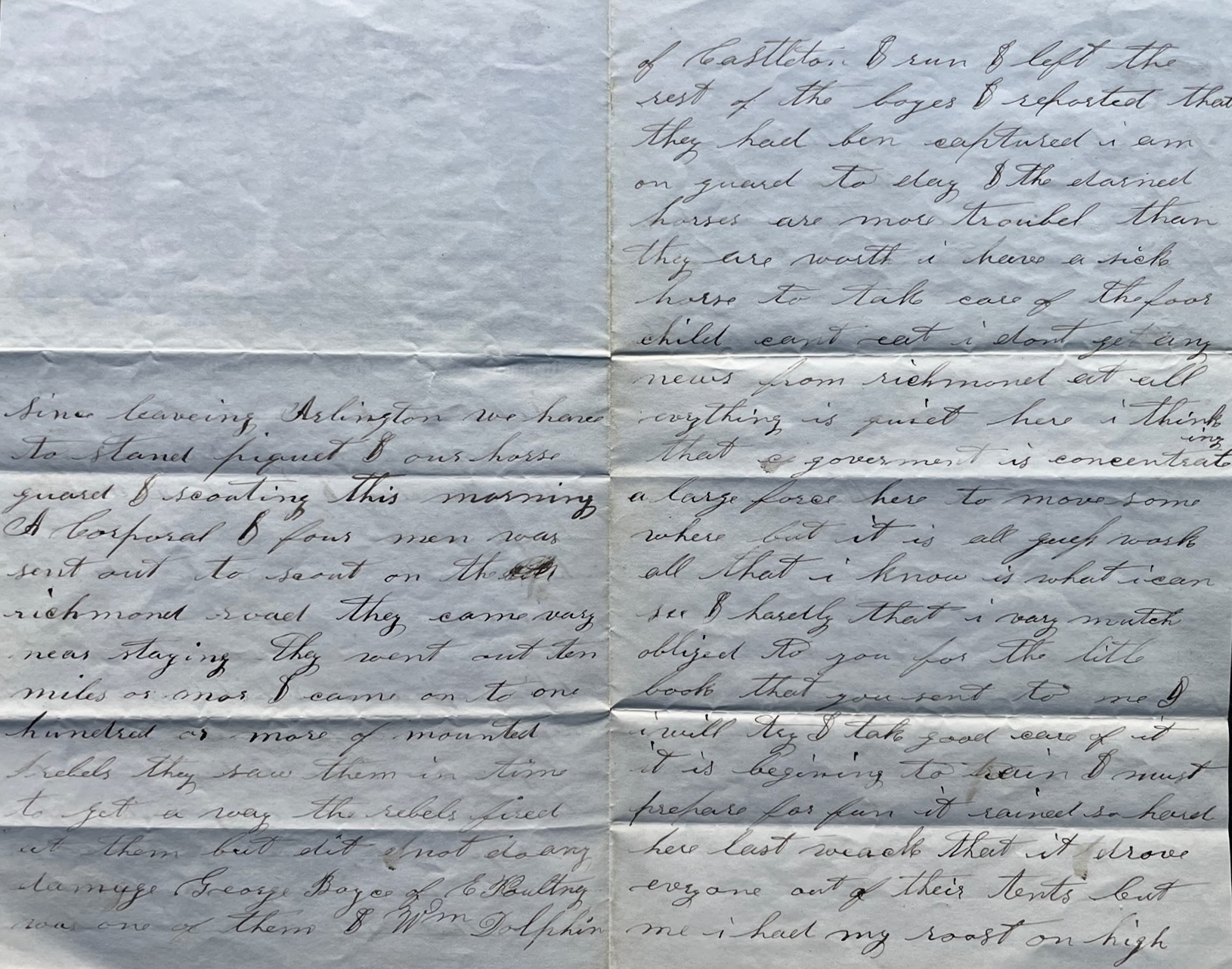
Chancy Warren arrived here today & found [me] well & tough. I saw Orson this morning. He is well. We are on detached service yet. I expect every day that we will have to join the regiment which is encamped nearly a mile from us. I had rather stay where I be but I won’t do to find fault. [We] obey orders if a regiment of rebels are before us.
We are having the best time now that we ever have had since leaving Arlington. We have to stand picket & our horse guard & scouting. This morning a corporal and four men was sent out to scout on the Richmond Road. They came very near staying. They went out ten miles or more and came onto one hundred or more of mounted rebels. They saw them in time to get away. The rebels fired at them but did not do any damage. George Boyce of E. Poultney was one of them. William Dolphin of Castleton run & left the rest of the boys & reported that they had been captured.
I am on guard today & the darned horses are more trouble than they are worth. I have a sick horse to take care of. The poor child can’t eat.
I don’t get any news from Richmond at all. Everything is quiet here. I think that our government is concentrating a large force here to move somewhere but it is all guess work. All that I know is what I can see & hardly that. I am very much obliged to you for the little book that you sent to me. I will try & take good care of it.
It is beginning to rain and I must prepare for fun, It rained so hard here last week that it drove everyone out of their tents but me. I had my roost on high ground. There, I don’t think of any more to write now & I think I had better close & fix my tent. Direct to Harris Light Cavalry, Co. F, Washington D. C.
The following letter was written by David Gardner (b. 1842) who enlisted on 8 April 1863 at New York City to serve three years in Co. I, 5th New York Cavalry. He was taken prisoner on 17 June 1864 at Ely’s Ford on the Rapidan river in Virginia and taken to Andersonville. Unlike most of his fellow prisoners, David survived the confinement and was paroled in January 1865.
I could not find an image of David Gardner but here is an ambrotype of a cavalryman from the collection of my friend, Megan Kemble, who thinks he was in either the 5th or 6th New York Cavalry.
The letter is addressed to “Dear Sir” and my assumption is that it was sent to James Emslie, the father of William H. Emslie (1842-1864) who enlisted on 12 August 1861 at the age of 18 in Co. G, 2nd New York Cavalry. William was captured at Ellis Ford on 17 January 1864 and died of chronic diarrhea at Andersonville Prison on 25 June 1864. William’s parents were James and Jane (Weston) Emslie of Cornwall, Orange county, New York. We learn from the letter that David and William were tent mates at Andersonville. William was buried at Andersonville.
Also mentioned in the letter are two other names. The first is Henry J. Brewer (1841-1864) who served with William in Co. G, 2nd New York Cavalry. Henry was taken prisoner on 22 August 1863 at U. S. Ford on the Rappahannock River in Virginia and was also sent to Andersonville. He died there on 31 October 1864. This letter informs us that he was suffering from scurvy.
The other soldier mentioned was Frank Wood (1842-1864) who served in Co. I, 5th New York Cavalry with David Gardner. He was taken prisoner on 1 March 1864 near Richmond and died at Andersonville Prison on 19 July 1864.
A burial trench outside Andersonville Prison
Transcription
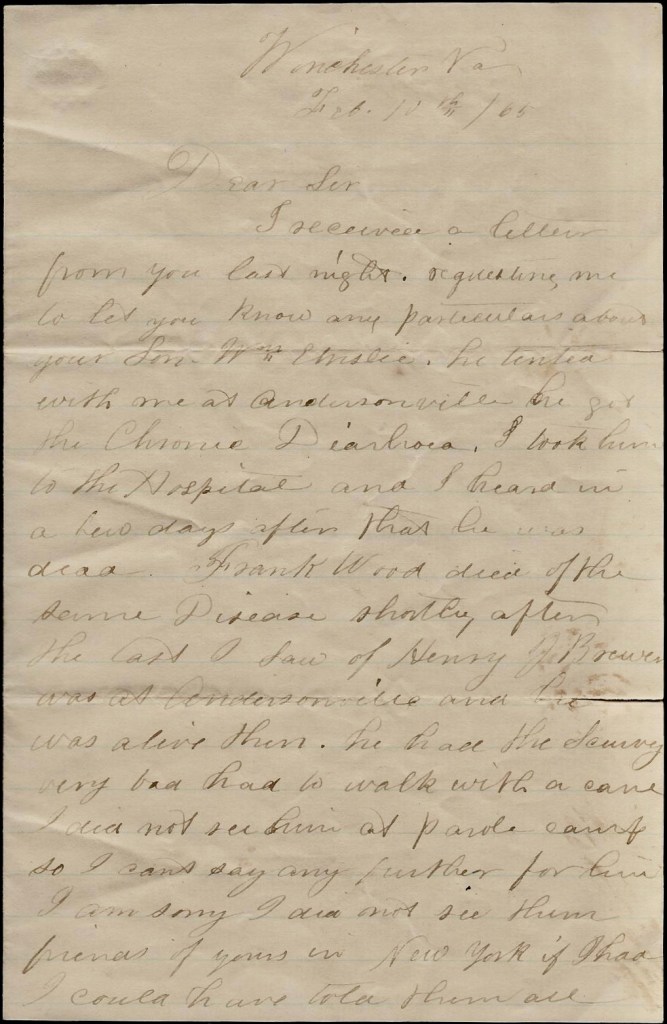
Winchester, Virginia February 10th 1865
Dear Sir,
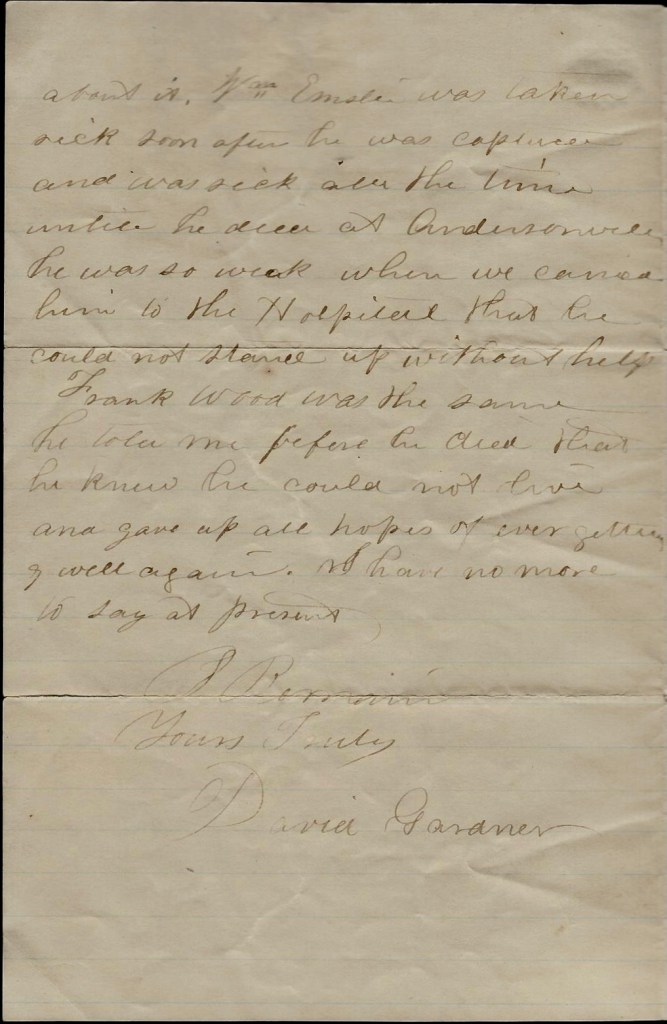
I received a letter from you last night requesting me to let you know any particulars about your son, Wm. Emslie. He tented with me at Andersonville. He got the chronic diarrhea. I took him to the hospital and I heard in a few days after that he was dead. Frank Wood died of the same disease shortly after. The last I saw of Henry J. Brewer was at Andersonville and he was alive then. He had the scurvy very bad—had to walk with a cane. I did not see him at parole camp so I can’t say any further for him. I am sorry I did not see them friends of yours in New York. If I had, I could have told them all about it.
Wm. Emslie was taken sick soon after he was captured and was sick all the time until he died at Andersonville. He was so weak when we carried him to the hospital that he could not stand up without help. Frank Wood was the same. He told me before he died that he knew he could not live and gave up all hopes of ever getting well again. I have no more to say at present.
I could not find an image of George but here is a CDV of Edward C. Morehouse who also served in the 2nd New York Cavalry (Co. C) (Photo Sleuth)
The following letter was written by George M. Warner (1843-1864) who enlisted at age 18 on 21 August 1861 at Fairhaven, Vermont, to serve three years in Co. F, 2nd New York Cavalry—a.k.a. Harris Light Cavalry. He was captured on 3 November 1863 at Stevensville and eventually taken to Andersonville Prison in Georgia where he died on 27 July 1864.
The Harris Light Cavalry suffered heavy casualties at Beverly Ford and Aldie, Virginia, in the early phase of the Gettysburg campaign while the Army of the Potomac was en route to Pennsylvania. It was not engaged at Gettysburg, being stationed at Westminster, Maryland, instead, so one has to wonder as to the validity of George’s letter which describes his having been momentarily taken a prisoner in the cavalry fight on 3 July 1863 at Gettysburg when his horse was shot out from under him as Kilpatrick’s 2nd New York Cavalry attacked the rear of Lee’s infantry. It was in this attack, where Kilpatrick continuously charged the heavily fortified Confederate right flank, suffering heavy losses, that he earned the nickname “Kill-cavalry.”
Transcription
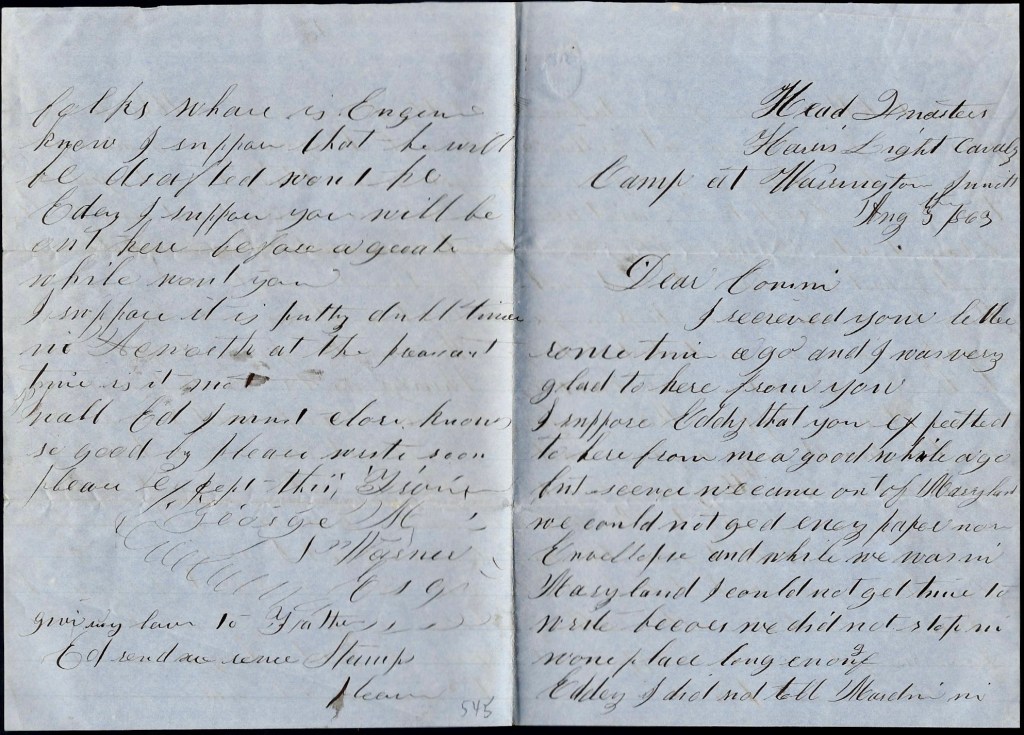
Headquarters Harris Light Cavalry Camp at Warrington Junction August 3, 1863
Dear Cousin,
I received your letter some time ago and I was very glad to hear from you. I suppose, Eddy, that you expected to hear from me a good while ago but since we came out of Maryland, we could not get any paper nor envelopes and while we was in Maryland, I could not get time to write because we did not stop in one place long enough.
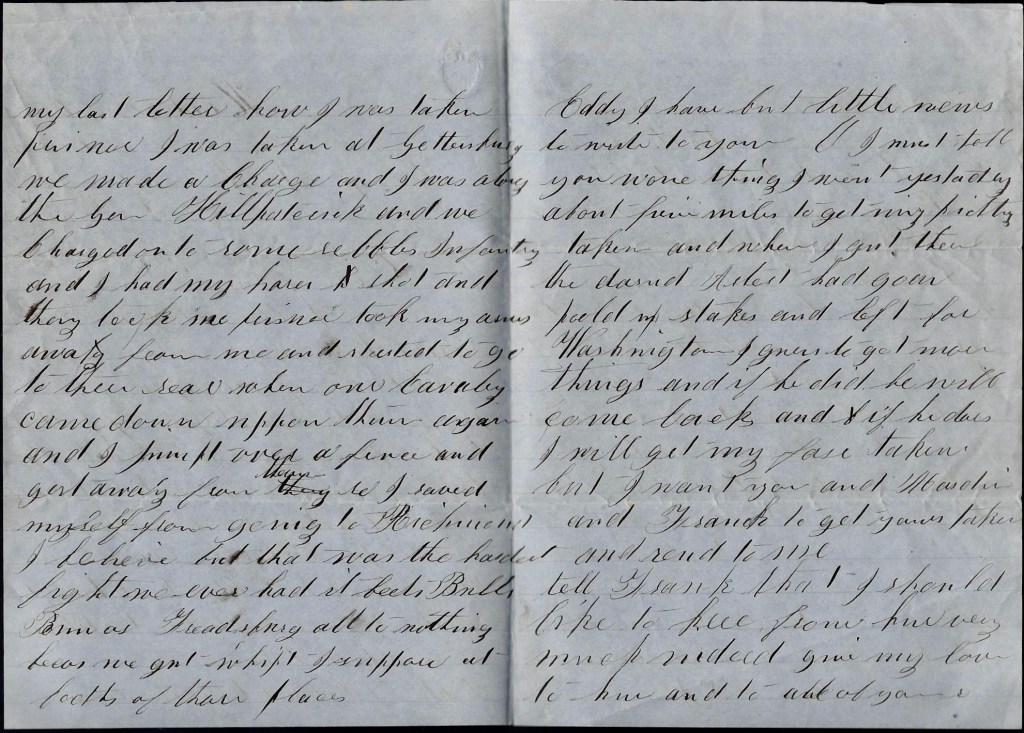
Eddy, I did not tell Mardin in my last letter how I was taken prisoner. I was taken at Gettysburg. We made a charge and I was along Gen. Kilpatrick and we charged onto some rebel infantry and I had my horse shot and they took me prisoner, took my arms away from me, and started to go to their rear when our cavalry came down upon them again and I jumped over a fence and got away from them so I saved myself from going to Richmond, I believe, but that was the hardest fight we ever had. It beats Bulls Run and Fredericksburg all to nothing because we got whipped, I suppose, at both of those places.
Eddy, I have but little news to write to you. Oh, I must tell you one thing. I went yesterday about five miles to get my picture taken and I when I got there, the darned artist had gone and pulled up stakes and left for Washington, I guess, to get more things, and if he did, he will be back and if he does, I will get my face taken. But I want you and Mardin and Frank to get yours taken and send to me.
Tell Frank that I should like to hear from her very much indeed. Give my love to her and to all of your folks. Where is Eugene now? I suppose that he will be drafted, won’t he? Eddy, I suppose you will be out here before a great while, won’t you? I suppose it is pretty dull times in __worth at the present time, is it not?
Well, Ed, I must close now so goodbye. Please write soon. Please accept this from, — George M. Warner, Esq.
Give my love to Father. Ed, send me some stamps please.
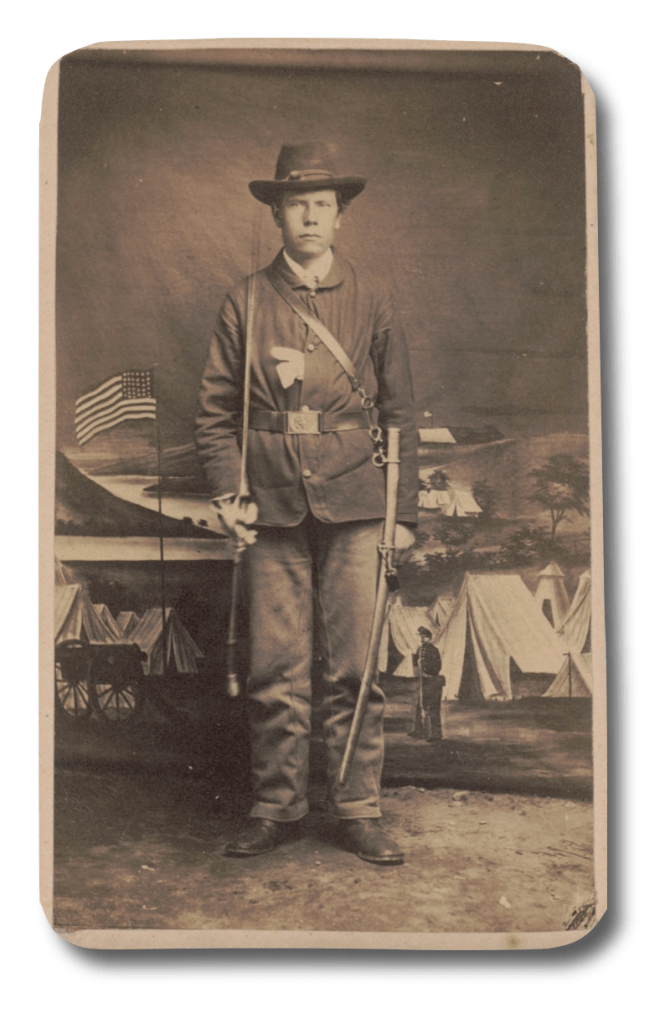
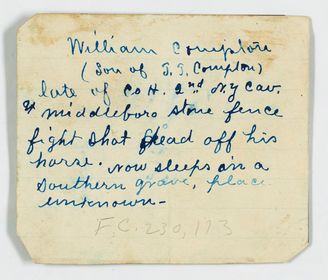
Willie Compton of the Harris Light Cavalry (card on reverse of image reads, “late of Co. H, 2nd N. Y. Cav., Middleboro, Stone Fence fight shot head off his horse. Now sleeps in a Southern grave, place unknown.”[Image in Pension File]
These letters were written by William Compton (1839-1863) of Co. H, 2nd New York Cavalry (a.k.a. “Harris Light Cavalry”). He wrote the letters to his father, Terrick Timbrook Compton (1812-1897)—or to his brother Francis (“Frank”) Compton—of Fountain county, Indiana. After Terrick’s first wife, Mary Ann Barshier (1821-1846) died in 1845, he married Mary Ann Neal in 1846, and then Ruth Herrel in 1849.
According to muster rolls, William enlisted on 3 August 1861 at Chambersburg, Orange County, Indiana, as a private in Co. H, 2nd New York Cavalry, to serve three years. He was killed in action at Middleburg, Virginia, on June 19, 1863. Sometime prior to his death he had been promoted to a sergeant.
Poor Terrick Compton lost all four of his sons in the Civil War. They were:
Pvt. Richard Compton (1837-1863) served in Co. D, 63rd Indiana Infantry; he was discharged for disability, came home and died on 17 June 1863. Pvt. John Compton (1838-1862) served in Co. C 17th Illinois Infantry; he was discharged for disability, and died before he could get home on 11 May 1862. Sgt. William Compton (1839-1863) served in Co. H, 2nd New York Cavalry; he was killed in action on 19 June 1863 at the Battle of Middleburg. Pvt. Francis M. Compton (1842-1865) served in Co. I, 154th Indiana Infantry; he died of disease at Harpers Ferry on 29 July 1865.
[Note: These letters were found in the Pension Files of the National Archives and have never been previously published to my knowledge.]
Letter 1
Washington [D. C.] September 3, 1861
Dear Father and Mother,
I take my pen in hand to inform you that I am well at present and hoping these few lines may find you well. We are all here enjoying ourselves very well. We have to drill 5 hours every day and I hate about soldiering. They wake me up too soon. They wake us up every morning at five o’clock every morning. I dreamed last night that I was back in Old Fountain [County] a cutting around [with] my old gal. I will not tell you anymore about my dream.
We have plenty to eat.
I seen sixteen rebels at Columbus, Ohio, as we come through. They came in while we was there. They was hard-looking bats, They was taken up Virginia somewhere by scouts. We was out on parade last evening. There was about twenty regiments out or there was not one out.
No more at present for I have a very bad place to write. You must write soon. Direct your letters this way:
William Compton Harris Light Cavalry Camp Oregon, D. C. In the care of S. McIrving
D. C. stands for District of Columbus
Letter 2
Virginia October 13, 1861
Dear Brother,
I take my pen in hand to inform you that I am well and I hope these few lines may find you enjoying the same state of health.
Frank, I will tell you something about the times here. I have to go and let my horse pick for we have no feed and I will tell you something more when I come back. I have got back now and my horse got a good belly full of clover.
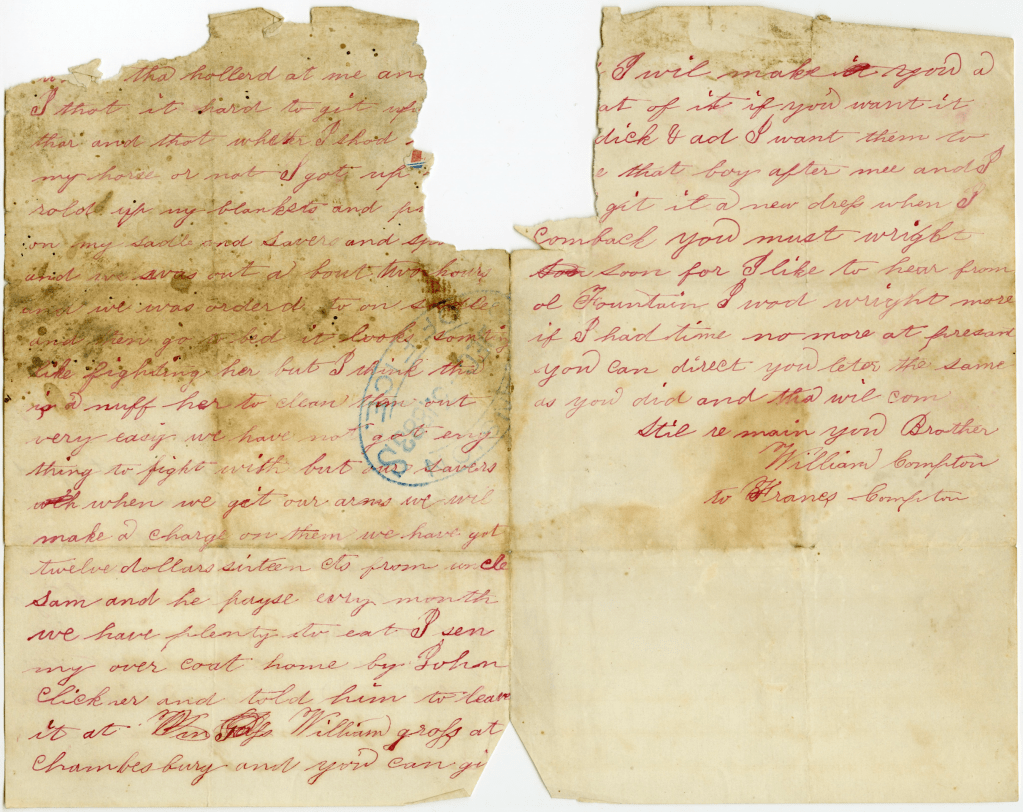
We moved yesterday and we are [with]in a half mile of Munson’s Hill where the rebels was drove from there about two weeks ago and we are [with]in about nine miles of Bull Run where we heard that the rebels was a driving our pickets in last night and we was ordered to saddle our horses. I was asleep when they hollered at me and I thought it hard to get up from there and thought whether I should get my horse or not. I got up, rolled my blankets, and put on my saddle and sabers ad spurs and we was out about two hours and we was ordered to unsaddle and then go to bed.
It looks some like fighting here but I think there is enough here to clean them out very easy/ We have not got anything to fight with but our sabers. When we get our arms, we will make a charge on them.
We have got twelve dollars, sixteen cents from Uncle Sam and he pays every month. We have plenty to eat. I send my overcoat home by John Clickner and told him to leave it with William Gross at Chambersburg and you can get it. It will make you a good coat if you want it….
You must write soon for I like to hear from Old Fountain [county]. I would write more if I had time. No more at present. You can direct your letter the same as you did and they will come.
Still remain your brother, — William Compton
To Francis Compton
Letter 3
Camp near Munson Hill October 26, 1861
Dear Brother,
It is with great pleasure that I take my pen in hand to inform you that I am well at present and hope these few lines may find you all well.
I received your letter this evening and was very glad to hear from you all. Frank, I would like to know what kind of a tale that Wilse Riley could make if he says that he got an honorable discharge. You must ask him to show his discharge [papers]. He got his discharge one morning after breakfast. They did not hunt for him much for they thought he was not worth hunting for. Well, I guess I have said enough about a deserter.
Frank, I will have to stop for tonight for it is roll call and I will finish some other time. So good night.
Well, good morning to you, Frank. I have been on guard yesterday and last night and I don’t feel very well but I will be alright when I get to take a nap. We are talking of moving today but I don’t know whether we will or not.
Frank, I will tell you what a time we had last Tuesday. It was a raining all day here and about the middle of the afternoon we was ordered to saddle up. Our squadron saddled up and we was marched about two miles off in the country and we found a a oats stock and we brought it in and then when I was about to go to bed, they called me out to go with the wagons after feed and I didn’t care much for I wanted to steal something. Well, I got ahead of cabbage and four nice beets and lots of turnips.
Frank, you said there was plenty of wild turkeys there and you killed two but if I was there, you would stand but little chance for I could kill one every time at a 100 yards with my revolver. I was out the other day a trying how well I could shoot. I think I could kill a man every time at a hundred and fifty yards.
Frank, you said they was plenty of parties there. I would like to be there and show them how I could shake my old foot. We have a dance here every night but it don’t go as well as if we had some ladies here. I think I will be at home this winter some time and I want them to prepare themselves for big parties.
Well, I must bring my scratching to a close. You must write soon. So no more at present but still remain your brother, — William Compton
to Francis M. Compton
Letter 4
Camp Palmer, Virginia November 17, 1861
Dear Brother,
It ’tis with the greatest of pleasure that I take up writing to you to inform you that I am well at the present and hope [when] these few lines comes to hand, they will find you all well.
Frank, I sent fifteen dollars home with Jake Dice and I want you to get it and write to me when you receive it. You can lend it to anybody that is good and will give their note and good security but if you can let it out, do it, if it will make anything for me. And if I never come back, you can have it. But there is no such good luck as me to never come back there for all thunder could keep me from there.
Well, I must tell you something about my horse. He is about seventeen hands high and he will be 5 years old next spring and he is all horse but the tail and it is a sprouting. His ribs would make good washboards from the looks of him. I gave him a good currying last evening and I think he will get fleshy now. I have been a wishing we would get in a fight so he would get shot and then I think I could get another better one. If we don’t get in a fight soon, I will gouge his eyes out and then I know that I will get another one.
I am on stable guard today but that is not very hard. The hardest work we have is standing guard. I must tell you what a glorious time I had standing guard the other night. I laid down on the ground to take a snooze and when I waked up, it was raining like all thunder and the water was running all over me. I got up and shaking [my]self and thought nothing of it. If I had exposed myself at home as much as I have since I came here, I would have been dead long ago.
There is a good many of the boys sick now. There are six of the boys out of this company has went to the city hospital. There is only one that you know—that is Joseph Shumaker. Them that went to town has got the measles. John Cooper and Dave has been very sick. They’re at the hospital now but they are getting a good deal better. I think they will be able to come back to their tent in a day or two. There is about sixteen on our company sick at this time. I have had good health ever since I have been here—only when I was vaccinated and then I was sick for a day or two.
Mary, I send you those feathers to show you what kind we wear on our hats. Id I had a chance to send you one of them, I would be glad for I know you would fancy one of them very much. Mary, I would like to be there and take another dance with you and that other girl. I hope that you had a better time than we had that night when I was at home. I want you when you have another dance to let me know and I will come over and stay a week or two.
I guess I have wrote all that is necessary for this time. You must write soon. So no more at present but still remain your brother, — William Compton
To Francis Compton
Letter 5
Camp Palmer, Virginia December 8, 1861
Dear Father and Mother,
I take this opportunity of writing to you to inform you that I am well at the present and hope when these few lines come to hand, they will find you all well.
Father, I must tell you about our Grand Review that we had last Thursday. Uncle Abe was out to see us and he presented the Stars & Stripes to our regiment and we was very thankful to have them. we do nothing but go on reviews here. For my part, I would rather go into a fight than to go to a review. I don’t know whether we will get in a fight this winter or not but I don’t think we will. But when we get out on picket, maybe we will have a chance to get a shot at some rebel.
There was three of our boys out the other day on picket and one of them shot two men but they happened not to be rebels. They was Union men that went to try their sentinels. They let on like they was rebel cavalry [and] as they come up, it was very dark and our boys could not see who they was. They stepped to one side and said [they’s] shoot if they came any closer, so they Coe up a little closer and our boys let slip at them and shot one of them through the arm and hurt him very bad and the other one did not get hurt very bad. And when they come ups they said they had done wrong. When they fool with the hoser [hoosier?], they will run against a snag.
Mother, I was very sorry to hear that Mary had left you for I know you have too much work there to do yourself and I think Mary is as good a girl as you could get. I hope you will get one as good as Mary. Frank said that Naomi Beals was gone to live with you. I guess she is a very good girl for work.
Frank, I want to give you a little advice. I heard that you was a running with Lames’ girls and if you want to go in decent company, you had better not let anybody see you with them. I want you to go wit somebody better than them for I know you can, or I think you could if I was there. If you hear from John, you write to me.
I guess I must bring my few lines to a close for it is a getting near roll call. You must write soon for I like to get letters from home every week. So no more at present but still remain your son till death, — William Compton
Letter 6
Camp on the ford near Fredericksburg May 13, 1862
Dear brother,
John Cave, Co. C, 2nd New York Cavalry (LOC)
I seat myself down to write you a few lines to inform you that I am well at present and hope when these few lines come to hand, they will find you well. I just received your letter and was very glad to hear from you. Frank, I suppose you have of the little fight we have been in. It was on the 17th of April. We marched from Catlett Station to Fredericksburg, Virginia, and we drove the rebels before us for about twelve miles and we took several prisoners and we got one of our Lieutenants killed. We followed them till dark and then we camped till about one o’clock in the morning and then we was rousted up and we got our horses and started after the retreating rebels.
We went about five miles and we was fired into. by the rebels and we made a charge on them and they made their bullets fly pretty thick around our heads. They was several fellers shot right by the side of me. I thought I would be shot but I come out safe and sound.
Frank, I will give you the list of the killed and wounded:
George Weller killed, from Osborn Prairie Josiah Kiff, killed from Newtown Cyrus Romaine, wounded James Baker, wounded William Ranken, wounded Patrick Ambrose, wounded Lewis Crane, wounded Jacob McClean, wounded
This is the list of the killed and wounded in our company. Frank, you said that you was a going to lend my money out. I want you to keep it and don’t lend it out for I think I will be at home in a month or two and then I will need it. I set fifteen dollars more too but you you was gone and so old Josey Bever has got it for me and he will keep it till I come home. Frank, you can spend some of my money if you need it and then you need not take up your wages till you get done working and then it comes all in a bunch—that is, if the man is good that you work for, and I suppose he is from what you say. I don’t think wages is very high there this spring. I get fourteen dollars a month and then I make right smart a [ ]. We got paid a two weeks ago and I sent fifteen dollars to you and I have got about twenty dollars yet and they is about three months pay a coming to us yet. We are going to get paid in a day or two.
Frank, you must write soon and tell me about John and how he is and whether you have heard from him. Well, I guess I have wrote all I can think of at this time. So no more at present but still remain your brother, — William Compton
Write soon.
Letter 7
Sunday, June 29, 1862
Dear Father and Mother,
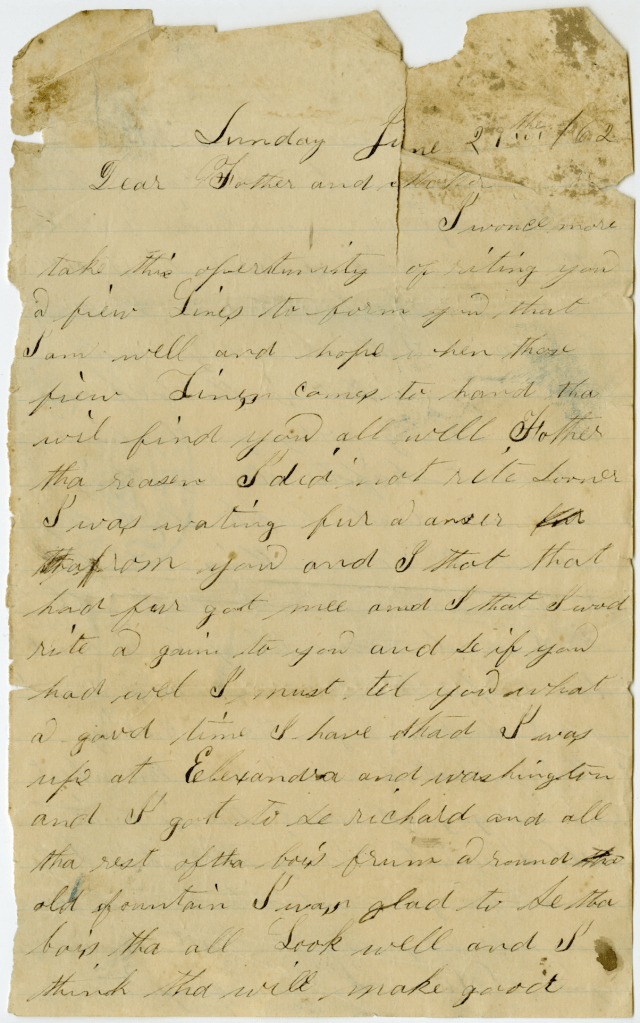
I once more take this opportunity of writing you a few lines to inform you that I am well and hope when these few lines comes to hand, they will find you all well. Father, the reason I did not write soon, I was waiting for an answer from you and I though that I would write again to you and see if you had. Well, I must tell you what a good time I have had. I was up at Alexandria and Washington and I got to see [brother] Richard and all the rest of the boys from around Old Fountain [county]. I was glad to see the boys. They all look well and I think they will make good soldiers. They all think they see hard times but I think that [if they] would come out and travel through the Virginia mountains awhile, they would think of hard times.
We have got back to Fredericksburg and I think we will go into Richmond or that is the talk now. We are seeing very good times. We don’t have to do everything now. We don’t have to drill any. WE don’t do anything but tend to our horses. Well, I must tell you about the crops. The corn is only about ankle high. They are cutting their wheat around here. The wheat is very good wheat, There is [lots] of it.
Well, I must bring these few lines to a close. You must write soon. So no more at present but remain your son, — William Compton
Letter 8
Camp near Fredericksburg, Va. July 24, 1862
Dear Brother,
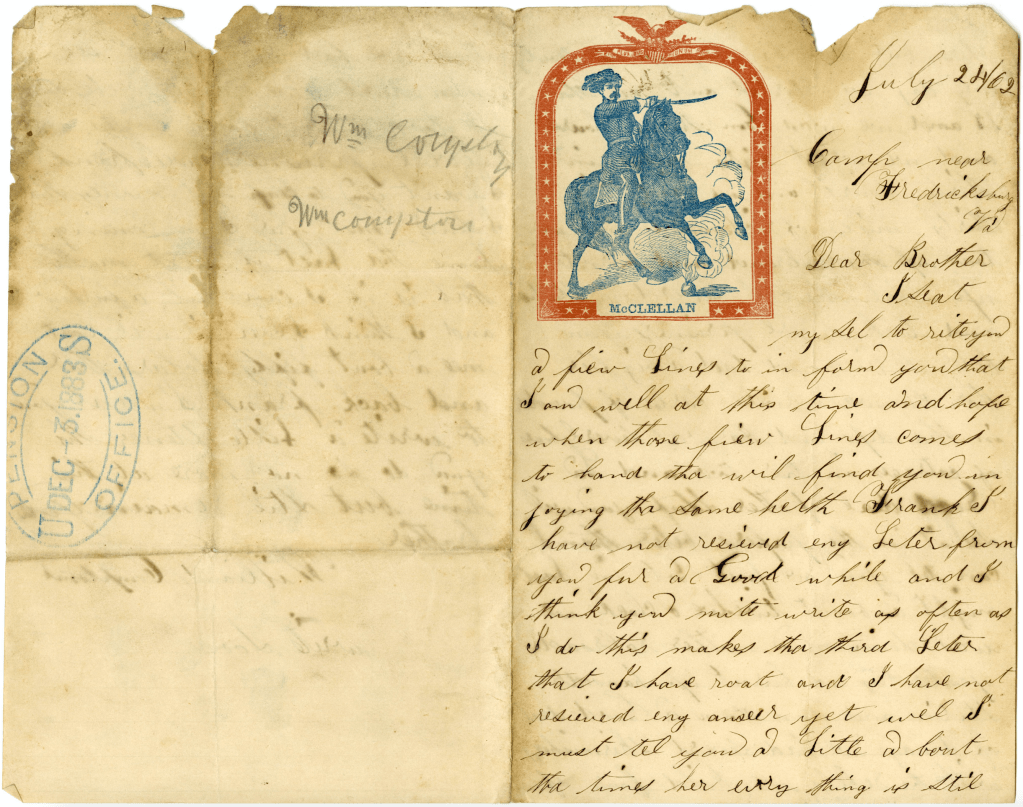
I seat myself to write you a few lines to inform you that I am well at this time and hope when these few lines does to hand, they will find you enjoying the same health. Frank, I have not received any letter from you for a good while and I think you might write as often as I do. This makes the third letter that I have wrote and I have not received any answer yet.
Well, I must tell you a little about the times here. Everything is still here but the cavalry. We are scouting every day. We started out on the 19th and we was gone thirty hours and we went eighty miles in thirty hours. And we went [with]in thirty miles of Richmond and we tore up the railroad and burnt up what they call Beaver Dam Station and took several prisoners.. You better believe we had a big fire there. There was several barrels of powder in the depot and there was several boxes of cartridges in there two and a good deal of other stuff. You will see it I the papers better than I can tell you.
We just got in last night about twelve o’clock. We was on another railroad yesterday. We burnt up Hanover Station and done them a good deal of damage. We had several skirmishes with the rebels. We killed four of them. We had none of our men hurt. We burnt a rebel camp and took about forty horses and several prisoners.
Well, Frank, I want you to keep that money that I sent last for I am coming home the last of next month—that is, if I can get a furlough, and I think I can. It will cost me about fifty dollars there and back. Frank, I want you to write a little oftener than you do. So no more at this time but still remain your brother, — William Compton
Write soon.
Letter 9
Camp near Fredericksburg, Va. July 29, 1862
Dear Brother,
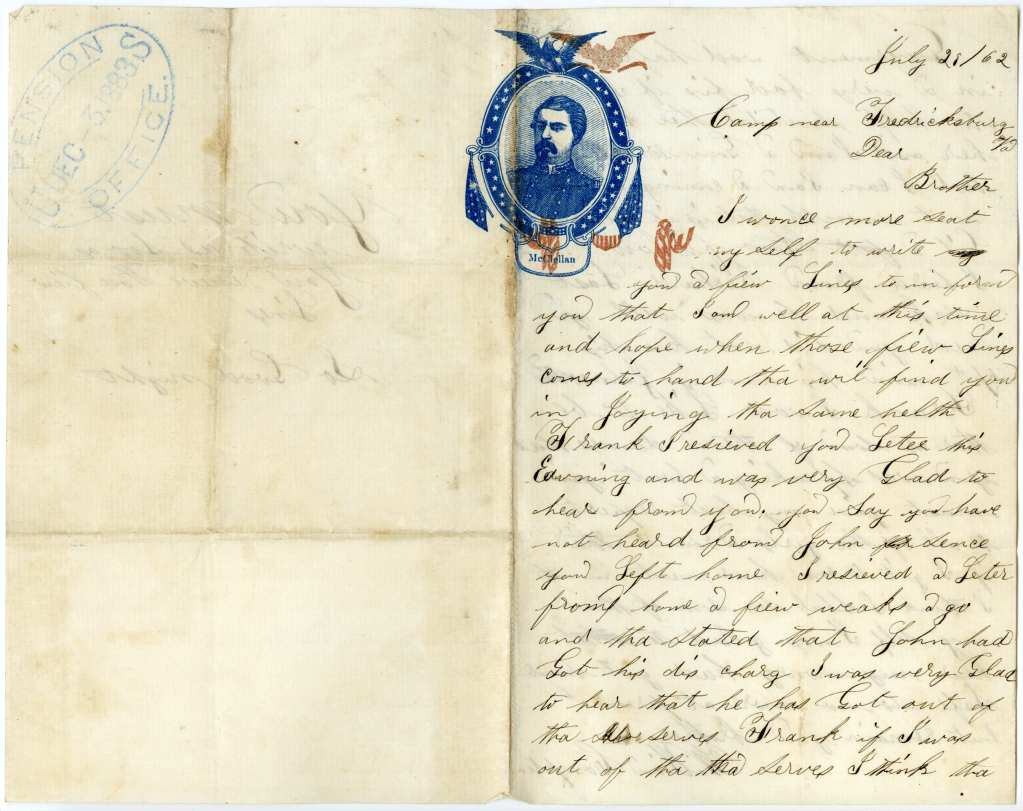
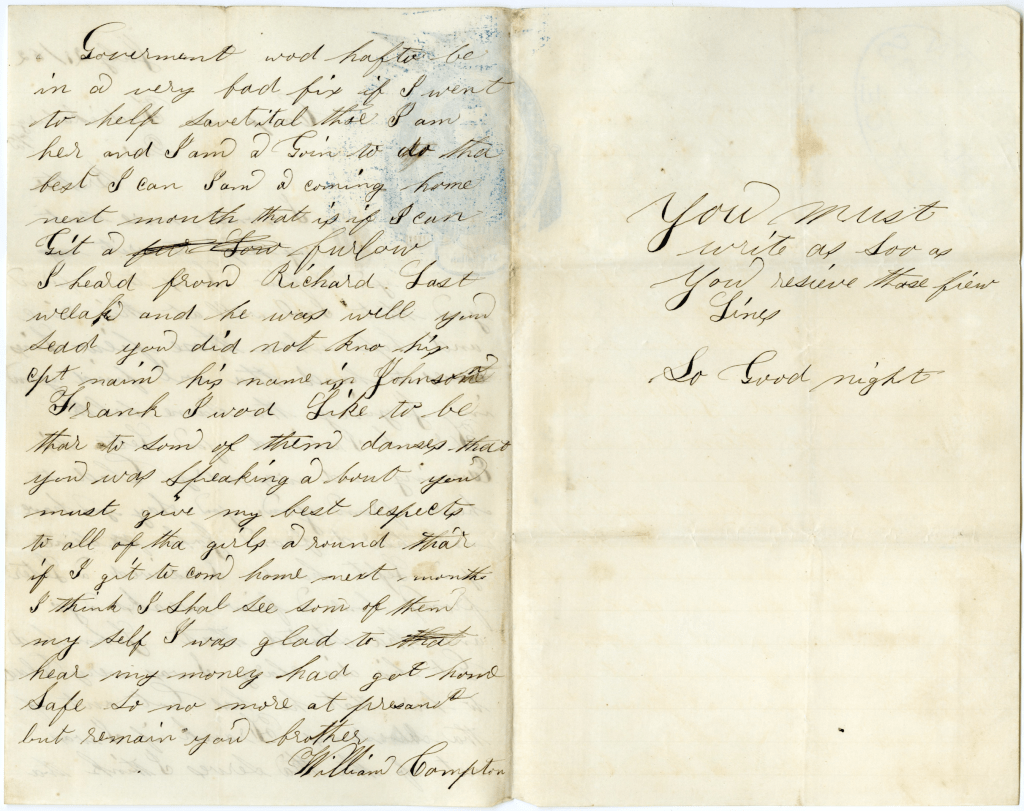
I once more seat myself to write you a few lines to inform you that I am well at this time and hope when these few lines come to hand they will find you enjoying the same health. Frank, I received your letter this evening and was very glad to hear from you. You say you have not heard from John since you left home. I received a letter from home a few weeks ago and they stated that John had got his discharge. I was very glad to hear that he has got out of the service. Frank, if I was out of the service, I think the government would have to be in a very bad fix if I went to help save it although I am here and I am a going to do the best I can.
I am a coming home next month—that is, if I can get a furlough. I heard from Richard last week and he was well. You said you did not know his captain’s name. His name is Johnson.
Frank, I would like to be there to some of them dances that you was speaking about. You must give my best respects to all of the girls around there. If I get to come home next month, I think I shall see some of them myself. I was glad to hear my money had got home safe. So no more at present but remain your brother, — William Compton
You must write as soon as you receive these few lines. So goodnight.
Letter 10
Harwood Hospital [Washington D. C.] October 1st [1862]
Dear Brother,
I once more seat myself to write you a few lines to let you know how I am a getting along. I have been sick for four weeks. I am a getting about well now except I am very weak yet. I think I will be able to go to the regiment the last of the week or the first of next. I am in the hospital at Washington. It is three weeks ago last Saturday since I are here and it seems like a year to me for it is very lonesome here and I hope when these few lines come to hand, they will find you enjoying food health.
Frank, I wrote you a letter the day before I came to the hospital and ain’t received any answer yet, but I expect there is a letter at the regiment for me. I ain’t heard from the regiment since I have been here. I wrote a letter to the Orderly last [week] and told him if there was any letters come for me, to send to me and I am looking for one today.
Frank, I will give you a little of my opinion of the war. I think the war will come to a close in less than three months. It is the report now that here is commissioners from the South that came as peace makers and I hope they will come to terms. For my part, I have seen fighting enough, but I think if they don’t come to terms, we have got men enough in the field to whip the hell out of them. The rebels thought they was sure of Washington when our army was a falling back [but] they did not know they was a running themselves into a trap. When Gen. McClellan got after them, he showed them where they was.
Frank, I have said enough about the war for this time. I want you to write as soon as you receive these few lines and I don’t want you to wait a week or two, and I shall be very prompt in answering yours. I want you to write every week and I will do the same as near as I can. You can direct your letters as you have heretofore. I want you to tell me all the news about the draft and how you are a getting along and whether you are working at the same place.
So no more for this time but still remain yours, — William Compton
To Francis M. Compton
Letter 11
Camp Manassas June 16, 1863
Dear Father & Mother,
I seat myself to write you a few lines to inform you that I am well at the present [time] ad hope when these few lines Coe to hand, they will find you all enjoying good health. I received your letter and was very glad to hear from you.
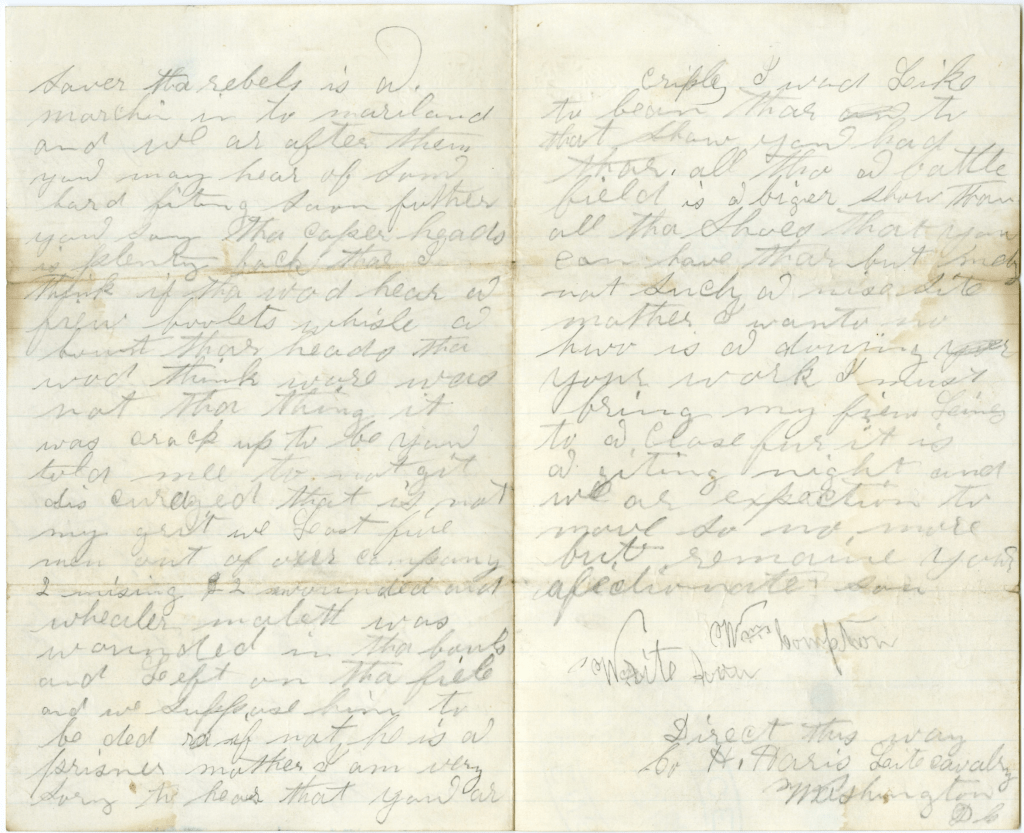
Well, Father, we have got back to the Army of the Potomac. We was in a fight on the [June] 9th at Brandy Station. It was a very hard cavalry fight. We had it hand to hand with the rebels. Our regiment made a charge and we had cutting and slashing. The fight was mostly done with the saver. The rebels is a marching to Maryland and we are after them. You may hear of some hard fighting soon.
Father, you say the Copperheads is plenty back there. I think if they would hear a few bullets whistle about their heads, they would think war was not the thing it was cracked up to be. You told me to not get discouraged. That is not my gripe. We lost five men out of our company, 2 missing, 2 wounded and Wheeler Mallett was wounded in the back and left on the field and we suppose him to be dead. If not he is a prisoner.
Mother, I am very sorry to hear that you are crippled. I would like to been there to that show you had there. Although a battlefield is a bigger show than all the shows that you can have there but maybe not such a nice sight.
Mother, I want to know who is doing your work. I must bring my few lines to a close for it is a getting night and we are expecting to move so no more but remain your affectionate son, — Wm. Compton
Write soon. Direct this way. Co. H, Harris Light Cavalry, Washington D. C.
William Compton
2 New York Cavalry, Company H Widow’s Certificate Pension 230113
RG 15
Records of the Department of Veteran’s Affairs






















 Spared & Shared 23