
The following letter was written by 18 year-old Winfield M. Perry of Co. M, 2nd New York Heavy Artillery. “Win” enlisted on 14 October 1861 at Utica, New York, mustering in as a corporal on 27 October 1861 to serve three years. Company M was sent to Washington D. C. where they were attached to Sturgis’ Command of the Military District.

Win reenlisted in November 1863 and was appointed sergeant in mid-February 1864. He was wounded in the hip on 3 May 1864 at Pamunkey, Virginia, and discharged for disability on 8 June 1865.
Win’s reenlistment is surprising given that he became quickly disillusioned with being a soldier. Shortly after enlisting he wrote his mother, “I think this soldiering thing is about played out and if I ever get out of this I scarcely think my patriotism will let me enlist again.” He admitted to his mother that he had enlisted out of a sense of patriotism and duty. Later in the letter, Perry wrote about abolitionism, saying that, “I see by the papers that Abolitionism has met with a serious chech [sic] in the state of N.Y. by this fall’s elections as well as in other states. I do not suppose that the elections pleased father much but I suppose that is where we would differ for I think they are capitall [sic] ones.” Here was another Utica native against the idea of abolition. He was fighting to preserve the Union, and he did not appreciate the efforts of the abolitionists. In January 1863, Perry wrote, “I guess the Abolitionists of Trenton will begin to think of something else besides niggers and money when they see this war touch as near home as it has within the last month.” He was content with the defeat of the abolitionists and the way that the 1862 elections had gone, even though his county remained a hotbed of Republican sentiment. Perry also commented on soldiers who did not enlist as early in the war as he had. Those that enlisted later were known as “bounty men,” while the original soldiers referred to themselves as “old soldiers.” He wrote, “Mother you can not imagine what a feeling there is between the old soldiers and the bounty men as these new Reg’ts are formed [sic].” The letter closed with the story of a bounty man who was bragging about his bounty, only to be ferociously beaten by more than twelve men, “because he said he enlisted for the bounty and not to fight.”
Just over three weeks after his January 1863 letter, Winfield Perry wrote home and expressed his undeniable opinion about abolition and, more specifically, the Emancipation Proclamation. Perry’s rant was an opinion that was not solely his; there were certainly a number of men who felt the same way.
But mother this Regt will never fight one inch to free the negroes. There are men in this Regt that would sooner fight the President himself than fight to free the negroes. It was not what they came for. They came to war for the union and if this is to be turned into a political war or in other words Abolition, Nigger, war they will not fight at all [sic]. I think these appropriations of money that Congress are making for the Negro had better be turned toward paying the soldiers who have been without pay for eight months. Their families at home in the poor house Suffering Starving [sic] even for the want of it. I need not go outside of this Co to find such cases. One Mr. Stowe of South Trenton or near there has a wife and three children his wife sick and the children not much better [sic]. They had to go to the Poor-house or Starve. Negro first and White Man afterwards is the motto of our government at the present day. It would seem as if our Army had lost confidence in their Commanders. The Commanders even themselves at the way this war is being carried on, it would seem as if nothing had gone right since McClellan and Battle have been Superceded for freeing men I believe never lived [sic]. Now do not think I am turning toward the rebels, but mother I did not come down here to fight [for] Niggers, and the long and short of it is, I won’t.”
As the war was ending, Perry’s opinions on Abraham Lincoln, and his policies changed somewhat. After the Civil War ended in April 1865, Perry was was still in the Army. He had been wounded in June 1864, and he was still trying to recover. He was in a hospital in Alexandria, Virginia when the war ended, and when Lincoln was assassinated. A man who had been so vocally against Lincoln’s proclamation went to visit the President’s remains in the capitol building. He wrote his mother of this experience and stated, “Mother it was to [sic] bad that “honest old Abe” was not allowed to live to see peace proclaimed. I can say nothing against him now.” [Source: Abolitionists or Volunteers, Historical Memory and Oneida County during the American Civil War, by Barry J. Fitzgerald; based on the Winfield M. Perry Papers housed in the Oneida Historical Society Manuscript Division.]
Transcription

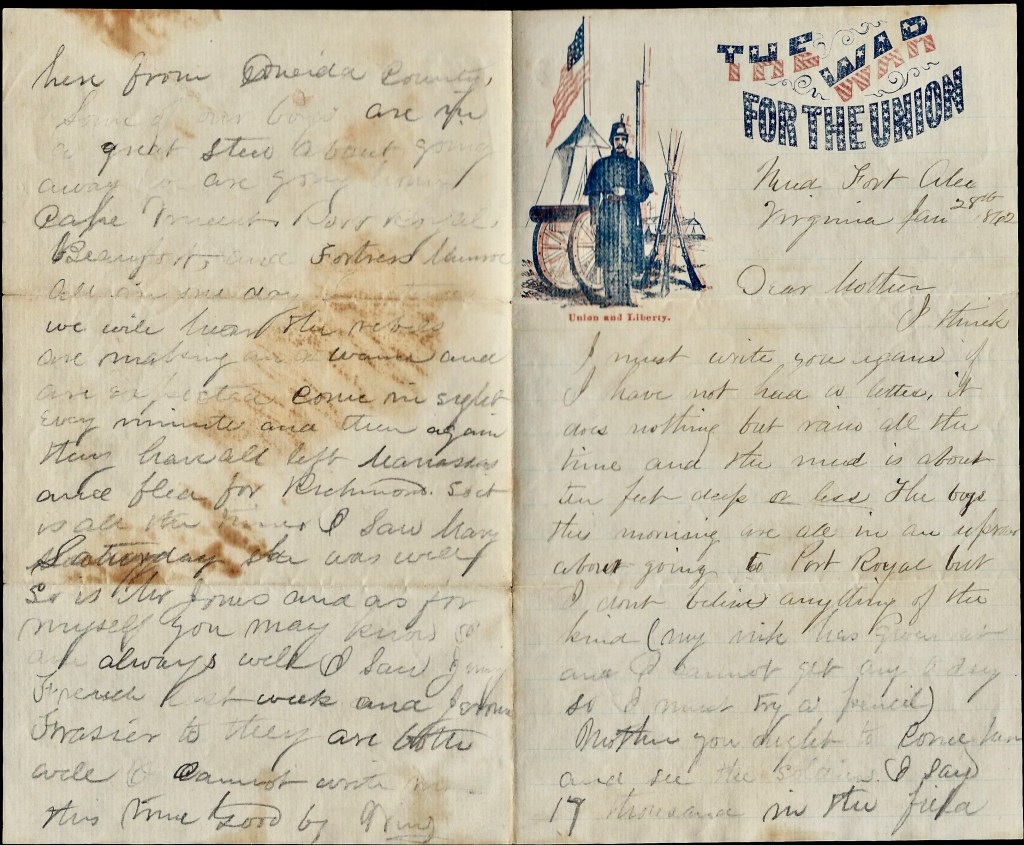
Mud Fort, Alexandria, Virginia
January 28, 1862
Dear Mother,
I think I must write you again [even] if I have not had a letter. It does nothing but rain all the time and the mud is about ten feet deep or less. The boys this morning are all in an uproar about going to Port Royal but I don’t believe anything of the kind (my ink has given out and I cannot get any today so I must try a pencil).
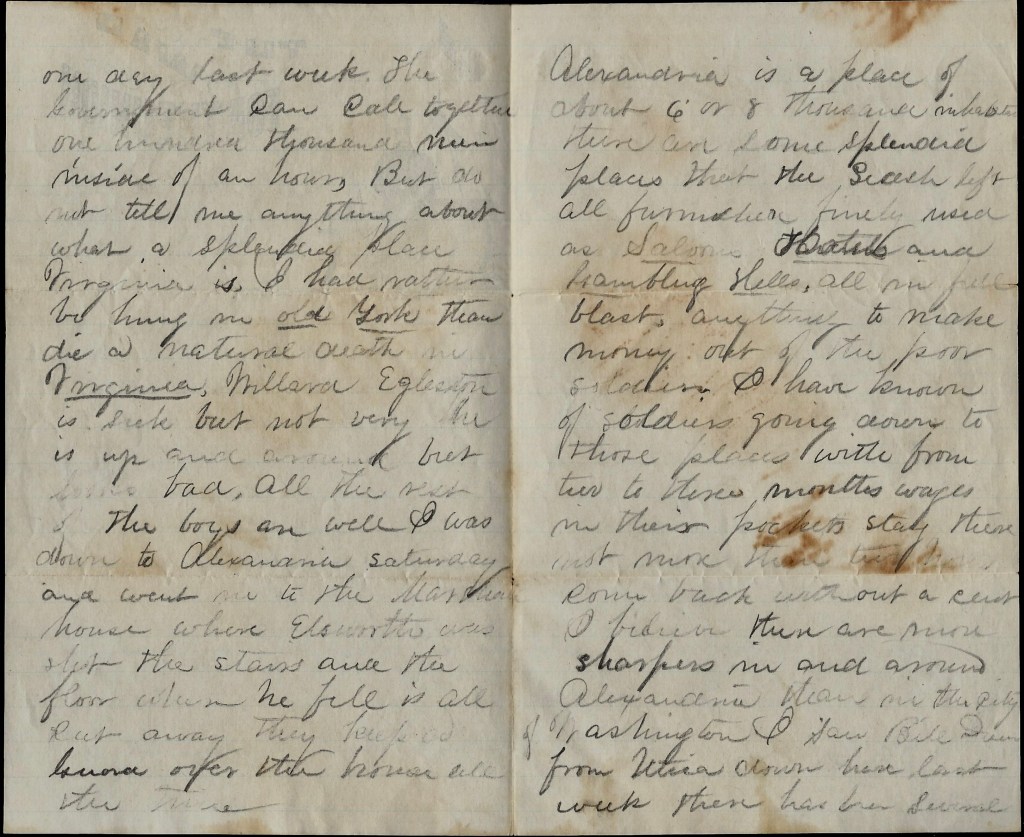
Mother, you ought to come here and see the soldiers I saw 17 thousand in the field one day last week. The government can call together one hundred thousand men inside of an hour. But do not tell me anything about what a splendid place Virginia is. I had rather be hung in Old York than die a natural death in Virginia.
Willard Egleston is sick but not very. He is up and around but looks bad. All the rest of the boys are well. I was down to Alexandria Saturday and went in the Marshall House where Ellsworth was shot. The stairs and the floor where he fell is all cut away. They keep a guard over the house all the time. Alexandria is a place of about 6 or 8 thousand inhabitants. There are some splendid places that the secesh left all furnished finely used as saloons, hotels and gambling halls all in full blast—anything to make money out of the poor soldiers. I have known of soldiers going down to those places with from two or three months wages in their pockets, stay there not more than two hours, and come back without a cent. I believe there are more sharpers in and around Alexandria than in the City of Washington.
I saw Bill Dunn from Utica down here last week. There has been several here from Oneida county. Some of our boys are in quite a great stir about going away or are going home, Cape Vincent, Port Royal, Beaufort, and Fortress Monroe all in one day. Sometimes we will hear the rebels are making an advance and are expected to come in sight every minute, and then again they have all left Manassas and fled for Richmond. Such is all the time.
I saw Mary Saturday. She was well. So is Mr. Jones and as for myself, you may know I am always well. I saw Jimmy French last week and Jerome Frasier too. They are both well. I cannot write more this time. Goodbye, — Win
 Spared & Shared 23