

The following letter was written by Ezra Greene, the son of Lawton Green (1811-1861) and Sarah Ann Card (1813-1904). Ezra learned the carpenter’s trade from his father and was a 22 year-old house carpenter when he mustered into Co H, 2nd Rhode Island Infantry on 5 June 1861. Company H was known as the Kentish Guards (being from Kent county) and were issued blue coats and grey trousers that no doubt added to the confusion in the fight at Bull Run.
Disenchanted with infantry service and disliking his commanding officers, Ezra shortly after the Battle of Bull Run volunteered for duty in the navy and was soon transferred.
See also—1861: Ezra Green to Susannah (Westcott) Greene published on Spared & Shared 13 in November 2017.
Transcription
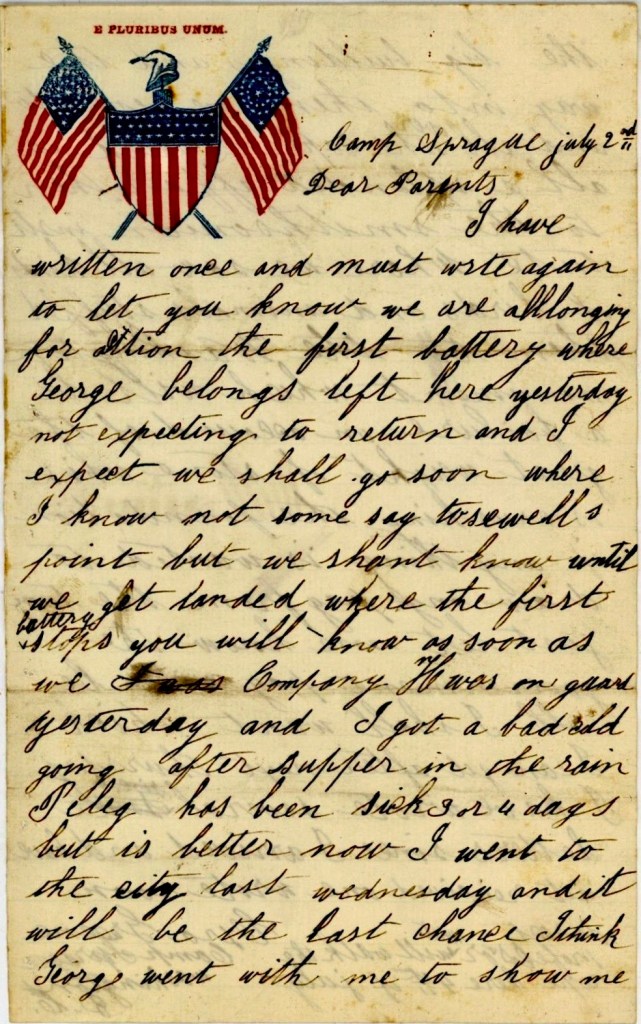
Camp Sprague 1
July 2nd [1861]
Dear Parents,
I have written once and must write again to let you know we are all longing for action. The first battery where George belongs left here yesterday not expecting to return and I expect we shall go soon. Where, I know not. Some say to Sewall’s Point but we shan’t know until we get landed. Where the first battery stops, you will know as soon as we.

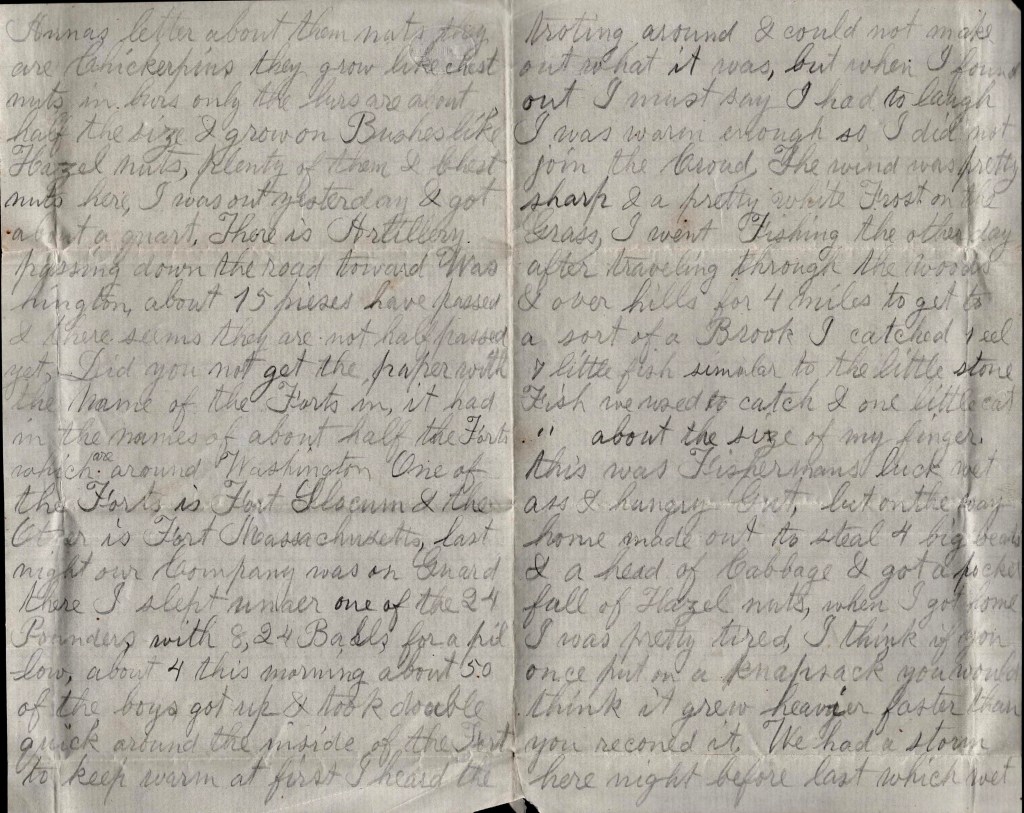
Company H was on guard yesterday and I got a bad cold going after supper in the rain. Peleg [Card] 2 has been sick three or four days but is better now. I went to the City last Wednesday and it will be the last chance, I think. George went with me to show me the big buildings and the way into them. We went into and all over the Capitol which is all a splendid affair. Then to the Smithsonian Institute where we saw all kinds of birds and animals stuffed. Then to the Washington Monument which will be a failure on account of the great weight of stone which is crushing the foundation. 3
If anything is wanted to draw my pay from the town, just let me know. The government pay will be all I shall want which I can get after next Thursday. I have wrote several letters since I arrived and have not received one. Write soon. — Ezra Greene, Camp Sprague, Washington D. C.
Professor [Benoni] Sweet 4 will walk the rope here 4th of July.
¹ Camp Sprague was located near Gales’ woods or G. Keating’s Farm, east of North Capitol Street in Washington D. C.
2 Peleg Card was Ezra’s cousin and served in the same company. Ezra was severely mortally wounded at the Battle of Bull Run some three weeks later. In a letter dated 4 August 1861, Ezra described returning to the battlefield during a lull in the fighting to find Peleg with a wound so severe that he made no attempt to remove him, electing instead to remain by his side until he expired. Remarkably, as he lay by his mortally wounded cousin, Ezra fell asleep from exhaustion only to be awakened by a renewal of the battle an hour later, at which time he retreated from the field and followed the remnants of his regiment as they straggled back toward Washington.
3 Construction on the Washington Monument was begun in 1848 but halted in 1854 when the Monument Society ran out of money. It was apparently widely known at the time of the Civil War that the foundation was suspected to be inadequate to support the weight of the stone and so before construction could resume in 1879, the first task was to strengthen the foundation. Lt. Col. Thomas Lincoln Casey, the engineer in charge, devised a way to underpin and widen the base. Construction was finally completed in 1884.
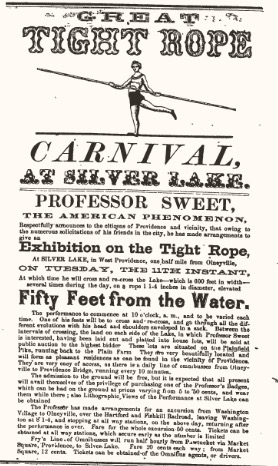
4 “Benoni Sweet” (b. 1840) of Phenix, Rhode Island, began performing feats of danger as a tight rope walker in 1859. “The year following his debut as a daredevil, Sweet was married on January 19, 1860, to Susan Colwell of Cranston. The newspaper announcement of the marriage referred to him as Professor Benoni Sweet. The title of Professor may have been intended to distinguish him from another Benoni Sweet in Rhode Island. Dr. Benoni Sweet, born in South Kingstown in 1840, came from a family that gained renown over generations for practicing the unique skill of setting broken bones (called bonesetting). Dr. Sweet too reached some acclaim for his ability to set broken bones. In 1861, with the outbreak of the Civil War, Sweet enlisted in the Union army. On July 4, Independence Day, just weeks before the disastrous battle at Bull Run, Rhode Island military units were encamped near Washington, D.C. at Camp Clark. Sergeant Elisha Hunt Rhodes noted in his diary, “Prof. Benoni Sweet, a member of Company H, Second Rhode Island gave an exhibition of tight rope walking.” (See Robert Hunt Rhodes, ed., All for the Union, The Civil War Diary and Letters of Elisha Hunt Rhodes (New York, 1991), page 13). In August 1861, Sweet walked across Pennsylvania Avenue from the National Hotel to the Clarendon Hotel. The walk was witnessed by President Abraham Lincoln and his wife, Mary. Appreciating the welcome distraction from war, Lincoln reportedly presented Sweet with a gold dollar.


 Spared & Shared 23