Category Archives: 2nd U. S. Sharpshooters

1862: Samuel Borrowe Rees to Catherine (Hallett) Rees

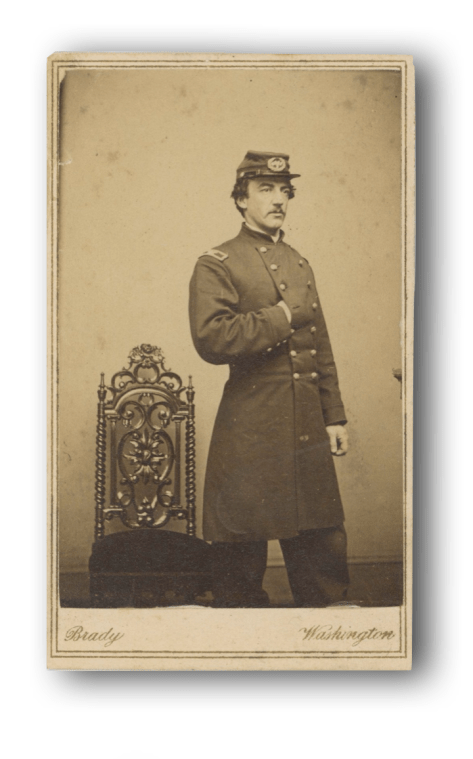
I could not find a war-time image of Samuel but located this tintype of his older brother Thomas Rees who served in the same company. (Brian White Collection)

This letter was written by Samuel Borrowe Rees (1844-1932) who served with his older brother, Thomas M. Rees (1837-1888) in Co. A, 2nd U. S. Sharpshooters. Company A was raised in Minnesota on October 5, 1861. He was born at Sodus Point, Wayne county New York, and moved with his family first to Bersheba Springs, Tennessee in the late 1840s, and then to Leech Lake, Minnesota in 1857. His father was Charles Williamson Rees (1807-1870) and his mother was Catherine Hallett (1810-1893).

Samuel and Thomas were part of the famous Berdan’s Sharpshooters. Thomas served with the Sharpshooters until his discharge on September 22, 1864. Samuel was wounded in the Battle of Antietam on 17 September 1862 and was discharged on 26 November 1862.

T R A N S C R I P T I O N

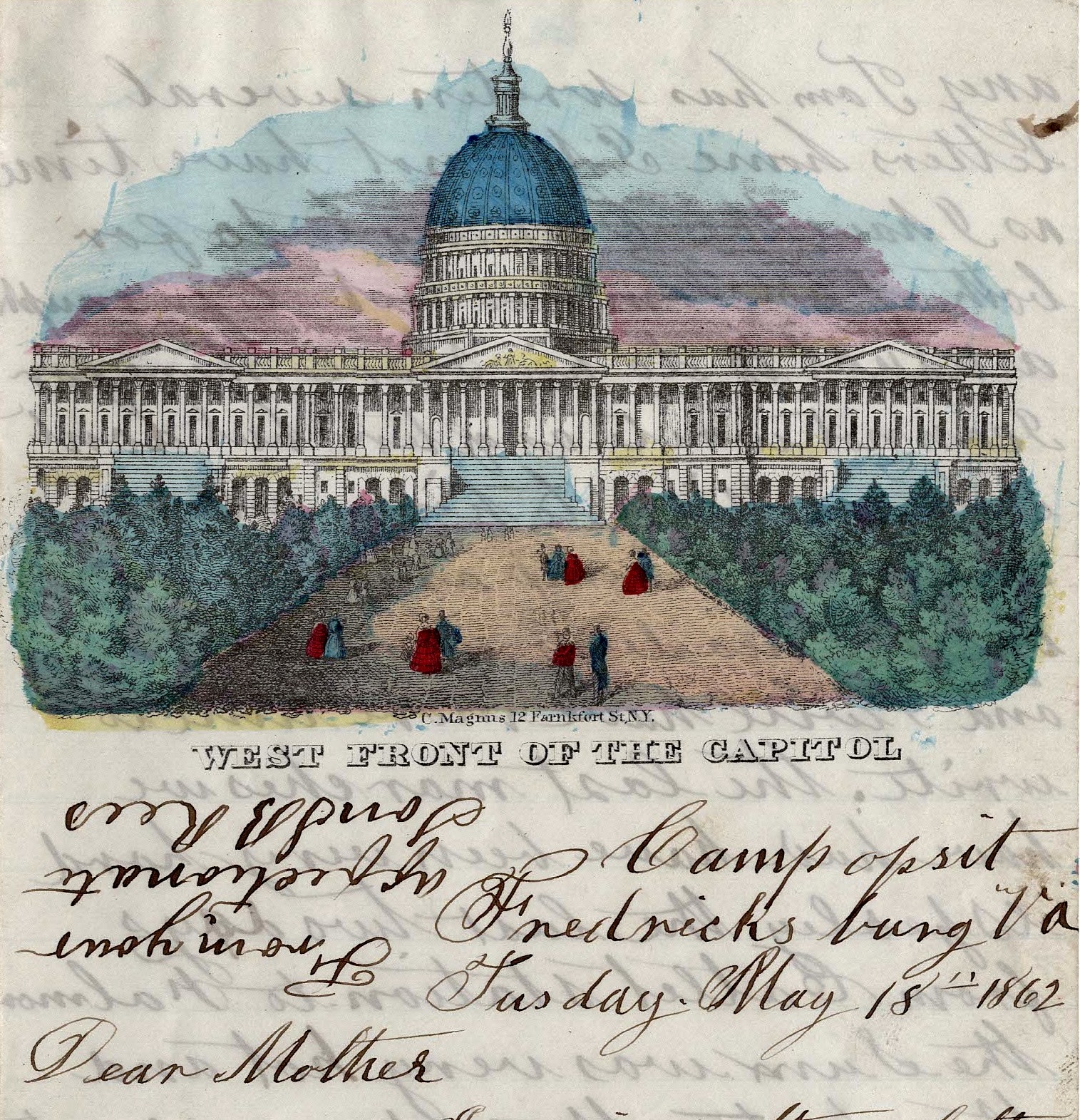
Samuel’s letter was written on stationery featuring a colored lithograph of the “West Front of the Capitol” by C. Magnus.

Camp opposite Fredericksburg, Va.
Tuesday, May 18, 1862

Dear Mother,

I received three letters from home the other day, the first mail that we have had in our Brigade for three weeks. We have been on the march for the last three weeks; therefore not having a chance either to get our mail or send any. Tom has written several letters home. I did not have time as I have the cooking to do for both of us. Tom has not life enough as usual to do his share. Therefore I cannot write as often but don’t say anything to him.

We are in our old camp as you will see by the heading of my letter and I will have more time to write. The last marches we have had have been very hard—especially the last two days from Catlett’s Station to Falmouth. The sun was very hot and they put us through in a forced march, notwithstanding that three men and three mules dropped dead by the road side for the want of rest and the sun so hot that they were sun struck. And a good many are still suffering from its effects.

Col. Henry Alberton Van Zo Post commanded the 2nd US Sharpshooters in 1862.

Notwithstanding all this, after a short rest, when the regiment was ordered to fall in to continue the march, one man who happened to be at a short distance eating a few cherries did not fall in quick enough to suit the Colonel [Henry Alberton Van Zo Post] and he tore down to where the man was and, riding his horse behind the man, made him run to the front of the regiment where he had four men with fixed bayonets to make him march at the point of the bayonet. This he laughed at.

The same day he kicked Capt. [Henry M.] Caldwell [of Co. F] in the back and ordered him to the rear of the regiment under arrest because he told a tired man to fall out of the ranks and rest. The Colonel has since offered said Captain his sword if he would let it pass. The Captain said to him he did not wish his sword but that he would have him put through to the extent of the law. Peleter is also under arrest because the Colonel took a Sharps rifle and beat his with Colts. Peleter is fighting mad because we have got that cause of so much trouble.

The Sharps rifle is a splendid gun, set lock and bronze barrel. We have just been paid off, dear mother, and I will send twenty-five dollars to you to use. I do not wish you to save any for me. I would rather you would use it and get all you want. Give my love to all and tell them I will write soon. It is getting time for dress parade and I must stop. From your affectionate son, — S. B. Rees

1863: Charles H. Forristall to Hattie & Florence

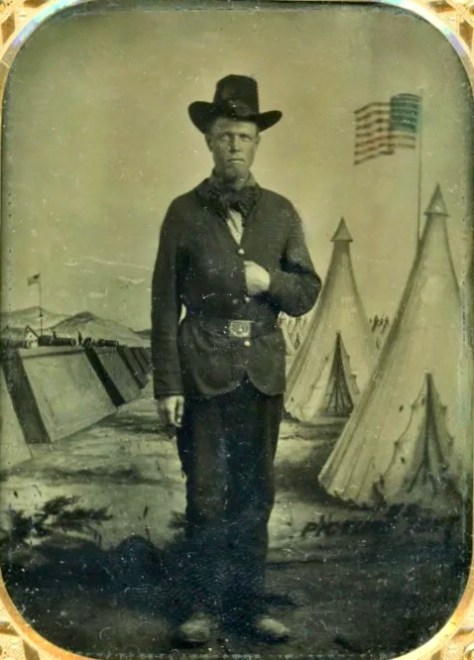
An unidentified member of the 2nd US Sharpshooters (Brian White Collection)

The following letter was written by Charles Hendrich Forristall (1841-1917), the son of Thomas Forristall (1810-1887) and Mary S. Morse of Fitzwilliam, Cheshire county, New Hampshire. Charles enlisted on 21 October 1861 in Co. F, 2nd US Sharpshooters and served three years, mustering out on 26 November 1864. Charles signed his surname with only one “r” in this letter but the family name on the grave markers is spelled with two.

I’m not certain who Hattie or Florence were, to whom he addressed the letter. His younger siblings were named Sarah, Levi, and Susan.

Charles’ letter speaks of the number of soldiers dying in Washington during the winter of 1861-62. He also describes the typical soldier burial including the time honored tradition of the three volley salute, firing three rounds into the air.

T R A N S C R I P T I O N

C. Magnus Illustrated Letterhead with images of St. Matthew Church, Trinity Church, U. S. Arsenal, and Military Asylum

Washington [D. C.]
Tuesday, January 28, 1862

Dear Hattie & Florence,

I now sit down to answer your letter that I received last Sunday. You wrote that you should of answered my other letter before you did if you could found time. You must answer this as quick as you can for I have got a picture of all the principle buildings in Washington, Now Hattie, if you will answer this before Florence, I will send it to you. But if Florence gets the start and answers it first, I will send to her.

I am in good health now. I had a letter from Charles S. Blodgett the other day. He wrote that he was well. It rains here today. I don’t have much to do now for it is so muddy. You wrote there was going to be dances at the Town Hall once a fortnight. If I was there I would go too but I am too far off for that this winter.

I have some good times and some times that I never thought of seeing. [A] soldier’s life is hard—especially them that are sick. There was a time that they died four and five every day for five weeks. Now they average about one. The way they bury the dead soldiers here is in this way. The minister says a few words, and ten soldiers are detailed out of the company to carry loaded guns. They follow the corpse to the grave and when the corpse are in the grave, they all fire three times together and then they fall in and march back to the camp.

I cannot think of anything more to write this time so good night.

From your friend, — Charles H. Foristall

1861: James F. Salley to Mary F. Salley

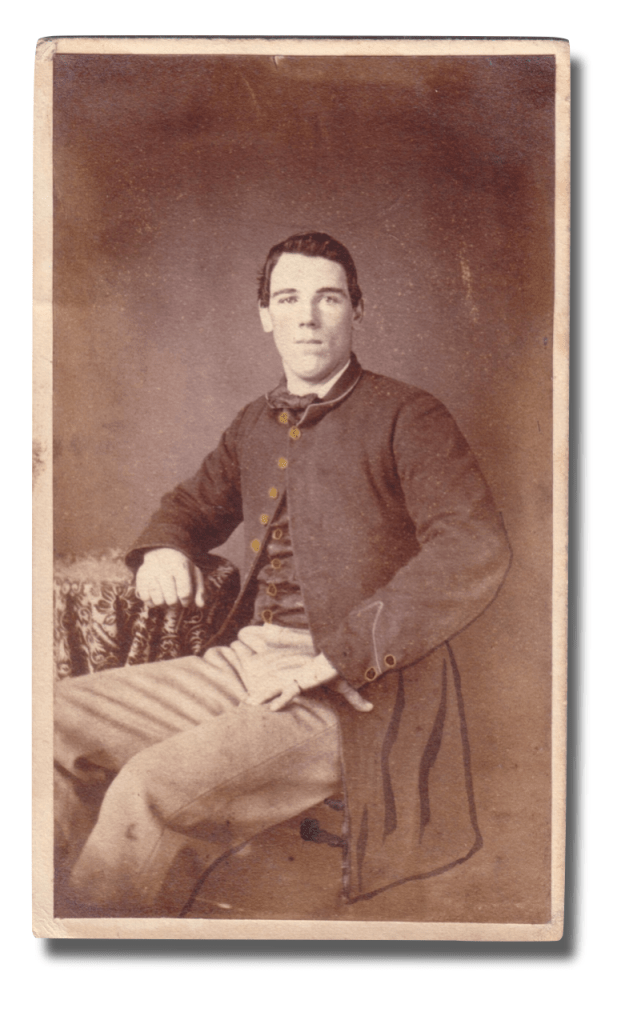
James F. Salley, 2nd US Sharpshooters, Co. D, Maine. (Brian White Collection)

This letter was written by James F. Salley (1843-1864), the son of Ephraim Salley and Mary F. [Liniston] of Madison, Somerset county, Maine. James enlisted on 2 November 1861 when he was 19 years old in the 2nd United States Sharpshooters, Co. D (Maine). This regiment was placed in the defenses of Washington D. C. until April 1862 and were part of the “First Iron Brigade.” The regiment was broken up on February 20, 1865, and Company “D” transferred to the 17th Maine Volunteer Infantry Regiment. The regiment suffered loss of 8 officers and 117 enlisted men who were killed in action or mortally wounded and 2 officers and 123 enlisted men who died of disease, for a total of 250 fatalities.

James was one of those who did not return home. He was killed in action on 9 June 1864 in the multi-day Battle of Cold Harbor. He was initially buried on McGhee’s Farm (at the intersection of Gaines’ Mill and Cold Harbor) but later moved to the Cold Harbor National Cemetery.

Note: This letter is from the personal collection of Greg Herr and was made available for transcription and publication on Spared & Shared by express consent.

Transcription

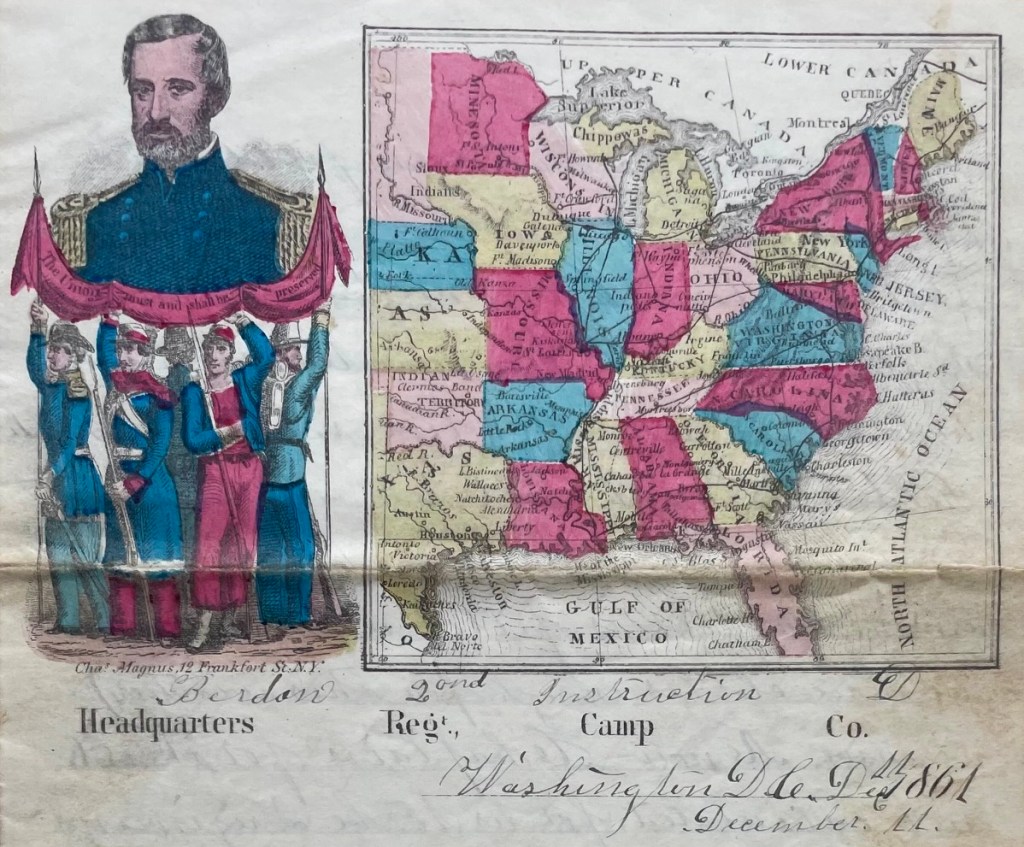
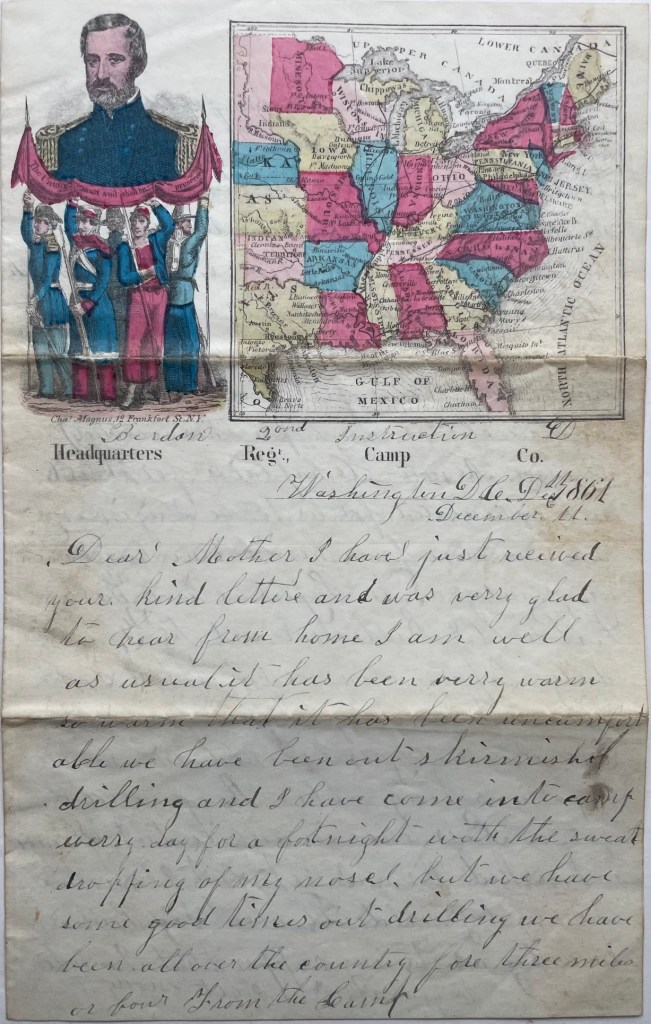
Patriotic letterhead “The Union Must & Shall be Preserved” on Salley’s letter.

Washington D. C.
December 11, 1861

Dear Mother,

I have just received your kind letter and was very glad to hear from home. I am well as usual. It has been very warm—so warm that it has been uncomfortable. We have been out skirmish drilling and I have come into camp every day for a fortnight with the sweat dropping off my nose. But we have some good times out drilling. We have been all over the country for three miles or four from the camp. We have been through cornfields with the corn all standing but you may guess that the boys have parched corn after we go through one.

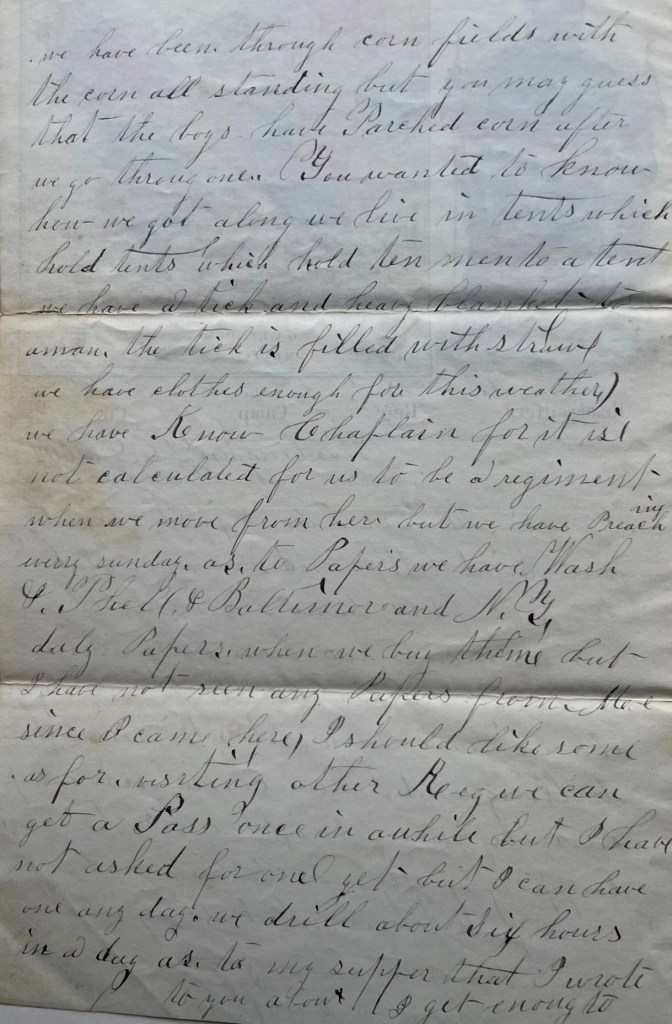
You wanted to know how we got along. We live in tents which hold ten men to a tent. We have a tick and heavy blanket to a man. The tick is filled with straw. We have clothes enough for this weather. We have no chaplain for it is not calculated for us to be a regiment when we move from here but we have preaching every Sunday. As to papers we have Washington & Philadelphia & Baltimore and New York daily papers when we buy them but I have not seen any papers from Maine since I came here. I should like some.

As for visiting other regiments, we can get a pass once in a while but I have not asked for one yet. But I can have one any day. We drill about six hours in a day. As to my supper that I wrote to you about, I get enough to make me as fat and lazy as a hog. We have shoes. I received Cephas’s letter at the same time that I did yours. Tell him that I will write in a few days. I have written to Sabrina but I have not heard from her yet.

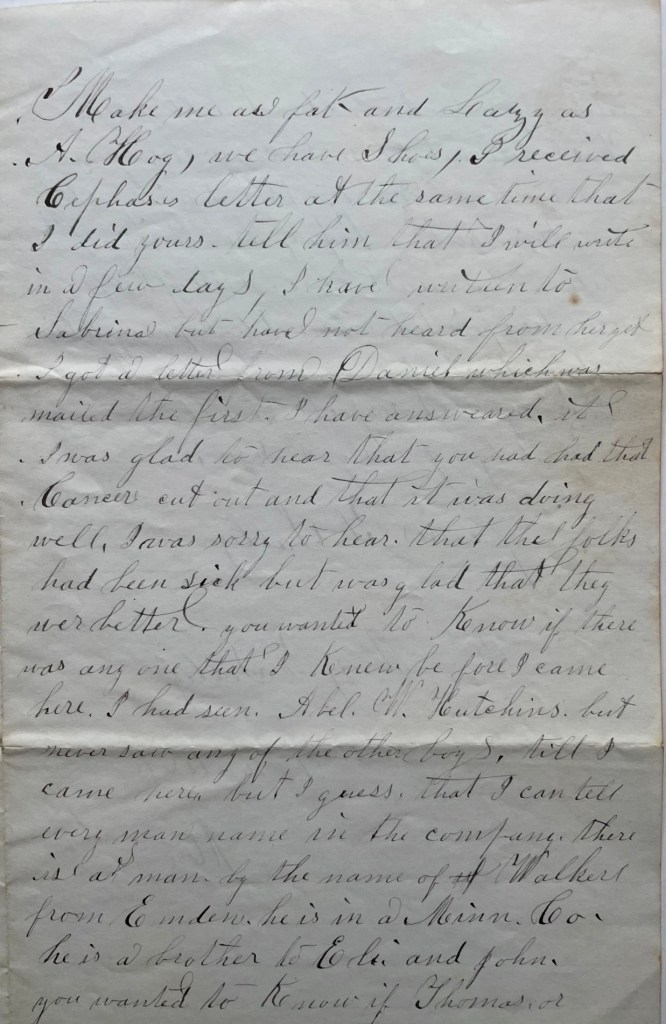
I got a letter from Daniel which was mailed the first. I have answered it. I was glad to hear that you had had that cancer cut out and that it was doing well. I was sorry to hear that the folks had been sick but was glad that they were better. You wanted to know if there was anyone that I knew before I came here. I had seen Abel W. Hutchins but never saw any of the other boys till I came here but I guess that I can tell every man name in the company. There is a man by the name of Walker from Emden. He is in a Minn. Co. He is a brother to Eli and John.

You wanted to know if Thomas or Thompson. I could not tell which was here but I do not know who you meant. Tell Amelia that I will give her this sheet of paper. But it is getting late and I must close. Write often for I am disappointed when I look for a letter and it does not come. Write all the news. Give my best respects to all. Goodbye from your son, — James T. Salley

To Mary F. Salley of Madison, Maine