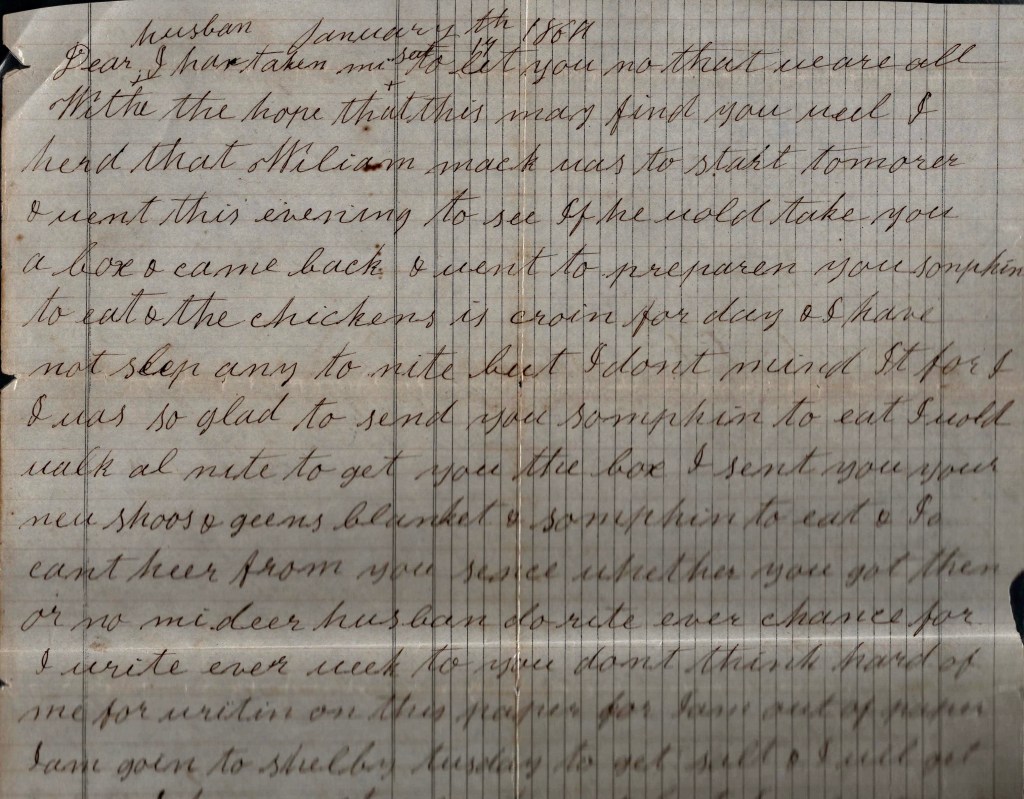
This letter originated as a letter from Mary Ann (Griffith) Green (1822-1906) to her husband James Lee Green (1822-1864) while he was serving as a private in Co. H, 30th North Carolina Infantry. The couple made their home in Rutherford county, North Carolina, and two of their four children are mentioned—George Washington Green (1858-1933) and Jasper L. Green (1860-1913).
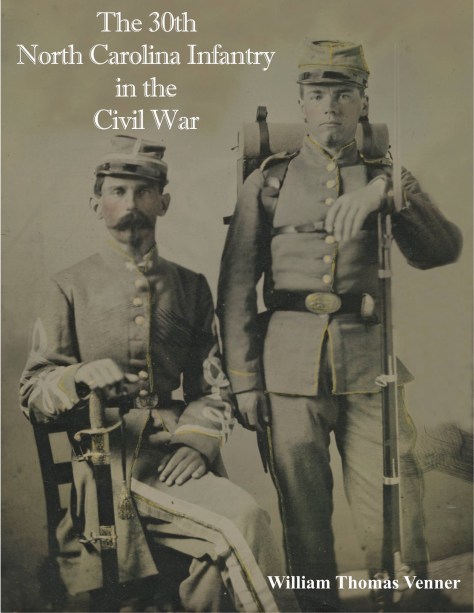
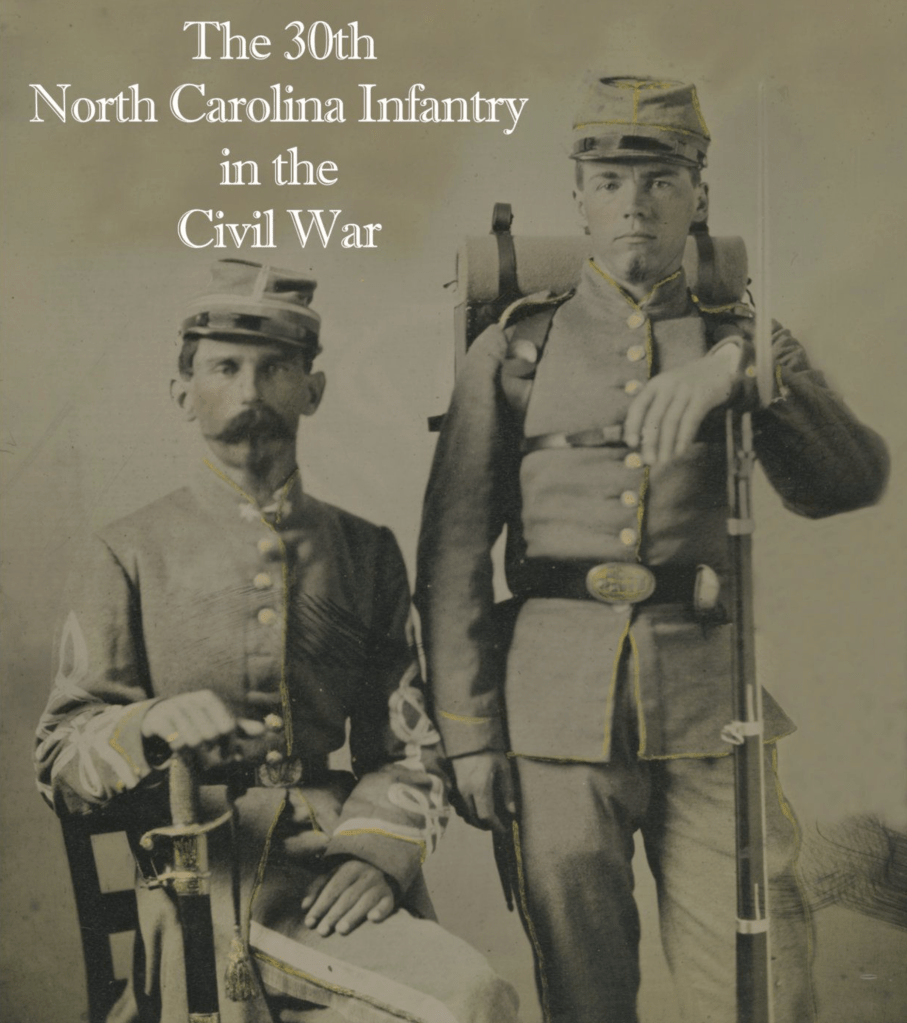
The jacket cover of William T. Venner’s book published in 2016.
The experiences of the Green family during the Civil War are meticulously documented in the book, “A Broad River Digest,” compiled in 1991 by Irene Roach Delano, a direct descendant. The narrative reveals that James entered military service in the spring of 1862. Prior to his departure to join his regiment, he took the necessary steps to ensure his affairs were in order, which included drafting his will and commissioning family portraits. Two of these portraits are featured in Delano’s work. Throughout his service in the Confederate army, James and Mary Ann maintained a profound emotional connection, exchanging heartfelt letters that conveyed their enduring love. These letters are currently preserved by Irene Delpino; however, it remains unclear whether this specific letter was included in that collection.
In May, 1864, James Lee was captured at the Battle of Bloody Angle in Spottsylvania Courthouse, Virginia, and transferred to the prison at Elmira, New York. In June of that year he wrote Mary Ann advising her of his capture, as well of his illness. On October 4, 1864, he died of dysentery at Elmira and was buried at the Woodlawn National Cemetery, in Elmira, in lot number 600W.N.C.
James does not give the location of his regiment but the regimental history indicates they would have been with the Army of Northern Virginia encamped somewhere along the Rapidan river.
T R A N S C R I P T I O N
January 14, 1864
Dear husband,
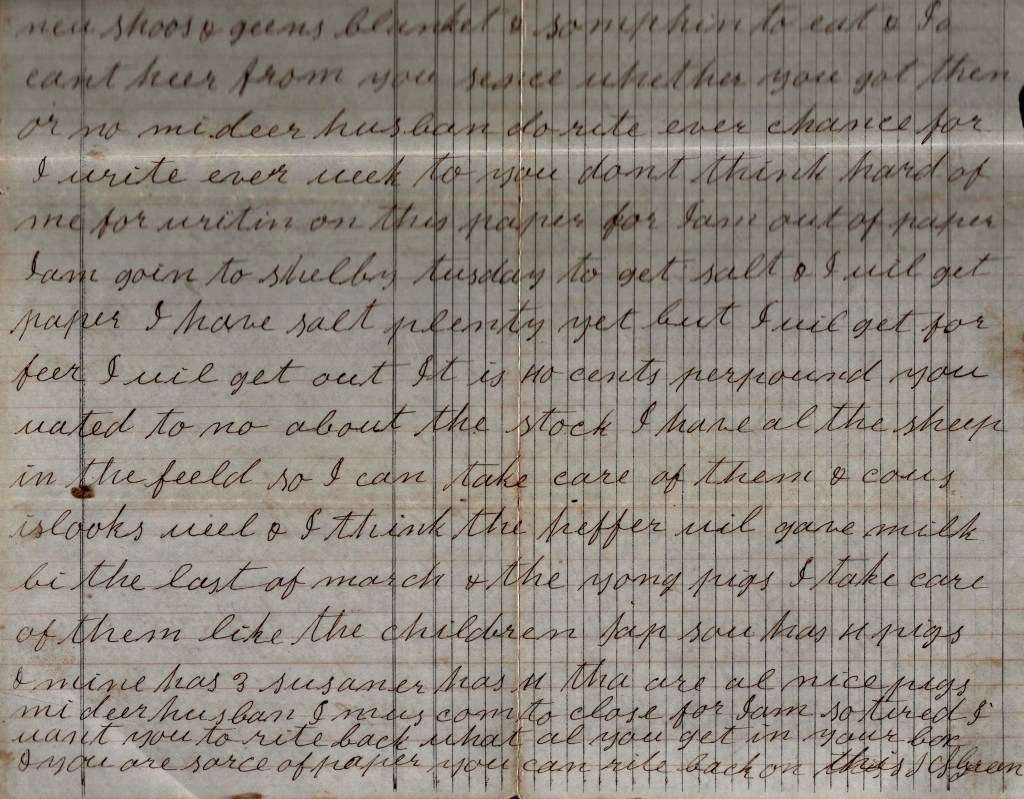
I have taken my seat to let you know that we are all with the hope that this may find you well. I heard that William Mack was to start tomorrow [for the regiment] and went this evening to see if he would take you a box & came back & went to preparing you something to eat & the chickens is crowin’ for day & I have not slept any tonight but I don’t mind it for I was so glad to send you something to eat. I would walk all night to get you the box. I sent you your new shoes and jeans, blanket, and something to eat & I can’t hear from you since whether you got them or no. My dear husband, do write every chance for I write every week to you. Don’t think hard of me for writing on this paper for I am out of paper. I am going to Shelby Tuesday to get salt and I will get paper. I have salt plenty yet but I will get [more] for fear I will get out. It is 40 cents per pound.
You wanted to know about the stock. I have all the sheep in the field so I can take care of them & cows is looking well & I think the heifer will give milk by the last of March & the young pigs, I take care of them like the children. Pap’s sow has 4 pigs and mine has three. Susan has 4. They are all nice pigs. My dear husband, I must come to a close for I am so tired. I want you to write back what all you get in your box & if you are scarce of paper, you. can write back on this.
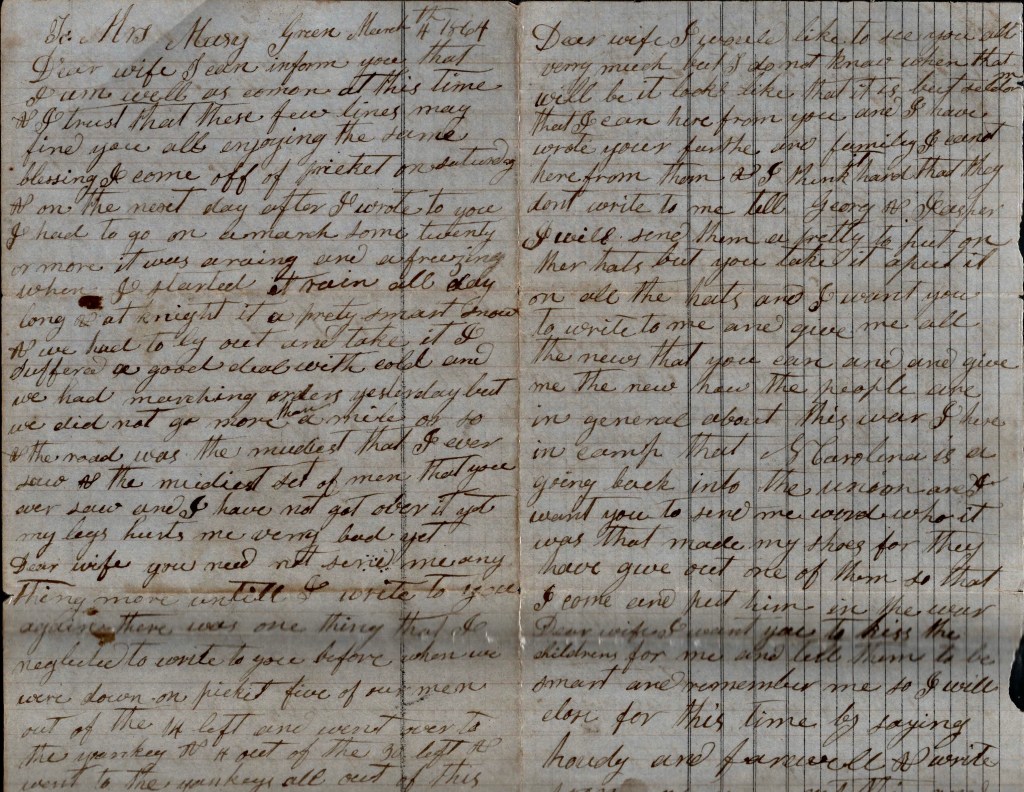
To Mrs. Mary Green March 4th 1864
Dear wife,
I can inform you that I am well as common at this time & I trust that these few lines may find you all enjoying the same blessing. I come off picket on Saturday & on the next day after I wrote to you I had to go on a march some twenty or more [miles]. It was a raining and a freezing when I started. It rained all day long and at night it [turned into] a pretty smart snow & we had to lay out and take it. I suffered a good deal with cold and we had marching orders yesterday but we did not go more than a mile or so & the road was the muddiest that I ever saw & the muddiest set of men that you. ever saw. And I have not got over it yet. My legs hurt me very bad yet.
Dear wife, you need not send me anything more until I write to you again. There was one thing that I neglected to write to you before. When we were down on picket, five of our men out of the 14 left and sent over to the Yankees and 4 out of the 30 left & went to the Yankees—all out of this brigade & two of them was out of my company & I was not close to them when it took place. One of them was my best friend—Hunter, my great mate. Hunter and Branch were the men’s names that deserted.
I want you to write to me how you are a getting on with your crop & I want you to move the cross fence at the upper side of the column [?] and tend all the good ground in it and also tear it out at the lower side & clean up around that big dead pine and you will have to get somebody to clean out the ditches.
Dear wife, I would like to see you all very much but I do not know when that will be. It looks like that it is but seldom that I can hear from you and I have wrote your father and family [but] I cannot hear from them. I think hard that they don’t write to me. Tell George & Jasper I will send them a pretty to put on their hats but you take it and put it on all the hats and I want you to write to me and give me all the news that you can. And give me the news how the the people are in general about this war. I hear in camp that South Carolina is a going back into the Union and I want you to sends me word who it was that made my shoes for they have give out—one of them—so that I come and put him in the war.
Dear wife, I want you to kiss the children for me and tell. them to be smart and remember me. So I will close for this time by saying howdy and farewell & write soon as you get this and let me hear from you. I remain your true friend until death, — J. L. Green
The following letter was written by Weldon Edwards Davis (1838-1863), the son of Edward (“Ned”) Davis (1806-1895) and Rebecca (“Becky”) O. Pitchford (1812-1900). Weldon grew up on his father’s plantation, “Lake O’ the Woods,” some 15 miles south of the city of Warrenton, Warren county, North Carolina. Weldon’s station in life as the son of a wealthy planter family combined with an above average education received at the University of North Carolina (A. B. 1861) no doubt resulted in his election as Third Lieutenant of Co. B (the “Nat Mason Guards”), 30th North Carolina Infantry, when they were organized in August 1861. His rise in rank did not take long. By late September 1861 he was promoted to 2nd Lieutenant and by the first of May 1862 to 1st Lieutenant. When Capt. William C. Drake resigned his commission on 10 December 1862, Weldon was elevated to command of the company, though he would not receive his official commission until 13 June 1863. Company records suggest that Weldon commanded his company as early as the summer of 1862 (at Malvern Hill) in the absence of his captain. He remained the captain of his company until he was cut down in the fighting at Kelly’s Ford on 7 November 1863 with a shattered leg that resulted in his capture, amputation, and death in Douglas Hospital in Washington D. C. on 22 November 1863.
The digitized transcript of the following letter can be found with many others of the Davis family in a collection housed at the Wilson Special Collections Library at UNC entitled, “Rebecca Pitchford Davis Letters, 1855-1899.” The collection does not state where the original letters may be found except to say they were “in private hands in 1955.” The type-written transcripts were donated to the library in 1958 by Blanche Egerton Baker who is credited with having performed them.
Normally I do not post transcripts performed by others, especially when I cannot verify the accuracy of the transcript against the original handwriting, but as a courtesy to a Spared & Shared follower and a descendant of Weldon’s parents named Betsey Brodie Roberts who kindly provided me with a PDF of family letters, I have decided to post three of Weldon’s letters—one of them describing the Battle of Chancellorsville and the other two from before and after the Battle of Gettysburg. Historians will recall that the 30th North Carolina joined the 2nd, 4th, and 14th North Carolina regiments in a brigade led by Stephen D. Ramseur and they had the honor of leading Stonewall Jackson’s flank attack on Hooker’s army at Chancellorsville.
Betsey informs me that the original letters are “still in Chapel Hill” but they do not appear to be digitized. I found a partial transcript of the Chancellorsville letter that was published on page 150 in a book entitled, “Mama, I am yet still alive: A composite Diary of 1863 in the Confederacy” by Jeff Toalson. I could not find evidence that the other two had ever been published. Betsy also informs me that some of the family letters may have been published in 1956 in the book, “Rebel Boast” by Manly Wade Wellman but I could not verify that.
Letter 1
Camp near Fredericksburg, Va. May 14, 1863
Dear Ma,
I wrote to you the day after I got back to camp from the battlefield and will now write according to promise, fearing that letter may not have reached its destination. We left the battlefield Wednesday the 6th inst., about 3 o’clock in the evening and marched back to our same old camp (about fifteen miles) without ever stopping to rest. For a good part of the way the rain was falling almost as hard as I ever saw it, and the mud was almost half leg deep a great part of the way.
Our regiment had 29 killed and about 125 wounded; don’t know how many of them have since died. Our Brigade carried into the fight a little over 1400 men and nearly 700 of them were killed, wounded and taken prisoners. Fortunately the number of killed was small compared to the number of wounded and most of the wounds were only slight.
From the jacket cover of William Thomas Venner’s book
Our Brigade suffered more than any I have heard of. We were in the hottest of the fight for nearly four hours and twenty minutes. Saturday night the Yankees threw up a breastwork and then cut down the trees for fifty yards all along in front of it. Sunday morning [May 3rd] we had to charge that breastwork over the tops and logs of those trees, and in that charge we suffered heavily. The Yankee flag was flying over the works until we got in about 40 yards of it, and then it got away from us. But I think our regiment killed many a Yankee in their retreat from that place. Their dead lay scattered through the woods for over two hundred yards. At that breastwork I witnessed a circumstance that I had never heard of before. There was a brigade of our men on our left who came to the works just before we did, and when we came up, that brigade was on one side, and a Yankee brigade on the other side of the works, and each man would stoop down to load his gun and then poke it over the top to shoot, then dodge back to load again, nothing between them but the thickness of the works.
Bob and Amos Williams stood up well all through the fight and both came out without a scratch. Ben Davis was taken sick late Saturday evening and did not get in the fight. If I had known the fighting was going to end Sunday evening I could have saved sugar and coffee enough to have lasted me a month or two. We got some of the nicest soap you ever saw and many of the boys supplied themselves with writing paper for some time to come. I didn’t even save a streaked cotton shirt as many as there were and bad as I needed them.
None of the wounded of our company have died since Sunday that I have heard of. All were sent to Richmond the Saturday after the fight. I went nearly all over the battlefield after the fight and I feel confident there were ten Yankees killed to one of our men. Can’t say anything about the proportion of the wounded. Yankee papers and Confederate papers may say what they please, but our army knows we have whipped them this time for they have seen it to their own satisfaction and there can be no doubt of it for we were two days on the field and each and every man could see for himself.
But for the hard rain Tuesday, we could almost have ruined the Yankee army. Our army formed three sides of a square and the river the fourth side. The Yankees were in there and the shot and shell from our artillery could meet in the centre. We had everything ready to begin upon them Tuesday when the rain fell in such torrents as to break it up and that night they skedaddled across the river.
Tell Pat I have safely passed through one more fight and intend to come home before the next one if I possibly can. There doesn’t seem to be much chance for it now though.
As ever, your affectionate son, — Weldon
I will send three Yankee letters I picked up on the field, more because they came from Yankeedom that for their contents, There may be a little extra postage on them. Your son, — Weldon
Letter 2
Carlisle, Pennsylvania June 28, 1863
Dear Ma,,
Your letter of June 3rd came to hand this morning, being the first mail we have received since leaving Fredericksburg. I was very glad indeed to get it too for it seems to have been so long since I had heard from home. I wrote to you from Hagerstown, Maryland, but don’t know that you will ever get that letter or this one either, for there is no regular mail and I gave it to a citizen who promised to send it to Winchester.
Our progress from Fredericksburg to Carlisle has been a series of complete victories, so easily won that we have not yet fired a gun. It is only 18 miles from here to Harrisburg and I hear that the Pennsylvania militia are preparing to meet us there. I never saw our army in finer condition for fighting in my life. Everybody seems to be in good spirits: there are but few sick ones, though some have sore feet.
The people about here are the most surprised that you ever saw. They say they thought nearly all the southern soldiers were killed long ago and the rebellion about to be crushed. Little did they think three weeks ago that their state would be invaded at this time. We are now quartered (that is, three North Carolina brigades) 1 in the old U. S. Barracks just in the edge of town. They consist of seven or eight buildings, each about one hundred yards long, and each containing about fifty or sixty rooms, besides numerous other smaller buildings. This place reminds me very much of Chapel Hill.
Saw Tom today. He is well. Said he wrote home only two or three days ago. There is so much news to tell that I never can think of writing it all. Hope I may be able to get home after awhile and give it all then. There is no danger of our suffering for anything to eat in this campaign for I have seen more wheat that I ever saw in all my life together before. There is very little woodland about here and the whole face of the earth is almost one big wheat lot with large clover and grass lots scattered here and there.
When I wrote home from Hagerstown, I only found out about fifteen minutes before dark that there would be an opportunity to send a letter next morning so I had to write mostly in the dark, and it was so dark that I could not make out the words after I had written them which will account for the bad writing.
Bob Williams says to tell his folks that he is all right, well and hearty as ever, and so am I with the exception of a cold and slight headache. When you write to any of us, just mention the company, regiment, brigade, division, and corps, Winchester, Virginia. I have a nice little Yankee portfolio with just as much paper as I want but it is all small like this sheet.
Nothing more at present. As ever your son, — Weldon
1 Hokes, Steuart’s, and Ramseur’s Brigades.
Letter 3
Hagerstown, Maryland July 8th 1863
Dear Ma,
Your letter of the 3rd inst. came to hand while we were in Carlisle, Pennsylvania. It seems that you had no idea at that time that we were going to Maryland so soon. Well we knew nothing of it either. A few days before starting we learned the army was going to start somewhere pretty soon but where to, we could not tell. The Yankee prisoners taken at Gettysburg say that they did not know we had left Fredericksburg until the 12th. We had gotten to Front Royal in the Valley [and] had been on the march eight days. I wrote home from Hagerstown before [but] don’t know though that you ever received my letter. From there we went into Pennsylvania for the purpose of collecting horses and cattle. Our army went to within 18 miles of Harrisburg, [but] hearing that the Yankees were collecting in our rear, we were forced to turn back [and] met them at Gettysburg on Wednesday the 1st of July—the anniversary of the Malvern Hill fight—and whipped them again. Took ten thousand prisoners. Also took their hospitals with all their wounded. The dead Yankees lay over the battlefield almost as thick as they did at Chancellorsville.
The Yanks retreated to the foot of the mountains where they made another stand, and their position was such a strong one that we could do nothing with them. I am afraid rather lost by it. There were two wounded in our company—Bob Williams slightly on top of his head, and Lieut. Loughlin’s brother, slightly through the leg just above the knee. Wharton Green was wounded very badly; also Lt. Mosely of the 12th. All of our neighborhood boys escaped unhurt except Bob Williams. Gus Kearney was killed. The 12th Regiment actually clothed itself in honor this fight. Three regiments of their brigade were taken prisoners, but the 12th kept fighting, would not surrender, and by itself held the line marked but for their whole brigade.
During the fight our wagon train went to the rear for a place of safety but went too far and a few Yankee cavalry made a dash on them, run off the Guard, and destroyed thirty or forty and carried off a few others. Our baggage wagon was among those destroyed so I have lost all my clothes again. They have sent for the mail to go off. I have time to write no more.
As ever, your son, — Weldon
P. S. I wrote a letter while at Carlisle but have had no chance to send but will send it now though it is out of date. — Weldon
Capt. Weldon E. Davis is buried in Arlington Cemetery




 Spared & Shared 23