Category Archives: 31st Iowa Infantry

1862: John Henry Hedges Cross to Catharine (Hedges) Cross

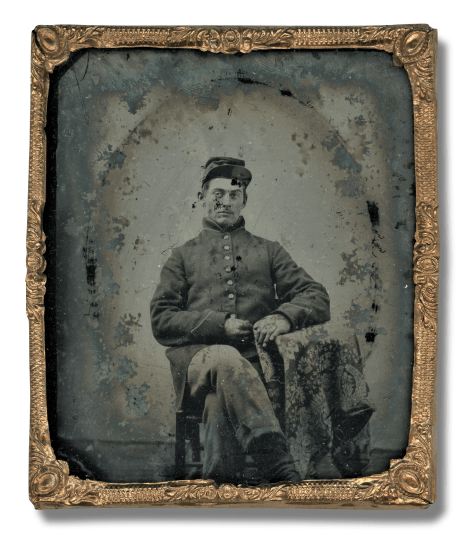
The following letter was written by John Henry Hedges Cross (1840-1926), the son of Henry Cross (1814-1888) and Catherine Hedges (1816-1888). John wrote this letter in November 1862 while serving in Co. H, 31st Iowa Infantry. His father was also in the service as a member of Co. D, 9th Iowa Infantry (from September 1861 to September 1864). He was wounded slightly in the shoulder at Pine Ridge, Arkansas.

John H. H. Cross enlisted on 14 August 1862 in the 31st Iowa Volunteers and was mustered into the service in mid September 1862 at Camp Herron in Davenport. He remained in the service for his full term of three years, mustering out on 27 June 1865. A few years after the war he married Melissa Mercy Bullock (1840-1923) and lived in Marshall county, Iowa, for a few years before moving to Nebraska.

John H. H. Cross, his wife Melissa, and their three sons, Zenas, Earnest and William (ca. 1900)

To read other letters by members of the 31st Iowa that I have previously transcribed and posted on Spared and Shared, see:

Andrew Gillespie Henderson, Co. F, 31st Iowa (1 Letter)
Milton S. Wade, Co. F, 31st Iowa (1 Letter)
Michael W. Kirby, Co. I, 31st Iowa (1 Letter)

To read a diary kept by an unidentified soldier of the 31st Iowa Infantry between 4 September 1862 to 30 September 1864 housed at the Missouri Historical Society (that does not appear to have been transcribed), see: Diary of Unidentified soldier of the 31st Iowa Infantry.

T R A N S C R I P T I O N

Benton Barracks, St. Louis, Mo.
Co. H, 31st Regiment Iowa Vols.
November 6, 1862
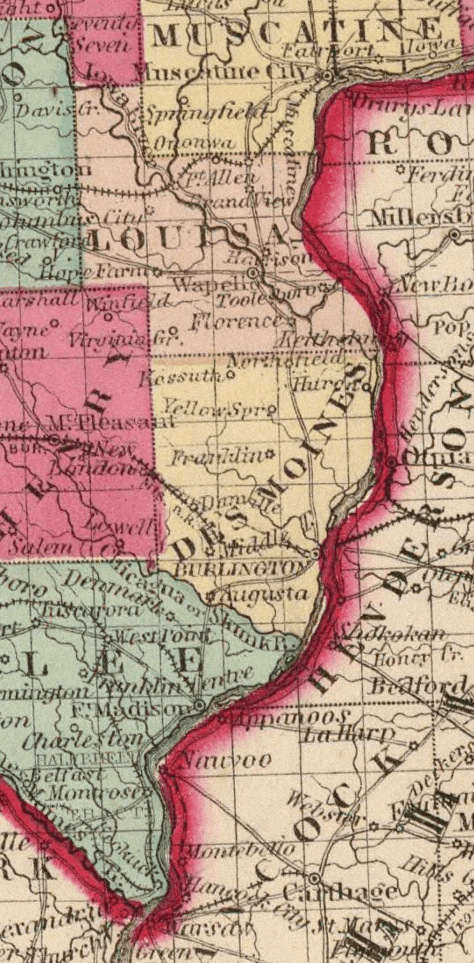
Stretch of the Mississippi River from Muscatine to Keokuk, Iowa (1860)

Dear Mother,

I take this blessed opportunity of writing to you to let you know that I am well and hope these few lines will find you enjoying the same blessing from God, the bountiful giver of all good.

I left Camp Herron [Davenport, IA] last Saturday in the afternoon and started for St. Louis and arrived here safe and sound on Tuesday night about 7 o’clock. Now I will endeavor to give you a description of the trip.

November 1st, left Camp Herron and got on board of the [steamer] Sucker State 1 in the evening about 8 o’clock and started at 10 and arrived at Muscatine [City] at 1 o’clock at night, November 2nd, and in the morning when I waked up, it was snowing like all fury. It was rather a cold time but we got along pretty well. About noon it turned warm and pleasant. Towards night we landed at a little town by the name of Pt. Ross 2 and there we got off and some supper and after supper, we went on the boat and stayed all night.

The next morning, November 3rd, we left the boat and took the cars for Keokuk. We arrived at the city at 8 in the morning and there we got breakfast. George Foster and myself got the breakfast for one mess. We stayed there about noon waiting for the boat to come down over the rapids and to unload some freight, and then we went on the old Sucker State again. It is one of the dirtiest boats that I ever seen and just before sundown the boat got stuck on a sand bar and was out of wood. The [boat] hands took a skiff and went to shore, got a flatboat load of wood and then we got off and started for Dixie but it was after dark when we got started. The weather was very pleasant.

November 4th, when the sun rose, my eyes could see the land of Missouri. It is a hard looking country and Illinois is not much better down here but the people are more like somebody. The weather is not quite so pleasant today as it was. The wind blows from the south and makes it disagreeable. But I have not had anything on but my blouse coat since I left Keokuk. We arrived at St. Louis in the evening and stayed on the boat all that night and most of the next day.
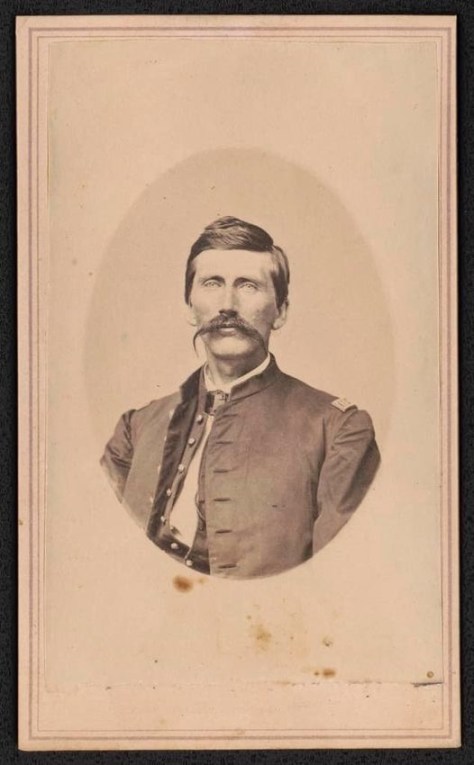
Sewall S. Farwell was the Captain of Co. H, 31st Iowa Infantry (Iowa Civil War Images)

November 5th, I went off of the boat and there I saw William Gates. He was taken prisoner at Shiloh. He belongs to the 20th Illinois. I saw John Conklin, He eat dinner with us. After dinner I went out in the city and the first man that I saw was Felix Basinger and pretty soon I met Jake Barnhill and Fred Houses and Larve [?] Smith. They were on their way to Kentucky. They were going as bridge builders.

St. Louis is a large city. I have not saw a frame house yet. They are all brick and stone and when I got back, the regiment had orders to march to Benton Barracks. We started from the boat after dark and arched up there. Some of the boys were almost tired out and when I got to the barracks, there came in John Hubanks and Steve Collins. They were glad to see their old neighbors. John has been sick.

November 6th, after breakfast I started to see the new home and first thing I knew I met James Wright. He is sick. He left the regiment three weeks ago. He said that Father was limping round with his cane. There is several of our company sick. Jacob Dreibelbis, S[amuel] J. Nelson, William Barnhill, William Whitmore, S[amuel] Williamson, L[eroy] Burnight. Them was left at Camp Herron and Merve [Mervin] Nelson, R[obert] Nelson, B. Jarret, [James] D. Ennis, O[liver] Ackerman, C. W. Halley, M[atthias A. Watson are sick here but not very bad. The rest of the boys are well. Write soon. — John H. H. Cross

[to] Catherine Cross


1 The Sucker State [slang for Illinois] was a sidewheel packet built at McKeesport, Pennsylvania, in 1860. It was built for the St. Louis to St. Paul trade. Her first home was in Galena, Illinois. She was burned in Alton Slough in 1872.

2 I could not find the name of this town on the early Iowa maps. Perhaps I have transcribed it incorrectly. It must have been somewhere near the bend of the Mississippi River opposite the Mormon village of Nauvoo, some dozen miles north of Montrose, as the 1860 map of Iowa shows a railroad running north from Keokuk to that location. Montrose was located near the foot of the Lower Rapids, also known as the Des Moines Rapids. These shallow rapids, about 11 miles in length, presented a major obstacle to river traffic, especially during periods of low water, which would explain why the author and other passengers took the train around the rapids.

1864: Andrew Gillespie Henderson to Sarah Ann (Barrow) Henderson

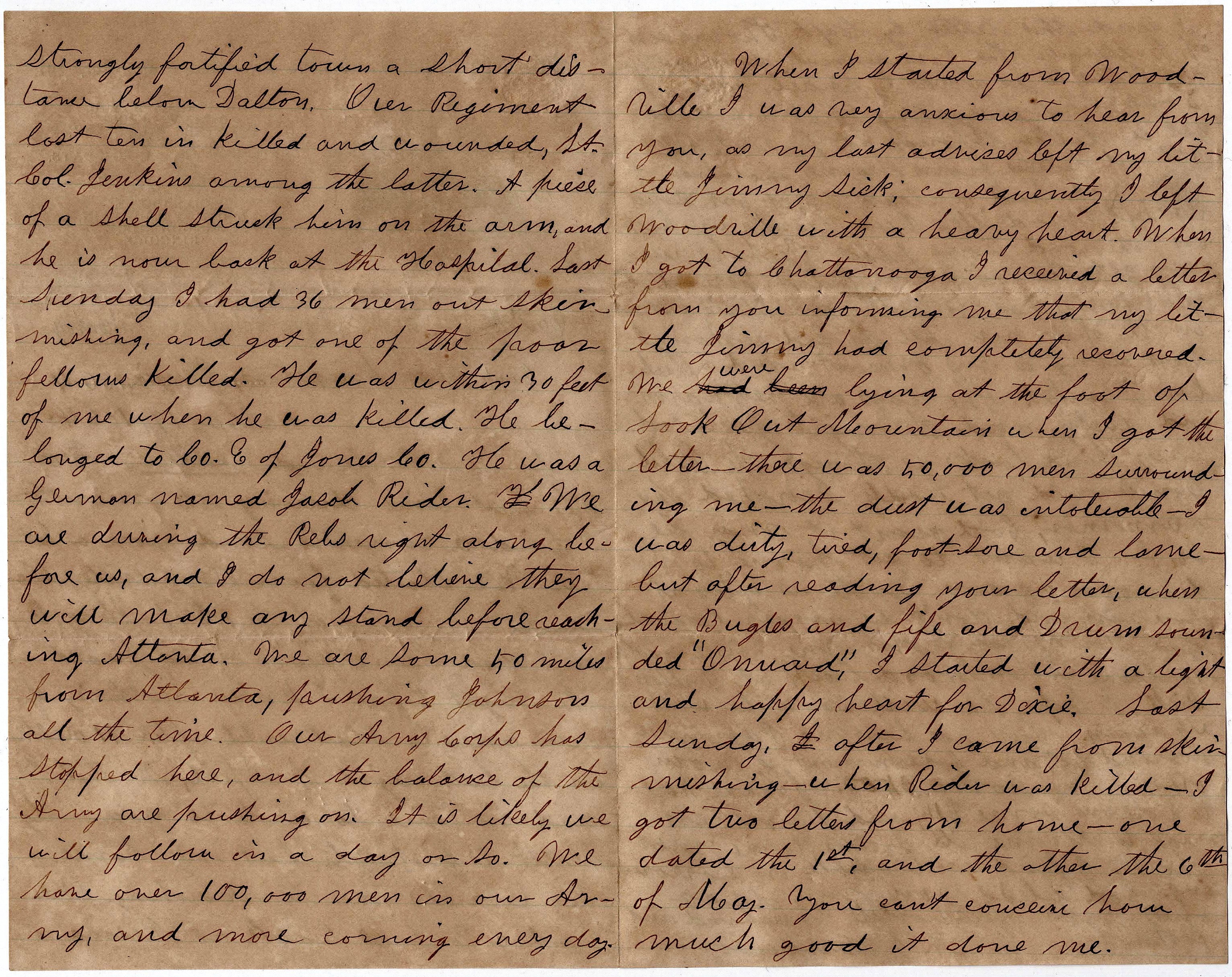
The following letter was written by 1Lt. Andrew Gillespie Henderson of Co. F, 31st Iowa Infantry of Maquoketa, Jackson county, Iowa. Andrew was appointed First Lieutenant shortly after he mustered into the regiment on 13 October 1862. He was wounded on 22 May 1863 at Vicksburg, Mississippi. He resigned 22 September 1864 at East Point, Georgia, after participating in the Atlanta Campaign.

I could not find an image of Andrew in uniform but here is one of Capt. Adam Gebert of Co. F, 31st Iowa Infantry (Iowa Civil War Images)

A biographical sketch for Andrew informs us that he was “a native of Franklin County, Pennsylvania, was born January 4, 1823; When 11 years of age his parents came to Illinois and located at Pekin, Tazewell County, Illinois, where he began to learn the printer’s trade; in 1838 he went to Springfield, Illinois, where he finished learning his trade and lived until the spring of 1843; then went to Ogle County, Illinois, and began publishing the Rock River Register; he afterwards sold out his interest and moved to Galena, Illinois; in January of 1846, he engaged in the mercantile business in Wisconsin. He married Miss Sarah Ann Barrow, a native of Madison County, Illinois, on October 6, 1846. In 1849 he started for California by boat to seek his fortune in the gold fields.  He returned in March of 1851 and moved to Maquoketa, Iowa. In 1853 he moved to Dubuque, Iowa, and bought a one-half interest in the Dubuque Tribune.” Mr. P. Moriarty, who in the mid 1850s a State Printer, determined, sometime in the latter part of 1855, to start a Republican paper in Maquoketa, the Republican party being then almost unknown in many parts of the West. Accordingly, January 1, 1856, Mr. A. G, Henderson, as agent for Mr. Moriarty, went to Chicago to purchase material for printing the Maquoketa Weekly Excelsior. It proved necessary to send to Philadelphia for the type, and the same becoming “snowed in” in Michigan on the way west; the first copy of the paper was not issued until March 1856. The growth of the paper was very rapid, and, on the 1st of the following August, it printed 54 quires, or 1,296 copies. A. G. Henderson was foreman, compositor and writer in. the office until the fall of 1859.”

T R A N S C R I P T I O N

Addressed to Mrs. A. G. Henderson, Maquoketa, Jackson county, Iowa

Co. F, 31st Regt., Iowa Volunteer Infantry
Camp near Kingston, Georgia
May 19, 1864

My Dear Wife and Children,

For the first time during the month I find a chance to send you a letter. We started from Woodville, Alabama, on the morning of the 1st of May & as I had been Officer of the Guard the night before, I knew nothing of our orders to start until after 11 o’clock on the last night of April, so that I had no time to write to you.

My health is first rate, but my lame leg troubles me in marching. We had a 3 days battle at Resaca—a strongly fortified town a short distance below Dalton. Our regiment lost ten in killed and wounded, Lt. Col. Jenkins among the latter. A piece of a shell struck him on the arm and he is now back at the hospital.

Last Sunday I had 36 men out skirmishing and got one of the poor fellows killed. He was within 30 feet of me when he was killed. He belonged to Co. E of Jones’ Company. He was a German named Jacob Rider.

We are driving the Rebs right along before us, and I do not believe they will make any stand before reaching Atlanta. We are some 50 miles from Atlanta, pushing Johns[t]on all the time. Our [15th] Army Corps has stopped here, and the balance of the Army are pushing on. It is likely we will follow in a day or so. We have over 100,000 men in our Army and more coming every day.

When I started from Woodville I was very anxious to hear from you, as my last advises left my little Jimmy sick; consequently I left Woodville with a heavy heart. When I got to Chattanooga, I received a letter from you informing me that my little Jimmy had completely recovered. We were lying at the foot of Lookout Mountain when I got the letter. There was 50,000 men surrounding me. The dust was intolerable. I was dirty, tired, foot-sore and lame, but after reading your letter, when the bugles and fife and drum sounded “Onward,” I started with a light and happy heart for Dixie.

Last Sunday after I came from skirmishing—when Rider was killed—I got two letters from home. One [was] dated the 1st and the other the 6th of May. You can’t conceive how much good it done me.

I send this letter by Capt. Thomspon of Bellevue. The Government don’t allow any letters to go North by mail and it is only by smuggling that we can get a letter through at present. We get all letters from home, however. I have not had a clean shirt on since we left Woodville. Our trunks are back on the road some place. Perhaps we may get them at some future period. The Army has no tents—we sleep out in the open air. All the bed clothing I have along is my overcoat and a rubber blanket. The days are very warm and dusty, and the nights quite cool. Everything looks as though the Rebellion would get badly scorched this summer. God grant it may be so, for I want to get home to my dear ones again. Write as often as you can and don’t be uneasy because you don’t hear from me. We had to leave Allen Wood back at Dalton sick. I hope he will be with us again. There has been no Paymaster around yet and Government is now owing me some $500. I have had to borrow some $15 and I have enough to do me till some time next month. I find no trouble in borrowing.

God bless you my dear ones. Your affectionate husband and father, — A. G. Henderson

1862: Michael W. Kirby to Juliette (Lindsey) Kirby

I could find no image of Michael but here is one of Charles P. Philpot who also served in the 31st Iowa. Charles died of disease in Andersonville Prison in 1864. (Iowa Civil War Images)

The following letter was written by Michael W. Kirby (1836-1863) of Cottonville, Jackson county, Iowa, who enlisted at the age of 27 on 6 August 1862 in Co. I, 31st Iowa Infantry. He died on 6 February 1863 at Young’s Point, Louisiana. Family tradition has it he died in battle but military records reveal that he died of disease though he likely participated in the three day battle of Chickasaw Bluffs near Vicksburg in late December 1862.

Michael wrote the letter to his wife, Juliette (Lindsey) Kirby (1843-1921). The couple were married on 30 May 1860 in Jackson County, Iowa, when she was but 16 years old. They were both natives of Pennsylvania.

Michael wrote this letter from the steamer that was transporting them down the Mississippi river to Helena, Arkansas, where they went into camp on November 20th, 1862. Another soldier in the 31st Iowa, Milton S. Wade of Co. F, wrote of the same journey in a letter to a friend, “We stopped at St. Louis on our way down and for 3 days we saw Benton [Barracks]. We were about 2 weeks coming from St. Louis. We got fast on those sand banks below the Ohio river. The farther we get down river, the smaller the river is. There is lots of troops coming down the river every day.” [Source: Milton Weed to Owen W. Nims.]  Though neither Michael or Milton mention the name of the steamer they were on, I found a notice in the Daily Democrat (Davenport) of 19 November 1862 that reported them on the steamer Continental with “625 tons of government freight.” The steamer’s captain was O’Neal.

Though he did not die in battle, Michael expressed the same patriotic sentiments that motivated many young men from both the North and the South to enlist: “We must expect to see hard times before we get back. I don’t care how much we have to endure if we only secure our liberty—if not for us, for those that are left at home and for the generations that may come after us. May the blessings of God attend our army.”

T R A N S C R I P T I O N

[Steamer Continental]
November 10, 1862

Dear Wife,

I take this time to let you know that I am well at the present time and hope these lies [lines] will find you all in good health. We started from St. Louis at night about 9 o’clock. We went three miles and run on a sand bar. Here we stayed trying to get off of it till the next day. And then, when we got off, went on awhile [and] struck again. We got off, then went on till 9 o’clock at night, then we struck again and have been trying to get off. We now are getting off. It is about 3 o’clock in the afternoon that I am writing. We are moving now.

The boat is loaded too heavy with freight. It is the largest one in the river. There is about 1200 soldiers on it, about 200 head of cattle and 50 horses, a very large amount of government grain, meat and hay, oats, and potatoes and other goods for the army.

I will tell you about the sick in the regiment. We left in Camp Herron four of our boys. One of our company in St. Louis—William Whitman—he had the measles. There was 31 of the regiment let at St. Louis sick with the measles. There is about 40 sick on the boat now. We are not over 40 miles from St. Louis now. I hope we will get better after this.

We [have] very poor accommodations on the boat. We live more like hogs than anything else. Our meat was poor. We now have three crackers and coffee but this is not if everything else was right but we must expect to see hard times before we get back. I don’t care how much we have to endure if we only secure our liberty—if not for us, for those that are left at home and for the generations that may come after us. May the blessings of God attend our army.

We have been very lucky with our regiment so far. There has not been one lost yet & in some of the other regiments there has been a good many killed by accidents and carelessness. Some have got into a fight with the boat hands. I have heard of about fifty that have been killed. There was 12 killed below here last week by the rebels. They shot from the shore [and] killed 12 of our men. This was a boat last week blowed up. The boiler bursted and killed some soldiers. I don’t know how many. So there is danger everywhere. I hope we will get along safe.

The sick that was left behind may be glad they did not come now for they will have a better chance to when there is not so many on the boat. I think I have wrote all that I think of now. The boat shakes no that it is hard for me to write. I am sitting on a pile of grain writing. We are going on now middling fast.

Dear friend, I think of home and friends but that is all the good it will do for the present. Most of us may not get back but it is hard to tell. God knows best. We expect to be in a battle before long, I will write as soon as we land where we are. Destined for Mrs. Juliette Kirby

From M. W. Kirby