These two letters were written to friends and family back home by James T. Pruitt and Elijah B. Hughes—members of Co. F, 31st Mississippi Infantry while encamped at Snyder’s Bluff overlooking the Yazoo River in 1 March 1863. The 31st Mississippi was organized a year earlier using the 6th Mississippi Infantry as its nucleus.
James T. Pruitt (1840-1918) was born in Lawrence county, Alabama, but was living in Pontotoc county, Mississippi when he enlisted in the 31st Mississippi. He married Frances J. Cypert (1841-1907) in 1865. Elijah B. Hughes (b. 1845) was the son of John Hughes (1799-Aft1860) and Mary Parker (1800-1845) of Cambellton, Itawamba county, Mississippi.
This letter is a good example of two soldiers from the same company sharing a sheet of stationery during a time when it was scarce in the Confederacy.
T R A N S C R I P T I O N
Snyder’s Bluff March 1, 1863
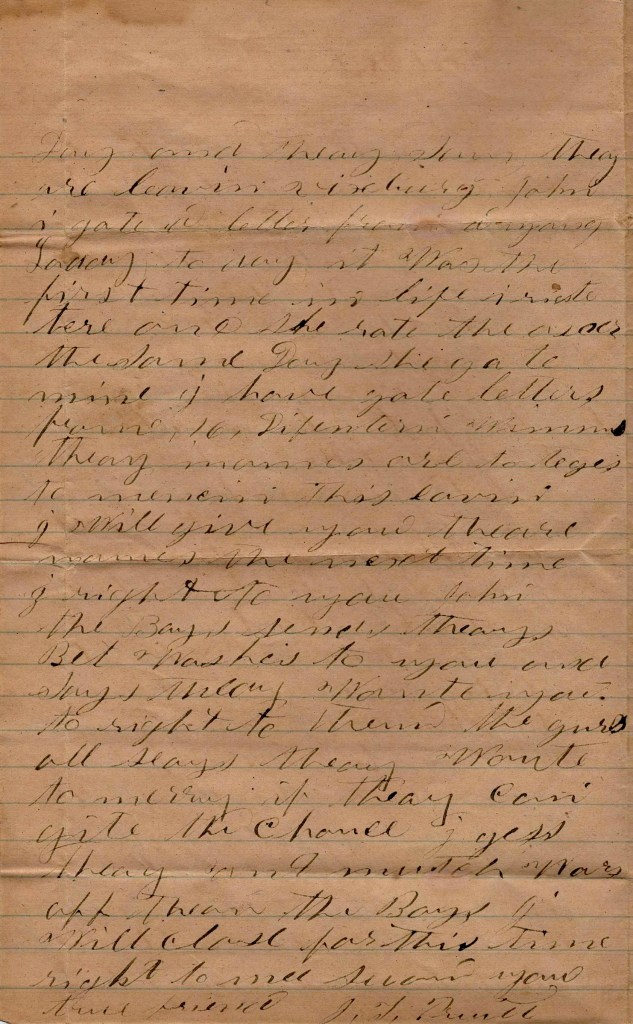
Dear old friend,
I seat myself to drop you a few lines to inform you I [am] well, hoping when these few lines come to hand they may find you enjoying the same blessing. John, I han’t got anything of importance to write to you. We have been running about a good deal since I saw you. It looks like we have to do all the running about. I don’t think we will get in any fight here soon. We are 15 miles above Vicksburg on the Yazoo river. They are preparing for the enemy. We are ready for them any time they come. There was a Yankee came across the river today and they said they are leaving Vicksburg.
John, I got a letter from a young lady today. It was the first time in my life I wrote her one. She wrote the answer the same day she got mine. I have got letters from 16 different women. Their names are too tedious to mention this evening. I will give you their names the next time I write to you.
John, the boys send their best wishes to you and says they want you to write to them. The girls all say they want to marry if they can get the chance. I guess they ain’t much worse off than the boys. I will close for this time. Write to me soon. Your true friend, — J. T. Pruitt
March 1st 1863
Dear brother,
I seat myself this evening to pen you a few lines to let you know that I am getting along. I am well and doing as well as could be expected under the present circumstances that are around me at this time. I have just got well. I have had the chills and fever. We had to march from Jackson here in the mud and water and it made me sick. But I think that I am about straight now.
I received your kind letter yesterday and it gave me great satisfaction to hear from you and to hear that you was well. B. F. H. is well. He is on guard now at this time. He has been sick also but is improving as fast as could be expected. I received a letter from home about three weeks ago. They wrote to me that sister Elizabeth was very sick. I have not heard from home since that time but I have wrote home since that time. I sent my letters by Redden Stephens 1 while I was at Jackson, Miss. We stayed there about two weeks, I believe. Direct your letters to Vicksburg when you write to me—if you ever write any while I stay here at this place. Give my best respects to all the boys. Tell D. C. and Samuel Stephens that if they don’t write to me, that I will treat them with the same respect. My time is up and so is my paper. John, please answer this.
Your brother until death, — E[lijah] B. Hughes
to J. B. Hughes
1 Redden Byrd Stephens (1826-1891) was a farmer in Itawamba, Mississippi, who had probably visited the encampment of the 31st Mississippi while at Jackson.
The following letters were written by Joseph “Freeman” Williams (1846-1908) of the 31st Mississippi Infantry. The regiment was organized in March 1862 and was initially part of the garrison at Vicksburg. They then fought at Baton Rouge and Jackson.
Letter 1
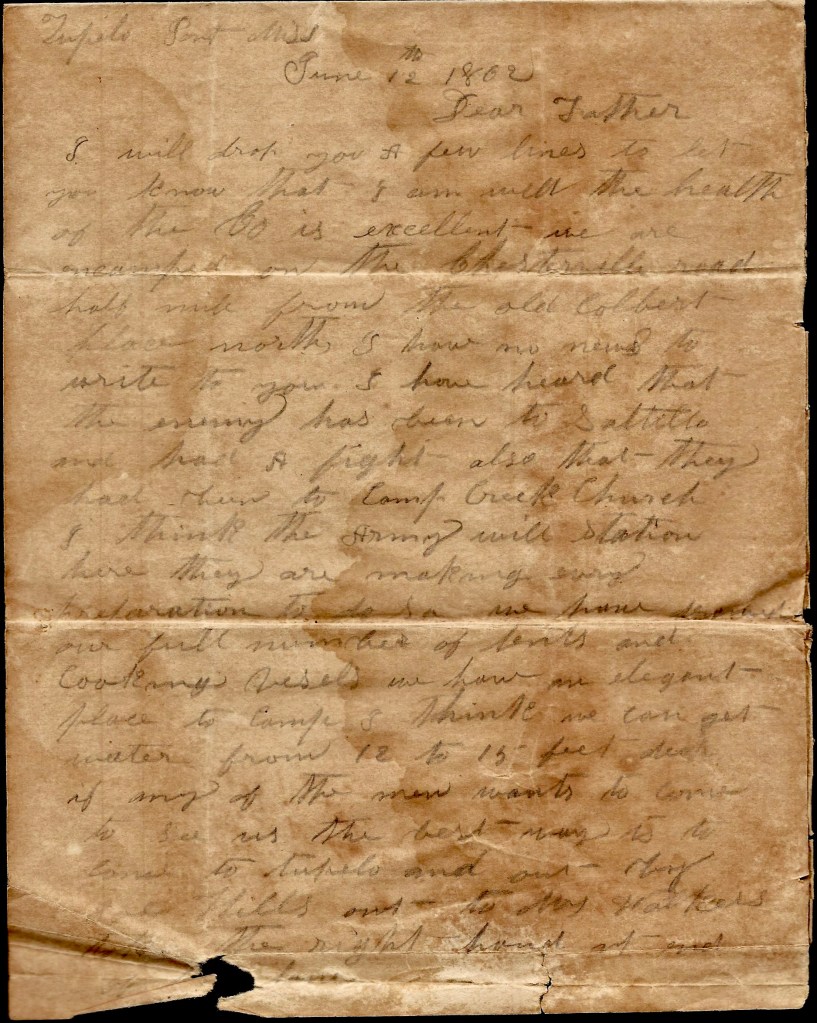
Tupelo Post, Mississippi June 12th 1862
Dear Father,
I will drop you a few lines to let you know that I am well. The health of the company is excellent. We are encamped on the Chesterville road half mile from the old Colbert place north. I know no news to write to you. I have heard that the enemy has been to Saltillo and had a fight. Also that they had been to Camp Creek Church. I think the army will station here. They are making every preparation to do so. We have drawed our full number of tents and cooking vessels. We have an elegant place to camp. I think we can get water from 12 to 15 feet deep.
If any of the men wants to come to see us, the best way is to come to Tupelo and out by [ ] Hill’s, out to Mrs. Walker’s. Take the right hand [road] at end of the lane [and] come up towards Parson More’s. You might come by Chesterville but the small pox I expect is there. Mr. Braley’s and Mr. Brandon’s family has it. The cases are getting better except one of Braley’s negro women, they think, will die. I have seen Mrs. Walker and Tom and Joe. They are all well.
I saw Tom Freeman. He invited me to come someday and take dinner with him. I will slide around someday when I get milk hungry. Fount is Provost Marshall in Tupelo. I saw a paper dated the 9th which stated that Stonewall Jackson had cut Fremont all to pieces. It is said that Jackson has the most able army that belongs to the South. Write soon to Freeman Williams
Letter 2
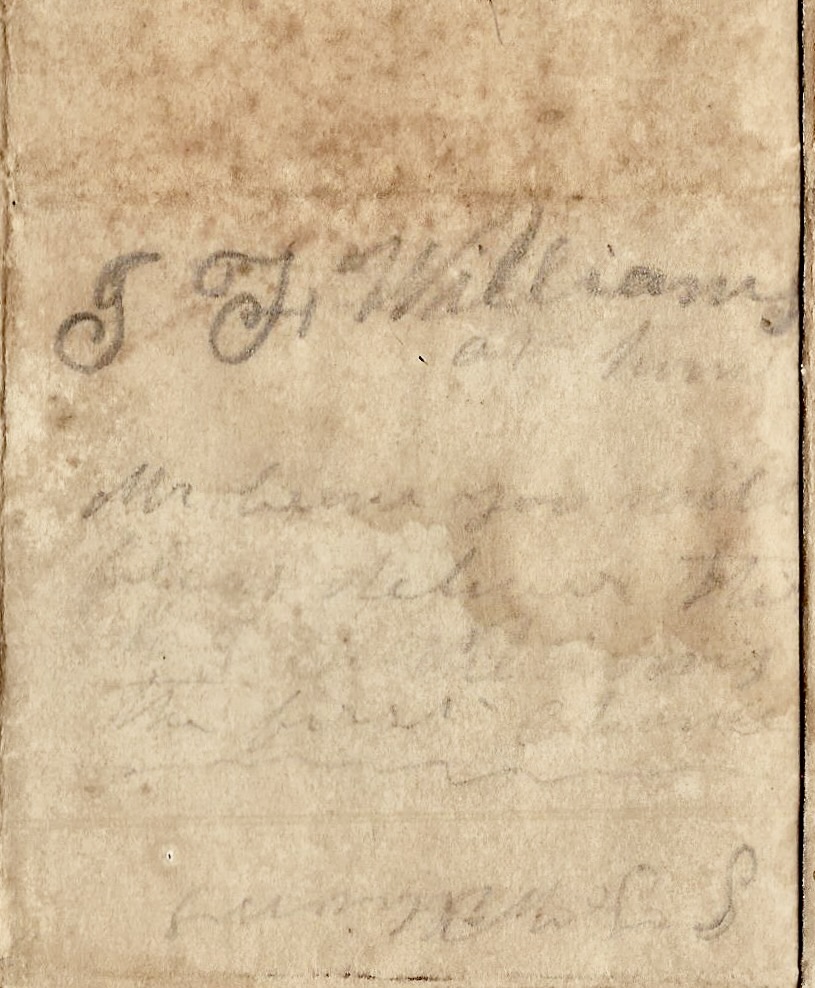
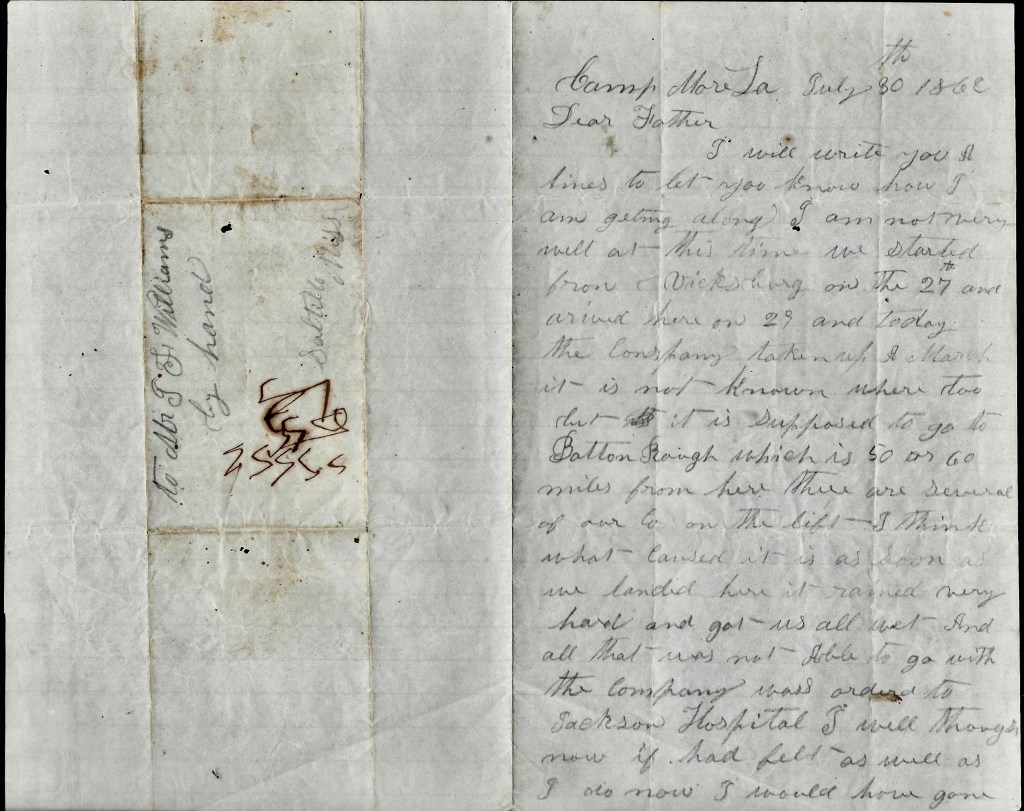
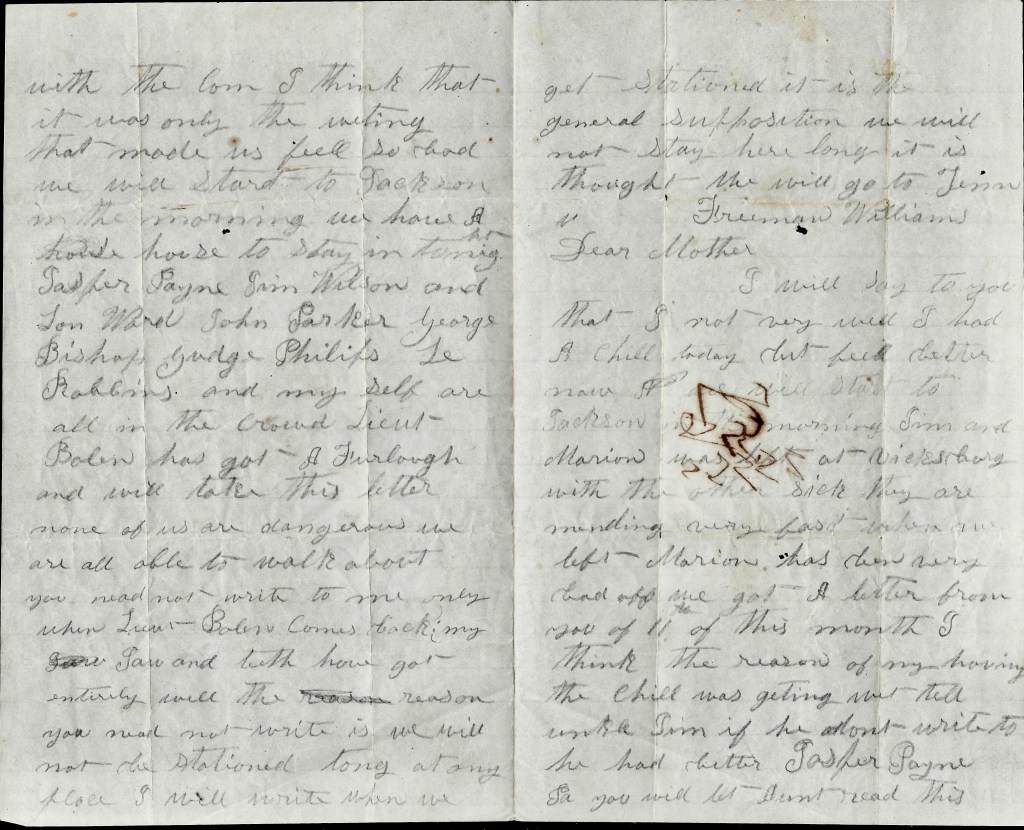
When this letter was penned in late July 1862, Freeman was with a handful of others from his regiment too sick to march so they were left behind at Camp Moore near Kentwood, Louisiana, and ordered to make their way to the hospital at Jackson, Mississippi. After finishing his letter, it appears that Freeman has written a short letter for his comrade Jasper Payne.
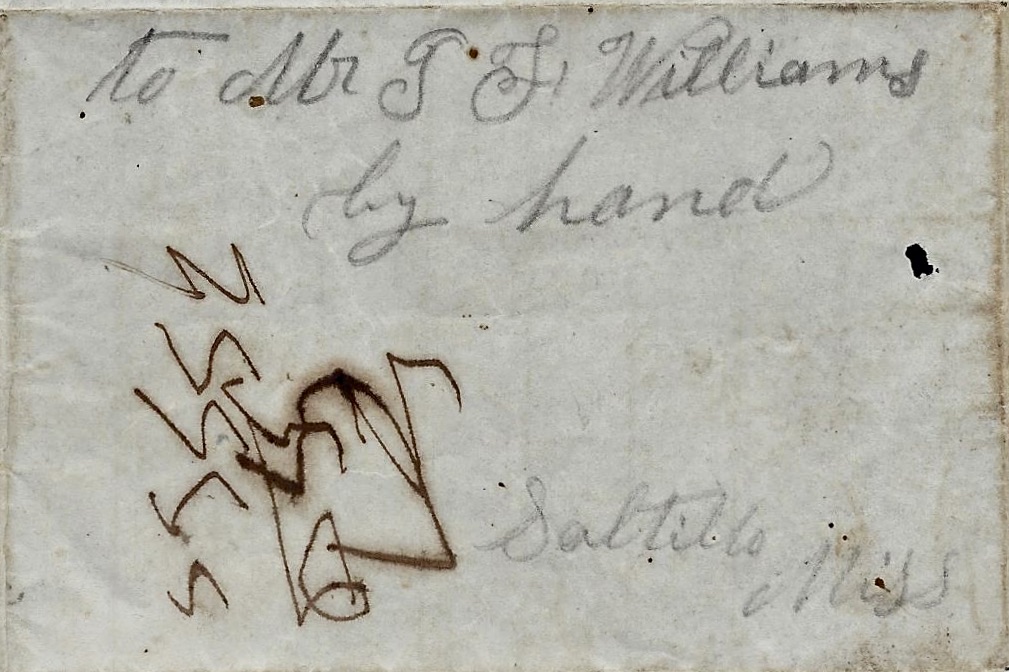
Hand carried Letter, addressed to Mr. J. F. Williams, Saltillo, Mississippi
Camp Moore, Louisiana July 30th 1862
I will write you a few lines to let you know how I am getting along. I am not very well at this time. We started from Vicksburg on the 27th and arrived here on the 29th and today the company taken up and march it is not known where to but it is supposed to go to Baton Rouge which is 50 or 60 miles from here.
There are several of our company on the [sick] list. I think what caused it is as soon as we landed here, it rained very hard and got us all wet. And all that was not able to go with the company was ordered to Jackson Hospital. If I had felt as well as I do now, I would have gone with the company. I think that it was only the wetting that made us feel so bad.
We will start to Jackson in the morning. We have a house to stay in tonight. Jasper Payne, Jim Wilson, and Tom Ward, John Parker, George [W.] Bishop, Judge Philips, L. Robbins and myself are all in the crowd. Lieut. [Willoughby] Bolen has got a furlough and will take this letter. None of us are dangerous. We are all able to walk about. You need not write to me only when Lieut. Bolens comes back. My jaw and teeth have got entirely well. The reason you need not write is we will not be stationed long at any place. I will write when we get stationed. It is the general supposition as will not stay here long. It is thought we will go to Tennessee.
— Freeman Williams
Dear Mother, I will say to you that I am not very well. I had a chill today but feel better now. We will start to Jackson in the morning. Jim and Marion was left at Vicksburg with the other sick. They are mending very fast when we left. Marion has been very bad off. We got a letter from you of 11th of this month. I think the reason of my having the chill was getting wet. Tell Jim if he don’t write to me he had better. Jasper Payne.
The following letters were written by 34 year-old James Milton Miller (1828-1892) to his wife, Mary Frances Milam (1838-1909). James was the son of Samuel Miller (1792-1873) and Jane Hamilton (1794-1865) of Itawamba, Mississippi. James and Mary were married in January 1857 and living in Pontotoc, Mississippi, when the Civil War began.
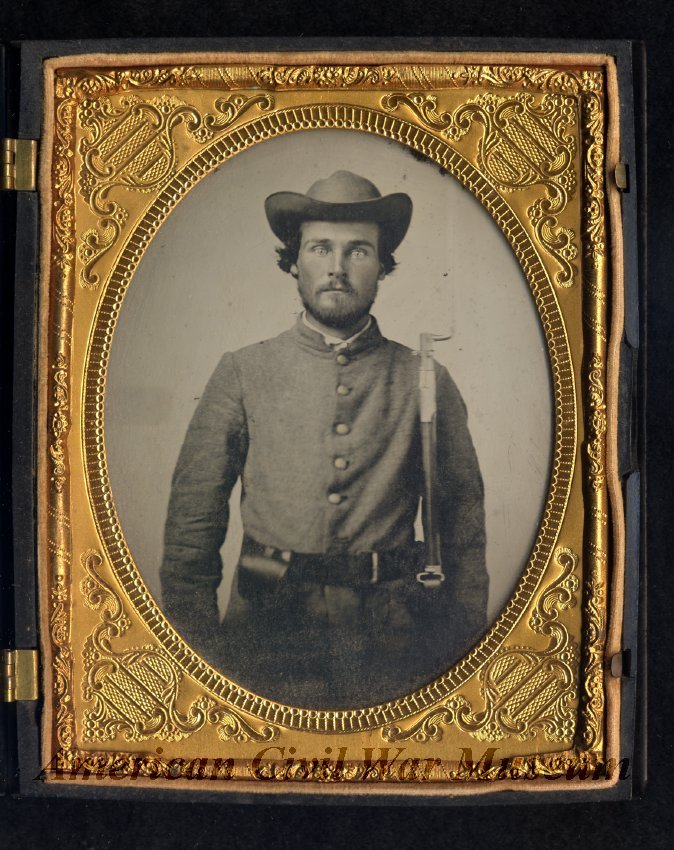
An unidentified Mississippian (Civil War Museum)
Both letters were written while James served as a private in Co. G (the “Orr Guards”), 31st Mississippi Infantry. He enlisted in March 1862 and seems to have been with his regiment or on detail through at least the spring of 1863 except for a time in the Durant Hospital in December 1862.
After the war, in 1869, James loaded all of his family and their possessions in wagons and relocated to Freestone county, Texas, in an area four miles south of Brewer Prairie, where he lived out his days. After his death, his widow filed for a Confederate Widow’s Pension which is where the following two letters were found and brought to my attention by Billy Mercer, his ggggreat-grandson.
The events taking place at the time of these two letters, copied from the regimental history, included: “When General Grant advanced from Memphis down the Central Railroad, Rust’s brigade (which included the 31st Mississippi) fell back from Holly Springs to the Tallahatchie River and thence in December to Coffeville, where they participated in the battle of December 5. Colonel Orr commanding the brigade and Stephens the regiment. The brigade pursued the Federal advance back to the main army at Water Valley, and then retired to Grenada. VanDorn’s raid to Holly Springs followed and Grant retreated to Memphis. The regiment was then sent to the support of S. D. Lee at Chickasaw Bayou. The brigade was met at Edwards as it moved to Vicksburg by General Featherston, who took command, the brigade then including the Fifteenth, Twenty-second, Thirty-first and Thirty-third Regiment and Rayburn’s Battalion. Featherston’s Brigade was ordered to Snyder’s Bluff March 19 on account of the Federal reconnaissance by General Sherman and Admiral Porter on Rolling Fork and Deer Creek, and toward the close of the ten days’ operation the Thirty-first joined the Twenty-second and Thirty-third at the scene of action. Colonel Orr then taking command of the Confederate forces with Featherston. After an unique campaign in the flooded swamps with the Federal gunboats that were crowding their way through the bayou, the gunboats escaped into Black Bayou, and the regiment took steamer for Fort Pemberton, confronted by a Federal fleet. Late in April they moved to Grenada, whence the regiment was ordered again to Edwards. May 3 Colonel Orr at Edwards was ordered, “on the arrival of Featherston, with his brigade, your regiment and Snodgrass’ Alabama Regiment will go to the Big Black bridge.”
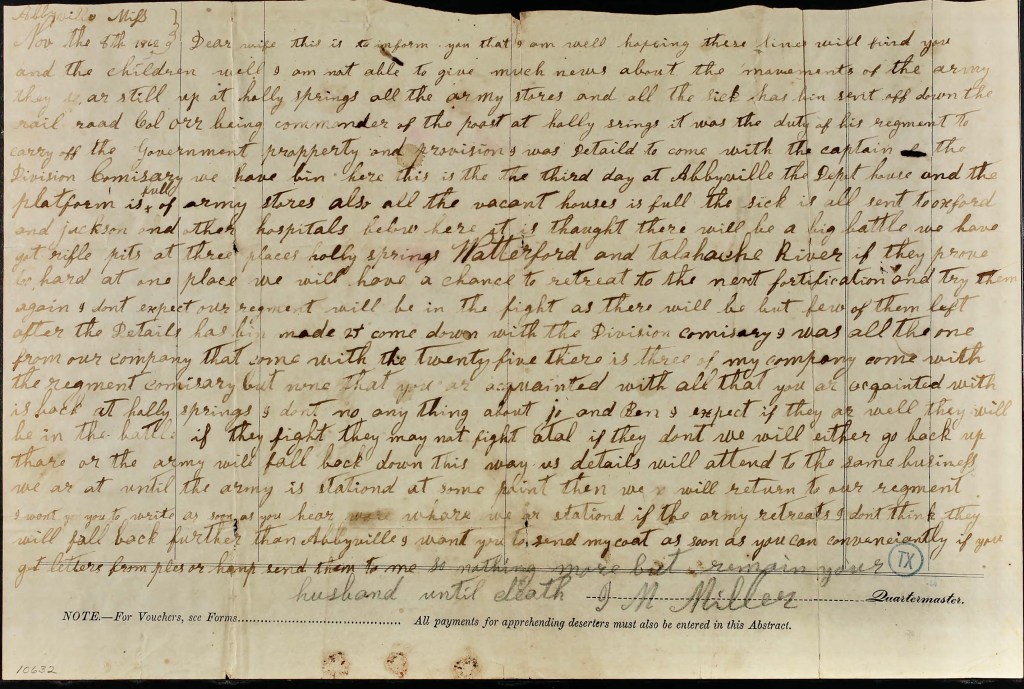
This is to inform you that I am well, hoping these lines will find you and the children well. I am not able to give much news about the movements of the army. They are still up at Holly Springs. All the army stores and all the sick has been sent off down the railroad. Col. [Jehu A.] Orr being commander of the post at Holly Springs, it was the duty of his regiment to carry off the government property and provisions. I was detailed to come with the captain of the Division Commissary. We have been here this is the third day at Abbeville. The depot house and the platform is full of army stores. Also all the vacant houses is full. The sick is all sent to Oxford and Jackson and other hospitals below here.
It is thought there will be a big battle. We have got rifle pits at three places—Holly Springs, Waterford, and Tallahatchie River. If they prove too hard at one place, we will have a chance to retreat to the next fortification and try them again. I don’t expect our regiment will be in the fight as there will be but few of them left after the details has been made. It come down with the Division Commissary. I was the [only] one from our company that come with the twenty-five. There is three of my company come with the regiment commissary but none that you are acquainted with. All that you are acquainted with is back at Holly Springs. I don’t know anything about Joe and Ben. I expect if they are well, they will be in the battle if they fight, [but] they may not fight at all. If they don’t, we will either go back up there or the army will fall back down this way. Us details will attend to the same business we are at until the army is stationed at some point. Then we will return to our regiment.
I want you to write as soon as you hear where we are stationed. If the army retreats, I don’t think they will fall back further than Abbeville. I want you to send my coat as soon as you can conveniently. If you get letters from Ples [Pleasant] or Hanp, send them to me. So nothing more but remain your husband until death, — J. M. Miller
Letter 2
Milldale, Mississippi February 25th 1863
Dear Wife,
This leaves me well except a bad cold. Hoping these lines will find you and the children well. I have got three letters from you since I came from the hospital. I have wrote you two but it appears that you have not got them. Lish Bowen 1 come in yesterday. He said you was at his house the day before he started and you had never had a letter from me since I went to the hospital. I believe all the chance to get getters through is to send then by hand.
I did not see Bill Ausbon [Osborn?]but I have got my socks and gloves. I have not saw Ben and Jo since we was at Jackson. I understand they have went up to Grenada.
We are camped in two miles of the Yazoo River among the biggest hills I ever saw. There is large cane growing on the top of the highest hills. We can see the smoke of the Yank’s gunboats on the Mississippi river 12 or 15 miles off. The cannons is firing every day and every night down in the direction of Vicksburg but I don’t think they do much damage. It is thought the Yanks is going up the river. If they are, we will not have them to fight here. If they go up the river, we will go to Granada or Holly Springs or to the mouth of Cold Water.
Our provisions is short. We get meal that is nearly all bran. Our beef cattle is so poor they can hardly stand up. They have got the hollow horn and hollow tail and hollow belly. They frequently get down on the lift. As bad as the beef and meal is, we don’t get enough of that. We sometimes have to live a day or two on parched corn.
I have not got time to write any more. So nothing more but remain your husband until death, — J. A. Miller
[In another hand; possibly a nephew of J. A. Miller who enlisted underage?]
Dear Father,
I embrace the present opportunity of writing you a few lines. I haven’t nothing new to write. I received a letter from Mother by [Elisha] Bowen yesterday. I was glad to hear from you all. My leg is about as it was when I left home. We are here at a place called Milldale [Snyder’s Bluff] 12 miles east of Vicksburg, a little north of east. I can’t say how long we will stay here. I think not long. There is some talk of us going north, maybe to Jackson, then to Grenada. We was ordered to the mouth of Cold Water [but] that order was countermanded. We have stopped here waiting for orders now.
Father, I went to the colonel yesterday and talked to him about being discharged. The colonel says that you must go before the justice of the peace and make out an affidavit of my age to the day and date of my birth and send it to the colonel, J. A. Orr. You can send it by D. Rodgers and maybe by Z. H. Fulton. Sam says that his pa is a coming to this regiment to see him before long. Sam Fulton wants you to tell his wife she can send a letter by D. Rodgers. I say no more at this time. I remain your son until death, — W. A. Miller
1 William Elisha Bowen (1834-1879) was from Itawamba county, Mississippi.Elisha served in Co. C, 1st Mississippi Infantry.






 Spared & Shared 23