Category Archives: 33rd Ohio Infantry

1861-62: Henry Clay Downing to Sena (Downing) Lightle

The following letters were written by Henry Clay Downing (1844-1862), the 17 year-old son of Timothy Downing (1801-1887) and Rachel Davis (1803-1883) of Pike county, Ohio. Henry enlisted in Co. D, 33rd Ohio Volunteer Infantry (OVI) in August 1861 and served until 20 August 1862 when he died of disease at General Hospital No. 14 in Nashville, Tennessee.

He wrote all of his letters to his sister, Sena (Downing) Lightle (1834-1919), the wife of Peter Lightle (1834-1862) who also served in the same company. Also serving in the same regiment was Henry’s older brother, William Washington Downing (1827-1908) who survived the war.

Henry’s letters and the tintype of Sena (Downing) Lightle are the property of Natalie Stocks who graciously made them available to Spared & Shared for transcription and publication. Sena was her g-g-g grandmother. She inherited the letters of Henry, and his brother, William Washington Downing, and Henry’s brother in law, Peter Lightle, all of the 33rd OH Infantry Regiment, Co.D. 

Letter 1
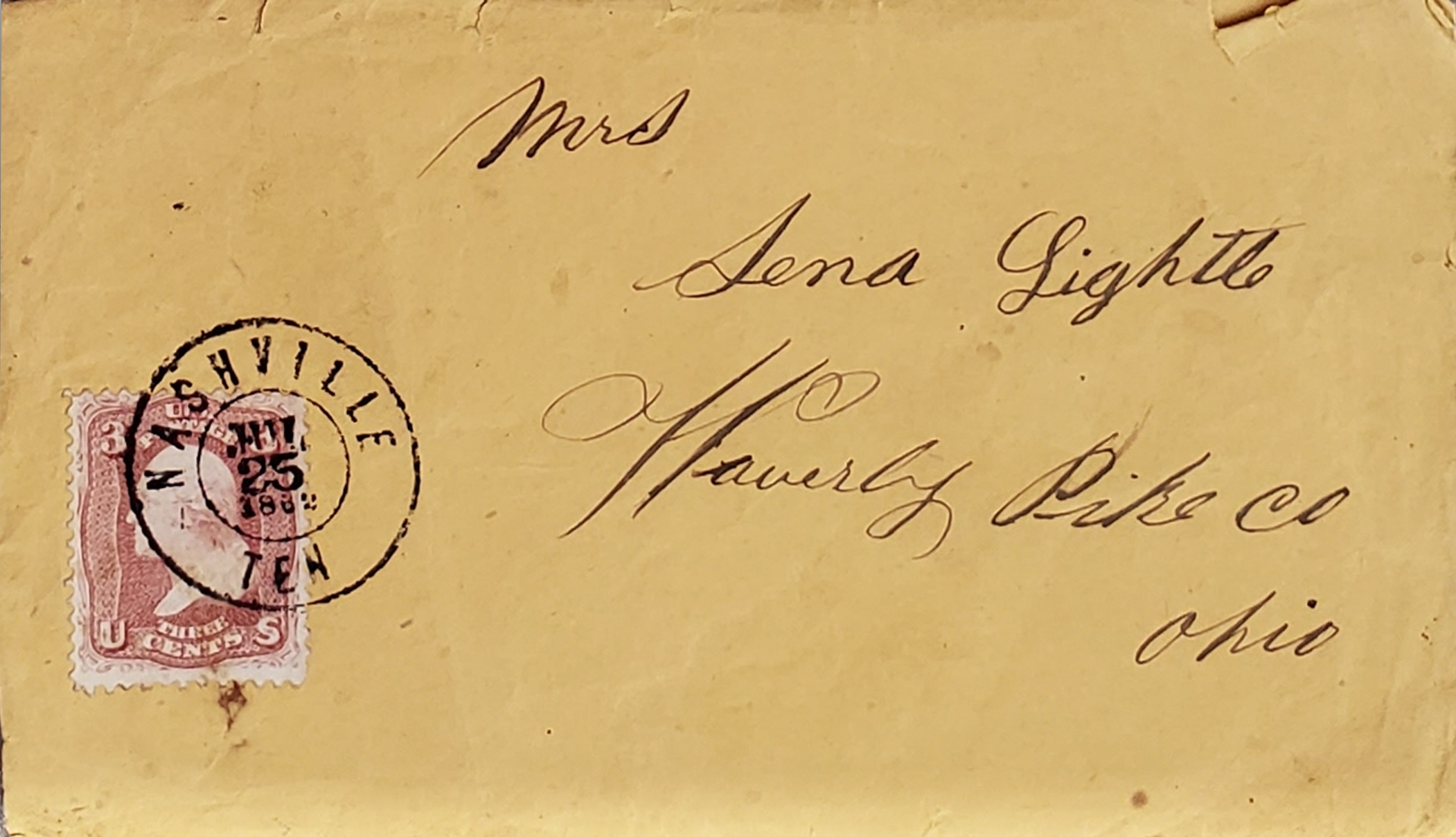
Addressed to Sena Lightle, Waverly, Pike county, Ohio

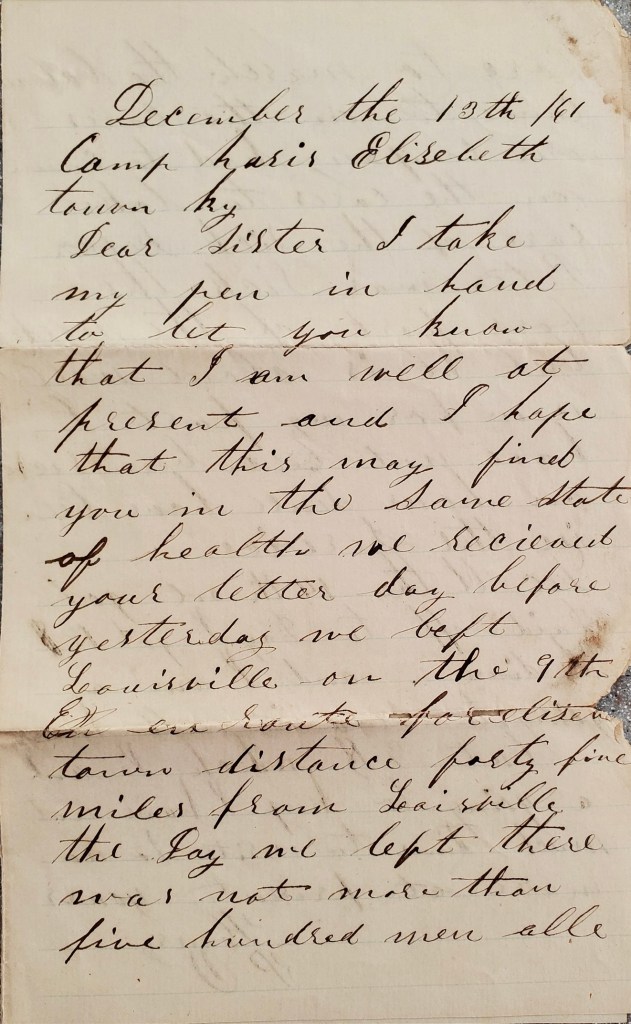
Camp Harris, Elizabeth Town, Kentucky
December 13, 1861

Dear sister,
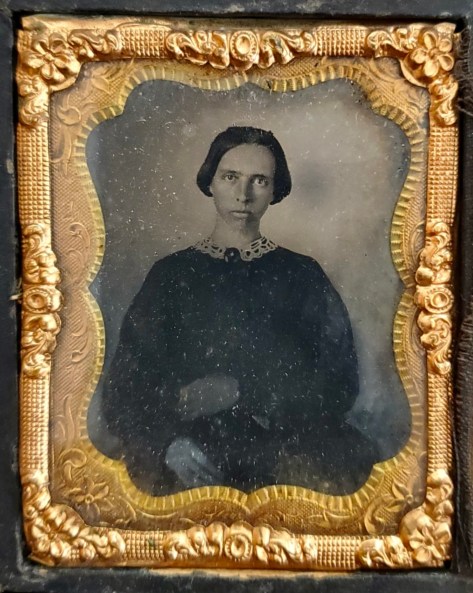
Henry’s sister—Sena (Downing) Lightle

I take my pen in hand to let you know that I am well at present and I hope that this may find you in the same state of health. We received your letter day before yesterday.

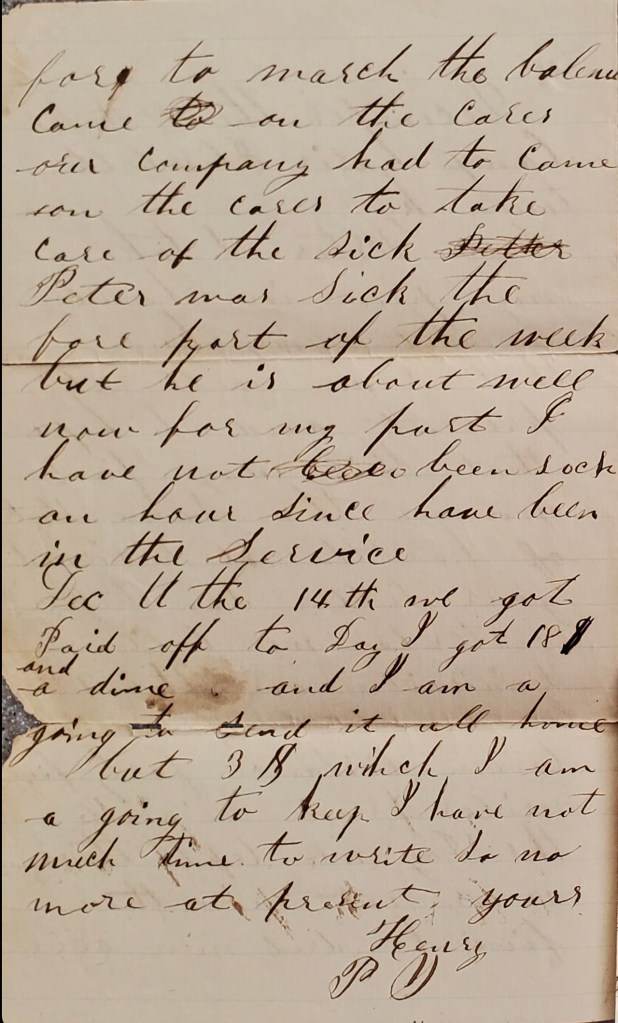
We left Louisville on the 9th en route for Elizabeth Town, distance forty-five miles from Louisville. The day we left there was not more than five hundred men able for to march. The balance came on the cars. Our company had to come on the cars to take care of the sick. Peter [Lightle] was sick the fore part of the week but he is about well now. For my part, I have not been sick an hour since [I] have been in the service.

December 14th, we got paid off today. I got $18 and a dime and I am a going to send it all home but $3 which I am a going to keep. I have not much time to write, so no more at present. Yours, — Henry

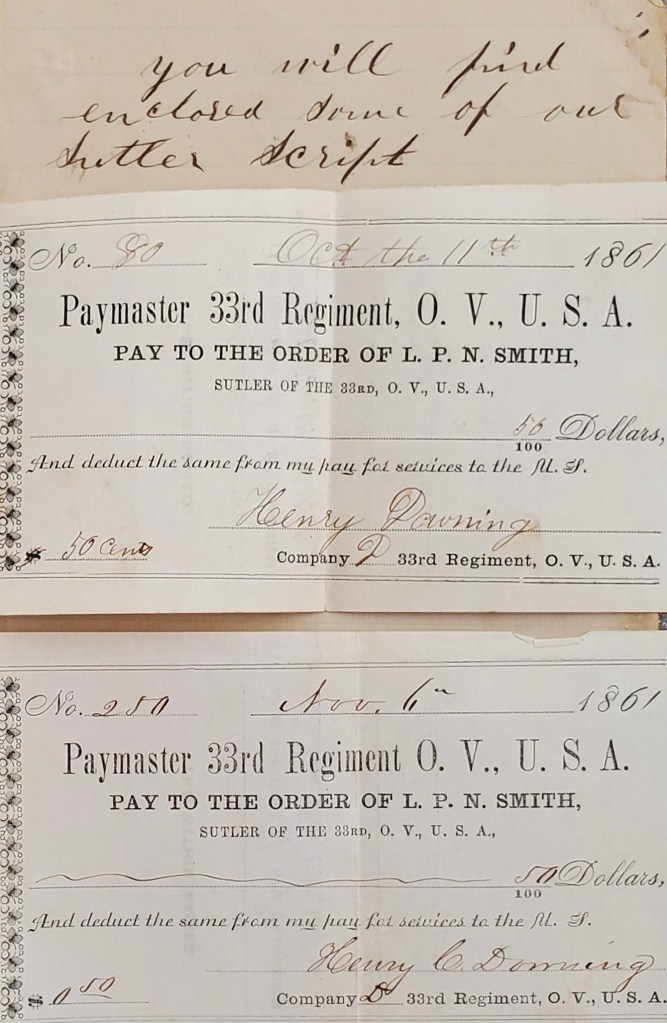
P. S. You will find enclosed some of our sutler script.

Letter 2

Camp Van Buren [near Murfreesboro, Tennessee]
March 30th 1862

Dear Sister,

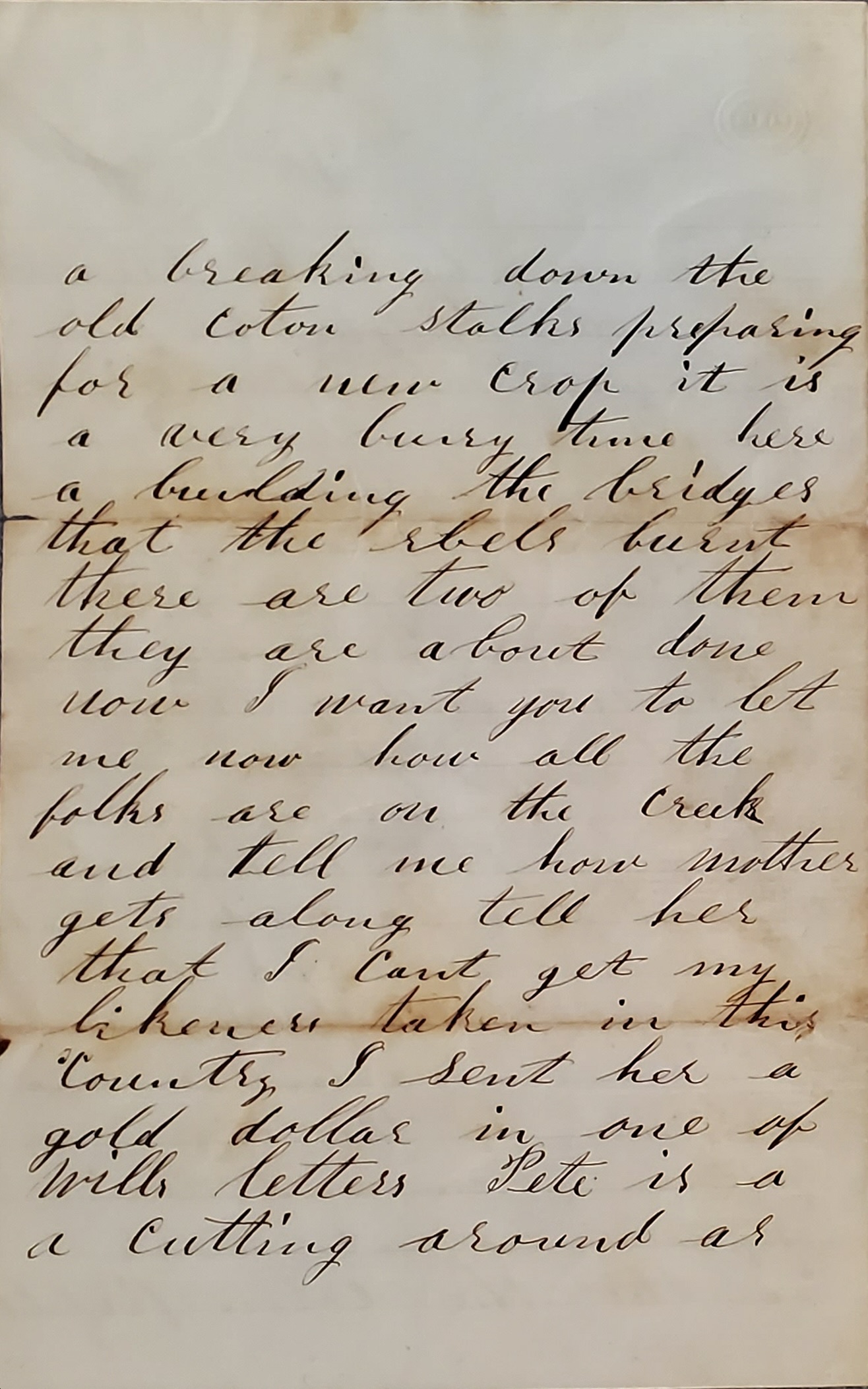
I take this present opportunity to inform you that I am well and I hope those few lines will find you and yours enjoying the same great blessing. I received your letter of the 19th with great pleasure and I was glad to hear from you. William got a letter from father who says it is as rainy and muddy as ever. We have very nice weather here. It is as warm as summer. The trees are a getting green and the negroes are at work in the cotton fields a breaking down the old cotton stalks preparing for a new crop. It is a very busy time here a building the bridges that the rebels burnt. There are two of them. They are about done now.

I want you to let me know how all the folks are on the creek and tell me how mother gets along. Tell her that I can’t get my likeness taken in this country. I sent her a gold dollar in one of Will’s letters. Pete [Lightle] is a cutting around as keen as a buck. He has cut off his whiskers and he looks just like a hawk. He is a getting fat again.

You say you have had no letters from me. The reason is I had no postage stamps but I sent you word in Will’s letters.

There is a rumor through camp that the paymaster is a coming to pay us off again before we leave here. I have wrote about all there is to write about so no more at present but ever [remain] yours, — Henry C. Downing

Write soon.


Letter 3

Camp Harrison [Shelbyville, Tennessee]
April 6, 1862

Dear Sister,

I seat myself this Sunday morning to inform you that I am well and I hope these few lines will find you in the same state of health. I have not got a letter from you for a long time. I would like to hear from home very well. We have not heard whether father got that money I and Will sent him or not and I would like to hear something about it. We have our pay rolls made out again for two more months pay but I do not know when we will get paid off again.

I have been sick for about two weeks but I am nearly well now. We have moved 25 miles further on to another town by the name of Shelbyville. It is a very thrifty town and a good portion of it is Union.

I want you to write and let me know how mother gets along. I want you to let me know how she gets along in every letter you write. I want you to write and let me know how all the folks are on the creek. I have not much more to write so no more at present. Yours, — Henry


Letter 4

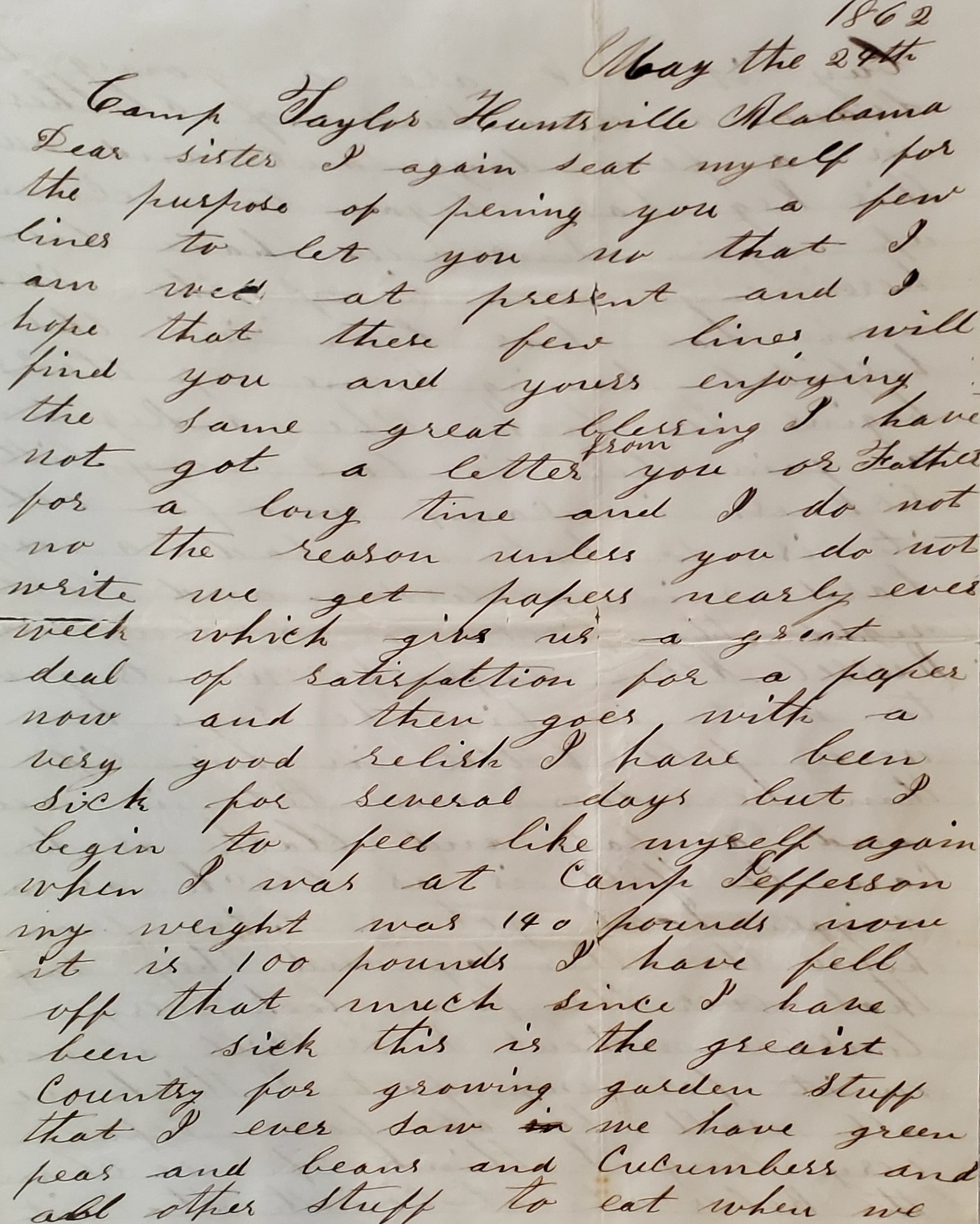
Camp Taylor, Huntsville, Alabama
May 24, 1862

Dear sister,

I again seat myself for the purpose of penning you a few lines to let you know that I am well at present and I hope that these few lines will find you and yours enjoying the same great blessing. I have not got a letter from you or father for a long time and I do not know the reason unless you do not write. We get papers nearly every week which gives us a great deal of satisfaction for a paper now and then goes with a good relish.

I have been sick for several days but I begin to feel like myself again. When I was at Camp Jefferson, my weight was 140 pounds. Now it is 100 pounds. I have fell off that much since I have been sick.

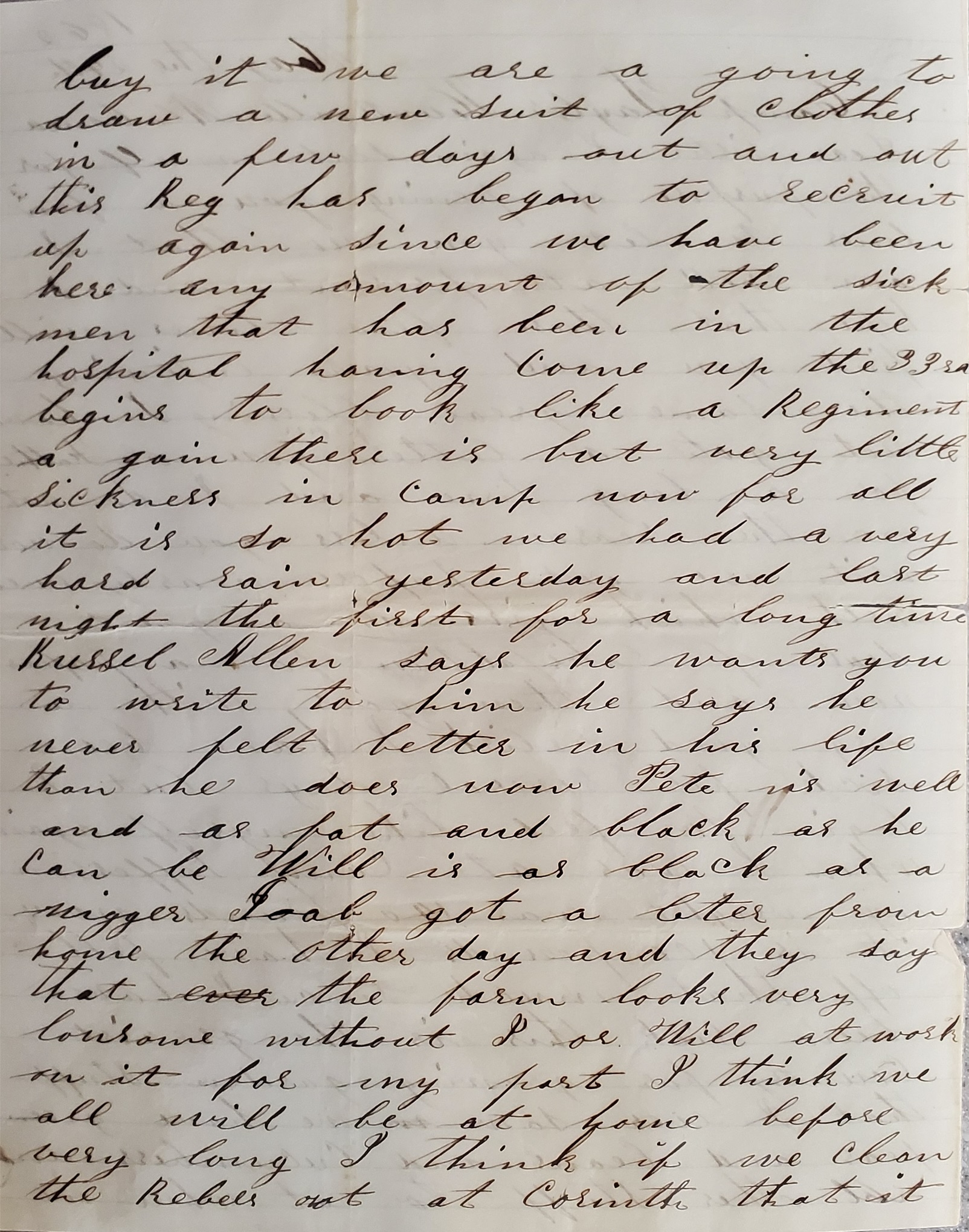
This is the greatest country for growing garden stuff that I ever saw. We have green peas and beans and cucumbers and all other stuff to eat when we but it. We are a going to draw a new suit of clothes in a few days out and out. This regiment has begun to recruit up again. Since we have been here, any amount of the sick men that has been in the hospital having come up. The 33rd [Ohio Infantry] begins to look like a regiment again. There is but very little sickness in camp now for all it is so hot. We had a very hard rain yesterday and last night—the first for a long time.

Russell Allen says he wants you to write to him. He says he never felt better in his life than he does now. Pete is well and as fat and black as he can be. Will is as black as a nigger. Joab [Davis] got a letter from home the other day and they say that the farm looks very lonesome without I or Will at work on it. For my part, I think we all will be at home before very long. I think if we clean the Rebels out at Corinth, that it will wind the war up. I am in hopes so anyhow.

One of our lieutenants met with a very serious accident the other day while out on picket. He was loading a shot gun for the purpose of shooting squirrels when it went off and the whole charge of 18 pistol balls entered his left side and shoulder which came very near a ending his life. But he is now on the mend.

I want you to write and let me know where Matilda is—how she and the children gets along. I have wrote her letters but never received no answer and you nor father never mention her name. I want you to write and let me know how mother is and how she gets along. Tell her that I try to do as she told me. How Arly does and whether he has got any new clothes or not. I must bring my letter to a close so no more at present but ever [remain] your affectionate brother, — Henry C. Downing.

The long roll has just beat and the whole camp is in a state of the greatest excitement. What the trouble is now, I do not know.
Letter 5

Camp Taylor [near Huntsville, Alabama]
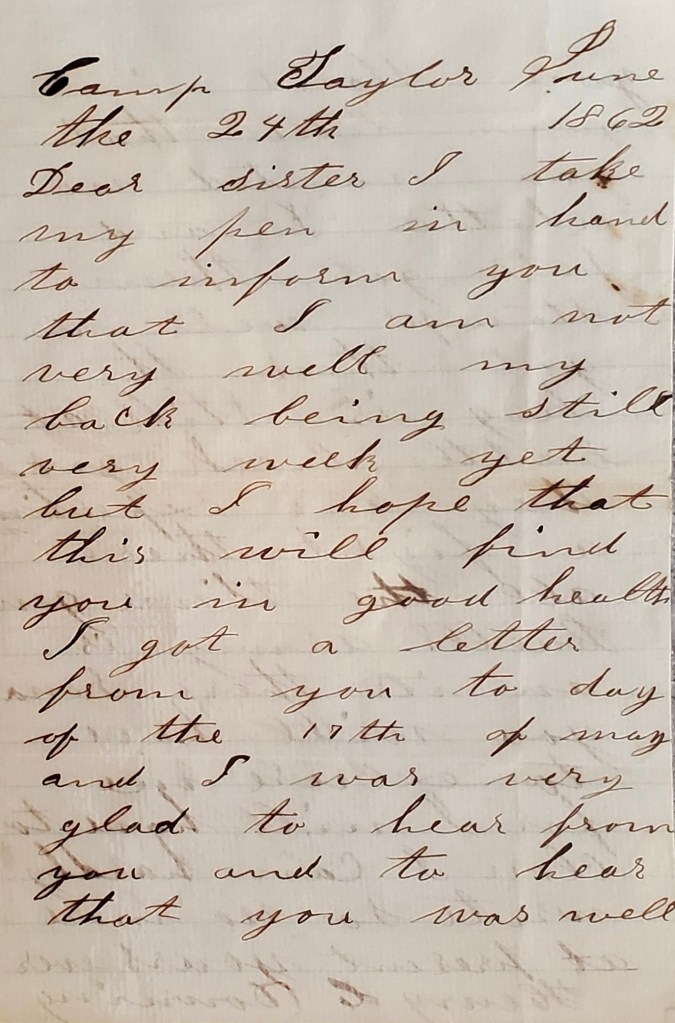
June 24, 1862

Dear Sister,

I take my pen in hand to inform you that I am not very well—my back being still very weak yet. But I hope that this will find you in good health.

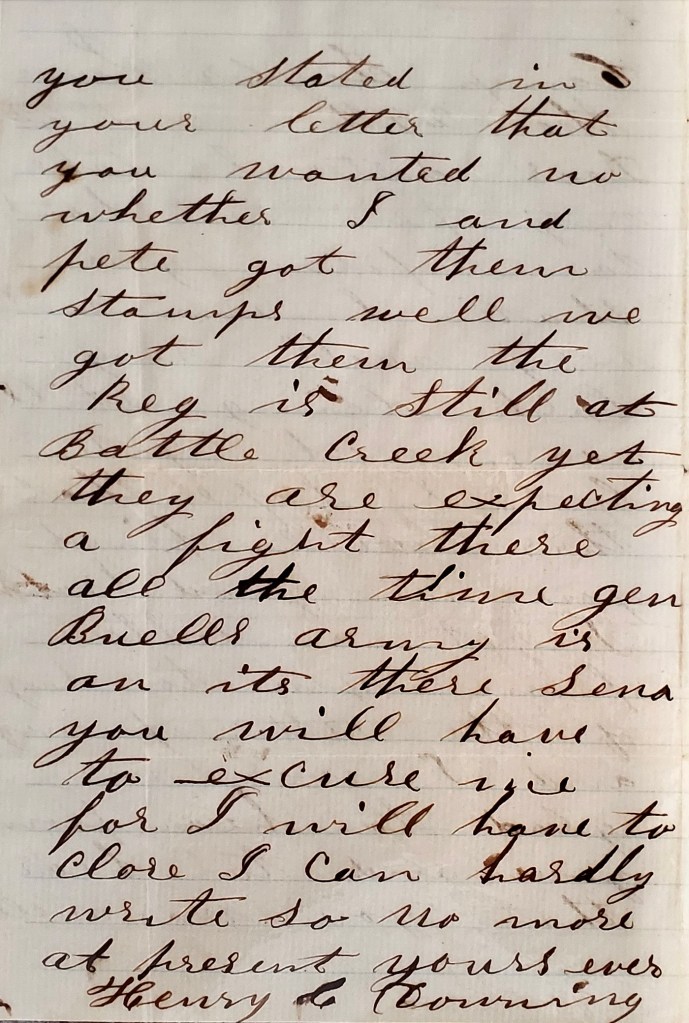
I got a letter from you today of the 17th of May and I was very glad to hear from you and to hear that you was well. You stated in your letter that you wanted [to] know whether I and Pete [Lightle] got them stamps. well we got them.

The regiment is still at Battle Creek yet. They are expecting a fight there all the time. Gen. Buell’s army is on its [way] there.

Sena, you will have to excuse me for I will have to close. I can hardly write. So no more at present. Yours ever, — Henry C. Downing
1862: Peter Lightle to Sena (Downing) Lightle

The following letters were written by Peter Lightle (1832-1862), the son of Samuel Lightle (1798-1851) and Lear Ford (1802-1870) of Ross county, Ohio. Peter was married to Sena Downing (1834-1910) 1856 in Pike county, Ohio, and had two young children, Evangeline (b. 1858) and Albert (b. 1860) at the time that he answered his country’s call to serve as a corporal in Co. D, 33rd Ohio Infantry. Muster records inform us that he enlisted on 17 August 1861 and served until his death on the battlefield at Perryville, Kentucky, on 8 October 1862. Pension records describe Peter as standing 5’9″ tall with dark eyes and black hair.

On August 27, 1862, Confederate cavalry and artillery attacked Fort McCook which was garrisoned by the 33rd Ohio Infantry, prompting the Union soldiers to retreat under the cover of darkness. The Northern soldiers withdrew to Decherd, Tennessee and then marched to Nashville and Bowling Green, where it rejoined the rest of the Army of the Ohio, which was in pursuit of General Braxton Bragg’s Confederate army. The Northern army then moved to Louisville, Kentucky, where it arrived on September 26. On October 1, 1862, the Army of the Ohio departed Louisville in search of the Confederates, finding them at Perryville, Kentucky. At the Battle of Perryville (October 8, 1862), the 33rd entered the engagement with approximately four hundred men. The regiment had 129 men killed or wounded in the battle, nearly one-third of its total active strength.

Peter’s letters and the family tintypes are the property of Natalie Stocks who graciously made them available to Spared & Shared for transcription and publication. Peter was her g-g-g grandfather by way of his daughter Evangeline. She inherited the letters of Peter, and his brother in law, William Washington Downing, and his brother in law, Henry Downing.(33rd OH Infantry Regiment). All of the letters were written to Peter’s wife, Mrs. Sena Downing Lightle.

Letter 1

Camp Taylor
May 14, 1862

Dear Sena,

I take my pen in hand to let you know that I am well at present and truly hope when this reaches you it may find you all well. I received a letter from you the 12th and was very glad to hear from you but sorry to hear that Albert was sick. I had no time to write to you any sooner. I came in the same day from picket that I received your letter and got my dinner and sit down to read the papers that the boys got from home and the next morning I went on camp guard and came off this morning.

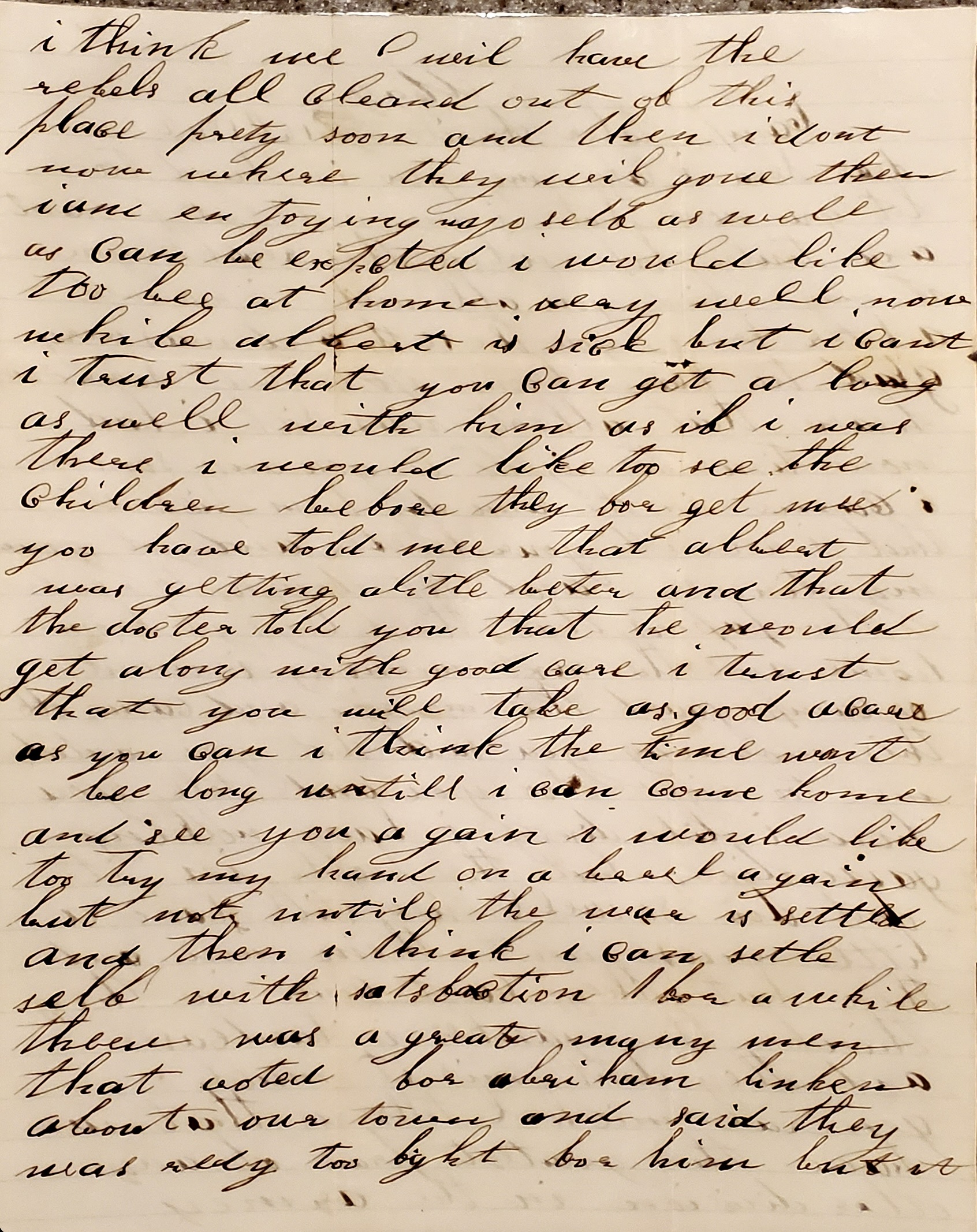
You said that you wanted me to write to you and tell you how I like Dixie but the people in it don’t do so well. We still have a little muss with them now and then but they can’t come in. They think that the Yankees is hard cases and they don’t miss it much. General Mitchell tells us that we have the greatest praise of any other division in the army. I think we will have the rebels all cleaned out of this place pretty soon and then I don’t know where they will go then.

Albert Lightle, b. 1860

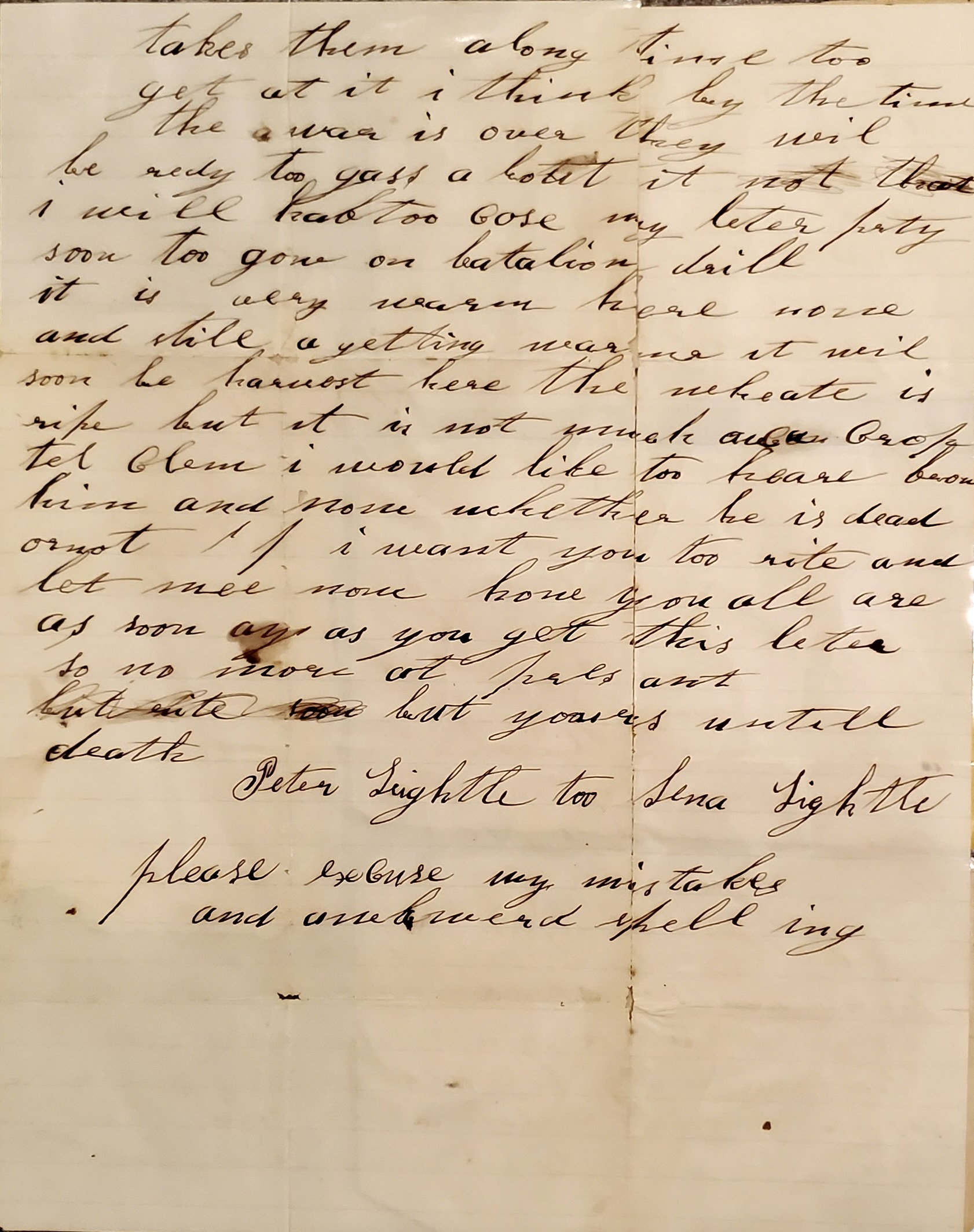
I am enjoying myself as well as can be expected. I would like to be at home very well now while Albert is sick but I can’t. I trust that you can get along as well with him as if I was there. I would like to see the children before they forget me. You have told me that Albert was getting a little better and that the doctor told you that he would get along with good care. I trust that you will take as good a care as you can. I think the time won’t be long until I can come home and see you again. I would like to try my hand on a [ ] again but not until the war is settled and then I think I can settle self with satisfaction. For a while there was a great many men that voted for Abraham Lincoln about our town and said they was ready to fight for him, but it takes them a long time to get at it. I think by the time the war is over, they will be ready to gass about it.

I will have to close my letter pretty soon to go on Battalion Drill. It is very warm here now and still a getting warmer. It will soon be harvest [time] here. The wheat is ripe but it is not much of a crop. Tell Clem [James] I would like to hear from him and know whether he is dead or not. I want you to write and let me know how you all are as soon as you get this letter. So no more at present but [remain] yours until death, — Peter Lightle

to Sena Lightle

Please excuse my mistakes and awkward spelling.


Letter 2

Camp near Battle Creek
August 17, 1862

Dear wife and children,

It is with pleasure that I take my pen in hand to inform you that I am well at present and truly hope when this reaches you it may find you all enjoying the same blessing.

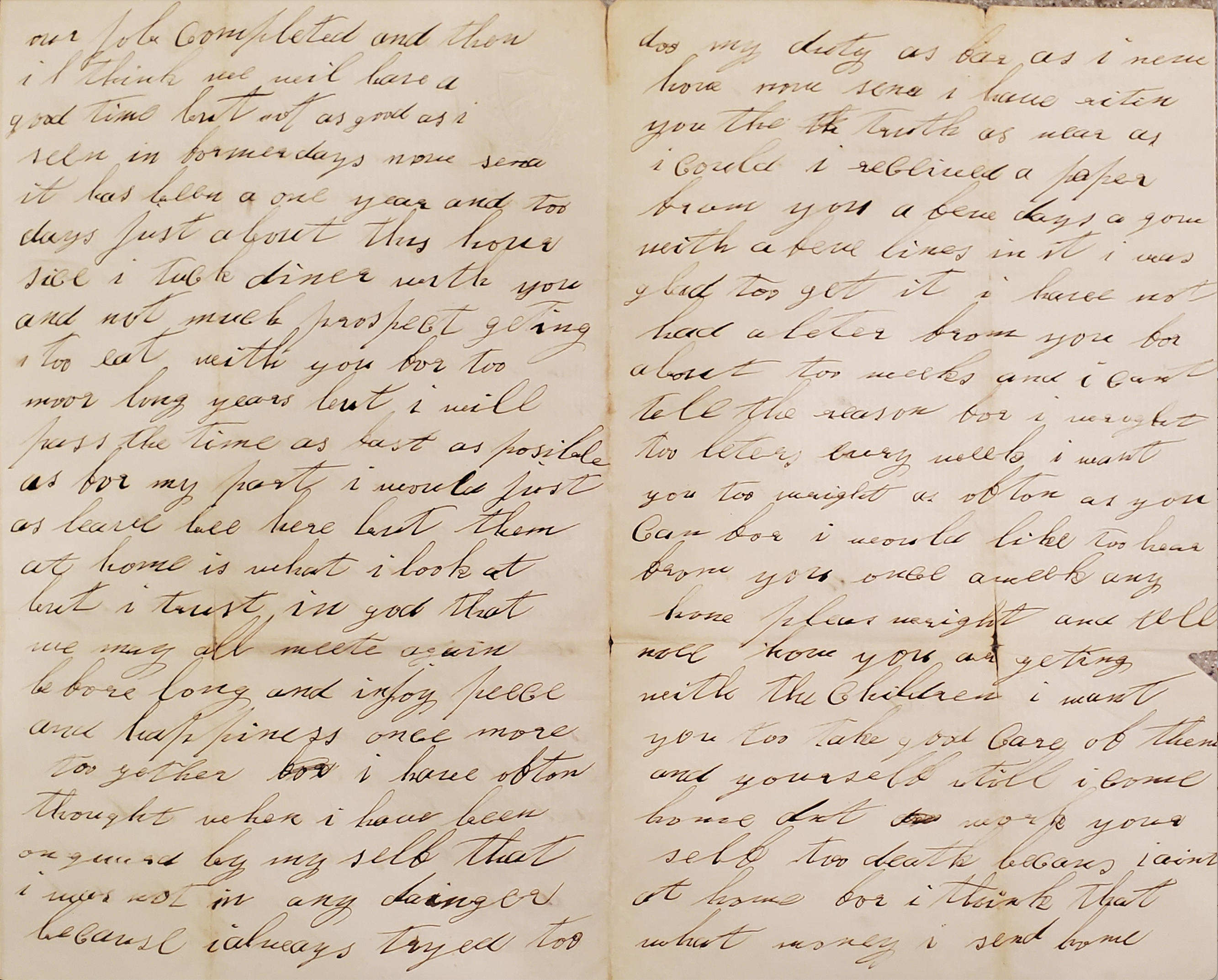
Now the first thing I will tell you what we are doing. We are fortifying this place. There is about six hundred men at work on it day and night. Our regiment is at work on it today. The reason that I am not at work there was about three corporals out of Co. D [were] detailed and that left Bewn Lewis and myself in camp. We are on duty about every other day and expect to be until we get our job completed and then I think we will have a good time—but not as good as I seen in former days.

Now Sena, it has been one year and two days [and] just about this hour since I took dinner with you and not much prospect getting to eat with you for two more long years. But I will pass the time as fast as possible. As for my part, I would just as leave be here. But them at home is what I look at. But I trust in God that we may all meet again before long and enjoy peace and happiness once more together. I have often thought when I have been on guard by myself that I was not in any danger because I always tried to do my duty as far as I knew how.

Now Sena, I have written you the truth as near as I could. I received a paper from you a few days ago with a few lines in it. I was glad to get it. I have not had a letter from you for about two weeks and I can’t tell the reason for I wrote two letters every week. I want you to write as often as you can for I would like to hear from you once a week anyhow. Please write and tell me how you are getting [along] with the children. I want you to take care of them and yourself until I come home. Don’t work yourself to death because I ain’t at home for I think that what money I send home [should] pretty near keep you.

But I must bring my letter to a close. Please write. So no more at present but remain yours until death, — Peter Lightle

to Sena


Letter 3

Camp on Chaplin Heights
October 11th 1862

Mrs. Lightle,

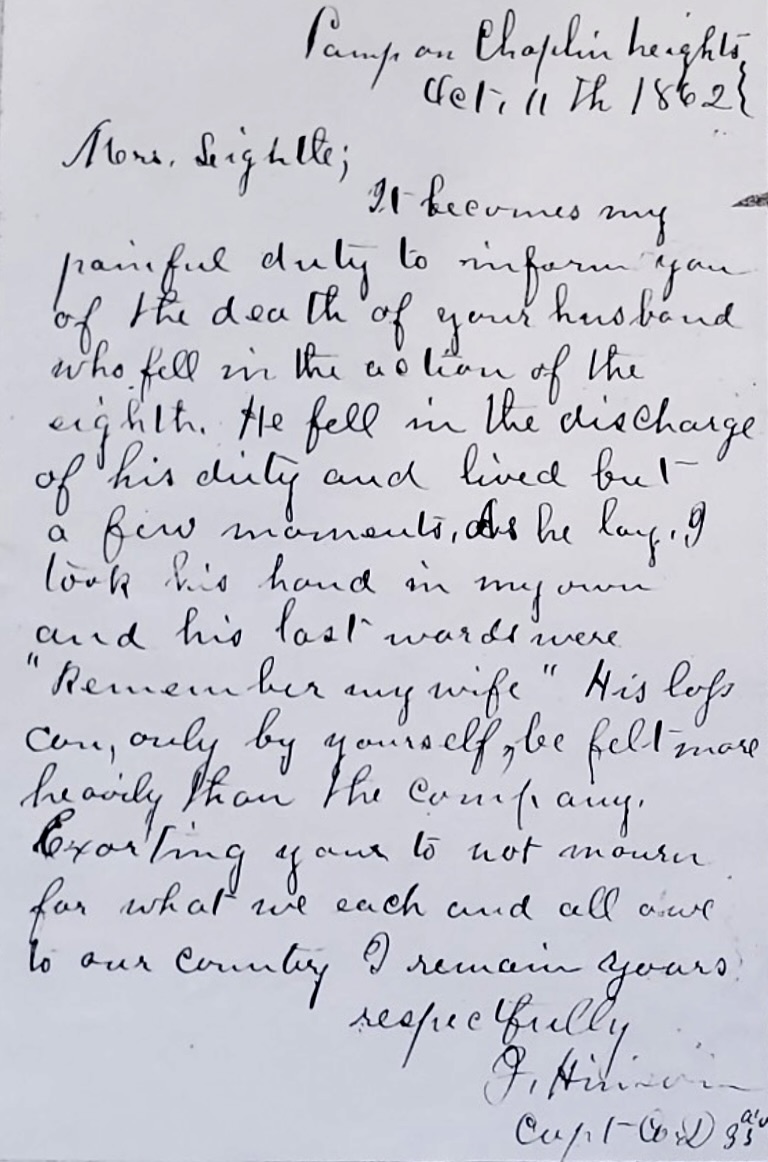
It becomes my painful duty to inform you of the death of your husband who fell in the action of the 8th [at Perryville, Kentucky]. He fell in the discharge of his duty and lived but a few moments. As he lay, I took his hand in my own and his last words were, “Remember my wife.” His loss can, only by yourself, be felt more heavily than the company. Exhorting you to not mourn for what we each and all owe our country, I remain yours respectfully, — J. Hinson, Capt. Co. d, 33rd OVI 1

1 Born in Ohio, Joseph Hinson (1842-1904) enlisted in the 1st Ohio Infantry for three months on 16 Apr 1861. Mustered in as a Private in Company G at Lancaster, Pennsylvania on 29 Apr 1861. Mustered out with his Company at Camp Chase, Columbus, Ohio on 1 Aug 1861. Enlisted in the 33rd Ohio Infantry for three years. Mustered in as 1st Lieutenant of Company D at Camp Morrow, near Portsmouth, Ohio on 27 Aug 1861. Promoted to Captain on 23 Mar 1862. Severely wounded in the left arm on 20 Sep 1863 during the Battle of Chickamauga, Georgia resulting in his arm being amputated. Returned to his Company on 23 Jan 1864. Promoted to Major on 28 Jan 1865 and transferred to Field and Staff (F&S). Promoted to Lieutenant Colonel on 18 May 1865. Promoted to Colonel on 26 Jun 1865, but not mustered. Mustered out with the Regiment at Louisville, Kentucky.

1861: Robert A. Dempster to his Friends

The following letter was written by Robert A. Dempster (1839-1912), the son of John Wesley Dempster (1817-1904) and Florania Huston (1820-1856) of Allen county, Ohio.

According to the 1890 Veterans Schedule, Robert served in Co. K, 33rd Ohio Infantry. The regiment was organized at Camp Morrow and in late October 1861 they were moved to Maysville, Kentucky where they spent the next two months pursuing Confederate Colonel John S. Williams’s command. Union forces eventually drove these Rebels out of Kentucky and into Virginia. The 33rd then boarded transports at Louisa, Kentucky on the Big Sandy River and traveled to Louisville, Kentucky, arriving here on December 1, 1861. At Louisville, the regiment was brigaded with the 10th Regiment Wisconsin Infantry, 2nd Regiment Ohio Volunteer Infantry, and the 21st Regiment Ohio Volunteer Infantry in Don Carlos Buell’s Army of the Ohio. The Army of the Ohio then advanced to Bacon Creek, Kentucky, where the 33rd remained until February 1862. After traveling further south into Tennessee and Alabama, the regiment participated in the Battle of Perryville where they entered the engagement with approximately four hundred men. The regiment had 129 men killed or wounded in the battle, nearly one-third of its total active strength.

The Ohio River Steamer Bostona (nearest shore) tied up at the Portsmouth Landing. It was owned and operated by William McClain and used as a regular mail packet between Portsmouth, Marysville and Cincinnati. Circa 1861. Portsmouth Public Library.

Transcription

[Camp Morrow at Portsmouth, Ohio]
October 9th 1861

Friend,

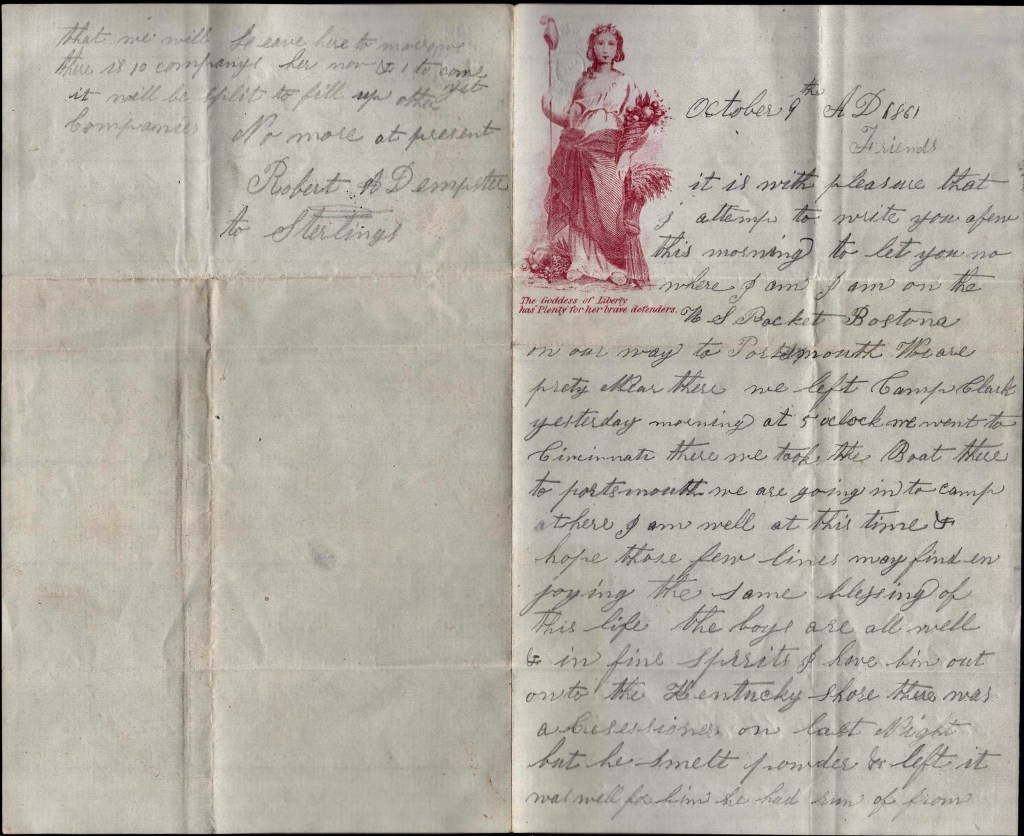
It is with pleasure that I attempt to write you a few [lines] this morning to let you know where I am. I am on the U. S. Packet Bostona on our way to Portsmouth. We are pretty near there.

We left Camp Clark [Springfield, Ohio] yesterday morning at 5 o’clock. We went to Cincinnati. There we took the boat there to Portsmouth. We are going into camp there. I am well at this time & hope these few lines may find [you] enjoying the same blessing of this life. The boys are all well & in fine spirits.

I have been out onto the Kentucky shore. There was a secessioner on last night but he smelt powder & left. It was well for him. He had run off from Kentucky about a week ago. He went back last night. When he got off, he said he would have to take the Oath of Allegiance before 12 today.

We did not get to go home when I wrote that we expected to, but the next evening after I wrote you that letter, Father came to see us. His visit was very unexpected to us for when we left, he did not think of coming to camp. He thought he could live in a place like that. The next morning there was 4 of the boys came down that we were acquainted with. Pap only stayed one night with us. Camp life agrees with me very well. I am cook.

The folks were all well then. Some of them has had the sore throat again. Mother was some better than we are just at past month.

Since I stopped, we have left the boat [and] marched to Camp Morrow. We are in sight of the Kentucky hills. The hills are very large. They look very low this morning. As we sailed along the shore of Kentucky, the men & boys, women & children were gathered on the shore in squads with music and the Stars & Stripes floating over them. As we passed, they would give the volunteers three hearty cheers, three for Lincoln, and then three for Kentucky. You’d better think they opened their mouths then. When we landed at Postsmouth, the people looked as though they had never seen anybody. I often think of home & of my home in Union. I think if ever I get home that I shall come to see you all. Tell the folks that I am well & that I like a soldier’s life.

Last night we slept on a bed for the first since we left home. Our trip from Springfield to Portsmouth will cost Uncle Sam over $300. You must give my respects to all enquiring friends. We don’t know how long we will stay here. Some of the boys here say that we will leave here tomorrow. There is ten companies here now & one to come. It will be split to fill up the other companies. No more at present. — Robert A. Dempster

To Sterlings