

The following letter was written by Beneville Schock (1824-1863), the son of John Shock (1784-1866) and Elizabeth Mary Faust (1789-1884) of Petersburg, Huntingdon county, Pennsylvania. He probably wrote the letter to his older sister Sarah (Schock) Fisher (1823-1882) and her husband Jacob Fisher (1818-1882) who lived in the same vicinity as his parents. Though Beneville spelled his last name “Shock” in this letter, the spelling on the family headstones is “Schock” so I have spelled it that way here.
Beneville was recruited into Co. I, 5th Pennsylvania Reserve Corps (34th Pennsylvania Volunteers) on 24 August 1862, only a few weeks prior to writing this letter. He joined the seasoned veterans of his regiment after the Second Battle of Bull Run so the battle scenes he describes in this letter at South Mountain and Antietam are the first he ever witnessed, prompting him to conclude, “War is a dreadful and horrible thing. May it soon be over.”
Beneville died on 4 February 1863 at Windmill Point, Virginia—the location of a large Union field hospital. His cause of death is not known but it was probably due to disease.
To read letters from other members of the 34th Pennsylvania Infantry that I have transcribed and published on Spared & Shared previously, see:
George Mickle Brown, Co. A, 34th Pennsylvania (1 Letter)
Albert Rake, Co. B, 34th Pennsylvania (1 Letter)
Alfred M. Smith, Co. C, 34th Pennsylvania (1 Letter)
[Note: This previously unpublished letter was graciously made available for transcription and publication on Spared & Shared expressly by the Sic Parvis Magna, Gratias Lesu Collection.]
Transcription
Camp near Sharpsburg, Maryland
September 30th 1862
Dear brother-in-law and sister,
I take the present opportunity to inform you that I am well at this time and hope that these few lines may find you in the same state of health.
I arrived at Washington City on the 6th of September and marched across the Long Bridge into Virginia 9 miles and back the same night. The next day early we started from Washington to Frederick and marched all that week. On the 14th we arrived at South Mountain or Hagerstown Heights about the middle of the afternoon when our Brigade was marched to the right with the Old Bucktails Regiment in advance when very soon the muskets began to crack in our advance. The rebels had taken a position on a high ridge or mountain very steep and rocky but our army drove them from it with great loss. We fought till it was so dark that we could not see anymore. They left that night and we followed them till the 16th in the evening when they made another stand near Sharpsburg. 1
When our Brigade was marched in advance, the Bucktails again took the lead. The rebels had a battery in our advance. They gave us a pretty good shelling that evening till it was dark when our regiment was put on picket duty and as it was quite dark, we marched within a few steps of the rebels when they fired into our regiment, but as it was quite dark, they did not much injury. Our regiment returned the fire when they ceased for a little while. When they fired again, our regiment returned the fire again when they ceased till break of day when they commenced again.
Our Brigade was drawn in line of battle and advanced toward them. We had a pretty sharp time for about an hour when fresh troops were brought up and we were withdrawn from the field and did no more fighting that day. We only lost a few men in our regiment. The battle continued all day without intermission. 2 The rebels fought bravely but could not stand the Yankees. In the night and the next day they got away as fast as they could and got over into Virginia again.

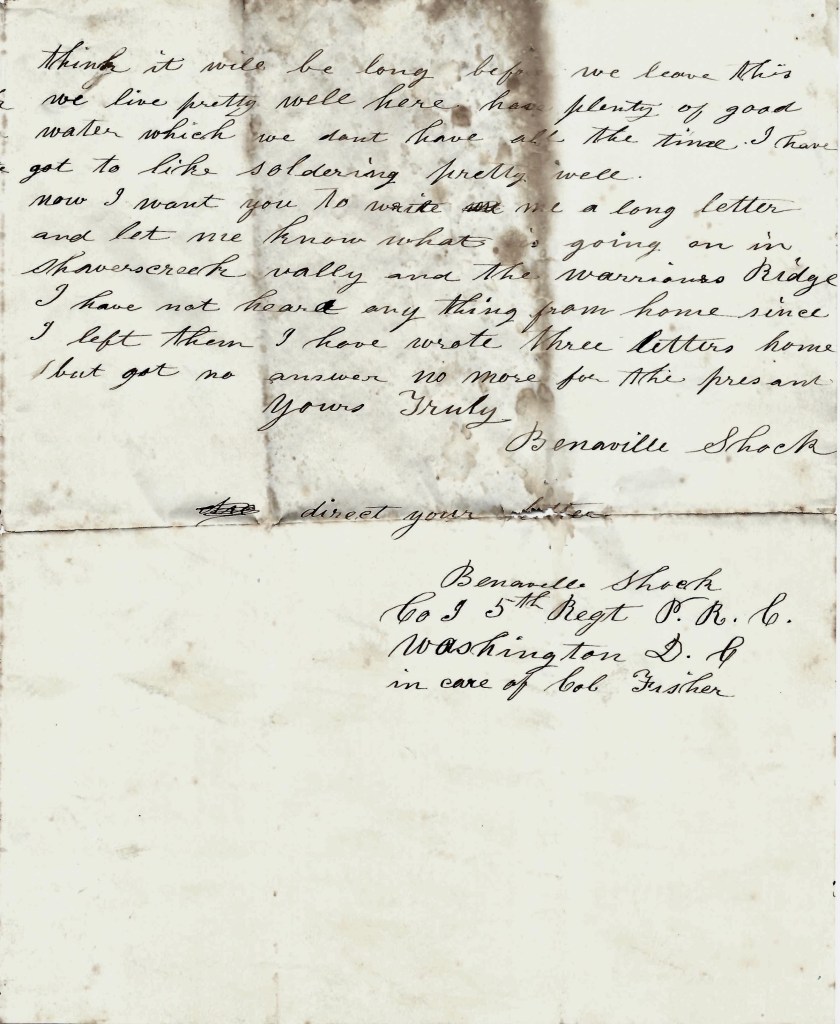
On the 19th we marched over the battleground. It was a horrible sight. The dead were not yet buried. The fields and woods were laying full of them, their faces all swollen and black. War is a dreadful and horrible thing. May it soon be over. We have been encamped near Sharpsburg for the last ten or twelve days. We don’t know when we will leave this but I don’t think it will be long before we leave this. We live pretty well here, has plenty of good water which we don’t have all the time. I have got to like soldiering pretty well.
Now I want you to write me a long letter and let me know what is going on in Shavers Creek Valley and the Warrior’s RIdge. I have not heard anything from home since I left them. I have wrote three letters home but got no answer. No more for the present.
Yours truly, — Benaville Shock
Co. I, 5th Regiment P. R. C.
Washington D. C.
in care of Col. [Joseph W.] Fisher
1 “The Bucktail regiment commanded by Colonel McNeil, was deployed as skirmishers in front of the division, and was closely followed by the whole line of battle; the enemy’s outposts were rapidly driven in, forced from the hills, and routed from the ravines, until suddenly the regiments of the First Brigade arrived at a cornfield, ‘full of rebels,’ protected by a stone wall at the foot of the abrupt mountain side; the Bucktails received a terrific volley of musketry, which brought them to a halt; General Seymour, who was on the ground with his men, seeing that this was the critical moment, called out to Colonel Roberts, commanding the First Regiment, to charge up the mountain, and at the same instant, turning to Colonel Fisher, of the Fifth Regiment, whose men were coming up in well dressed lines, he exclaimed: ‘Colonel, put your regiment into that cornfield and hurt somebody.’ ‘I will, General, and I’ll catch one alive for you’ was the cool reply of Colonel Fisher. The Second regiment, commanded by Captain Byrnes, and the Sixth, Colonel Sinclair, were ordered forward at the same time. The men of the Fifth leaped the stone wall, immediately captured eleven prisoners, and sent them back to the General.” The regiment steadily ascended the rugged side of the mountain under a heavy fire of artillery and musketry, and after a severe struggle, lasting five hours, carried the heights with the triumphant division and planted its standard upon the summit. It entered the engagement with three hundred and fifty-seven men. Its loss was one killed and nineteen wounded. [PA-Roots]
2 “On the 16th, [the regiment] crossed Antietam Creek, and moving to the right, engaged the enemy at four P. M., and was engaged at intervals during the night. The battle was renewed at daylight on the following morning, and raged with unabated fury on that part of the line where the Reserves were posted during the early part of the day, the Fifth not being relieved until one P. M.” [same source as previous footnote]





 Spared & Shared 23