Unidentified member of the 4th Virginia Heavy Artillery (LOC)
The following letter was written by George T. Herndon (1844-1864) while serving as a private in Co. D, 4th Regiment Virginia Heavy Artillery. He enlisted in Jul 1863, and was sent with his regiment to Charleston in September 1863. He was transferred to Co. D, 34th Virginia Infantry in March 1864, and was killed in action near Port Walthall Junction on 16 May 1864. George was the son of James Herndon (1789-1857) and Esther Ferneyhough (18xx-1892) of Madison, Madison county, Virginia. His older brother Daniel Boone Herndon (1838-1923), also served in the Confederate army as a private in Co. C (the “Madison Invincibles”), 4th Virginia Cavalry on 24 April 1861. His military record indicates he was wounded on 15 February 1862.
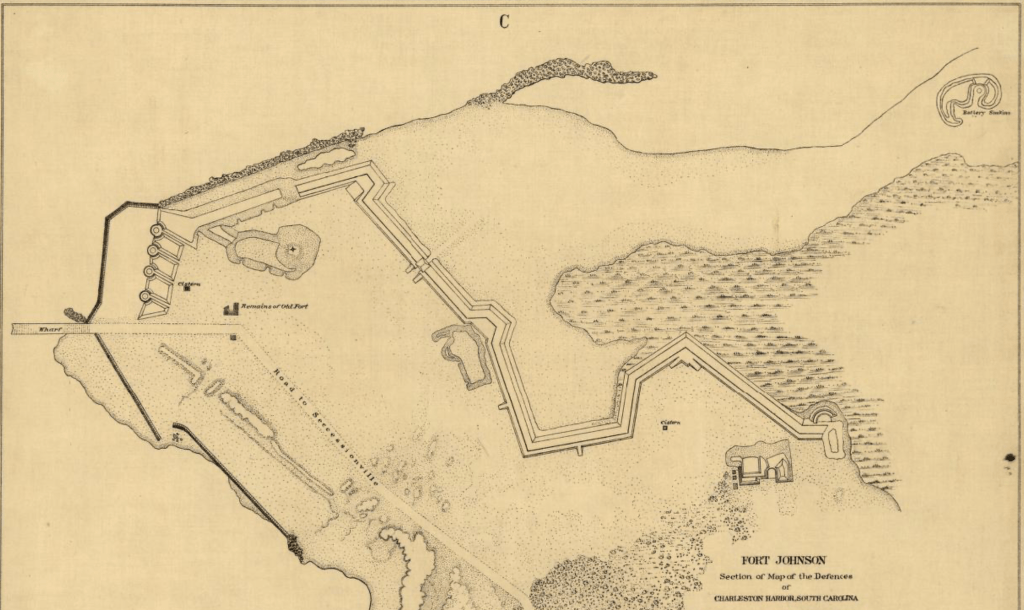
Map of Fort Johnson in Charleston Harbor; Battery Simpkins is the shown in the upper right part of the map. Herndon informs us that he was stationed at Battery Simpkins on Thursday, 19 November 1863, under a heavy fire from the enemy’s batteries.
[This letter is from the private collection of Greg Herr and was transcribed and published on Spared & Shared by express consent.]
Transcription
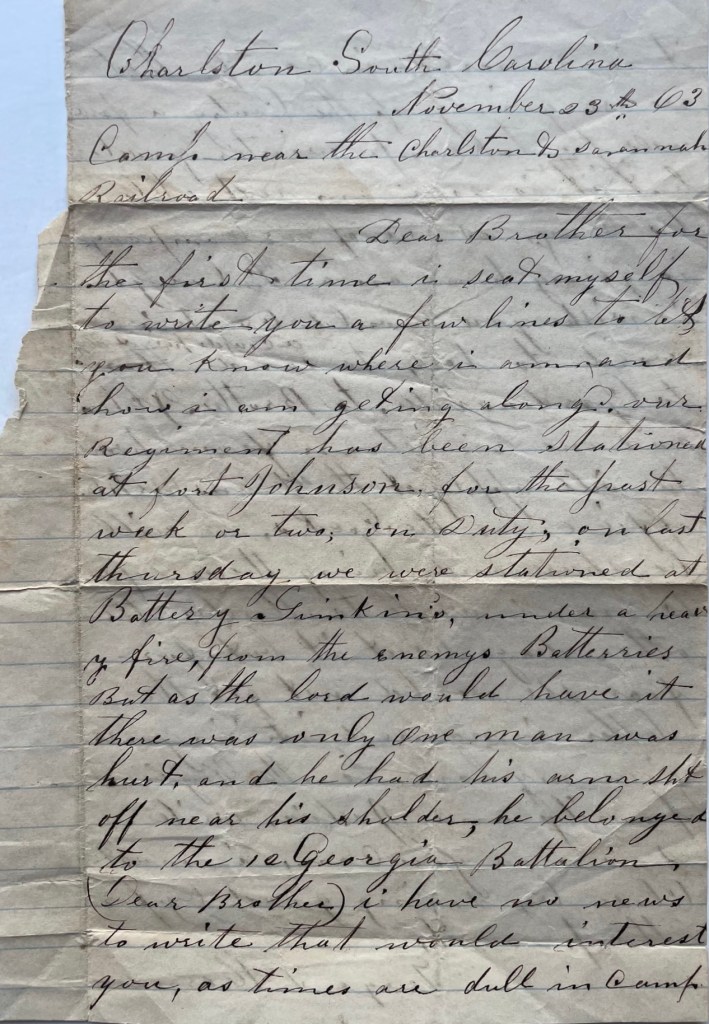
Camp near Charleston & Savannah Railroad Charleston, South Carolina [Monday] November 23, 1863
Dear Brother,
For the first time I seat myself to write you a few lines to let you know where I am and how I am getting along. Our regiment has been stationed at Fort Johnson for the past week or two on duty. On last Thursday we were stationed at Battery Simpkins under a heavy fire from the enemy’s batteries. But as the Lord would have it, there was only one man was hurt and he had his arm shot off near his shoulder. He belonged to the 12th Georgia Battalion.
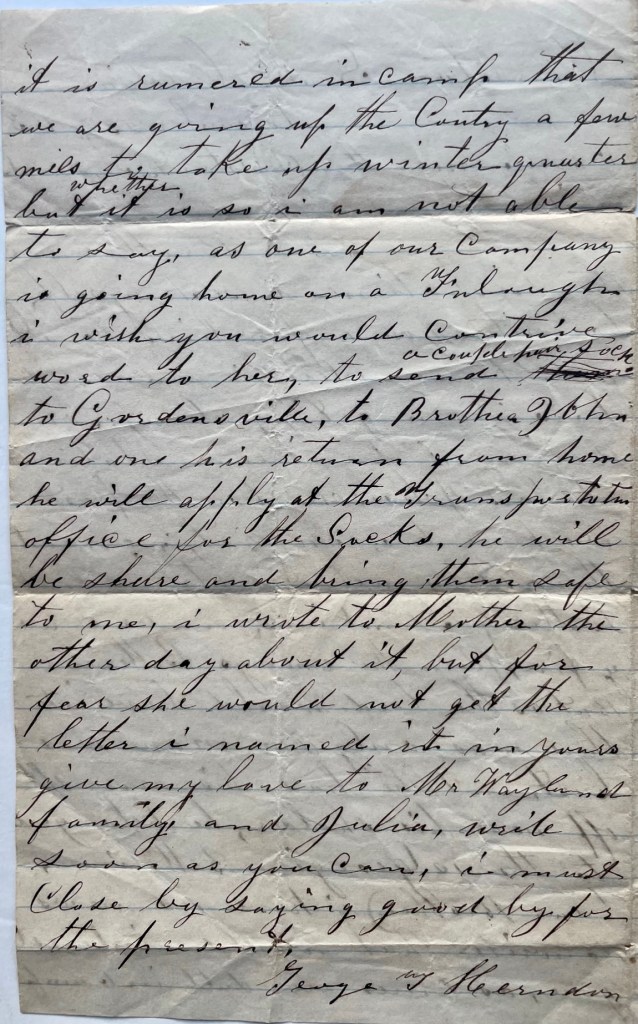
Dear Brother, I have no news to write that would interest you as times are dull in camp. It is rumored in camp that we are going up the country a few miles to take up winter quarter but whether it is so I am not able to say.
As one of our company is going home on a furlough, I wish you would contrive word to her to send a couple pair of socks to Gordonsville to brother John and on his return from home he will apply at the transportation office for the socks. He will be sure and bring them safe to me. I wrote to Mother the other day about it but for fear she would not get the letter, I named it in yours.
Give my love to Mr. Wayland’s family and Julia. Write soon as you can. I must close by saying goodbye for the present. — George T. Herndon
These two letters were written by George Bouton (1817-1891), the son of Richard Crittenden Booton (1785-1842) and Lucy C. Ware Scott (1789-1846) of Madison county, Virginia. In his letters, George mentions two of his brothers, James W. Booton (1815-1889) and R. Sinclair Boton (1830-1882). George was married to Lucetta F. Nalle (1819-1893). I believe the plantation where they lived at the time of the Civil War was called “Hilton” and was located in Rochelle, Madison county. It should be noted that George’s signature appears to read “Bouton” but the family surname was actually Booton. This change in spelling appears to have been intentional as his name appears as Bouton in military records and post war census records.
Thomas Taylor Pettus was 1st Lt. in the 34th Virginia and took over as Captain of Co. B, 4th Regt., Heavy Artillery in May 1862.
Muster records of the 34th Virginia Infantry indicate that George raised his own company and joined the regiment in June 1861 when he was nearly 45 years old. His company was shortly afterward designated Co. B (“Madison Artillery”), 4th Regt. Heavy Artillery and placed in charge of some of the guns at Yorktown. His requisition for fuel in December 1861 indicates that he had in camp a total of 37 members in his company, including himself and two lieutenants. The placement of the Madison Artillery in the defenses is not known but it was reported to be near the “Naval Battery.” In late May 1862, at the reelection of officers following one years service, George was not reelected as captain. His last requisition as captain of the company was for the replacement of tents and cooking utensils—having been “left on the field at Yorktown” when it was evacuated—was dated 8 May 1862.
Once replaced as captain of his company, it appears that he took a position as captain of Co. H in the 1st Battalion of Virginia Reserves guarding Richmond. He did not take the Oath of Allegiance to the United States until 1865.
The first transcribed letter comes from a private collection and was written not long after George and his company arrived at Yorktown, having come from Culpeper, Virginia. The second letter was transcribed by me from the on-line digital archives of Cornell Library where the letter is housed but not previously transcribed. It should also be noted that the Library of Virginia purchased two letters of George’s letters—one dated 13 January and the other 20 February 1862 while stationed at Yorktown, Virginia, to his wife, Lucetta Bouton discussing his health, camp life, military preparations at Yorktown, and friends in the regiment; and another, 2 March, to his daughter Mollie Bouton discussing the same topics and trying to explain the significance of the war. (44972)
Letter 1
Addressed to Mrs. Lucetta F. Bouton, rochelle, Madison county, Virginia
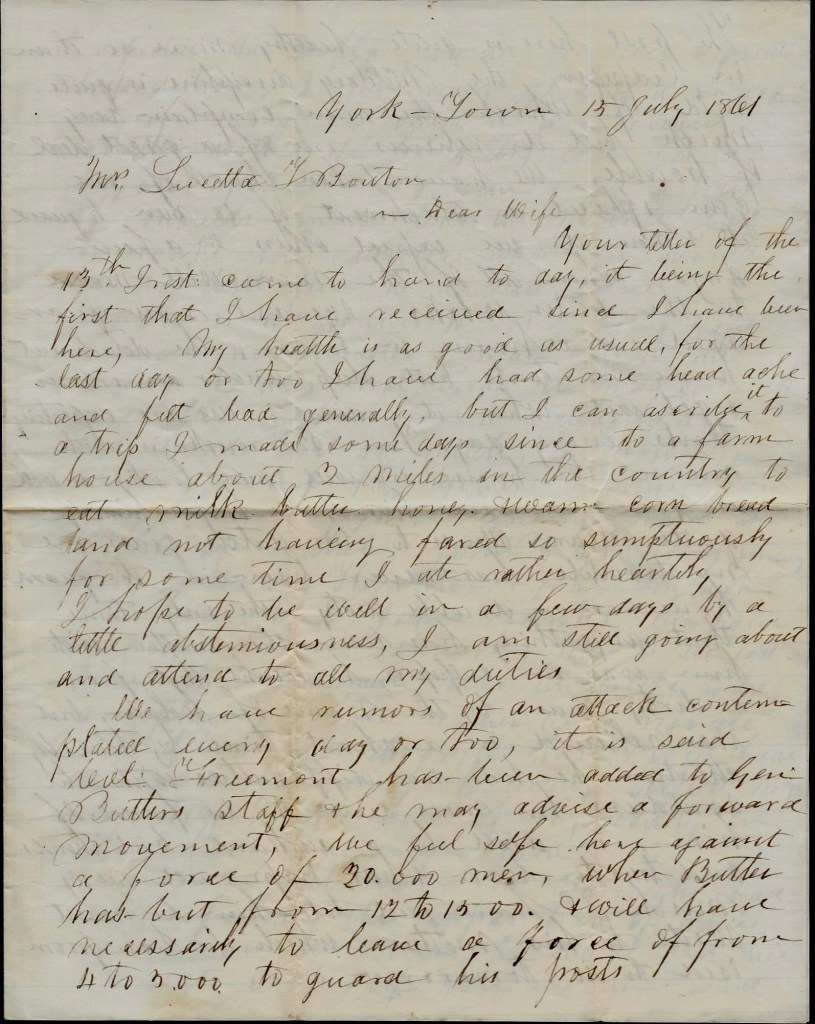
Yorktown [Virginia] 15 July 1861
Mrs. Lucetta F. Bouton, dear wife,
Your letter of the 13th inst. came to hand today, it being the first that I have received since I have been here. My health is as good as usual. For the last day or two I have had some headache and felt bad generally, but I can assign it to a trip I made some days since to a farm house about two miles in the country to east milk, butter, honey, warm corn bread, and not having fared so sumptuously for some time, I ate rather heartily. I hope to be well in a few days by a little abstemiousness. I am still going about and attend to all my duties.
We have rumors of an attack contemplated every day or two. It is said Col. Fremont has been added to Gen. Butler’s staff [at Fortress Monroe] adn he may advise a forward movement. We feel safe here against a force of 20,000 men, when Butler has but 12 to 15,00[0] & will have necessarily to leave a force of from 4 to 5,000 to guard his posts.
The post here is quite healthy—more so than in Culpeper. The military discipline is quite rigid of which the men complain very much but it relieves me of a great deal of trouble. We have taken charge of one gun and placed a detachment of 10 men to guard & man it. we expect others in a few days when all of the men will move to the outer works.
We are now quartered in a house in town. The detachment have no tents but sleep under an arbor & get wet when it rains. We are expecting tents every day. Tom Burroughs is with me in the house, is well, and looks as well as you ever saw him. He keeps himself quite clean, attends to his duties, gives me no trouble, has never been in the guard house or on double duty. The only time that anything has been the matter with him was in Culpeper, he caught that from a dirty man by the name of Colvin, but was relieved in a short time by timely attention. He has no difficulties with the soldiers. His mess seem to be fond of him. In drill he is awkward but attends and tries to learn & has improved very much. I have just told him he must write to his mother which he has promised to do tomorrow.
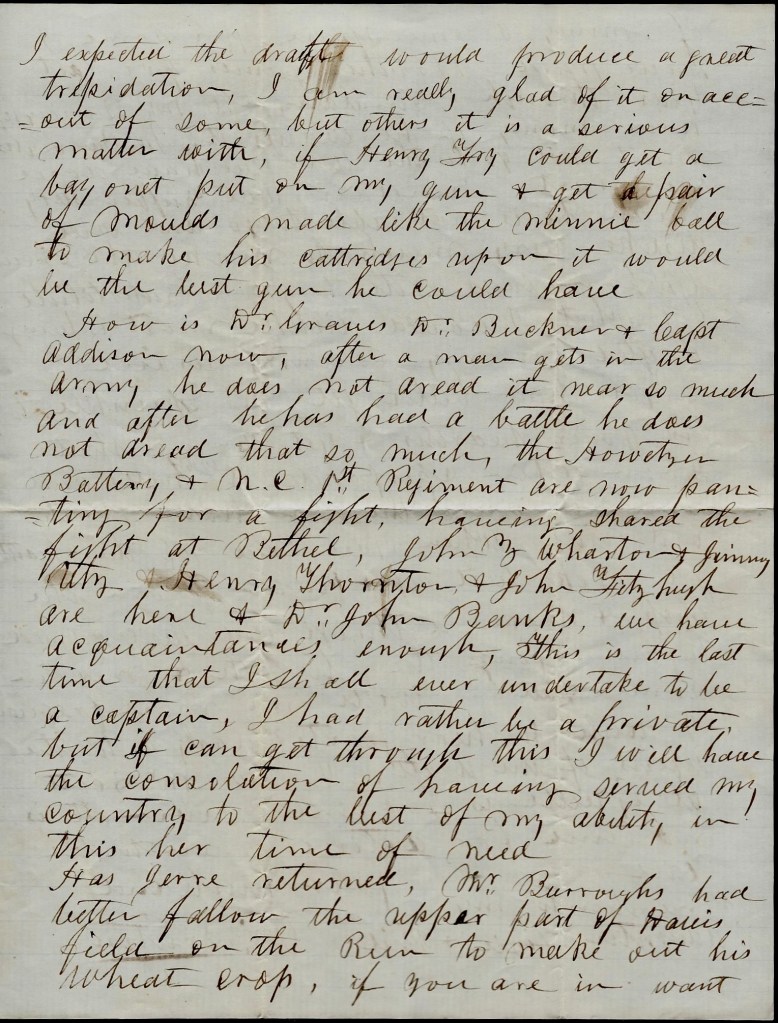
I expected the draft would produce a great trepidation. I am really glad of it on account of some, but others it is a serious matter with. If Henry Fry could get a bayonet put on my gun & get the pair of moulds made like the minié ball to make his cartridges upon, it would be the best gun he could have.
How is Dr. Graves, Dr. Buckner, and Capt. Addison now? After a man gets in the army, he does not dread it near so much and after he has had a battle, he does not dread that so much. The Howitzer Battery & N. C. 1st Regiment are now panting for a fight, having shared the fight at Bethel. John Z. Wharton & Jimmy Utly & Henry Thornton & John Fitzhugh are here & Dr. John Banks. We have acquaintances enough. This is the last time that I shall ever undertake to be a captain. I had rather be a private but if I can get through this, I will have the consolation of having served my country to the best of my ability in this her time of need.
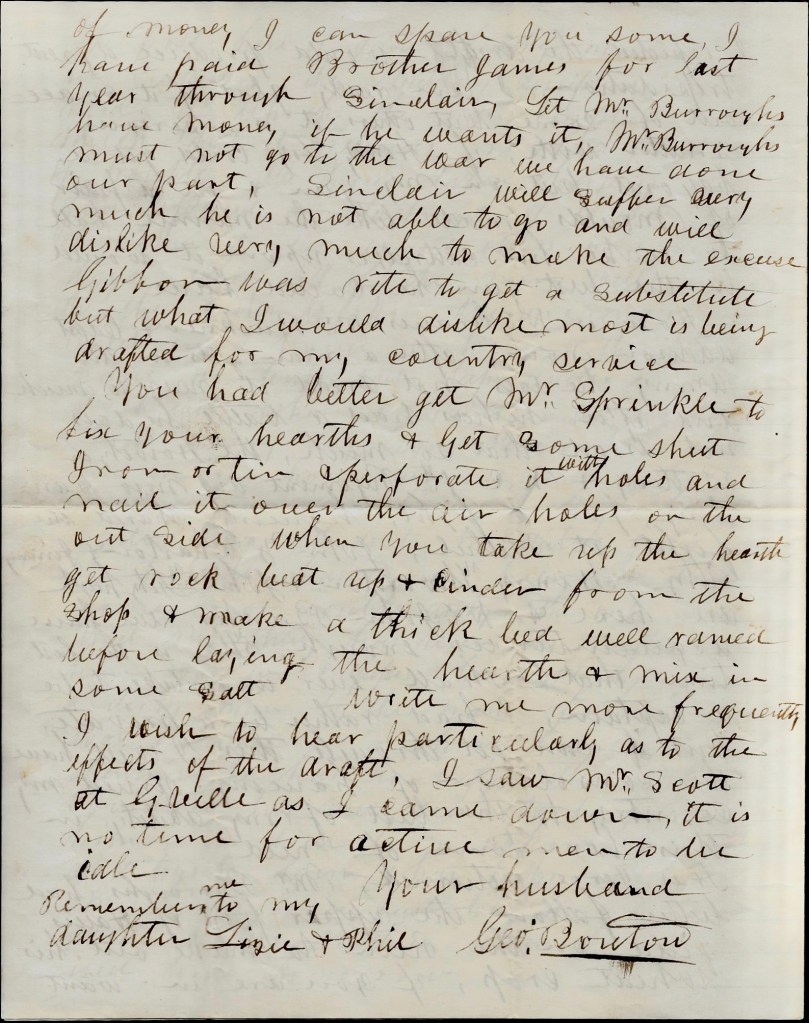
Has Jerre returned? Mr. Burroughs had better fallow the upper part of Davis field on the Run to make out his wheat crop. If you are in want of money, I can spare you some. I have paid Brother James for last year through Sinclair. Let Mr. Burroughs have money if he wants it. Mr. Burroughs must not go to the war. We have done our part. Sinclair will suffer very much. He is not able to go and will dislike very much to make the excuse. Gibbon was right to get a substitute. But what I would dislike most is being drafted for my country service.
You had better get Mr. Sprinkle to fix your hearths & get some sheet iron or tin & perforate it with holes and nail it over the air holes on the outside. When you take up the hearth, get rock beat up & cinder from the shop and make a thick bed, well rammed before laying the hearth & mix in some salt.
Write me more frequently. I wish to hear particularly as to the effects of the draft. I saw Mr. Scott at Gordonsville as I came down. It is no time for active men to be idle. Yours husband, — George Bouton
Remember me to my daughter Lizzie & Phil
Letter 2
Yorktown [Virginia] 20 March 1862
Mrs. Lucetta F. Bouton, dear wife,
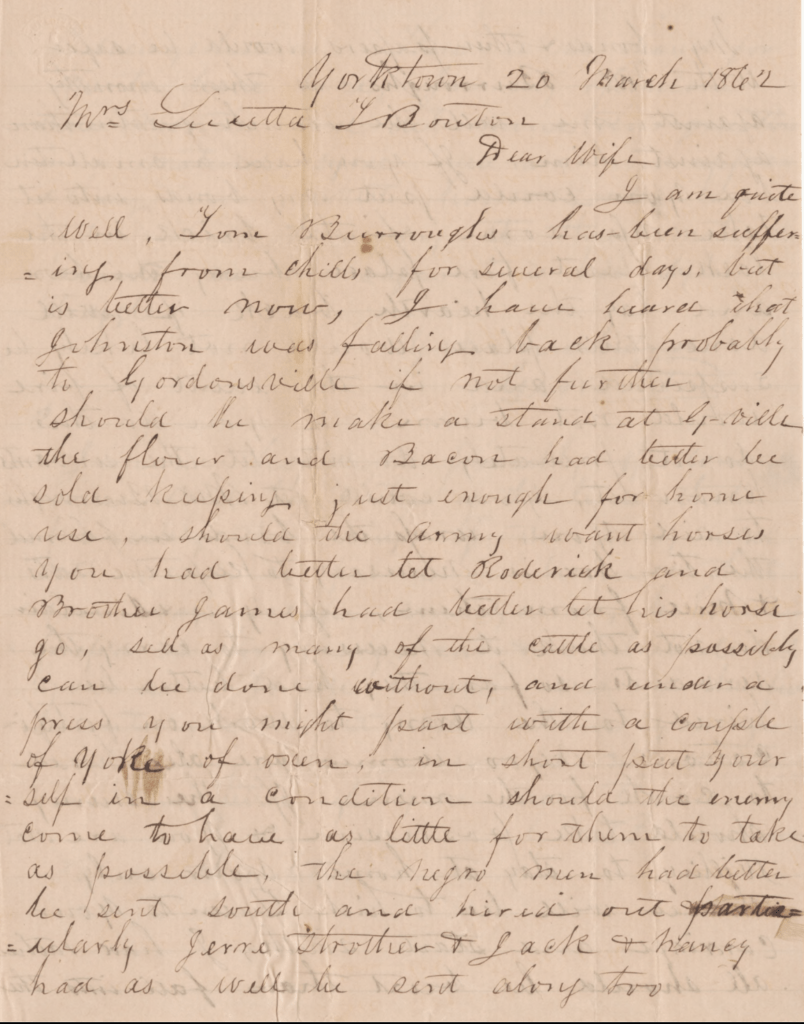
I am quite well. Tom Burroughs has been suffering from chills for several days but is better now. I have hearrd that Johnston was falling back, probably to Gordonsville, if not further. She he make a stand at Gordonsville, the flour and bacon had better be sold keeping just enough for home use. Should the enemy want horses, you had better let Roderick and Brother James had better let his horse go. Sell as many of the cattle as possibly can be done without, and under a press you might part with a couple of yoke of oxen. In short, put yourself in a condition should the enemy come to have as little for them to take as possible. The negro men had better be sent south and hired out—particularly Jerre Strother, & Jack & Nancy had as well be sent along too.
My bonds and other papers would be safe with Mr. Burroughs as their e__ity against me will be much greater than against him. If you have a small tin box, you coud put my bonds into it, take up some of the brick in the lock closet fire place, bury the box, and lay the hearth back. If well done, this place would not likely be suspected and in the event of fire, would not burn. If you do this, do it privately. Do not let the servants know it. You could get Mr. Burroughs to aid you. Wrap the bonds in flannel. The tin box is necessary to keep the rats and mice from them. If you & Sinclair do not think it necessary to carry the servants so far, they had better be hired to the Army to work on fortifications. Negro women are also hired to cook for the men. If the enemy should take possession & you are not willing ot stay at home, your only chance will be to hitch Queen to your carriage and start south. I had rather all should be burnt than fall into the enemy’s hands.
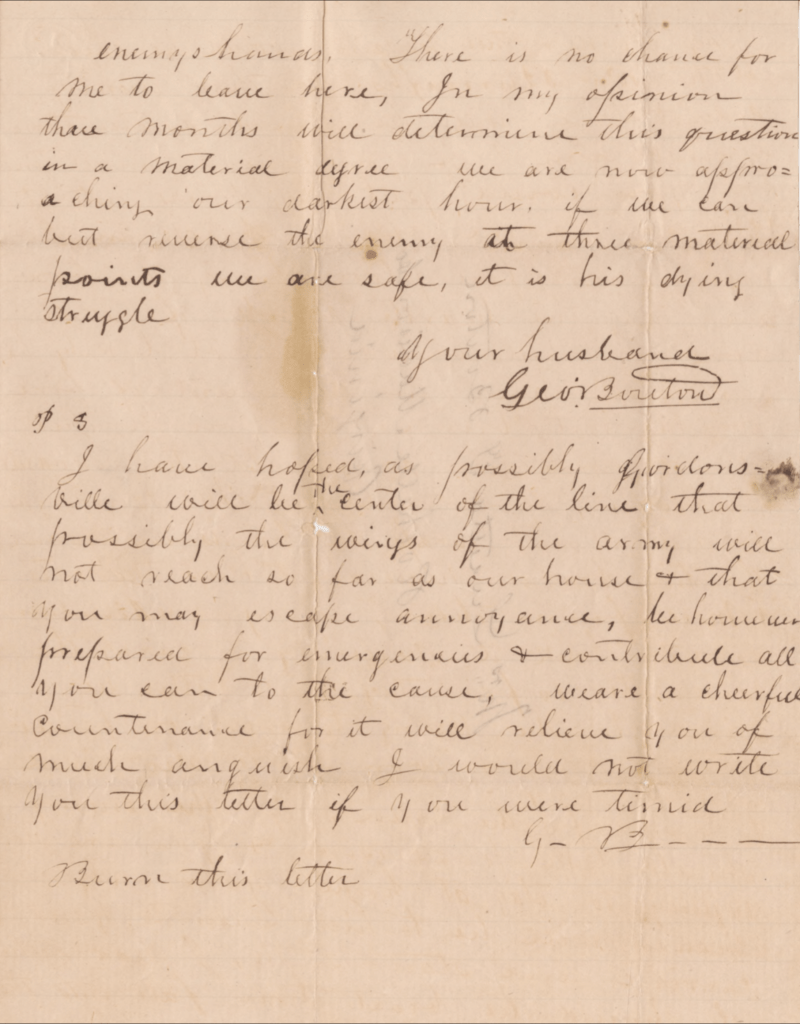
There is no chance for me to leave here. In my opinion, three months will determine this question in a material degree. We are now approaching our darkest hour. If we can but reverse the enemy at three material points, we are safe/ It is his dying struggle.
Your husband, — George Bouton
P. S. I have hoped as possibly Gordonsville will be the center of the line that possibly the wings of the army will not reach so far as our house & that you may escape annoyance. Be however prepared for emergencies & contribute all you can to the cause. Wear a cheerful countenance for it will relieve you of much anguish. I would not write this letter if you were timid. — G. B.






 Spared & Shared 23