

The following letter was written by Lewis Morton Hunter, the son of Lewis M. Hunter (1806-1859) and Maria Martin (1836-1914) of Jackson, Decatur county, Indiana. Lewis wrote the letter to his younger sister, Harriet (Hannah”) Elizabeth Hunter (1845-1920).
Lewis enlisted on 18 October 1861 as a private in Co. H, 37th Indiana Infantry. He survived the war and mustered out three years later on 27 October 1864. In his letter he refers to his brother Sgt. Joseph Hunter (1834-1880) who served in Co. E, 82nd Indiana Infantry.
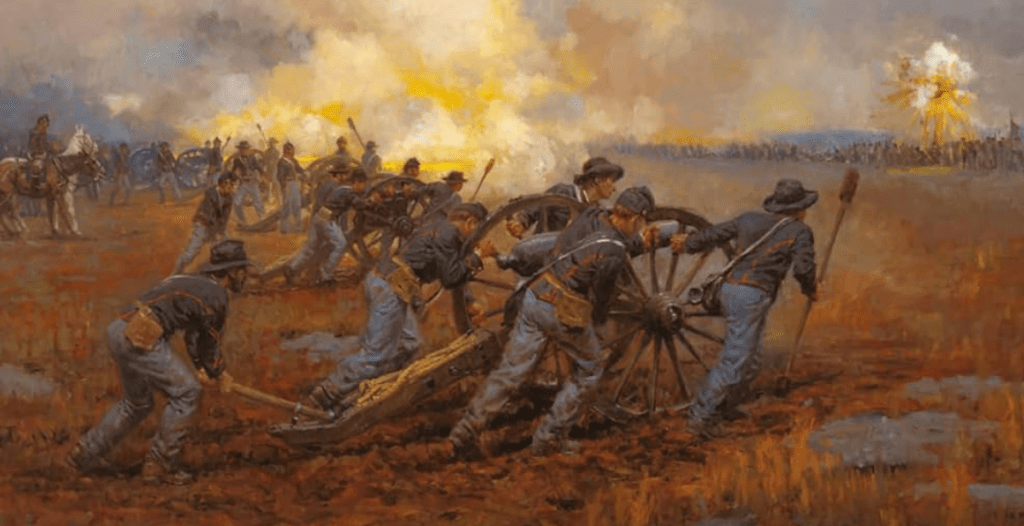
In his letter, Lewis provides a brief sketch of the Battle of Stones River in which his regiment played a part, being in Negley’s Division of Rosecrans’ Army of the Cumberland. The 37th was up early in line of battle on the frosty morning of December 31st 1862, when “scarcely clear daylight…the awful roar of cannon, and the sharp rattle of thousands of rifles told us plainly that the battle had begun” on its right. In Dan Master’s recently published book, “Hell by the Acre,” (page 361): “Negley’s men spent the first few hours of the battle as spectators to the disaster on the right. As the roar of the battle ‘drew louder and louder, evidently directing itself somewhat at our rear. we began to choke in the throat, to think of home, and wondering if our turn would come soon,; recalled Henry Haynie of the 19th Illinois. ‘The right was not so far off and we could see the enemy doubling up the boys in blue. We could hear the hoarse shriek of the shell, the swift rattle of musketry, the sound of buzzing bullets. the impact of solid shot, the chug when human forms were hit, the yells of pain, cries of agony, the fearful groans and encouraging words and the death gasps of which told of those who had reported to the God of Battles.'”
It wasn’t long before the boys of the 37th saw a “great crowd of demoralized soldiers running to the rear” and they were ordered to pile knapsacks and form a line in a cedar thicket about one mile to the right of the Nashville Pike and ordered “to check, and hold in check the advancing enemy.” But the regiment “had scarcely got into position when the Confederates, flushed with their success on our right, assailed the 37th with all the pride and determination of the Southern soldiers. The conflict was fierce, close, and bloody.” After repulsing the enemy three times, the 37th fell back, “passing over the ground that had been fought over by troops in its rear, unknown to the regiment.” [Source: Regimental History by George H. Puntenney, 1896]
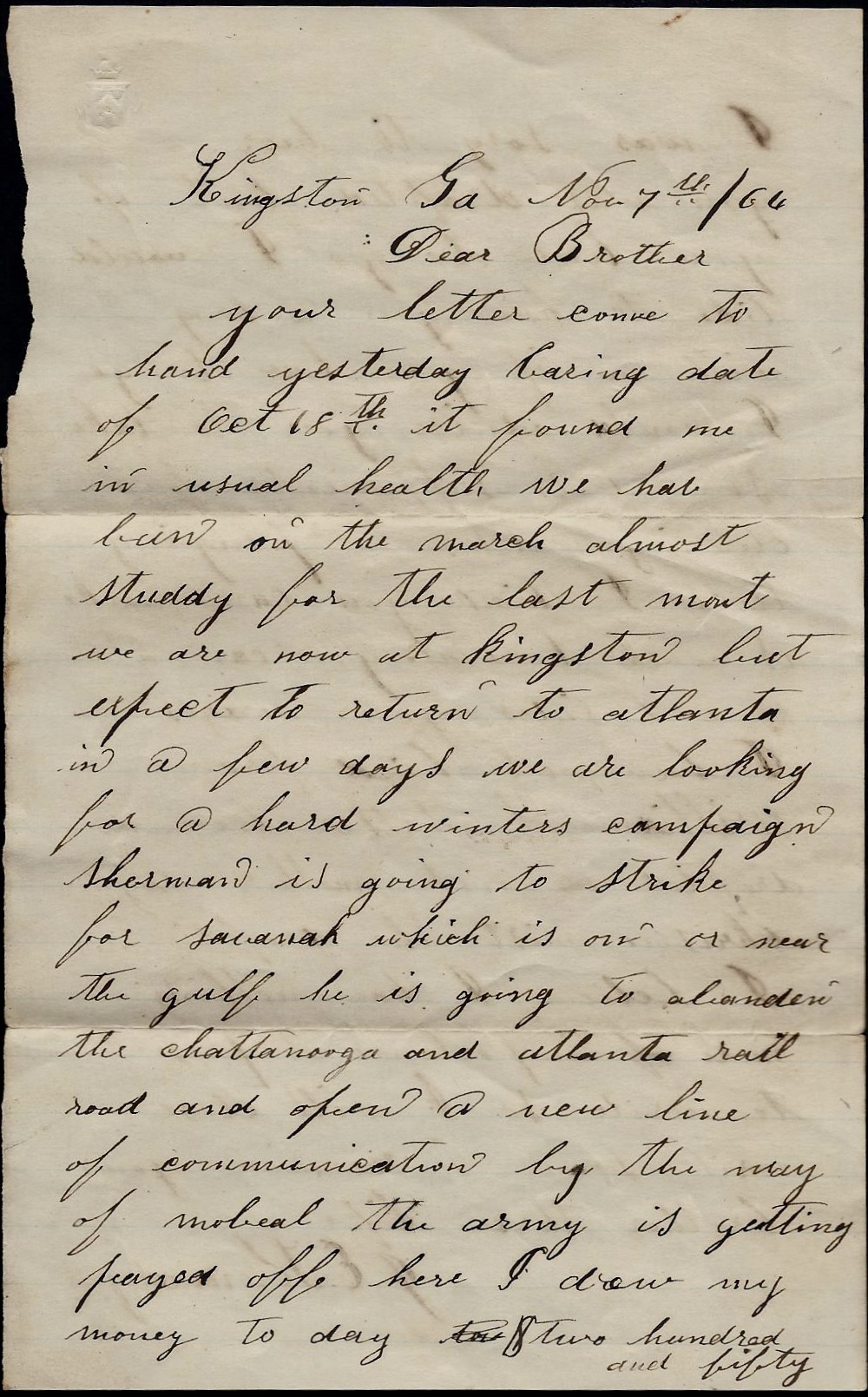
Transcription
Camp near Murfreesboro
January 25, 1863
Dear Sister,
I take this opportunity this Sabbath morning to write you a few lines to let you know that I am well and I sincerely hope that this will find you in the enjoyment of good health. It is raining today. It rains most of the time this winter. We have had very little snow this winter and very little cold weather.
The 82nd [Indiana Infantry] is camped close to us. I get to see Jos. often. He is well and looks well in soldier clothes. Captain Kendrick died yesterday with the fever. He was a brave and gallant man. I have remailed John’s letters to him and wrote to him but got no answer since the first letter that I got from him. He was then in the Convalescent Camp in Nashville.
January 26th. Joseph and Dan Baker come over and I stopped writing till today. Dan was just come from Nashville. He saw John in town. His health is some better. He has left the Convalescent Camp and I don’t know where he is now. If you write to him, direct to Nashville P. O., Tennessee. But perhaps he has written to you and that you know where he is.
But another subject. I will send my likeness to you as soon as I can get it taken but that may be a long time and military life is very uncertain. I will sed you money sometime for you to send me your likeness. I am glad that you got them rings that I sent to you. I made them. The red one I made in Alabama. I heard from John’s letter that you had gone out to Ripley to Mother’s so I will send this letter to Elrod’s. When you write, write a long letter and tell me how much you learned this winter at school and how you get along and all the news. You don’t know how bad I want to see you, my sister Hattie, but as a soldier, I must be contented with a soldier’s lot to be always at my post in defense of our glorious country.
You have heard of our fighting and of the great Battle of Stones River and how we whipped Braxton Bragg and the rebels and his retreat in the night and of our brave men that fell. The 37th [Indiana Infantry] fought on the last day of the old year and the second of the new. The last day that we fought, we charged on the rebels whipping them and drove them from the field with great slaughter. They was on both sides of the river. The Federals crossed the river on double quick, charged into the woods and captured the rebel battery. The day was ours. We whipped them badly. Our first day’s fight we come near being all captured. We was nearly surrounded. We passed over rebel dead to get out. I was in the hottest of the fight and the air was full of bullets but I did not get a scratch or a mark on me.
Farewell for this time. From L. M. Hunter
To his sister Hattie E. Hunter



 Spared & Shared 23