Category Archives: 38th USCT

1864: Dwight H. Howland to Jennie Palmer

Dwight Howland’s headstone

This letter was written by Dwight H. Howland (1839-1866), a farmer from Gill, Massachusetts, who enlisted on 13 September 1861 as a musician, later as a private, in Co. C. 27th Massachusetts Infantry. He remained with the regiment until 133 August 1864 when he transferred to the 38th U. S. Colored Troops to serve as the Quartermaster Sergeant. Dwight was listed as “absent sick” (suffering from chronic diarrhea) for the months of January, February, and March, 1865. He seems to have been present April, May and June but was discharged from the service for disability on 8 July 1865. Though he “survived” the war, he died on 7 January 1866 in Tinmouth, Vermont, where he was buried next to his parents.

Dwight was the orphaned son of Consider Howland (1809-1856) and Lydia P. Stafford (1813-1864) of Tinmouth, Rutland county, Vermont.

[This letter is from the private collection of Greg Herr and was transcribed and published on Spared & Shared by express consent.]

Transcription

Addressed to Miss Jennie Palmer, Wallingford, Vermont

Camp of the 38th U. S. C. Troops
Deep Bottom, Va.
September 4th, 1864

Cousin Jennie,

I am at liberty today to do about as I please so will pen a few lines in answer to your welcome letter that was received yesterday. I was very glad to hear from you as I always am. I still jog along nearly the same as usual although I am at present suffering with a very hard cold, but that is of but little consequence when compared with a thousand other ills that I might have here in this low, unhealthy place. It is very sickly here now. The weather is fine but it is bad for us Northern men. The days are hot and the nights cold—so cold that 2 wool blankets are none too much to sleep under.

When I last wrote you we were in front of Petersburg. Now we are at what is called Deep Bottom, some 12 miles from our last camp. We are on the north side of James river on a high bluff about 5 miles from Bermuda 100. All of the 18th S. C. are in this vicinity but only 1 Brigade here. We have a very strong place here and one that would cost the Rebs dear should they undertake to take it from us. Three gunboats lie here near us. One of them is a torpedo boat that was taken from the Rebs some time ago.

We are doing nothing but picket duty here. Half of the regiment are on one day, the other half the next. That is far easier than the duties they had to do when in front of Petersburg. There they had to be on duty all the time and be under fire at that.

I don’t know how long we will stay here but probably not long. Then we will have to go into the trenches again. I hope Petersburg & Richmond will be taken before long if it is agoing to be such work as this. I am sick of it and will be glad when they go over the Bey [?]. We got the news last night that Atlanta was in our hands. Hope it is so but am afraid it is too good to be true.

The 27th [Massachusetts] time expires now soon. I almost wish I was one of the number that was going home. Poor fellows. They will be glad to get out of it. Suppose you expect John home this fall. Hope his health will be good so that he can enjoy himself after 3 years of hardship. I can think of nothing more to write so with much love, I will bid you goodbye for this time. Remember me to your brother and all of our friends & relatives that you chance to see.

I remain your affectionate cousin, as ever, — Dwight

Address D. H. Howland, 38th Reg. U. S. C. Troops, 2nd Brigade, 3rd Division, 18th A. C., Fort Monroe, Virginia

1864: George Roy Tubbs to Adam S. Miller

This letter was written by three different soldiers, all serving in in Co. B, 148th New York Infantry. The first part was written by George “Roy” Tubbs who enlisted on 8 August 1862 at Starkey to serve three years. He was wounded in action on 16 May 1864 in the fighting at Drewry’s Bluff and died of his wounds on 19 June 1864 at Fortress Monroe.

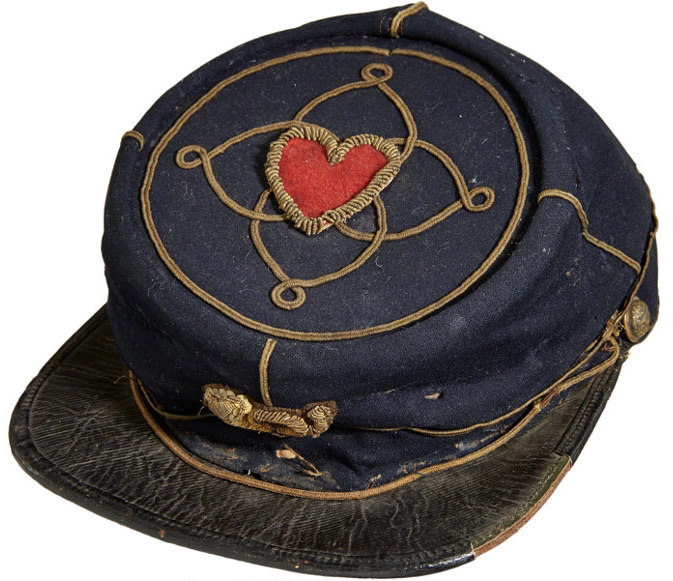
A kepi identified to George Waddle of the 148th new York Infantry

The second part of the letter was written by Benjamin Grace of Barrington who enlisted on 26 August 1862 who, like Roy Tubbs, wounded at Drewry’s Bluff and died of his wounds on 25 July 1864.

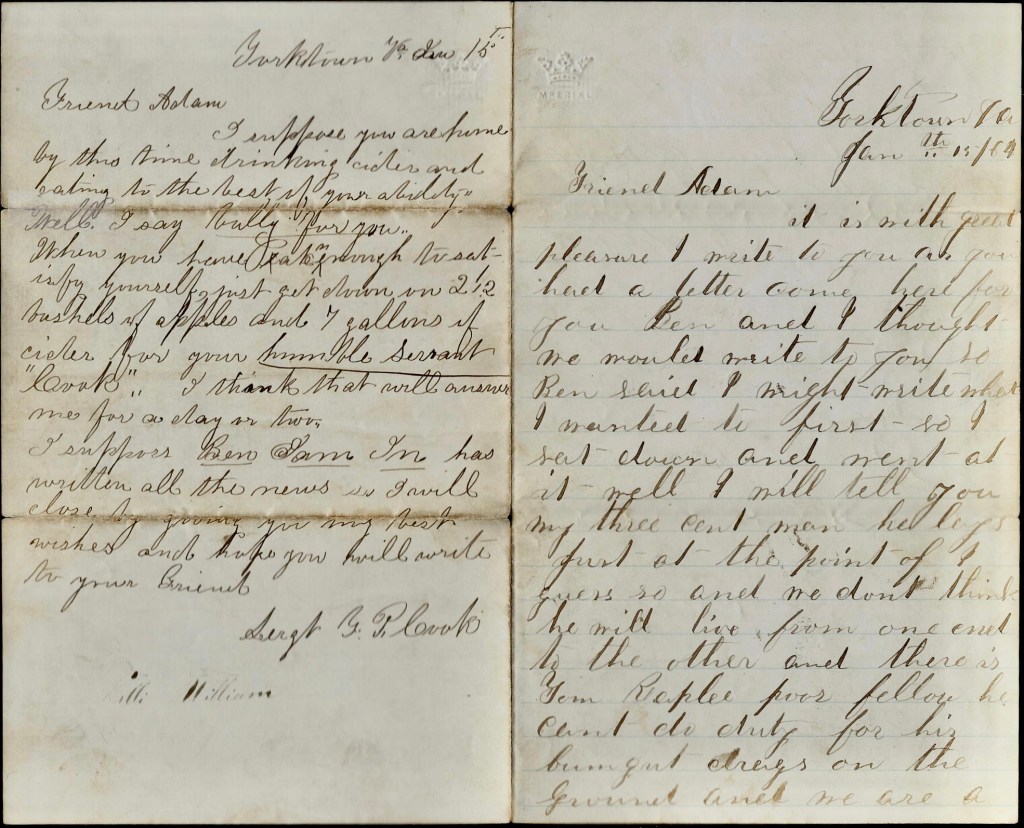
The third part of the letter was written by Sergt. Foster P. Cook of Starkey who enlisted on 28 August 1862 and was promoted to sergeant in October 1862. He made 1st Sergt. on 17 January 1864 and was wounded in action on 15 June 1864 near Petersburg. Unlike his two buddies, however, Foster survived his wounds and was promoted to Lieutenant in Co. F.

The letter was addressed to Adam S. Miller of Starkey, Yates county, New York, who enlisted in the company at the same time as the others but mustered out of the regiment on 8 January 1864 for disability.

Transcription

Yorktown, Virginia
January 15, 1864

Friend Adam,

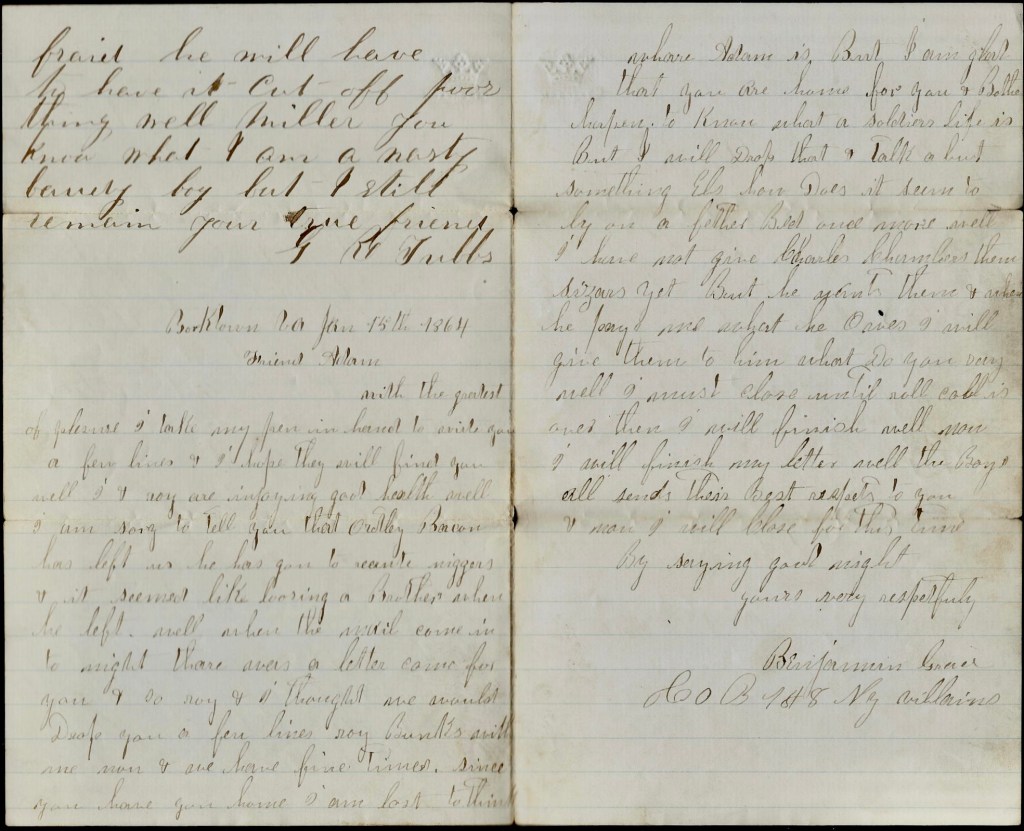
It is with great pleasure I write to you as you had a letter here for you Ben and I though we would write to you so Ben said I might write what I wanted to first. So I sat down and went at it. Well I will tell you my three cent man he lays just at the point of I guess so and we don’t think he will live from one end to the other and there is Tom Raplee, poor fellow. He can’t do duty for him bum gut drags on the ground and we are afraid he will have it cut off. Poor thing. Well, Miller, you know what? I am a nasty [ ] boy but I still remain your true friend. — G. Roy Tubbs

[in a different hand]

Yorktown, Va.
January 15th 1864

Friend Adam,

With the greatest of pleasure I take my pen in hand to write you a few lines & I hope they will find you well. I & Roy are enjoying good health. Well, I am sorry to tell you that Orderly [Randall G.] Bacon has left us. He has gone to recruit niggers & it seemed like losing a brother when he left. 1 Well, when the mail came in tonight, there was a letter came from you & so Roy and I thought we would drop you a few lines. Roy bunks with me now & we have fine times. Since you have gone home I am lost to think where Adam is. But I am glad that you are home for you & Both happen to know what a solder’s life is. But I will drop that & talk about something else.

How does it seem to lay on a feather bed once more? Well I have not give Charles Chambers them cigars yet. But he wants them and when he pays me what he owes me, I will give them to him. What do you say?

Well, I must close until roll call is over. Then I will finish. well, now I will finish my letter. well the boys all sends their best respects to you and now I will close for this time by saying good night. Yours very respectfully. — Benjamin Grace. Co. B, 148th New York Villains

[in a different hand]

Yorktown, Va.
January 15th

Friend Adam,

I suppose you are home by this time drinking cider and eating to the best of your ability. Well, I say “Bully for you.”

When you have ate enough to satisfy yourself, just get down on 2.5 bushels of apples and 7 gallons of cider for your humble servant “Cook.” I think that will answer me for a day or two.

I suppose Ben has written all the news so I will close by giving you my best wishes and hope you will write to your friend, — Sergt. F. P. Cook


1 Randall Graves Bacon (1837-1924) was mustered in as a 1st Lieutenant on 6 February 1864 in the 38th U. S. Colored Infantry. He served as adjutant of the regiment for a time and when he requested to resign with an honorable discharge in January 1865, his request was disapproved with the following less than complimentary comments: “Disapproved. Lieut. Bacon is a restless, negligent, and discontented officer who is not pleased at being required to perform his duty. He has been an officer about twelve and a half months, has been absent from his regiment about six months of that time on recruiting service and other pleasant detached duty, and has little to complain. In my opinion, the spirit of his resignation is highly reprehensible and he not deserve an honorable discharge. He was finally discharged after he received a gunshot wound on April 5, 1865 near Richmond necessitating the amputation of the first two fingers on his right hand.