Category Archives: 39th Illinois Infantry

1861: Allen B. Johnson to “Dear Eliza”

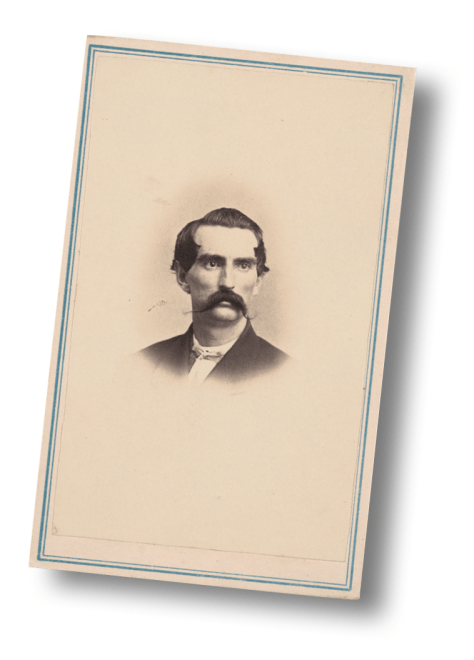
I could not find an image of Allen but here is a cdv of Lester W. Hamilton of Co. C, 39th Illinois Infantry.

This letter was written by Allen B. Johnson of Wilmington, Will county, Illinois, who served as the Commissary Sergeant of the Yates Phalanx Independent Regiment. This regiment began to organize not long after the news of the firing on Fort Sumter reached Chicago but did not raise troops quickly enough. “The state having filled its quota without this regiment, efforts were made to get it accepted into the State service of Missouri, but without success. The regiment had already assumed the name of His Excellency, the governor of Illinois, and was known as the “Yates Phalanx”. Governor Yates manifested an earnest desire to see it brought into the service, and sent General O. L. Mann (then known as Captain) to Washington, with strong commendatory letters to the President and Secretary of War, urging the acceptance of the regiment, which at this time had over 800 men on the rolls.” The regiment was finally mustered into service on 11 October 1861 as the 39th Illinois Volunteers.

According to muster records, Allen was commissary sergeant until 1 December 1861 when he was commissioned a 2nd Lieutenant in Co. A. He was later promoted to 1st Lieutenant but died of Yellow Fever in September 1864 while in Newbern, North Carolina. He was single and working as a merchant in Wilmington prior to his enlistment. He was born in Montrose, Susquehanna county, Pennsylvania.

T R A N S C R I P T I O N

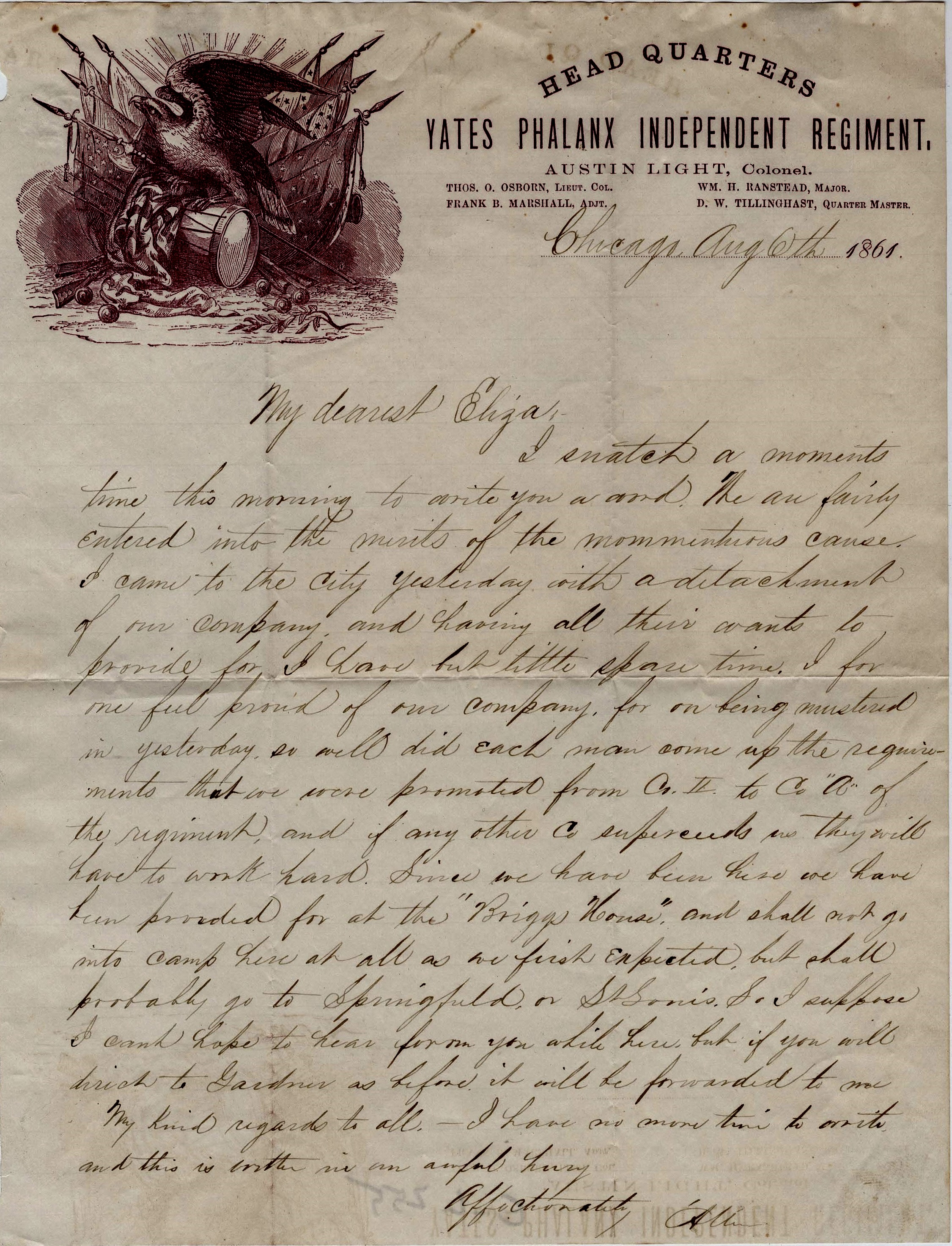
Rare stationery used by Allen Johnson to write his letter.

Head Quarters Yates Phalanx Independent Regiment
Austin Light, Colonel Chicago, Aug 6th, 1861

My dear Eliza,

I snatch a moments time this morning to write you a word. We are fairly entered into the merits of the momentous cause. I came to the city yesterday with a detachment of our company, and having all their wants to provide for I have but little spare time. I for one feel proud of our company, for on being mustered in yesterday, so well did each man come up to requirements that we were promoted from Co. II. to Co “A” of the regiment, and if any other company supersedes us, they will have to work hard. Since we have been here we have been provided for at the “Briggs House” and shall not go into camp here at all as we first expected, but shall probably go to Springfield, or St Louis. So I suppose I can’t hope to hear from you while here, but if you will direct to Gardner as before, it will be forwarded to me.

My kind regards to all. I have no more time to write, and this is written in an awful hurry, Affectionately — Allen
1864: John R. Hafter to his Sister

The following letter was written by John R. Heafer (1845-1864), the 19 year-old son of John Heafer (b. 1820) and Nancy (b. 1826) who moved with his family from Charleston, Jefferson county, Virginia, to a farm in Bloomington, McLean county, Illinois in the 1850s. John was serving as a private in Co. B, 39th Illinois Infantry when he wrote this letter from Bermuda Hundred in June 1864. 

He was carried on the muster rolls as “Hafter” which may explain why he can’t be found under his given name. Unfortunately he did not survive the war. He was killed along with many other comrades in his regiment on 13 October 1864 in the Battle of Darbytown Road. The Union advance was repulsed with heavy casualties and John’s body was left on the field.

John wrote the letter to his sister, Sarah (“Sallie”) Heafer (b. 1844), the wife of William M. Steele, a former soldier in Co. A, 94th Illinois Infantry and a teamster working in Bloomington. He later became a minister..

From the Regimental History of the 39th Illinois Infantry

Transcription

Near Bermuda Hundred
June 4th 1864

Dear Sister,

I received your letter of the 25th of May this morning and was glad to hear from you. I have not been well for a few days but am well this morning. I have not had much time to write since we have had so much fighting to do and I have not felt much like either. We had another fight [see Ware Bottom Church] on the 20th of last month. I guess you have heard about it by this time. Our loss was pretty heavy. We had to make a charge on the Rebels rifle pits. We had a skirmish yesterday. We lost 31 men. That makes 250 men we have lost since we have been here. If we keep on that way, we will soon play out.

Lt. Algernon Cox Sweetser of Co. B, 39th Illinois Infantry (LOC)

Lieut. [Algernon Cox] Sweetser was wounded yesterday in both legs. One had to come off. 1 We have some fighting every day now. When the Rebs commence to throw shell over, we all have to skedaddle to the breastworks. The shells burst all over our camp. There was a bullet went through my tent the other day. It hit just where I lay but I happened to be out. This is the first letter I have got from home for some time. I think you might [write] oftener. I expect we will have a big fight here some day. I would like to see Sallie’s baby. I hope she will get along well. I am expecting a letter from Mat every day. I suppose it is pretty dry in Bloomington now. But for all that, I would like to be there. I think I could enjoy myself pretty well.

I don’t feel much like writing today and I will have to go on picket tonight so I will not write much more. Your brother, — John

P. S. My love to all the family and Sallie and the baby. My love to all the friends. — John

Please send some stamps.


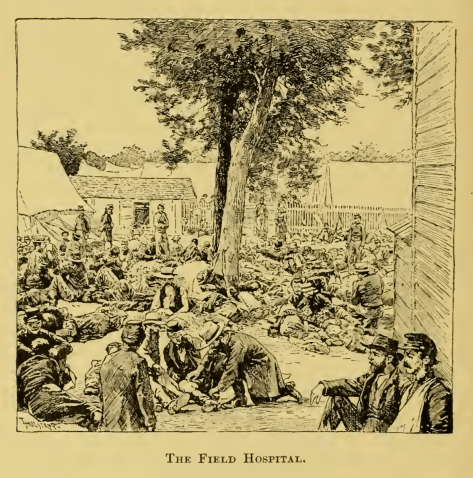
1 The regimental history Lieutenant Al. C. Sweetser of Company B was wounded through both legs. The wound of the left leg was not serious, the ball making merely a flesh wound. The right limb fared worse, the bullet passing through the knee- joint and so disrupting the articulation that amputation at the lower third of thigh became necessary. We shall never forget the courage and fortitude of Lieutenant Sweetser while on the operating-table, or while suffering for long months at Chesapeake hospital by reason of hospital gangrene and the subsequent operations that become necesssary from the necrosis of bone. He came back to the field hospital on a stretcher, calmly smoking a cigar, and after an examination, when told that he must sacrifice a limb, he said, “Well, ‘Doc,’ just go to work, and do the very best you can for me.” Lieutenant Sweetser was a brave and gallant officer.” (pp. 201-202)

1862: Barton Smith Walters to his Parents

I could not find an image of Barton but here is Orlando Starkey of Co. C, 39th Illinois Infantry (Al & Claudia Niemiec Collection)

The following letter was written by Barton Smith Walters (1841-1865), the son of William Walters (1814-1890) and Malinda C. Smith (1822-1888) of Minooka, Grundy county, Illinois. Barton enlisted in October 1861 to serve in Co. A, 39th Illinois Infantry. He did not survive the. war, however. The following excerpt was lifted from “The Patriotism of Will County.”

“Barton Smith Walters enlisted in the 39th Regiment at the age of 21, re-enlisted and served faithfully and bravely without any casualty until in May 1863 when he was taken prisoner. He with two others had been detailed to go upon the battlefield and bring in an officer who had been wounded. He was captured with two others, David Hanson and Andrew Sybert, of the same regiment, and they were taken to Andersonville. Hanson and Sybert fell victims to their treatment and were buried in that locality. Young Walters was released before his death, but he only lived to reach Annapolis, where he died April 1st 1865. His remains were brought home and repose in the Channahon cemetery.”

Transcription

Addressed to Mr. William Walter, Minooka, Grundy county, Illinois

Columbian Bridge
Sunday, May 4th 1862

Dear Father & Mother,

I now sit down in the shade of an apple tree to write after a march of 7 miles. We are all well but me. I have the erysipelas in my legs but they are now better. I have not seen nor heard from Mike for three weeks. He is at Mt. Jackson. When I saw him last, he was sick but on the gain. Charlie got a letter from Fatha [?] Hunter today. They were all well when she wrote and she had not heard from you for some time.

We are having nice spring weather here now only rather warm for marching. We are soon to have another fight, I think, from the way things are moving. We have two days rations in our haversacks. [Stonewall] Jackson is reported to have been reinforced but we don’t care for that. We want to have the fun of reinforcing him ourselves but the trouble is we can’t get near enough to him. He always runs away. We have the two fighting regiments together—namely 13th Indiana and the bloody 39th from Illinois. We bear a good name wherever we have been but now we are somewhat dissatisfied. Our Brigadier [General] Sullivan has been transferred to the 3rd Brigade of yankees and a yankee—General [Orris S.] Ferry—put over the brave sons of the west. They have gained a name which will live for years after they are laid to moulder in the grave. I have become an old man in my views of the war. I am glad to hear of the several democratic victories throughout my native state, one of the most beautiful lands in the world, and when you ask one of them abolitionists the reason why they were beat in the election and they will answer by saying they have gone to put down the rebellion, but we can rule them in this regiment.

I think our town is gone up when Dick Briscoe can get two officers. I wish you to let me know who are the town officers and if snipe bill or H. H. Randall got any. I have wrote 3 letters in the last two weeks to see if any of them would get through the mail here is uncertain, and if we don’t get any answer, we are not much disappointed. While I write, Earnest Holz is talking about this cursed rebellion. He is my right bower. This is the oldest country in the states. I was talking with a woman last night and she told me that she had lived in the same house for the last 65 years and her 4 sons were in the army and she was surprised when I told her that we had taken them prisoner a week before. When I told her their names, she felt very bad. At first she did not believe it or she would have heard it.

Write as soon as possible. Write like I have—without waiting for an answer. I still remain your affectionate son, — Barton S. Walters

Tell Sarah to write.

1864: John R. Heafer to Sarah E. (Heafer) Steele

The following letter was written by John R. Heafer (1845-1864), the 19 year-old son of John Heafer (b. 1820) and Nancy (b. 1826) who moved with his family from Charleston, Jefferson county, Virginia, to a farm in Bloomington, McLean county, Illinois in the 1850s. John was serving as a private in Co. B, 39th Illinois Infantry when he wrote this letter from Bermuda Hundred in July 1864.

He was carried on the muster rolls as “Hafter” which may explain why he can’t be found under his given name. Unfortunately he did not survive the war. He was killed along with many other comrades in his regiment on 13 October 1864 in the Battle of Darbytown Road. The Union advance was repulsed with heavy casualties and John’s body was left on the field.

John wrote the letter to his sister, Sarah (“Sallie”) Heafer (b. 1844), the wife of William M. Steele, a former soldier in Co. A, 94th Illinois Infantry and a teamster working in Bloomington. He later became a minister.

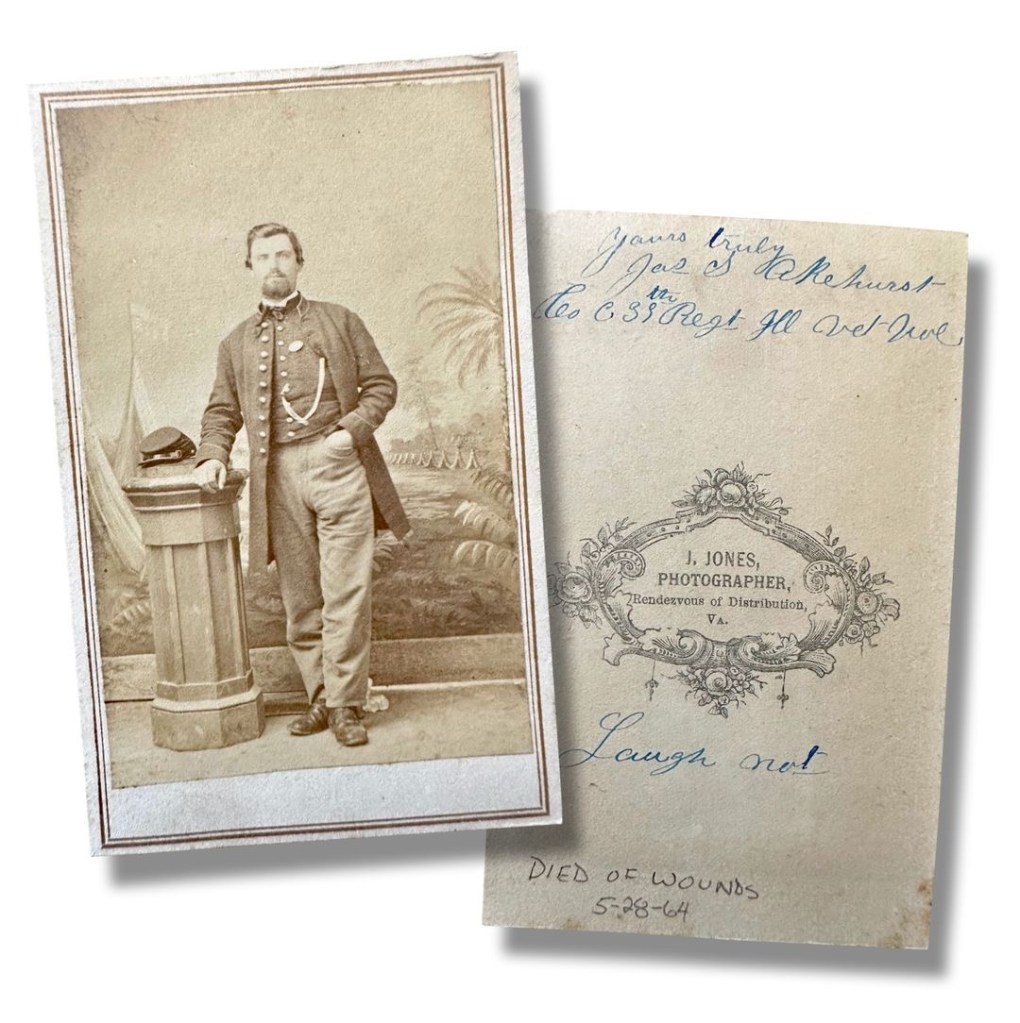
I could not find an image of Robert, but here is a cdv of James S. Akehurst (1843-1864) of Pontiac, Illinois, not previously published to my knowledge. James served as a private in Co. C, 39th Illinois Infantry. He enlisted in October 1861 and was wounded on 20 May 1864 at Drewry’s Bluff, Virginia. The wound to his left arm was so severe it required amputation but the procedure did not save him—he died on 28 May 1864 at Hampton, Virginia. The news must have come as quite a shock to his wife, Elizabeth, who had promised to love and respect James “till death do us part” only three months earlier. James’ image was taken in front of a backdrop that features tropical type vegetation suggesting the cdv was probably taken in 1863 while the regiment was on the South Carolina coast. (Courtesy of Claudia & Al Niemiec Collection)

Transcription

Bermuda Hundred [Virginia]
July 4th 1864

Dear Sister,

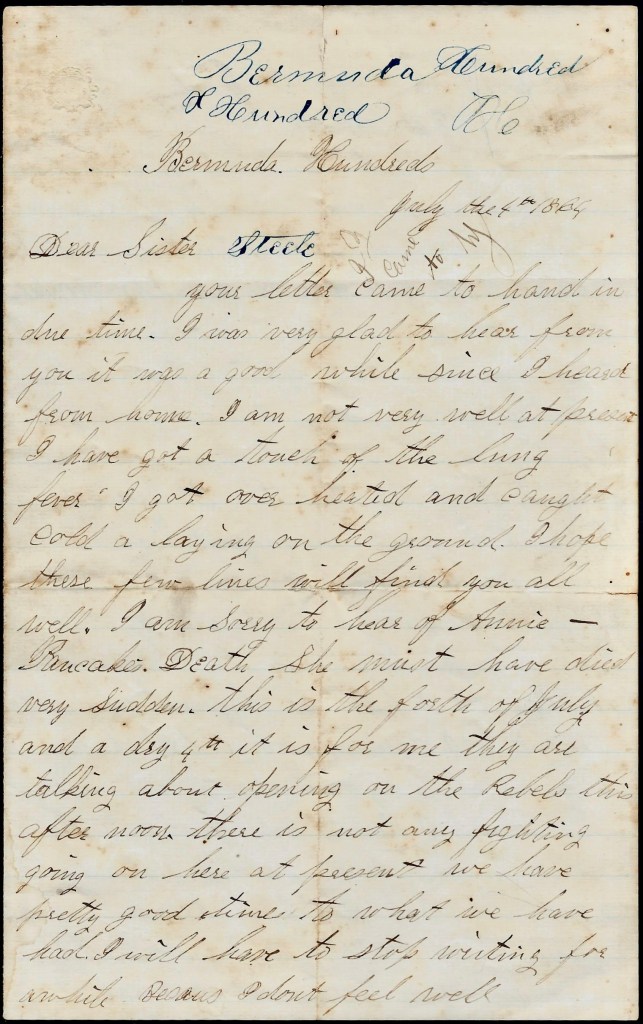
You letter came to hand in due time. I was very glad to hear from you. It was a good while since I heard from home. I am not very well at present. I have got a touch of the lung fever. I got over heated and caught cold a laying on the ground. I hope these few lines will find you all well. I am sorry to hear of Annie Pancake’s death. 1 She must have died very sudden.

This is the Fourth of July and a dry 4th it is for me. They are talking about opening on the Rebels this afternoon. There is not any fighting going on here at present. We have pretty good times to what we have had. I will have to stop writing for a while because I don’t feel well.

July 7th, Thursday. Dear sister, I will commence and finish this letter and I am better. I was very sick for a few days in my quarters and was getting worse until the doctor came to see me and saw me to the Convalescent Hospital. I am better now. The doctor says I have not got the lung fever. I guess I have got the pleurisy. I think I will soon get over it.

The weather is very warm here but it is cool enough in the hospital tent. You will have to excuse this writing as I have to lay on my side to write. I commenced this letter a few days ago but could not finish it. I told Ed[win] Wolcott to write me a letter because I thought I would not be able to write for some time but I guess I can a little yet. But you need not expect many.

There is good news here now. They are fighting at Petersburg. But we can’t hear anything from Grant. The rebels are deserting by hundreds. I have seen a good many go by here today. I will have to come to a close. My love to all. — John R. Hafer

P. S. Be sure and send the photograph.

Mr. John R. Heafer, Co. B, 39th Regt. Illinois Vols., 1st Brigade, 1st Division, 10th A. C.


1 Ann Marie Pancake (1847-1864) died on 20 June 1864 when she was 17 years old. She is buried in Evergreen Memorial Cemetery in Bloomington.