
The following letter was written by George M. Chambers (1842-1907) of Lisbon, St. Lawrence county, New York. George was a sergeant in Co. D, 39th New York Infantry—sometimes called the “Garibaldi Guard.” Initially, the regiment was divided into ten companies of men of different national heritage: three German, three Hungarian, one Swiss, one Italian, one French, one Portuguese and Spanish. On May 31, 1863, the regiment was consolidated into four companies: A, B, C and D. The regiment expanded as new companies were recruited in the field. On December 8, 1863, Company E was added; on December 14, 1863, Company F joined. On December 19, 1863, Company G was added; and on December 30, 1863 Company H joined. Companies I and K joined in January, 1864. Companies A, B, C and D were mustered out in New York city June 24, 1864. Enlistees who were not entitled to be discharged were transferred to other companies within the regiment. Six companies: E, F, G, H, I and K, remained in service. In October, 1864, a new Company D, mustered mostly from Malone, New York joined the regiment for one year. George Chambers would have been in this last enlistment. He was still employed as a 20 year-old farmer in Lisbon at the time of the 1863 Draft Registration. He wrote the letter to his older sister, Rachel Chambers (1826-1880) who died single.
T R A N S C R I P T I O N
Fort Stevenson 1
November 27th 1864
Rachel,
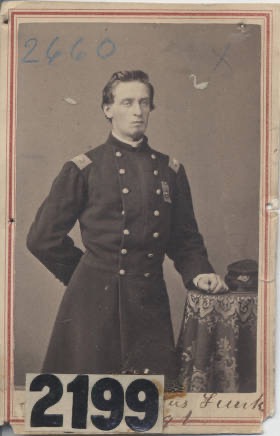
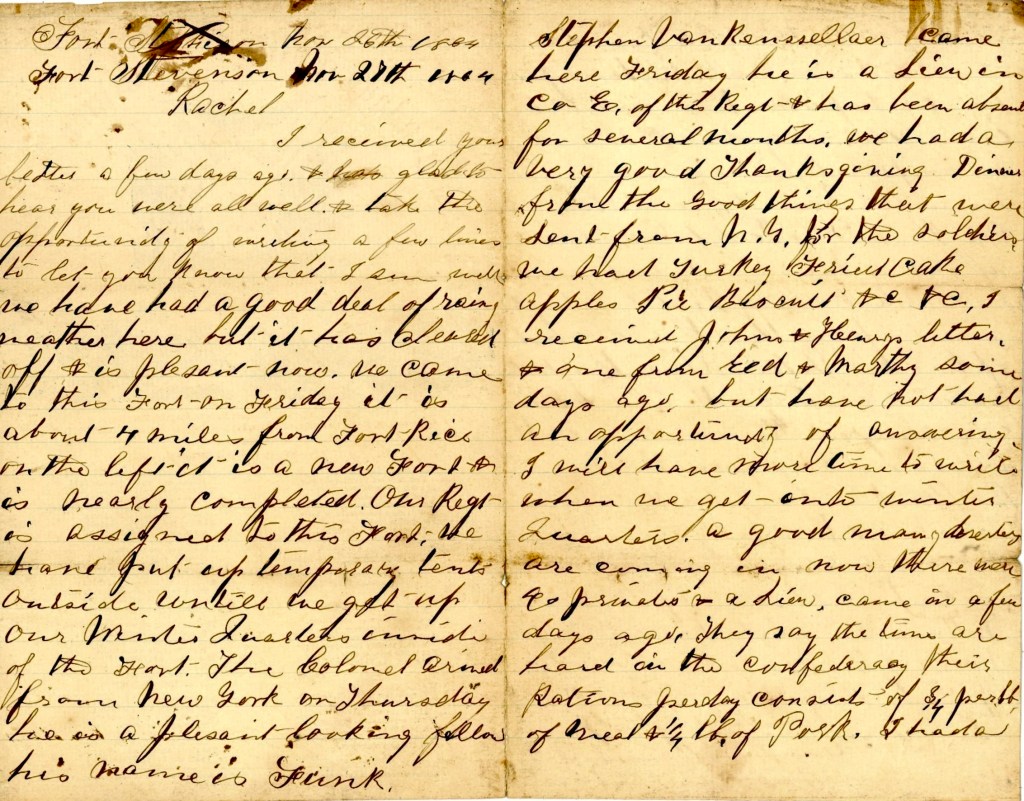
I received your letter a few days ago and was glad to hear you were all well & take the opportunity of writing a few lines to let you know that I am well. We had a good deal of rainy weather here but it has cleared off & is pleasant now. We came to this fort on Friday. It is about 4 miles from Fort Rice on the left. It is a new fort & is nearly completed. Our regiment is assigned to this fort. We have put up temporary tents outside until we get up our winter quarters inside of the fort. The Colonel arrived from New York on Thursday. He is a pleasant looking fellow. His name is [Augustus] Funk.
Stephen Van Rensselaer came here Friday. He is a lieutenant in Co. E of this regiment & has been absent for several months. We had a very good Thanksgiving dinner from the good things that were sent from New York for the soldiers. We had turkey, fried cake, apple pie, biscuits &c. &c. I received John & Henry’s letter and one from Red & Marthy some days ago but have not had an opportunity of answering. I will have more time to write when we get into winter quarters. A good many deserters are coming in now. There was 40 privates & a lieutenant came in a few days ago. They say the times are hard in the Confederacy. Their rations per day consist of 3/4 per lb. of meal & 1/4 lb. of pork.
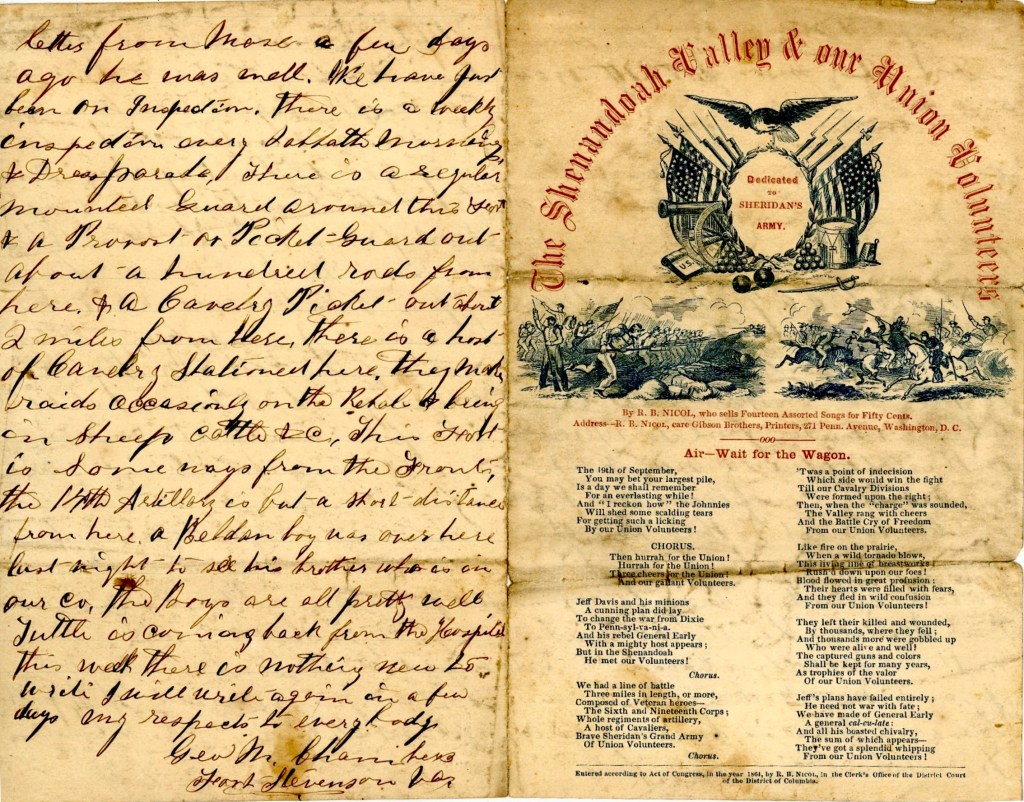
I had a letter from Mose a few days ago. He was well. We have just been on inspection. There is a weekly inspection every Sabbath morning & Dress Parade. There is a regular mounted guard around this fort & a Provost or picket guard out about a hundred rods from here & a cavalry picket out about two miles from here. There is a host of cavalry stationed here. They make raids occasionally on the Rebels and bring in sheep, cattle, &c.
This fort is some ways from the front. The 14th Artillery is but a short distance from here. A Belden boy was over here last night to see his brother who is in our company. The boys are all pretty well. Tuttle is coming back from the hospital this week. There is nothing new to write. I will write again in a few days. My respects to everybody. — George M. Chambers, Fort Stevenson, Va.
1 Fort Stevenson was described by Theodore Lyman, a member of Meade’s staff, as being by the William House, near the Jerusalem Plank Road, not far from Petersburg, Va. On 14 October 1864 he described Fort Stevenson as nearly done, “a work of large relief, capable of sheltering near 1,000 men and with a bastion front.” [The Private Notebooks of Lt. Col. Theodore Lyman, Edited by David Lowe, Kent State University Press, 2007]
 Spared & Shared 23