Category Archives: 3rd Michigan Infantry

1861: George W. Ball to his Mother

The following letter was written by 18 year-old George W. Ball (1843-1923) of Ottawa county, Michigan, while serving in Co. B, 3rd Michigan Infantry. George enlisted on 13 May 1861 at Grand Rapids and was discharged from the regiment in June 1863.

I could not find an image of George but here is one of Edward C. Brown of Co. E, 3rd Michigan Infantry

George’s letter offers a detailed first-hand account of the First Battle of Bull Run, during which the 3rd Michigan was engaged when the conflict erupted at Blackburn’s Ford on July 18, 1861. This event unfolded near the center of the Confederate line, held by General James Longstreet’s Virginians, along the brush-lined banks of Bull Run. The approach down the wooded slope to the Ford, executed by Richardson’s Brigade, was initiated by the gray-clad 1st Massachusetts, which valiantly contested the Confederates for the first hour. Eventually, the other three regiments—the 2nd and 3rd Michigan and the 12th New York—were called into action, with the 3rd Michigan positioned on the extreme right of the line, while Ayres’ artillery from the ridge adjacent to the farm path that led to the ford engaged the enemy. Remarkably, the 3rd Michigan found themselves relatively secure during the engagement, to the point where some members were reported to be picking berries until they became aware that their brigade was in full retreat. Understandably, George’s letter to his mother portrays the role of the 3rd Michigan in a slightly different light.

The 3rd Michigan Infantry were initially issued gray uniforms but by the Battle of Bull Run, the consensus of opinion is that they wore a mix of uniforms colors, including blue or black trousers, and both blue and gray coats.

A great reference book by my friend, John Hennessy—“The First Battle of Manassas, An End to Innocence, July 18-21, 1861,” 1989.

T R A N S C R I P T I O N

Washington
August 2, 1861

Dear Mother,

I now sit down to write you a few lines to let you know how I was getting along. I am well off at present and I hope these few lines will find you the same.

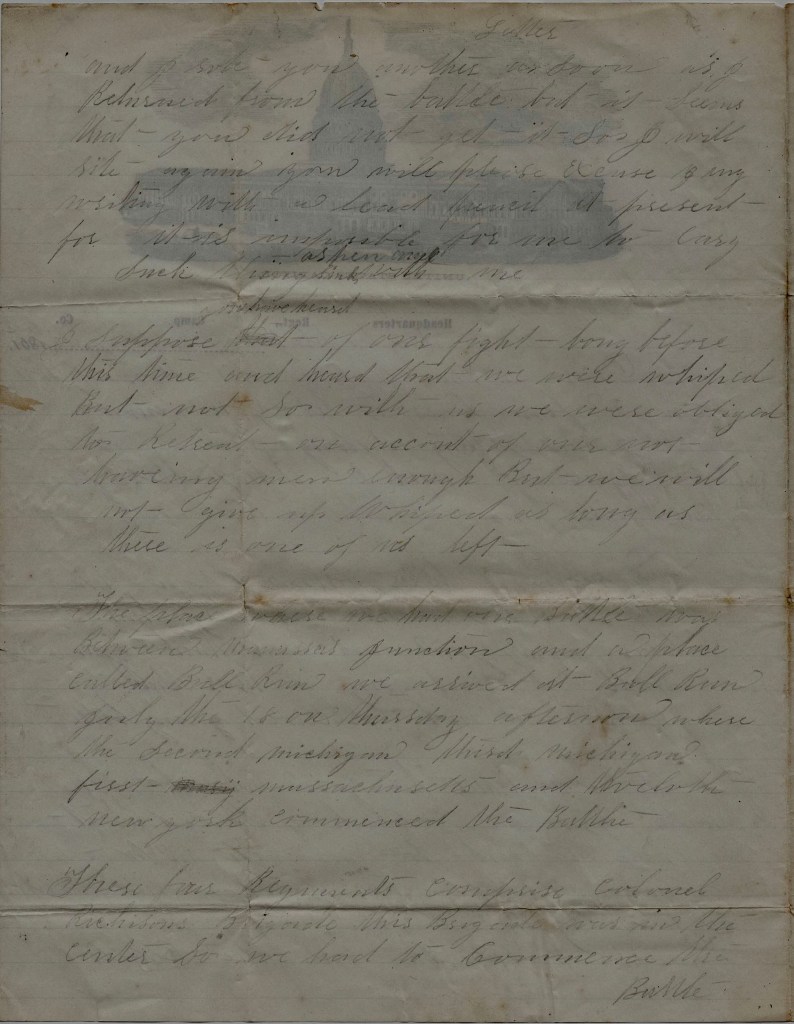
I received a letter from you dated July the 29th and was very glad to hear from you and hear that you were well but was sorry to hear that you had not received my letter. I wrote one letter to you about one month ago in which I stated that we were about to march into Virginia. We left our camp and went into Virginia about 25 or 30 miles where we had a battle with the Rebels. And I wrote you another letter as soon as I returned from the battle but it seems that you did not get it so I will write again. You will please excuse my writing with a lead pencil at present for it is impossible for me to carry such things as pen and ink with me.

I suppose you have heard of our fight long before this time and heard that we were whipped but not so with us. We were obliged to retreat on account of our not having men enough but we will not give up whipped as long as there is one of us left.

The place where we had our battle was between Manassas Junction and a place called Bull Run. We arrived at Bull Run July the 18th on Thursday afternoon where the 2nd Michigan, 3rd Michigan, 1st Massachusetts, and 12th New York commenced the battle. The four regiments comprise Colonel [Israel B.] Richardson’s Brigade. This brigade was in the center so we had to commence the battle.

The battle commenced a short time after noon and lasted till about seven when we commenced our retreat and went back as far as Centerville where we camped for the night and the next morning before daylight, our 3 o’clock, our picket guard was fired upon and drove in to the camp and we were waked up and got ready for a march and as soon as we could, we were divided into three divisions and went back within half a mile of the rebels and waited for our right and left divisions to come up but they did not get their position till Sunday morning when we commenced at them again.

We commenced fire upon them at 7 o’clock and fought till four in the afternoon. But they had too many men for us and we were obliged to retreat back within two miles of Washington where we shall stay till we get a large force. There was a great many of the Rebels killed as near us. We can’t ascertain how many but the report that they lost about three times the number killed that we had. One of their Generals was shot through the head with a cannon ball and Gen. Beauregard’s horse was shot from under him. We took twelve Secesh prisoners back with us to Washington…

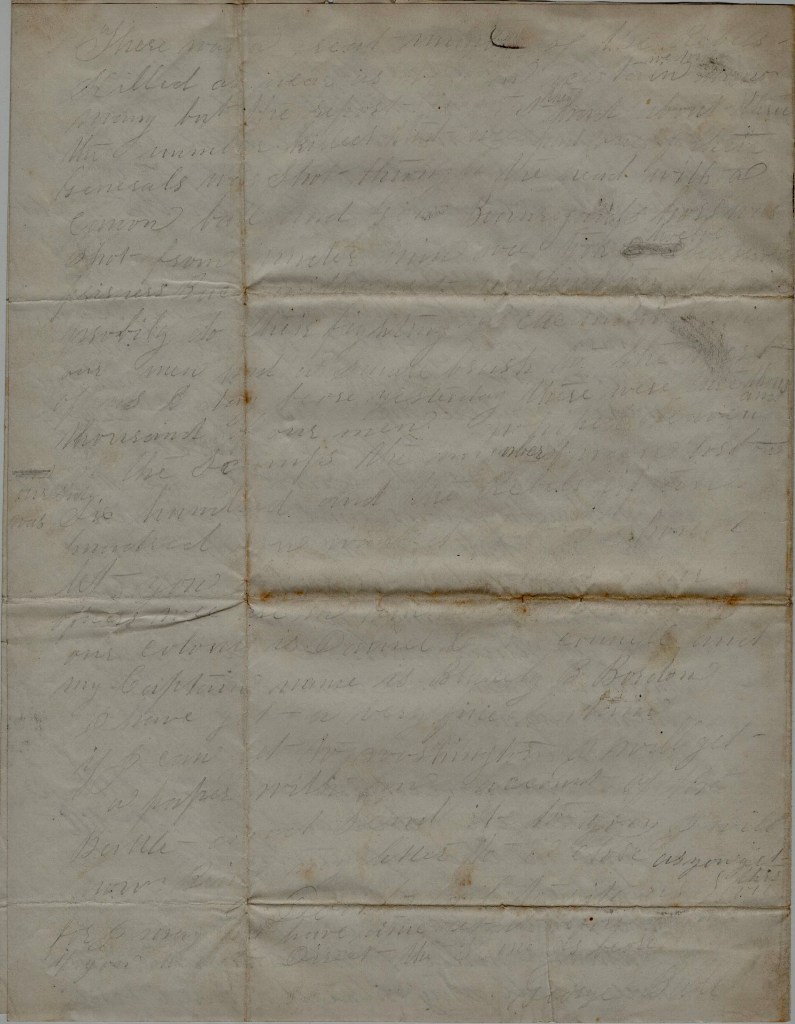
Our men had a small brush to the west of us day before yesterday. There were three thousand of our men whipped cavalry of the Scamps. The number of men lost on our side was six hundred and the Rebels fifteen hundred…Our colonel is Daniel McConnell and my captain’s name is Blakely B. Borden. I have got a very fine position. If I can get to Washington, I will get a paper with an account of the battle and I will send it to you.

I will now bring my letter to a close. As soon as you get this, don’t fail to write me for I may not have time… Direct the same as before, — George Ball

1863: Samuel Benjamin Barber to Martha Ray

The following letter was written by Samuel Benjamin Barber (1838-1873). Samuel was born in Lewis, Essex county, New York but was living in Grand Rapids, Michigan in 1861 when he enlisted in Co. D, 3rd Michigan Infantry (1st Organization). He was wounded on 15 July 1864 and mustered out that same year. He died in 1873 and was buried in New Boston, Michigan.

Transcription

Culpeper Court House, Va.
Saturday, September 26, 1863

My dear friend,

Yours of the 11th came duly to hand and found me in the best of health and hope that these few lines will find you as they leave me.

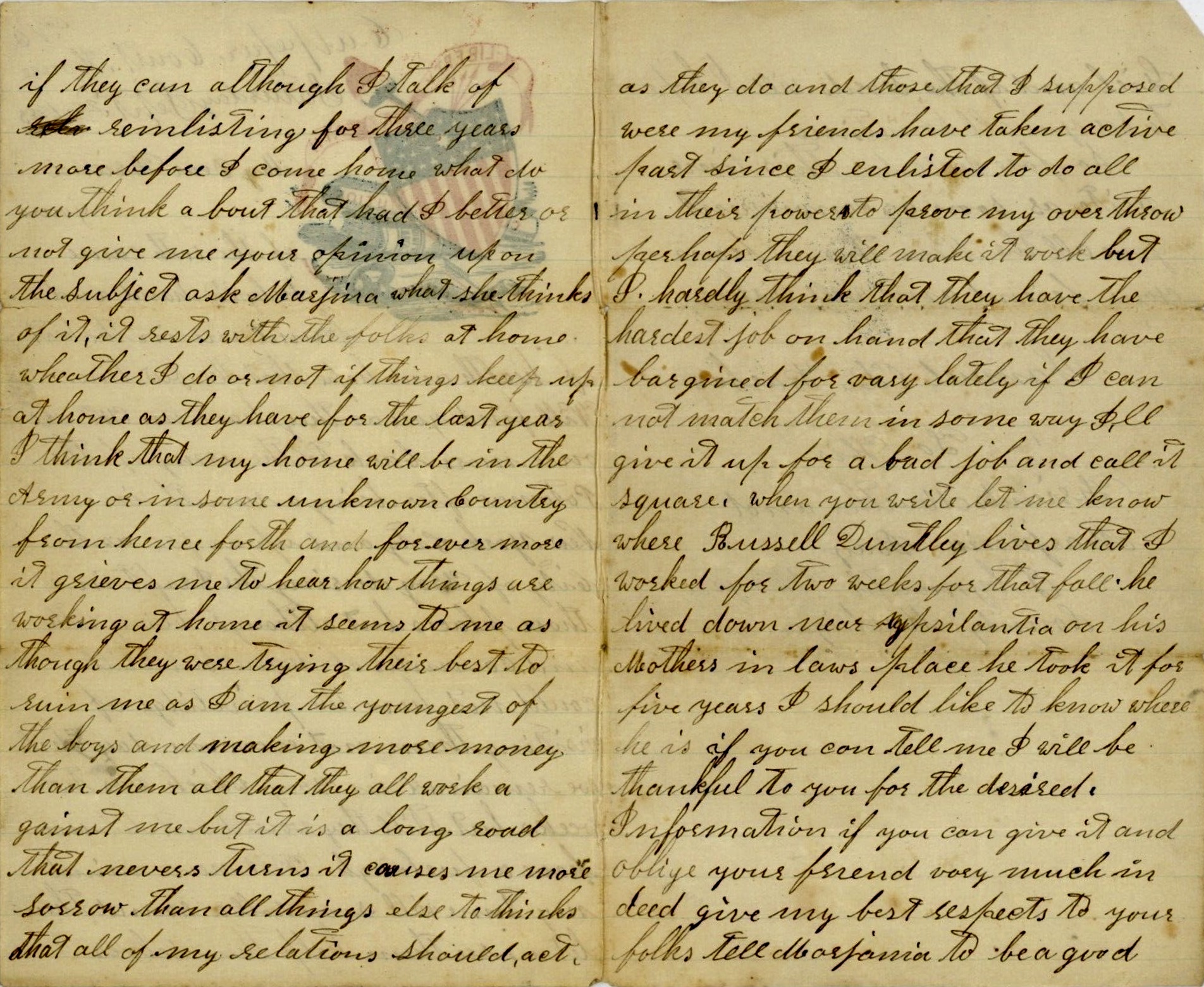
We are once more back to the Army of the Potomac after being a month inn New York City and up as far as the City of Troy during the draft in those places, but although being within 160 miles of home but still could not have the privilege of visiting them—not even one day while we remained in Troy which was two weeks, but still they would not let me have a furlough. Well never mind. My time will soon roll around. Then let us see them help themselves if they can although I talk of re-enlisting for three years more before I come home. What do you think about that? Had I better or not? Give me your opinion upon the subject. Ask Marjania what she thinks of it.

It rests with the folks at home whether I do or not. If things keep up at home as they have for the last year, I think that my home will be in the Army or in some unknown country from henceforth and forever more. It grieves me to hear how things are working at home. It seems to me as though they were trying their best to ruin me as I am the youngest of the boys and making more money that them all that they all work against me. But it is a long road that never turns. It causes me more sorrow than all things else to think that all of my relations should act as they do and those that I supposed were my friends have taken active part since I enlisted to do all in their power to prove my overthrow. Perhaps they will make it work, but I hardly think that they have the hardest job on hand that they have bargained, for very lately, if I cannot match them in some way, I’ll give it up for a bad job and call it square.

When you. write, let me know where Russell Duntley lives that I worked for two two weeks for that fall. He lived down near Ypsilanti on on his mother-in-law’s place. He took it for five years. I should like to know where he is. If you can tell me, I will be thankful to you for the desired information if you can give it and oblige your friend very much indeed.

Give my best respects to your folks. Tell Marjania to be a good girl and if the Lord’s will, I hope to see you all sometime. So farewell for this time. Write as soon as convenient. Give all the news. This is from your friend and well wisher, — Samuel B. Barber

To his friends Martha and Marjania Ray, Plymouth, Wayne county, Michigan

1861: Andrew Nickerson to Emma Wade

I could not find an image of Andrew but here is a cdv of Frederick L. Barker, Co. K, 3rd Michigan Infantry (LOC)

Though he only signed his name “Andrew,” I feel confident this letter was written by Andrew Nickerson (1834-1864), the son of Elihu Nickerson and Mary Winegarden. The family from Cattaraugus County, New York to Lake County, Indiana, about 1840 where they remained until sometime around 1848 when the family moved to Michigan. “By 1850 Elisha was running a hotel in Prairieville, Barry County, where Andrew attended school with seven of his younger siblings, including his brother Edwin who would also join the Third Michigan. By 1860 Elisha or Elihu had moved the family to a farm in Leighton, Allegan County where Andrew worked as a farm laborer (along with his younger brother Edwin) and was living with his family. He was 27 years old and probably still living in Allegan County when he enlisted as 4th Sergeant in Co. E on May 13, 1861; his younger brother Edwin would join Co. E the following year.

It is quite possible that Andrew enlisted in the Hastings Rifle Company in April of 1861. That company was disbanded shortly after it arrived in Grand Rapids to join the Third Michigan infantry then forming at Cantonment Anderson south of city and its members distributed to other companies of the Regiment. Andrew was promoted to 1st Sergeant on July 19 or July 23, 1861, at Hunter’s Farm, Virginia. He was subsequently promoted to 2nd Lieutenant and transferred to Co. H on August 12, 1862, at Harrison’s Landing, Va., replacing Lieutenant Thomas Waters. 

In October Andrew was transferred to Co. K and promoted to 1st Lieutenant on October 20, replacing Lt. Fred Stowe. He was home in Michigan during the winter of 1863, and rejoined the regiment in early March of that year. He was charged with neglect of duty, in that he reportedly forged discharge papers for a private, but nothing came of this apparently and he was never court-martialed. Andrew was then appointed acting Regimental Quartermaster from July 13, 1863, through September, and in December he was on detached service in Michigan, probably recruiting for the Regiment. Although he was still reported detached in Grand Rapids in January of 1864 (since December 28, 1863), he was promoted to Captain on January 18, 1864, and commissioned to date November 1, 1863. He eventually returned to the Regiment before the spring campaign of 1864, and was killed in action on May 6, 1864, at the Wilderness, Virginia.

According to Dan Crotty of Co. F, Nickerson was killed on May 7. Some years after the war Crotty wrote that during the engagement at the Wilderness, “The fearful butchery commences on the morning of the 7th, and charge after charge is made on both sides,” and at one point the Regiment had driven the rebels back inside their works. “They reform and drive us back. We take shelter in some temporary works thrown up by themselves, and here hold them in check for awhile. But they come down on us with superior numbers. We keep them on the other side for awhile, and a hand to hand fight takes place. Here is where Captain Nickerson, of Co. K, was killed by a bayonet thrust.” Andrew was buried in Fredericksburg National Cemetery: grave 3550 (old 191).

[Note: The following letter is from the private collection of Greg Herr and was offered for transcription and publication on Spared & Shared.]

Transcription

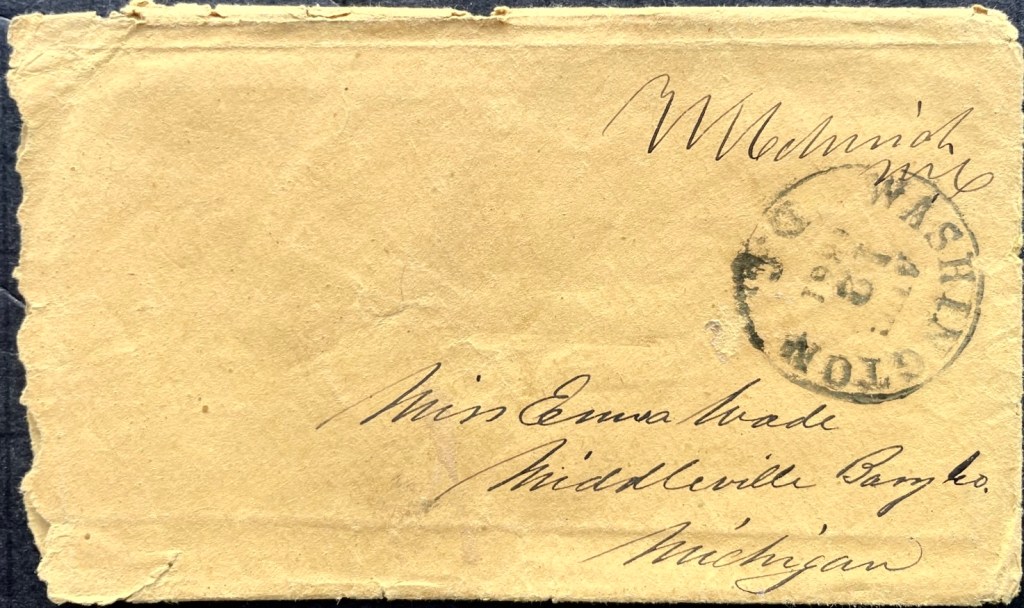
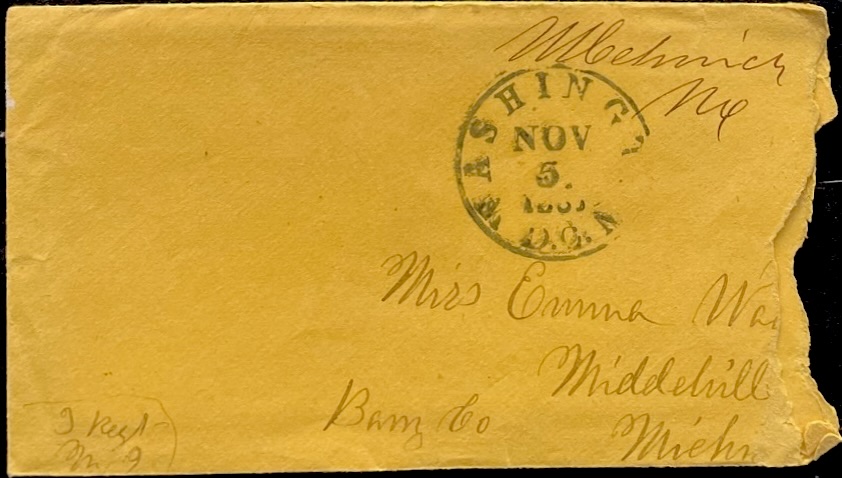
Addressed to Miss Emma Wade, Middleville, Barry county, Michigan

Washington D. C.
August 10th 1861

Friend Emma,

Today I received your kind letter and perused it with great pleasure. You seem to have a wrong impression in regard to the battles up at Bull Run. We were in the battle on Thursday [at Backburn’s Ford]. There was not so much close fighting as on Sunday but the cannon balls and shells fell all around us and there we stood without any chance to shoot back. To be sure, our cannon kept firing all the time and did great execution among the rebels.

The next day, and the next, and the next we laid on the field of battle and on Sunday when the fight was raging upon our right, we were on the field in reach of the enemy’s cannon and sometimes some of their musket balls would come whizzing over our heads. It was more good luck than anything else that saved us from half being killed, or being half killed I should say.

Then you think that Ell Felton and Jim Drew are about to make their beds together. Well “long may they wave.” Ell is a very pretty girl and makes a very good appearance. As for Jim, I do not know much about him, not being much acquainted with him.

Then you don’t think much of the courage of Barrell family, eh? I thought you used to think considerable of one of the boys, didn’t you? But I suppose you don’t like the way he runs over west do you. I don’t believe I should like it either.

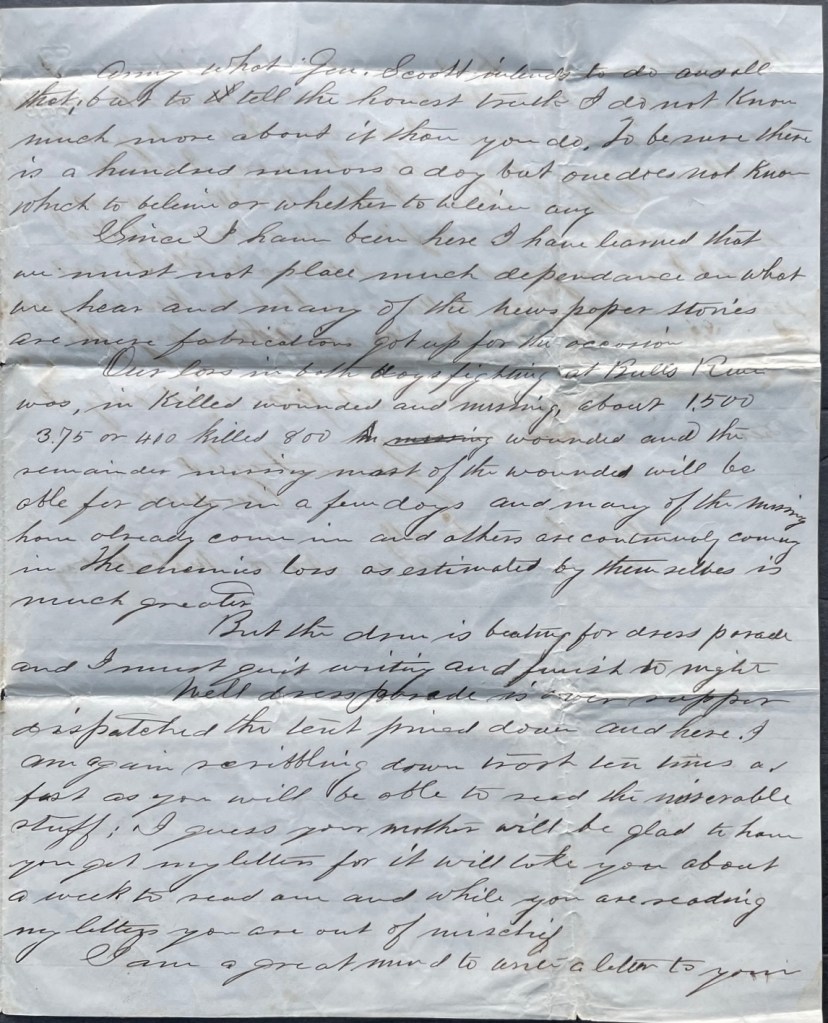
Now I know you want me to write a long letter and tell you all about the movements of the army, what Gen. Scott intends to do, and all that, but to tell the honest truth, I do not know much more about it than you do. To be sure, there is a hundred rumors a day but one does not know which to believe or whether to believe any.

Since I have been here, I have learned that one must not place much dependence on what we hear and many of the newspaper stories are mere fabricationsm got up for the occasion.

Our loss in both days fighting at Bulls Run was, in killed, wounded and missing, about 1,500; 375 or 400 killed, 800 wounded, and the remainder missing. Most of the wounded will be able for duty in a few days and many of the missing have already come in and others are continually coming in. The enemy’s loss as estimated by themselves is much greater.

But the drum is beating for dress parade and I must quit writing and finish tonight.

Well, dress parade is over, supper dispatched, the tent pinned down, and here I am again scribbling down traash ten times as fast as you will be able to read the miserable stuff. I guess your mother will be glad to have you get my letter for it will take you about a week to read one and while you are reading my letters you are out of mischief.

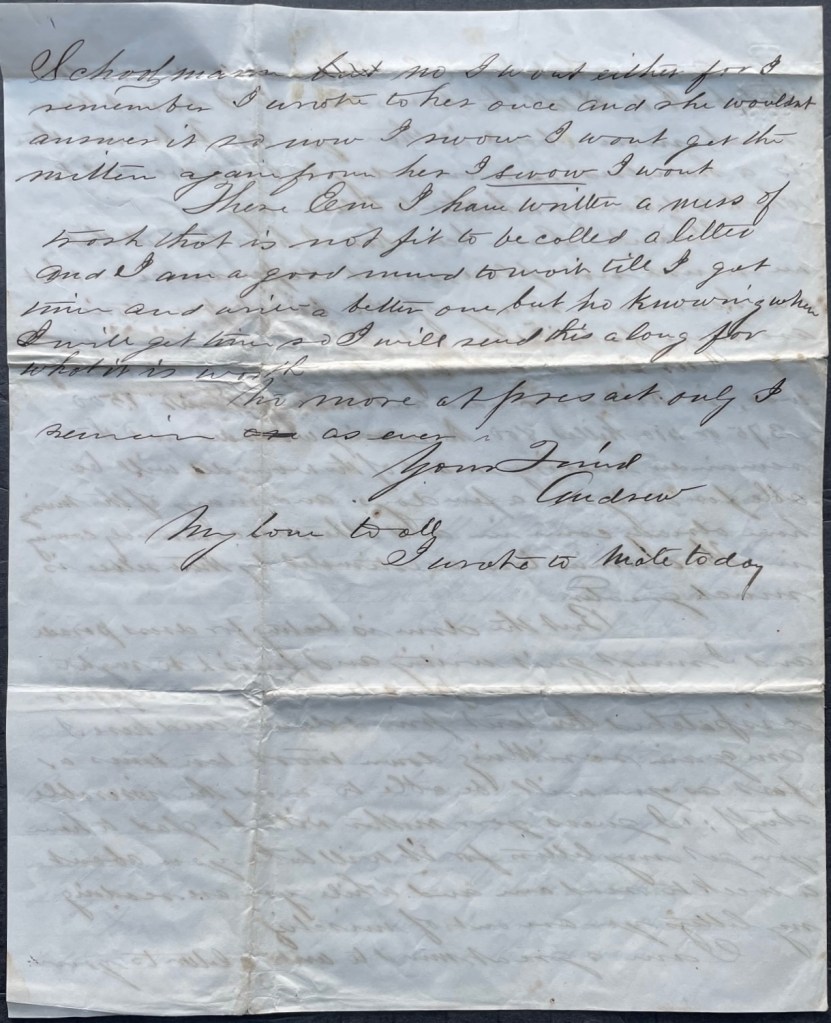
I am a good mind to write a letter to your school marm. No, I won’t either for I remember I wrote to her once and she wouldn’t answer it so now I swear I won’t get the mitten again from her, I swear I won’t.

There Em, I have written a mess of trash that is not fit to be called a letter and I am a good mind to wait till I get time and write a better one but not knowing when I will get time so I will send this along for what it is worth. No more at present, only I remain as ever your friend, — Andrew

My love to all. I wrote to Mate today.

1861: Edward Townsend Webster to Emma Frances Wade

I could not find an image of Ed but here is one believed to be Virgil Mortimer Hamilton of Co. K, 3rd Michigan Infantry. His brother Emmet served with Ed in Co. E. (Doug Sagrillo Collection/CW Faces)

The following letters were written by Edward Townsend Webster (1841-1864), the son of Roswell Webster, Jr. (1815-1864) and Harriet Townsend (1822-1896) of Leighton township, Allegan county, Michigan. Ed enlisted on 10 June 1861 to serve three years in Co. E, 3rd Michigan Infantry. He was killed in action 5 May 1864 on the opening day’s fight in the Battle of the Wilderness. A memorial marker in Hooker Cemetery in Wayland, Michigan, states that Ed’s brother, Henry W. Webster (1846-1864) died in Andersonville Prison on 24 August 1864. Henry served with Emma’s brother, Isaac Clinton Wade.

The 3rd Michigan’s baptism of fire took place at Blackburn’s Ford on July 18, 1861—a prelude to the first battle of Bull Run on July 21. The Third suffered its first wartime casualty early on Saturday morning, July 20, 1861, when Homer Morgan of Company B allegedly took his own life. The regiment covered the retreat of the federal troops from Bull Run on July 21, and subsequently went into a succession of camps around Washington throughout the fall and winter of 1861-62. The regiment participated in McClellan’s Peninsular campaign of 1862 and suffered its worst casualties to date at the Battle of Seven Oaks, Virginia on May 31, 1862 and at Groveton (or Second Bull Run) on August 29, 1862.

Ed addressed the letters to his cousin, Emma Frances Wade (b. 1846), who became the wife of John A. Holliday (1843-1913) in 1862. Nothing more could be found regarding her. It’s believed she died in the mid-1860s. Emma’s parents were Thaddeus Wade and Mary J. Townsend of Leighton township, Allegan county, Michigan.

[Note: The following letters are from the collection of Greg Herr and were offered for transcription and publication on Spared & Shared by express consent.]

Letter 1

Eagle Hill, Virginia
Monday, November 4th 1861

Dear Cousin Emma,

It was with great pleasure that I received and read your welcome favor of the 27th ult. and I will attempt to answer the same although I do not think of much to write this morning. Everything goes on about as usual here. Nothing new turning up to interest or excite a person.

The weather is fine this morning and so it was yesterday but the day before was about the worst day I ever saw in my life. It rained and blew all day like a perfect hurricane. I did not get out my tent but once all day and that was to get wood to burn. There was a good many of th tents blew down and tore to pieces and I expected that every moment we should be without a shelter to cover our heads, but our old tents stood the test nobly. We are to have new tents soon. we expect to get them now every day. I understand that we are to get small tents for four or six persons. I hope we shall for it would be a great deal more comfortable than to have large tents with sixteen in them. When we get the new ones, we have got new bed ticks to put into them. They will not let us put them into these old ones and we do not want to for they would get spoilt before we get the new ones.

There is a good many things that looks as if we were going to quarter here for the winter but I do not know what may turn up or what we shall do, anything about it, ad I have given up guessing, or trying to.

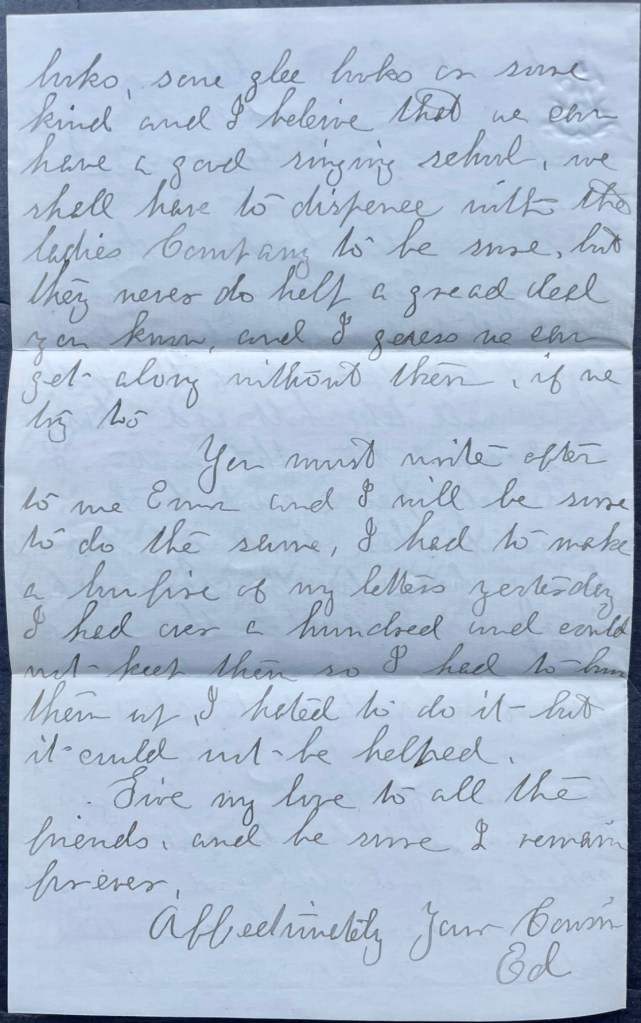
I am glad to hear that the singing school is going on finely. I hope that it will continue to prosper. I hope that all of the folks there will take hold and have a good school there this winter. I will help pay a god teacher. I cannot be there probably but will do my share for the sake of keeping up a school there this winter. There was a movement among a few of us yesterday to start one here in camp. There is a man by the name of Mead in George’s company that has taught singing school a good deal and is a good singer. He says he will take hold and we will get a lot of books—some glee books or some kind, and I believe that we can have a good singing school. We shall have to dispense with the ladies company to be sure, but they never do help a great deal you know, and I guess we can get along without them if we try to.

You must write often to me, Emma, and I will be sure to do the same. I had to make a bonfire of my letters yesterday. I had over a hundred and could not keep them so I had to burn them up. I hated to do it but it could not be helped. Give my love to all the friends and be sure, I remain forever, affectionately, your cousin, — Ed


Letter 2

Addressed to Miss Emma Wade, Middleville, Barry county, Michigan; envelope signed by Major Byron Root Pierce, 3rd Michigan Infantry

In Camp before Yorktown
Wednesday, April 23rd 1862

Dear Cousin Em,

Yours of the 13th ult. is just received and I thank you for it even if it a short one. I have had no letters for a long time until yours today. I do not know without my friends are forgetting me. What is the reason. But that cannot be the cause. It is true that I am a good distance from home, but still it cannot be that I am forgotten for I do not forget my friends who are so far away. But they are often present to my mind and whether lying in my tent, or whether on picket guard before and in sight of the enemy, wherever I am, my mind reverts to home and friends and the pleasing associations that my memory connects therewith. And I am unwilling to believe that I am not often in the thoughts of those dear to me. I hope that they will all prove that they think of me by writing often good long letters which do much to encourage ad lighten the dreary life of the soldier in the field.

I do not like to write very often and do not write as many letters lately as I would like to because I am out of postage money and even if I had the money, it would be impossible to procure the stamps. And I dislike to write for my friends to pay the postage but I feel as if I must write occasionally to let the friends know of my welfare. So please excuse this for this time and I hope to be able to do better when I want to write the next time.

My health still remains excellent. All of the Leighton Boys are well with the exception of George Joslin who is in the hospital. He went there about one week ago. Mr. Paine told me this morning that he saw George yesterday and he was much better and would probably be able to return to the regiment in the course of a few days. I hope he will for it is somewhat lonesome without him here. I mention his being sick as his folks not getting letters as usual from him would be more uneasy than if they knew the truth, but I assure them that he is not dangerously ill and hope they will not be troubled upon his account.

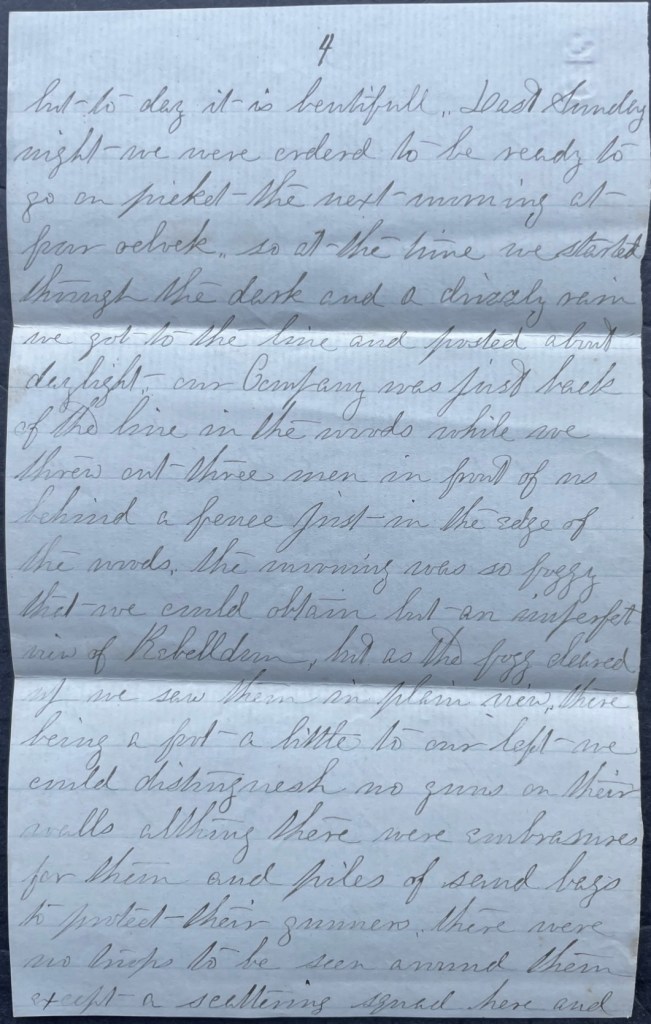
The weather is splendid for the most part although for two or three days it has been quite rainy but today it is beautiful. Last Sunday night we were ordered to be ready to go on picket the next morning at 4 o’clock. So at the time, we started through the dark and a drizzly rain. We got to the line and posted about daylight. Our company was just back of the line in the woods while we threw out three men in front of us behind a fence just in the edge of the woods. The morning was so foggy that we could obtain but an imperfect view of Rebeldom, but as the fog cleared off, we saw them in plain view. There being a fort a little to our left, we could distinguish no guns on their walls although there were embrasures for them and piles of sand bags to protect their gunners. There were no troops to be seen around them except a scattering squad here and there, but I doubt not that they have men there or near at hand but they are afraid to show themselves for we keep a battery of artillery along the line that play “the deuce” with them whenever htey venture to show themselves in any considerable numbers.

Our artillery “spoke” to them occasionally through the day. Some of our shells scattered their sand bags in all directions but go no answer at all. To the right of their fort and along in front of us was a field of some 80 rods [440 yards] wide and on the other side of it was woods along the edge of which their pickets were posted, and right in frint of us within easy rifle shot was an embankment thrown up that looked as if they had begun to build a fort and had not time to complete it before the “Yankees” came upon them. They now use it to protect their pickets and there seemed to be quite a number of them behind it from the smoke which came from it. But they were very careful to show themselves up in sight. There was one fellow that I noticed particularly as he would show himself above the works to the waist. He had on an old black hat and white or grey coat, I actually believe that he was a “Nigger.” He would crawl along until he got a good chance when he would “pop away” in our direction several times through the day. His bullets flew through the trees above our heads. We are not allowed to fire a shot and I never before had any inclination to shoot at pickets but I did ache to send him the contents of my rifle. I could hardly contain myself. I do not know as I could have hit him but I believe I could have given them a pretty good “scare.” At all events, I should liked to have tried some of them on.

Here in the woods where we are, we would not think that much is being done to ensure the success of the siege and a person has to look sharp to see what is being done. But I have seen enough to satisfy me that the thing is being rapidly pushed forward. Everyone here has the utmost faith in Gen. McClellan and believe him to be the one to lead on to certain victory. I am sure that he will do it.

There is continually the boom of cannon to be heard more or less at all hours of the day and night. It is probably done to prevent the “Secesh” from working on their defenses and often the sharp crack of a rifle of the sharpshooter in front is to be heard, which is almost a sure sign that one more rebel is defunct. By the way, these same Berden’s Sharpshooters are a terrible “eyesore” to these doers of iniquity and and it is very seldom that they venture to expose their precious persons to the range of one of those telescopic rifles.

Remember me to all of the friends. Write often and as ever, I remain your affectionate cousin, — Ed

1862: Israel S. Geer to his Cousin Lucy

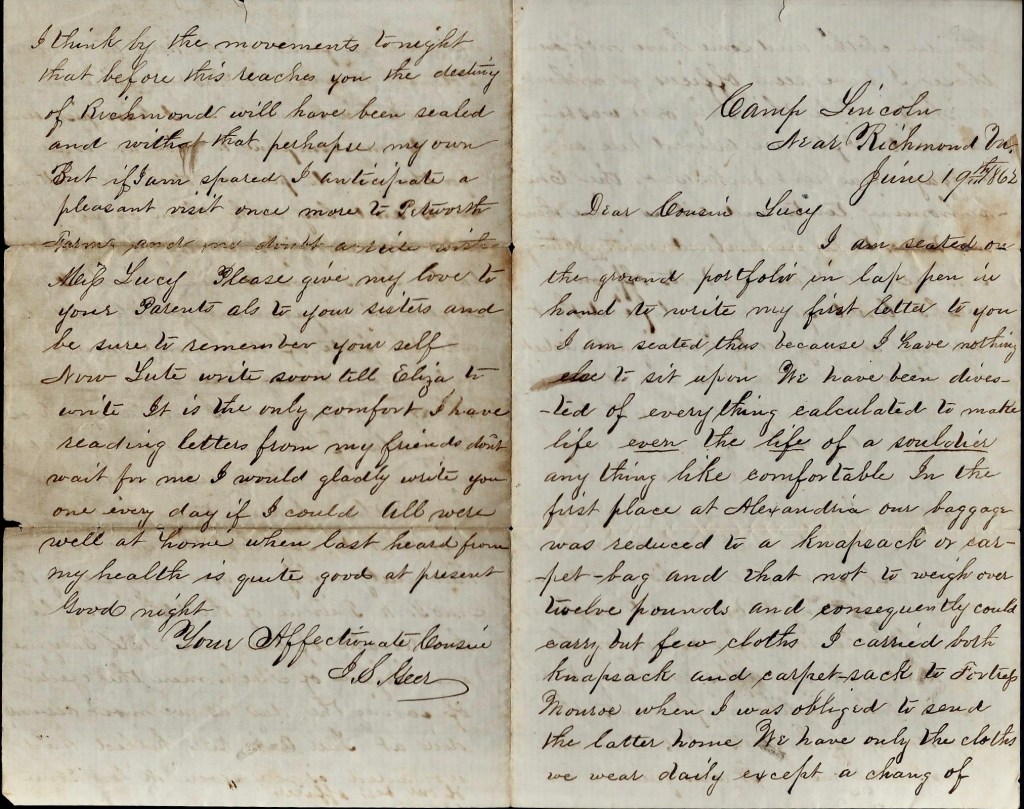
The following letter was written by Israel S. Geer (1822-1881) while serving as captain of Co. C, 3rd Regiment Michigan Infantry. Israel began his service in the 3rd Michigan on 13 May 1861 as a sergeant in Co. D, but was promoted to sergeant major and then captain of Co. C on 26 December 1861. He was residing in Hastings, Barry County, Michigan just prior to the war. Co. C was a challenging command. It was made up largely of German and Dutch immigrants, many of whom lived on the west side of the Grand River in Grand Rapids. This company was the descendant of the old Grand Rapids Rifles, also known as the “German Rifles,” a prewar local militia company composed solely of German immigrants.

On May 6, 1864 he was wounded (shot fracture of right leg with subsequent primary amputation of thigh in lower third) and taken prisoner at the Battle of the Wilderness, Orange County, Virginia; his surgeon being a Confederate doctor. He was paroled at Richmond, Virginia on September 12, 1864 and was mustered out on September 21, 1864 at the expriation of his term. He had fought in the battles of Bull Run, Yorktown, Williamsburg, Fair Oaks, Richmond, Charles City Crossroads, Malvern Hill, Manassas, Fredericksburg, Chancellorsville, Wilderness, Virginia and Gettysburg, Pennsylvania.

Transcription

Camp Lincoln
Near Richmond, Virginia
June 19, 1862

Dear Cousin Lucy,

I am seated on the ground, portfolio in lap, pen in hand to write my first letter to you. I am seated thus because I have nothing else to sit upon. We have been divested of everything calculated to make life—even the life of a soldier—anything like comfortable. In the first place, at Alexandria our baggage was reduced to a knapsack or carpet bag and that not to weigh over twelve pounds and consequently could carry but few clothes. I carried both knapsack and carpet sack to Fortress Monroe when I was obliged to send the latter home. we have only the clothes we wear except a change of under clothes and some have not even those. I have seen officers go without a shirt while their only one was being washed.

After we arrived here our baggage was sent back across the Chickahominy, tents and all, so since them we have been encumbered with nothing. I have not had my boots off in four weeks and you may depend that we are a very seedy looking set indeed. I will be glad when this war is over. If it was not for the looks of the thing and the disposition I have to carry through what I undertake, I would resign and go home.

It is one constant scene of excitement. Not one moment’s quiet rest from one week’s end to another. Nothing to be heard night or day but the roar of cannon or the crack of rifles. Nothing to be seen but warlike implements, the glittering of bayonets, and dead and wounded men. It was quiet when we were in front of the Rebel army on the Potomac to what it has been since we came to the Peninsula.

I have just been out to my company to give an order for the men to put on their accoutrements and lay with them on all night and be ready for an immediate attack. It is now eleven o’clock p.m. A general engagement which will decide the fate of Richmond may be expected to commence at any moment.

I should speak of the battles of Williamsburg and Fair Oaks but you have most likely read much more of them than I have time to write. Suffice it to say that the Michigan 3rd done their duty nobly as you may see by the New York Tribune of the 12th inst. Also the Herald of the same date. They give our Brigade of Michigan men the credit of saving the day as we most assuredly did at Fair Oaks. Our killed and wounded is very severe. We lost some of our best officers.

I think by the movements tonight that before this reaches you, the destiny of Richmond will have been sealed and with that, perhaps my own. But if I am spared, I anticipate a pleasant visit once more to Petworth Farm and no doubt a ride with Miss Lucy. Please give my love to your parents. Also to your sister and be sure to remember yourself. Now, Lute, write soon. Tell Eliza to write. It is the only comfort I have—reading letters from my friends. Don’t wait for me. I would gladly write you one every day if I could. All were well at home when last heard from. My health is quite good at present. Good night.

Your affectionate cousin, — I. S. Geer

1861: Samuel Dowell to a Dear Friend

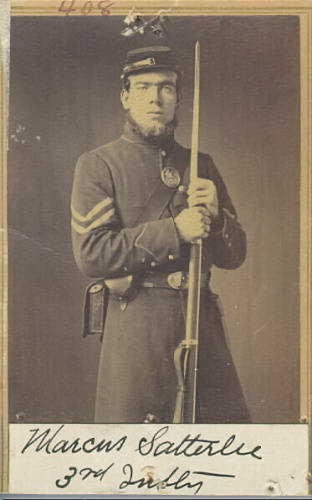
I could not find an image of Samuel but here is one of Marcus Satterlee wearing the uniform of the 3rd Michigan Infantry. (Michigan Digital Collection)

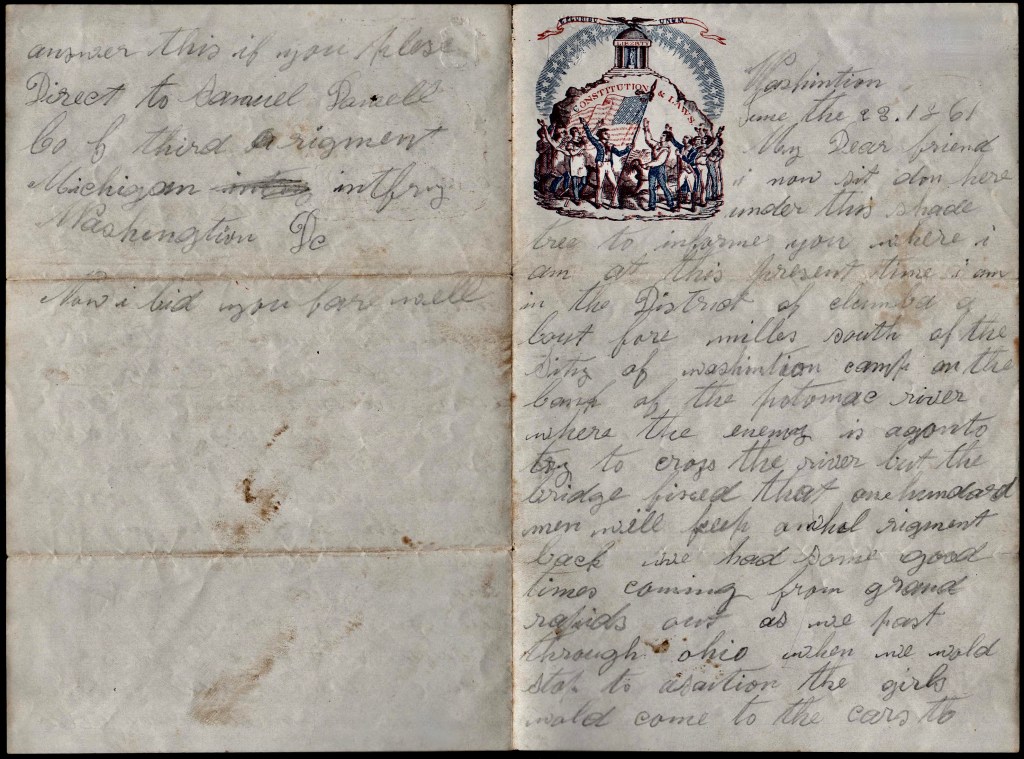
The following letters were written by Pvt. Samuel Dowell (1838-1862) of Co. G, 3rd Michigan Infantry (1st Organization). This regiment was mustered into service on 21 May 1861 and served in McDowell’s Army of Northeastern Virginia until August 1861 and then was attached to Richardson’s Brigade, Heintzelman’s Division, Army of the Potomac.

Samuel was the son of Charles Dowell (1799-1871) and Elizabeth Pool (1797-1860) of Windsor, Eaton county, Michigan. Samuel was killed at the Battle of Seven Pines on 31 May 1862.

Samuel wrote the letters to a dear friend whose name was Amelia Scofield.

Letter 1

Washington
June 23, 1861

My dear friend,

I now sit down here under this shade tree to inform you where I am at this present time. I am in the District of Columbia about four miles south of the City of Washington camped on the Potomac River where he enemy is agoin’ to try to cross the river. But the bridge [is] fixed [such] that one hundred men will keep a whole regiment back.

We had some good times coming from Grand Rapids out as we passed through Ohio. When we would stop to a station, the girls would come to the cars to shake hands with soldiers and bid them goodbye.

I received your letter when I was in Grand Rapids. I was in the hospital sick with the measles when Till give it to me but I am well now and hoping that these few lines will find you in the same state of health at this time and enjoying yourself, well and happy and merry and that you may have good times there. I would like to see you very well but now I am twelve hundred miles from you. I oft times think of you since I kissed your rosey cheeks. I am so sleepy that I [can’t] think of anything to write now for I was on guard yesterday.

Last night we heard that since we came here that we was all but seventeen of us when we came through Baltimore but there wasn’t a gun fired when we passed through last Sunday morning and arrived at this place in the afternoon. There is sixty thousand troops camped within eight miles of us.

No more at present but I remain your friend forever and I will write to you as often as I can. I send my best respects to you and all of your folks and to all enquiring friends. Please excuse my poor writing. Yours truly, — Samuel Dowell

to Amelia Scofield


Letter 2

Fort Richardson
Northeast Virginia
September 25, 1861

Dear friend,

I take this present time to write a few lines to you to let you know that I am well at this present time and hoping that these few lines will find you in the same state of health at this time and are enjoying yourself well.

I received your letter and was glad to hear from you once more. We are having good times here now and lots of fun and not much fighting. We have lots of music here. They are having a good time a dancing tonight. I am sorry that I did offend you in the last letter that I wrote to you. But you must excuse me for I was so sick that I did not know what I did [write] in the letter at that time.

No more at present. I send my best respects to you and to all enquiring friends and neighbors, — S. Dowell

The Young Soldier Dream
Amelia don’t secede

Kiss me Amelia ere I go
Armed and drilled to meet the foe;
Gun in hand and on my back
A sixteen pounder haversack.
I go, my country calls—adieu
To battle, my darling girl, be true
And come success comes scathe and need
Amelia, Amelia, don’t secede

When on the tented field perhaps
With rations short and shorter naps
With wheel present, advance, retreat
Thou’lt have O heavens at thy feet
Some are persuadingly present
Himself and an establishment
Amelia, no such trifler heed
Though the glitter’t secede

Cling unto thy mother dear
Let no home guards come a near
Dancing [  ] for the eyes
Making light of household ties
Prating of thy woman’s rights
Gallanting thee about o’night
Lest the rose should prove a weed
Basely crimsoned don’t secede

Goodbye Amelia, no regrets
If from balls and bayonets
From trials and battles
Far deadlier is the soup tureen
When badly seasoned than the bare
Of the loudest cannon that can roar
Safe delivery swiftly
Back to ease and the will fly
United then in word and deed
Amelia, dear, we’ll both secede

— S. Dowell

Prayer of the Young Soldier

[ ] of mercy, hear my prayers
Preserve my husband’s life
Cast o’er him thy protecting shield
In this unhallowed strife
Oh guard him in the battlefield
Unscathed through wars alarms
Restore him to his happy home
And his fond parents’ arms.

But if it be thy will, oh God
To take the life that gave
Then let him die where the stars and stripes
O’er his head shall ever wave.
If it be thy will in his country’s cause
My husband should lose his life
If fatherless he his only child
Widowed his wretched wife

Then let his name on history’s page
Be enrolled with the free and the brave
Let him nobly die a hero’s death
And rest in a hero’s grave.

— S. Dowell