The following letter was written by German emigrant Pvt. Jacob W. Rush (1845-1902) of Co. L, 3rd Ohio Cavalry. His pension records inform us that Jacob was wounded twice and spent 8 months in prison at Cahaba, Alabama. He was exchanged from prison on 27 April 1865 and survived the explosion aboard the steamboat Sultana on his return home. He married Sarah Kelley Webb (1846-1915) in 1868.
Jacob’s father was Thomas Rush, born in Bavaria in 1813, and in 1860 enumerated as a farmer in Kelleys Island, Erie county, Ohio. We learn from the letter that 16 year old Jacob did not have his father’s permission to enlist so he probably lied about his age in order to be accepted into the regiment.
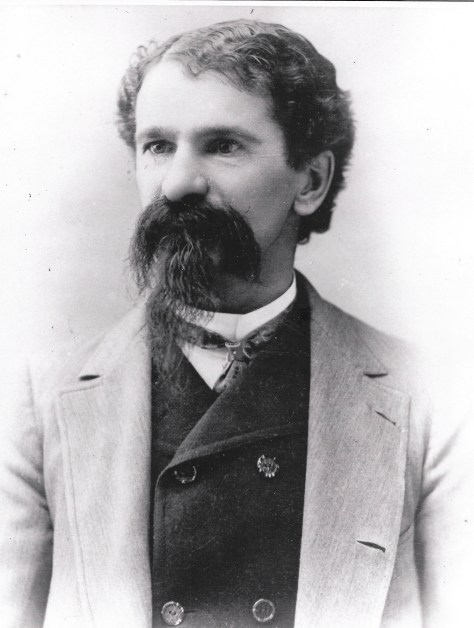
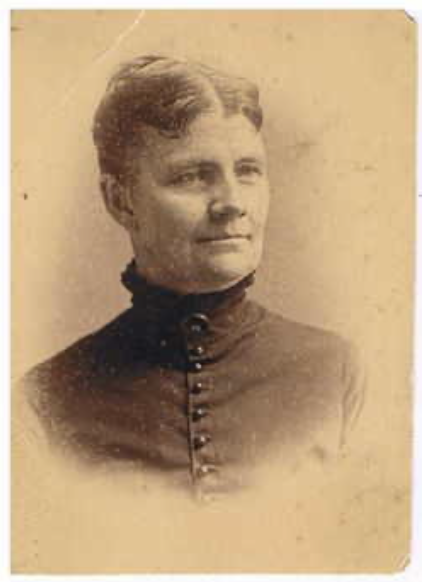
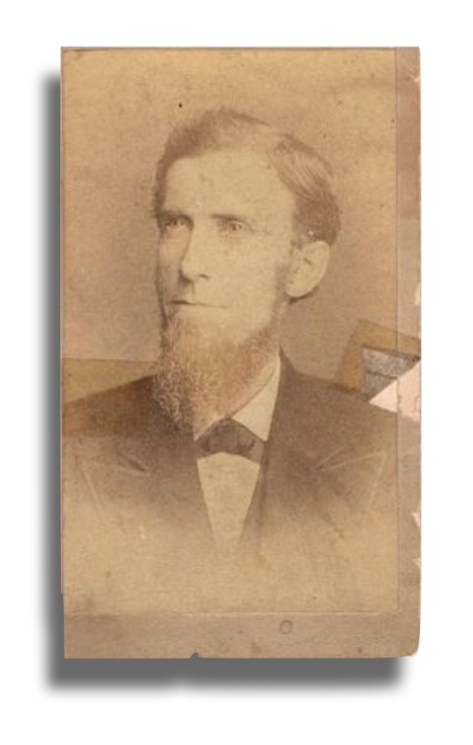
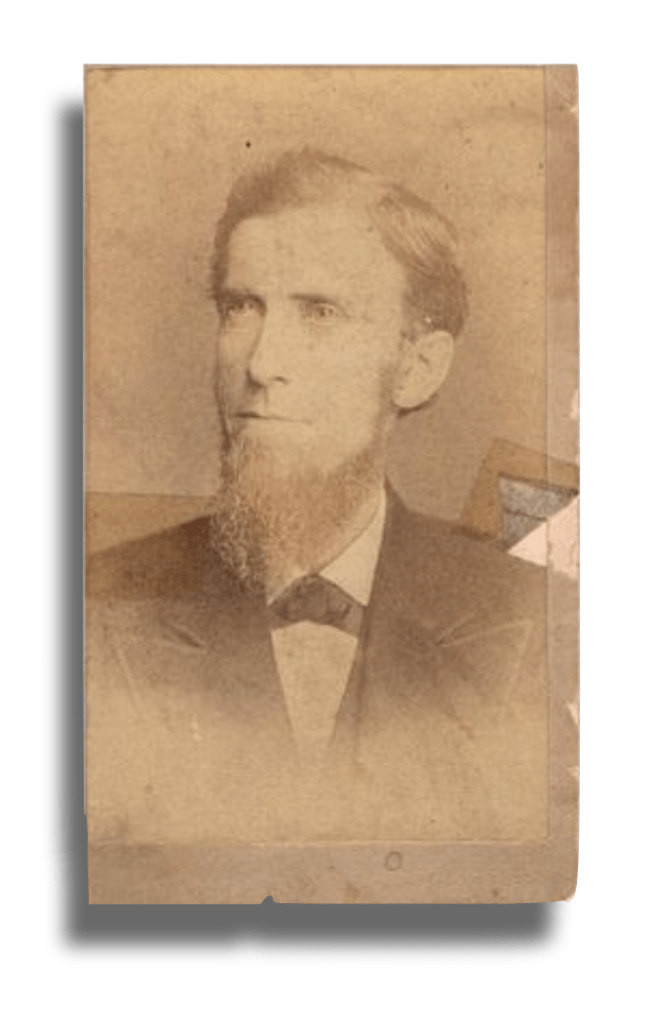
A post war image of Jacob W. Rush
An obituary posted on Find-A-Grave states that “Jacob W. Rush was one of the most conspicuous characters in the affairs of Pawnee county and western Kansas for many years. He came to Larned from Kelly’s Island, Ohio, in the later seventies, and engaged in the banking business and for many years was president of the First National Bank, which closed its doors in 1896 under circumstances well known to all our readers. He took a prominent part in politics for a number of years, being state senator from this district from 1882 until 1890. He was financier of remarkable ability and was closely connected with all the trouble that disturbed this community since the early nineties. His life was one of many ups and downs but he met all reverses resolutely and never failed to retrieve himself from them. There is no doubt that had death not overtaken him he would have soon repaired in his new home at Lawton, where he was in the brokerage business, the fortune which it is believed was seriously crippled towards the end of his career in Larned and during his short experience in business in Kansas City. He was a man of decided character and made equally strong enemies and friends wherever he was. His death is the concluding chapter to one of most remarkable and notorious conditions of business and social affairs that ever existed in any community in the state. He leaves three daughters, one son and a widow to mourn his untimely death. The sympathy of the entire community is extended to Mrs. Rush, who during the past few months has lost her father and mother, and now her husband.”
[Note: This letter is from the personal collection of Evan Iannone and was made available for transcription and publication on Spared & Shared by express consent.]
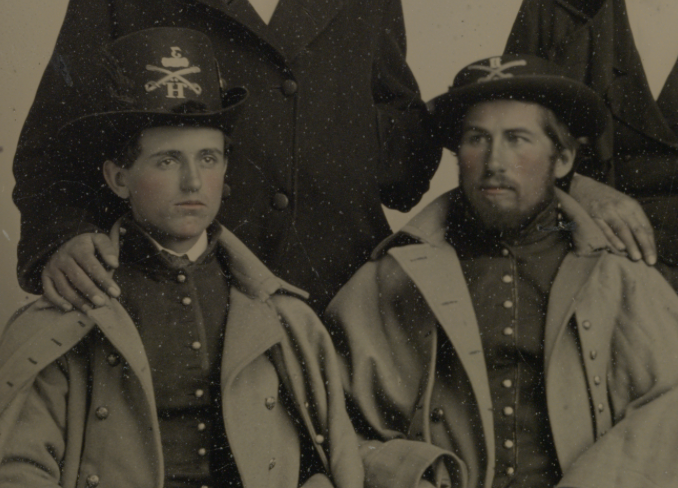
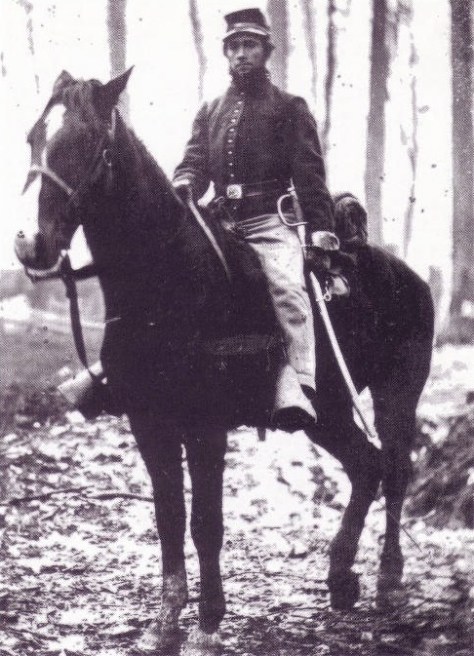
A couple of unidentified troopers from Co. H, 3rd Ohio Cavalry. Taken at Camp Worcester in 1861. (LOC)
T R A N S C R I P T I O N
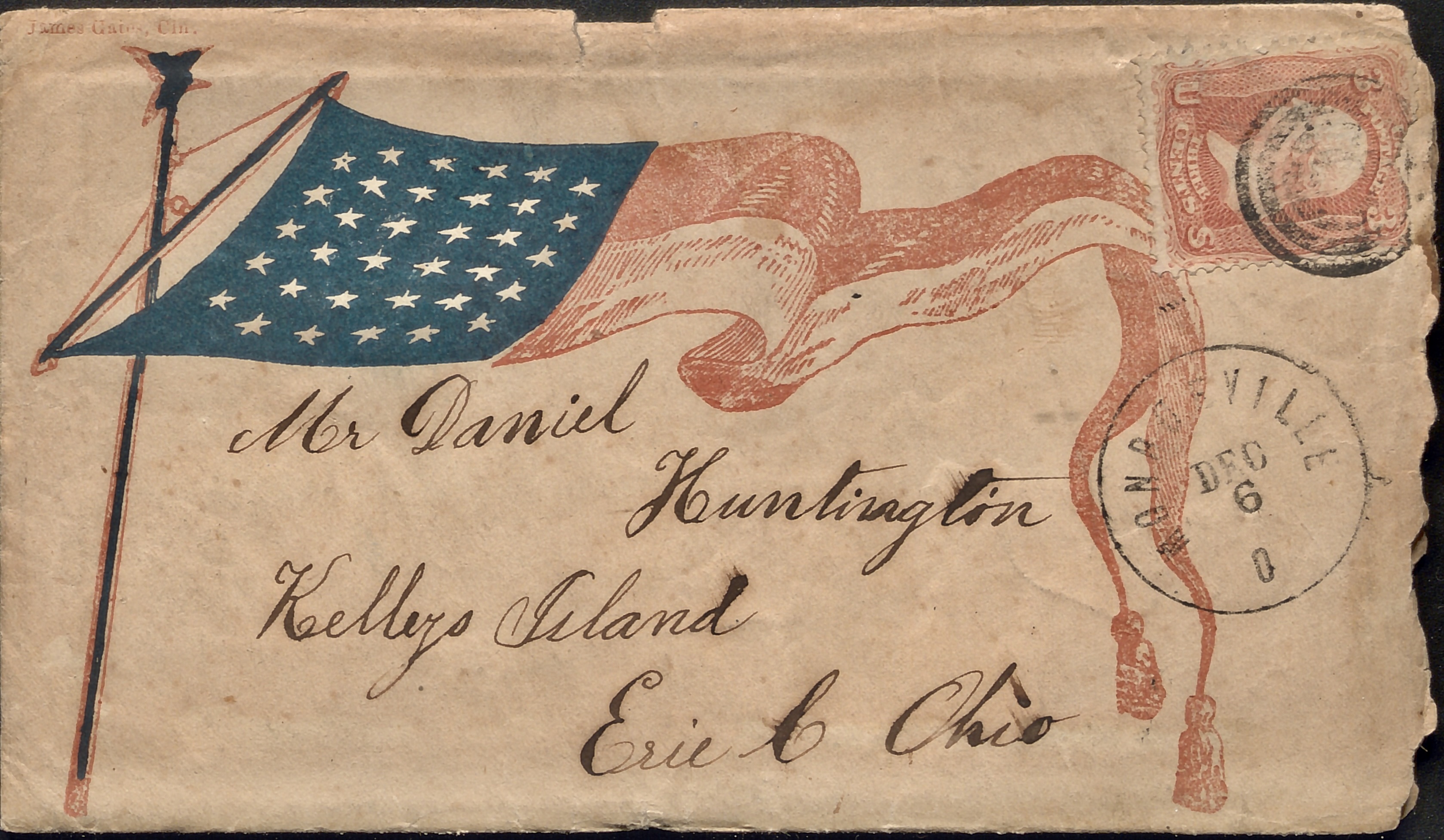
Addressed to Mr. Daniel Huntington, Kelley’s Island, Erie county, Ohio
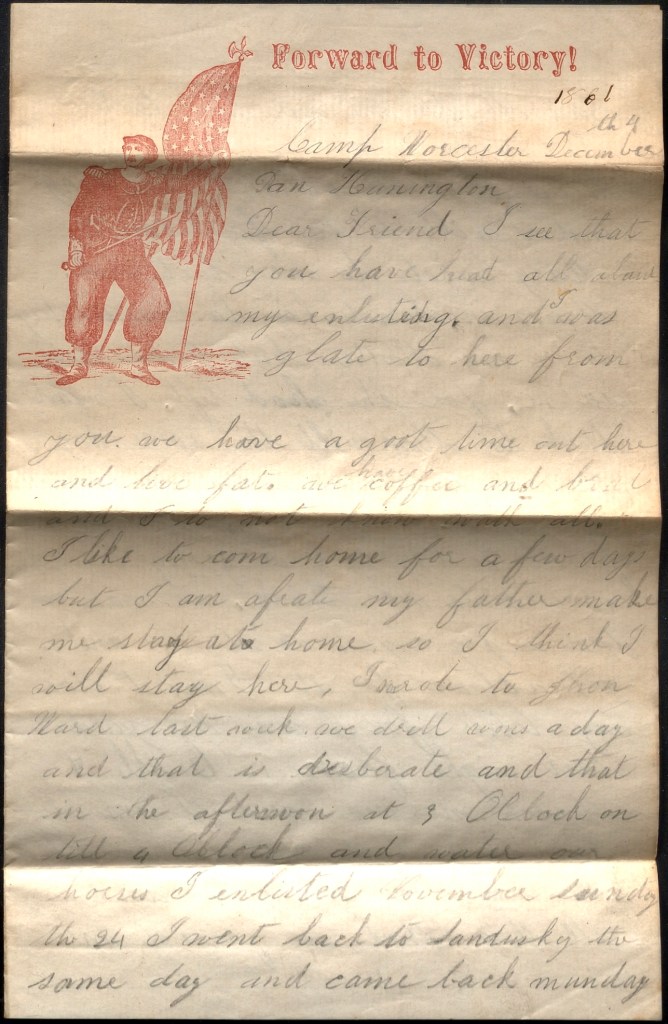
Camp Worcester [Monroeville, Ohio] December 4, 1861
Dan Huntington,
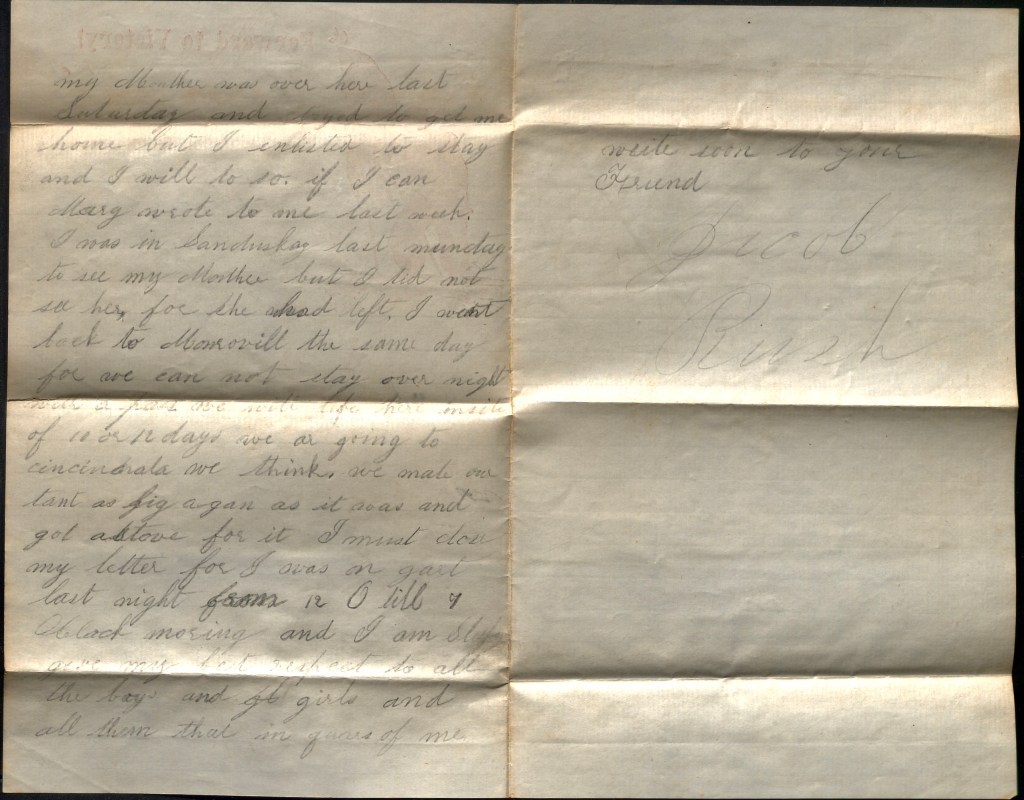
Dear friend, I see that you have heard all about my enlisting and I was glad to hear from you. We have a good time out here and live fat. We have coffee and bread and I do not know what all. I’d like to come home for a few days but I am afraid my father [would] make me stay home so I think I will stay here. I wrote to John Ward last week.
We drill once a day and that is dress parade and that is in the afternoon at 3 o’clock until 4 o’clock. And [then] we water our horses. I enlisted Sunday, November the 24th. I went back to Sandusky the same day and came back Monday. My Mother was over here last Saturday and tried to get me home but I enlisted to stay and I will do so if I can.
Mary wrote to me last week. I was in Sandusky last Monday to see my Mother but I did not see her for she had left. I went back to Monroeville the same day for we cannot stay over night with a pass. We will leave here inside of 10 or 12 days. We are going to Cincinnati we think. We made our tent as big again as it was and got a stove for it.
I must close my letter for I was on huard last night from 12 o’clock till 7 o’clock this morning and I am sleepy. Give my best respects to all the boys and girls and all them that inquire of me. Write soon to your friend, — Jacob Rush
I could not find an image of James but here is one of Pvt. Wilson Farner, Co. C, 3rd Ohio Cavalry (Ohio Memory)
The following letter was written by James Hudson Prickett (1843-1924) of Co. H, 3rd Ohio Cavalry. This regiment was organized at Camp Worcester in the fall of 1861 and remained there until mid-January 1862 when they were sent to Cincinnati, and then on to Nashville, Tennessee where they were attached to the 6th Division, Army of the Ohio.
James served in the 3rd Ohio Cavalry from 20 August 1861 until 4 August 1865. He was taken prisoner at Bardstown, Kentucky, on 4 October 1862 but paroled shortly afterward. He began his service as a private and ended it as a corporal. Also serving in the same company as a quartermaster sergeant was James’ older brother, Daniel J. Prickett (1840-1927). Their parents were Japhet Leed Prickett (1815-1893) and Phebe Sharp Borton (1815-1901) of West Unity, Williams county, Ohio.
T R A N S C R I P T I O N
Camp Worcester, Ohio Wednesday, October 30, 1861
Dear Parents.
I take a seat to write you a few lines. We are well and hope you are the same, We have had a visit from several of the Unity folks lately. [Gilbert] Doughton waited till he got tired of waiting for something to be done, then he went to the Colonel and talked with him. The Colonel told him he had nothing to do with him. I suppose the Captain wanted the warrant and the Colonel gave it to him. Captain done nothing with Doughton. [Michael] Hibbard I believe is a going to stay with the company. There is one Dave Hart in our mess that is a brother to Wash O. J. Barn’s brother of Christina of old. Also Seth Hamlin. He is an old rascal, as he calls himself. He has been there. He helped me to get rid of an old plug of a horse that I had to take. He understands it. [David] Hart worked in Shafer’s old mill with Glad Ewers. He is like Wash—quiet and still. He is [ ].
There is nothing I want, I believe. I get along first rate. I can stand the fare as well as the rest of the boys. They grumble because things ain’t as they want them. A fellow might as well save his wind for hard times.
I guess the chestnuts that Bill Rings says are so plenty are in the grocery. Hickory nuts are thick enough but there can’t anyone but them that in [Lt.] Sam Hansey’s tent get a pass to go after any. They can go out and stay all day & it is all right. Dan told Bill Gardner to get a couple of bushels of hickory nuts for him down town if he could & take them home. Bill said they cost 50 cents a bushel. There is no beech timber around here. One of the boys said he saw one in the woods. I think it has strayed down here from Bill county. This is a hickory county—a good share smooth bark.
There was several—say four of our boys—got kicked on their knees when they go to water the horses. They let their horse get too close to the others. That is something I always avoided. Our company has done well to what the rest have in the kicking line. Others have been hurt so they had to lay by. We have a dress parade every evening at five. At present it amounts to nothing.
I have done a most to [ ] since we left home. I have gained seventeen pounds in weight which is enough to make the child weigh 153 pounds. The boys in our mess are giving Dan [J. Prickett] fits because he don’t get plenty of wood & other things like the other companies have. When he told them that the other quartermasters had a Captain & two Lieutenants to help them along, they stopped & begin to give the officers fits. Sam can’t stop every load of wood, hay or straw, draw for the officers and their horses, and carry it to them & they do nothing. He has more than he can do without [help]. No more this time. I send my love to you all, — J. H. Prickett
The following letter was written by Alice “Maria” (Lee) Warner (1843-1915), the daughter of Barton B. Lee (1811-1856) and Henrietta Lee Steele (1808-1869). Maria was married in October 1859 to Rev. Elmore Yocum Warner (1833-1886). She wrote the letter to her younger brother, David Henry Lee (1845-1912).
In her letter, Maria informs her brother of her travel in mid-February 1862 to visit her husband at Camp Dennison, Ohio, where he was serving as the Chaplain of the 3rd Ohio Cavalry. Her letter also describes the journey of the regiment from Camp Dennison to Camp Joe Holt near Jeffersonville, Indiana. She mentions a Zouave regiment drilling at Camp Dennison in February 1862 which may well have been the 54th Ohio Infantry. They wore Zouave uniforms that were identical to those of the 34th Ohio (Piatts Zouaves). They left for Paducah on 17 February 1862.
Transcription
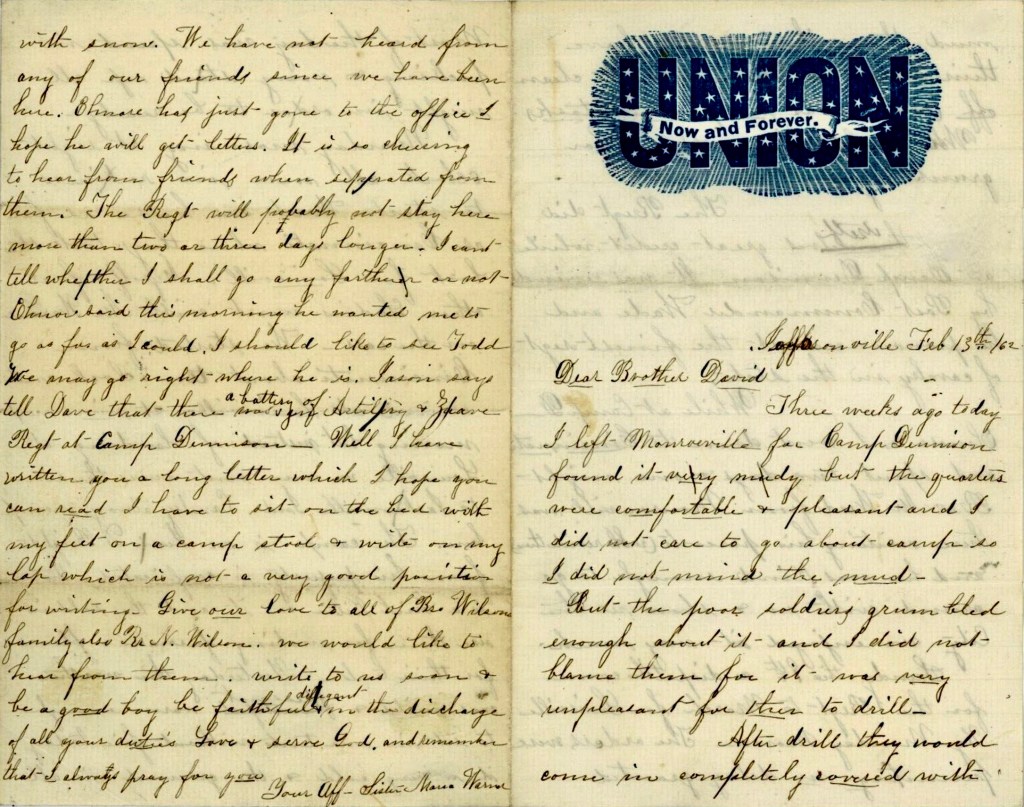
Jeffersonville [Indiana] February 13th 1862
Dear Brother David,
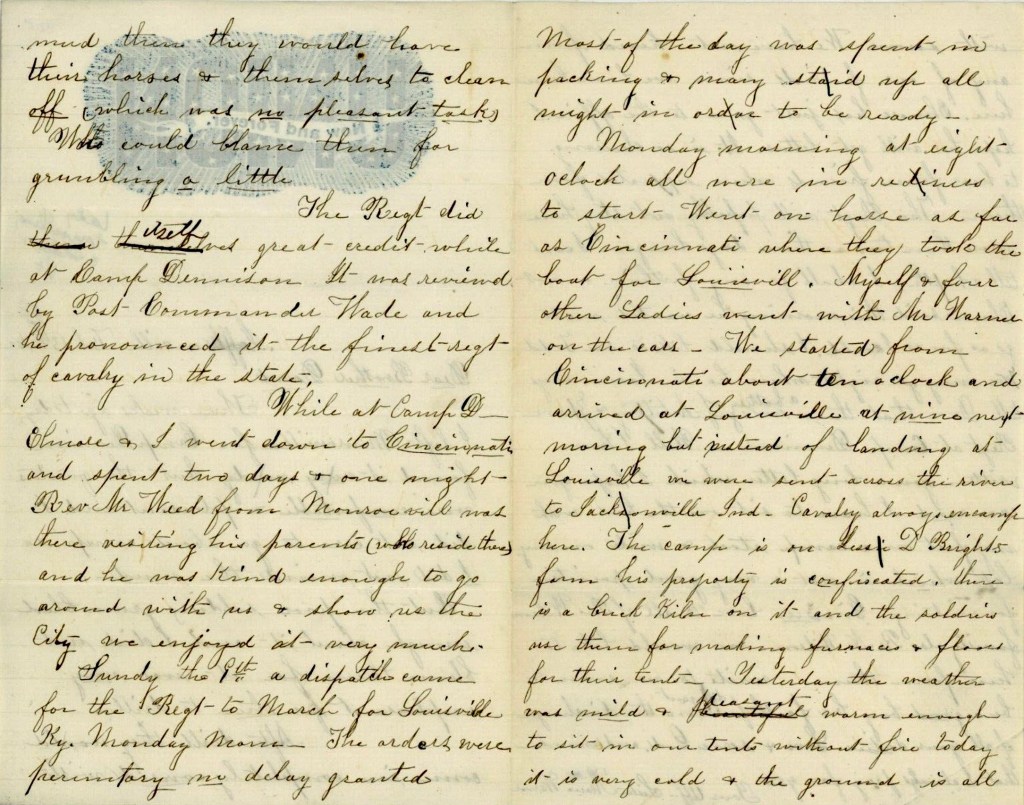
Three weeks ago today I left Monroeville for Camp Dennison. Found it very muddy but the quarters were comfortable & pleasant and I did not care to go about camp so I did not mind the mud. But the poor soldiers grumbled enough about it and I did not blame them for it was very unpleasant for them to drill. After drill they would come in completely covered with mud. Then they would have their horses & themselves to clean off (which was no pleasant task). Who could blame them for grumbling a little.
The regiment did itself great credit while at Camp Dennison. It was reviewed by Post Commander Wade and he pronounced it the finest regiment of cavalry in the state.
While at Camp Dennison, Elmore & I went down to Cincinnati and spent two days & one night. Rev. Mr. Weed from Monroeville was there visiting his parents (who reside there) and he was kind enough to go around with us and show us the city. We enjoyed it very much.
Sunday, the 9th, a dispatch came for the regiment to march for Louisville, Kentucky, Monday morn. The orders were peremptory—no delay granted. Most of the day was spent in packing & many stayed up all night in order to be ready.
Monday morning at eight o’clock all were in readiness to start. Went on horse as far as Cincinnati where they took the boat for Louisville. Myself and four ladies went with Mr. Warner on the cars. We started from Cincinnati about ten o’clock and arrived at Louisville at nine next morning but instead of landing at Louisville, we were sent across the river to Jacksonville [Jeffersonville], Indiana. Cavalry always encamp here. The camp is on Jessie D. Bright’s farm. His property is confiscated. There is a brick kiln on it and the soldiers use them for making furnaces and floors for their tents.
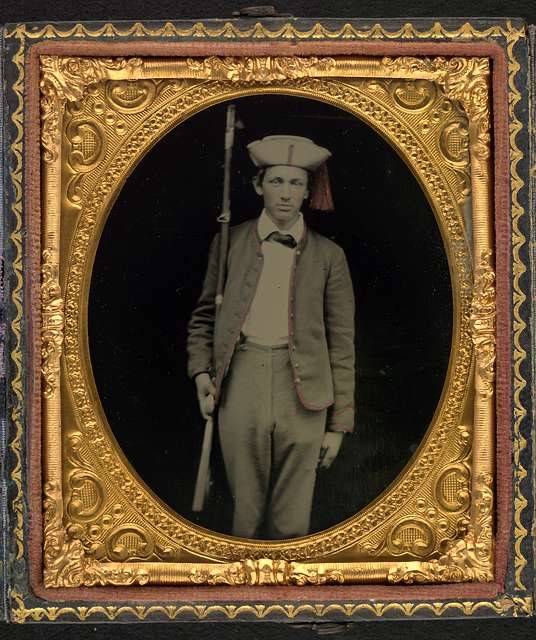
Pvt. Christian H. Cook, Co. B, 54th Ohio Infantry. This regiment was drilling at Camp Dennison in early February 1862. (LOC)
Yesterday the weather was mild and pleasant—warm enough to sit in our tents without fire. Today it is very cold & the ground is all [white] with snow. We have not heard from any of our friends since we have been here. Elmore has just gone to the office. I hope he will get letters. It is so cheering to hear from friends when separated from them. The regiment will probably not stay here more than two or three days longer. I can’t tell whether I shall go any farther or not. Elmore said this morning he wanted me to go as far as I could. I should like to see Todd. We may go right where he is. Jason says tell Dave that there was a battery of artillery & Zouave Regiment at Camp Dennison.
Well, I have written you a long letter which I hope you can read. I have to sit on the bed with my feet on a camp stool & write on my lap which is not a very good position for writing. Give our love to all of Bro. Wilson’s family. Also Br. N. Wilson. We would like to hear from them. Write to us soon and be a good boy. Be faithful & diligent in the discharge of your duties. Love & serve God, and remember that I always pray for you. Your affectionate sister, — Maria Warner
The signature on this letter has been shaved off the bottom of the digitized image but enough of it remains and because I have transcribed a couple of his letters before, I can be confident this letter was penned by Elmore Yocum Warner who served as the Chaplain of the 3rd Ohio Cavalry from the time of its formation until August 1862 when he resigned. [See: Letter of 18 July 1862 from Woodville, Alabama] The following letter was written on 31 March 1862, just one week before the Battle of Shiloh.
Warner lived in North Fairfield, Huron county, Ohio. An obituary for Warner published in the Wayne County Democrat on 14 July 1886 said of him:
“This well-known minister of the North Ohio Conference of the Methodist Episcopal Church, and son of the late Rev. Jesse Warner, was born in Wayne County, July 3, 1833, and died in Norwalk, Oh., July 6, 1886, aged 53 years. Mr. Warner, after a faithful use of the educational advantages furnished by the common schools, entered the Ohio Wesleyan University and while he did not complete the course, he did lay the foundation of a respectable scholarship, which enabled him to pursue so intelligently his future studies in connection with his ministry that, subsequently, the Faculty and Trustee of the University felt justified in conferring upon him the honorary degree of Master of Arts. He was married in 1857 to Maria Lee, of Huron county, who survives, with five children, one of whom is also a minister, and represents the third generation of the same line in succession in the same Conference. During the Civil War, Warner served as chaplain of the 3rd Ohio Cavalry and was on the field of Shiloh; but the exposure in the service being too severe for a constitution not naturally robust, he secured his discharge, but had already laid the foundation of the disease to which, after heroic struggle for years, he had, at last, to yield….”
Transcription
Patriotic stationery used
Camp near Columbia 3rd Ohio Volunteer Cavalry March 31, 1862
Dearest wife.
Longer time has elapsed since I wrote you than I intended should but with moving & changing I have been unable. We left Nashville last Saturday and have now marched three days on a very dusty pike lime dust which is suffocating almost. But I have stood it well and am able to eat my full rations. We have passed over a beautiful country.
Yesterday we passed through the town of Franklin in which Sidney and Benjamin Hildreth reside. Capt. Frank Hunt stopped at Ben’s house and said that Ben and his wife wished to be remembered to you. I see Frank and Bill Hunt everyday. As I told you, we are attached to the Sixth Division of Gen. Buell’s Army under Gen. Wood so you may know by this when you read of us. Gen. Wood has under him some fourteen thousand. These all march together. Then there are several divisions just before us.
There is perhaps 60,000 troops within two or three miles of this point. Gen. Nelson’s division is just ahead of us perhaps five to ten miles and perhaps not so far. I can’t ascertain where they are—only that they are a short distance before us. Tod is in that. I expect to see him yet but when I know not. That division is in the advance.
We all expect to participate in the great battle soon to come off near Corinth, Mississippi. I suppose it will be a desperate one and one that will decide the contest. I want to be at home but I am so far in the enemy country, if there is to be a battle, I want to see it. For your sake, I will try to keep out of danger but I expect if this conflict commences, I will feel like having a hand in it.
I dropped you a line the other day informing you of Jason going home. There were a number of reasons why I sent him. 1st, he seemed to want to go, yet was willing to stay. 2nd, his clothing was worn out and I could not get him any here. 3rd, I feared he might get sick and I would have to stay with him for I could not leave him in a hospital for he is his mother’s baby and I should feel bound to care for him. 4th, I thought it best for him to work where he would be learning something or else going to school. If you or Mother could find a place where he could do chores for his board and go to school, I think it would be well. Or if you can find a good place for him to work this summer, do so. I gave him twenty-five dollars when he left which would take him home and get him all the clothes he wants, perhaps more. If he has more than he wants, I told him to give it to you or Mother. Watch over him and try to keep him a good boy. I felt somewhat lonesome after he left. Sergt. Major [James Ransom] Hall is my room mate now. Your friend. He now sleeps on the ground while I am writing.
My dear wife, I have only received letters from you once. True, I received three at that time but it has been some time since the reception of them. Please try to write often. We get our mail very irregularly but it generally comes some time so write. I know you love me and will do anything you can to make me happy. Then write sweet letters of love and if I have done or said anything to afflict you, I beg pardon for it all. I have read and reread your letters with great interest. You ask in one if you are any comfort to me? Wife, you make my happiness next to God. you cannot imagine the comfort you are to me—how many thousand times I have been cheered by you. I love you with all my heart and now I miss you, I just realize how much I am dependent upon you for my happiness. I will send as often as I can.
Wife, if anything should happen to you—if you should be very sick or anything of that kind, try telegraphing first. But if you can’t reach me that way, send a messenger to me and I’ll pay the expenses. But I trust in God that nothing will happen to you. Oh God should be our trust constantly. Wife, spend hours in prayer. If the war don’t close in a couple of months, I think I shall resign and come home. But don’t tell anybody this.
I understand we are to march at half past three tomorrow morning in order to pass another division. Tod may be thirty miles ahead of us.
I must close. I never can close until I have filled my sheet when writing to you. Write often and direct to 3rd O. V. I., 6th Division, Gen. Wood, Nashville, Tennessee. Your loving husband, — E. Y. Warner A kiss.
The following letter was written by Rev. Elmore Yocum Warner (1833-1886), the son of Jesse Warner (180201872) and Jane Goodfellow (1811-1843) of Wooster, Wayne county, Ohio. Elmore was married to Alice Maria Lee (1843-1915) in 1859 at North Fairfield, Huron county, Ohio.
Elmore accepted a commission as Chaplain of the 3rd Ohio Volunteer Cavalry on 11 December 1861 and remained with the regiment until 1 August 1862 when he resigned and returned to his home in North Fairfield, Huron county, Ohio. [Note: the regimental roster erroneously recorded his name as “Edward” rather than “Elmore.”]
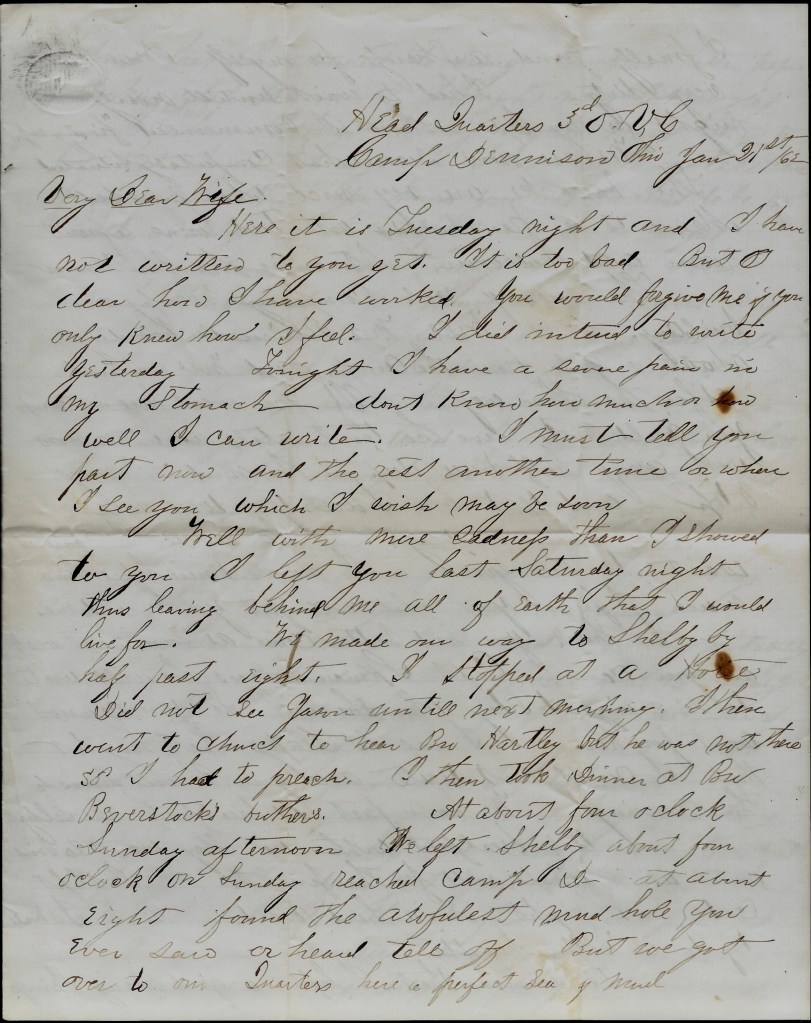
Here it is Tuesday night and I have not written to you get. It is too bad. But O dear, how I have worked. You would forgive me if you only knew how I feel. I did intend to write yesterday. Tonight I have a severe pain in my stomach. Don’t know how much or how well I can write. I must tell you part now and the rest another time or when I see you which I wish may be soon.
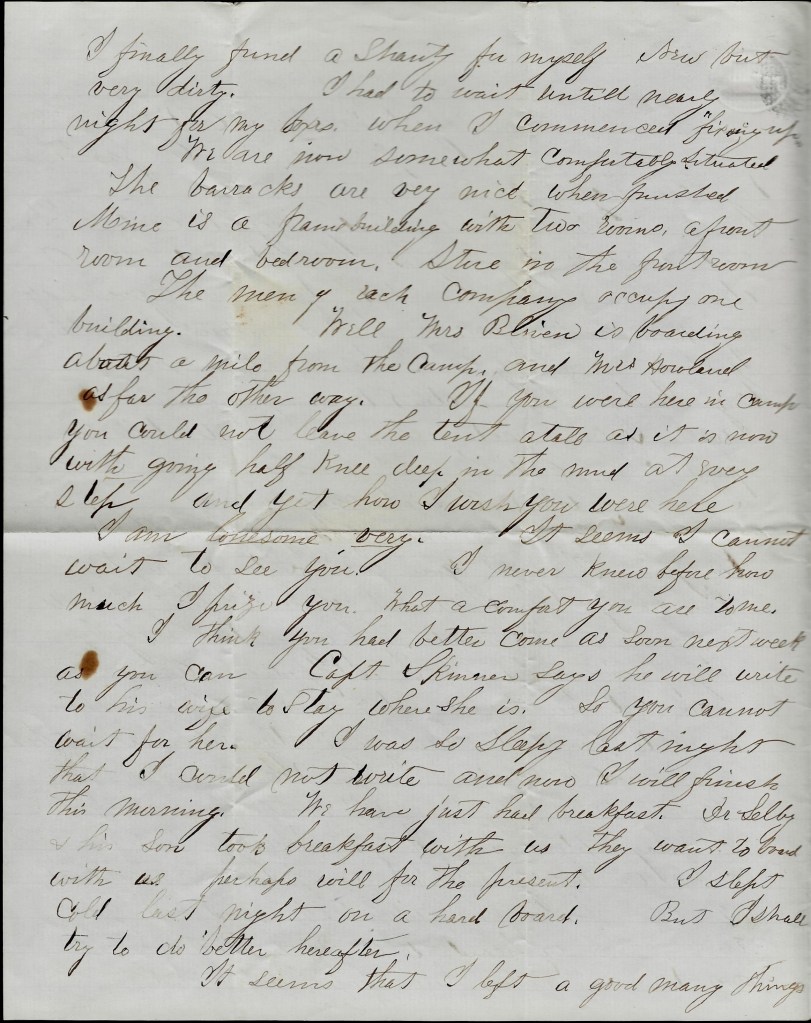
Well with more sadness than I showed to you, I left you last Saturday night, thus leaving behind me all of earth that I would live for. We made your way to Shelby by half past eight. I stopped at a Hotel. Did not see Jason until next morning. I then went to church to hear Bro. Hartley but he was not there so I had to preach. I then took dinner at Beverstock’s brothers. At about four o’clock Sunday afternoon, we left Shelby [and] reached Camp D[ennison] at about eight. Found the awfullest mud hole you ever saw or heard tell of. But we got over to our quarters here a perfect sea of mud. I finally found a shanty for myself—new, but very dirty. I had to wait until nearly night for my boxes when I commenced “fixing up.”
We are now somewhat comfortably situated. The barracks are very nice when finished. Mine is a frame building with two rooms—a front room and bedroom. The men of each company occupy one building. Well, Mrs. Bliven is boarding about a mile from the camp and Mrs. Howland as far the other way. If you were here in camp, you could not leave the tent at all as it is now with[out] going half knee deep in the mud at every step, and yet how I wish you were here.
I am lonesome—very. It seems I cannot wait to see you. I never knew before how much I prize you What a comfort you are to me. I think you had better come as soon next week as you can. Capt. Skinner says he will write to his wife to stay where she is so you cannot wait for her. I was so sleepy last night that I could not write and now I will finish this morning.
We have just had breakfast. Dr. Selby & his son took breakfast with us. They want to board with us—perhaps will for the present. I slept cold last night on a hard board. But I shall try to do better hereafter. It seems that I left a good many things behind that I intended to bring such as letter paper, looking glass, saw, &c. I bought me a looking glass.
Then I forgot to say a great many things to you that I did not say. I wanted to say take care of your health. you know you are inclined to be a little careless in that respect. Do be careful. I wish you would put away my coats & vests that I left behind. Get things in the drawers and put away in various places all snug and safe so that they will not be scattered nor lost that we may have them when we want to go to housekeeping again. And I pledge you now that when I get through with this, I will never—unless in the strictest sense of duty—take a position that will separate us or tear us up in the world as we now are. You may write this down in your memorandum.
There is much talk and a strong probability of our being disbanded. Our officers fear it greatly—some of them, and some I guess don’t care much. I don’t, for one. If the regiment is not needed in war, I hope it will be disbanded. Keep for the present the money you have. Bring with you when you come one or two felt comforts after you get your trunk filled. Then have Hosford tie the comforts on the top. Bring your coarsest clothing and warmest, perhaps one nice dress, plenty of calico, and such as will bear the dirt and rub. Better get you a new calico frock. Get your shoes fixed, &c. &c. And come on.
You had better start from Monroeville on the morning train at 7 o’clock. Get you a ticket and get your baggage checked to Shelby Junction, not Shelby town. When at the junction, buy your ticket and get baggage checked to Camp Dennison. You will then come through safe without changing cars and I will meet you at the Depot here. By starting in the morning, you save the night travel and can see the country as you come.
You will have to wait a while at Shelby. Be sure and tell me what day you will come so that I can meet you. If I should not meet you, you would not know where to go. The Railroad runs directly through the camp. I have just been to see Capt. Skinner. He says he will send for his wife probably next week so that she can come the last of the week. Perhaps you had better wait until the last of the week. He is waiting for pay day. You had better come as soon as Friday of next week.
Well, you see my sheet is full and I must close. Keep good spirits and hope to meet soon. Sarah lives some 8 or 9 miles from Jason. Says tell you he is well and likes it first rate. I think though that he will get tired. Give my love to Mother and write soon as you receive this. Let us meet at the throne of grace often.
This letter was written by Elmore Yocum Warner (1833-1886), the Chaplain of the 3rd Ohio Volunteer Cavalry (OVC). Elmore accepted his commission on 11 December 1861 and remained with the regiment until 1 August 1862 when he resigned and returned to his home in North Fairfield, Huron county, Ohio. [Note: the regimental roster erroneously recorded his name as “Edward” rather than “Elmore.”]
Warner’s letter is obviously just a draft of a letter that he addressed to the “Register.” This was undoubtedly the Sandusky Daily Commercial Register which had previously published a couple of his other letters, one in January 1862 calling upon citizens to donate books for a traveling library in the regiment, and another one written from Jeffersonville, Indiana, in March 1862 as the regiment readied itself for a march into “Secech Land,” saying, “We are near enough to know something of the beating of the Secesh pulse, which we believe grows fainter every day, and will soon cease to beat forever—leaving the ghostly carcass of Secession prostrate—a stench, and yet a valuable lesson to the world.“
If Warner ever sent a final copy of this draft to the newspaper editor, I could not find it among the on-line issues of the paper. Perhaps he thought best not to send it, or maybe the editor decided the chaplain’s sentiments didn’t not seem very charitable—especially since Warner apparently was the recipient of charity from a secesh family when he fell ill in March 1862.
An obituary for Warner published in the Wayne County Democrat on 14 July 1886 said of him:
“This well-known minister of the North Ohio Conference of the Methodist Episcopal Church, and son of the late Rev. Jesse Warner, was born in Wayne County, July 3, 1833, and died in Norwalk, Oh., July 6, 1886, aged 53 years. Mr. Warner, after a faithful use of the educational advantages furnished by the common schools, entered the Ohio Wesleyan University and while he did not complete the course, he did lay the foundation of a respectable scholarship, which enabled him to pursue so intelligently his future studies in connection with his ministry that, subsequently, the Faculty and Trustee of the University felt justified in conferring upon him the honorary degree of Master of Arts. He was married in 1857 to Maria Lee, of Huron county, who survives, with five children, one of whom is also a minister, and represents the third generation of the same line in succession in the same Conference. During the Civil War, Warner served as chaplain of the 3rd Ohio Cavalry and was on the field of Shiloh; but the exposure in the service being too severe for a constitution not naturally robust, he secured his discharge, but had already laid the foundation of the disease to which, after heroic struggle for years, he had, at last, to yield….”
At least one other letter of Warner’s is known to exist which is housed in the collections at Western Michigan University Archives. The letter was written on 24 March 1862 (two weeks before the Battle of Shiloh) and is summarized as follows by the curator:
It is filled with general news. He talks about that the regiment may be on the way further south. Warner had been sick but felt better. He had stopped at the house of a widow and five daughters who helped him even though all their friends had been in the Confederacy. He reported that the ladies, “…don’t know anything about cooking.” He stated that he had not heard from her in almost four weeks and “…give me at least the scratch of your pen…” The small addition dated March 27 states that Warner is homesick and wants to go home to see his wife.
See also: Solomon Shoman, Troop I, 3rd Ohio Cavalry (Union/3 Letters)
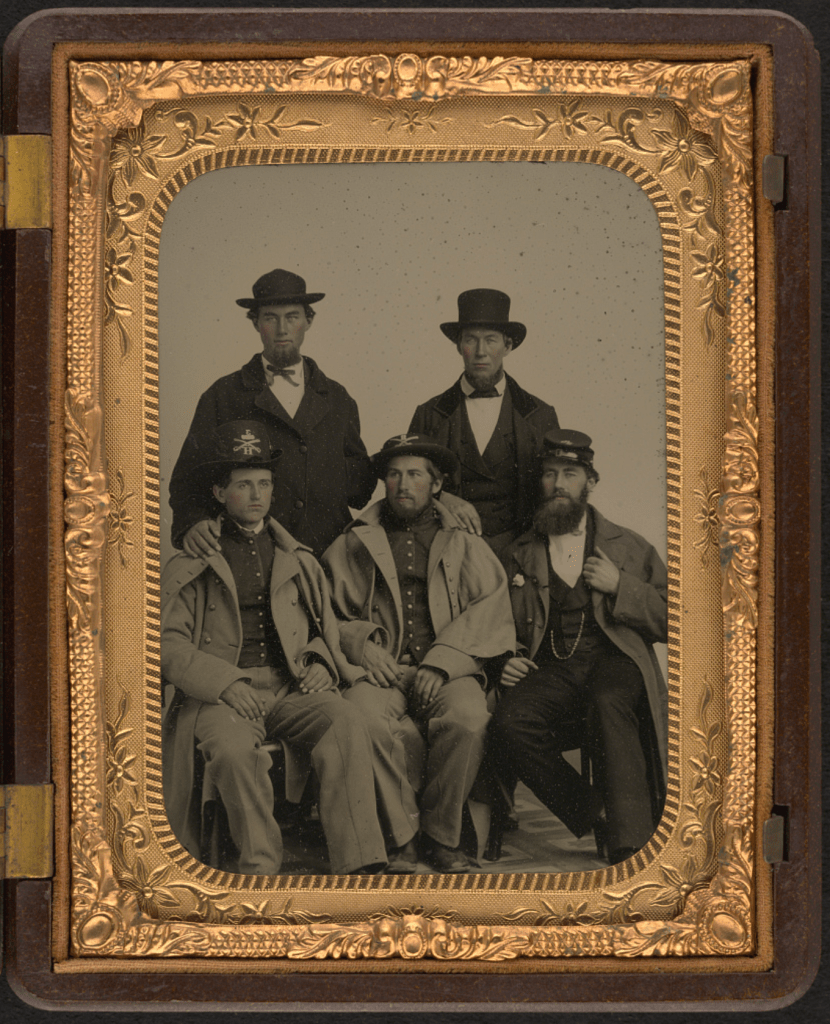
Three troopers from the 3rd Ohio Cavalry and two dressed in Civilian clothes; the civilian at right almost looks like he could be Rev. Warner. (Library of Congress)
Transcription
Headquarters 3rd Ohio Cavalry Woodville, Alabama July 18, 1862
Dear Resister,
We are now with two battalions of one regiment about twenty miles northeast from Huntsville near Woodville Station on the Memphis & Charleston Railroad. We came here for the purpose of ferreting out some guerrilla and bushwhacking bands who infest the mountains in this vicinity. Lieut. Col. [Douglas A.] Murray is in command, Col. [Lewis] Zahm having gone home on leave. The first battalion under command of Major Foster is with the division near Winchester.
Much hard scouting has been done by the men over a rough mountainous country, scarcely passable for cavalry. A great many prisoners have been taken, some of whom confess to belonging to the bushwhackers. There are several companies of these desperadoes as near as we can discern who are ranging through these mountains shooting down straggling soldiers and Union men adn watching every opportunity of pouncing upon trains and small parties of troops. A man by the name of Harris was captured the other day who confessed to having been one of the party who captured four sutler teams a few days since with all the goods and to have participated in eating & drinking some of these stores. One of the teams belonged to Mr. Drennan, sutler of the 64th Ohio Volunteers. A force is going out today who think they have track of the wagons and teams.
Two or three nights ago our pickets were attacked by a small force but were almost immediately repulsed by the watchful sentinels. The alarm was instantly given in camp and although the men were mostly asleep, it was but the work of a minute for them to get out in line ready to receive the enemy. The general desire was to see them come and I think from the position we hold that our men would have cordially received a force even greatly superior to our own but they chose not to come.
I do not think that there is any considerable force anywhere in this region of country but the guerrilla warfare has fairly opened and the manner in which it is carried on is disgraceful to any civilized nation and the villainy and deception practiced [by] them is without a parallel. Nearly all claim to be Union men in our presence, but when inquired of among the bushwhackers, they know nothing and never ever heard of such things. When we go to find those who do engage in this work, we find them quietly working in their fields apparently as innocent as the unborn but no sooner do we leave them than they join the gang again. They can lie and put on the most perfect air of innocence of any persons I ever saw. I don’t believe the devil in hell can begin to match them.
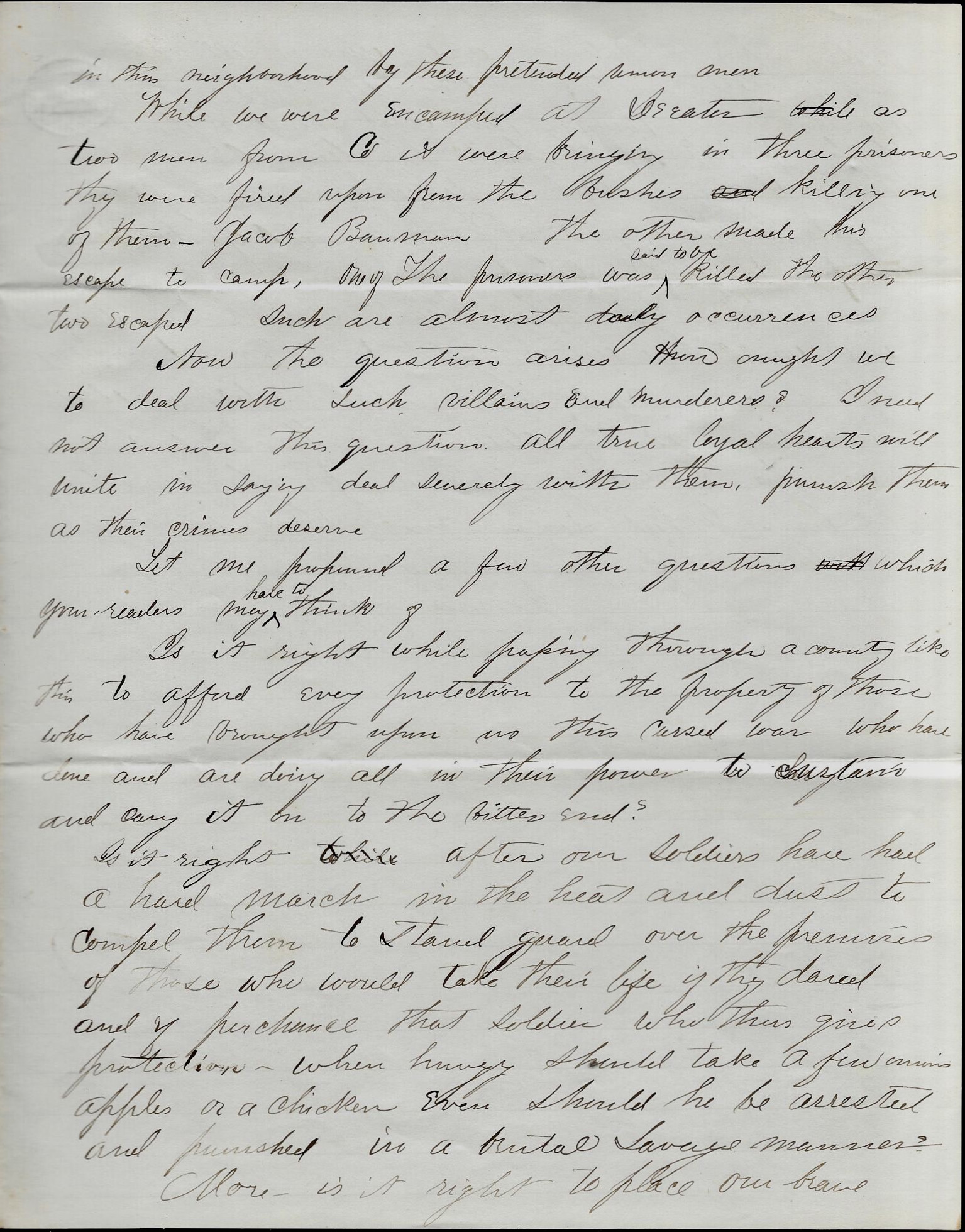
Quite a number of persons have been shot recently in this neighborhood by these pretended Union men. While we were encamped at Decatur, two men from Co. A were bringing in three prisoners when they were fired upon from the bushes, killing one of them—Jacob Bauman. The other made his escape into camp. One of the prisoners was said to be killed [and] the other two escaped. Such are almost daily occurrences.
Now the question arises then, [how] ought we to deal with such villains and murderers? I need not answer this question. All true loyal hearts will unite in saying deal severely with them—punish them as their crimes deserve. Let me propound a few other questions which your readers may have to think of. Is it right while passing through a country like this to afford every protection to the property of those who have brought upon us this cruel war—who have done and are doing all in their power to sustain and carry it on to the bitter end?
Is it right after our soldiers have been on a hard march in the heat and dust to compel them to stand guard over the premises of those who would take their life if they dared and if perchance that soldier who thus gives protection, when hungry, should take a few onions, apples, or a chicken, even if he should be arrested and punished in a brutal savage manner?
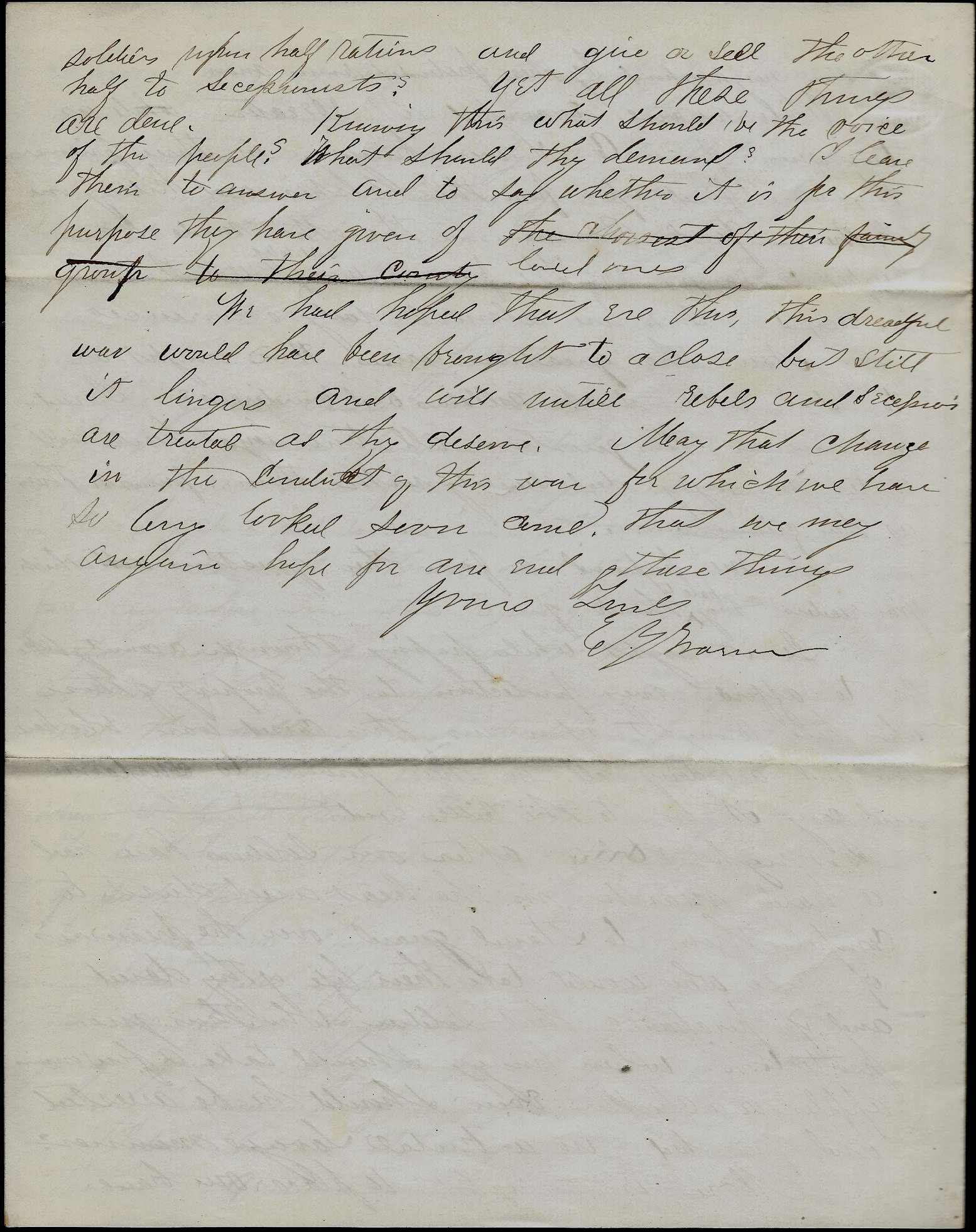
More, is it right to place our brave soldiers upon half rations and give or sell the other half to secessionists? Yet all these things are done. Knowing this, what should be the voice of the people? What should they demand? I leave them to answer and to say whether it is for this purpose they have given up their loved ones.
We had hoped that ere this, this dreadful war would have been brought to a close but still it lingers and will until rebels and secessionists are treated as they deserve. May that change in the conduct of this war for which we have so long looked soon come, that we may again hope for an end of these things.









 Spared & Shared 23