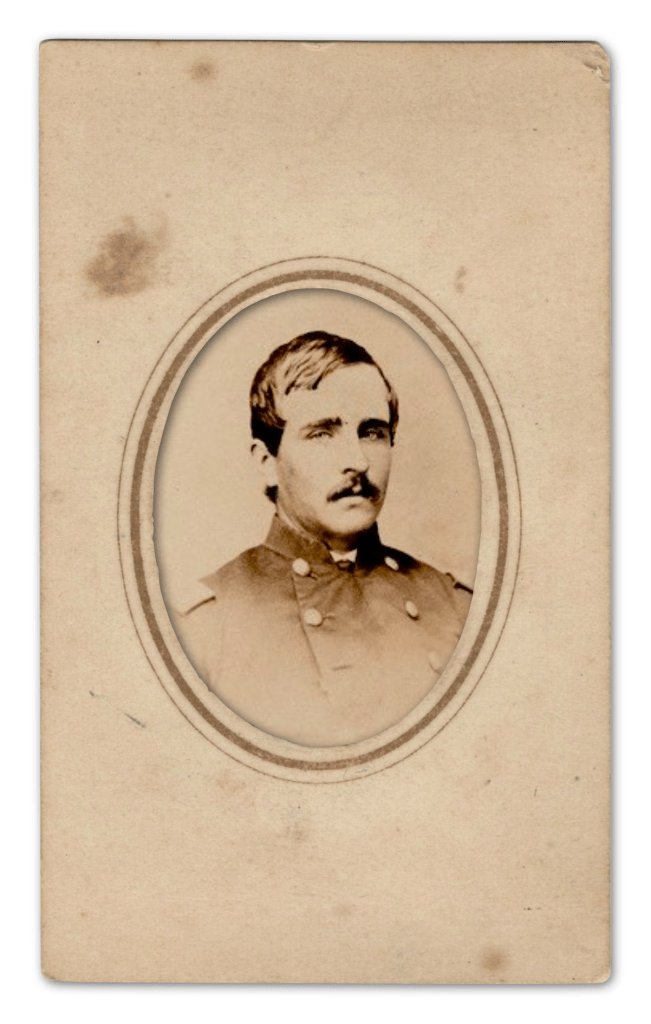
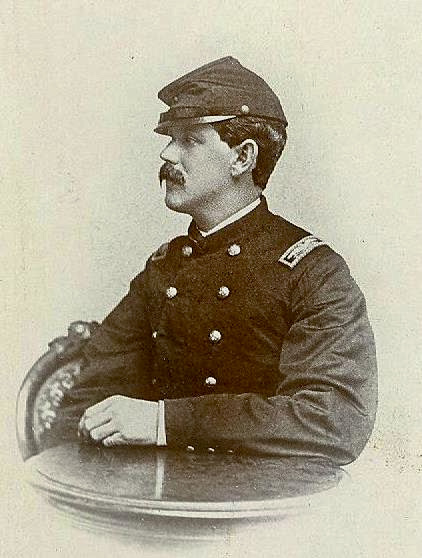
William Ames in his Colonel’s uniform, 3rd Rhode Island Heavy Artillery
The following letter was written by Major William Ames (1842-1914) of the 3rd Rhode Island Heavy Artillery while commanding the post at Fort Pulaski near Savannah, Georgia in late October 1863. William was the son of Samuel Ames (1806-1865) and Mary Throop Dorr (1811-1869) of Providence, Rhode Island. He began his service as a captain in the 2nd Rhode Island Infantry but accepted an appointment to Major of the 3rd Rhode Island in February 1863.
We learn from this letter that William was having second thoughts about having taken the promotion to command a post where the daily routine was quite dull. He did, however, rise in rank to Colonel of the 3rd Rhode Island Heavy Artillery and towards the end of the war he served as Chief of Artillery on the staff of Major General Quincy A. Gillmore. He was brevetted Brigadier General, US Volunteers on March 13, 1865 for “meritorious services during the war.”
William wrote the letter to Col. Edwin Metcalf (1823-1894), a Harvard-educated lawyer and Rhode Island state legislator when he resigned his seat to join the war. Commissioned as Major of the 3rd Rhode Island Heavy Artillery, he immediately made a name for himself and the regiment when he led the first battalion in the battle of Secessionville, SC. Promoted to Colonel and transferred at the governor’s request to command the new 11th Rhode Island Infantry, Metcalf was with the Army of the Potomac only a short time before being recalled to South Carolina. Yellow fever had swept the ranks and claimed Col. Brown of the 3rd RI HA, as well as several other officers, and Metcalf was seen as the one to revitalize the demoralized regiment. He commanded the regiment and served as Chief of Artillery until January 1864, when he returned to Providence on medical leave. He resigned due to illness on February 5, 1864.
Inside Fort Pulaski 1862-3
[Note: This letter is from the private collection of Greg Herr and was transcribed and published on Spared & Shared by express consent.]
Transcription
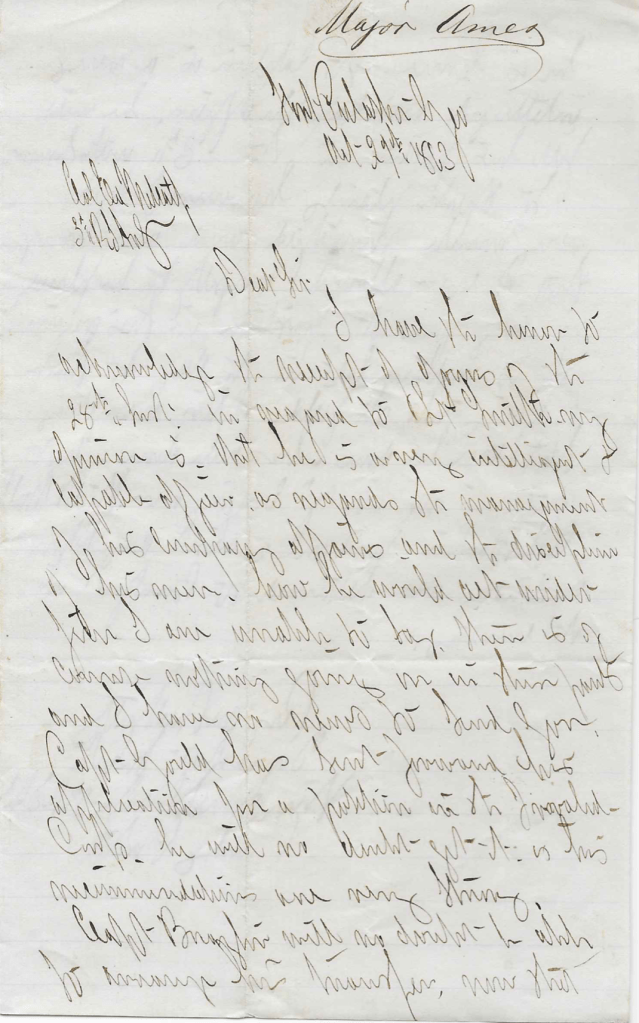
Fort Pulaski, Georgia October 29th 1863
Col. Ed Metcalf, 3rd Rhode Island [Heavy] Artillery,
Dear sir, I have the honor to acknowledge the receipt of yours of the 28th inst. in regard to Lt. Smith. My opinion is he is a very intelligent & capable officer as regards to management of his company affairs and the discipline of his men. How he would act under you I am unable to say. There is, of course, nothing going on in these parts and I have no news to send you. Capt. Gould has sent forward his application for a position in the Invalid Corps. He will no doubt get it as his recommendations are very strong.
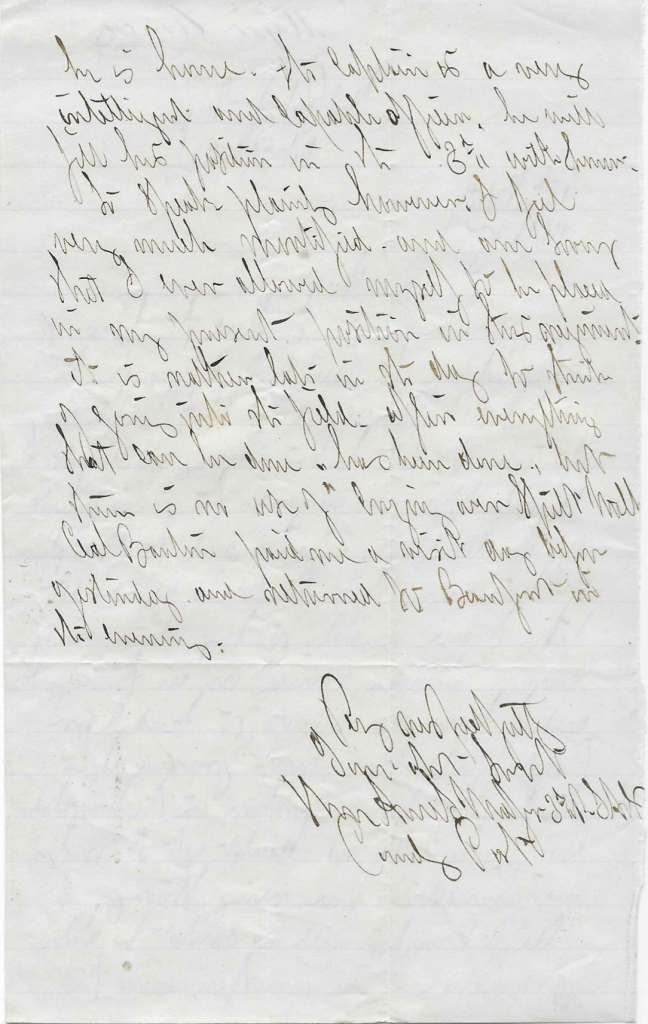
Capt. Boughton will not doubt be able to arrange his transfer, now that he is home. The captain is a very intelligent and capable officer. He will fill his position in the 3rd with honor. To speak plainly, however, I feel very much mortified and am sorry that I ever allowed myself to be placed in my present position in this regiment. It is rather late in the day to think of going into the field after everything that can be done has been done, but there is no sense of crying over spilt milk.
Col. Barton paid me a visit day before yesterday and returned to Beaufort in the evening.
Very respectfully your obedient servant, — Wm. Ames, Major 3rd Rhode Island Artillery, Commanding post.
The following letter was written by Martin Stoddard James (1841-1910), the son of John M. James (1816-1853) and Eunice Albee White (1813-1881) of Providence, Rhode Island.
I could not find an image of Martin but here is one of John M. Barker who served as Capt. of Co. D, 3rd Rhode Island Heavy Artillery (The Horse Soldier)
20 year-old Martin was mustered into service on 20 August 1861 and commissioned a 2nd Lieutenant in Co. A of the 3rd Rhode Island Heavy Artillery. He was appointed post adjutant in January 1862 and was placed on detached service on General Terry’s staff until August 1863. He was promoted to 1st Lieutenant in late December 1862 and to Captain of Co. C in November 1863. A biographical sketch claims that he took part in the engagements at Pocotaligo, Morris Island, Fort Sumter, Fort Wagner, Olustee, Drury’s Bluff, Laurel Hill, Fort Burnham, and Petersburg. In the last five engagements, Co. C was the only battery present of the regiment. He is further credited with leading the dismantling of the rebel works around Richmond after the city fell. His only wound came at Laurel Hill where he received a hip wound.
A Note from the Siege of Petersburg Online: This unit is incorrectly designated as Battery C of the Third Rhode Island “Light” Artillery in the June organizational tables in the Official Records and possibly elsewhere, but there was no 3rd Regiment of Light Artillery for the state of Rhode Island. The correct designation is Battery C of the Third Rhode Island Heavy Artillery. It would appear from the official report of operations on October 7, 1864, linked to near the bottom of this page, that company C was acting as light artillery. The designation used in the report is “Light Company C, 3rd Rhode Island Artillery.”
[Note: This letter is from the personal collection of Greg Herr and was transcribed and published on Spared & Shared by express consent.]
Transcription
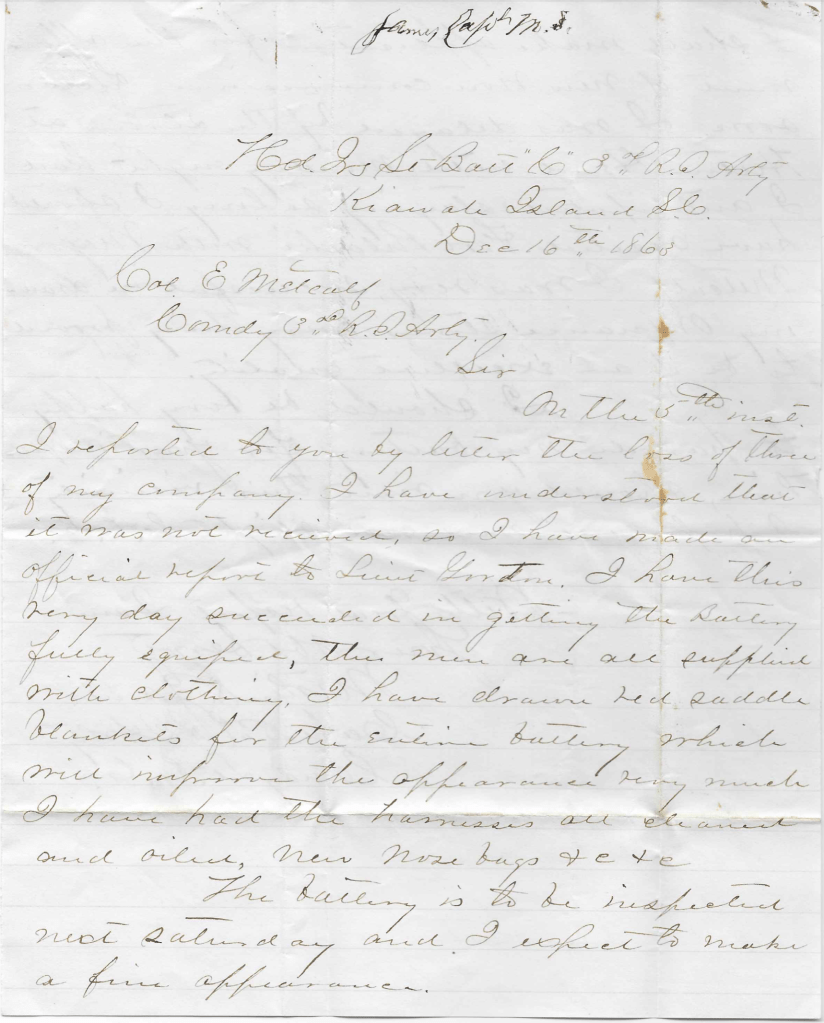
Headquarters Light Battery C, 3rd Rhode Island Artillery Kiawah Island, South Carolina December 16th 1863
Col. E. Metcalf Commanding 3rd Rhode Island Artillery
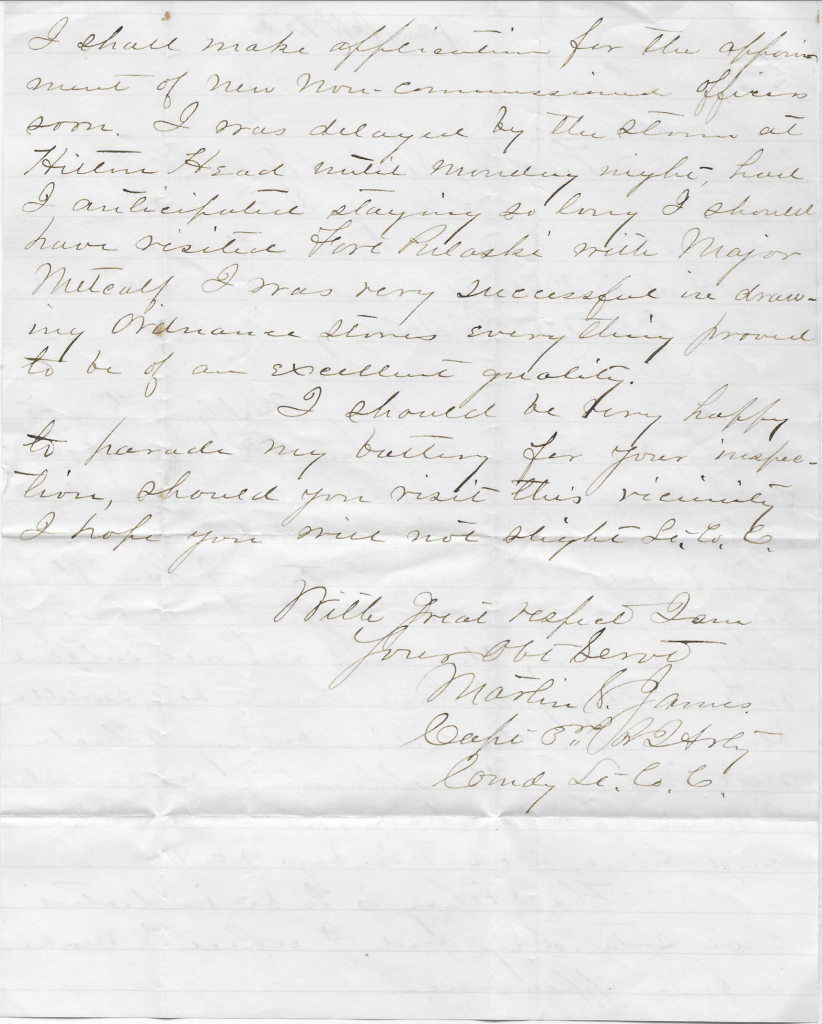
Sir, on the 5th inst. I reported to you by letter the loss of three of my company. I have understood that it was not received so I have made an official report to Lieut. Gorton. I have this very day succeeded in getting the Battery fully equipped. The men are all supplied with clothing. I have drawn red saddle blankets for the entire battery which will improve the appearance very much. I have had the harnesses all cleaned and oiled, new nose bags, &c. &c.
The battery is to be inspected next Saturday and I expect to make a fine appearance. I shall make application for the appointment of new non-commissioned officers soon.
I was delayed by the storm at Hilton Head until Monday night. Had I anticipated staying so long, I should have visited Fort Pulaski with Major Metcalf. I was very successful in drawing ordnance stores. Everything proved to be of an excellent quality.
I should be very happy to parade my battery for your inspection, should you visit this vicinity. I hope you will not slight Light Co. C.
With great respect, I am your obedient servant, — Martin S. James, Capt. 3rd Rhode Island Artillery, Commanding Light Co. C.
Col. Charles Ray Brayton, 3rd Rhode Island Heavy Artillery
Charles R. Brayton (1840-1910) was born in Warwick, Rhode Island to William Daniel Brayton and Anna Maud (Clarke) Brayton. In 1857, his father was elected as a Republican representing Rhode Island in the U.S. Congress. In 1859, he began attending Brown University in Providence, but left in the middle of his second year to join the 3rd Rhode Island Heavy Artillery. He was commissioned as first lieutenant in 1861, promoted to lieutenant colonel in 1863, and to colonel in April 1864. He was honorably mustered out of service in October 1864. In March 1865, along with many others, he received a brevet (honorary promotion) to the rank of brigadier general. That same year, just a month before the end of the war, he married Antoinette Percival Belden.
Charles wrote the letter to Col. Edwin Metcalf of the 3rd Rhode Island Heavy Artillery. At the time of this letter, the 3rd Rhode Island Heavies were still stationed on Morris and Folly Islands near Charleston, South Carolina.
[Note: These letters are from the personal collection of Greg Herr and were transcribed and published on Spared & Shared by express consent.]
Letter 1
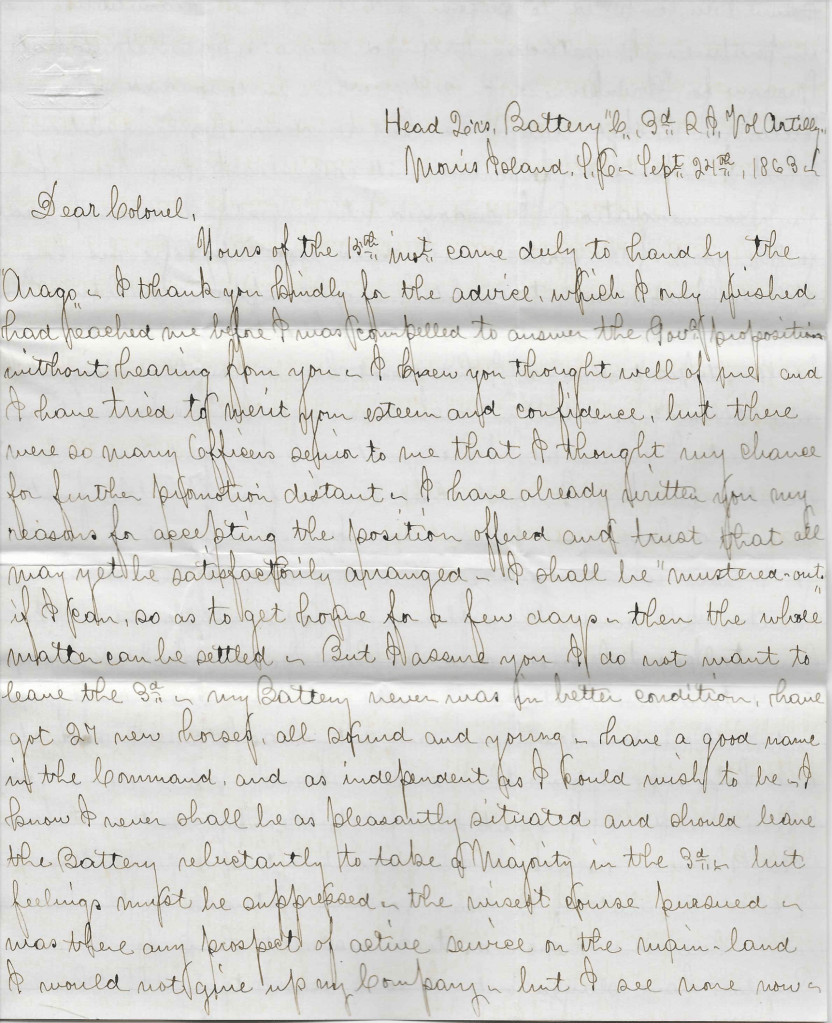
Headquarters Battery C, 3rd Rhode Island Vol. Artillery Morris Island, South Carolina September 14, 1863
Dear Colonel,
Thinking you would be pleased to hear from us on Morris Island and having something to say on my own account which I intended to have said to you personally before you went home, I write this epistle. You may think me presumptuous, egotistical, and inordinately ambitious for so young a man when I ask that if Frieze is removed, I may have his position as Lieut. Colonel. There are many reasons why I should not have it—my age, present position in the line, and three Majors besides. There are also others why I feel that I could fill the position as well as an officer in the regiment, certainly with as much credit and satisfaction to yourself as the present incumbent. I hardly think you would recommend any of the “Senior” Captains for the position. Neither would your judgement lead you to select either Day or Bailey for equally strong reasons.
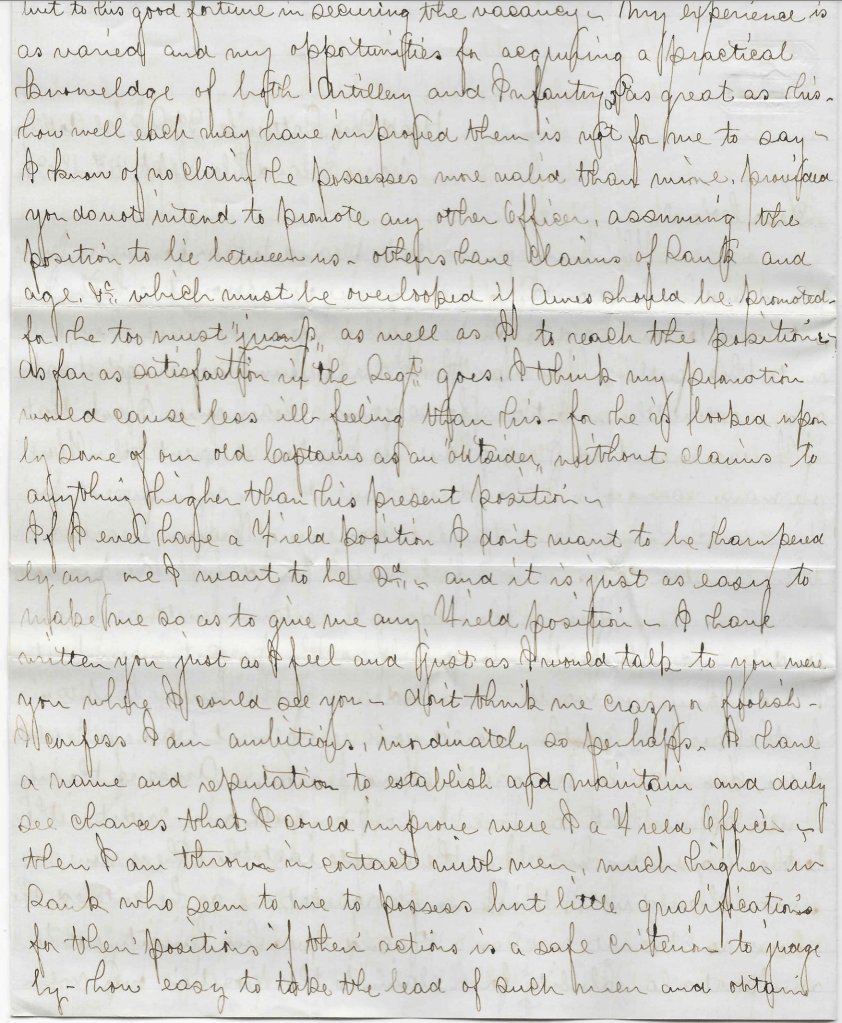
Ames is the only Field Officer that can fill the position with any credit, either to the regiment or himself. The simple fact that he is now my Senior should not, I think, weigh against me as he entered the service as 2nd Lieutenant and I as a 1st, and owes his seniority not to any particular ability for, or claim to, the position over me, but to his good fortune in securing the vacancy. My experience is varied and my opportunities for acquiring a practical knowledge of both artillery and infantry are as great as his. How well each may have improved them is not for me to say. I know of no claim he possesses more valid than mine, provided you do not intend to promote any other officer, assuming the position to lie between us. Other have claims of rank and age, &c., which must be overlooked if Ames should be promoted for he too must “jump” as well as I to reach the position.
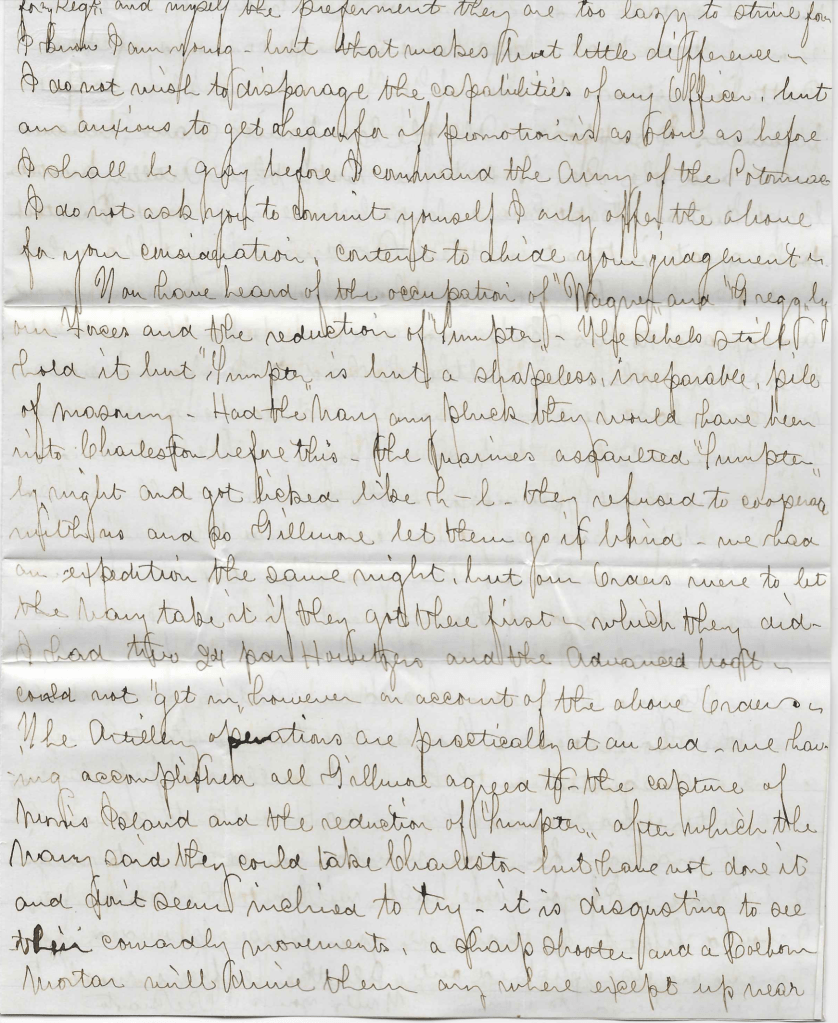
As far as satisfaction in the regiment goes, I think my promotion would cause less ill feeling than his for he is looked upon by some of our old Captains as an “outsider” without claims to anything higher than his present position. If I ever have a Field Position, I don’t want to be hampered by anyone. I want to be 2nd and it is just as easy to make me so as to give me any Field Position. I have written you just as I feel and just as I would talk to you were you where I could see you. Don’t think me crazy or foolish. I confess I am ambitious, inordinately so perhaps. I have a name and reputation to establish and maintain and daily see chances that I could improve were I a Field Officer. I am thrown in contact with me, much higher in rank who seem to possess but little qualifications for their positions. If their actions is a safe criterion to judge by, how easy to take the lead of such men and obtain for my regiment and myself the preferment they are too lazy to strive for.
I know I am young but that makes but little difference. I do not wish to disparage the capabilities of any officer, but am anxious to get ahead for if promotion is as slow as before, I shall be gray before I command the Army of the Potomac. I do not ask you to commit yourself, I only offer the above for your consideration—content to abide your judgement.
You have heard of the occupation of [Forts] Wagner and Gregg by our forces and the reduction of “Sumpter.” The rebels still hold it but “Sumpter” is but a shapeless, irreparable pile of masonry. Had the Navy any pluck, they would have been into Charleston before this. The Marines assaulted “Sumpter” by night and got licked like hell. They refused to cooperate with us and so Gillmore let them go it blind. We had an expedition the same night but our orders were to let the Navy take it if they got there first, which they did. I had the 24 pounder Howitzers and the Advanced boat. Could not “get in” however on account of the above order. The artillery operations are practically at an end—we having accomplished all Gillmore agreed to—the capture of Morris Island and the reduction of “Sumpter” after which the Navy said that they could take Charleston but have not done it and don’t seem inclined to try. It is disgusting to see their cowardly movements. A sharpshooter and a Coehorn Mortar will drive them anywhere except up near the Rebel Batteries and we have not any ordnance here heavy enough to do that.
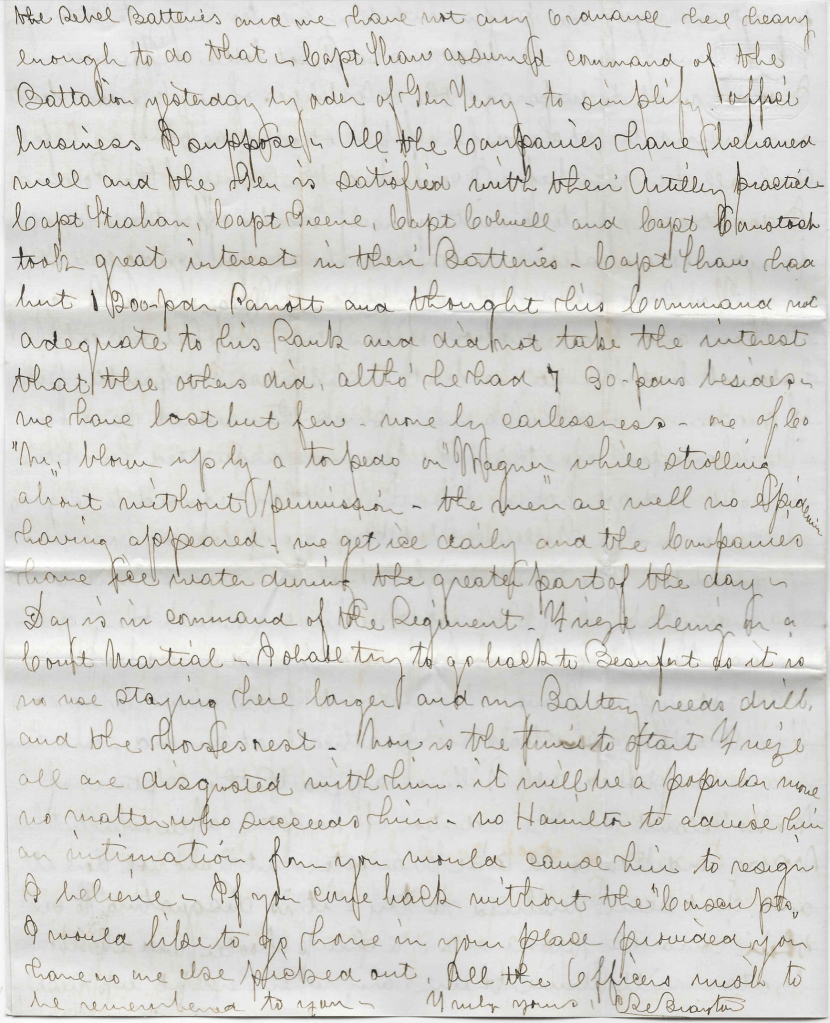
Capt. Shaw assumed command of the Battalion yesterday by order of Gen. Terry to simplify office business, I suppose. All the companies have behaved well and the General is satisfied with their artillery practice. Capt. Strahan, Capt. Greene, Capt. Colwell, and Capt. Comstock took great interest in their batteries. Capt. Shaw had but one 200-pounder Parrott and thought his command not adequate to his rank and did not take the interest that the others did, although he had seven 30-pounders besides.
We have lost but few—none by carelessness. One of Co. “M” blown up by a torpedo on “Wagner” while strolling about without permission. The men are well. No epidemic having appeared. We get ice daily and the companies have ice water during the greater part of the day. Day is in command of the regiment, Frieze being on a court martial. I shall try to go back to Beaufort as it is no use staying here longer and my Battery needs drill, and the horses rest. Now is the time to start Frieze. All are disgusted with him. It will be a popular move no matter who succeeds him. No Hamilton to advise him. An intimation from you would cause him to resign, I believe. If you come back without the “conscripts,” I would like to go home in your place provided you have no one else picked out. All the officers wish to be remembered to you.
Truly yours, — C. R. Brayton
Letter 2
Headquarters Battery C, 3rd Rhode Island Vol. Artillery Morris Island, South Carolina September 24, 1863
Dear Colonel,
Yours of the 13th inst. came duly to hand by the Arago. I thank you kindly for the advice which I only wished had reached me before I was compelled to answer the Governor’s proposition without hearing from you. I knew you thought well of me and I have tried to merit your esteem and confidence, but there were so many officers senior to me that I thought my chance for further promotion distant. I have already written you my reasons for accepting the position offered and trust that all may yet be satisfactorily arranged. I shall be “mustered out” if I can so as to get home for a few days. Then the whole matter can be settled. But I assure you I do not want to leave the 3rd. My Battery never was in better condition. Have got 27 new horses, all sound and young, have a good name in the command, and as independent as I could wish to be. I know I never shall be as pleasantly situated and should leave the Battery reluctantly to take a Majority in the 3rd but feelings must be suppressed—the wisest course pursued. Was there any prospect of active service on the main land, I would not give up my company, but I see none now.
I have been compelled to perform a duty at once humiliating and imperative. I yesterday preferred charges against Lieut. Morrow for “Drunkenness on duty” while in command of a section on picket duty. He has tendered his resignation which I respectfully forwarded. It came back from Henry Metcalf for my recommendation. I endorsed it “respectfully recommended for the good of the service.” I could not approve his honorable discharge and thought I might appear to crowd him too hard did I insist on a court martial. As it is, he may be court martialed as I have not heard from the resignation and Gillmore is severe in such cases. Did I do more than my duty? No doubt of his guilt, as I brought him to camp beastly drunk. I regret that my company furnishes the first case and hope you will not consider it a fault of mine for I have ever discouraged drinking and no one ever saw me drunk or under the influence of liquor while here.
I have talked to Morrow and let him pass when my judgment told me better. I could not have been more lenient with my own brother. My duty was plain. I did it and hope you approve the course. It may save some good officers and be of great benefit to the regiment in the end. Gen. Gillmore has received his appointment as a Major General. I fired a salute of 13 guns for his yesterday on the beach where there were thousands to congratulate him by cheers.
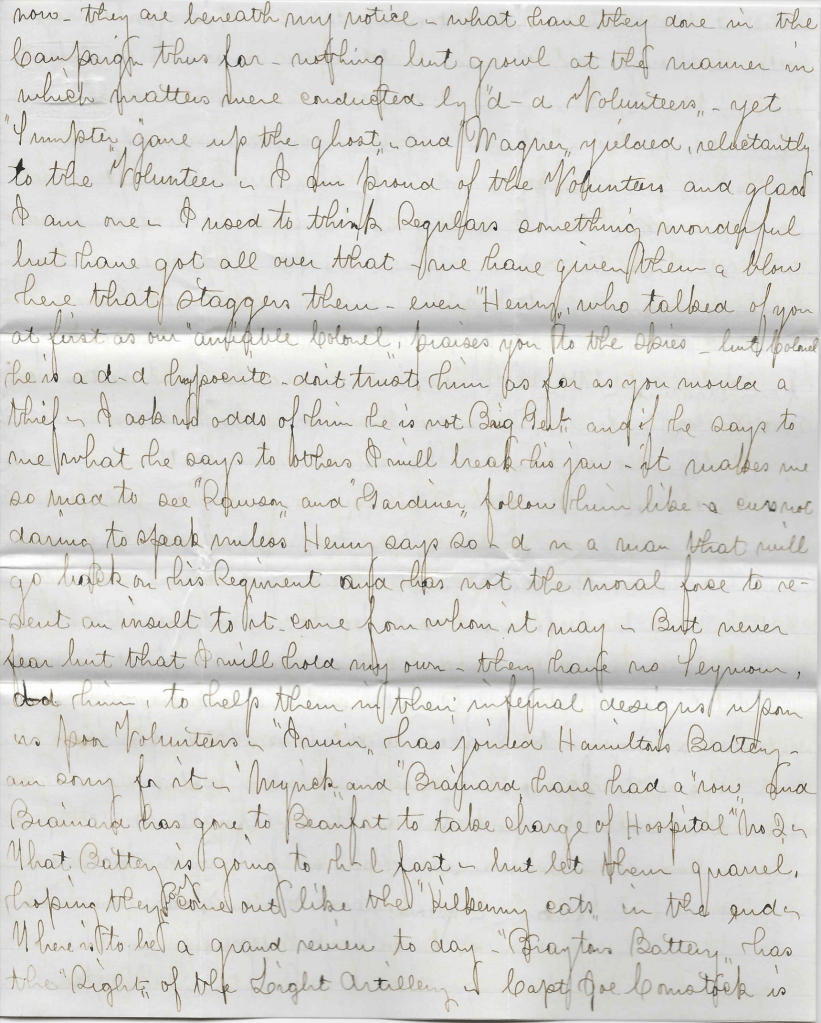
Regulars have “played out.” I don’t associate with them now. They are beneath my notice. What have they done in the campaign thus far—nothing but growl at the manner in which matters were conducted by “damned Volunteers,” yet “Sumter” gave up the ghost, and “Wagner” yielded reluctantly to the Volunteer. I am proud of the Volunteers and glad I am one. I sed to think Regulars something wonderful but have got all over that. We have given them a blow here that staggers them. Even Henry, who talked of you at first as our “amiable Colonel, praises you to the skies.” But Colonel, he is a damned hypocrite. Don’t trust him as far as you would a thief. I ask no odds of him. He is not Brig. Gen. and if he says to me what he says to others, I will break his jaw. It makes me so mad to see “Rawson” and “Gardiner” follow him like curs—not daring to speak unless Henry says so. Damn a man that will go back on his regiment and has not the moral force to resent an insult to it—come from whom it may. But never fear but that I will hold my own. They have no Seymour, damn him, to help them in their infernal designs upon us poor Volunteers.
“Irwin” has joined Hamilton’s Battery. Am sorry for it. “Myrick” and “Brainard” have had a “row” and Brainard has gone to Beaufort to take charge of hospital. No. 2 in that Battery is going to hell fast. But let them quarrel, hoping they may come out like the “Kilkenny cats” in the end.
There is to be a Grand Review today. “Brayton’s Battery” has the “Right” of the Light Artillery. Capt. Joe Comstock is still at the [Hilton] Head awaiting transportation. You speak in your letter as though the 3rd was intolerable now. I can’t believe you really mean any such thing. Cursed we are by as miserable a lot of Field Officers (excepting yourself and Ames) as ever sapped the life of any regiment, but still we have talent among us sufficient to fill creditably any position. Our officers are far in advance of any I have seen here, take them as a class. You have no idea of the class of officers that came with those troops from Virginia. The 3rd stands well and are treated as Artillery Companies should be. They have done well. I am proud of them. If you can make a better regiment than stands out of the 4rd Rhode Island, mark out your cause and there are enough of us to support you. Only a few croakers to deal with.
Never fear about our getting into Charleston before you come back. Don’t you think me rather precocious in asking what I did. But I can’t help it for if I am left out now, I shall never command a regiment, I fear, and it is hard jumping from Major to Colonel over a Lieut. Colonel. But we will talk this over I hope before anything definite is done. I can keep my counsel—have so far—and promise you I will in future. Please excuse the emphatic remarks. Yours truly, — C. R. Brayton
Letter 3
Office of the Chief of Artillery Morris Island, South Carolina December 14, 1863
Dear Colonel,
Yours ofthe 4th and 5th (postscript) was duly received a few hours after I had mailed one for you. I think Eddy’s case settled for I well knew the Gov. had “no personal interest in the matter.” Bailey, I think, was at the bottom of the affair, put up to it by Eddy’s friends at home. If you think the matter need more attention, I will write the Governor about it, but I think it unnecessary.
Maj. Ames is in command of the Battalion. I showed him your letter about Report and Returns. Peirce of Co. D had a Descriptive List which Burton says he gave to Lamson, one having been given, the Company Commander has no right, I think, to give another.
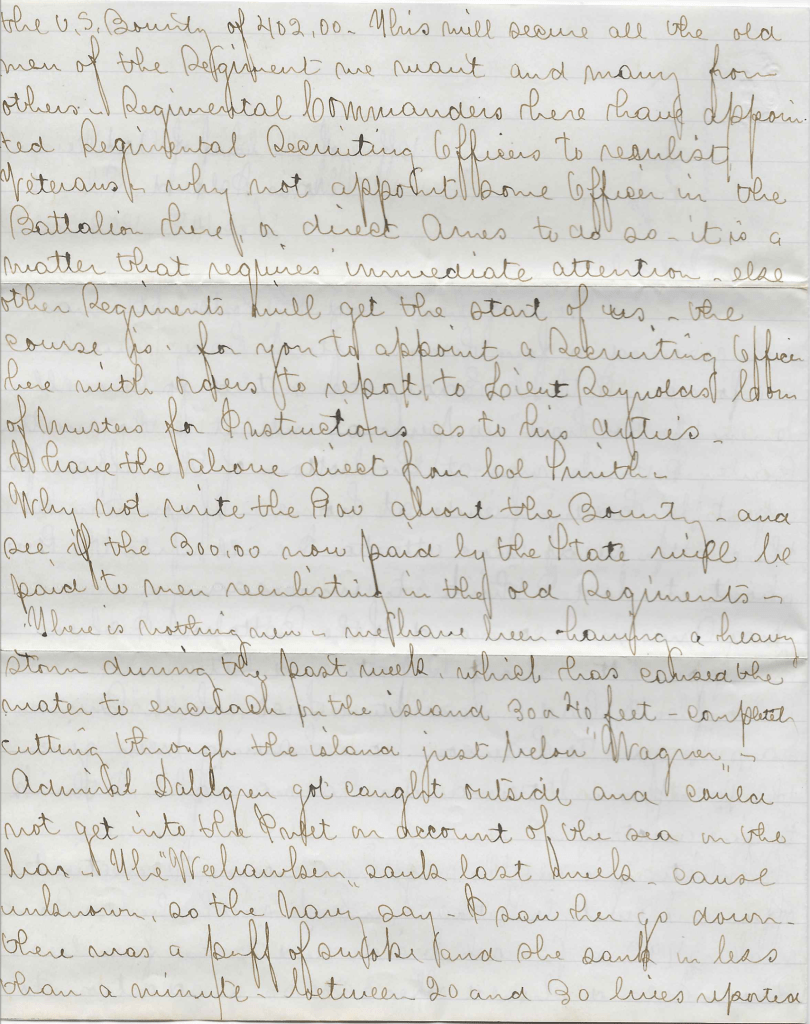
Reenlisting is all the rage here now. Connecticut offers a bounty to Veterans which with the US Bounty, makes $792 for cash, beside aid to the families. Rhode Island should offer $500 in addition to the US Bounty of $402. This will secure all the old men of the regiment we want and many from others. Regimental commanders here have appointed Regimental Recruiting Officers to reenlist Veterans. Why not appoint some officer in the Battalion here or direct Ames to do so? It is a matter that requires immediate attention—else other regiments will get the start of us. The course is for you to appoint a Recruiting Officer here with orders to report to Lieut. Reynolds, Com. of Musters for instructions as to his duties. I have the above direct from Col. Smith.
Why not write the Governor about the Bounty and see if the $300 now paid by the State will be paid to men reenlisting in the old regiments.
There is nothing new. We have been having a heavy storm during the past week which has caused the water to encroach on the island 30 or 40 feet, completely cutting through the island just below “Wagner.” Admiral Dahlgren got caught outside and could not get into the Inlet on account of the sea on the bar. The “Weehawken” sank last week—cause unknown, so the Navy says. I saw her go down. There was a puff of smoke and she sank in less than a minute. Between 20 and 30 lives reported to have been lost.
The storm has evidently broken up the “obstructions” 1 between Sumter and Moultrie as large masses of timber, evidently links of some chain have been driven on shore. They consist of 9 sticks of 15 in. hard pine timber firmly bound together with iron hoops. Through the centre is a bar of railroad iron, on either end of which iron links have been attached so that an indefinite number of these wooden masses can be joined together and thus make a chain of great strength. The timber having buoyancy enough to support the railroad iron at all times and the iron being strong enough to prevent vessels from forcing their way past it.
Sumter was on fire in the Southwest corner during the past week—cause unknown to us. We shell the city every twenty-four hours. I will see about King’s Case Co. M today. Regards to all your officers. I pity Lanahan’s wife—she being alone at Pulaski, but Capt. Jerry is satisfied, I suppose. Write soon. Have not yet received our mail by the Arago. Can’t it be sorted at the Head some way?
Ever your sincere friend, — C. R. Brayton
1 The New York Herald of 7 April 1863 carried an article on “the obstructions” in Charleston Harbor. They were said to consist of “floating rafts, made of heavy timber, securely lashed together by cable chains, and then bolted to an upper layer of timber, which not only covers the chains, but adds a bracing strength to the structure. At a given point this bar or boom is provided with a moveable gate, which is opened to allow their own vessels to pass in and out. This place of ingress is directly under the guns of Fort Sumter and so close that it seems impossible that any vessel could pass them, A chain and a connecting seres of obstructions exist between Forts Sumter and Moultrie.”
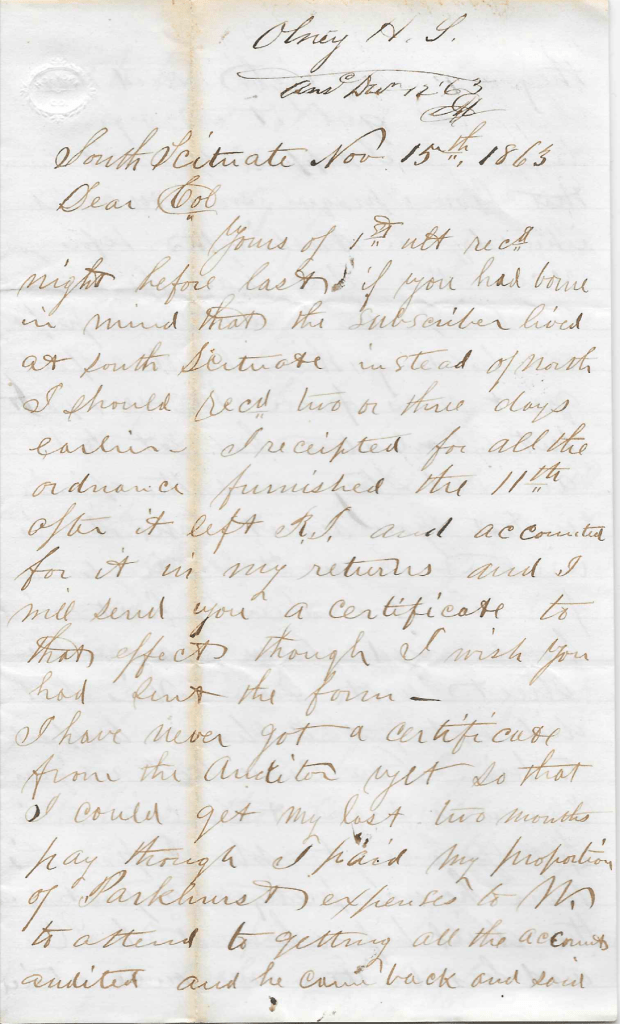
The following letter was written by Henry S. Olney (1831-1907), a 2nd Lieutenant in Co. G, 3rd Rhode Island Heavy Artillery from February 1862 to August 1862, six months and 5 days, serving as the regimental quartermaster. When this letter was written in November 1863, Henry had been discharged from the service for 15 months and was working as a manufacturer in South Scituate, Providence county, Rhode Island.
Henry was the son of Amos Atwell Olney and Elizabeth Williams. He wrote the letter to Col. Edwin Metcalf of the 3rd Rhode Island Heavy Artillery. At the time of this letter, the 3rd Rhode Island Heavies were still stationed on Morris and Folly Islands near Charleston, South Carolina.
[Note: This letter is from the private collection of Greg Herr and was transcribed and published on Spared & Shared by express consent.]
Transcription
South Scituate November 15th 1863
Dear Col.,
Yours of the 1st ult. received night before last. If you had borne in mind that the subscriber lived at South Scituate instead of North, I should have received it two or three days earlier. I receipted for all the ordnance furnished the 11th after it left Rhode Island and accounted for it in my returns and I will send you a certificate to that effect though I I wish you had sent the form.
I have never got a certificate from the auditor yet so that I could get my last two months pay though I paid my proportion of Parkhurst expenses to W. to attend to getting all the accounts audited and he came back and said they are all right and that I should get it in a few days.
I suppose you will. know that Gov. Sprague was married Thursday in Washington before you receive this. That is all the news of much importance just now. People are holding their breath expecting great news from Meade & Grant but Charleston has got to be an old story and the opinion is that you won’t take it this winter.
I saw Lt. Col. [Charles R.] Brayton a few minutes when he first arrived home and I saw Day in the street with some ladies but did not get a chance to speak to him. How came he to resign?
There is a Sergeant [James W.] Slocum in Co. L of your regiment who is from this town. He was pretty well posted in the drill before he went to South Carolina and has written me once or twice to try and get him promoted. I wish if you can you would give him a lift. He is a pretty good fellow & more deserving of shoulder strop than many that wear them. If you don’t want him there, please recommend him for the 14th [Corps]. Some of the 11th [Corps] are going out in the 14th & some in the 3rd Cavalry.
Thomas, I see, has a 1st Lieutenancy—this is wonderful, isn’t it. I should have thought Parkhurst would have kept him out. I was sorry I could not have seen you and had a long talk when you were North & intended to have done so but I was starting the old mill & did not have much time to stay in town. Write me again sometime. Please remember me to Brayton. Tell [him] he owes me a letter.
The following letters were written by Frederick Metcalf (1847-1864) who was mustered in as 2nd Lieutenant of Co. K, 3rd Rhode Island Heavy Artillery on 1 October 1863. He was promoted to 1st Lieutenant on 6 May 1864 and transferred into Co. B on 27 May 1864. “Fred” was serving as the Acting Regimental Adjutant when he wrote the first letter while on special duty at Fort Pulaski.
The second and third letters were written in July 1864 from the encampment of the 3rd Rhode Island Heavies just outside of Fort Welles on Hilton Head Island. Unfortunately for Fred, he did not survive the war. He died of disease at a hospital at Beaufort on 28 August 1864, less than a month after he penned the third letter.
Fred was the son of Providence attorney Edwin Metcalf (1823-1894) and Eliza Spear Atwell (1824-1863).
[Note: These letters are from the personal collection of Greg Herr and were transcribed and published on Spared & Shared by express consent.]
Letter 1
Headquarters U. S. Forces Fort Pulaski & Tybee Island, Georgia February 23rd [1864] 11 o’clock P.M.
Dear Cousin,
I suppose you think, and very justly too, that is about time for that scrapegrace cousin of yours to answer some of your letters—very acceptable they are too him, I assure you—although he takes such a poor way of showing it. If you only knew what a bore and detested thing it is for me to write letters and how many stings of conscience it takes before I can bring myself down to it, you would forgive me I am sure.
We are having a few days of busy life and a little excitement down here in the land of all that is detestable, but I am not allowed to say anything about the movements of the army and so you must be content to know that I do not see as I shall have any chance of going on any of the expeditions, if there are any. And so you see that as I cannot say anything of the movements of the army, there is not much to write of. I might describe the islands to you but they are all the same thing—mud, mud, mud, nothing but mud anywhere except where artificial ground has ben made around the fort. I sometimes go over to Tybee and there there is a little more variety, some trees, &c., but nothing worth mentioning except the light house which the rebels burnt when they left and the old Martello tower, Some deserters come in once and awhile. A sergeant came down from Savannah the other day. e had on a very fair pair of boots. I asked him what they cost and he replied that he paid $125 for having a pair of old legs footed. What do you think they are coming to up there?
I have not heard from Sam since he was here but suppose he writes home much more regularly than I do. I enclose an invitation that I received to a ball at Beaufort. But i assure you that there was altogether a different ball going on not many miles from here that took our attention during the day.
It is getting quite late now and I must go to bed. I have been writing this in my office and by the light of a government candle. A pet kitten has been running all over the table most of the time and I suppose it will be a hard scrawl to read. The sentry on the parapet has just called 11 o’clock and “All’s well.” So goodbye.
Very affectionately your cousin, — Fred
Letter 2
Adjacent to Fort Welles, Hilton Head
Camp Co. B, 3rd Rhode Island Artillery Fort Welles, Hilton Head, South Carolina June 21, 1864
Dear Cousin,
I received yours of the 5th yesterday. It was the first letter I had received for two weeks. It is getting very hot out here. we live with our tents up on all sides to allow the air to come in and then are nearly suffocated sometimes. We have been moving for the week past. Have changed camp four times and that with it raining all the time nearly. One night the Captain and myself had no tent pitched and had to sleep in a guard house the darkies had just left. I could stand [not] that, however, and moved my bunk outside. We are still settled now, however, and are encamped just outside Fort Welles, the captain being in command of the fort. We have also an infantry company under our command—one of the 144th N. Y. Vols. and are instructing them in artillery.
I witnessed the most impressive sight I believe there is in the world last Sunday—I mean a military execution. It was a clear, hot morning. All the troops on the island were formed in a hollow square on a large plain. The prisoner was marched into the centre, seated on his coffin, and there after his eyes were blind-folded, he was shot at a signal from the Provost Marshal. We were then wheeled into columns of companies and marched in review by the corpse. A most impressive spectacle, I assure you, but a soldier has to get used to such scenes. The man deserved it. He was caught deserting to the enemy. 1
I am boarding now at the house of a refugee from Charleston. The fare consists of “bully” beef and potatoes. The price six dollars per week. This is very cheap for down here but would be considered high at home for board and lodgings both. I have paid as high as $40 a month at Pulaski for simply my board. My washing bill is about a dollar and a half a week and my servant I pay $10 a month and yet they talk about an officer’s pay being large. I tell you, “Sis”, an enlisted man as a general thing can save more money than an officer.
Well, I think that I have scribbled about enough—particularly as I was up late last night. The men got some liquor from the Drago & had a little “toot” but they soon found out who was “boss” and kept pretty quiet. We never have any trouble with our men except through liquor and even then they know enough to mind when spoken to.
Give my love to all. Excuse the writing as we have no table yet and this I wrote on my knee.
Ever your affectionate cousin, — Fred
1 The soldier executed by firing squad at Hilton Head would have been John Flood of the 41st New York Infantry. He was executed on 19 June 1864.
Letter 3
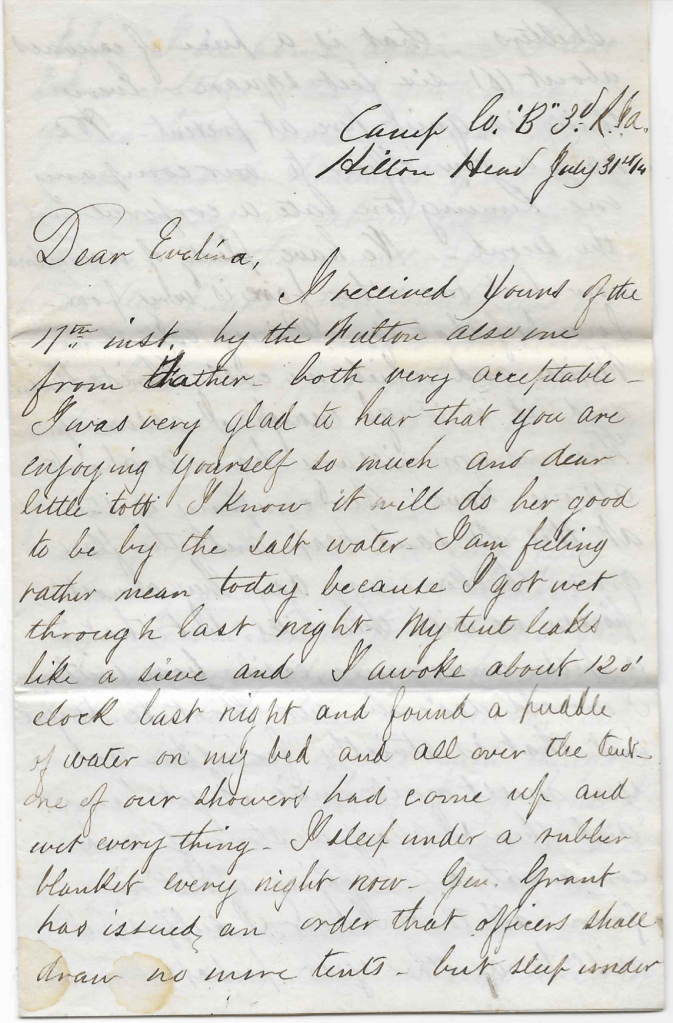
Camp Co. B, 3rd Rhode Island Artillery Hilton Head July 31st 1864
Dear Evelina,
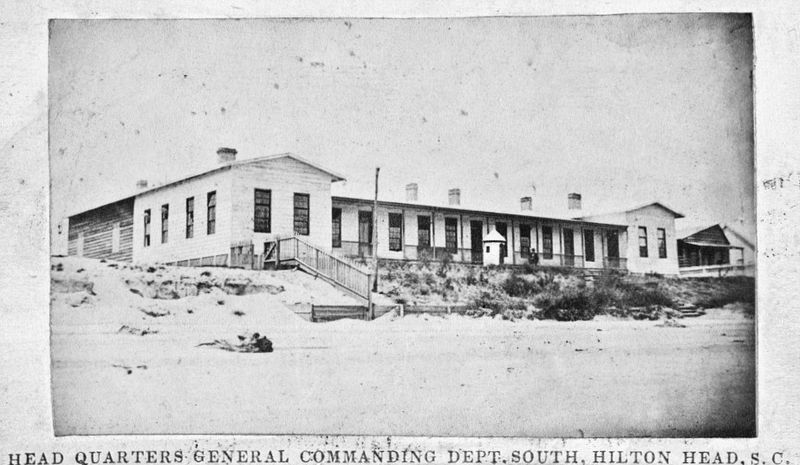
I received yours of the 17th instant by the Fulton. Also one from Father. Both very acceptable. I was very glad to hear that you are enjoying yourself so much and dear little Tott. I know it will do her good to be by the salt water. I am feeling rather mean today because I got wet through last night. My tent leaks like a sieve and I awoke about 12 o’clock last night and found a puddle of water on my bed and all over the tent. One of our showers had come up and wet everything. I sleep under a rubber blanket every night now. Gen. Grant has issued an order that officers shall draw no more tents but sleep under shelters—that is, a piece of canvass about 6 feet square.
Everything is quiet here at present. We have a new officer to our company—Remington—late a corporal in the Second. We have plenty of watermelons now but our other fare is very poor. Some beef that Gen. Birney captured in Florida and which we call Florida Venison and it is tough enough, I assure you. This and commissary ham is about all we have.
Our company is still at this old sand heap and the fleas grow thicker every day. They almost poison me with their bites, but that is a petty annoyance, easily born with. I would describe our fort, &c. to you but that is strictly forbidden and you must wait until I get home and then I shall [share] a store of conversation.
Talking about home, from all that I hear, I suppose it will be another year—perhaps two—before I see home again. I tent now with a very gentlemanly young fellow named [George S.] Reed—the senior second lieutenant of our company. Our quarters are about eight feet square. In this small space we have two bunks, two trunks, and one table. The bunks answer for seats. That leaves us just room enough to undress and dress in. So you see I shall learn not to be very dainty when I get home. My bed consists of a bunk made of fine boards, a sack filled with hay, and a couple of blankets. My overcoat serves for a pillow. Sam gave me some sheets when he went home but the last time we moved, they went the way of all such things—even to ruin.
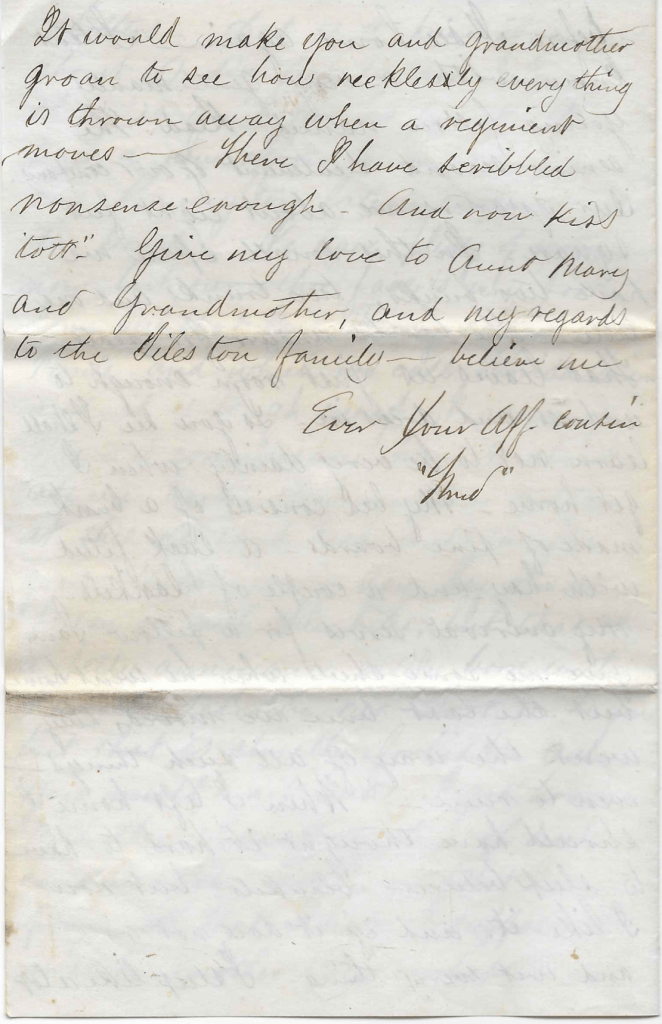
When I left home, I should have thought it hard to have to sleep between blankets, but now I like it and if it does not rain and wet everything, I sleep like a top. It would make you and grandmother groan to see how recklessly everything is thrown away when a regiment moves.
There, I have scribbled nonsense enough. And now, kiss Tott. Give my love to Aunt Mary and Grandmother, and my regards to the Tileston family. Believe me ever your affectionate cousin, — Fred
This letter was written by Lt. Henry H. Metcalf (1842-1904) of Co. C, 3rd Rhode Island Heavy Artillery while serving in the Post Adjutant’s Office at Hilton Head, South Carolina, in September 1863.
Lt. Henry H. Metcalf, 3rd Rhode Island Heavy Artillery
Edwin Metcalf (1823-1894) was a Harvard-educated lawyer and Rhode Island state legislator when he resigned his seat to join the war. Commissioned as Major of the 3rd Rhode Island Heavy Artillery, he immediately made a name for himself and the regiment when he led the first battalion in the battle of Secessionville, SC.
Promoted to Colonel and transferred at the governor’s request to command the new 11th Rhode Island Infantry, Metcalf was with the Army of the Potomac only a short time before being recalled to South Carolina. Yellow fever had swept the ranks and claimed Col. Brown of the 3rd RI HA, as well as several other officers, and Metcalf was seen as the one to revitalize the demoralized regiment. He commanded the regiment and served as Chief of Artillery until January 1864, when he returned to Providence on medical leave. He resigned due to illness on February 5, 1864.
[This letter is from the private collection of Greg Herr and is published on Spared & Shared by express consent.]
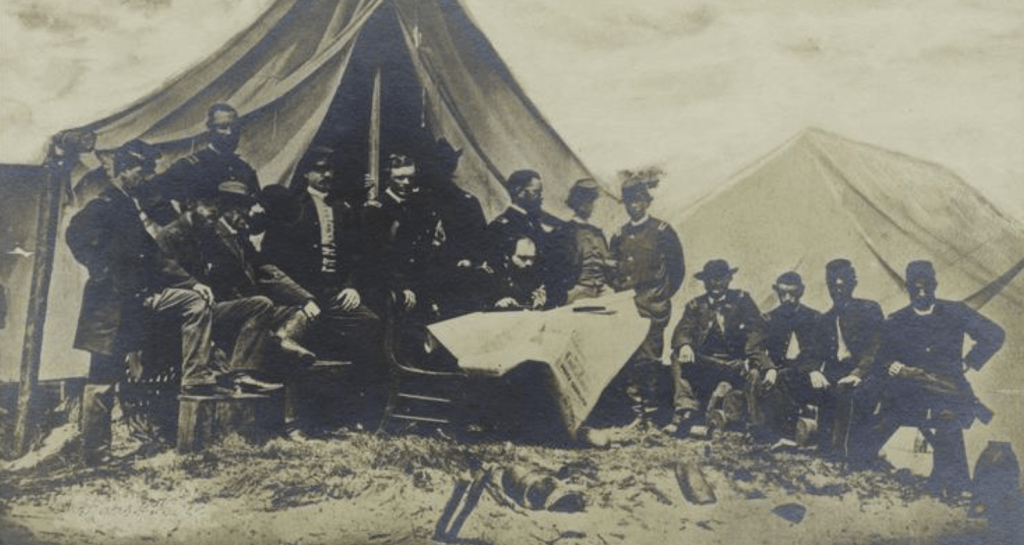
Maj. Gen. Quincy A. Gilmore and staff (N. Y. Public Library Digital Collections)
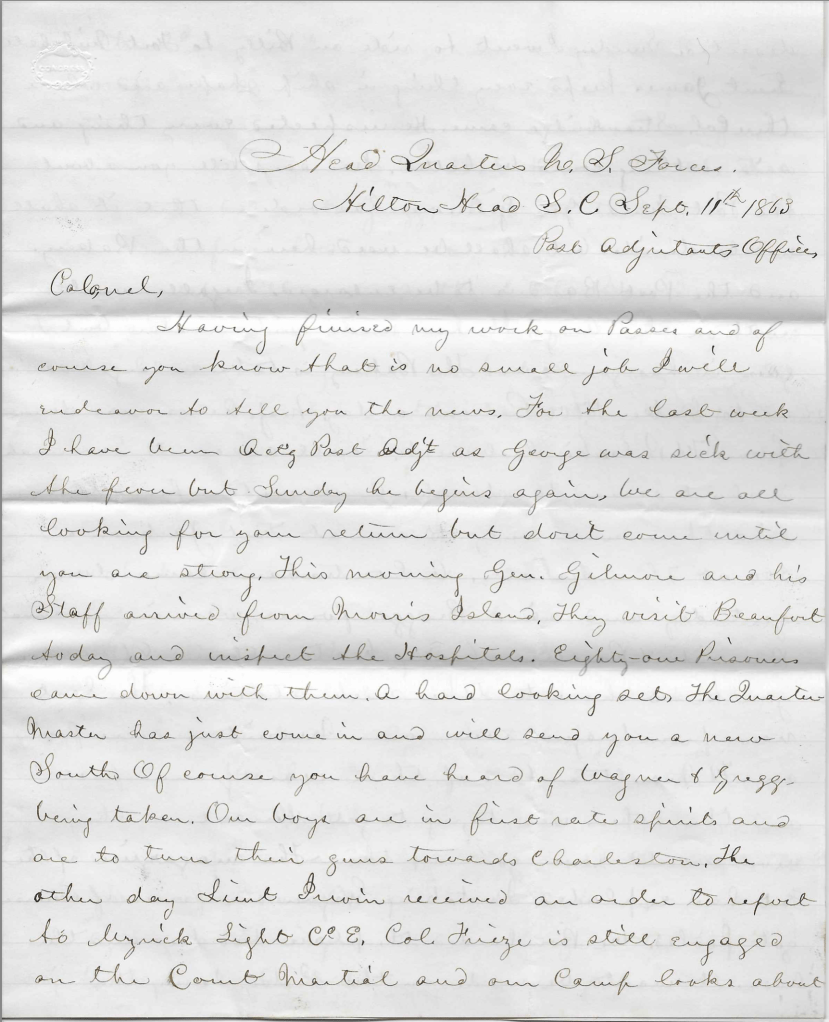
Transcription
Headquarters U. S. Forces Hilton Head, S. C. September 11th 1863 Post Adjutant’s Office
Colonel [Edwin Metcalf]
Having finished my work on passes and of course you know that is no small job, I will endeavor to tell you the news. For the last week I have been acting post adjutant as George was sick with the fever but Sunday he begins again. We are all looking for your return but come come until you are strong.
This morning Gen. [Quincy Adams] Gilmore and his staff arrived from Morris Island. They visit Beaufort today and inspect the hospitals. Eighty-one prisoners came down with them—a hard-looking set. The Quartermaster has just come in and will send you a new South. Of course you have heard of [Forts] Wagner & Gregg being taken. Our boys are in first rate spirits and are to turn their guns toward Charleston. The other day Lieut. Irwin received an order to report to [ ]ick Light Co. E. Col. [John] Frieze is still engaged on the court martial and our camp looks about deserted.
Sunday I went to ride on Billy to Fort Mitchell. Lieut. [J. P.] James keeps everything in ship shape and while there, Col. [DeWitt Clinton] Strawbridge came. He inspected everything and said nothing could be better. Fred says tell you about the Post Fund. Gen. Gilmore has ordered that it shall not be divided but shall be used here in the Bakery and the Post Band is to be enlarged. Ingalls went North on the Arago. It has made quite a stir but I guess it has gone over. The Bakery is to be enlarged so as to bake 15,000 rations a day. Maj. Ames was down from Ft. Pulaski last week. To all accounts, Savannah is about scared to death. A deserter from there said there were only 15 men at Fort Jackson [on the Savannah river] and 300 at [Fort] Thunderbolt [on the Wilmington river] . A contraband came down yesterday and said Bragg’s forces were in Savannah, Burnside & Rosecrans having beaten them. Of course you know how to take such stories.
The last news from Wagner were our monitors were firing on Ft. Moultrie. One of them [the Weehawken] was aground fast and the others were trying to get her out or they never would have gone up there. The magazine of the fort had exploded. I taking Wagner, our forces of course got fooled. We bombarded the place two days and the assault was made on the 3rd day. During the night of the 2nd day a deserter came in and said they had vamoosed. Five me were sent forward and after looking round the fort, came back. Then the wildest confusion prevailed in the trenches. We took 15 men in the fort and then pushed on to Gregg. There we took 85 in the water. But if we had assaulted Wagner, we would have had our match. All around the ditch, pikes had been placed and between them were torpedoes. Everything would have gone against us but Gen. Terry says his plan would have taken the fort. Ahem.
Capt. [David B.] Churchill met with an accident the other night which has laid him up for a short time. His horse struck the chain at the barn and of course the Captain took French Leave but the horse followed him in his somerset and fell on his arm. Lieut. Robinson was mustered yesterday. Our new doctor has arrived and is now flying round with his red whiskers in the wind. I like this business first rate and Col. Strawbridge [of the 76th Pennsylvania Infantry] is a good commandant.
We have had quite cool weather since you have been North but no rain. Your horse the other night ran with me and there was music for a short time. That head would turn and look me right in the eye but the ring is too much for him. The old Orderly is back behaving himself first rate and everything is going just as you would like to have it (except the Post Fund). I hope you will soon be with us but don’t come until your health will permit it. Give my love to Mother & all hands. I send you a paper with this. Also a letter received here for you.
I am yours truly, — Henry H. Metcalf
We have got the meanest Navy the Lord ever did float.
And send their best respects and hope that you will soon join us.
















 Spared & Shared 23