The following letters were written by Hosea B. Williams (1841-1864) who served in Co. C, 3rd Vermont Infantry. He enlisted on 16 July 1861 and was killed in the fighting at Spotsylvania Court House on 12 May 1864. Hosea wrote the letters to his mother, Olivia, in Concord, Vermont. The first letter was found in Hosea’s Pension File in Washington D. C.; the second letter is in private hands.
Hosea’s second letter refers to “bosom pins” that he opted to send home for safekeeping. Unfortunately he was no more specific as to the nature of these pins, but promised one to each of two older brothers, Hiram (b. 1836) and William (b. 1837), if he did not return home from the war.
Letter 1
Camp near Herson [Harrison] Landing August 1, 1862
Dear Mother,
I received your letter and I was very glad to hear that you were as you were. I am well and I hope that these few lines will find you the same. Dan is well and he is a going to write a few lines to Father.
We have not had a battle since the Battle of Malvern Hill till last night the rebels drawed up some artillery and began to shell our troops but they were sorry that they ever come down there for we drawed out our siege guns and gunboats and give them hell to hteir own satisfaction so they left the ground. But it was a noisy time, I tell you.
Now I want you to write to me often as you can. You tell William to write and Hiram too. I have not much to write now. I want you to write whether John Morse has paid that money to your or not. I have got two hundred dollars in the State Treasury and I have put it so that you can draw it if I should be killed here for I stand a fair chance to be killed every day or so far it is shell and shot all the time. But Iam happy as a clam in deep water, Write to me often as you can. — Hosea B. Williams, Co. C, 3rd Vermont Volunteer Militia, Washington D. C.
I will send you a paper that [shows] where we fought the rebels at Savage Station and the battle elsewhere too on the retreat.
Letter 2
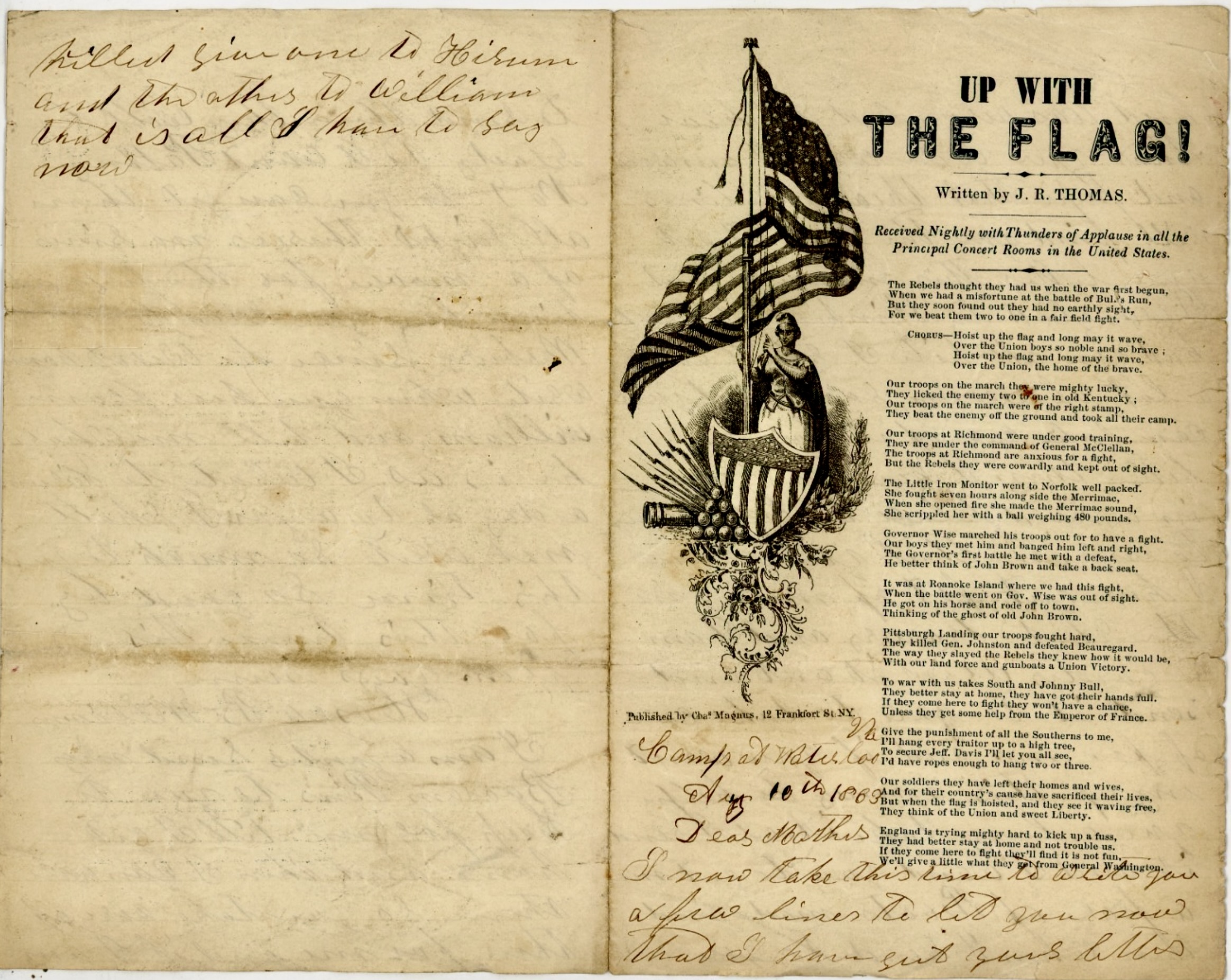
Patriotic stationery used in Hosea’s Letter
Camp at Waterloo, [Fauquier Co.] Virginia August 10, 1863
Dear Mother,
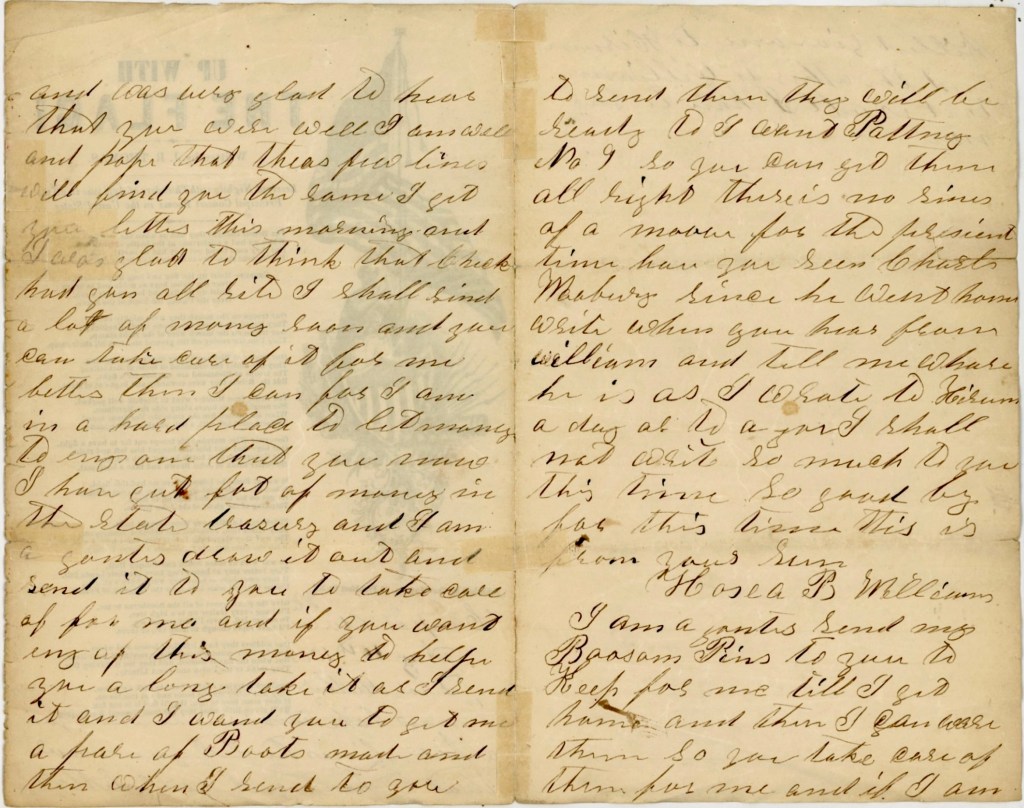
I now take this time to write you a few lines to let you know that I have got your letter and was very glad to hear that you were well. I am well and hope that these few lines will find you the same. I got your letter this morning and was glad to think that check had gone alright. I shall send a lot of money soon and you can take care of it for me better than I can for I am in a hard place to let money in the State Treasury and I am a going to draw it out and send it to you to take care of for me. And if you want any of this money to help you along, take it as I send it and I want you to get me a pair of boots made and then when I send to to send them, they will be ready. I want Patent No. 9 so you can get them alright.
There is no signs of a move for the present time. Have you seen Charles Mabury since he went home? Write when you hear from William and tell me where he is. As I wrote to Hiram a day or two ago, I shall not write so much to you this time. So goodbye for this time. This is from your son, — Hosea B. Williams
I am a going to send my Bosom Pins to you to keep for me till I get home and then I can wear them so you take care of them for me and if I am killed, give one to Hiram and the other to William. That is all I have to say now.
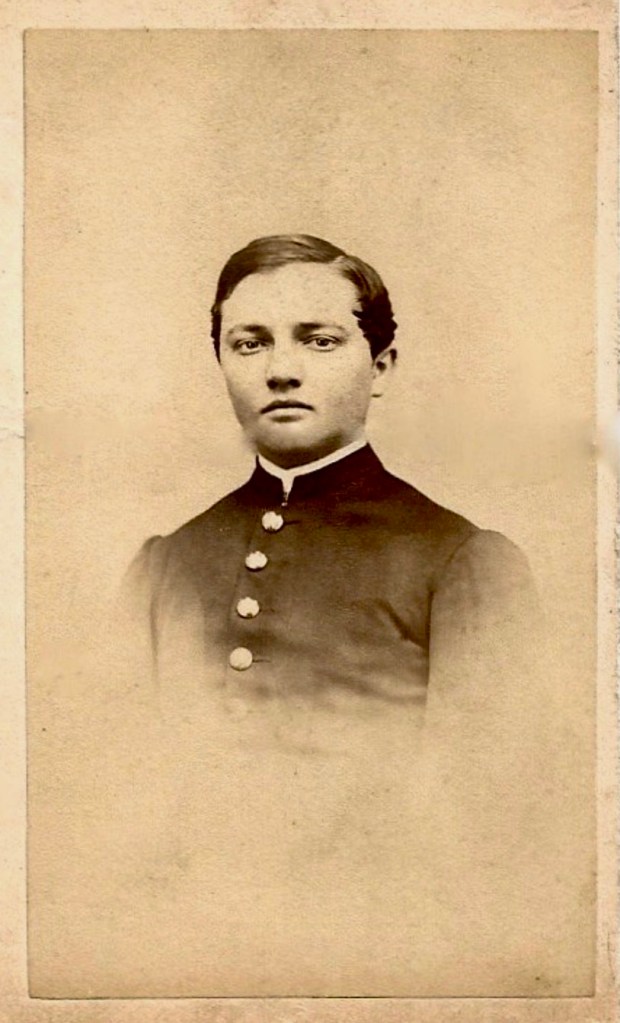
I could not find an image of Albert but here is a cdv of Gardner C. Hawkins of Co. F, 3rd Vermont Infantry (Ed Italo Collection)
The following letters were written by Albert Luther Bartholomew (1838-1864), the son of Noah Bartholomew (1801-1871) and Mary Freeman (1802-1902). Albert wrote the letters to his brother, George “Kellam” Bartholomew (1833-1917), a graduate of Dartmouth College, and residing in Cincinnati, Hamilton County, Ohio, where he was employed as a professor.
Albert was living at home with his parents in Hartford, Windsor county, Vermont, when he enlisted on 17 September 1861 to serve in Co. F, 3rd Vermont Infantry. He was first wounded on 29 May 1862—the nature and cause of his injury is not stated in the muster rolls. He was severely wounded in the leg on 5 June 1864 at Cold Harbor, necessitating amputation, but died three weeks later at the Armory Square Hospital in Washington D. C. on 28 June 1864.
Letter 1
Camp Advance, Va. October 6th, 1861
Dear Brother,
Have you heard that I was in the land of Dixie? If not, I’ll tell you that I have at last arrived safe and sound among the hills and masked batteries of Old Virginia. Our location is on an inclined slope both from the quarters of Gen. Smith and one mile west from Chain Bridge. The other Vermont regiments are stationed nearby.
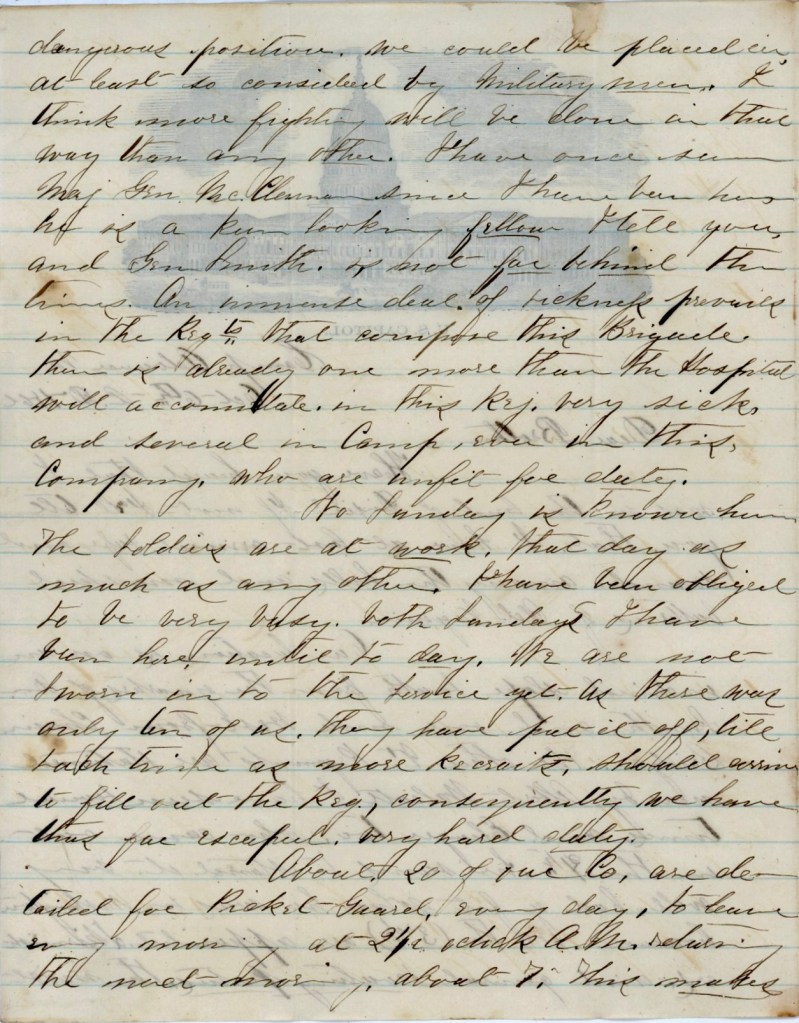
Albert Wolcott I have seen several times, and Eleazer too, who came out in the 4th. He seems to stand it very well. Had a fit when he was in Washington, however. We, the 3rd, are appointed skirmishers and general scouting parties—the most dangerous position we could be placed in, at least so considered by military men. I think more fighting will be done in that way than any other. I have once seen Maj. Gen. McClellan since I have been here. He is a keen looking fellow, I tell you, and Gen. Smith is not far behind the times.
An immense deal of sickness prevails in the regiments that compose this Brigade. There is already one more than the hospital will accommodate in this regiment very sick and several in camp, even in this company, who are unfit for duty.
No Sunday is known here. The soldiers are at work that day as much as any other. I have been obliged to be very busy both Sundays I have been here until today. We are not sworn in to the service yet. As there was only ten of us, they have put it off till such time as more recruits should arrive to fill out the regiment. Consequently, we have thus far escaped very hard duty.
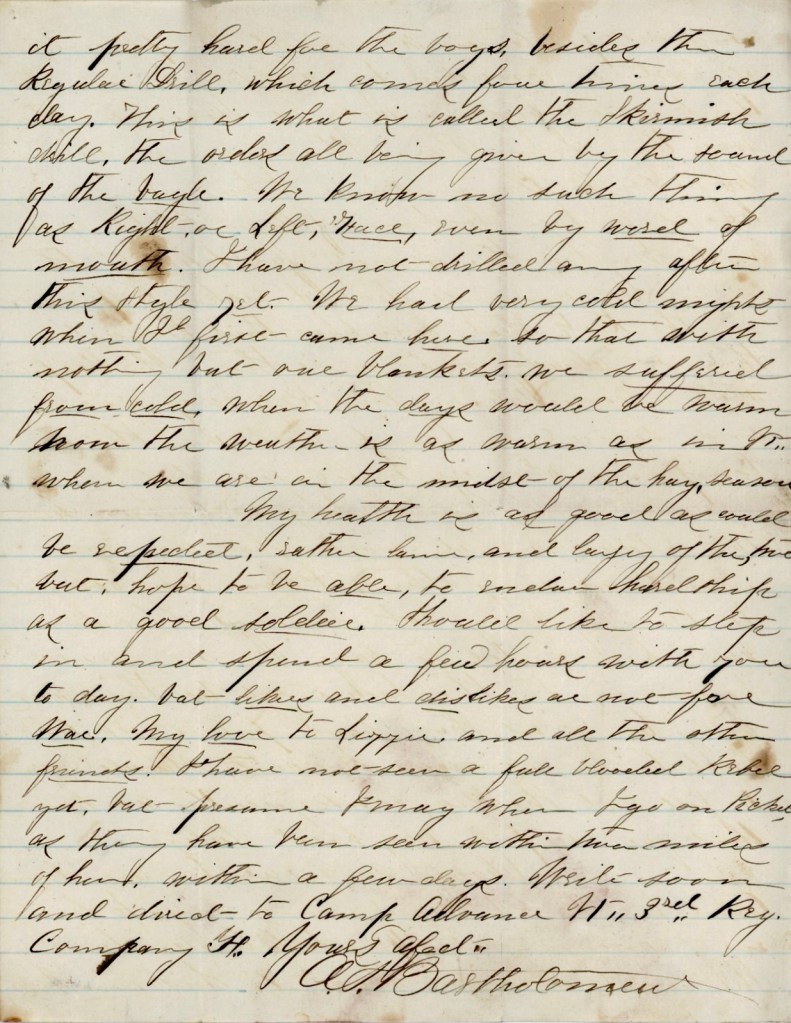
About 20 of our company are detailed for picket guard every day, to leave every morning at 2.30 o’clock a.m., returning the next morning about 7. This makes it pretty hard for the Boys, besides their regular drill which comes four times each day, This is what is called the skirmish drill. The orders all being given by the sound of the bugle. We know no such thing as right or left face, even by word of mouth. I have not drilled any after this style yet. We had very cold nights when I first came here so that with nothing but one blanket, we suffered from cold. When the days would be warm now, the weather is as warm as in Vermont when we are in the midst of the hay season.
My health is good as could be expected, rather lame, and lazy of the [ ] but I hope to be able to endure hardship as a good soldier. Should like to step in and spend a few hours with you today but like and dislikes are not for war. My move to Lizzie and all the other friends. I have not seen a full-blooded Rebel yet but presume I may when I go in picket as they have been seen within two miles of here within a few days.
Write son and direct to Camp Advance, Vermont 3rd Regiment, Company H. Yours affectionately, — A. L. Bartholomew
Letter 2
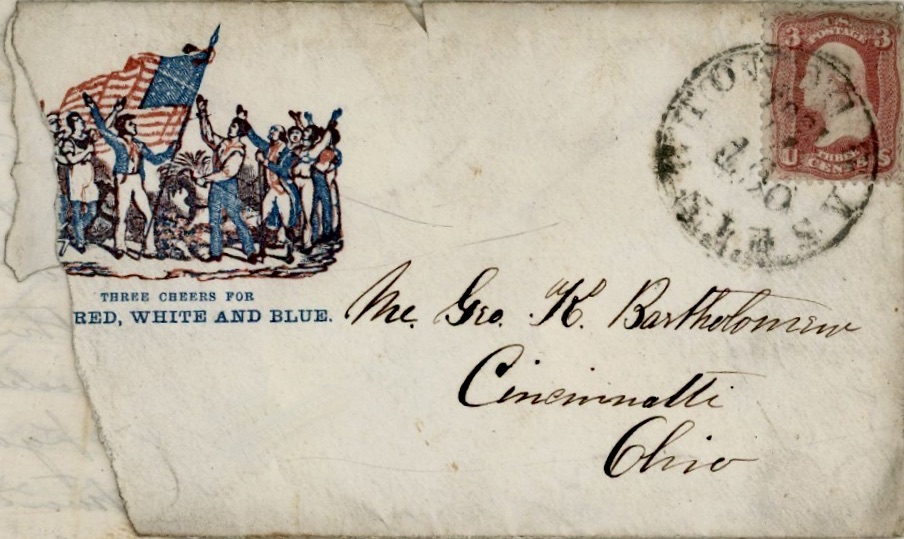
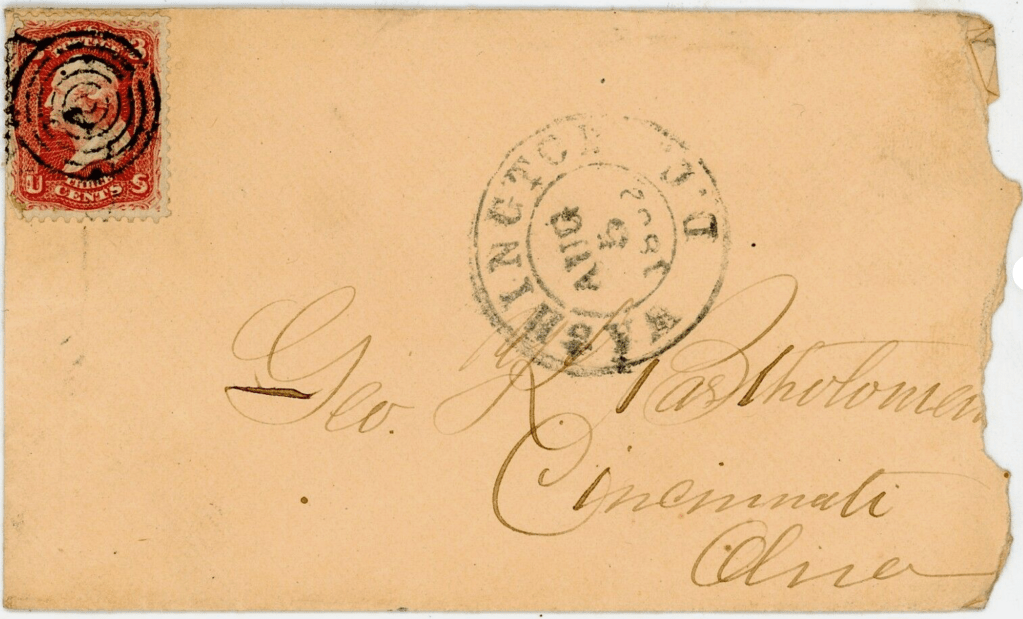
Addressed to George K. Bartholomew, Cincinnati, Ohio
Carver [General] Hospital Meridian Hill Washington D. C. August 5th 1862
Dear Brother,
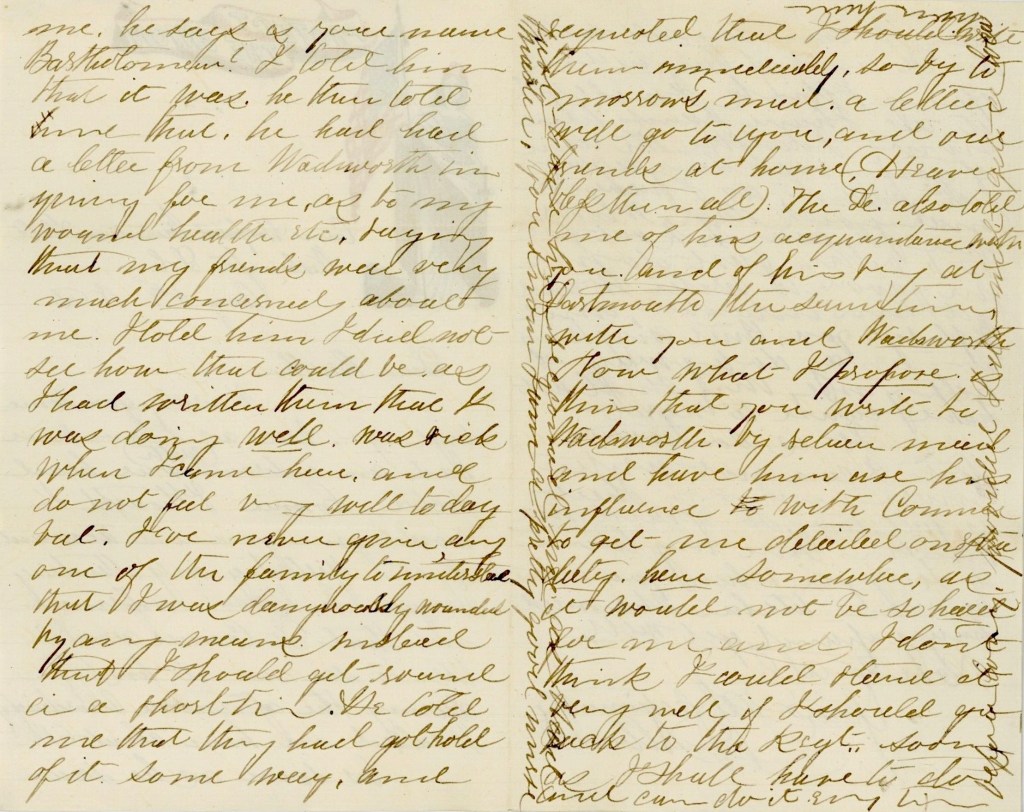
I wrote you some days ago but as I have since had an interview with our head doctor [Phineas Sanborn] Conner, I thought I would give you an account of it. Yesterday my attending Surgeon Dr. Russell informed me that Dr. Conner would like to see me at his office during the afternoon. Accordingly, I called on him about 7 p.m. As soon as he saw me he says, “Is your name Bartholomew?” I told him that it was. He then told me that he had had a letter from Wadworth enquiring for me as to my wound, health, etc. saying that my friends were very much concerned about me. I told him I did not see how that could be as I had written them that I was doing well, was sick when I came here, and do not feel very well today, but I’ve never given anyone of the family to understand that I was dangerously wounded by any means. Instead, that I should get round in a short time. He told me that they had got hold of it some way and requested that I should write them immediately, so by tomorrow’s mail, a letter will go to you and our friends at home. (Heaven bless them all.)
The Dr. also told me of his acquaintance with you and of his being at Portsmouth at sometime with you and Wadsworth. Now what I propose is this—that you write to Wadsworth by return mail and have him use his influence with Conner to get me detailed on [ ] duty, here, somewhere, as it would not be so hard for me and I don’t think I could stand it being well if I should go back to the regiment soon as I shall have to do and can do it any time before long provided I do not get a [ ] here. Just have him recommend me as Ward Master. You know I am a pretty good nurse.
Then Wadworth can consult with the Dr. and if there is an opening, I think I will get it as I have friends here now. I dislike the idea of going back there again at present as I have so many sick days while here I can look out for No. 1 better. Just do me the favor to write Wadsworth and get him interested and I pledge you that anything they may do by way of helping me, they shall not have cause to regret.
It is so [ ] that I cannot write more and my sheet is full too. So excuse me this time. Give my love to Lizzie when you write her and tell her she must hurry up and get well. Love to all. Yours affectionately, — Albert
I could not find an image of Ira but here is a tintype of John L. Cleveland of Co. B, 3rd Vermont Infantry
The following letters were written by Ira E. Morse (1837-1862) of Co. D, 3rd Vermont Infantry. Ira enlisted on 1 May 1861 and was mustered into the regiment on 16 July 1861. He received a gunshot wound on 16 April 1862 at Lee’s Mills, Virginia, but recovered only to die of disease on 29 November 1862. It appears that Ira, weakened from chronic diarrhea, had fallen out of the ranks while on a march and that a Boonsboro, Maryland, resident named Cornelius Wertz found Ira by a tree in the woods near his home and took him in and cared for him until he died. He was buried “in front of the church in Boonsboro where several Union soldiers had been buried.” David Trull claimed to have received Ira’s diary and bible from Mr. Wertz and delivered them to Ira’s parents.
Ira was the son of David Morse (b. 1807) of Charleston, Vermont, who was said to be physically unable to support his family financially. David and his wife Fanny’s net worth in 1860 was only $400 and they had come to rely on the money that Ira sent home to his family. By the time of his death, Ira had sent home $200 between his wages and the bounty he received for enlisting.
While researching Ira, I discovered in the “Widow’s Pension” claim filed by Ira’s mother following his death, that two of Ira’s letters written during the Peninsula Campaign in the summer of 1862 had been sent to the Pension Office as proof of Ira’s having sent money home to his parents for their use. I have transcribed these and added them with the 3rd Letter describing the Battle of Antietam.
Letter 1
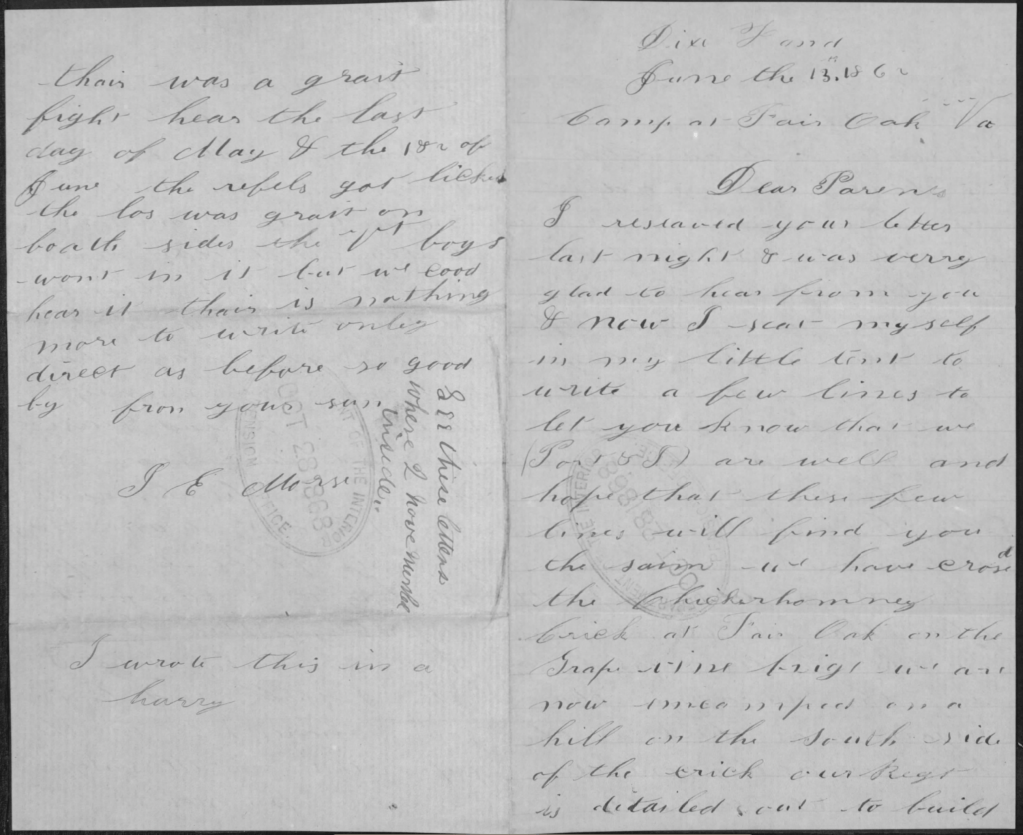
Dixie Land June 13, 1862 Camp at Fair Oak, Va.
Dear Parents,
I received your letter last night & was very glad to hear from you & now I seat myself in my little tent to write a few lines to let you know that we (Port & I) are well and hope that these few lines will find you the same.
We have crossed the Chickamoniny Creek at Fair Oaks on the grapevine bridge. We are now encamped on a hill on the south side of the creek. Our regiment is detailed out to build a bridge across the crick. The rest of the [Vermont] Brigade is 1.5 miles ahead. There is heavy cannonading up there this morning. Our picket is so close to the Rebs that they have to post themselves in the night & lay flat on their bellies until the next night. Our men are a building forts all along the lines. We shall have Richmond before long.
This is a very pretty place here. It is all oak on the hills and pine in the swamps. The niggers is as thick as the hair on a dog. One old nigger is 106 years old. Little niggers from 10 to twelve will carry a pail of water on their heads and not touch a hand to it.
I am sorry to hear that Dan ain’t so well. I don’t think he had ought to work at all. You may take any of my money that you need and use it and get Dan some clothes too if he needs them. I don’t want any of my folks to suffer as long as I can work. We probably shall be paid off again before long & then I shall send home some more.
I see in the papers that the Mississippi River is open now.There was a great fight here the last day of May & the 1st of June. The Rebels got licked. The loss was great on both sides. The Vermont boys weren’t in it but we could hear it. There is nothing more to write—only direct as before. So goodbye from your son, — I. E. Morse
I wrote this in a hurry.
Letter 2
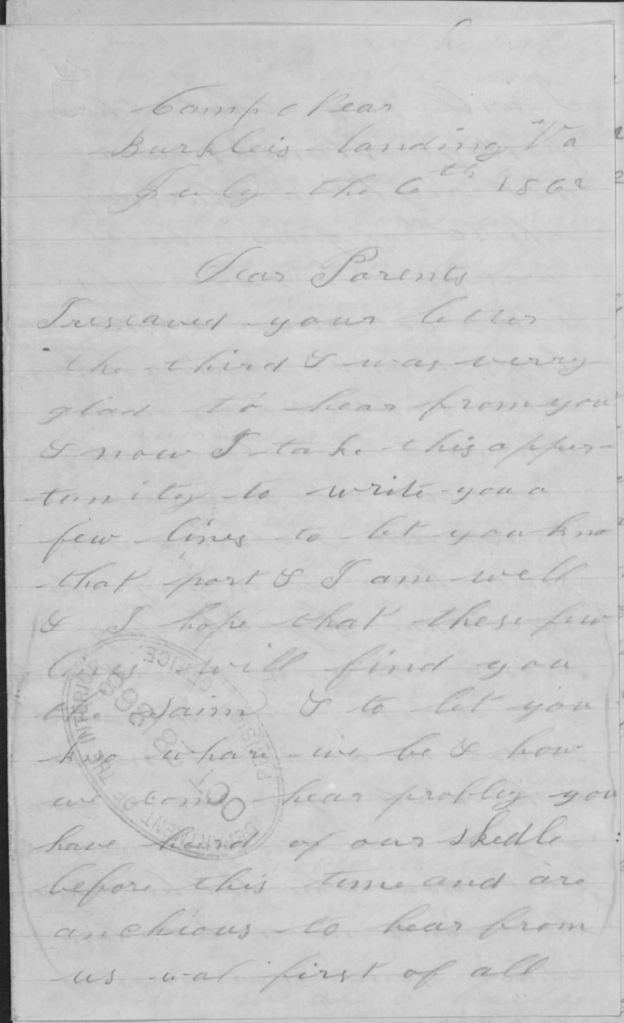
Camp near Berkeley’s Landing, Va. July 6th 1862
Dear Parents,
I received your letter the third. I was very glad to hear from you. i now take this opportunity to write you a few lines to let you know that Port and I are well and I hope that these few lines will find you the same & to let you know where we be & how we come here. Probably you have heard of our skedaddle before this time and are anxious to hear from us.
Well, first of all I will say that them postage stamps was all right.
Thursday the 26th of June, a battle was fought on our right & we got news that our boys was a licking them. Cheers after cheers was given all along the lines. We was paid off the same day & Port & I sent home our money the next day by the pay master…
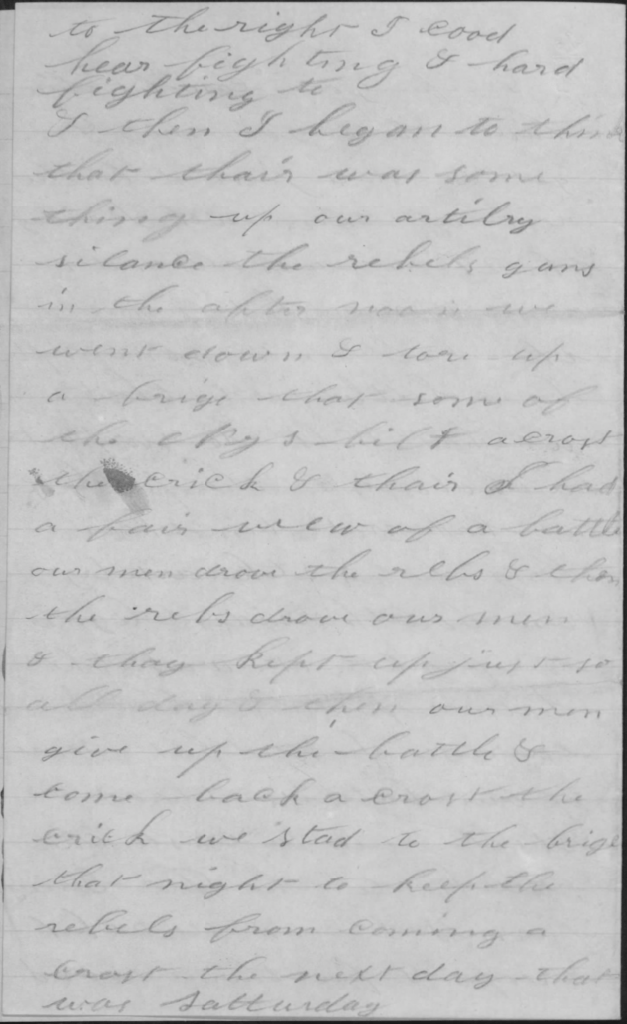
Well. Friday the 27th we was all under arms & marched up onto the hill into some rifle [pits] by a little fort that we had built to support a battery & the pickets. We had not been there long before the artillery on both sides began to fight. It was the hottest place that I ever see. I see that some of our batteries throwed shell over across the crick to the Dr. Gaines’ farm & I could see rebel troops & further around to the right I could hear fighting & hard fighting too.
And then I began to think that there was something up. Our artillery silenced the rebel guns. In the afternoon we went down & tore up a bridge that some of the nigs built across the creek & there I had a fair view of a battle. Our men drove the rebs & then the rebs drove our men & they kept up just so all day and then our men give up the battle & come back across the creek. We stood to the bridge that night to keep they rebels from coming across. The next day—that was Saturday—our troops wrecked the rebels all out and took a lot of prisoners. We was completely cut off twice but forces come up in the rear from the James river and drove the rebels back. The 2nd day we arrived at this landing. It rained all day hard & the mud was half a knee deep & we all got wet as rats & our legs was all mud up to our bodies.
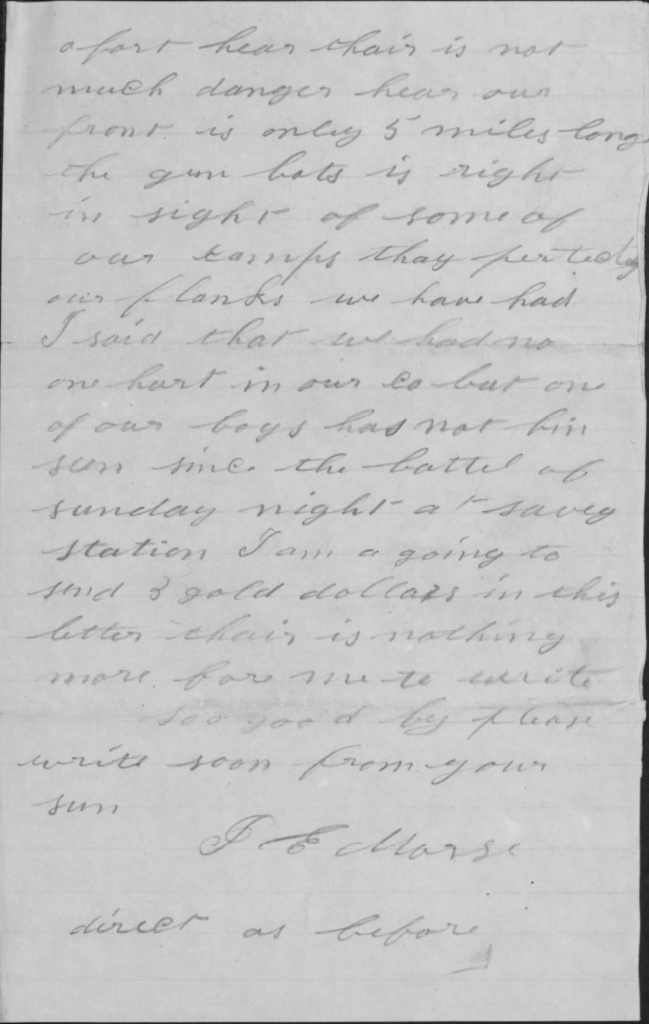
The next day the rebels got into a hill and began to shell some of our camps. The cavalry went up and drove them off & took their guns & then we loved to the place that we are now. We lost everything on this retreat almost. We are a building a fort here. There is not much danger here. Our front is only 5 miles long. The gunboats is right in sight of some of our camps. They protect our flanks. I said that we had no one hurt in our company but one of our boys has not been seen since the Battle of Sunday night at Savage Station. I am a going to send 3 gold dollars in this letter. There is nothing more for me to write. So goodbye. Please write soon. From your son, — I. E. Morse
Direct as before.
Letter 3
Camp near Hagerstown, Maryland October 13, 1862
Dear Brother & Sister,
It is with pleasure that I can have time to write you a few lines to let you know that I am some better than I have been. I had had the diarrhea for two months but I am on the gain now. I shall be all right before long now.
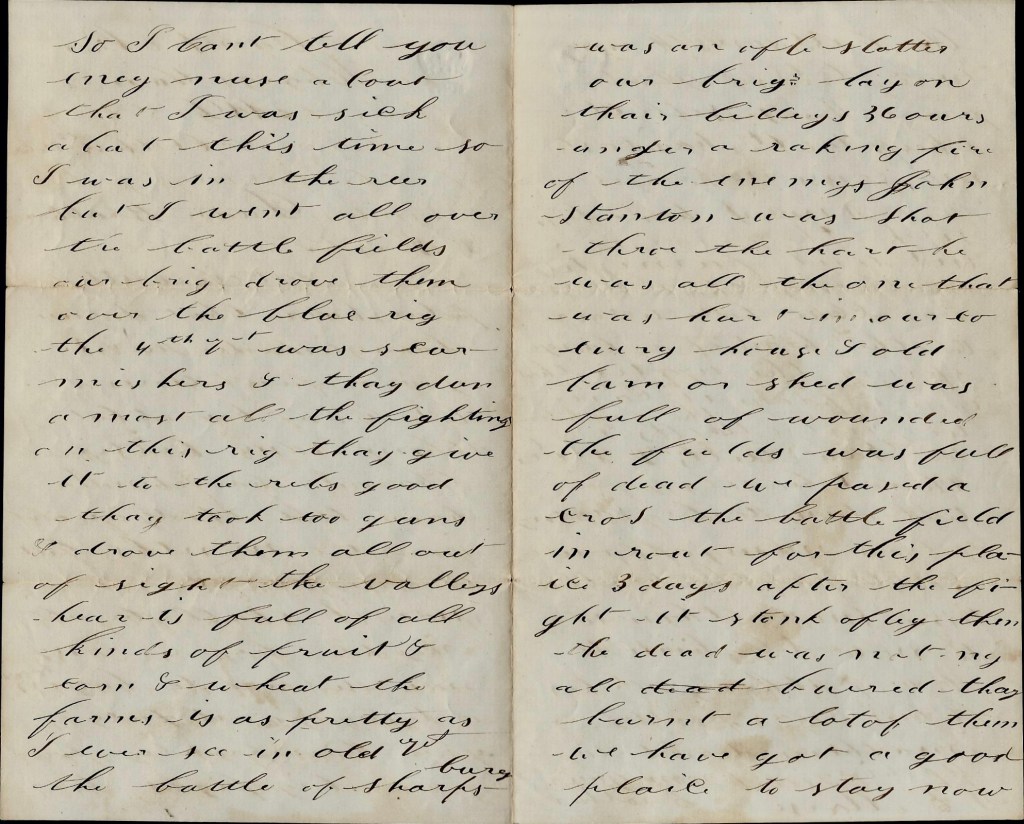
We are to Hagerstown a doing guard duty. You have probably heard of our big fight here so I can’t tell you any news about that. I was sick about this time so I was in the rear but I went all over the battlefields. Our brigade drove them over the Blue Ridge. The 4th regt. was skirmishers & they done a most all the fighting on this ridge. They give it to them Rebs good. They took two guns and drove them all out of sight.
The valleys here is full of all kinds of fruit & corn & wheat. The farms is as pretty as I ever see in old Vermont.
Ira’s account of the battlefield—the stench, the unburied soldiers and animals, & the houses filled with wounded are described in detail in Steven Cowie’s new book, “When Hell Came to Sharpsburg”
The Battle of Sharpsburg was an awful slaughter. Our Brigade lay on their bellies 36 hours under a raking fire of the enemy [guns]. 1 John Stanton was shot through the heart. He was all the one that was hurt in our company. Every house & old barn and shed was full of wounded. The fields was full of dead. We passed across the battlefield en route for this place three days after the fight. It stank awfully then. The dead was not nye all buried. They burnt a lot of them.
We have got a good place to stay now. The citizens bring in a lots of good provisions & sell it cheap too. It has cost me some money to live since I have been sick. The government don’t furnish one thing that a sick man can eat. We are to the head of a large spring. The water that comes from it carries two grist mills & two saw mills & several small shops.
Tell Dan to be saving of his money for we shall need it sometime more than we do now. Tell him to let father get his clothes and have mother mail them. Direct to Washington. From your brother, — I. E. Morse
1 The 3rd Vermont, being in Brooks’ Brigade, left its camp in Pleasant Valley at 6 A.M. of the 17th, crossed the Antietam at Pry’s Ford and reached the field about noon. It was ordered to the support of Sedgwick’s Division, Second Corps, on the Union right but, before getting into position, was ordered to the support of French’s Division and formed in Mumma’s Cornfield, on ground vacated by the 14th Connecticut, its left connecting with French, its right resting on Mumma’s Lane, facing south parallel to and about 170 yards from the Bloody Lane. It was subjected to a galling fire of both Artillery and Sharpshooters, causing some loss. It remained in this position until the morning of the 19th.











 Spared & Shared 23