Category Archives: 42nd Ohio Infantry

1863: Thomas Corwin Parsons to Wilder Curtis Parsons

The following letter was written by 22 year-old Thomas Corwin Parsons (1842-1913) who enlisted as a sergeant in Co. A, 42nd Ohio Volunteer Infantry (OVI) in September 1861 and was promoted to Orderly Sergeant in July 1862. He mustered out of the service on 30 September 1864.

Thomas the son of Roswell Pease Parsons (1808-1893) and Rhoda Eggleston (1808-1901) of Chardon, Geauga county, Ohio. He wrote the letter to his younger brother, Wilder Curtis Parsons (1846-1929) and refers to an older brother named Milo Roswell Parson (1840-1932) who also served his country in Co. G, 2nd Ohio Heavy Artillery during the Civil War.

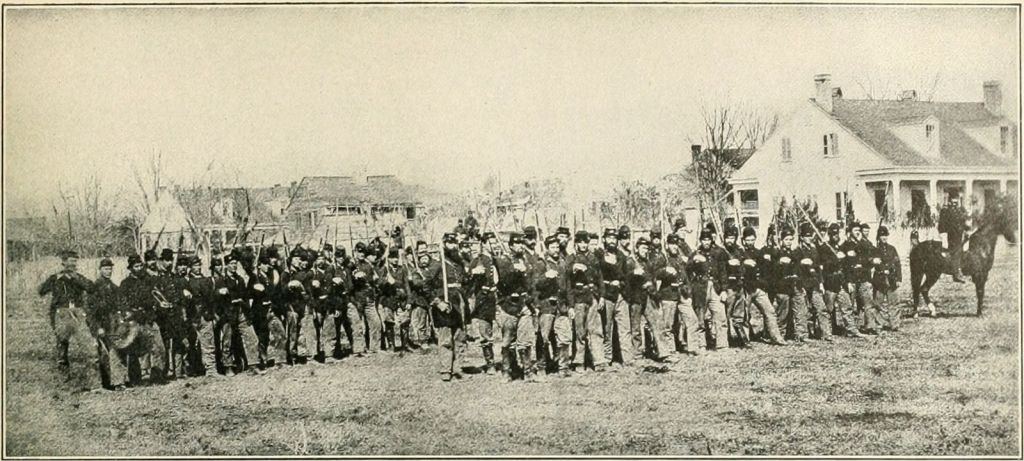
Thomas’s letter was datelined from Brashear City (modern day Morgan City) in S. Mary Parish, Louisiana. Though he anticipated they would march to Texas, the regiment would soon after participate on the Western Louisiana Campaign. The 42nd Ohio’s first commander was Colonel James A. Garfield (the 20th President of the United States).

To read other letters by members of the 42nd OVI thatI’ve transcribed and published on Spared & Shared, see:

Jasper S. Ross, Co. A, 42nd Ohio (11 Letters)
Frederick Erasmus Underwood, Co. A, 42nd Ohio (2 Letters)
William H. Jacqueys, Co. E, 42nd Ohio (6 Letters)
Owen Johnson Hopkins, Co. K, 42nd Ohio (1 Letter)


Transcription

Brashear City, Louisiana
September 16th 1863
Dept. of the Gulf

Dear Welden,

I must beg your pardon for not writing to you sooner but I do assure you that if we had not been on the move, I should have written to you before. My stock of paper is nearly out so I must fill out my sheet double lined. I suppose you must be aware before this of our move from Vicksburg. We had a fine time while in the vicinity of New Orleans. New Orleans is the largest city I was ever in but it is not so fine in many respects as Cincinnati. This city is about the size of Chardon but has a fine, large depot. Southern cities are noted so far as I have had experience for the size and fineness of their depots. The cars come from New Orleans every day but don’t carry any papers or any mail—only once in a great while.

I think you have done well in making the bargain with Messrs. Wilkins & Kelly. But you will need to improve all your time next winter at school or you will have to stop clerking and go to school. Lay up your money. I got a letter from Milo last night. He was at Lexington, Kentucky. He was well and in good spirits. I also got a letter from Melbourne & one from an old friend (a captain) in the 3rd Miss. Colored Vols. 1 I also got three Democrats sent to P___ ____. From appearances I think we shall soon start for Texas and if we do go & should march, you must not expect me to write to you much till I get through—if I should be so lucky as to get through—for it will be a long, tedious march. You see we left our thins, knapsacks and all, at New Orleans, so I shall soon be out of writing material. But if we should be paid off, I can get a supply. But if you don’t hear from me, don’t think I have forgotten you. I will tell you a long story when I get through with the trip.

I hear a fine brass band playing. It reminds me of home and old times. Oh, Wilder, I shall be a happy boy to get home at the end of my three years. It’s a long time to be away, isn’t it? But I can stand it. But I must stop and write to Lucius, or he will surely be mad and for good reason.

Direct to Co. A, 42nd Ohio Vol. Infantry, 4th Brigade, 1st Division, 13th Army Corps, via New Orleans. To follow regt.

Yours truly, — T. C. Parsons, O.S.

To W. C. Parsons, Chardon, Ohio


1 Possibly Orlando C. Risdon who had been a 1st Lieutenant in the 42nd OVI. He was commissioned in the 3rd Mississippi Colored Troops in 1863 and later promoted to Colonel of that regiment that was redesignated the 53rd Regt. USCT.

1862: Frederick Erasmus Underwood to his Parents

These two letters were written by Frederick Erasmus Underwood (1841-1889) the son of Albert Underwood (1810-1881) and Susan Moulton (1821-1891) of Brimfield, Portage county, Ohio.

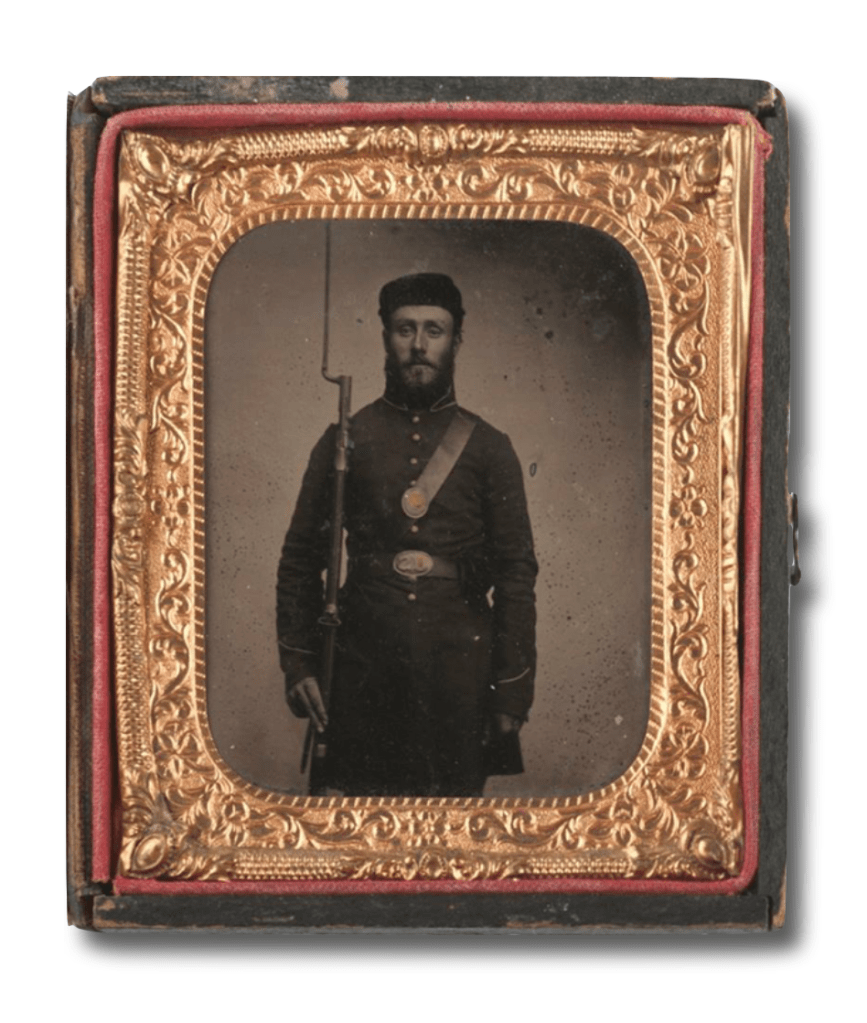
I could not find an image of Erasmus, but here is one of William E. Carlton of Co. B, 42nd OVI (Cowan’s Auctions)

According to muster records, Erasmus entered the service on 20 September 1861 as a private in Co. A, 42nd Ohio Volunteer Infantry (OVI). He mustered out of the service in 20 September 1864 after three years.

Events described in these letters correspond to the following two paragraphs from the regimental history”

On February 1, 1862, the 42nd boarded boats and sailed up the Big Sandy River to Pikeville, Kentucky. On March 14, 1862, the regiment with other Northern units seized Pound Gap, Kentucky. The Union force spent the next few days skirmishing with Confederate guerrillas, before marching for Louisville, Kentucky on March 18. Upon reaching this new location on March 29, 1862, the 42nd entered camp. 

In May 1862, the 42nd boarded railroad cars and traveled to Lexington, Kentucky. The regiment then joined Brigadier-General George W. Morgan’s command and marched to Cumberland Ford, where officials brigaded the organization with the 16th Regiment Ohio Volunteer Infantry and the 14th and 22nd Regiments Kentucky Infantry. On May 15, 1862, the brigade crossed the Cumberland River and entered camp at the junction of the roads leading to Cumberland Gap and to Rogers’s Gap. On June 5, 1862, General Morgan led his troops against Confederate troops at Rogers’s Gap. The 42nd participated in several skirmishes upon reaching this location. On June 18, 1862, the Northerners attempted to strike a Confederate force at Big Spring, but the enemy withdrew as the Union soldiers approached. Morgan ordered his command to Cumberland Gap later that same day, with Confederate soldiers again withdrawing as the Federals approached. The 42nd Ohio entered camp near Yellow Creek and spent the next six weeks participating in various expeditions.

Letter 1

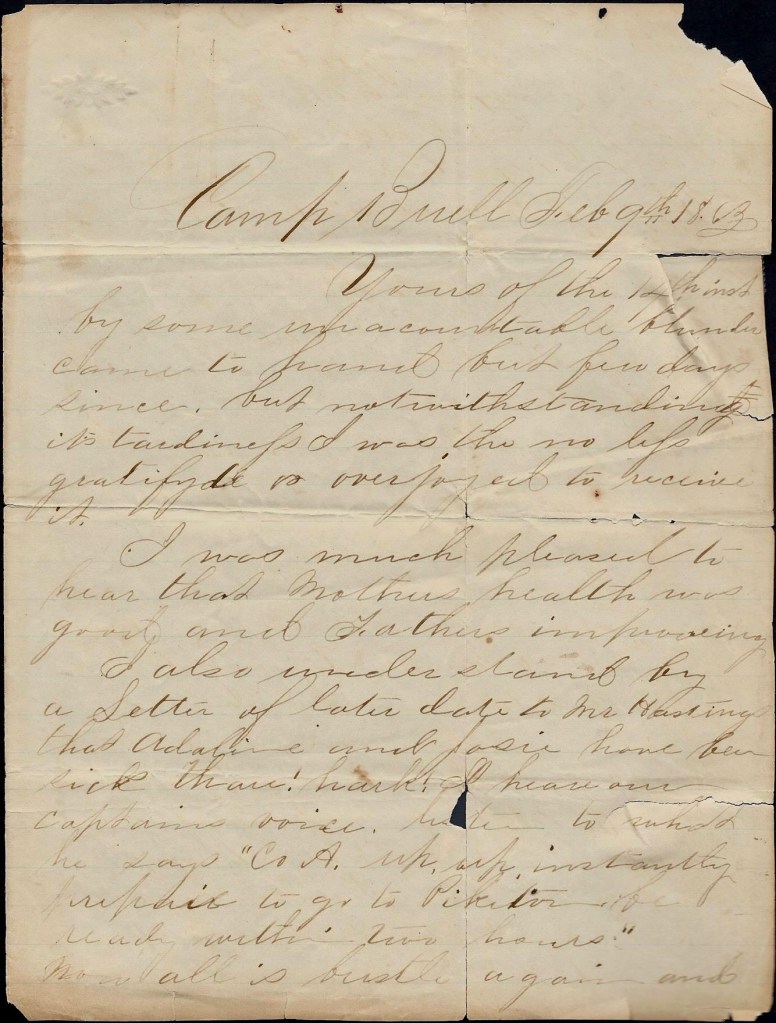
Camp Buell
February 9, 1862

Yours of the 14th inst. by some unaccountable blunder came to hand but few days since but notwithstanding its tardiness, I was the no less gratified & overjoyed to receive it.

I was much pleased to hear that Mother’s health was good and Father’s improving. I also understand by a letter of later date to Mr. Hastings that Adaline and Josie have been sick.

There! Hark! I hear our captain’s voice. Listen to what he says, “Co. A, up, up instantly prepared to go to Piketon. Be ready within two hours.”

Now all is bustle again and I shall have to postpone writing for the present to finish in the future. Good night. — F. E. Underwood

Camp Brownlow
February 11, 1862

Again, dear parents and sisters, after 50 miles ride on a steamboat and after the confusion which ever and eternally accompanies the setting of tents, I find myself settled again and conversing with you.

We are now situated very pleasantly at Piketon—a small town in the Big Sandy about 35 miles from the Cumberland Mountains. We have now cleaned out every vestige of secession in Eastern Kentucky. The rebel regiment under command of Col. Williams have left the state entirely and marshal force have disbanded. How long we shall stay here, I know not but hope that the next move we make will be down the river.

I regret much to inform you that my health has been quite poor for the last three weeks. I am troubled with the dysentery and rheumatism. I am getting to be quite poor. Oh! Mother, I would choose you in preference to a thousand regimental doctors for a nurse. I think though that I shall get along without going to the hospital. I hope so at least. The captain is now administering to my wants. He has given me two doses of “Hygean’s Pills” which sicken me to an alarming extent. I was sent yesterday to see the doctor and in so doing, exposed myself with many others from our company to the “mumps.” I have forgotten whether I ever had them or not. If not, I will consider myself “elected.”

Tell Adaline and Josie to write just how many such sutlers as that last one [ ] there are “amignto.” I shall always receive them with great joy and delight. I am heartily sick of our “stuff” on which we subsist. If I could only have a little potato [and] some soft bread, it would be such a help. I don’t know if we shall be paid as soon as I expected when last I wrote you. The paymaster hasn’t shown himself yet and not much prospect of it. If I had money, I might buy milk, bread and butter, but I would not ask you to send me any for it might not reach me.

Why don’t Lavina and Ellen write to me? I have not hear a word from them since I came to Kentucky. All write and oblige your son, — F. E. Underwood

To Father, Mother, Addie, Josie, and Sumner.


Letter 2

Camp Virginia
Cumberland Gap
July 4, 1862

My dear parents,

Sadly and with a sorrowful heart do I sit down to reply to yours of the 2nd that came to my perusal yesterday. Glad indeed was I to hear from you for my mind—-since I learned of the irrevocable rent so suddenly and unexpectedly made in our dear circle—has been in a state of continual agitation searing, lest the deep affliction so suddenly brought upon you would crush the already bruised and mangled heart of my dear mother.

It is now nearly two weeks since I was appraised by Alice Savina and Ellen of the death of Josie. 1 Could I? Must I believe it? That she whose quick perceptibility’s and bright and untarnished intellect was seldom equalled; whose nature ever seemed to be inspired with the love of truth and acted accordingly, must be so rashly stricken down in this, her life’s springtime. But dear parents, I will cease to agitate your already turbulent ocean of trouble.

When I wrote you last we were encamped in Tennessee on the old Rebel camping grounds. But in consequence of the unpleasant, as well as unhealthy odor that constantly arose from the very earth so long polluted by their foul footsteps, Gen. Morgan gave our officers leave to seek a more congenial atmosphere which was done by moving over into the valley on the Kentucky side and pitching our tents in a beautiful grove of pine about 2.5 miles from the Gap. We shall probably stay here through this month although there is one regiment in our Brigade to be sent as provost guard to Frankfort, Louisville, and Lexington. The rumor through camp today intimates that our regiment is th one detailed. We all hope and trust it is.

The boys are all well from Brimfield with the exception of Jim who I think is threatened with a fever though he tells me today that he feels better.

Write to me often and tell me all the news connected with home and vicinity. And now with a hope that God will level his mighty power in bringing about a speedy restoration of peace that we may once more return to our homes and loved ones, I will close.

Your obedient son, — F. Erasmus

Cumberland Gap via Lexington, Co. I, 42nd OVM

P. S. Tell [sister] Adaline to write me a good long letter and [ ] that I could with my presence console her in her deep affliction. — F. E. U.

1 Mary Josephine (“Josie”) Underwood (1849-1862) died on 11 June 1862.


Letter 2