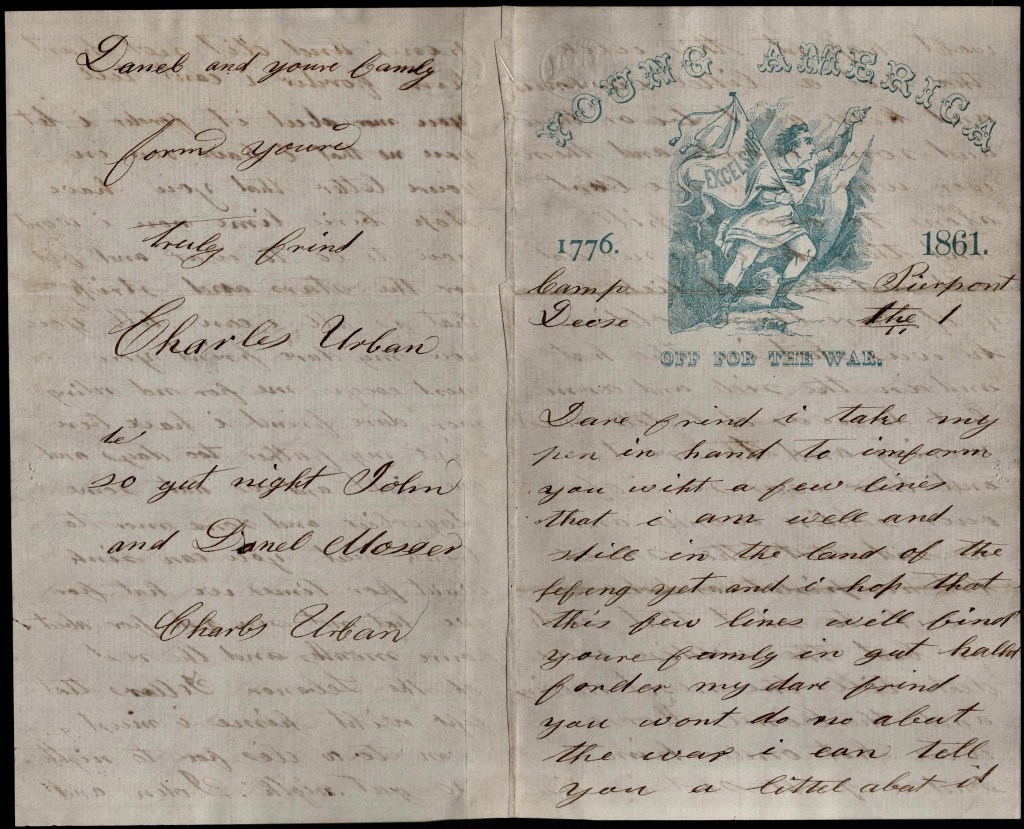
The following letter was written by Charles Frederick Urban (1838-1916) of Co. H, 13th Pennsylvania Reserves (42nd Pennsylvania Infantry), also known as the 1st Pennsylvania Rifles, Kane’s Rifles, or simply the “Bucktails.” Charles enlisted on 1 August 1861. He was wounded on 19 August 1864 in the fighting at Weldon Railroad and was taken prisoner. He was released in March 1865.
Charles was born in Saxony (Germany) and was laboring as a stone mason in Lebanon, Lebanon county, Pennsylvania, when he volunteered to fight for the stars and stripes. He was barely literate and I had to interpolate a bit to make any sense of his letter.
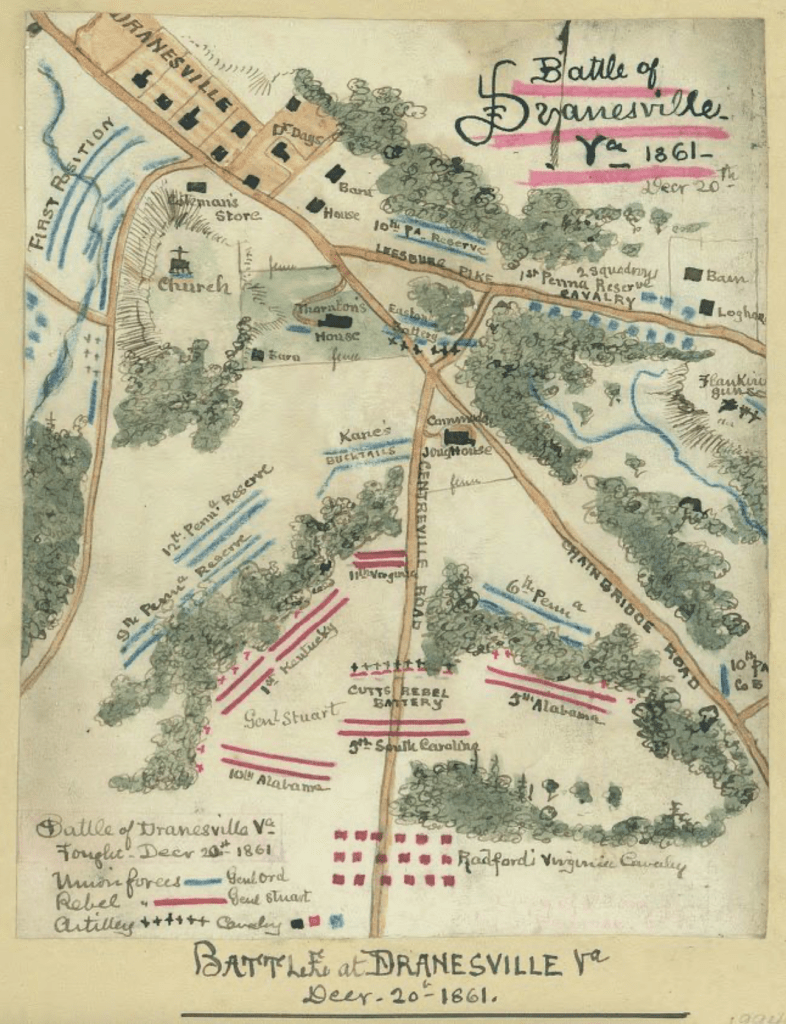
The letter appears to have been datelined from Pierpont on December 1 but I suspect the fighting described refers to the Battle of Dranesville which occurred on 20 December 1861. It was in that battle that Col. Thomas L. Kane was wounded (though not in the penis, that I am aware of).
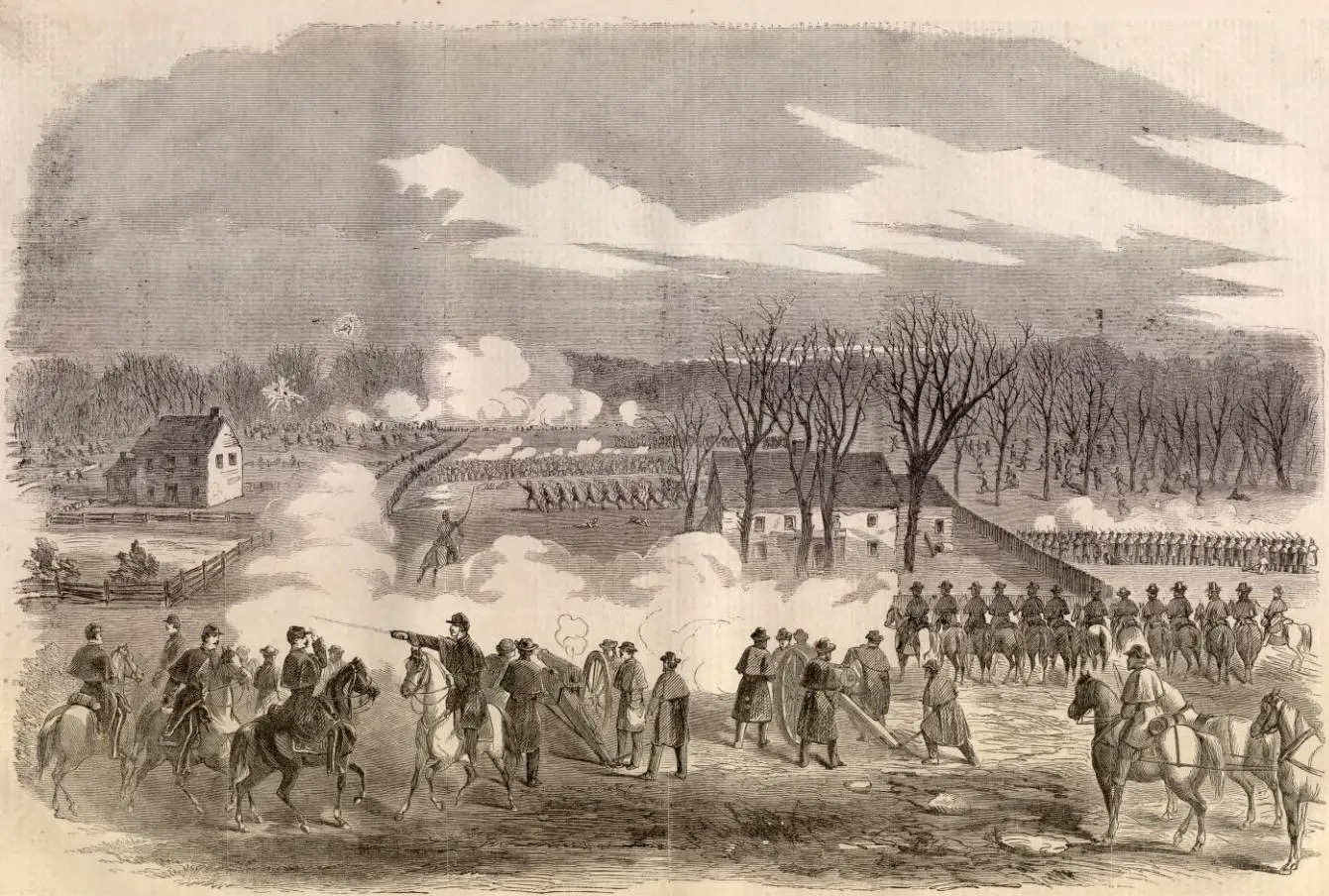
The Battle of Dranesville
Transcription
Camp Pierpont [near Langley, Va.] December 1, [1861]
Dear friend,
I take my pen in hand to inform you with a few lines that I am well and still in the land of the living yet and I hope that this few lines will find your family in good health.
My dear friend, you wanted to know about the war. I can tell you a little about it what happened this week. They had a little [ ] and killed two or three and some wounded and them that were wounded we carried along to our hospital and when he was near dead, said he could lick four of our Union Soldiers. He was shot in the head and in the side and arm, but he was dead the next morning and the rest [too]. There was one of our soldiers wounded and he said that they should get his pistol and shoot that secesh but the soldier was dead the next morning. The Colonel’s horse was shot under him and a [ ] shot in his penis and did not hurt him further. I cant tell you more about it.
Further, I let you know that I have seen in your letter that you have stopped berry time now [and] I want you to come to war and fight for the stars and stripes. That is all I can tell you now, my dear friend. You must excuse me for not writing more. Dear friend, I have been with my father two days and one night and we had some Lager beer and some more to drink, but you can see what fun times we had for we have not seen each other for about four months and the rest of the Lebanon fellers that left with him.
I must come to a close for tonight. So good night John and Danel and your family. From your true friend, — Charles Urban
I could not find an image of Julian but here is an unidentified member of Co. K, 44th New York Infantry who looks to be about Julian’s age. The “P. E.} on his hat stands for “People’s Ellsworth Zouaves” which is how they were originally designated. (Dan Binder Collection)
The following letter was written by Pvt. Julian Knowlton (1834-1881) of Co. A, 44th New York Infantry. The 44th was organized at Albany, New York, and was transported to Washington D. C. in late October 1861 where they were attached to Butterfield’s Brigade, Fitz-John Porter’s Division of the Army of the Potomac. They did not see their first action until the siege of Yorktown in April 1862. Julian was captured in action during the Battle of Gaines’ Mills but soon paroled. He then was wounded in the Battle of Gettysburg on the second day of fighting, having participated in turning back Longstreet’s assault on the Union left. A member of Co. A later wrote of that day: “Our regiment lost very heavy; 111 out of 300. Our company lost more than any other company in the regiment, 22 out of 40, had 5 killed. Each company cared for their wounded. [Julian] Knowlton, from Forestville, was badly wounded in the knee. I helped carry him off from the field. The last I heard from him, he was doing well. Both of my tent mates were wounded.—After we had carried our wounded of from the field, we then buried our dead. Three boys from our company together with myself, carried four of our dead comrades back. It seemed hard, I tell you. They had stood right beside us, in the ranks all through everything until now.” Though Julian survived the war, his right leg continued to cause him pain, and it was finally amputated in 1880. He died the following year in Elliott, Ford county, Illinois.
The letter was datelined from Camp Butterfield on Christmas day, 1861—just five days after the Battle of Dranesville—a skirmish really—in which both sides suffered relatively low casualties. The Union infantry regiments engaged in the fight included the 9th, 12th and 13th Pennsylvania Reserves (the latter being designated the 42nd Pennsylvania, the 1st Pennsylvania Rifles, or more popularly referred to as “Kane’s Bucktails”). Julian’s younger brother, Byron (“By”) D. Knowlton (1842-1923) was a member of Co. D in the Bucktails but we learn from Julian’s letter that By was not in the battle. Rather, he was on guard duty at their camp on the day of the battle.13th Pennsylvania Reserves, Officially designated the 42nd Pennsylvania Volunteer Infantry, the unit was also known as the 13th Pennsylvania Reserves, the 1st Pennsylvania Rifles, and the Kane Rifles.
Julian and Byron were the sons of William and Mary Ann (Whipple) Knowlton of Forestville, Chautauqua county, New York. Though unnamed, Julian no doubt wrote the letter to his brother Jerome (b. 1836).
Transcription
Camp Butterfield [December] 25, 1861
Dear Brother,
It is with pleasure I resume my pen to inform you that I received your letter and was very glad to hear from you and to hear that you were well. I was glad to hear that you received the money that I sent you. I began to think that you had not received it. I am as well as usual and I hope that these few lines will find you enjoying the same blessing.
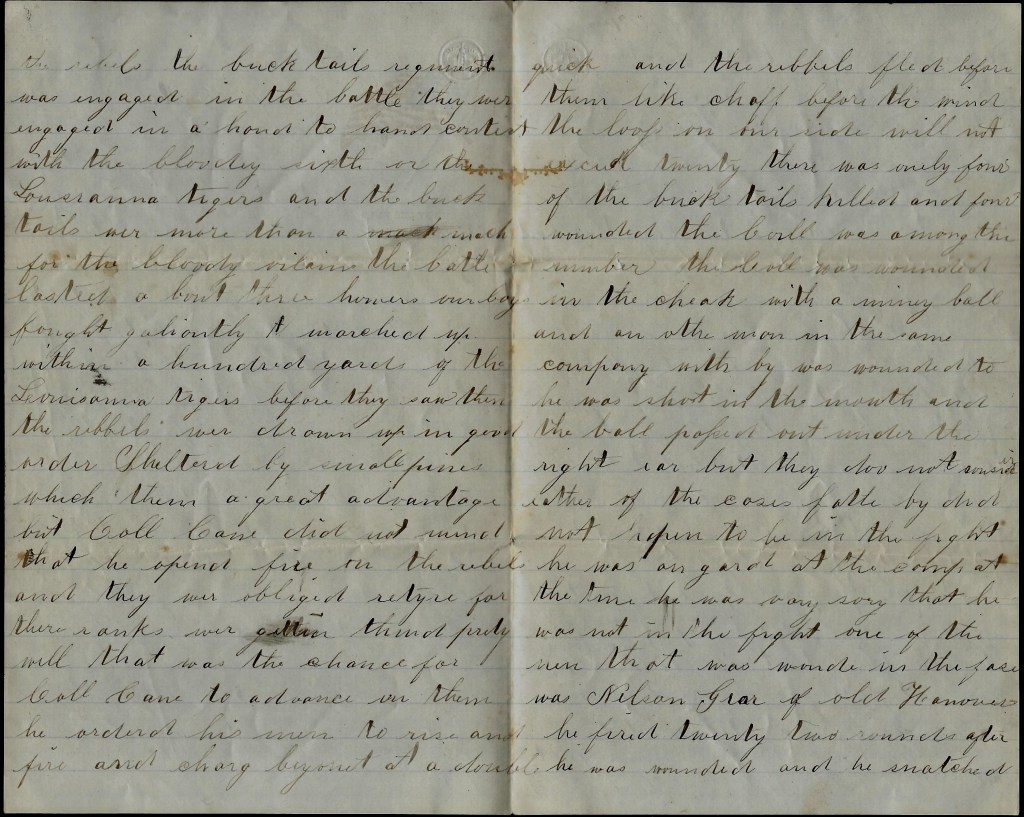
We still remain in our old camp but I do not think that we shall not remain here long for the rebels are getting rather bold of late. They have made several charges on our pickets and our men had quite a battle. There was three regiments of our men engaged with four or five regiments of the rebels. The Bucktails regiment was engaged in the battle. They were engaged in a hand-to-hand contest with the Bloody Sixth or the Louisiana Tigers and the Bucktails were more than a match for the bloody villains.
The battle lasted about three hours. Our boys fought gallantly. It marched up within a hundred yards of the Louisiana Tigers before they saw them. The rebels were drawn up in good order sheltered by small pines which [give] them a great advantage but Col. [Theodore L.] Kane did not mind that. He opened fire on the rebels and they were obliged to retire for their ranks were gettin’ thinned pretty well. That was the chance for Col. Kane to advance on them. He ordered his men to rise and fire and charge bayonet at a double quick and the rebels fled before them like chaff before the wind.
The loss on our side will not exceed twenty. There was only four of the Bucktails killed and four wounded. The Colonel was among the number. The Colonel was wounded in the cheek with a minié ball and one other man in the same company with By [Byron] was wounded too. He was shot in the mouth and the ball passed out under the right ear but they do not consider either of the cases fatal. By did not happen to be in the fight. He was on guard at the camp at the time. He was very sorry that he was not in the fight. One of the men that was wounded in the face was Nelson Geer 1 of old Hanover. He fired twenty-two rounds after he was wounded and he snatched a sword from the sheath of a dead rebel and fetched it off as a trophy. The boys brought of numerous things such as revolvers and watches and rifles, &c.
I was over to see By yesterday. The boys were in fine spirits. They have got themselves a very comfortable encampment. I saw Nelt Geer. He looked rather hard. His face was very badly swollen but he does not mind that.
I have nothing of importance to communicate but what I have already written so I will speak of our business. I shall send you twenty or twenty-three dollars the first of next month and I want you to settle my account at the farmers and if there is anything left, I want you to pay Pierce that five dollars that you got him for me. I am owing W. M. Gardner a little but I cannot pay him now as I see. Give my respects to all enquiring friends. Give my respects to Mr. Pierce and tell him that I am much obliged to him. In haste, — J. Knowlton
About the things of mine that you spoke of, you can keep until I give you different orders. I think that they [ ] as well as they are.
Julian’s letter asserts that the Bucktails faced the Louisiana Tigers at Dranesville but he was mistaken. The Confederate forces consisted of Kentucky, Virginia, Alabama, and South Carolina troops under the command of General Stuart.
1 Nelson Theodore Geer (1842-1895) of Warren county, served as a private in Co. D (the “Raftsman Guard”), 42nd Pennsylvania Rifles. He enlisted in May 1861 and was discharged for wounds in March 1863.He was first wounded in the Battle of Dranesville on 20 December 1861 and wounded a second time at the Battle of Antietam on 17 September 1862.
The following letter was written by 37 year-old Amos Clinton Metzgar (1825-1903) who enlisted on 31 May 1861 in Co. E, 42nd Pennsylvania (1st Pennsylvania Rifles, or “Bucktails”) and was discharged on a Surgeon’s Certificate 23 February 1862. A note in his 1890 Veteran’s Schedule claims he was discharged from the service “due to epilepsy” but this letter suggest that he received a gunshot wound to his leg on 15 September 1861 that was not healing. I can’t find any engagement of the regiment on that day so it may have been an accidental discharge.
I could not find an image of Amos or Edward but here is one of Robert B. Valentine who fought with the Bucktails (Ronn Palm Collection)
The boys of Co. E were recruited primarily in Tioga county and, like other companies in the regiment, were mostly lumbermen on the upper reaches of the Susquehanna River. The boys wore a distinctive bucktail in their hats and bragged of their marksmanship. Co. E branded themselves the “Tioga Rifles.”
The last page of the letter was written by Edward Osborn (1833-1876) who enlisted on 7 August 1861 in Co. E, 42nd Pennsylvania, and was discharged on a surgeon’s certificate on 18 April 1863. Edward was the son of Daniel Osborn (1809-1878) and Harriette Hoadley (1811-1863) of Stony Fork, Tioga county, Pennsylvania. In the 1860 US Census, Amos Metzgar lived on the property adjacent to the Osborn family in Stony Creek, Tioga county.
Amos and Edward addressed the letter to Edward’s brother, Albert Osborn (1836-1908) who also was in the service. Albert served initially as a sergeant in Co. G, 7th Pennsylvania Cavalry from 9 October 1861 to 2 June 1862. He then reenlisted as a private in Battery E, 5th US Artillery from 10 August 1863 to 17 June 1866 (though the veteran’s schedule claims he was a veteran of Gettysburg and Cold Harbor).
To read other letters I have transcribed and published on Spared & Shared that were written by members of this regiment, see: Jacob Snyder, Co. E, 42nd Pennsylvania (Union/1 Letter) Lewis Hoover, Co. K, 42nd Pennsylvania (Union/1 Letter)
Transcription
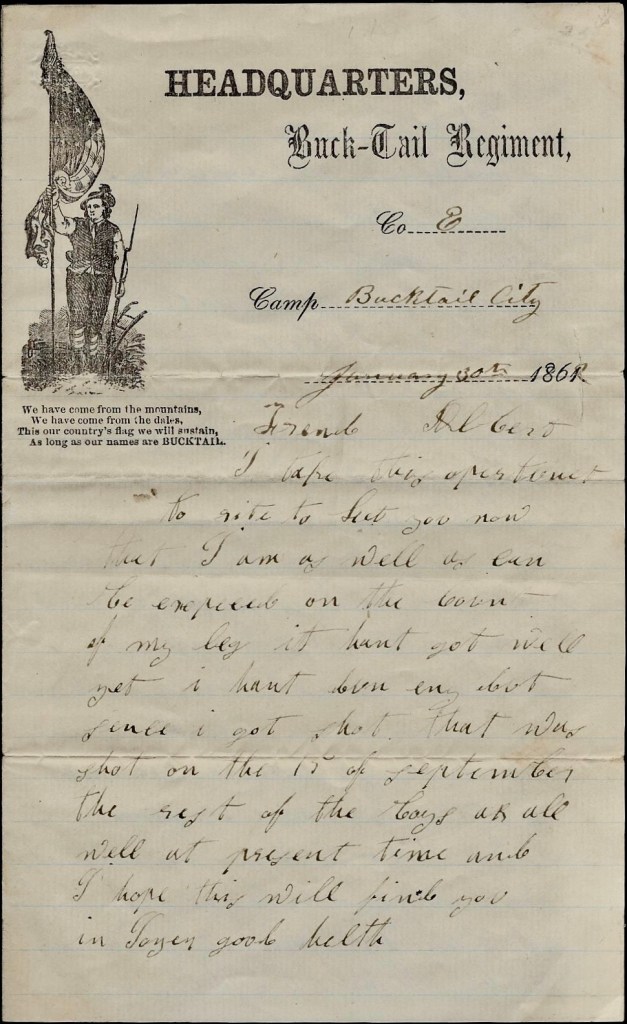
Headquarters Bucktail Regiment, Co. E Camp Bucktail City January 30th 1862
Friend Alberto,
I take this opportunity to write to let you know that I am as well as can be expected on the account of my leg. I han’t got well yet. I han’t been any about since I got shot. That was shot on the 15th of September. The rest of the boys are all well at present time and I hope this will find you enjoying good health.
Albert, they have made out my discharge and I will start for home next week and when I get home, I will write to you again. Albert, it is very muddy and rainy here all the time. The camp is very quiet at present time. Nothing going on to raise a excitement in or about camp for the mud is so deep that they can’t get around.
Albert, may God watch and protect you through this campaign and land you safe in the old free state once more on Stony Fork to join your friends there that is close to you.
So no more at present. From your friend, — Amos C. Metzgar
[In a different hand]
Dear brother,
I thought that I would write a few lines in Amos’s letter. I received a letter from you night before last about eight o’clock in the evening and I sat down and answered it before I went to bed. Captain [Alanson E.] Niles started for home last Sunday and I sent 30 dollars by him.
The weather is not very cold. It is not as cold as I wish it was. If it was cold enough to harden the mud so that we could get top of it, it would be a great blessing. No more at present. From your affectionate brother, — Edward Osborn
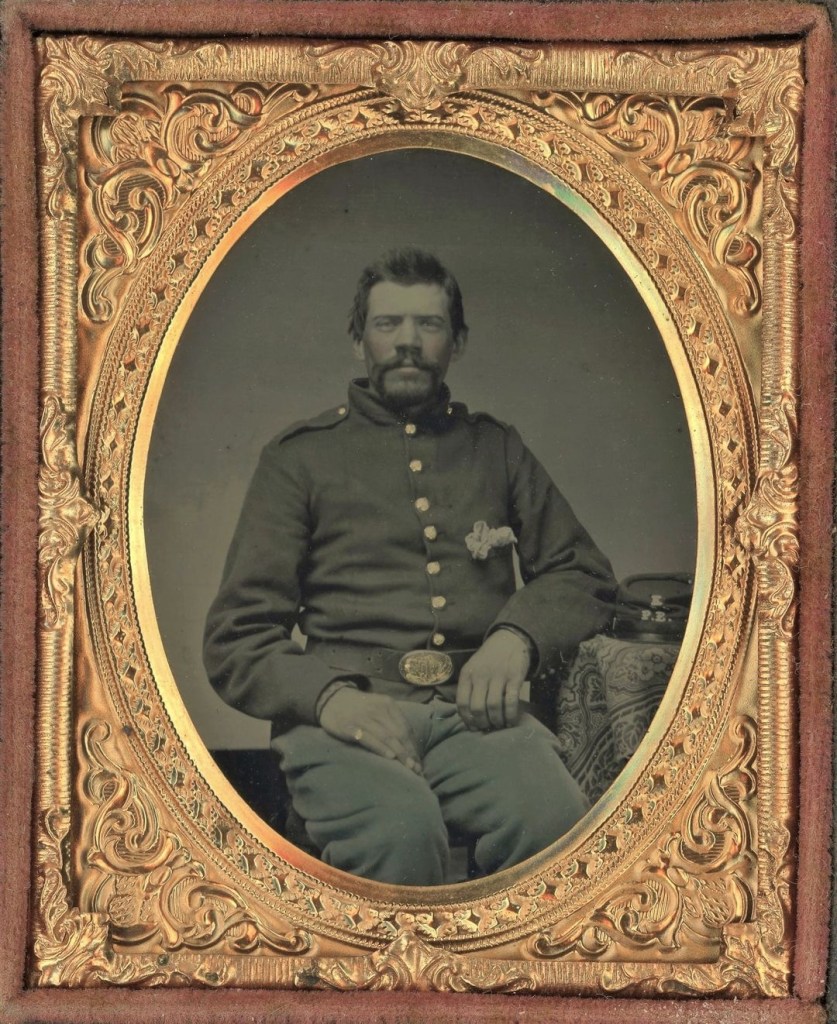
This early-war tintype of an unidentified soldier was probably a member of Kane’s Rifle Regiment. Note the bucktail on the side of his cap. ( Dale Niesen Collection)
This letter was written by Seneca Freeman Minard (1837-1914) of Shippen, Cameron county, Pennsylvania, who mustered into the Kane Rifle Regiment of the Pennsylvania Reserve Corps (13th Pennsylvania Reserves, 42nd Pennsylvania Infantry)—better known as the “Bucktail Regiment”—on 1 June 1861 as a private in Co. C. At the time of his enrollment he was described as standing 5′ 9.5″ tall, with black hair, and blue eyes. He gave his occupation just prior to his enlistment as “lumberman.”
At some point Seneca appears to have been promoted to a corporal but there are no muster-out records for him and a note in the regimental history indicates that Seneca deserted his regiment though no date was given. The 1890 Veteran Schedule records him as a resident of Milton, Rock county, Wisconsin and states that he served 2.5 years.
Seneca’s letter describes the Battle of Dranesville that took place between Confederate forces under Brig. General J. E. B. Stuart and Union forces under Brig. Gen. Edward O. C. Ord on 20 December 1861 in Fairfax county, Virginia.
Transcription
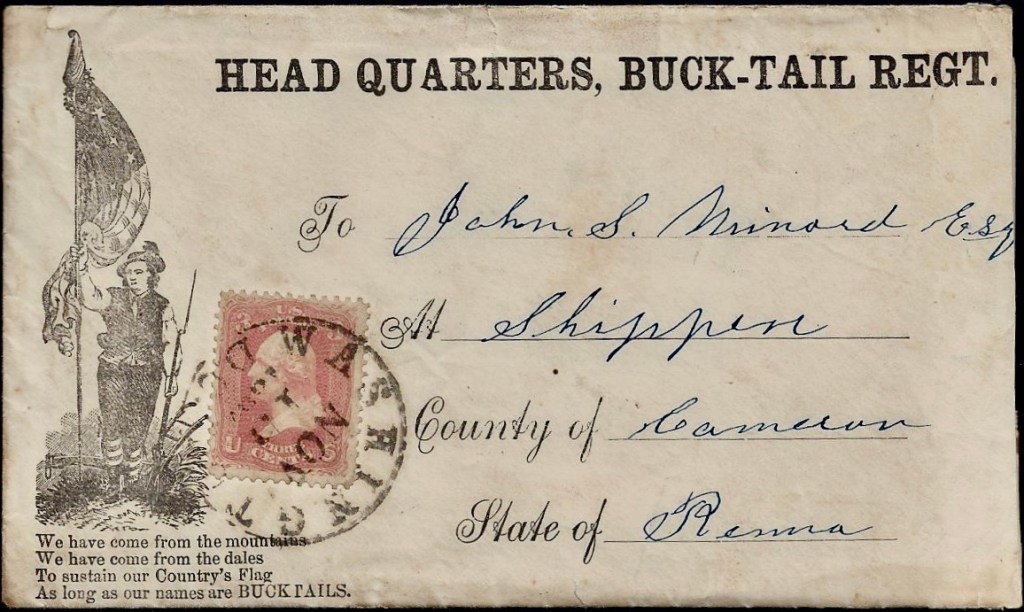
Addressed to John S. Minard, Esq., at Shippen, Camden county, Penna.
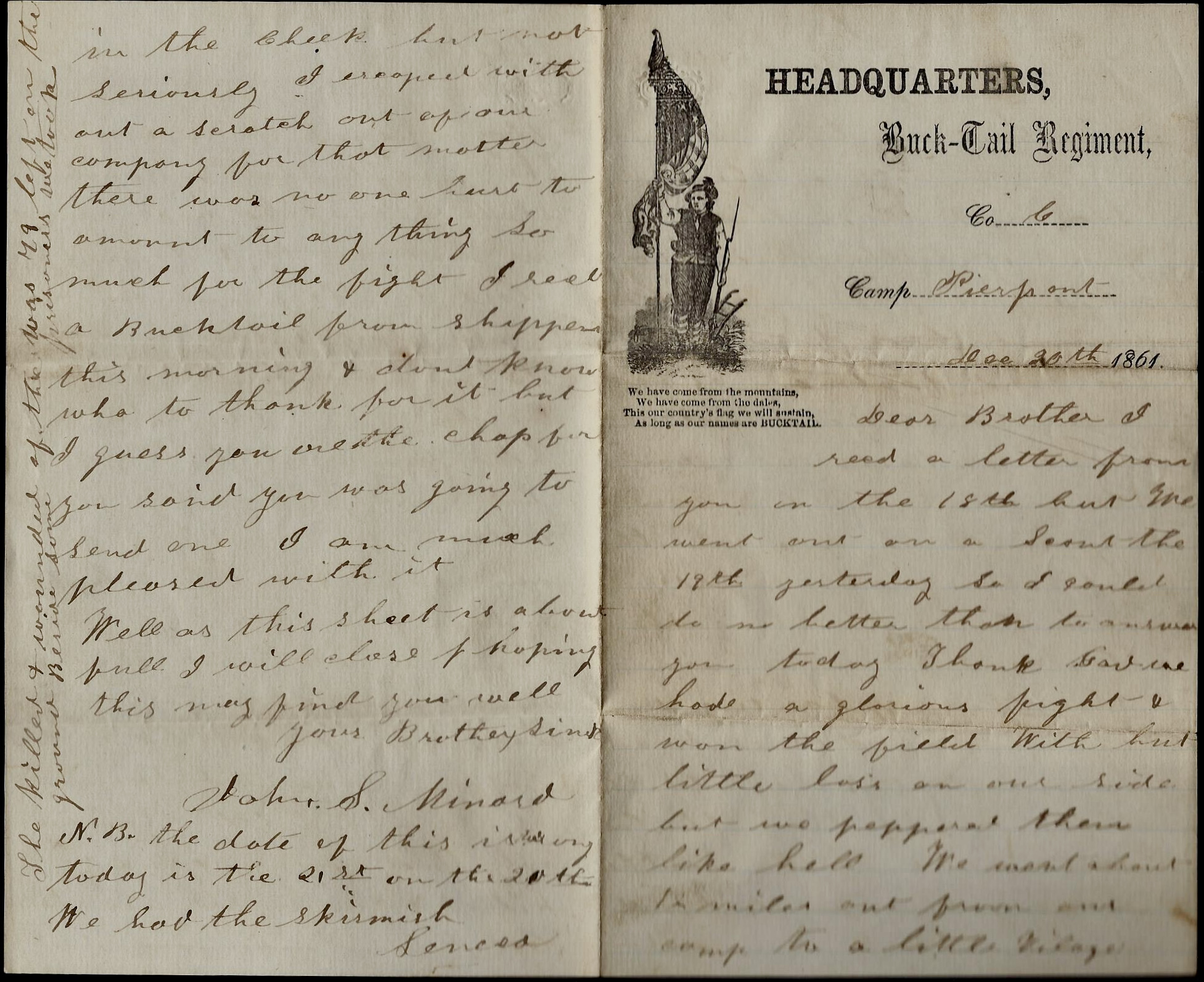
Headquarters, Bucktail Regiment Co. C, Camp Pierpont December 20th 1861
Dear Brother,
I read a letter from you on the 18th but we went out on a scout the 19th yesterday so I could do no better than to answer you today, thank God. We had a glorious fight & won the field with but little loss on our side but we peppered them like hell. We went about two miles out from our camp [on the Leesburg pike] to a little village called Dranesville. After scouting around there for about an hour we run into a nest of them stationed in a thick grove of little pines. They had four pieces of artillery and about four or five thousand footmen as near as we could find out.
The Bucktails were on the ground first and consequently were in the hottest of the fight. We were coming along the road & one of our [men] saw them planting a cannon in a crossroad to our left and he told the Colonel of it. Then the Colonel took us in behind a large brick house for shelter. we had hardly taken our position when they opened fire on us. The grapeshot and bomb shells flew like hail among us but we laid down as close to the ground as we could hug and they couldn’t do us much harm. But we did not have to stay here long until our big guns got on the ground and then we went in on our shape & within half an hour from the time our cannons got there, we were masters of the field.
Our loss was about ten killed and fifteen wounded—the most of them slightly. There was only three of our regiment killed and five or six wounded. [Lt.-]Col. [Thomas Leiper] Kane was wounded in the cheek but not seriously. 1 I escaped without a scratch. Out of our company, for that matter, there was no one hurt to amount to anything. So much for the fight.
I received a Bucktail from Shippen this morning & don’t know who to thank for it but I guess you are the chap for you said you was going to send one. I am much pleased with it.
Well as this sheet is about full, I will close hoping this may find you well.
Your brother, — Seneca
to John S. Minard
N. B. The date of this is wrong. Today is the 21st. On the 20th we had the skirmish. — Seneca
The killed and wounded of the [Rebs] was 79 left on the ground besides some prisoners we took.
1 Lt. Col. Kane was struck in the face by a ball that pierced his upper jaw. He halted just long enough to tie a bandage and resumed his position at he lead of his men.








 Spared & Shared 23