Category Archives: 44th Indiana Infantry

1863: Samuel Andrew Baker to Nancy E. Baker

I could not find an image of Samuel but here is one of David E. Brallier (1841-1928) of Kosciusko county, Indiana. He served in Co. B, 44th Indiana Infantry (sometimes under name Brawlier). He enlisted on 22 November 1861 and mustered out at Chattanooga on 14 September 1865. (Ancestry.com)

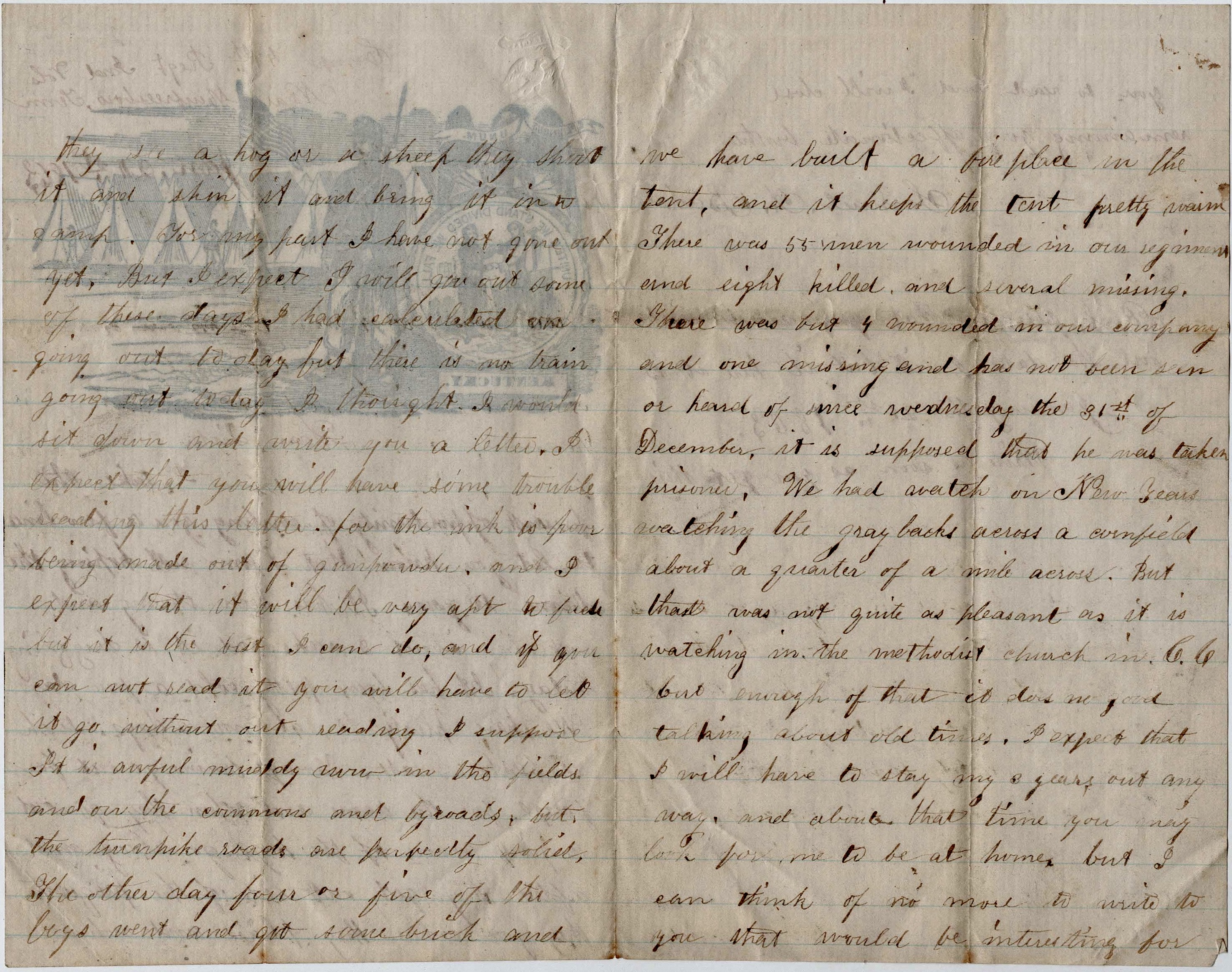
This letter was written by Samuel Andrew Baker (1844-1865) while serving as a private in Co. E, 44th Indiana Infantry. He enlisted in October 1861 when he was 18 years old. At his enlistment, he was described as a 5’5″ tall, blue-eyed, blond-haired carpenter. He was the son of Joseph W. and Hulday (Convers) Baker of Columbia City, Whitley county, Indiana. Columbia City is about 20 miles WNW of Fort Wayne, Indiana.

He was promoted to a corporal in December 1864 but on 30 January 1865, he was killed in an accident when the train car he was riding in on the way to Athens, Alabama, from Nashville, ran off the track and was smashed by another car. Samuel was the only one killed though five others were wounded. This was on the Knoxville & Chattanooga Railroad near Cleveland, Tennessee. [Source: The Iron Men of Indiana’s 44th Regiment by Margaret Hobson]

Samuel wrote the letter to his older sister, Nancy E. Baker (b. 1842), a school teacher in Columbia City.

Samuel’s Find-A-Grave includes a letter by Baker written from McMinnville, TN, on 26 July 1863. This letter is archived in the Special Collection (online) at the University of Tennessee along with another one written on 28 January 1862 from South Carrollton, Kentucky.

T R A N S C R I P T I O N

Camp 44th Indiana Volunteers
Near Murfreesboro, Tennessee
January 21st 1863

Dear Sister,

I take the present opportunity of writing you a few lines to let you know that I am well hoping the same to you. It has been stormy and wet for a bout two weeks and it is drizzling today. It has been pretty cold a few days. We have plenty to eat now-a-days such as fresh meat. Forage trains go out for forage for the teams and when they go out a good many of the boys go along and after they get outside of the pickets, they go where they please. And when they see a hog or a sheep, they shoot it and skin it and bring it into camp. For my part, I have not gone out yet but I expect I will go out some of these days. I had calculated going out today but there is no train going out today.

I thought I would sit down and write you a letter. I expect that you will have some trouble reading this letter for the ink is poor, being made out of gunpowder. And I expect it will be very apt to fade. But it is the best I can do and if you cannot read it, you will have to let it go without reading, I suppose.

It is awful muddy now in the fields and on the commons and byroads, but the turnpike roads are perfectly solid. The other day four or five of the boys went and got some brick and we have built a fireplace in the tent and it keeps the tent pretty warm.

There was 55 men wounded in our regiment and eight killed and several missing. There was but four wounded in our company and one missing and has not been seen or heard of since Wednesday, the 31st of December. It is supposed that he was taken prisoner. We had watch on New Year’s watching the graybacks across a cornfield about a quarter of a mile across. But that was not quite as pleasant as watching in the Methodist church in C. C. [Columbia City]. But enough of that. It does no good talking about old times. I expect that I will have to stay my three years out anyway. And about that time, you may look for me to be at home. But I can think of no more to write to you that would be interesting for you to read. I will close remaining your affectionate brother, — Samuel A. Baker

P. S. for fear that you cannot make out the date, I will put it here. It is January the 21st, 1863

Write as soon as you get this.

1862: William W. Wright to his Brother & Sister

I could not find an image of William but here is Sgt. Moses B. Willis of Co. K, 44th Indiana Infantry. He was killed at Shiloh.

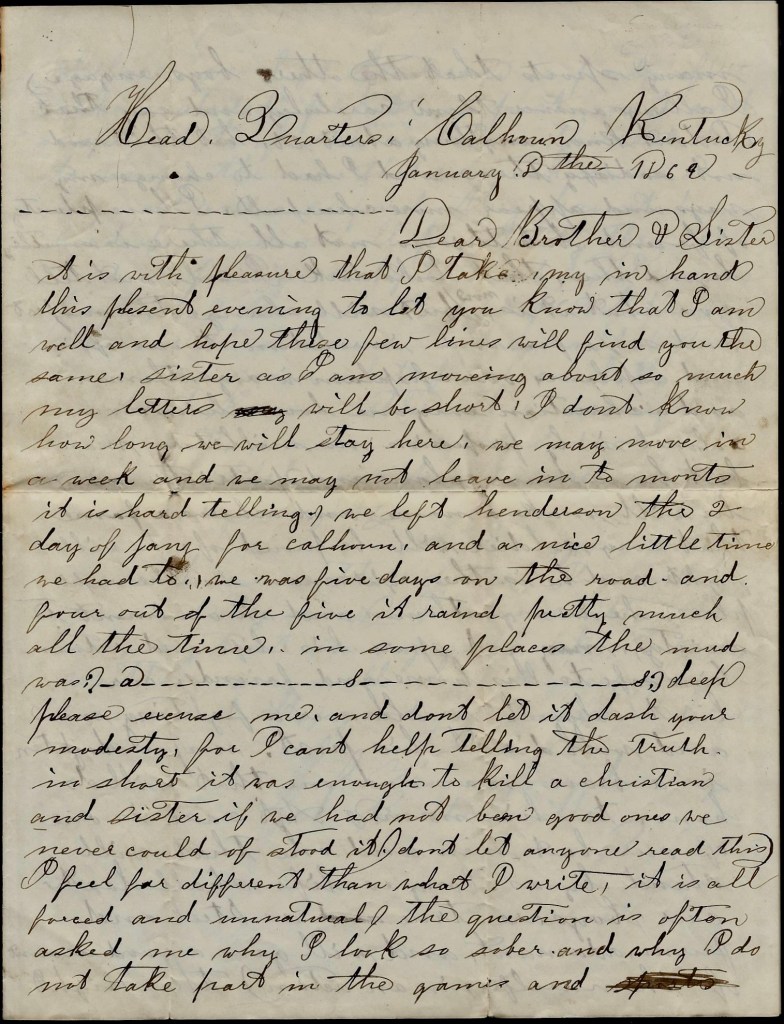
The following letter was written by Sgt. William W. Wright of Co. A, 44th Indiana Infantry. William was 21 years old when he enlisted in August 1861. He died in a St. Louis hospital on 2 March 1862—less than two months after this letter was penned. At the time of the 1860 US Census, William was working as a laborer on the farm of J. H. Chappell of Salem, Steuben county, Indiana.

In his letter, William describes the tramp of the 44th Indiana Infantry from Henderson to Calhoun, Kentucky—a distance of 40 miles—which took them four days due to inclement January weather. They reached Calhoun on 6 January 1862 and went into camp. They remained there until the 15th of January when they relocated to South Carrolton. In February the regiment in the battles of Fort Henry and Fort Donelson, and then later in April in the Battle of Shiloh.

To read letters by other member of the 44th Indiana Infantry published on Spared & Shared, see: Solomon Bean, Co. G, 44th Indiana (2 Letters), and Daniel Rowe, Co. H, 44th Indiana (1 Letter).

Transcription

Headquarters, Calhoun, Kentucky
January 8th 1862

Dear Brother & Sister,

It is with pleasure that I take my [pen] in hand this pleasant evening to let you know that I am well and hope these few lines will find you the same. Sister, as I am moving about so much, my letters will be short. I don’t know how long we will stay here. We may move in a week and we may not leave in two months. It is hard telling.

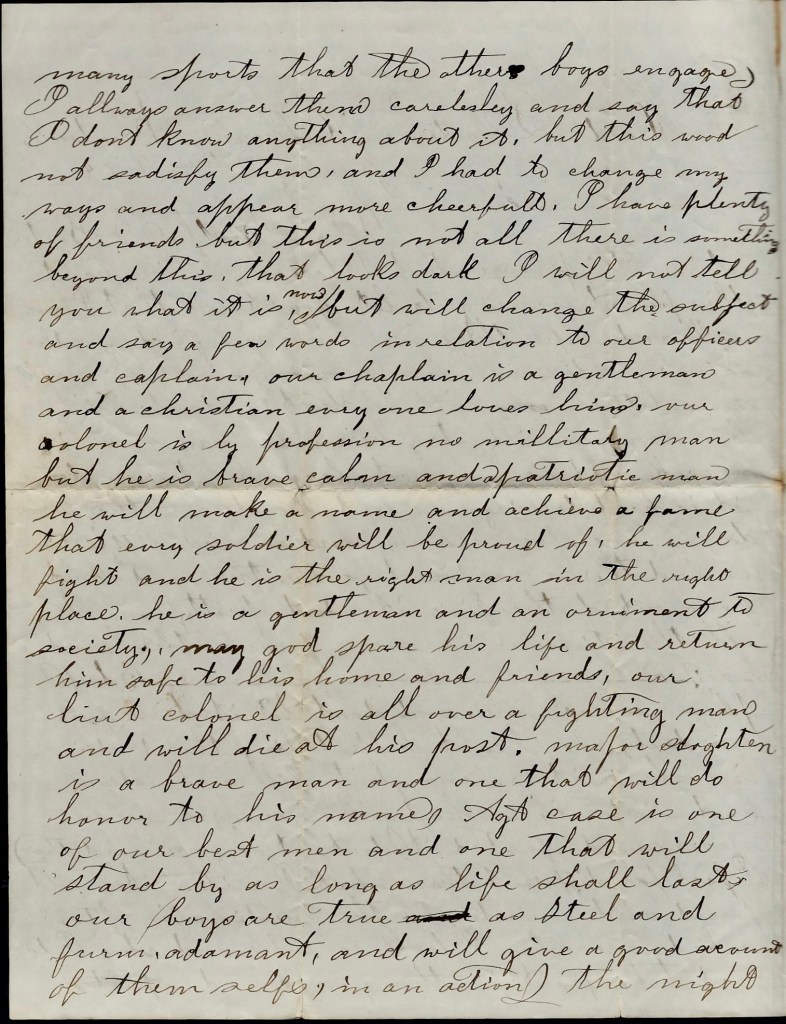
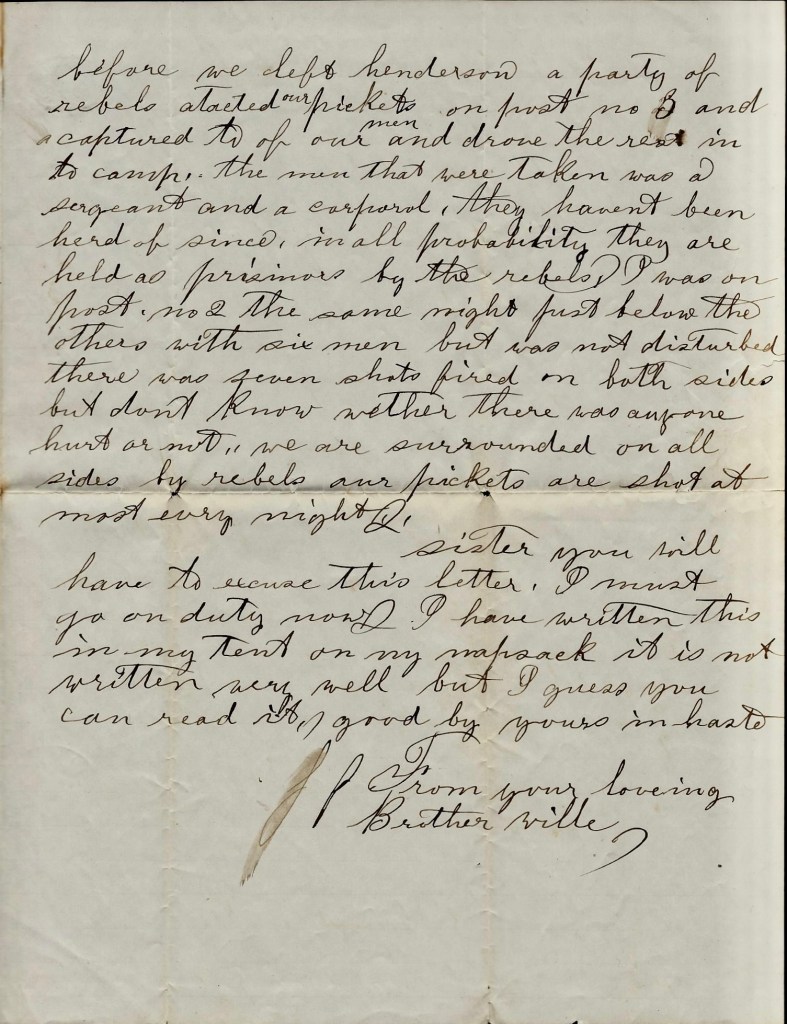
We left Henderson [Kentucky] the 2nd day of January for Calhoun and a nice little time we had too. We was five days on the road and four out of the five it rained pretty much all the time. In some places the mud was a—-s—s deep. Please excuse me and don’t let it dash your modesty for I can’t help telling the truth. In short, it was enough to kill a Christian and sister, if we had not been good ones, we never could of stood it. (Don’t let anyone read this.) I feel far different than what I write. It is all forced and unnatural. The question is often asked me why I look so sober and why I do not take part in the games and many sports that the other boys engage. I always answer them carelessly and say that I don’t know anything about it, but this would not satisfy them and I had to change my ways and appear more cheerful. I have plenty of friends, but this is not all. There is something beyond this that looks dark. I will not tell you what it is now, but will change the subject and say a few words in relation to our officers and chaplain.

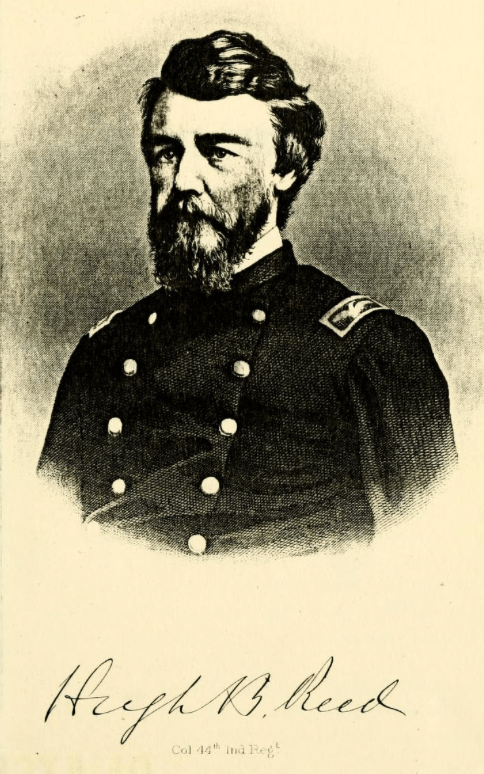
Col. Hugh B. Reed, 44th Indiana

Our chaplain [G. W. Beeks] is a gentleman and a Christian. Everyone loves him. Our colonel [Hugh B. Reed] is by profession no military man but he is brave, calm, and a patriotic man. He will make a name and achieve a fame that every soldier will be proud of. He will fight and he is the right man in the right place. He is a gentleman and an ornament to society. May God spare his life and return him safe to his home and friends. Our lieutenant-colonel [Baldwin J. Crostweit] is all over a fighting man and will die at his post. Major [Sanford J] Sloughton is a brave man and one that will do honor to his name.

Adjutant [Charles] Case is one of our best men and one that will stand by as long as life shall last. Our boys are true as steel and firm, adamant, and will give a good account of themselves in an action. The night before we left Henderson, a party of rebels attacked our pickets on Post No. 3 and captured two of our men and drove the rest into camp. The men that were taken was a sergeant and a corporal. They haven’t been heard of since. In all probability they are held as prisoners by the rebels. I was on Post No. 2 the same night just below the others with six men but was not disturbed. There was seven shots fired on both sides but don’t know whether there was anyone hurt or not. We are surrounded on all sides by rebels. Our pickets are shot at most every night.

Sister, you will have to excuse this letter. I must go on duty now. I have written this in my tent on my knapsack. It is not written very well but I guess you can read it. Goodbye. Yours in haste, From your loving brother, — Wille

[Wm. W. Wright on reverse of letter]

1862: Daniel Rowe to his Friend

The following letter was written by Daniel Rowe (1837-1874), the son of Abraham Rowe (1796-1865) and Margaret Gunsallus (1806-1850) of Valentine, LaGrange county, Indiana. Daniel enlisted on 8 October 1861 in Co. H, 44th Indiana Infantry. He was discharged from the service as a sergeant on 23 November 1864. The 44th Indiana was organized at Fort Wayne and participated in the taking of Fort Henry and Fort Donelson, the Battle of Shiloh, the Siege of Corinth, Stones River, Chickamauga, and Missionary Ridge.

Daniel wrote this letter from the encampment near Battle Creek on the Tennessee river where the Federals had constructed Fort McCook. This was located in a narrow valley with the Cumberland range in the rear and the enemy’s pickets in full view across the river. It was some five miles above Bridgeport. Five weeks after this letter was penned, the fort was abandoned when it shelled unmercifully by Rebel artillery from the other side of the river.

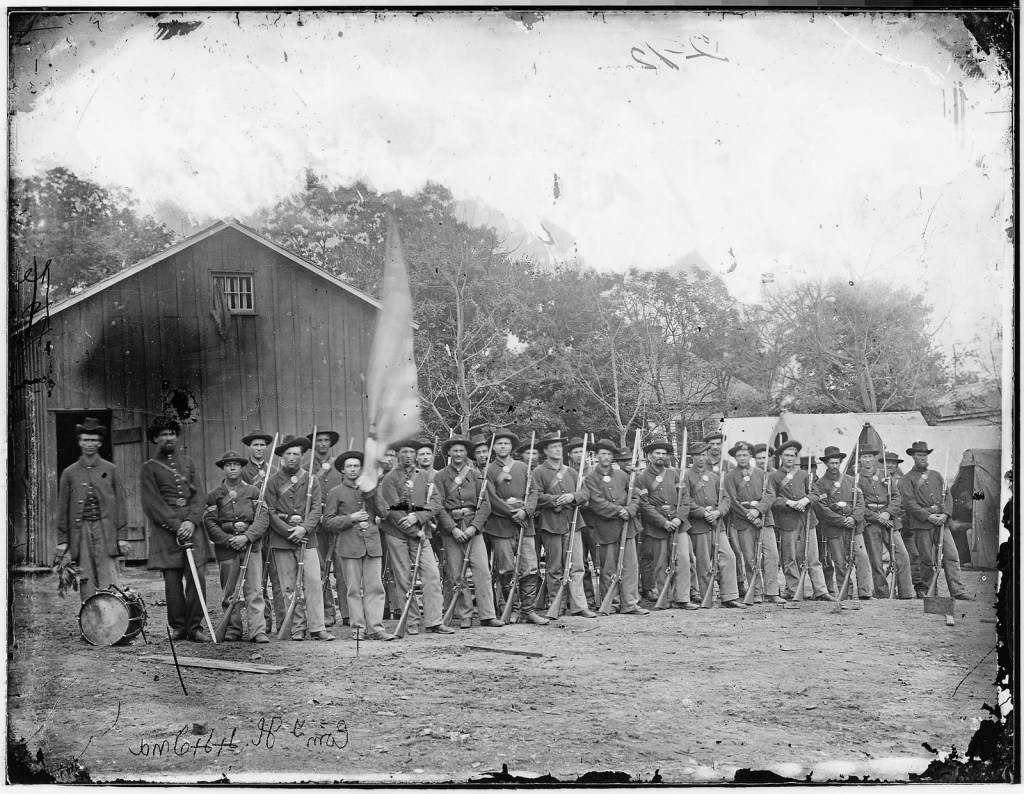
Members of Co. H, 44th Indiana Infantry at Chattanooga early in 1864

Transcription

Camp near Battle Creek, Tennessee
July 20th 1862

My dear friend,

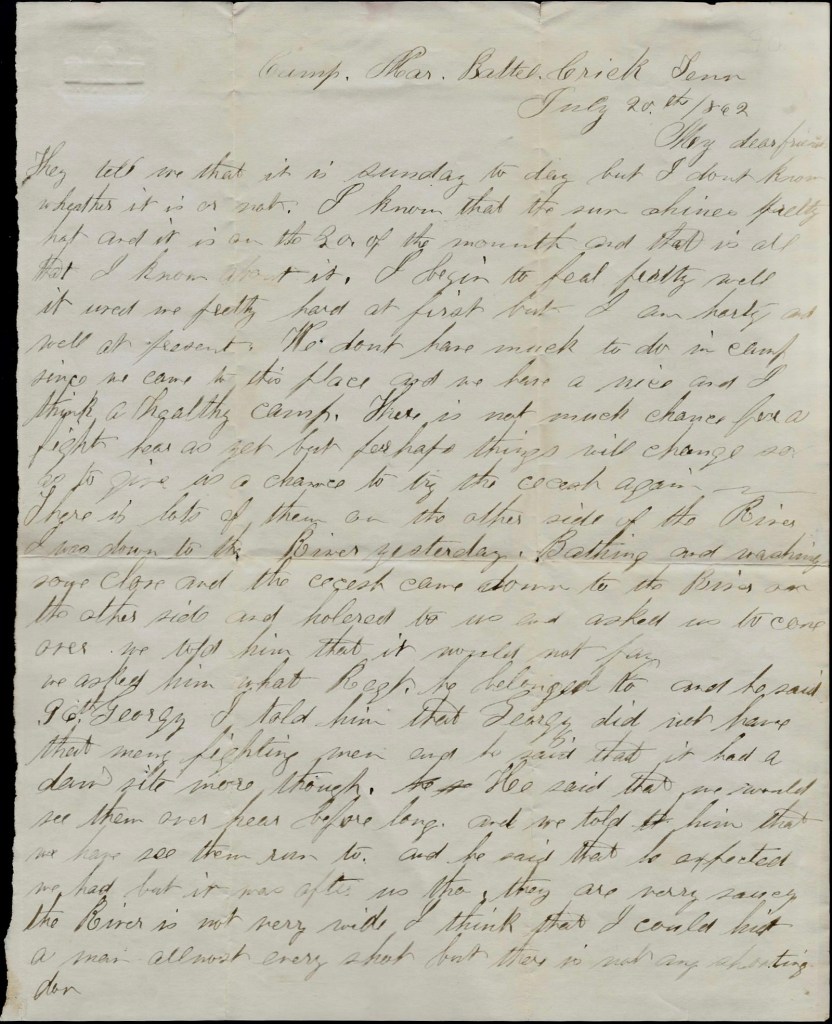
They tell me that it is Sunday today but I don’t know whether it is or not. I know that the sun shines pretty hot and it is on the 20th of the month and that is all that I know about it. I begin to feel pretty well. It used me pretty hard at first but I am hearty and well at present. We don’t have much to do in camp since we came to this place and we have a nice and I think a healthy camp.

There is not much chance for a fight here as yet but perhaps things will change soon as to give us a chance to try the secesh again. There is lots of them on the other side of the river. I was down to the river yesterday bathing and washing some clothes and the secesh came down to the river on the other side and hollered to us and asked us to come over. We told him that it would not pay. We asked him what regiment he belonged to and he said 96th Georgy. I told him that Georgy did not have that many fighting men and he said that it had a damn sight more though. He said that we would see them over hear before long and we told him that we have seen them run too and he said that he expected we had but it was after us that they run. They are very saucy. The river is not very wide. I think that I could hit a man almost every shot but there is not any shooting done.

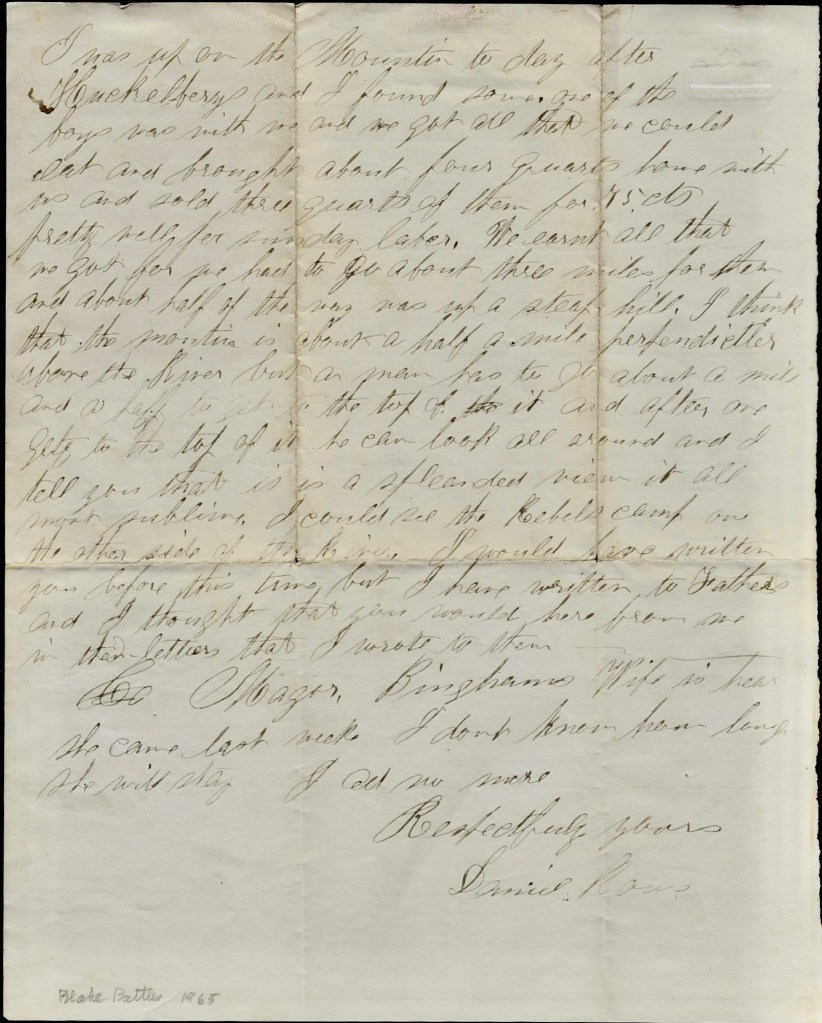
I was up on the mountain today after huckleberries and I found some. One of the boys was with me and we got all that we could eat and brought about four quart home with us and sold three quarts of them for 75 cents—pretty well for Sunday labor. We earned all that we got for we had to go about three miles for them and about half of the way was up a steep hill. I think that the mountain is about a half mile perpendicular above the river but a man has to go about a mile and a half to get to the top of it and after one gets to the top of it, he can look all around and I tell you, that is a splendid view. It’s almost sublime. I could see the Rebel’s camp on the other side of the river. I would have written you before this time but I have written to Father and I thought that you would hear from me in their letters that I wrote to them.

Major [William B.] Bingham,’s wife is here. She came last week. I don’t know how long she will stay. No more. Respectfully yours, — Daniel Rowe