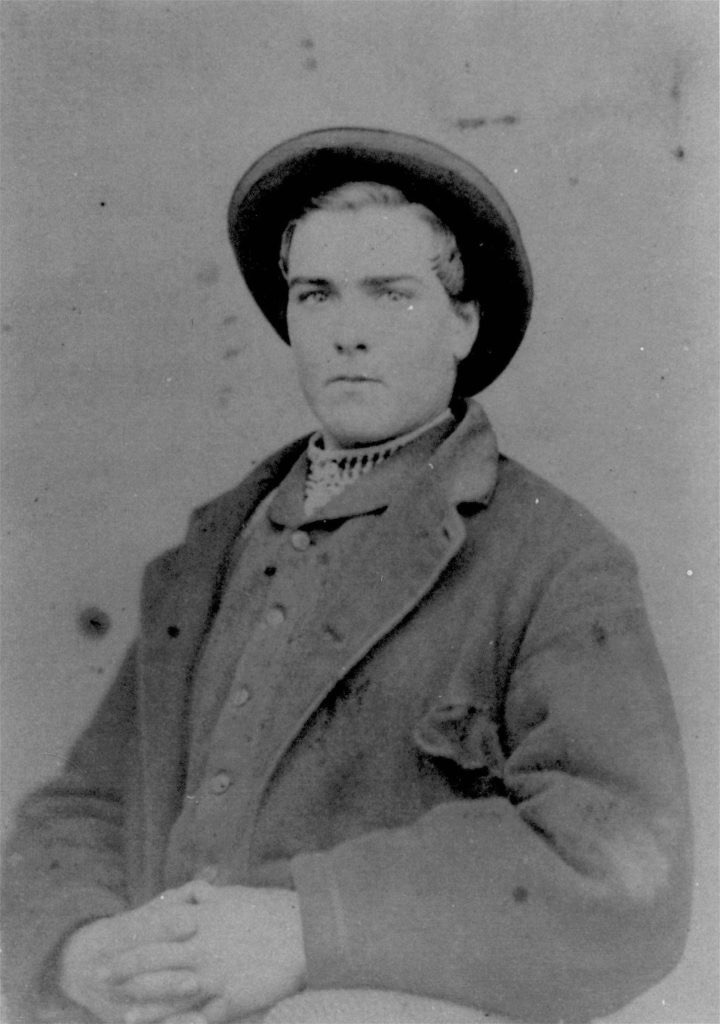
I could not find an image of Warner but here is one of John Kirkpatrick who served in the 45th Pennsylvania. He was mortally wounded at the Battle of Antietam. (Barry van Brunt Collection)
The following letter was written by Pvt. Daniel “Warner” Button (1841-1864) of Co. I, 45th Pennsylvania Infantry. This regiment was mustered in at Harrisburg in November 1861 and saw service in South Carolina where they participated in the Battle of Secessionville in June 1862 before returning back to Maryland for the Battles at South Mountain and Antietam. This letter was written shortly after the Battle of Fredericksburg where they were held in reserve and suffered no casualties. Warner would later be wounded in the Battle of Spotsylvania Court House on 12 May 1864 and died of his wounds on 21 May.
Warner was the son of Hiram Button (1817-1899) and Jane Tuttle (1821-1897) of Middlebury, Tioga county, Pennsylvania.
This letter from the collection of Greg Herr. To read other letters by members of the 45th Pennsylvania that I have transcribed and published on Spared & Shared, see:
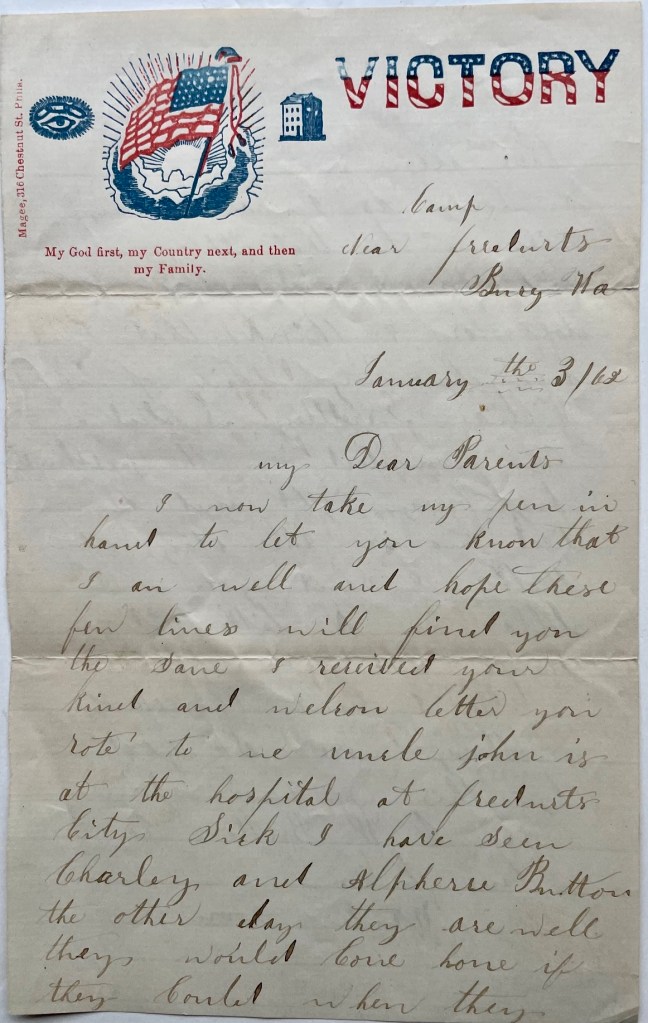
Camp near Fredericksburg, Virginia January 3, 1862 [should be 1863]
My dear parents,
I now take my pen in hand to let you know that I am well and hope these few lines will find you the same. I received your kind and welcome letter you wrote to me. Uncle John is at the hospital at Frederick City [Maryland] sick. I have seen Charley and Alpheus Button 1 the other day. They are well. They would come home if they could. When they have been in [the service] as long as I have, they will wish that they was home for I know that I do for I think that I have done my share of it.
William Gridley 2 is dead. He was wounded in the Fredericksburg fight and he died two or three days after.
Mother, I sent you one dollar in a letter for stamps. Did you get it? So I can’t think of nothing more so goodbye. This is from your son, — D. W. Button
to Jane Button. Write soon.
1 Charles (1843-1863) and Alpheus Button (1841-1909) were brothers and privates in Co. A, 136th Pennsylvania Infantry. The regiment was mustered into service in August 1862 and it’s first engagement was the Battle of Fredericksburg.Alpheus survived the war but Charles was killed at Gettysburg.
2 William M. Gridley was a private in Co. A, 136th Pennsylvania Infantry. He enlisted with Charles and Alpheus Button.William was from Tioga county, Pennsylvania.
The following letter was written by Jacob Bruckart Eshleman (1843-1864), the son of Jacob S. Eshleman (1813-1889) and Fanny Bruckart (1816-1890) of West Hempfield township, Lancaster county, Pennsylvania. The letter was mailed to his older brother, John B. Eshlen (1839-1906).
Jacob enlisted at the age of 19 on 29 August 1862 to serve as a private in Co. B, 45th Pennsylvania Infantry. His name appears on muster roles as Echelman but the family gravestones spell the name as he has signed this letter, Eshleman. He was taken prisoner at Poplar Springs Church, Virginia, on 30 September 1864 and ultimately taken to the stockade at Salisbury, North Carolina, where he died of disease. On June 4, 1883, Jacob applied for a father’s pension but did not receive it. On December 2, 1887, Fanny applied for a mother’s pension and did receive it.
Jacob wrote this letter less than three weeks before the Battle of Fredericksburg in which his regiment was held in reserve and suffered no casualties. They were, as stated in the letter, attached to the 3rd Brigade (Leasure), 1st Division (Burns), 9th Army Corp (Willcox). The regiment was brigaded with the 36th Massachusetts and the 100th Pennsylvania.
To read letters by other members of the 45th Pennsylvania Infantry that I have transcribed and posted on Spared & Shared, see: Lawrence P. Williams, Co. D, 45th Pennsylvania (1 Letter) William B. Glenn, Co. E, 45th Pennsylvania (3 Letters) Homer S. Thompson, Co. E, 45th Pennsylvania (1 Letter) Henry Tyrus Rice, Co. G, 45th Pennsylvania (1 Letter) Eli Smith, Co. G, 45th Pennsylvania (1 Letter) William Chase, Co. I, 45th Pennsylvania (2 Letters) Thomas Layton, Co. I, 45th Pennsylvania (1 Letter)
I could not find an image of Jacob but here is one of George Henry Bockus of Co. G, 45th Pennsylvania Infantry
Transcription
Fredericksburg, Va. November 26th 1862
Dear brother,
I will inform you a few lines to let you know that I am well. I received your letter of the 17th and that pin cushion. I was glad to get it but there is something wanting yet and that is a shears or scissors.
Tell father to come down for he can find us. It is strange that you did not send something with Welch for I am the only one in the company that did not get anything. Benjamin got a pair of boots and cigars and a pair of gloves and some other things. But it is all right. Tell father to come right on sight.
Washington Hershey says that his father is coming down and that he drawed his bounty $41.44 cents so I suppose you drawed mine, and father can take of that money to pay his fare. They may have all that but when I send for a little, I want you to send it. When father comes, let him be prepared to leave $5 here for me. And tell them to bake some custard and cakes and bring some [ ] along and two good cotton shirts—dark colored, and two pair of cotton stockings, boots, and a pair of gloves, and a good pair at that. A yard of that good pocket strip for pockets in my overcoat and blouse. Tell him to come to Washington D. C. and then to Aquia Creek. He must enquire for the regiment. If it ain’t there, then come up the river to Fredericksburg along the railroad and after the army.
The regiment is in the 1st Division, 3rd Brigade, 9th Army Corps. But I think we will stay here for the Colonel reported his regiment not fit for duty. There are not more than 350 men fit for duty now. I wish we would stay.
Amos Hogendobler 1 is close with us. He was picked up as a straggler and put under arrest. It was the greatest wonder in the world that I kept after for we march 15 and 20 miles every day for 4 days and with our knapsacks on. If Hogendoblers want to send anything to Amos, he can bring it along. Tell him to come as soon as he possibly can.
Your brother, — Jacob Eshleman
To John Eshleman
1 Amos Hogendobler was not in the 45th Pennsylvania Infantry. Rather, he served in Co. K, 34th Pennsylvania Infantry. He was also from Lancaster county, Pennsylvania.
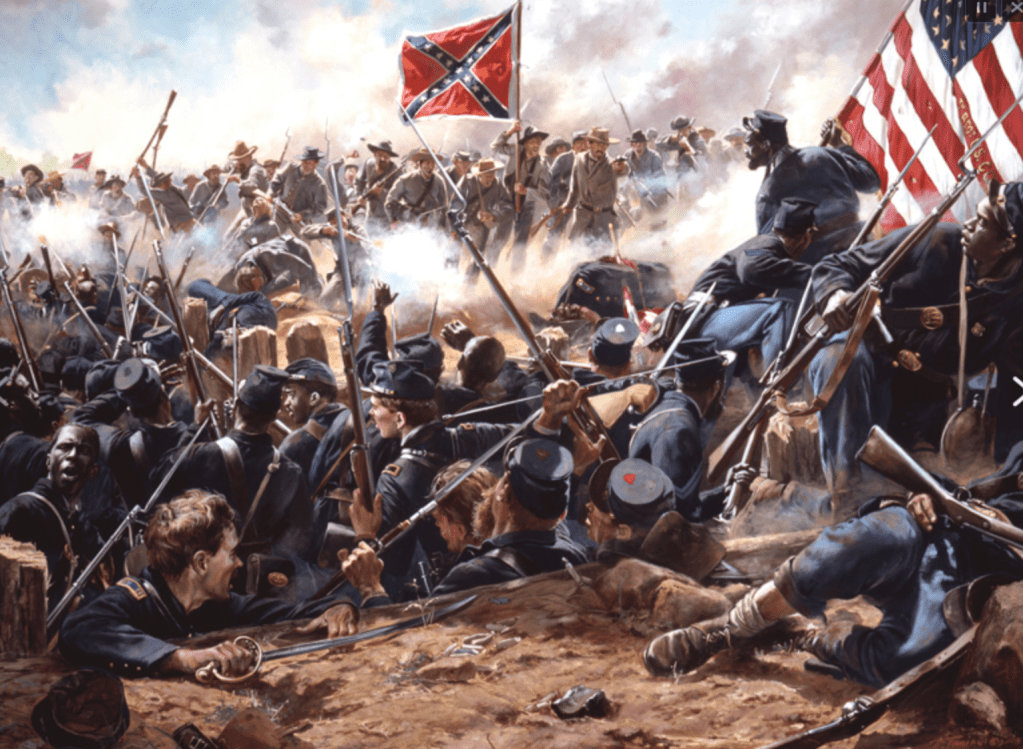
Dan Troiani’s painting “Remembering the Battle of the Crater”
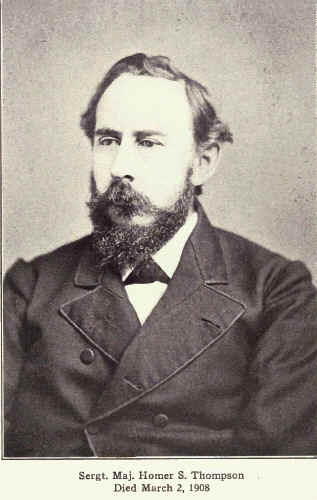
This letter was written by Homer Shunk Thompson (1842-1909) who enlisted as a private on 2 September 1861 in Co. E, 45th Pennsylvania Infantry and rose in rank to Sergeant Major in the regiment before he was mustered out of the service on 17 July 1865 as a veteran.
Homer was the son of sheriff John Thompson (1798-1876) and Lydia Blake (1799-1871) of Centre county, Pennsylvania. After the war, Homer entered the mercantile business at Stormstown. He married Francina Walton (1845-1901) and later a woman named Harriet. He relocated to Kansas a few years to try farming but returned to Pennsylvania and resumed the mercantile business at Reed’s Gap, then Shade Valley, and finally Pine Grove Mills. He eventually returned to Stormstown.
Homer’s letter contains an incredible account of the Battle of the Crater fought on July 30, 1864. In his letter, Homer informs his sister of his injuries, his treatment, and recalls some of the details of the fighting that he witnessed before being taken from the field with a head wound. See also: “Refusing Capture: Capt. Theodore Gregg, Co. F, 45th Pennsylvania” by Tim Talbott.
[Note: This letter is from the personal collection of Richard Weiner and is published on Spared & Shared by express consent.]
Transcription
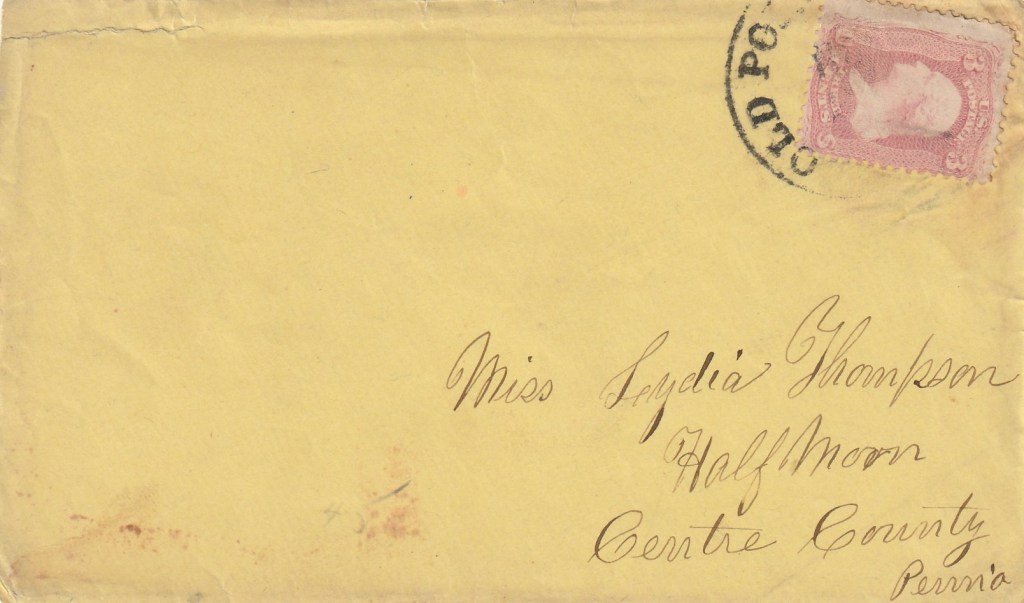
Addressed to Miss Lydia Thompson, Half Moon, Centre county, Pennsylvania
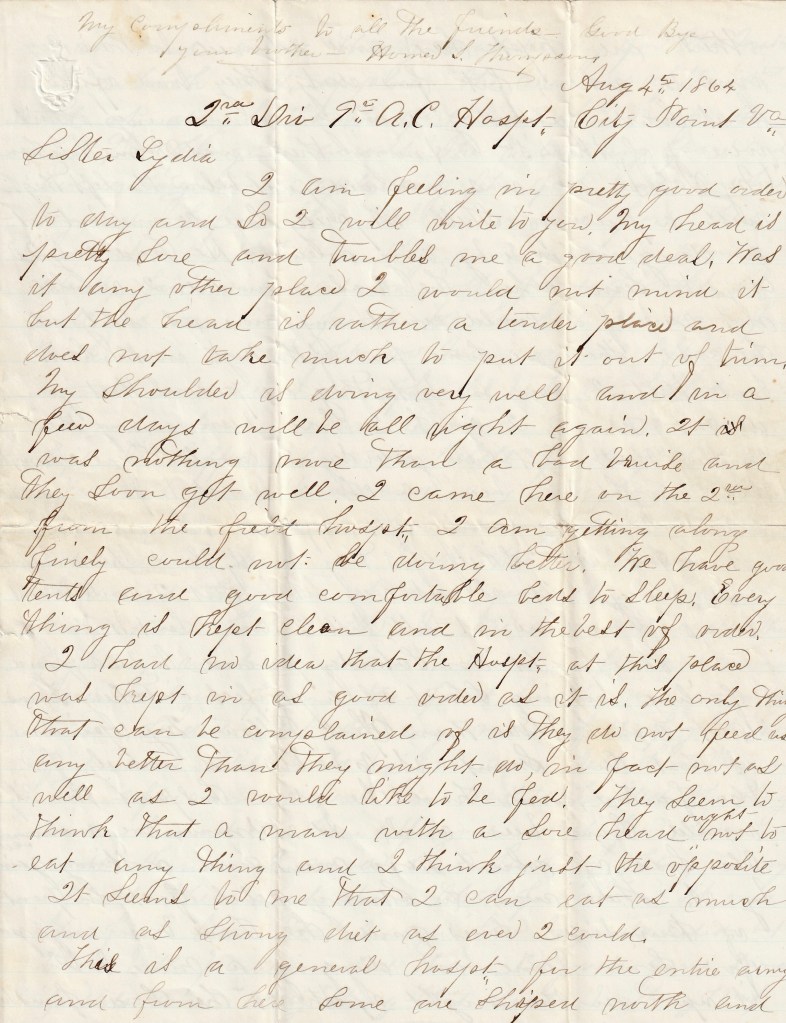
2nd Division, 9th Army Corps Hospital City Point, Virginia August 4th 1864
Sister Lydia,
I am feeling in pretty good order today and so I will write to you. My head is pretty sore and troubles me a good deal. Was it any other place, I would not mind it but the head is rather a tender place and does not take much to put it out of trim. My shoulder is doing very well and in a few days will be all right again. It was nothing more than a bad bruise and they soon get well. I came here on the 2nd from the field hospital. I am getting along finely. Could not be doing better. We have god tents and good comfortable beds to sleep. Everything is kept clean and in the best of order. I had no idea that the hospital of this place was kept in as good order as it is. The only thing that can be complained of is they do not feed us any better than they might do. In fact, not as well as I would like to be fed. They seem to think that a man with a sore head ought not to eat anything and I think just the opposite. It seems to me that I can eat as much and as strong diet as ever I could.
This is a general hospital for the entire army and from here some are shipped north and others are kept here and returned to their regiments when fit for duty. They took off a boat load yesterday evening and among others were 4 of the 45th. Among them was John Holahan—“(My John).” He was wounded just below the left thigh with a piece of shell. A pretty sore wound but not a dangerous one by any means. He had only 20 days to serve when he was wounded. I would not care if I could count my time as easily as he can. There are some four of the regiment in the same tent that I am in but they are persons that you do not know. I wish I had been among the number that left here yesterday. I would have thought there might have been a chance to get to Pennsylvania a while. I may possibly get off in the next boat but it is not very likely for they mostly send the worst ones away. It is not very likely that I will be sent away from here at all—till I am sent to the regiment.
The fight on Saturday proved to be a grand failure—nothing short of a perfect butchery. T’was not much better than Fort Pillow. My opinion is that Gen. Grant is to be blamed entirely for the failure, and had he done his part, the city would have been ours. As it is now, we mourn the loss of about 4,000 men and nothing gained by it.
There was a strong rebel fort in front of Burnsides lines and he had been engaged for some time in digging a mine to blow it up. On the night of the 29th he had finished it and everything was ready for the match which was applied the morning of the 30th and at daylight the fort was blown up. The Old 9th charged across the intervening space and succeeded in capturing the fort and one line beyond before the Rebels recovered from their surprise. By this time they commenced to pour a deadly fire into us on both flanks as well as in our front. We looked in vain for Butler on our right or Meade on our left to advance and cover our flanks but we looked in vain. Not a man moved and we were left to suffer alone.
The Rebels—finding that we were not going to advance any other part of the line—massed almost their entire force on us and advanced to drive us back. The outer line was held as long as it was possible to hold it and then fell back to the second line. There the fighting went on hand-to-hand. After our men were driven from the front line, I was wounded and so I did not see any more of the fight. The fort was still held by our men till sometime in the afternoon when Gen. Bartlett hoisted the flag and surrendered himself and what few men were with him.
“I never saw such fighting in my life as there was done that forenoon. It was the first time that I ever saw bayonets used, but there both parties used them. Bayonets, guns, swords, pistols, and everything could be thought of was used.”
Homer S. Thompson, Co. E, 45th Pennsylvania Vols., 4 August 1864
I never saw such fighting in my life as there was done that forenoon. It was the first time that I ever saw bayonets used, but there both parties used them. Bayonets, guns, swords, pistols, and everything could be thought of was used. Prisoners were taken and retaken by both parties without ever getting out of the same breastworks. Some of our prisoners were shot down on the spot after they had surrendered. Surely the 9th Corps can hereafter take for their battle cry, “Remember Petersburg!”
Lt. Waldo C. Van Valin taken prisoner at the Battle of the Crateron July 30, 1864
Our darkey troops were engaged for the first time and fought well—full as well as the whites did. They lost very heavily as the Rebs did not have much mercy on them. There was only a portion of our regiment in the fight. Almost one half the men were on picket at the time and so escaped. We went into action with 90 men and out of that number, 68 were killed, wounded, or taken prisoners—by far the heaviest loss according to the number of men that we ever had. Our company only lost 4—one killed, one wounded, and two missing. We were more fortunate this time than usual. We had several officers taken prisoner who I fear will meet with hard usage. Among them was Lt. Van Valin of Unionville or vicinity. He was a very fine man and one of my particular friends. I would give anything to know how he is at the present time—whether living or not. I should not wonder if they killed the officers taken there. They are devils enough to do such things. 1
Some 5 days ago I received a letter from you but do not know the date on it. Sam Brook(?) was sent to Philadelphia sick, so that it was our Sam that you saw in the papers. As for hair I cannot send you any because I have none to send. When I was wounded, they cut my hair off so that it would not be in the way of hunting the ball. You may direct your letters to the regiment and if I stay here they can be sent down and if not they can be forwarded from there just as well.
My compliments to all the friends. Good Bye. Your brother, – Homer S. Thompson
1 Lt. Waldo Carrollon Van Valin (1840-1907) of Unionville served in Co. A, 45th Pennsylvania Infantry. He was taken prisoner in the Battle of the Crater on 30 July 1864 and was confined at Macon, Georgia, until he was paroled.






 Spared & Shared 23