Category Archives: 46th Indiana Infantry

1862: George H. Tyler to his Cousin

The following letter was written by George H. Tyler (1837-19xx) of Winamac, Indiana, who served in Co. H of the 46th Indiana Infantry. He was enlisted on 25 November 1861 and mustered out of the regiment on 31 May 1862. The 46th Indiana was organized at Logansport and spent most of the winter at Wickliffe, Kentucky. Some ten days after this letter was penned, the regiment moved to the Mississippi River where they took part in the siege of New Madrid and the capture of Island No. 10.

T R A N S C R I P T I O N

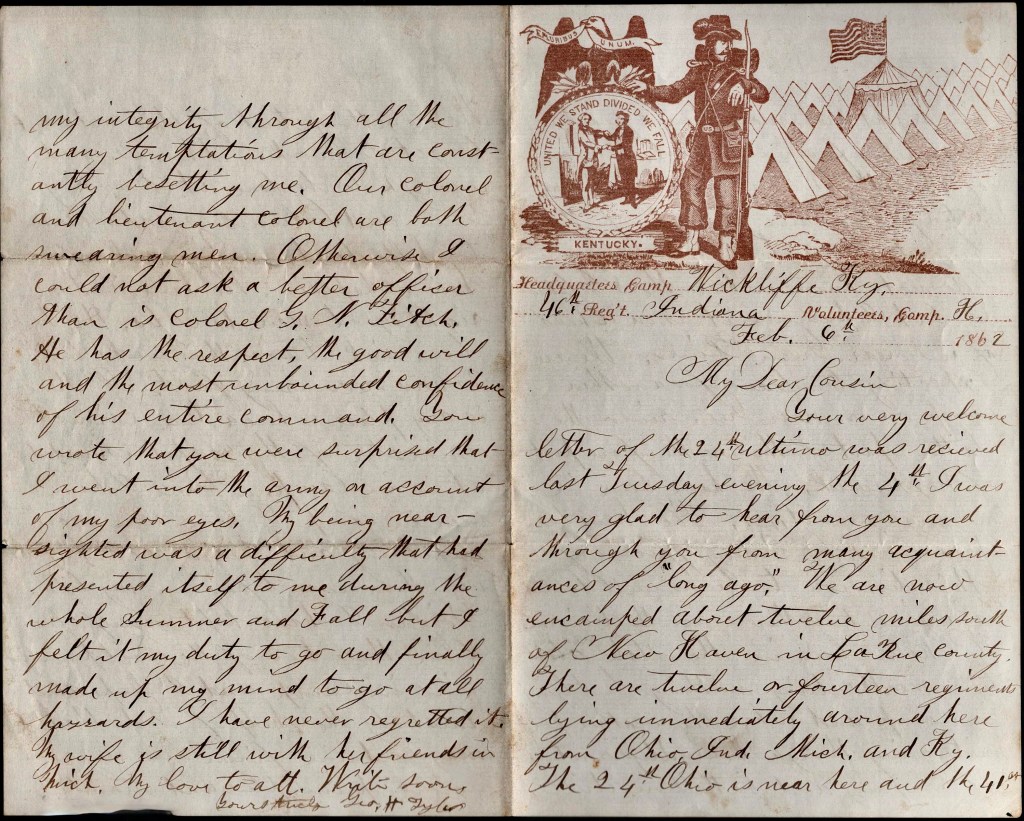
Wickliffe, Kentucky
46th Indiana Volunteers, Co. H
February 6th 1862

My dear Cousin,

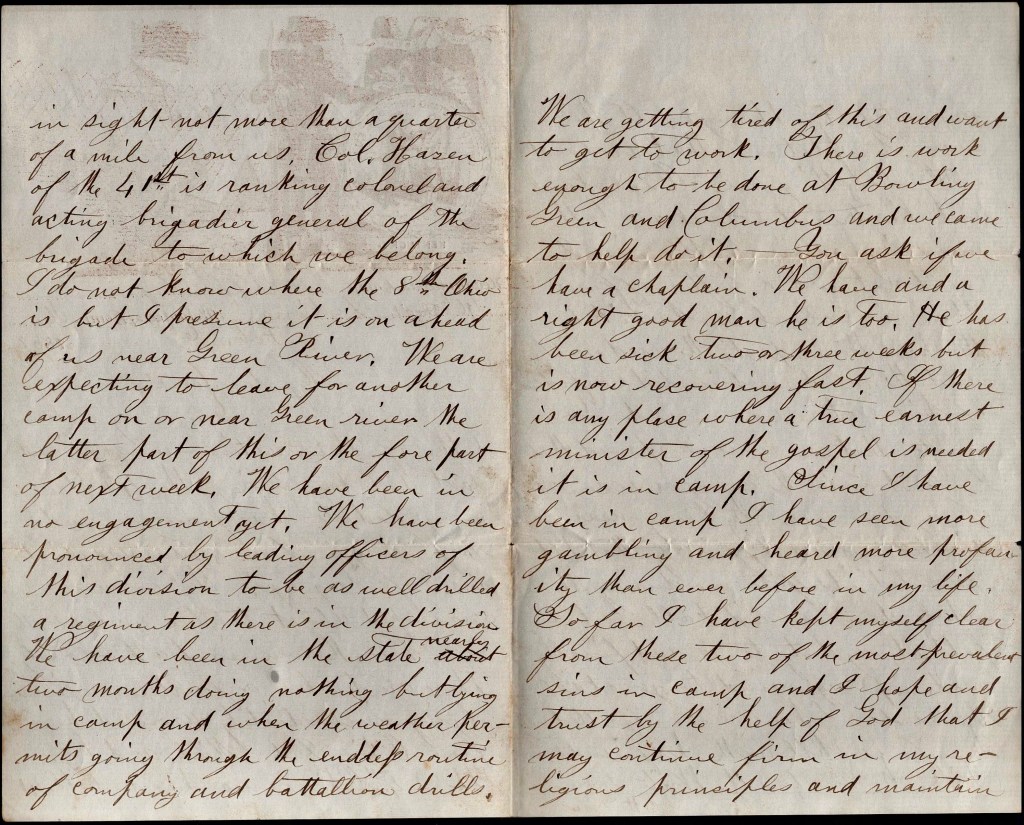
Your very welcome letter of the 24th ultimo was received last Tuesday evening the 4th. I was very glad to hear from you and through you from many acquaintances of “long ago.” We are now encamped about twelve miles south of New Haven in La Rue County. There are twelve or fourteen regiments lying immediately around here from Ohio, Indiana, Michigan, and Kentucky. The 24th Ohio is near here and the 41st in sight not more than a quarter of a mile from us. Col. [William Babcock] Hazen of the 41st is ranking Colonel and acting Brigadier General of the brigade to which we belong. I do not know where the 8th Ohio is but I presume it is on ahead of us near Green River. We are expecting to leave for another camp on or near Green River the latter part of this or the fore part of next week.

We have been in no engagement yet. We have been pronounced by leading officers of this division to be as well drilled a regiment as there is in the division. We have been in the State nearly two months doing nothing but lying in camp and when the weather permits, going through the endless routine of company and battalion drills. We are getting tired of this and want to get to work. There is work enough to be done at Bowling Green and Columbus and we came to help do it.

You ask if we have a chaplain. We have and a right good man he is too. He has been sick two or three weeks but is now recovering fast. If there is any place where a true, earnest minister of the Gospel in needed, it is in camp. Since I have been in camp, I have seen more gambling and heard more profanity than ever before in my life. So far I have kept myself clear from these two of the most prevalent sins in camp and I hope and trust by the help of God that I may continue firm in my religious principles and maintain my integrity through all the many temptations that are constantly besetting me.

Our Colonel and Lieutenant Colonel [Aaron Miller Flory] are both swearing men. Otherwise I could not ask a better officer than in Colonel G[raham] N[ewell] Fitch. He has the respect, the good will, and the most unbounded confidence of his entire command.

You wrote that you were surprised that I went into the army on account of my poor eyes. My being near-sighted was a difficulty that had presented irself to me during the whole summer and fall but I felt it my duty to go and finally made up my mind to go at all hazards. I have never regretted it. My wife is still with her friends in Michigan. My love to all. write soon. Yours truly, — George H. Tyler
1862: Joshua H. Perfect to his Parents

An unidentified Indiana Soldier (Indiana Historical Society)

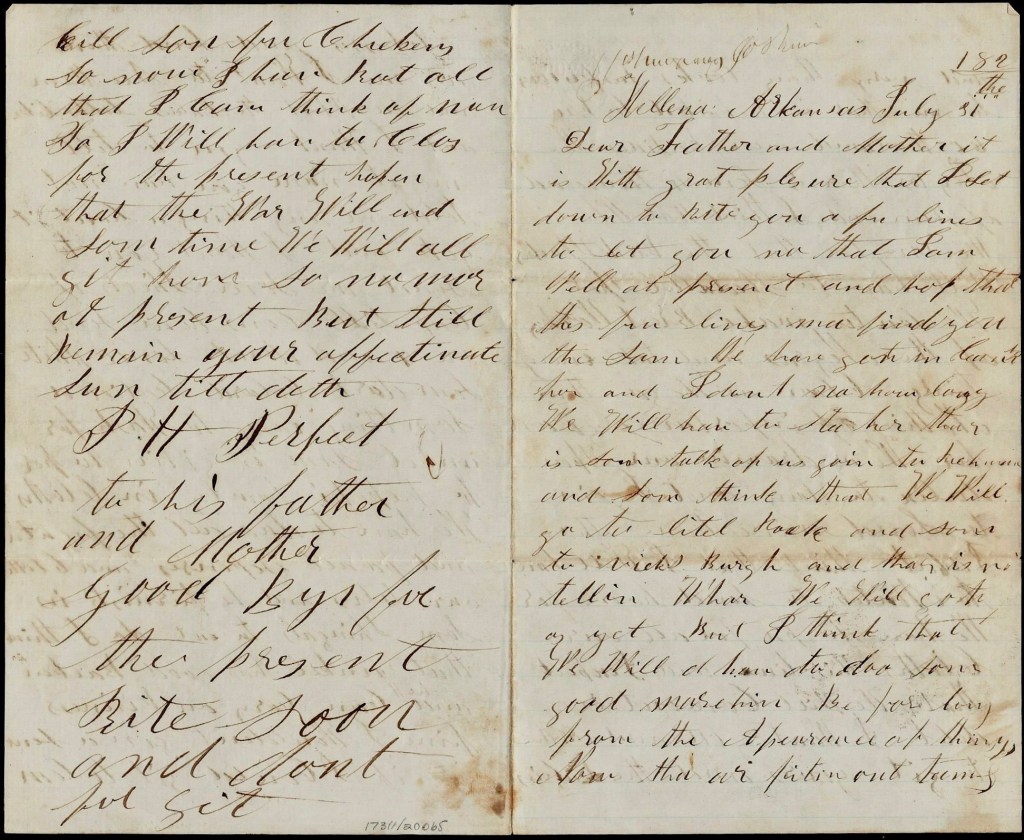
This letter was written by Joshua Hickman Perfect (1843-1864), the son of Joshua H. Perfect (1815-1882) and Sarah Jane Shields (1822-1843) of West Point, White county, Indiana. Joshua’s mother died giving birth to him and not long after remarried his wife’s younger sister, Nancy Maria Shields (1824-1906). It fell to Nancy to raise her sister’s three children as well as the additional 12 children she bore of her own.

During the Civil War, Joshua enlisted at the age of 18 in November 1861 in Co. G, 46th Indiana Infantry. It was while serving with that regiment that he wrote the following letter in July 1862 from Helena, Arkansas. He was discharged from the 46th Indiana after two years service, and enlisted again at Indianapolis in Co. K, 11th Indiana Infantry, on 29 March 1864. He died of disease on 24 August 1864 and now lies buried in the Chalmette National Cemetery in Louisiana.

Transcription

Helena, Arkansas
July 31st 1862

Dear Father & Mother.

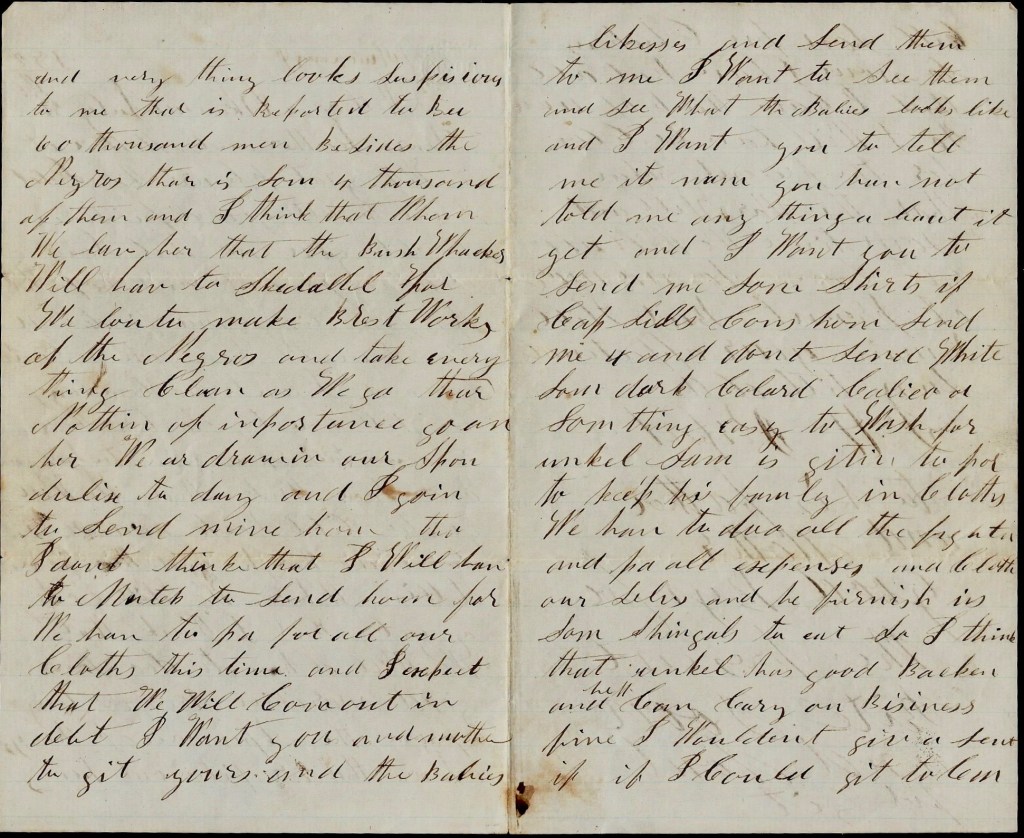
It is with great pleasure that I sit down to write you a few lines to let you know that I am well at present and hope that these few lines will find you the same. We have got in camp here and I don’t know how long we will have to stay here. There is some talk of us going to Richmond and some think that we will go to Little Rock and some to Vicksburg and there is no telling where we will go to as yet. But I think that we will have to do some good marching before long from the appearance of things now. They are putting out teams and everything looks suspicious to me. There is reported to be 60 thousand men besides the Negroes. There is some 4 thousand of them and I think that when we leave here that the bushwhackers will have to skedaddle for we oughta make breastworks of the Negros and take everything clean as we go.

There is nothing of importance going on here. We are drawing our [money] today and I am going to send mine home though I don’t think that I will have too much to send home for we have to pay for all our clothes this time and I expect that we will come out in debt. I want you and mother to get yourselves and the babies likenesses and send them to me. I want to see them and see what the babies looks like and I want you to tell me its name. You have not told me anything about it yet and I want you to send me some shirts if Capt. [Robert W.] Sill comes home. Send me 4 and don’t send white. [Send] some dark collared calico or something easy to wash for Uncle Sam is getting too poor to keep his family in clothes. We have to do all the fighting and pay all expenses and clothe ourselves and he furnishes us some shingles to eat so I think that Uncle has good bacon and he can carry on business fine. I wouldn’t give a cent if I could get to kill some few chickens.

So now I have put all that I can think of so I will have to close for the present hoping that the war will end sometime [soon and] we will all get home. So no more at present but still remain your affectionate son till death.

— J. H. Perfect

To his father and mother. goodbye for the present. Write soon and don’t forget.