Category Archives: 46th Ohio Infantry

1862: William E. Joshua to Joseph Joshua

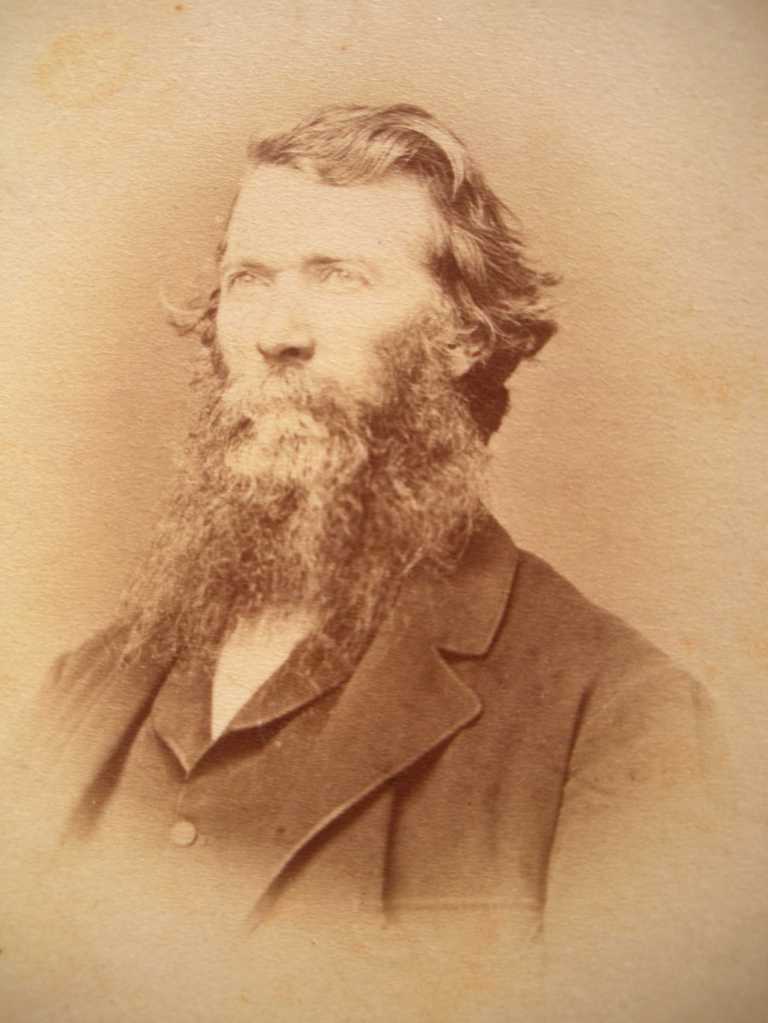
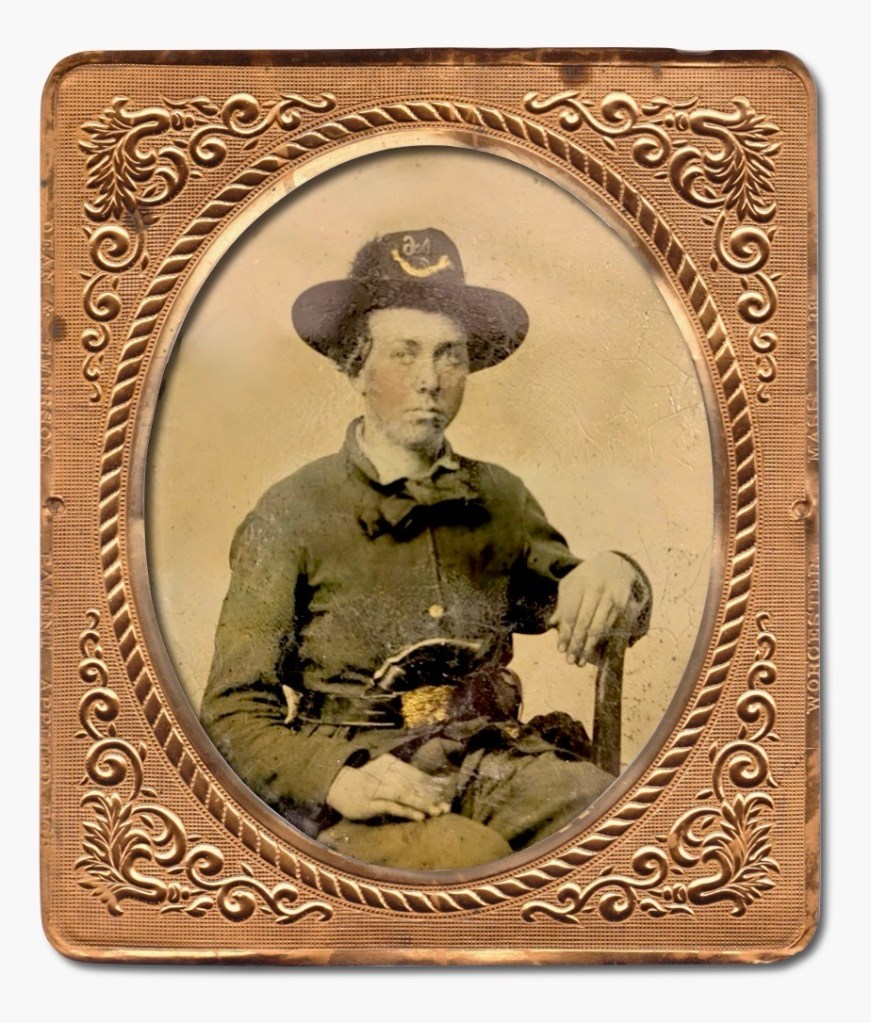
An unidentified member of the 46th Ohio (Carl Fogarty Collection)

The following letter was written by William E. Joshua (1833-1869), who came to the United States from Wales with his parents, Joseph Joshua (1810-1878) and Sarah Lewis (1813-1887) in the 1850s and resided in Newport, Campbell county, Kentucky. William enlisted as a private in Co. D, 46th Ohio Infantry on 10 September 1861. He died of disease at the City Hospital in St. Louis, Missouri, on 28 January 1863.

This letter was written just a week before the Battle of Shiloh. For a great article on the 46th Ohio and the role they played in that two-day engagement, see “Crank” Worthington’s Boys at Shiloh, published in Dan Masters’ Civil War Chronicles in 2020.

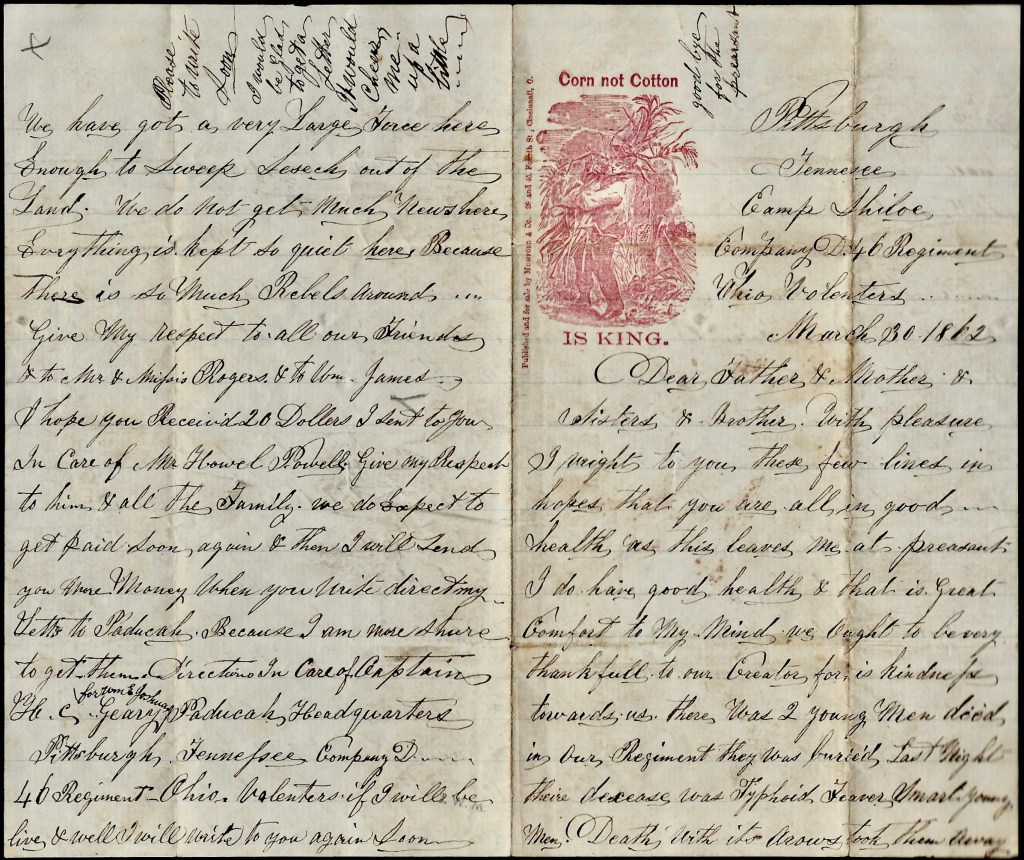
Transcription

Addressed to Mr. Samuel Moon, for Mr. Joseph Joshua, Newport, Kentucky

Pittsburg, Tennessee
Camp Shiloe [Shiloh]
Company D, 46th Regiment Ohio Volunteers
March 30, 1862

Dear Father & Mother & Sisters & Brother,

With pleasure I write to you these few lines in hopes that you are all in good health as this leaves me at present. I do have good health & that is great comfort to my mind. We ought to be very thankful to our Crestor for his kindness towards us. There was two young men died in our regiment. They was buried last night. There disease was typhoid fever—smart young men. Death with its arrows took them away to the land where there is no shot nor shell. Our band played very mournfully the Dead March. It was very striking. It’s a hard thing for a young man to die in a strange country without any parents, without relative or friends. I hope it will never come to my lot to be numbered with the dead in this country. But I hope that I shall return home safe and sound again.

Today is Sunday—the Lord’s Day. It’s a very fine day. How brightly the sun shines today. We are encamped in the wild woods of Tennessee. Our soldiers does burn the woods for miles. It looks very pretty at night. It gives a good sign that the Union brave boys are approaching. They are in camp about 18 miles from here. The name of the place is Corinth, Mississippi.

There was two young men deserted from their camp. One of them is from Cincinnati. He is a very smart young man. His name is Rice. They pressed him at New Orleans. The came in last night. They are very glad that they have come to us. They told us that the Rebels had 80 thousand men there. They said they had not much to eat. There is two railways at Corinth & we are a going to attack them some of these first days. We are waiting for General Buell’s Army to come. As soon as they come. we are going to take the junction & cut all communication from east and west so we intend to starve them out. They say after this fight the war will be at an end. I say may it be so.

We have got a very large force here—enough to sweep Secesh out of the land. We do not get much news here. Everything is kept so quiet here because there is so much Rebels around.

Give my respect to all our friends & to Mr. & Mrs. Rogers & to Wm. James. I hope you received 20 dollars I sent to you in care of Mr. Howell Powell. Give my respect to him & all the family. We do expect to get paid soon again & then I will send you more money. When you write directing letters to Paducah because I am more sure to get them. Directions: In care of Captain H[arding] C. Geary, for William E. Joshua, Paducah, Headquarters, Pittsburg, Tennessee, Company D, 46th Regiment, Ohio Volunteers. If I will be live & well, I will write to you again soon. Please to write soon. I would be glad to get a letter. It would cheer me up a little. Goodbye for the present.
1862: Mitchell Campbell Lilley to Amanda (Brooks) Lilley

The following letter was written by 43 year-old Mitchell Campbell Lilley (1819-1897), the proprietor of a moderately successful bindery and printing firm in Columbus, Ohio, at the time that civil war erupted in 1861. Having served previously in the Mexican War, and being a member of the local militia, Lilley was quick to offer his service as Captain of Co. H, 46th Ohio Volunteer Infantry (OVI). Ill health, however, forced Lilley to resign from active service in January 1863 but he returned to Columbus to command a home guard militia for the duration of the war. 

Mitchell Campbell Lilley

Following the war, Lilley convinced the Ohio General Assembly that deaf students at the state institution for the deaf could be trained in bookbinding skills which enabled him to expand his business and branch out into other endeavors, such as manufacturing and distributing fraternal regalia.

Lilley was married in 1849 at Paris, Illinois, to Amanda C. Brooks. They had 13 children, five of who died in infancy.

The 46th OVI took part in Grant’s first attempt to seize Vicksburg which was to march his army overland from La Grange, Tennessee, following the Mississippi Central Railroad south toward Vicksburg. He imagined that a supply line could be maintained from Columbus, Kentucky, but this proved impossible. Once Grant’s forces had made it as far as 35 miles south of Grand Junction, the large supply depot he had established at Holly Springs in his rear was swiftly and unexpectedly attacked by Earl Van Dorn’s Cavalry, destroying $1.5 million of supplies, capturing the Federal garrison quartered there, and destroying track and bridges. The damage inflicted by Van Dorn’s troopers caused sufficient harm for Grant to withdraw his forces to Memphis and rethink his strategy.

In this letter, Capt. Lilley describes their return to Holy Springs and what they found when they got there.

For an interesting article by my friend Dan Masters, see “Crank” Worthington’s Boys at Shiloh, published on 28 June 2020.

See also—Letter dated 31 December 1862 by Capt. Lilley from Holly Springs, Mississippi.

Transcription

Yocknapatufa, Mississippi
December 18th 1862

Dear Wife,

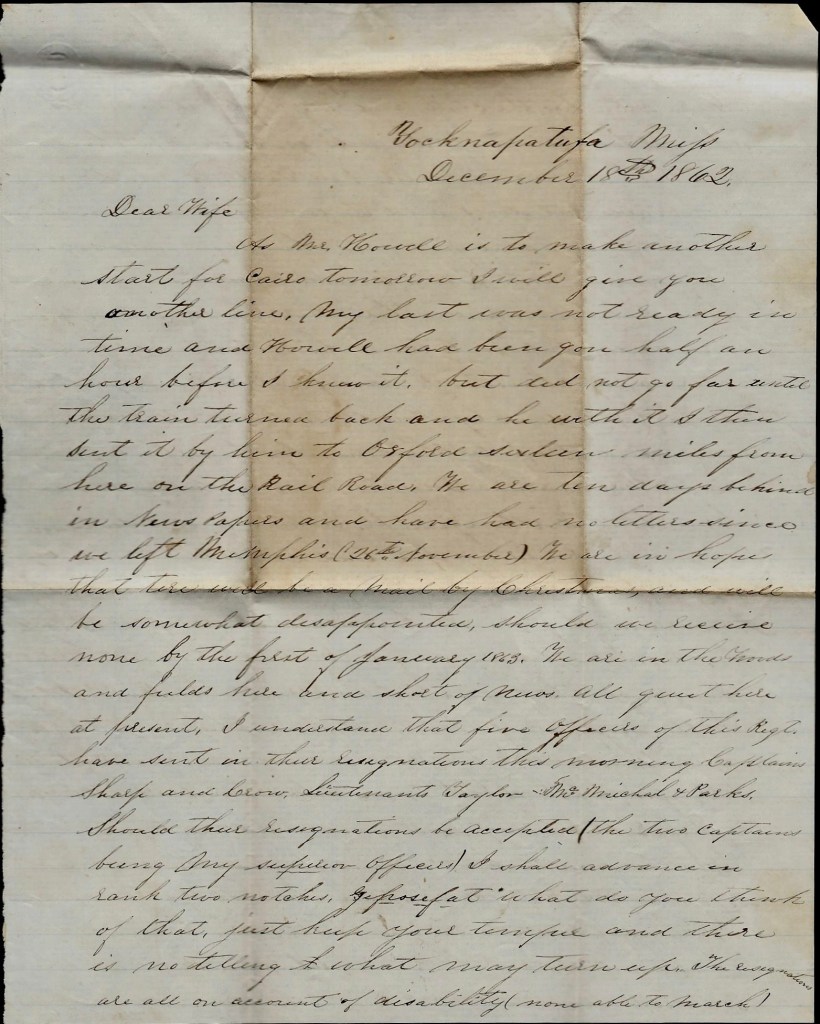
As Mr. Howell is to make another start for Cairo tomorrow, I will give you another line. My last was not ready in time and Howell had been gone half an hour before I knew it, but did not go far until the train turned back and he with it. I then sent it by him to Oxford sixteen miles from here on the railroad. We are ten days behind in newspapers and have had no letters since we left Memphis (26th November). We are in hopes that there will be a mail by Christmas and will be somewhat disappointed should we receive none by the first of January 1863.

We are in the woods and fields here and short of news. All quiet here at present. I understand that five officers of this regiment have sent in their resignations this morning—Captains [A. Grant] Sharp and [Philip A.] Crow, Lieutenants [Charles E.] Taylor, [Harrison] McMichael, and [Amos L.] Parks. Should their resignations be accepted (the two captains being my superior officers), I shall advance in rank two notches. Jehoshaphat! What do you think of that? Just keep you temper and there is no telling what may turn up. The resignations are all on account of disability (none able to march).

Our boys are all well enough to keep about. George Aston has the chills and William Taylor is lame yet with his toe but will be well in a week. John and Bub are well as usual. Our table is made of clapboards outdoors and it is a little cool on the fingers today and gives me the rheumatism in my hands, and I am troubled with it some all over in damp weather. Our cook is improving and we shall have to train him to it as that is our only chance. I have packed Henry’s clothes in a box to send by Howell to his mother. Louis can send it up by the omnibus to Worthington His mother’s name is Dolly Turk. Everybody knows her about Worthington. 1

Lt. Beckett is out superintending the building of a railroad across the creek by order of General Denver. The flat is about one mile wide and they are making a corduroy road through it. Adjutant found some relatives two miles from camp by the name of Morgan. Col. [Charles C.] Walcutt is well and all the other officers.

If you get into any trouble about horses or cows, Mr. Mosberry will tell you what is best to do with them. Send letters to Cairo and they will find us some time. There is some talk of our marching tomorrow from this camp, I suppose we will go towards Grenada. Write and give us all the news. I did not put Tom’s handkerchief in the trunk but will try and take care of it for him. Yours, — M. C. Lilly


1 I infer from the preceding paragraph that Henry Turk was the black cook brought with the regiment to cook for the officers. Henry (or Hendrick) was the 27 year-old son of Henry and Dolly Turk of Worthington, Franklin county, Ohio. Dolly and her husband had been born in Virginia—most likely former slaves. In the same paragraph that “Henry’s clothes” are mentioned, it is stated that they are training a new cook.

1865: John C. Lilley to Mitchell Campbell Lilley

The following letter was written by John C. Lilley (1842-1890) of Shelby county, Ohio. He enlisted as a corporal in September 1861 in Co. D, 46th Ohio Volunteer Infantry (OVI) but later transferred to F&S as Quartermaster Sergeant of the regiment. He mustered out of the service on 22 July 1865.

John wrote the letter to his uncle, Mitchell Campbell Lilley (1819-1897) of Columbus, Ohio, who served as a Captain of Co. H, 46th Ohio Volunteer Infantry.

After the war, John became a medical doctor and practiced medicine in Quincy, Logan county, Ohio.

Transcription

Addressed to Capt. M. C. Lilley, Company H, 46th Regt. OVI, Memphis, Tennessee

Quartermaster Office 46th Ohio V. V. I.
Thunderbolt, Georgia
January 11, 1864 [should be 1865]

Dear Uncle,

I have not received a letter from the North (that is, since we occupied Savannah). I must write anyhow. We are on the move once more. We will stop here only long enough to get boats to take us someplace above on the coast. Beaufort is thought our destination. The 17th Army Corps has already gone. This place is about 4 miles by land from Savannah on the river. It is said that Hon. E. M. Stanton is here this evening. We have heard of Butler’s safe return to Ft. Monroe—a fine thing—something that the 15th don’t do. Our chaplain arrived today. He is from Van Wert—Rev. George [Alexander] Exline. I think that he is a very good man.

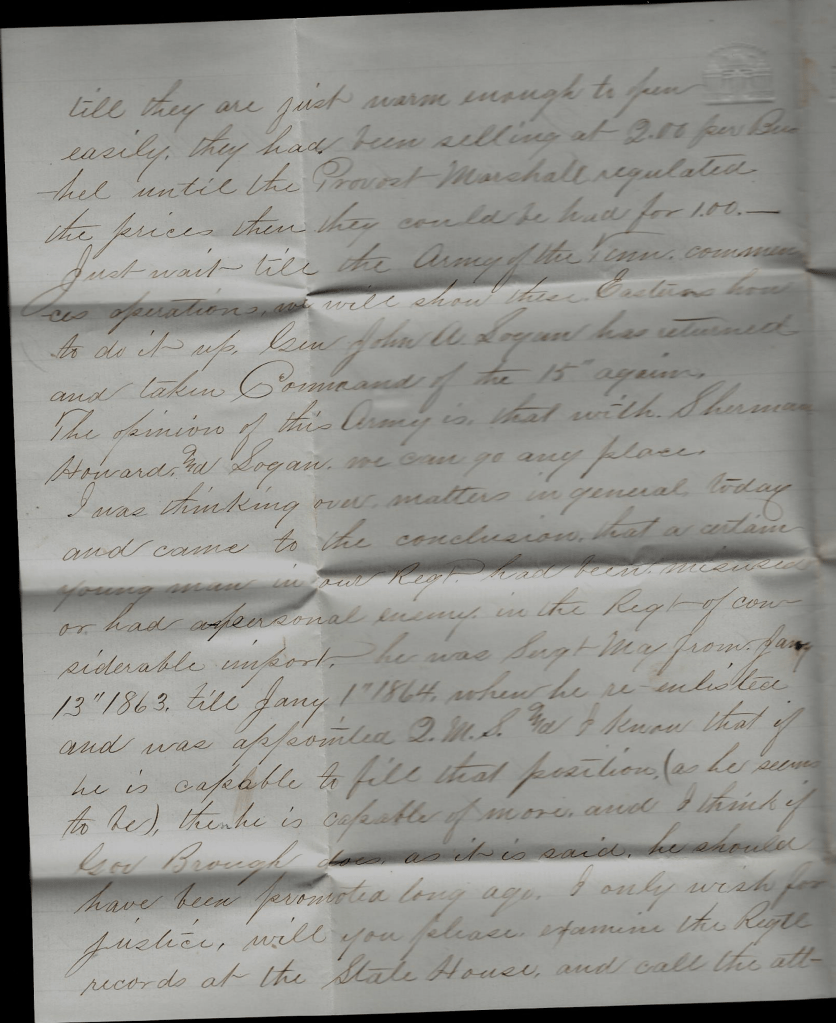
I did not have a very fine Christmas but New Years we had all the oysters we could eat—raw, friend, soup, &c. I think they are best to lay them on the fire till they are just warm enough to open easily. They had been selling at $2 per bushel until the Provost Marshal regulated the prices. They they could be had for $1.

Just wait till the Army of the Tennessee commences operations. We will show these Easterns how to do it up. Gen. John A. Logan has returned and taken command of the 15th again. The opinion of the Army is, that with Sherman, Howard, and Logan, we can go any place.

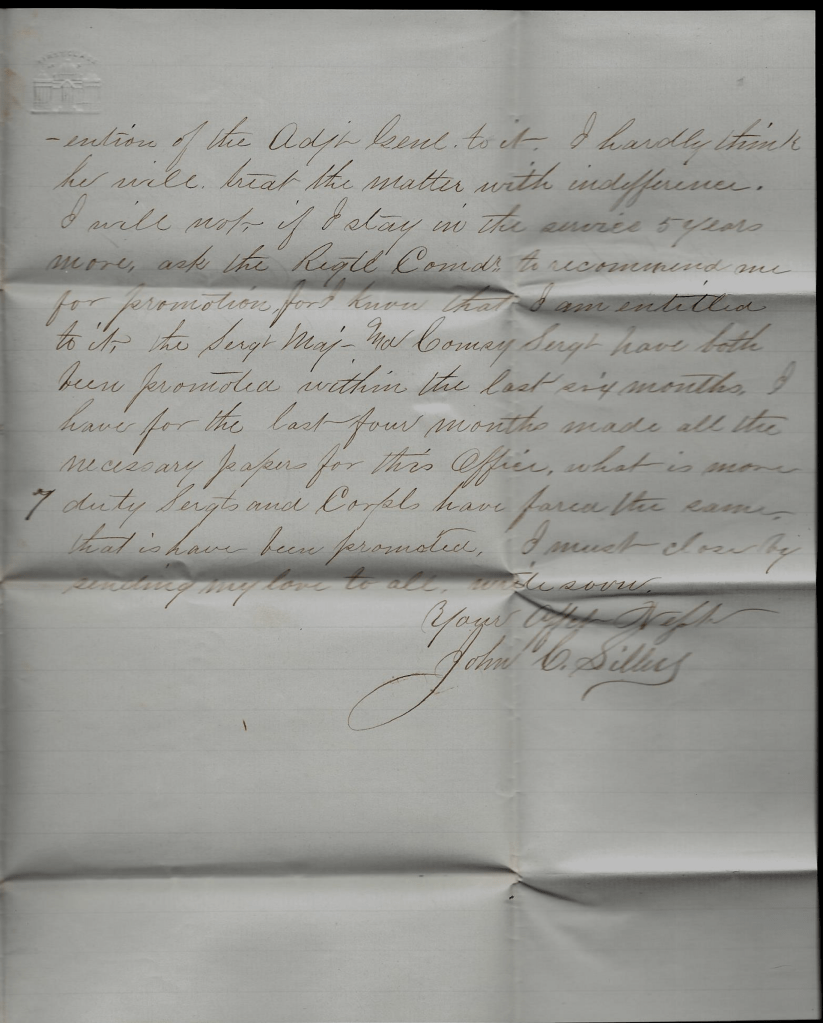
I was thinking over matters in general today and came to the conclusion that a certain young man in our regiment had been misused or had a personal enemy in the regiment of considerable import. He was Sergt. Major from January 13, 1863 till January 1, 1864 when he re-enlisted and was appointed Q. M. S. and I know that if he is capable to fill that position (as he seems to be), think he is capable of more, and I think if Gov. Brough does, as it is said, he should have been promoted long ago. I only wish for justice. Will you please examine the Regimental records at the State House and call the attention of the Adjutant General to it? I hardly think he will treat the matter with indifference. I will not, if I stay in the service 5 years more, ask the Regimental Commander to recommend me for promotion for I know that I am entitled to it. The Sergt. Major and Commissary Sergt. have both been promoted within the last six months. I have for the last four months made all the necessary papers for this office. What is more, 7 duty sergeants and corporals have fared the same—that is, have been promoted.

I must close by sending my love to all. Write soon. Your affectionate nephew, — John C. Lilley

1862: Mitchell Campbell Lilley to Amanda (Brooks) Lilley

The following letter was written by 43 year-old Mitchell Campbell Lilley (1819-1897), the proprietor of a moderately successful bindery and printing firm in Columbus, Ohio, at the time that civil war erupted in 1861. Having served previously in the Mexican War, and being a member of the local militia, Lilley was quick to offer his service as Captain of Co. H, 46th Ohio Volunteer Infantry (OVI). Ill health, however, forced Lilley to resign from active service in January 1863 but he returned to Columbus to command a home guard militia for the duration of the war.

Mitchell Campbell Lilley

Following the war, Lilley convinced the Ohio General Assembly that deaf students at the state institution for the deaf could be trained in bookbinding skills which enabled him to expand his business and branch out into other endeavors, such as manufacturing and distributing fraternal regalia.

Lilley was married in 1849 at Paris, Illinois, to Amanda C. Brooks. They had 13 children, five of who died in infancy.

The 46th OVI took part in Grant’s first attempt to seize Vicksburg which was to march his army overland from La Grange, Tennessee, following the Mississippi Central Railroad south toward Vicksburg. He imagined that a supply line could be maintained from Columbus, Kentucky, but this proved impossible. Once Grant’s forces had made it as far as 35 miles south of Grand Junction, the large supply depot he had established at Holly Springs in his rear was swiftly and unexpectedly attacked by Earl Van Dorn’s Cavalry, destroying $1.5 million of supplies, capturing the Federal garrison quartered there, and destroying track and bridges. The damage inflicted by Van Dorn’s troopers caused sufficient harm for Grant to withdraw his forces to Memphis and rethink his strategy.

In this letter, Capt. Lilley describes their return to Holy Springs and what they found when they got there.

For an interesting article by my friend Dan Masters, see “Crank” Worthington’s Boys at Shiloh, published on 28 June 2020.

[Note: This letter is from the personal collection of Greg Herr and was transcribed & published on Spared & Shared by express consent.]

Transcription

Holly Springs, Mississippi
December 31, 1862

Dear Wife,

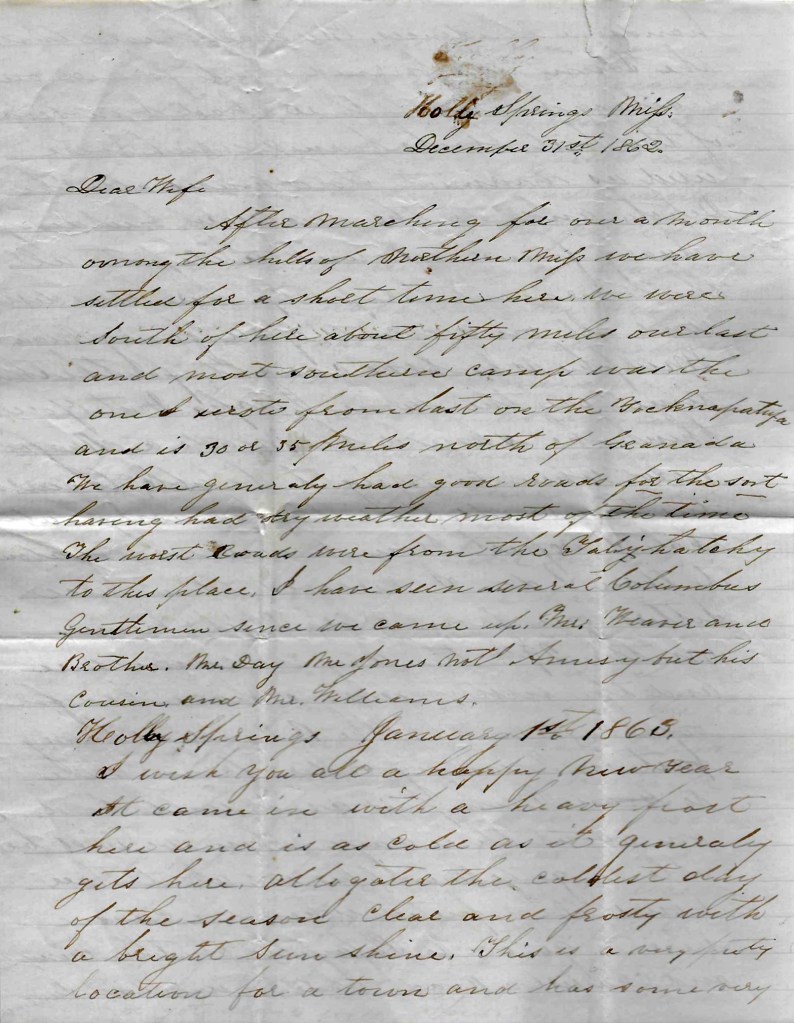
After marching for over a month among the hills of Northern Mississippi, we have settled for a short time here. We were south of here about fifty miles. Our last and most southern camp was the one I wrote from last on the Yachnapatufa and is 30 to 35 miles north of Grenada. We have generally had good roads for the sort, having had dry weather most of the time. The worst roads were from the Tallahatchie to this place. I have seen several Columbus gentlemen since we came up. Mr. Weaver and brother, Mr. Day, Mr. Jones—not Amisy but his cousin, and Mr. Williams.

Holly Springs, January 1st 1863. I wish you all a happy New Year. It came in with a heavy frost here and is as cold as it generally gets here, altogether the coldest day of the season, clear and frosty with a bright sunshine. This is a very pretty location for a town and has some very handsome residences. We had heard that the town was burned but found on reaching here that there had been several of the best blocks burned which were used as Government storehouses—also the depot, and all the necessary buildings usually found around a depot. All the government property here was destroyed and all on account of a fancy man, Col. [Robert C.] Murphy, who was caught for the third time in the same trap. Don’t you think he should be made a Major now when he might be able to surrender his thousands.

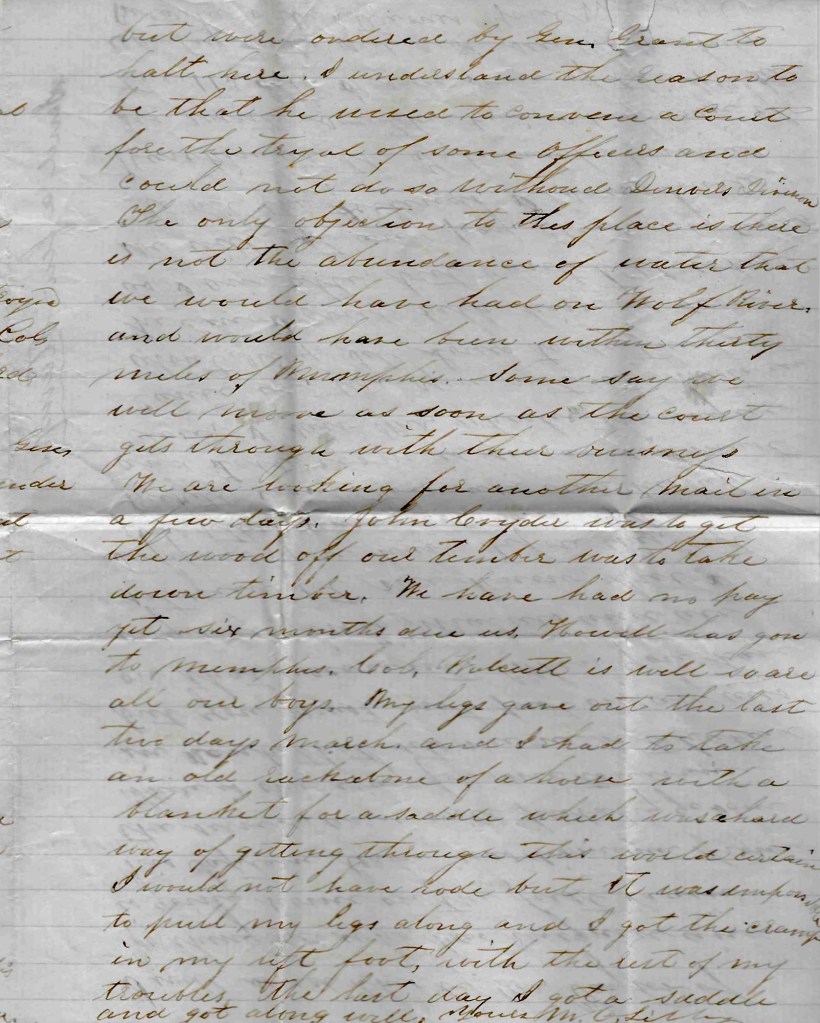
Well, talk enough about that. I expect you know more about it than I do. I received your three letters—one from Cairo, Paris, and home—on the 29th, the day we came here, and the first news we have had for over a month. The railroad is being put in running order from here to Memphis and will be done in about three days when we will be able to go to Memphis in about three hours. We expected when we came here to go on to Lafayette on the Memphis & Charleston Road where we were last summer, but we were ordered by Gen. Grant to halt here. I understood the reason to be that he wished to convene a court for the trial of some officers and could not do so without Denver’s Division. 1 The only objection to this place is there is not the abundance of water that we would have had on Wolf River, and would have been within thirty miles of Memphis. Some say we will move as soon as the court gets through with their business.

We are looking for another mail in a few days. John Cryder was to get the wood off our timber was to take down timber. We have had no pay yet—six months due us. Howell has gone to Memphis. Col. Wolcutt is well. So are all our boys. My legs gave out the last two days march and I had to take an old rackabone of a horse with a blanket for a saddle which was a hard way of getting through this world certain. I would not have rode but it was impossible to pull my legs along and I got the cramps in my left foot, with the rest of my troubles. The last day I got a saddle and got along well. Yours, — M. C. Lilley

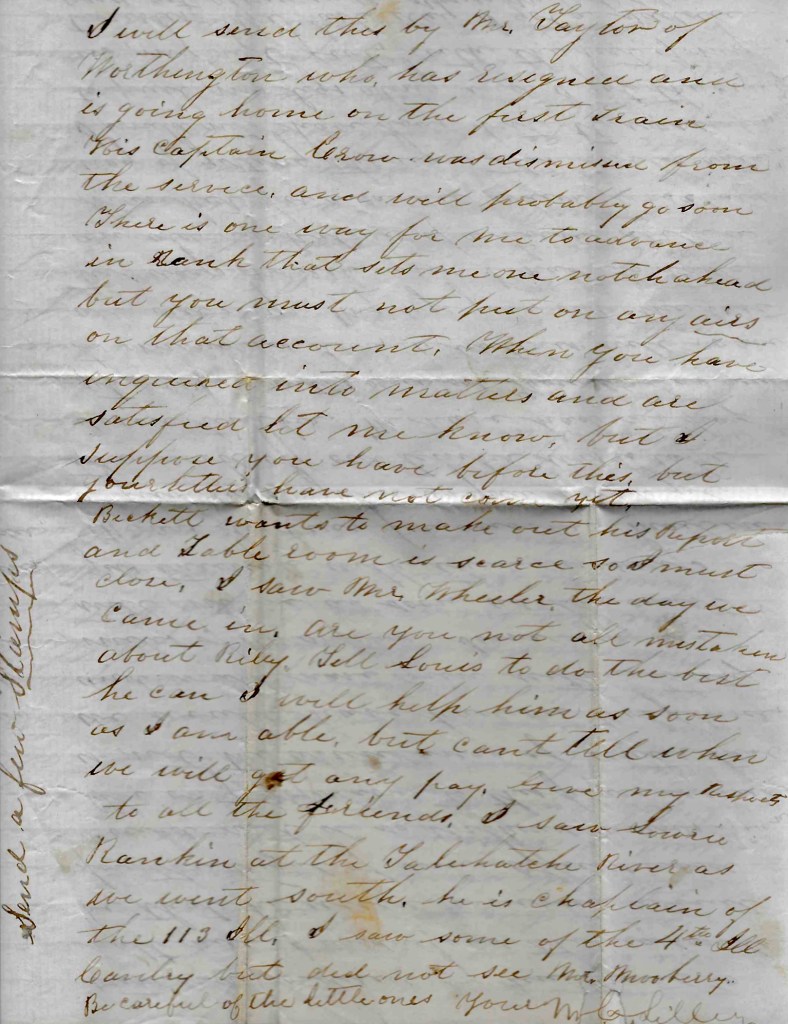
I will send this by Mr. Taylor of Worthington who has resigned and is going home on the first train. His Captain Crow was dismissed from the service and will probably go soon. There is one way for me to advance in rank. That sets me one notch ahead but you must not put on any airs on that account. When you have enquired into matters and are satisfied, let me know, but I suppose you have before this. But your letters have not come yet.

Beckett wants to make out his report and table room is scarce so I must close. I saw Mr. Wheeler the day we came in. Are you not all mistaken about Riley? Tell Louis to do the best he can. I will helm him as soon as I am able, but can’t tell when we will get any pay. Give my respects to all the friends. I saw Lowrie Rankin at the Tallahatchie River as we went south. He is chaplain of the 113th Illinois. I saw some of the 4th Illinois Cavalry but did not see Mr. Mooberry. Be careful of the little ones. Yours, — M. C. Lilley


1 Gen. James W. Denver remained in command of this brigade until about November 23, 1862 when he was given the command of one of the three divisions Sherman’s division was split into. During this period Gen. Denver and his brigade participated in the Siege of Corinth, a march to Memphis, and a brief move south with Sherman toward Holley Springs, December 5, 1862. After returning to Memphis his division transferred to Gen. Hurlbut’s XVI Corps where it was designated as the First Division. Its assignment was to guard 65 miles of the Memphis & Charelston Rail Road. He was preforming this duty when he resigned his commission March 18, 1863. He remained in his command until his replacement, Gen. William Sooy Smith, took command of the division.

1862: William Henry Brink to his Uncle

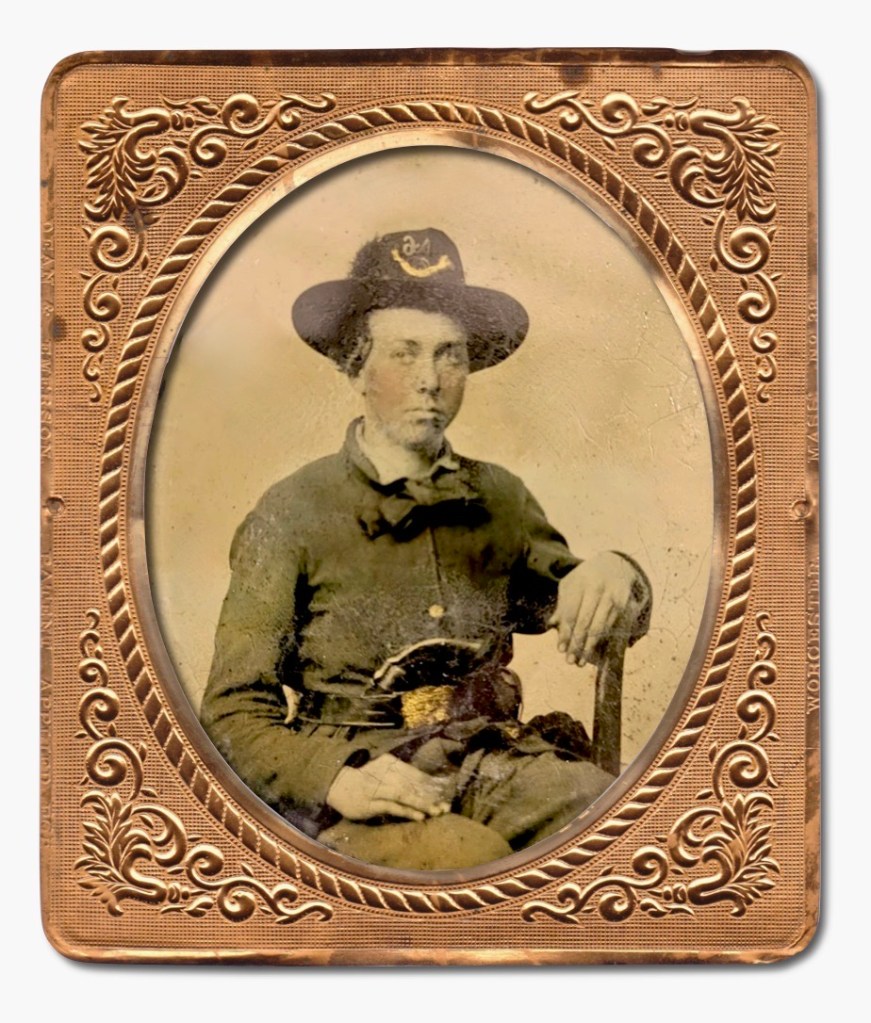
A young, unidentified member of the 46th Ohio appears ready for action. (Carl Fogarty Collection)

The following letter was written by 18 year-old William “Henry” Brink (1843-1920), the son of Calvin B. Brink (1820-1880) and Cornelia Caroline Butts (1823-1903) of Rome, Athens county, Ohio. The family moved to Coatsville, Adams county, Ohio in the 1850s. After the war, Henry married Sarah Amanda Weaver (1854-1938).

Henry enlisted in Co. B, 46th Ohio Infantry on 5 October 1861 and was with the regiment throughout the entire war, mustering out in July 1865 at Louisville, Kentucky. The regiment was organized at Camp Chase in Ohio but were ordered to Paducah, Kentucky, in mid-February 1862, and then taken to Savannah, Tennessee, where they went on an expedition to Yellow Creek, Mississippi, and then to Pittsburg Landing where they took part in the Battle of Shiloh. Following that, they marched on Corinth with Halleck’s army throughout the month of May when this letter was written.

Transcription

U.S. Camp No. 7
May the 24th 1862

Dear Uncle,

I take my pen in hand to inform you that I am well at present and hope that these few lines will find you all the same. We received our pay last week and I sent 15 dollars home. I will send the receipt to you and you can go to the same place when you want for the money.

We have not had any battle since the Battle of Pittsburg [Landing]. There has been skirmishing and I have had the chance to try my gun by myself. We are but a short distance from Corinth where we expect a hard fight. The pickets have been skirmishing five days when we came here on the 21st and put up breastworks. We worked until nearly twelve o’clock at night throwing dirt. We will move tomorrow half a mile farther and throw up some more works. There is a great many men here and our works are 17 miles long and still making them longer. There is five siege guns right close to us. They are 24 pounders and other things called a mortar ( 4 pound shells).

“We cut all the trees down as we go along and tear all the houses down and take the boards to sleep on.”

—Henry Brink, Co. B, 46th Ohio Infantry, 24 May 1862

I have written to John Walton two weeks ago today. Tell him to write. I have not had any letter for a long time. Everything looks very well here. It is a very pretty country. The apples are more than half grown as plenty of them and peaches too. But we cut all the trees down as we go along and tear all the houses down and take the boards to sleep on.

It rained very hard last night and we just had to stay out in it for we had no tents to sleep in and have not had for a month. But I must not tell you all until I get home. Write soon. Tell me how all the folks is a getting along. Tell our folks that I am well. I send my best respects to all enquiring friends—if I have any. Excuse this scribbling for it was a very bad pen. No more at present.

— Henry Brink

to Lewis Walton