Category Archives: 48th New York Infantry

1861: Henry Baker to Sallie B. Taylor

Henry Baker (1843-1911), the son of Henry Baker, Sr. (1808-Aft1860) and Anna P. (1814-Aft1860) of Hopewell, Mercer county, New Jersey, wrote the following letter in September 1861 from Wesleyan University—a Methodist affiliated college in Middletown, Connecticut. Shorty after he graduated he 1864, he was ordained a minister of the Methodist Episcopal Church and he remained in the profession for 45 years.

Henry wrote the letter to his cousin, Sarah (“Sallie”) B. Taylor (1840-18xx), the daughter of Samuel Buell Taylor (1809-1870) and Margaret Head (1812-1880) of Upper Makefield, Bucks county, Pennsylvania.

T R A N S C R I P T I O N

Addressed to Miss Sallie B. Taylor, Taylorsville, Bucks county, Penn.

Middletown [Connecticut]
Sunday afternoon, September 22, [1861]

Dear Sallie,

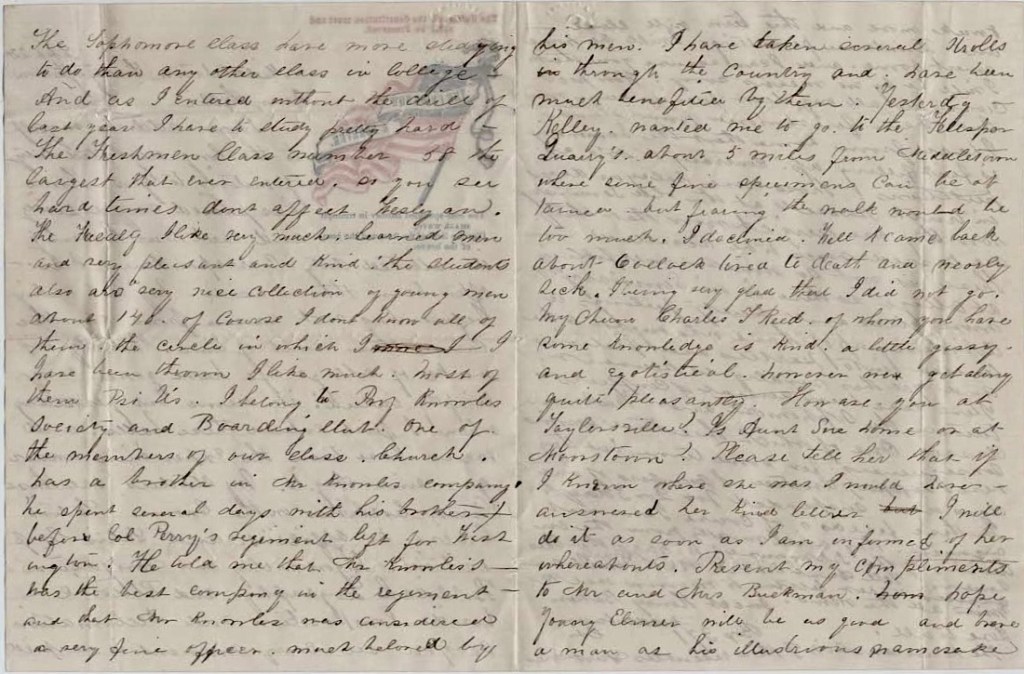
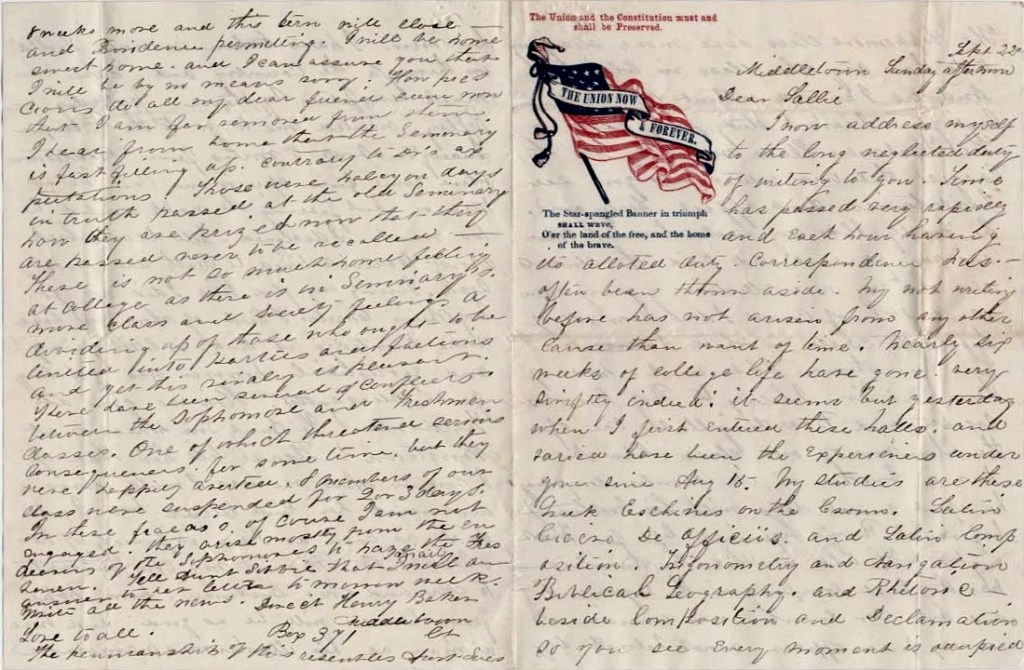
I now address myself to the long neglected duty of writing to you. Time has passed very rapidly and each hour having its allotted duty, correspondence has often been thrown aside, My not writing before has not arisen from any other cause than want of time. Nearly six weeks of college life have gone very swiftly indeed. It seems but yesterday when I first entered these halls and varied have been the experiences undergone since August 15th. My studies are these—Greek Aeschines on the Crown, Latin Cicero De Officiis, and Latin Composition, Trigonometry and Navigation Biblical Geography and Rhetoric, beside Composition and Declamation, so you see every moment is occupied.

The Sophomore class have more studying to do than any other class in college. And as I entered without the drill of last year, I have to study pretty hard. The Freshman Class number 58, the largest that ever entered. So you see hard times don’t affect Wesleyan.

The faculty I like very much—learned men and very pleasant and kind. The students also are a very nice collection of young men, about 140. Of course I don’t know all of them. The circle in which I have been thrown I like much. Most of the Psi U’s.
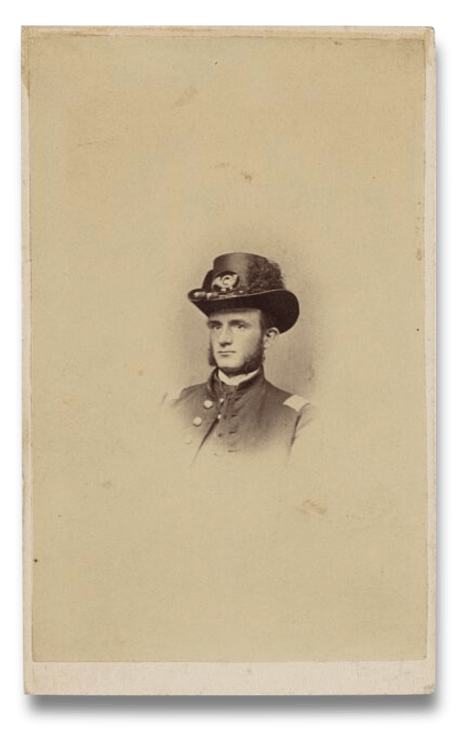
Capt. Daniel C. Knowles, Co. D, 48th N. Y. Vols.

I belong to Prof. Knowles Society and Boarding Club. One of the members of our class—[Charles Washburn] Church—has a brother in Mr. [Capt. Daniel C.] Knowles’s Company. He spent several days with his brother before Col. [James H.] Perry’s regiment [48th New York Vols.] left for Washington. He told me that Mr. Knowles’s was the best company in the regiment and that Mr. Knowles was considered a very fine officer, much beloved by his men.

I have taken several strolls through the country and have been much benefited by them. Yesterday, Kelley wanted me to go to the Feldspar [or White Rock] Quarries about five miles from Middletown where some fine specimens can be obtained, but fearing the walk would be too much, I declined. Well, Kelley came back about 6 o’clock tired to death and nearly sick, I being very glad that I did not go.

My chum, Charles T. Reed, of whom you have some knowledge is kind; a little gassy and egotistical however. We get along quite pleasantly. How are you at Taylorsville? Is Aunt Sue home or at Moorstown? Please tell her that if I knew where she was, I would have answered her kind letter. I will do it as soon as I am informed of her whereabouts. Preset my compliments to Mr. and Mrs. Buckman. Hope young Elmer will be as good and half a man as his illustrious namesake.

Eight weeks more and this term will close and Providence permitting, I will be home, sweet home, and I can assure you that I will be by no means sorry. How precious do all my dear friends seem now that I am far removed from them. I hear from home that the [Pennington] Seminary is fast filing up, contrary to Dr.’s expectations. Those were halcyon days in truth passed at the Old Seminary. How they are prized now that they are passed, never to be recalled. There is not so much home feeling at college as there is in Seminaries. More class and society feelings a dividing up of those who ought to be united into parties and factions and yet this rivalry is pleasant. There have been several of conflicts between the Sophomore and Freshman classes, one of which threatened serious consequences for some time, but they were happily averted. Eight members of our class were suspended for two or three days. In these fracas’s of course, I am not engaged. They arise mostly from the endeavors of the Sophomores to haze the Freshmen.

Tell Aunt Sybil that I will answer to her letter tomorrow week. Write all the news. Direct to Henry Baker, Box 371, Middletown, Ct.

Love to all. The penmanship of htis resembles Aunt Sue’s.
1863: George T. Conklin to Friend Emma

Pvt. Philip Daniel Hublitz of Co. D, 48th NY Infantry

The following letter was written by George T. Conklin (1839-1863) of Co. K of the 48th New York Infantry. The regiment was organized at Brooklyn in September 1861 and participated in Sherman’s South Carolina Expeditionary Corps in the spring of 1862. They began siege operations of Fort Pulaski, Georgia, that led to the bombardment and capture of the Confederate stronghold until May 1863 when this letter was penned.

George appears erroneously in the regimental roster as “George A. Conklin.” That record states that he was 22 years old when he enlisted on 9 August 1861 at Galeville to serve three years. He was initially mustered into Co. D as a private but later transferred to Co. K. That same record states that George was captured in action during the assault on Fort Wagner, South Carolina, on 18 July 1863, and that he died of disease on 11 December 1863. His father made a pension claim in 1879 for his son’s service but there was no other information provided on-line.

The history of the 48th New York says that the regiment (with the exception of Cos. G and I) left Fort Pulaski and were transported to Hilton Head where they were attached to Strong’s Brigade, 10th Corps. In the assault on Fort Wagner, the loss of the 48th was 242 killed, wounded and missing, including Col. Barton wounded and Lieut.-Col. Green killed. The regiment received high praise from the commanding officers for its gallantry in this action. Strong’s Brigade included the Black troops of the 54th Massachusetts. How poignant that George would close his letter with: “And some of us may kiss the sod before long and I might be the first. Is it not enough to make you feel sad?”

T R A N S C R I P T I O N

Fort Pulaski [Georgia]
May 3rd 1863

Dear Emma,

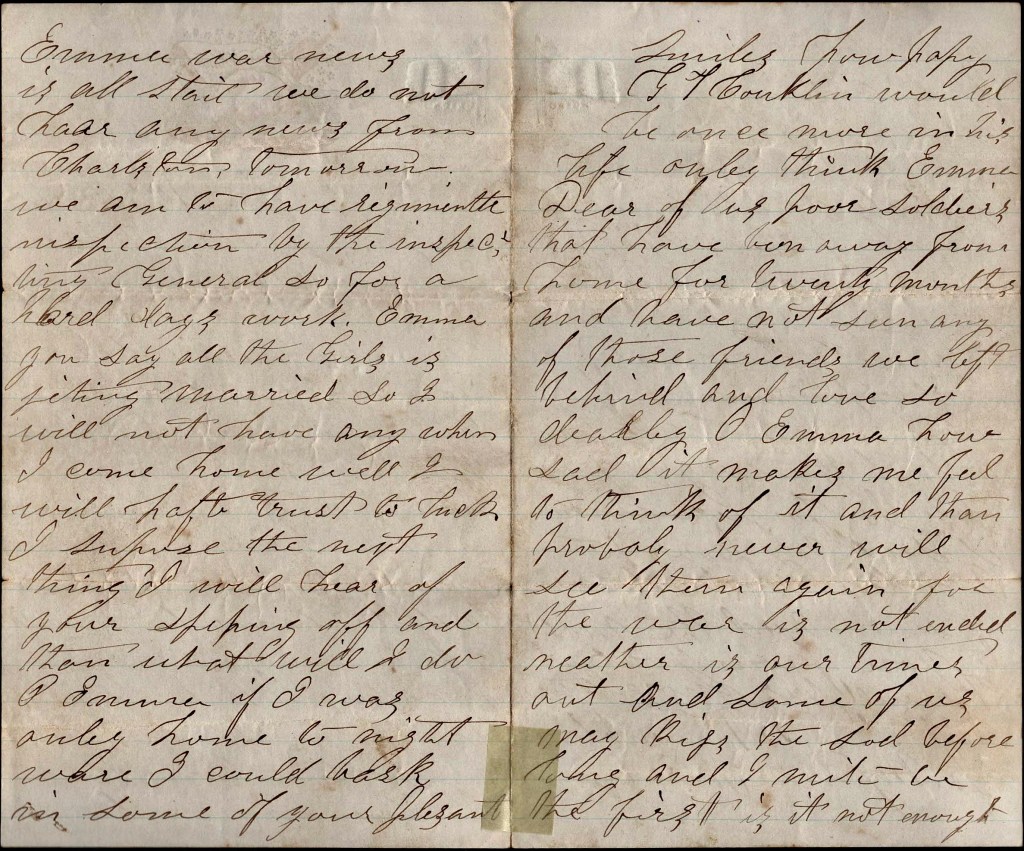
Once more I have the pleasure of answering one of your kind and welcome letters. Emma, I will send you my picture as quick as I can get it taken and I would like to have you to do the same for I would like to see your dear face once more. But would rather see the owner of the picture than the picture itself.

Emma, war news is all stale. We do not hear any news from Charleston. Tomorrow we are to have regimental inspection by the Inspector General so for a hard day’s work.

Emma, you say all the girls is getting married so I will not have any when I come home. Well I will have to trust to luck. I suppose the next thing I will hear of your stepping off and then what will I do? Oh, Emma, if I was only home tonight where I could bask in some of your pleasant smiles, how happy G. T. Conklin would be once more in his life. Only think, Emma dear, of us poor soldiers that have been away from home for twenty months and have not seen any of those friends we left behind and love so dearly. Emma, how sad it makes me feel to think of it and then probably never will see them again for the war is not ended. Neither is our times out. And some of us may kiss the sod before long and I might be the first. Is it not enough to make you feel sad?

Well, Emma, you must tell me in your letter who is getting married. Probably I will know some of them. Well, Emma, I will have to close my short letter. Excuse the writing and spelling and if I have said anything out of the way, I pray you to forgive me. I send my love to Amelia and all my friends and the most to you. From your friend—yes, more than friend, — G. T. Conklin

To my dear Miss Emma

1862: George H. Reed to his Friends

I could not find an image of George but here is one of Abraham Palmer who also served in Co. D, 48th NYSV. He was a musician and was taken prisoner in the assault of Fort Wagner on 18 July 1863. (Claudia & Al Niemiec Collection)

The following letter was written by Pvt. George H. Reed who mustered into the 48th New York Infantry at Brooklyn on 10 September 1861 when he was 23 years old. He was initially mustered into Co. C but soon after transferred to Co. D. Company C’s members were mostly Brooklyn Boys so it may be that George requested the transfer to be with his friends from Trenton in Co. D. He was discharged from the service on 22 September 1864 after three years. He was carried on the muster rolls as “Reid” but he clearly spelled his name “Reed.”

George was the son of George and Sarah (Wright) reed of Mercer county, New Jersey. He mentions the birth of a niece in the last paragraph.

“The 48th New York is one of the lesser-known regiments involved in the fight for Fort Wagner. Yet, it was a key component of the history of that campaign. Theregiment helped secure the southern tip of Morris Island during the initial Federal landing on July 10th, and was integral to the Federal grand assault on the evening of July 18th. In fact, of all the Federal regiments involved during the battles for Fort Wagner, the 48th ranks highest in terms of total number of soldiers killed. By war’s end, it would rank 17th (out of the all Union regiments) in total number of soldiers killed during its time of service.Plus, its storied history would show that the 48th New York suffered its greatest sacrifice during the fight for Fort Wagner.” [Source: “So Rudely Sepulchered: The 48th New York Volunteer Infantry Regiment During the Campaign for Charleston, July 1863,” Thesis by Luis M. Evans, University of Oklahoma]

Transcription

Daw Fuskie [Daufuskie] Island
February 10th 1862

Dear friends,

You have doubtless heard before this is my joining the army in the defense of my country. It was just five months ago yesterday since I enlisted and in that short time I have become pretty well initiated into the arts of war. When I was down to your house last summer, I had not the least idea enlisting but after I had got back to town, I was so taken with the war fever that I could not resist, but the first thing I knew after I had come to my senses was that I belonged to Uncle Sam. Since that time I have seen quite considerable of the world and have experienced some of its hardships.

The regiment that I joined was laying in Brooklyn, New York, near Hamilton. I joined on the 9th September and about the 17th we left for Washington. We had a most delightful ride in going from New York to Washington. After we had been about two weeks at the latter place, we again struck again and went to Annapolis. There we stayed about two weeks and again we was ordered to pack up for another move.

At Annapolis we was taken on board of vessels and for three weeks and two days we were kept on board. The worst part of it all was the storm at sea. The wind whistled through her rigging like a whirl wind and the rain fell in torrents, the thunder roared, the lightning flashed, and the waves ran mountain high. Our noble ship [the Empire City], she struggled hard. Every once and a while a large swell would take her and her paddle wheels would dip clear under. Two or three times the bow of the boat dipped clear under and the water would be a foot deep on deck. If you have ever seen a panorama of a storm at sea, you may have some idea of our situation at that time, but it is out of my power to give anything like a description of the scene. But we got through all right and never lost a thing.

Our regiment—which was the last to land—went ashore on Sunday, the 10th of November. We remained at Hilton Head until two weeks ago last Saturday. During our stay there we seen pretty good times. Of course we had to drill and to do some work but that only served to pass away time. Before we left there, we had the place very strongly fortified.

Where we are now, or close by, we have been building a battery where we have to work in mud and water up to our knees. The battery is intended to cut off communication between Fort Pulaski and Savannah. Our encampment is about six miles from Fort Pulaski and within 14 miles of Savannah. I am in hopes that we will be in the city before long, for ever since we came to this place we have had to work night and day and Sunday in the bargain.

When I enlisted I thought that I should get home by spring but I begin to think otherwise now for I don’t believe the war will be ended in a year yet to come. And a soldier while engaged in active warfare has but a slim chance of ever getting home until the end of the war.

How is times up your way this winter? Is there anything going on? What kind of luck did you have with your crops this year? How is John and Cad getting along? I have no doubt they were a little surprised when they heard that I had gone to war for I didn’t talk much like going when I was there. What is George driving at? Is he still working out by the year or has [he] gone to the wars. When did you see Uncle Charles’ folks last? I expect they are all fixed in their new house before this, are they not? Does Uncle Charlie drink yet as bad as ever?

I got a letter from Reuben last week. He says Druscilla’s husband is dead and buried. Mell has had a young daughter since I left. They call it Ida Violette Estella Pownall. 1 They have moved to No. 33 Broad Street, Mill Hill [Trenton, New Jersey], where they intend to keep a shop. I will now bring my letter to a close. Please write soon and give my love to all my friends. Yours truly, — George H. Reed

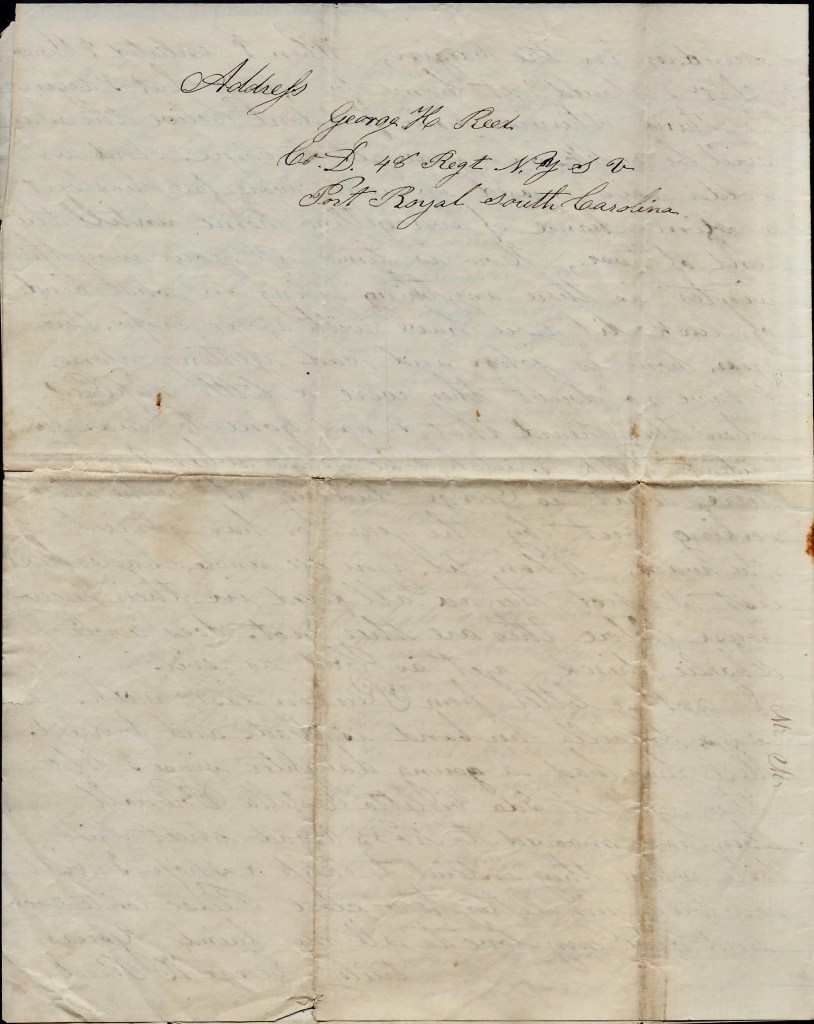
Address: George H. Reed, Co. D, 48th NYSV, Port Royal, South Carolina


1 Ida V. E. Pownall (1861-1923) was born on 10 November 1861, the daughter of Reuben Pownall (1831-1895) and Charlotte Malvina (“Mell”) Reed (1836-1898). She was married to Harry D. Beatty (1855-1936) in 1877.

1864: Rufus R. Gardner to Enoch Dingee

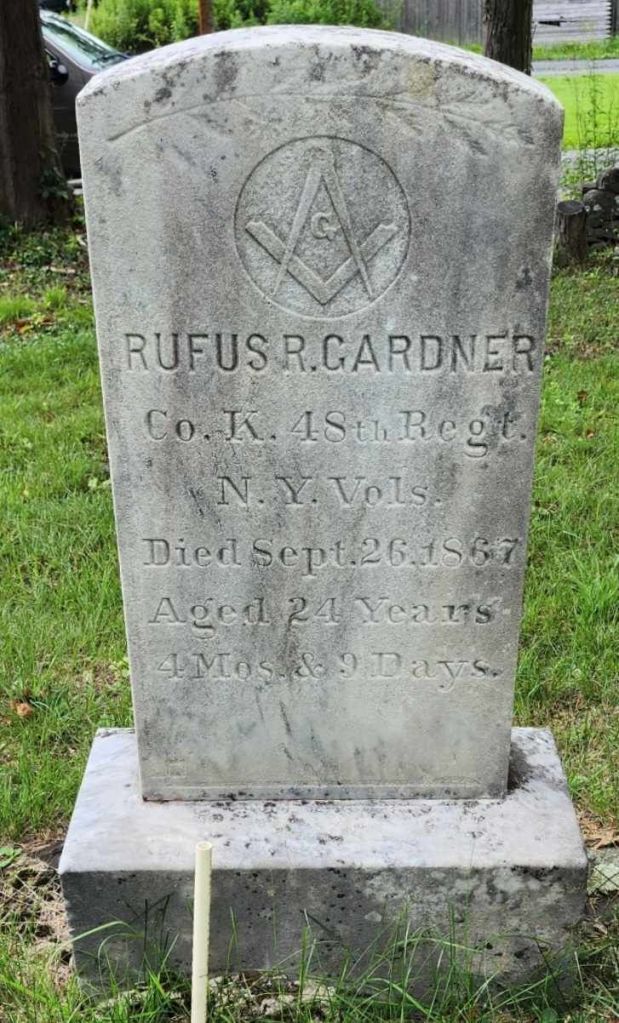
Headstone of Rufus R. Gardner

The following letter was written by Rufus R. Gardner who served as a private in Co. D, (later Co. K) in the 48th New York Infantry. Rufus was the son of Aaron B. Gardner (1812-1886) and Mary C. Belknap (1814-1846) of Newburgh, Orange county, New York. Though the regimental records indicate that Rufus was discharged for disability in July 1862, this letter proves otherwise. In all probability he was discharged in August 1864 after three years service (not having reenlisted as a veteran). He died three years later in September 1867 at the age of 24.

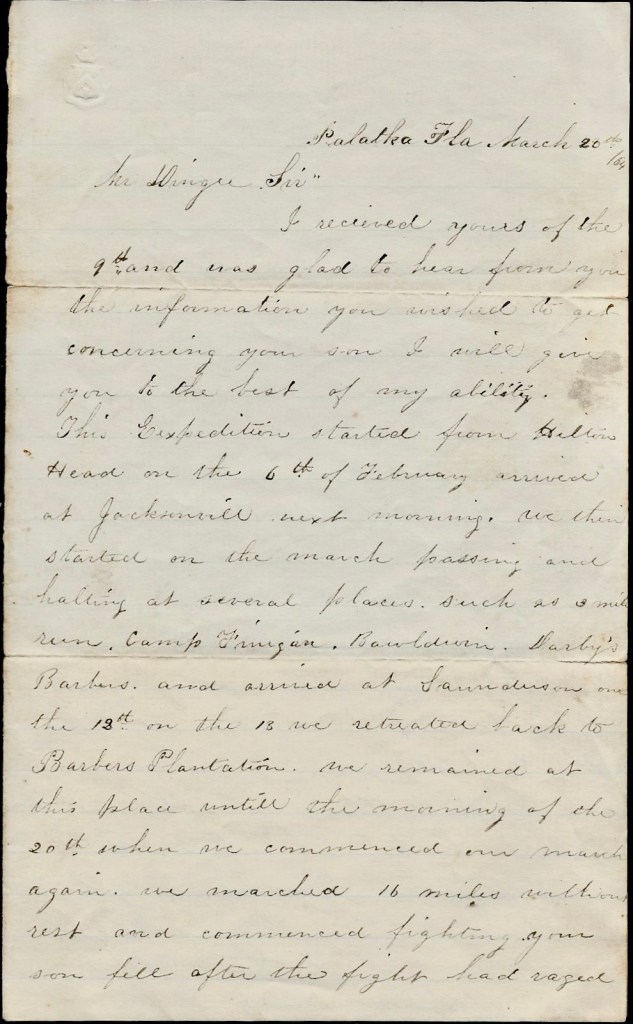
In his letter, Rufus provides 50 year-old Enoch Dingee (1814-1872) more details of his son’s death—killed on the field at the Battle of Olustee in Florida in February 1864. Enoch’s son was Hezekiah Dingee (1843-1864) who enlisted in September 1861 as a private in Co. C, 48th New York Infantry (he later transferred to Co. K). Both Rufus and Hezekiah joined and served together from the same community.

Transcription

Palatka, Florida
March 20th 1864

Mr. Dingee, Sir,

I received yours of the 9th and was glad to hear from you. The information you wished to get concerning your son, I will give you to the best of my ability.

This expedition started from Hilton Head on the 6th of February, arrived at Jacksonville next morning. We then started on the march, passing and halting at several places such as Three Mile Run [or McCoy’s Creek], Camp Finegan, Baldwin, Darby’s, Barbus, and arrived at Saunderson on the 12th. On the 13th, we retreated back to Barber’s plantation. We remained at this place until the morning of the 20th when we commenced our march again. We marched 16 miles without rest and commenced fighting.

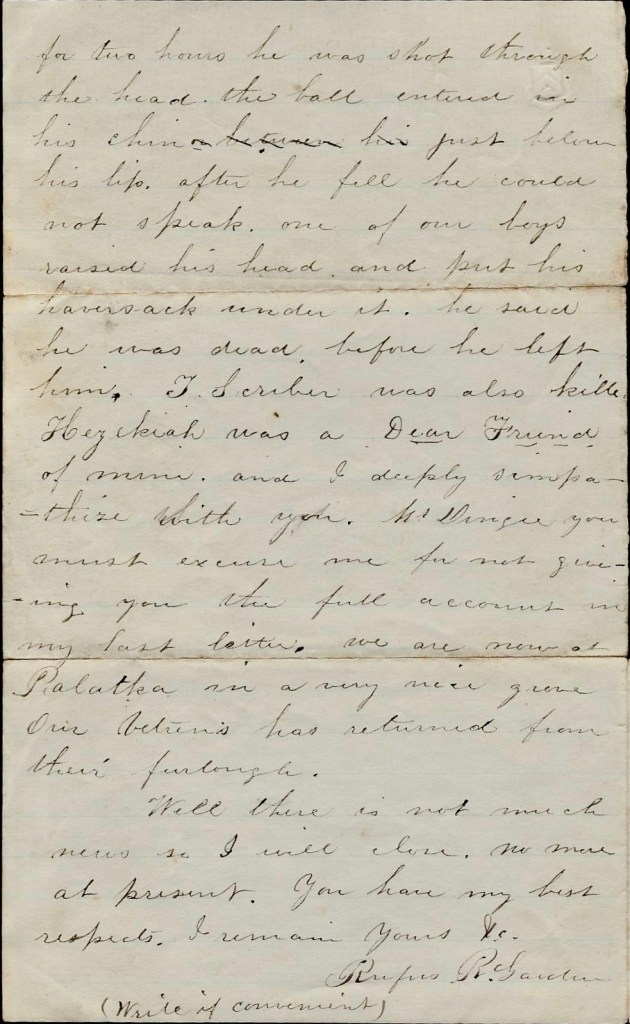
Your son fell after the fight had raged for two hours. He was shot through the head—the ball entered in his chin just below his lip. After he fell, he could not speak. One of our boys raised his head and put his haversack under it. He said he was dead before he left him. T. Scriber was also killed.

Hezekiah was a dear friend of mine and I deeply sympathize with you. Mr. Dingee, you must excuse me for not giving you the full account in my last letter. We are now at Palatka in a very nice grove. Our veterans has returned from their furlough.

Well, there is not much news so I will close. No more at present. You have my best respects. I remain yours, &c. — Rufus R. Gardner

Write if convenient.