Category Archives: 49th Ohio Infantry

1862: Rezin Shawhan Debolt to his Mother

The following letter was written by Rezin Shawhan DeBolt (1843-1927), and his older brother, Silas Debolt (1841-1924), when they served in the 49th Ohio Volunteer Infantry (OVI) during the American Civil War. They were the sons of Silas DeBolt, Sr. (1807-1895) and Betsy Parkison (1812-1893) of Tymochtee, Wyandot county, Ohio. Their older brother, George Rider DeBolt (1833-1864) also served in the same regiment as a member of Co. K with Silas. Rezen was a principal musician in Co. D, later, F&S. George died a POW at Danville Prison in Virginia in April 1864. The boys enlisted in August 1861. Silas mustered out in September 1864 after being wounded in the Battle of Picketts Mills. He had previously been a POW when captured in the Battle of Stones River. Rezin was also present in the Battle of Picketts Mills where he received an injury to the head from the concussion of an exploding shell. Although he was in hospitals in Kingston, Georgia, and Louisville, Kentucky, the injury was not adequately treated at the time, and it affected him the rest of his life, eventually resulting in the loss of sight in his right eye. His struggle with “chronic sore eyes” was recognized in affidavits by friends in his records with the federal pension office. His discharge took place at Victoria, Texas, on Nov. 30, 1865. He went home to Wyandott County, which was his legal residence until 1871. He began to teach school from 1871 to 1875 in Benton County, Mo., where he married her in 1874.

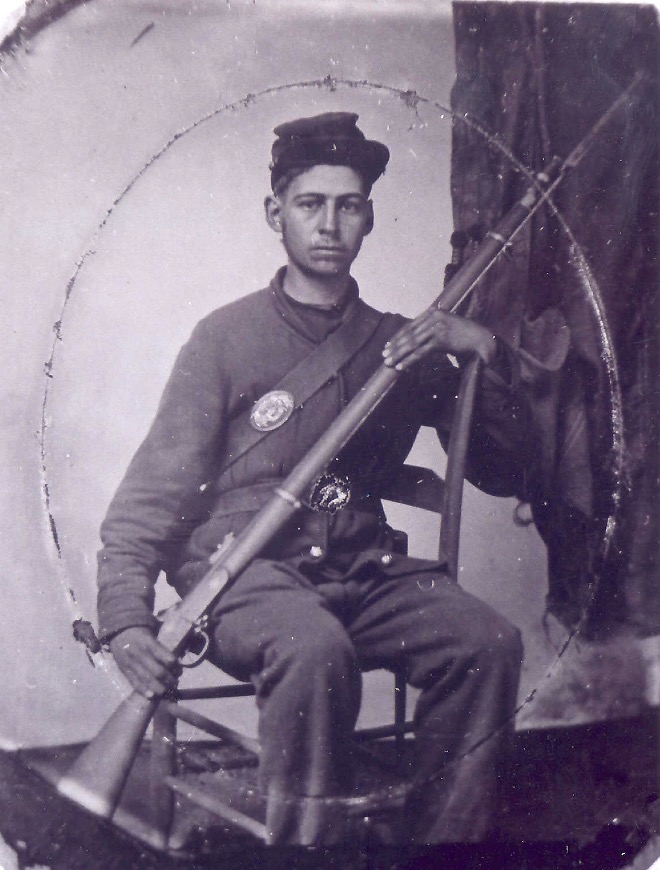
An obituary notice for Rezin appearing in the Anderson (Indiana) Herald claimed that Rezin was a “veteran bugler of 28 major conflicts in the Civil War…His record of military service included participation in the battles of Shiloh, Lookout Mountain, Chickamauga, Pickett’s Mill and Nashville. At the battle of Missionary Ridge, the intrepid bugler broke the code of military ethics by sounding “charge” against the orders of his commander and brought about victory instead of defeat.” Rezin won a citation for this action and the bugle is now a treasured relic in the Archaeological building at Ohio State University.

T R A N S C R I P T I O N

Camp on the Mississippi Valley
6 Miles from Corinth
May the 26th 1862

Dear Mother,

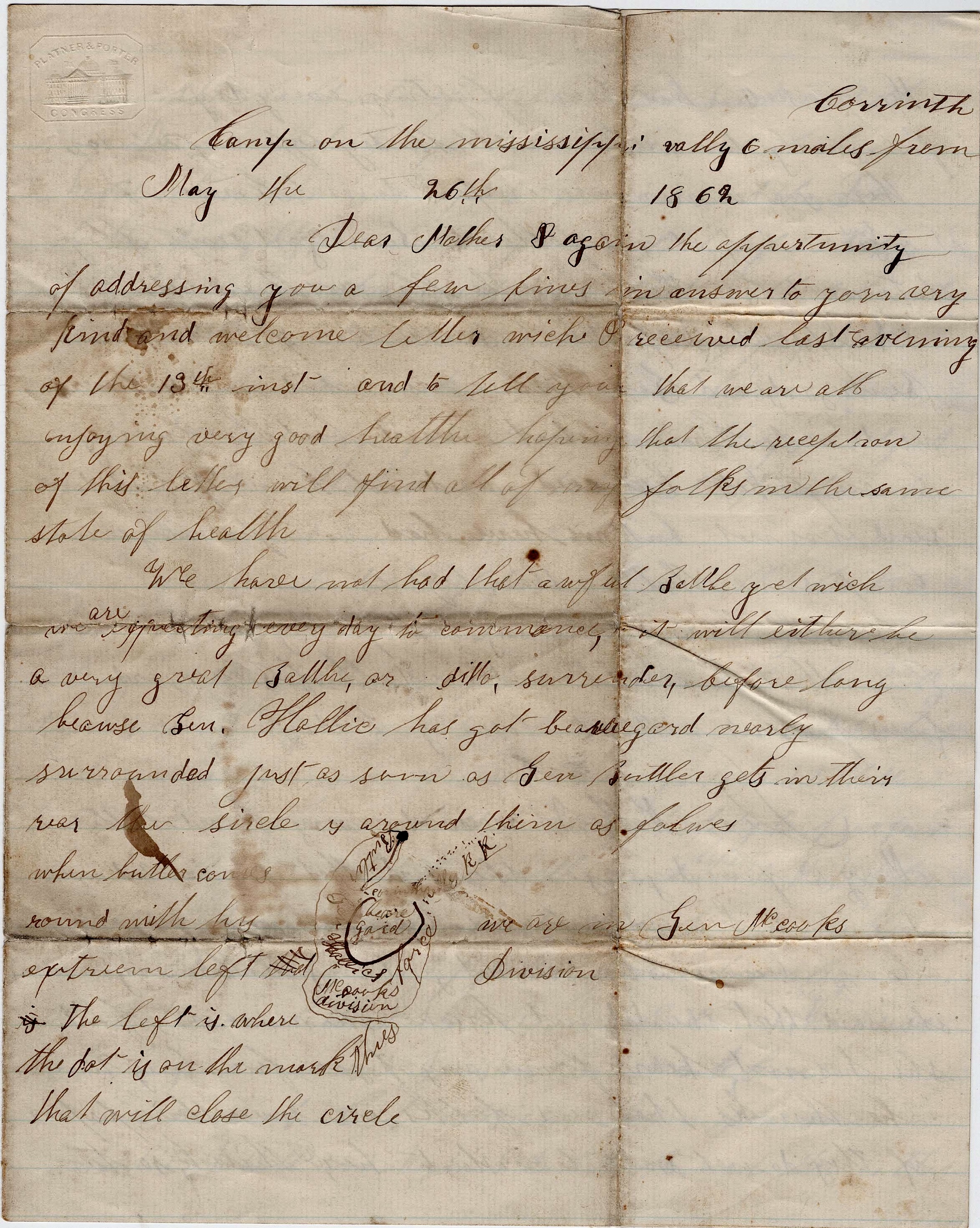
I again [have] the opportunity of addressing you a few lines in answer to your very kind and welcome letter which I received last evening of the 13th inst. and to tell you that we are all enjoying very good health, hoping that the reception of this will find all of my folks in the same state of health.
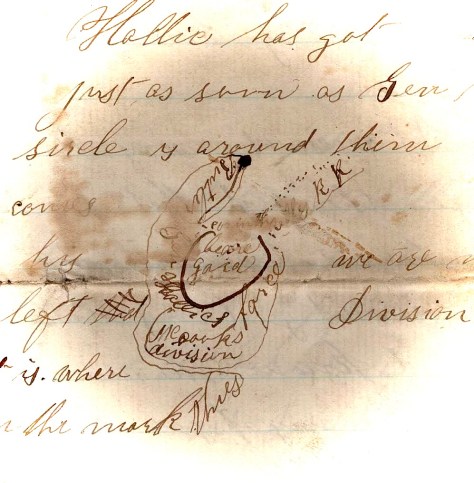
Debolt’s sketch of Union forces surrounding Beauregard in Corinth, MS, in late May 1862

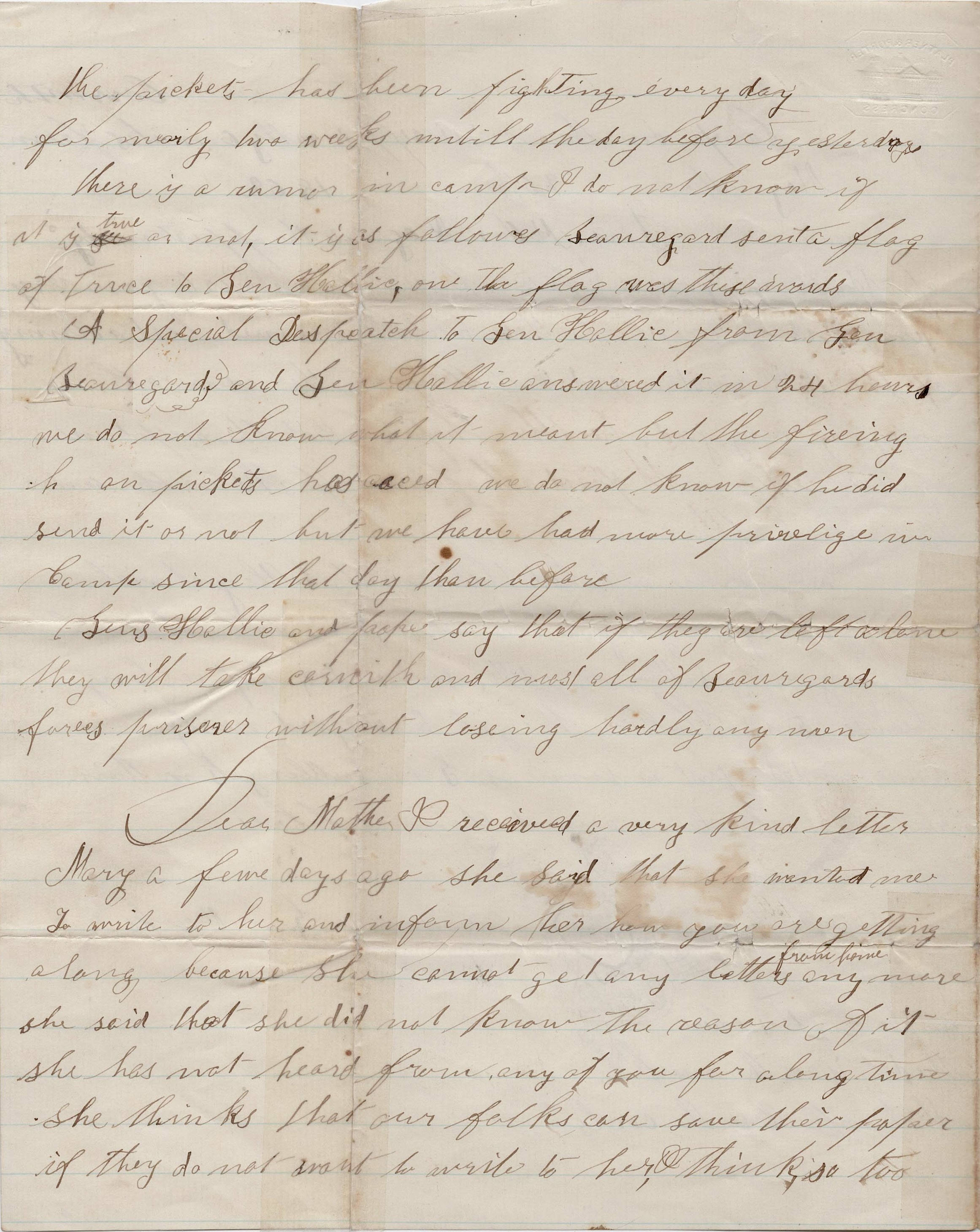
We have not had that awful battle yet which we are expecting every day to commence. It will either be a very great battle, or [ ], surrender, before long because Gen. Halleck has got Beauregard nearly surrounded. Just as soon as Gen. Butler gets in their rear the circle is around them as follows. When Butler comes round with his extreme left (the left is where the dot is on the mark), that will close the circle.

The pickets has been fighting every day for nearly two weeks until the day before yesterday. There is a rumor in camp—I do not know if it is true or not. It is as follows. Beauregard sent a flag-of-truce to Gen. Halleck. On the flag was these words, “A Special Dispatch to Gen. Halleck from Gen. Beauregard,” and Gen. Halleck answered it in 24 hours. We do not know what it meant but the firing on pickets has ceased. We do not know if he did send it or not but we have had more privilege in camp since that day than before.

Gen. Halleck and papers say that if they are left alone, they will take Corinth and most all of Beauregard’s forces prisoner without losing hardly any man.

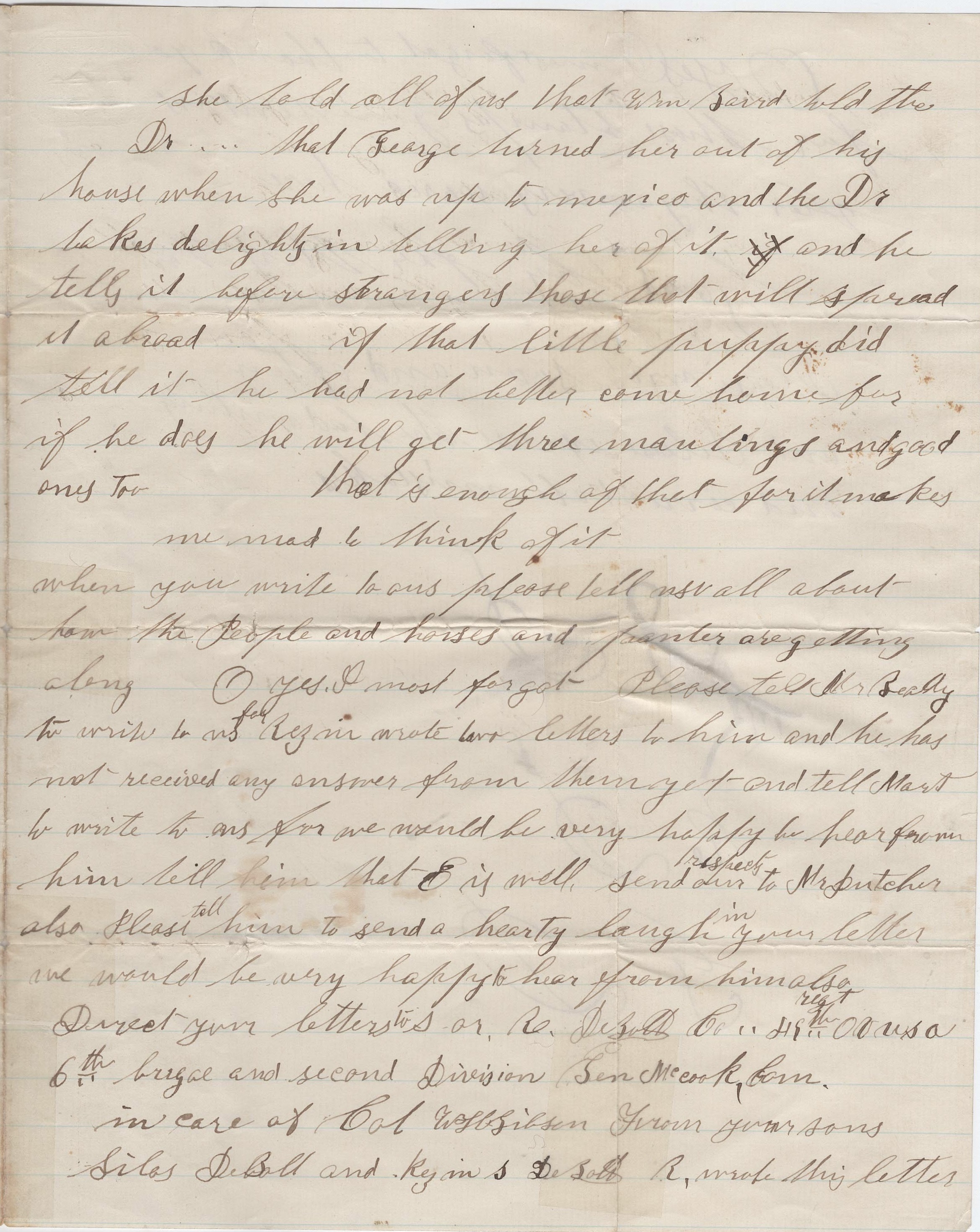
Dear Mother, I received a very kind letter [from] Mary a few days ago. She said that she wanted me to write to her and inform her how you are getting along because she cannot get any letters from home anymore. She said that she did not know the reason of it. She has not heard from any of you for a longtime. She thinks that our folks can save their paper if they do not want to write to her. I think so too. She told all of us that William Baird told the Dr. that George turned her out of his house when she was up to Mexico [Ohio] and the Dr. takes delights in telling her of it and he tells it before strangers—those that wil spread it abroad. If that little puppy did tell it, he had not better come home for if he does, he will get three maulings and good ones too. That is enough of that for it makes me mad to think of it.

When you write to us, please tell us all about how the people and horses and panter [?] are getting along. Oh yes, I most forgot. Please tell Mr. Beckly to write to us. Rezen wrote two letters to him and he has not received any answer from them yet. And tell Mart to write to us for we would be very happy to hear from him. Tell him that E. is well. Send our respects to Mr. Dutcher also. Please tell him to send a hearty laugh in your letter. We would be happy to hear from him also.

Direct your letters to S. or R. Debolt, Co. [K], 49th Ohio Volunteers, USA, 6th Brigade and 2nd Division, Gen. McCook commanding, in care of Col. W. H. Gibson.

From your sons, Silas Debolt and Rezin S. Debolt. R. wrote this letter.

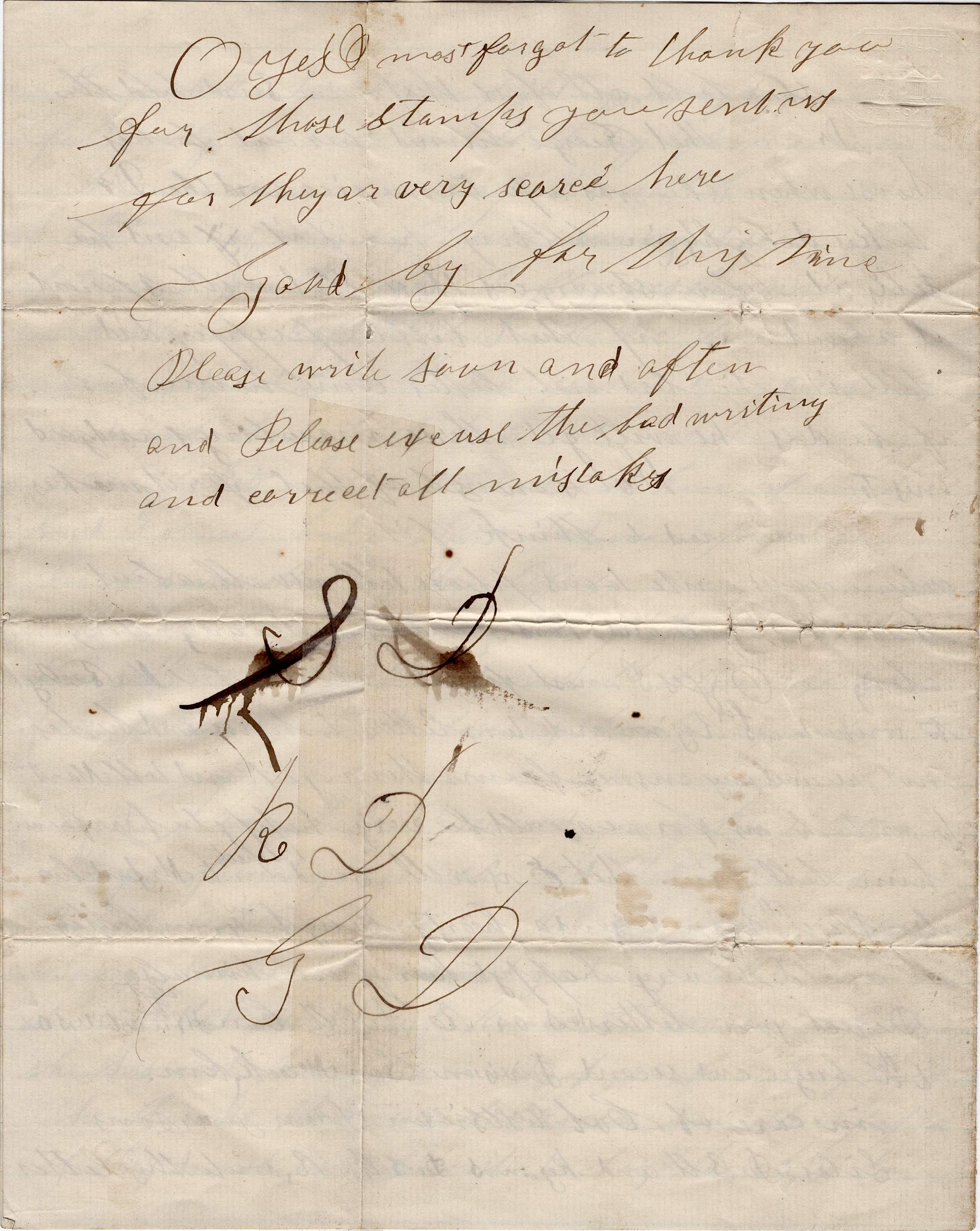
Oh yes. Most forgot to thank you for those stamps you sent us for they are very scarce here. Goodbye for this time. Please write soon and often and please excuse the bad writing and correct mistakes. — S.D., R. D., G. D.
1863: John Ingerson to Tirsa A. (Palmer) Ingerson

The following letter was written by John Ingerson (1837-1913), the son of Alvin C. Ingerson (1815-1857) and Tirza A. Palmer (1816-1895) of Sycamore, Wyandot county, Ohio. John’s obituary, published in the Marion Star on 2 July 1913, states that he was a “veteran of the Civil War who was wounded and disfigured for life in the battle of Gettysburg…when a shell hit him in the face, cutting his upper lip and terribly disfiguring him.” He served three years and eight months; was with Sherman on his march to the sea. After the war, he followed the occupation of a farmer in Sycamore. John served in Co. G though his grave marker says “Co. C.”

In this letter, John describes the Battle of Stones River to his mother, giving the names of killed and wounded. Readers are referred to Dan Master’s article entitled, “Yelling like fiends incarnate”—the opening moments of Stones River published on 3 May 2020.

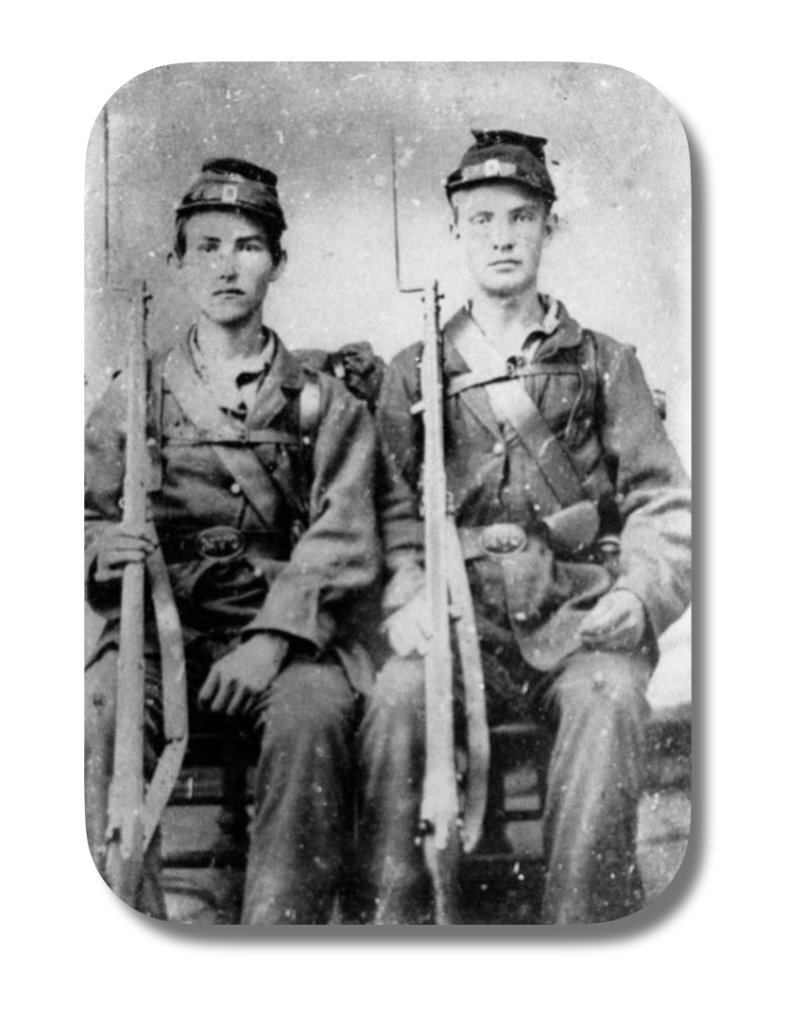
I could not find an image of John but here is a tintype of Winfield “Scott” Stevens (left) and Samuel Oscar Chamberlain (right) who were cousins and served together in Co. E, 49th Ohio Volunteer Infantry (OVI). Scott was wounded in the Battle of Stones River on 31 December 1862 and be discharged in May 1863. Samuel served out his entire term and reenlisted as a veteran.

Transcription

In camp four miles south of Murfreesboro, [Tennessee]
Monday morning, January 12th 1863

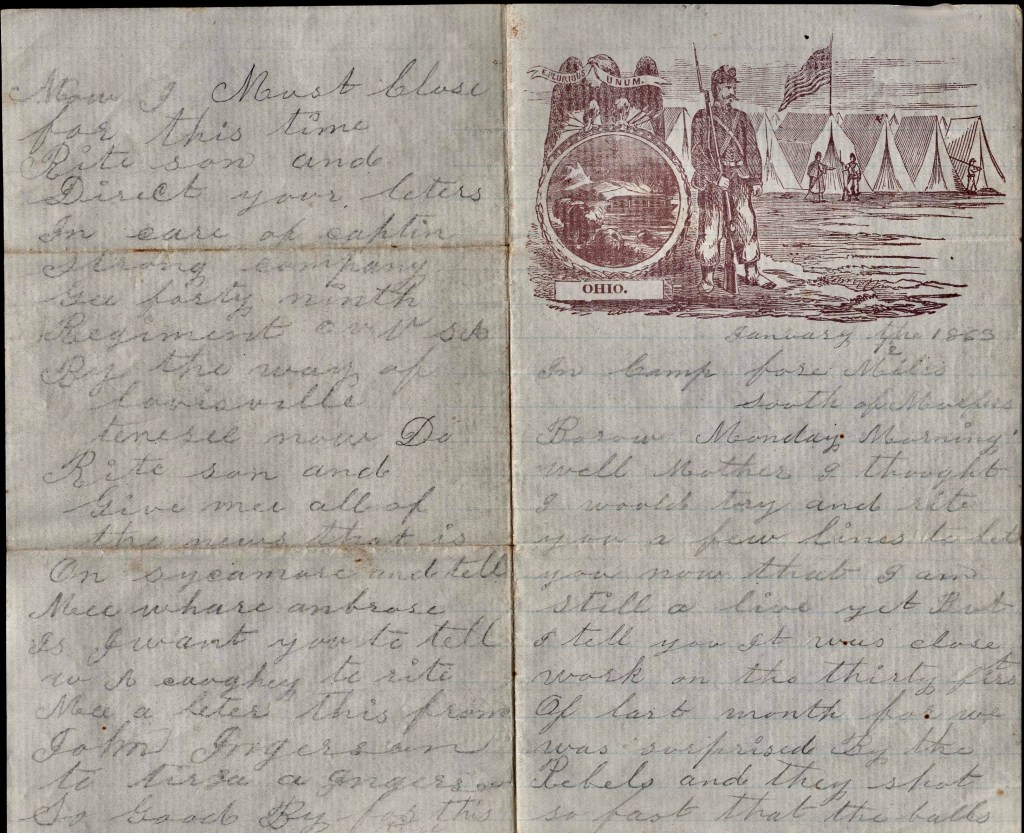
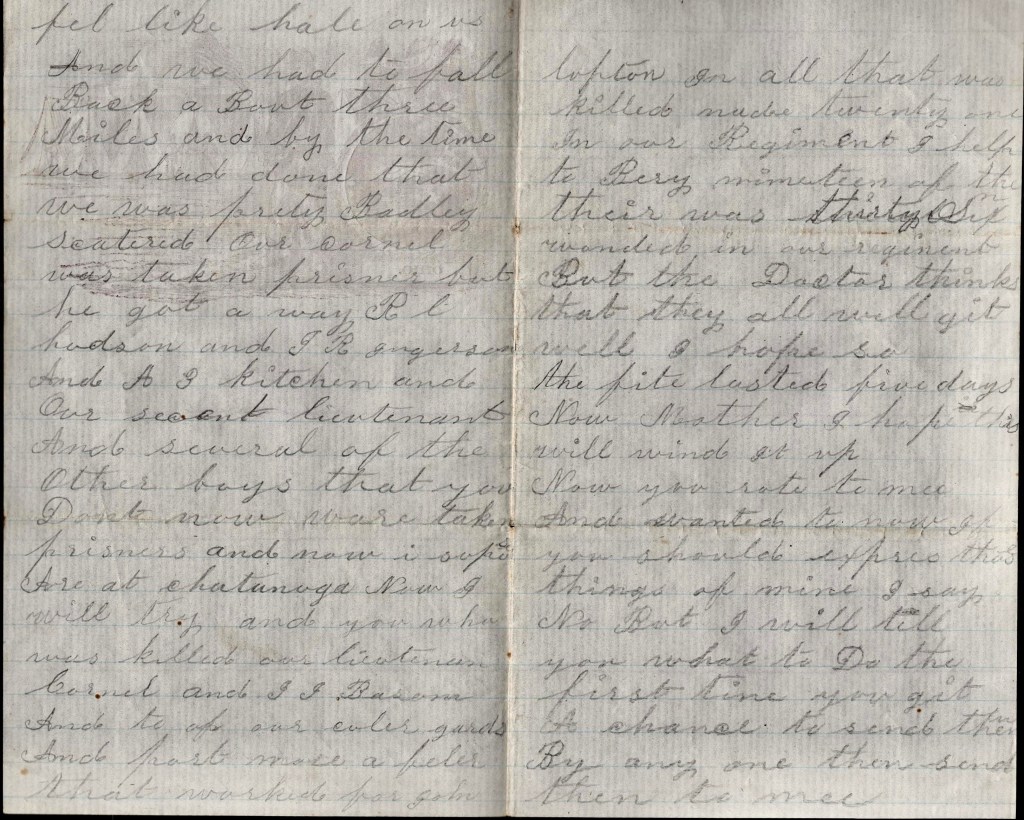
Well, Mother, I thought I would try and write you a few lines to let you know that I am still alive yet but I tell you, it was close work on the 31st of last month for we was surprised by the Rebels and they shot so fast that he balls felt like hail on us and we had to fall back about three miles and by the time we had done that, we was pretty badly scattered. Our colonel was taken prisoner but he got away. R. L. Hudson and J[ames] R. Ingerson and [Amos E.] Kitchen and our 2nd Lieutenant [Isaac H. White] and several of the other boys that you don’t know were taken prisoners and now is supposed are a Chattanooga.

Now I will try and [tell] you was killed. Our Lieutenant-Colonel [Levi Drake] and J[oseph] J. Basom and two of our color guards and Post Wate, a feller that worked for John Lofton. In all that was killed made twenty-one in our regiment. I helped to bury nineteen of them. There was thirty-six wounded in our regiment but the doctor thinks that they all will get well. I hope so.

The fight lasted five days. Now, Mother, I hope this will wind it up. You wrote to me and wanted to know if you should express those things of mine. I say no, but I will tell you what to do the first time you get a chance. Send them by anyone, then send them to me. Now I must close for this time. Write soon and direct your letters in care of Capt. [Luther M.] Strong, Company G, 49th Regiment Ohio Volunteers, USA, by the way of Louisville, Tennessee. Now do write soon and give me all of the news that is on Sycamore and tell me where Ambrose is. I want you to tell to A. Coughey to write me a letter. This from John Ingerson to Tirsa A. Ingerson. So goodbye for this time.

1861: John Ingerson to Tirza Ann (Palmer) Ingerson

An unidentified member of the 49th OVI

This letter was written by John Ingerson (1837-1913) of Sycamore, Wyandot county, Ohio. He was the son of Alvin C. Ingerson (1815-1857) and Tirza Ann Palmer (1816-1895). John was 24 years old when he enlisted in August 1861 to serve as a private in Co. G, 49th Ohio Volunteer Infantry (OVI). He survived the war but was wounded in the Battle of Pickett’s Mills, Georgia, on 27 May 1864. He was discharged for disability on 29 October 1864. [It should be noted that John’s obituary appearing in the Marion Star (Marion, OH) claimed that John was “wounded at Gettysburg when a shell hit him in the face, cutting his upper lip and terribly disfiguring him.” Since the regiment never fought at Gettysburg, the wound is presumed to have occurred at the Battle of Pickett’s Mills in Georgia. The 1890 Veteran’s Schedule claims that John’s wound was caused by a gunshot wound, not a shell.]

After the war, John returned to farming in Ohio. In 1875, he married Lydia Ann Shaffer (1839-1931)

Transcription

Camp George
December 10th 1861

Well friend Mother, I guess tonight I would write you a few lines to let you know how I am. I am well at present and so is all of the rest of the Sycamore Boys and I hope these few lines will find you the same. The 32nd had a fight yesterday and they lost eleven men and had twelve wounded and the secesh lost forty and about that many wounded. The young men killed several of their horses. There only was three companies of them against five hundred and they whipped them and made them [paper creased]…If Co. G had been with them, we would have taken eight of their cannons. The boys got two or three of their horses and several of their guns.

Now Mother, I want you to write to me and tell me all of the news that it afloat in Sycamore. I am the fattest now that I ever was in all of my life. I only weigh one hundred and sixty-five pounds. We have between 60 and 70,000 men here in the field with us and I think we will flog them nicely. I hope so.

We have plenty to eat and plenty to wear and good water to drink. I hant been sick yet and I hope I won’t get in that way. I got my pay last Monday but I don’t want you to think hard of me for not sending you some of it for I got five dollars of Daniel Hartsough to get me a pair of boots and I’d drawn five dollars off the sutler which makes ten dollars [I owed] and I have got [only] a little left and I think that will last me for a good while. We will draw pay again in twenty days and then I will send all of that to you for I shan’t need it.

So now I must stop writing for this time. Write soon and direct your letters in the care of Capt. [Luther M.] Strong, 49th Regiment, OV, USA. by the way of Louisville, Kentucky.

This from John Ingerson

To Tirza Ann Ingerson