Category Archives: 4th Iowa Cavalry

1863: Cordelia Havens to Hospital Surgeon

The following distressing letter was written by 37 year-old Cordelia [Scovell] Havens (1826-1898), the wife of Thomas Havens (1812-1875) whom she married after her first husband, James Jameson (1819-1845) died in 1845. Cordelia and her 2nd husband moved to Henry county, Iowa, in 1854 and to Cherokee county, Kansas in 1866. Her letter implores of an unidentified hospital surgeon the fate of the only son by her first marriage—Harlan J. Jameson (1843-1886). I believe the letter was sent to Annapolis, Maryland, where paroled soldiers were exchanged.

Harlan Jameson enlisted as a private when he was 18 years old in Co. K, 4th Iowa Cavalry. He was mustered into service on 25 November 1861 and was taken prisoner at Bear Creek, Mississippi, on 22 June 1863. He was exchanged and returned to service on 14 October 1863 at Vicksburg. He mustered out of the regiment on 4 December 1864 when his term of service expired.

Harlan J. Jameson, Co. K, 4th Iowa Cavalry
Iowa Civil War Images

Harlan’s obituary, published in the Cherokee Sentinel on 21 January 1887, claims that he was seriously wounded in the Battle of Helena (Arkansas) and “subsequently captured and carried to Castle Thunder and Libby prison in which places he was confined for nine months, when he was exchanged and again joined his command and served till the expiration of his term of service in December, 1864, at which time he received an honorable discharge.” Clearly there is a discrepancy between the military record and the obituary record, and I’m inclined to believe the obituary was fabricated out of half-truths and exaggerated tales told by the old warrior, especially given that Co. K was, indeed, on Hill’s Plantation near Bear Creek on 22 June 1863. On page 557 of his book, The Story of a Cavalry Regiment, William Force Scott informs us that Harlan was among several men of the 4th Iowa Cavalry captured, exchanged, and returned to service in October 1863. While he may have been sent to Richmond as a POW, he did not languish there for nine months.

Harlan met his death by falling from the tramway at the Cherokee coal shaft, where he was employed as night watchman and while in the discharge of duty, between 10 and 11 o’clock at night Jan. 17th, 1887.

Letter 1

Mt. Pleasant, Iowa
August the 2nd, 1863

Mr. Hospital Surgeon,

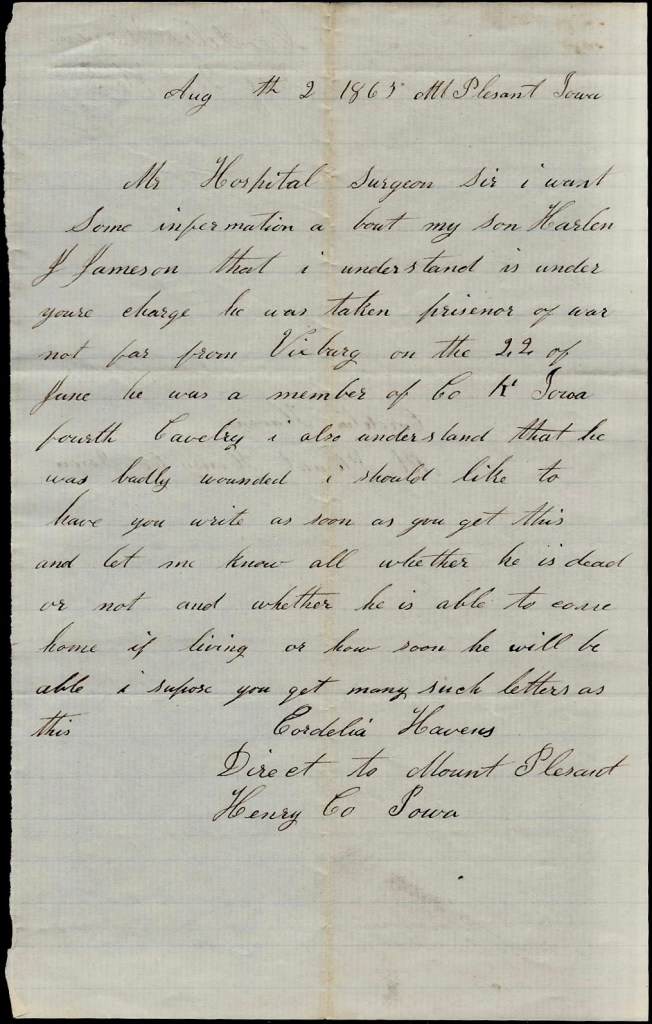
Sir, I want some information about my son Harlen J. Jameson that I understand is under your charge. He was taken prisoner of war not far from Vicksburg on the 22nd of June. He was a member of Co. K, Iowa Fourth Cavalry. I also understand that he was badly wounded. I should like to have you write as soon as you get this and let me know all—whether he is dead or not, and whether he is able to come home if living, or how soon he will be able.

I suppose you get many such letters as this. — Cordelia Havens

Direct to Mount Pleasant, Henry county, Iowa

Letter 2

Mt. Pleasant, Iowa
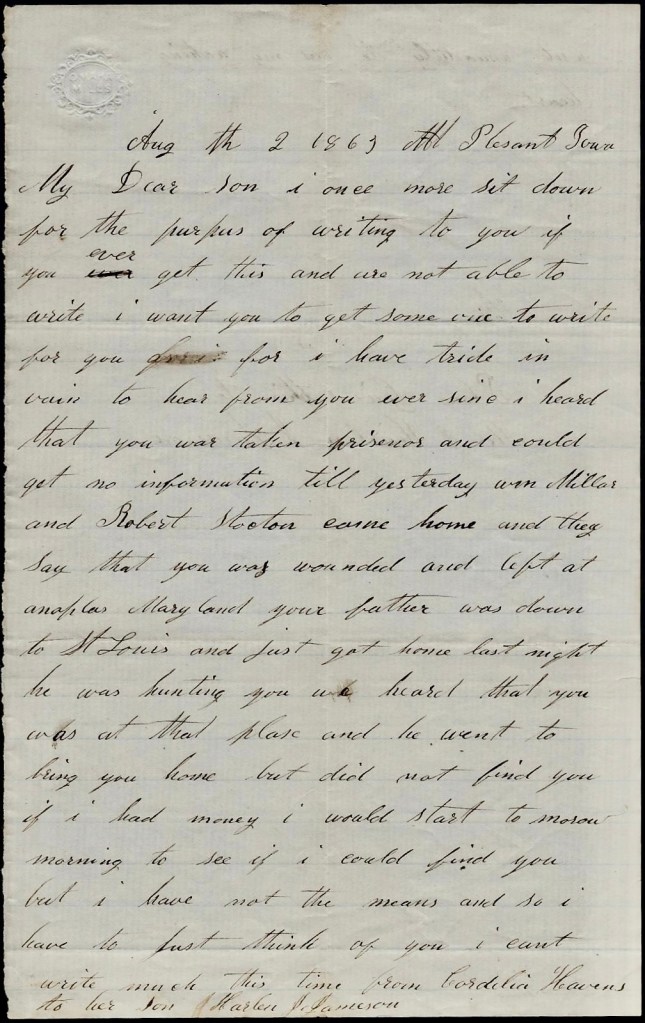
August 2nd 1863

My Dear Son,

I once more sit down for the purpose of writing to you—if you ever get this—and are not able to write, I want you to get someone to write for you for I have tried in vain to hear from you ever since I heard that you were taken prisoner and could get no information till yesterday when [William] Miller and Robert [S.] Stockton came home and they say that you was wounded and left at Annapolis, Maryland.

Your father was down to St. Louis and just got home last night. He was hunting you. We heard that you was at that place and he went to bring you home but did not find you. If I had money, I would start tomorrow morning to see if I could find you but I have not the means and so I have to just think of you. I can’t write much this time.

From Cordelia Havens

to her son Harlan J. Jameson
1864: Isaac Harry Botkin to William Lowery

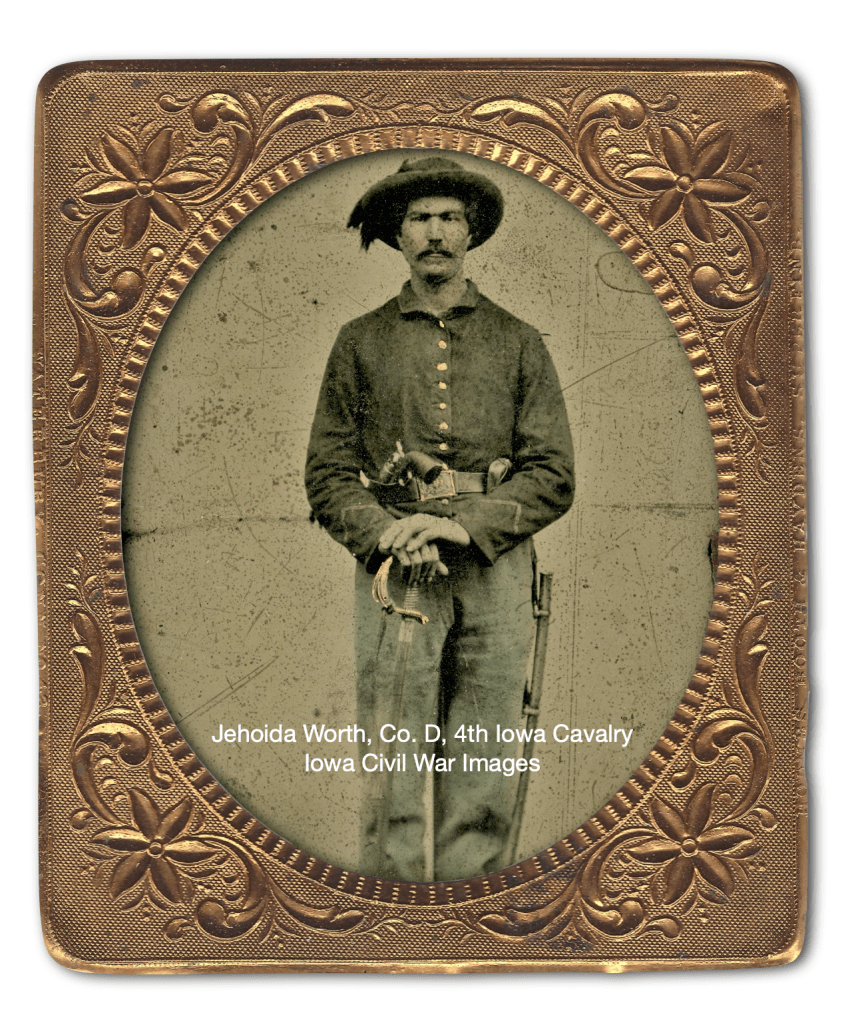
I couldn’t find an image of Isaac in uniform but here is Jehoida Worth of Co. D, 4th Iowa Cavalry.

The following letter was written by Isaac Harry Botkin (1834-1922), the son of Robert C. Botkin (1791-1863) and Rachel Vernon (1796-1841). Isaac was living in Mt. Pleasant, Henry county, Iowa, when he enlisted as a Private in Co. C of the 4th Iowa Cavalry on Oct 15, 1861. He was mustered into federal service on Nov 25, 1861, and appointed as 4th Corporal. During his term of service, Botkin was promoted to 3rd Corporal on Feb 1, 1862; to 2nd Corporal on Feb 25, 1862; to 1st Corporal on Sept 1, 1862; to 6th Sergeant on June 10, 1863; to 2nd Sergeant on Feb 9, 1864; and finally commissioned as the 1st Lieutenant of Co. I of the 4th Iowa Cavalry on Feb 18, 1865.

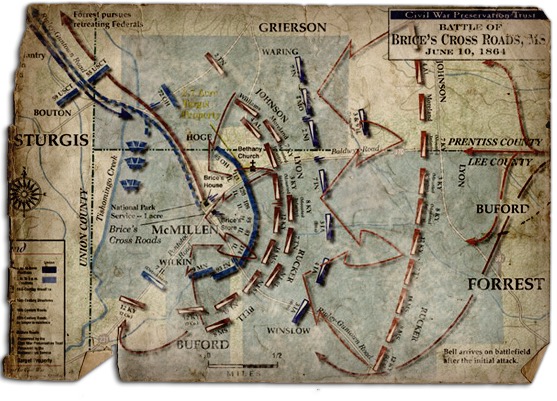
Isaac’s letter gives us a good description of Brig. Gen. Samuel D. Sturgis’s June 1864 expedition from Memphis down into Mississippi hoping to cut the Mobile & Ohio Railroad and proceed on as far as Mobile, if possible. The expedition was a disaster. Though Isaac claimed they were outnumbered 2:1, Maj. Gen. Nathan B. Forrest with only 3,500 cavalry were successful in turning back Sturgis who had 4,800 infantry and 3,300 cavalry with him—odds that favored the Federal force by nearly 3:1. Sturgis and his men retreated all the way back to Memphis, losing men and military supplies all the way. The fight came to be known as the Battle of Brice’s Cross Roads or the Battle of Guntown.

Several years ago I transcribed the diary of Lot Abraham who served in Co. D of the 4th Iowa. His diary entries for the day of the battle, June 10, and the day after read as follows:

Friday, 10. Moved out early. Went 10 miles & met the Rebels at 11 o’clock A.M. 1st Brigade of Cavalry went in 1st. We went in about noon & there in that thick brush at Brice’s cross roads [we] witnessed sights & heard noises that will never be forgotten. Infantry got cut all to pieces. Had our artillery taken & was in full retreat at sundown. Badly whipped.

June, Saturday, 11, 1864. A ruined army retreated all night. Lost all our train. Abandoned all artillery that was not taken [by the enemy] & could see nothing but confusion & rout. Rebels come up with us at daylight. Four hit hard in Ripley & got routed. They passed us hard, took all the infantry, then we come faster. All I knew how & kept the 1st Battalion together (except Co. A). The boys done well. The Rebels gave up the chase at dark.

Transcription

Memphis, Tennessee
June 21st [1864]

Mr. William Lowery

Sir, being anxious to hear from that quarter, I thought I would drop you a few lines. I was reading a speech made by the traitor [Clement] Vallindigham 1 and was surprised to hear of his being back there again [in Ohio]. There is considerable talk in our regiment about it and I think the people of Ohio ought to do something with him immediately. He has come back on no other purpose but to raise another disturbance this fall and I am in hopes some soldier will shoot him. He has done more harm to our cause than Jefferson Davis himself and [I] say let him suffer a traitor’s doom. Well, I close on that subject.

I had a very pleasant trip from there back to the army again. Our regiment did not have a man that stayed over his time. All was prompt to return at their appointed time.

We have been moving ever since we came back into the field. We have just returned from the Expedition under General [Samuel D.] Sturgis. There was about eight thousand troops started from here to cut the Mobile and Ohio Railroad and to drive Forrest out of the country. Well we moved along without being molested until we came within five miles of the railroad where the enemy met us. I suppose they had been preparing for us and the met us in the morning about ten with about two to one. The fight lasted until dark. Our forces was rather worsted and retreated that night. The enemy followed in full force. We lost considerable in wagons and prisoners and some artillery. We fought the enemy all the way back to Memphis.

A. J. Smith is here now and is building the railroad from here to Corinth and is in command of the army and tomorrow we will move on the enemy again in the direction of Tupelo, Mississippi. I suppose you will hear from us soon again. The boys are anxious to give Forrest another fight and I think we will clean him out this time. Our company lost thirteen men killed and wounded—two killed dead, the rest badly wounded. We went into the fight dismounted and stayed there until the retreat was ordered.

I will close by saying do something with Vallandigham. Do not let him raise another fuss this fall.

Give my love to all and if I come back safe this time, I will write again. Yours, — Isaac H. Botkin

Co. C, 4th Iowa Cavalry


1 “During the Civil War he bitterly attacked the administration of President Abraham Lincoln, charging that it was destroying not only the Constitution but civil liberty as well. He also became commander of the secret, antiwar Knights of the Golden Circle (later Sons of Liberty). In 1863 he made vigorous speeches in Ohio against the war and the government and consequently grew to be one of the most suspected and hated men in the North. He was arrested in May by military authorities for expressing treasonable sympathy with the enemy; tried and found guilty by a military commission, he was sentenced to imprisonment. Soon afterward Lincoln commuted his sentence to banishment behind Confederate lines. Bored with exile in the South, Vallandigham made his way to Canada, where he continued his campaign of harassment from across the border. In September 1863 the Ohio Peace Democrats nominated him in absentia for governor, but resounding Union military victories at Gettysburg and Vicksburg in July ensured his decisive defeat at the polls. He returned illegally to Ohio in 1864 and took an active part in that year’s election campaign. He also wrote part of the national Democratic platform in which the war was denounced as a failure.”

1862: Sanford Troop to Kinyon Terry

I can’t be certain of his identity but I believe this letter may have been written by Sanford Troop (b. 1832), a native of New York State, who’s brother was a merchant in Mt. Pleasant, Henry county, Iowa. They were enumerated together in the same household in the 1860 US Census at Mt. Pleasant. Perhaps he was a buyer for his brother’s store which would explain his knowledge of commodity prices and the necessity of his traveling around Iowa.

He wrote the letter to his cousin who I believe was Thomas “Kinyon” Terry (1834-1900 of Norwich, Chenango county, New York. Kinyon was married to Lucy “Elvira” Gleason (1842-1866) in 29 August 1861 in Broome county, New York.

Transcription

Iowa City, [Iowa]
January 5th 1862

Dear Friend Kin,

Many weeks have passed since I wrote to you, yet you have never been forgotten. And now, without making any apologies, I will endeavor to reply to you last favor.

My letter to Elvira was perhaps as acceptable to you as her, & as you are both one, you may not think that I deserve a real chastising after all. I have been to Mt. Pleasant since writing to Elvira but they would not let me stay long so I’m again on my errand of mercy, destined to Monticello, Davenport, Dubuque, & McGregor. The weather has been beautiful and the traveling good & I feel thankful that I have been so wonderfully favored. Today it is snowing and we have the promise of sleighing. I suppose you have already been favored with sleigh rides as good perhaps as when I lived near you. I have had but one sleigh ride and that was on a sleigh drawn by oxen on bare ground & uphill at that. I made it pleasant, however, from the fact that a jolly number was in company with me.

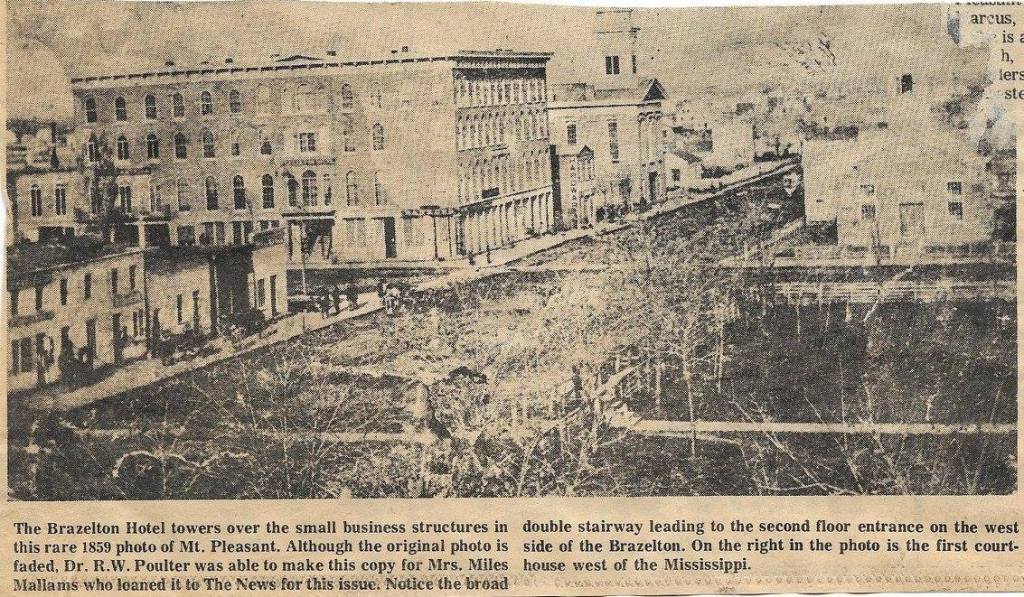
I should like to know what you are doing. I have not heard from the East in a long time. Perhaps it is owing to my own negligence in writing. If you do not think me wholly unworthy of a letter, I should like well to hear from you & the friends. I know not whether Libbie is at home or away. If Olivia has a melodeon or piano, I have a beautiful piece of music that I would like to send her. You will please tell me. It has been published only about three weeks. Composed & arranged by an intimate acquaintance here in Mt. Pleasant, it was played at the Good Templars Supper a few evenings since, held at the City Hall in Mt. Pleasant with great applause. Mt. Pleasant is quite a place for amusement & something is most constantly going on to make it lively. The 4th Regiment of Cavalry are yet in camp and adds, I suppose, to its liveliness. 1

I find the farmers rather disheartened & well they might while stock and produce remain at the present prices. Beef is now selling at three dollars, pork at two dollars, corn at ten cents per bushel, and other grain in like proportion. At Washington ( a business railroad town), these that I mentioned are the current prices at present. Yet we are hoping for something better than this. How soon they may be realized, I know not.

Kin, I have not much news to write you today, but if I find something between here and Dubuque that I think will interest you, I will write you from that place. I would like to meet you now & have one of those good old chats. When will that time come? I am alone today, yet I am not lonely for I have become hardened and accustomed to this kind of life. When I leave Mt. Pleasant, it is very unpleasant, but in two or three weeks I forget it during my business hours. But when the day is past & I am quietly retired for the night, my thoughts go back to the land of my younger days. I think how pleasant they were. But now it makes me sad and lonely so I try to forget them.

Kin, you well know that if our leisure hours are all taken up, it serves to hide & dispel the little sad thoughts & troubles that arise. I must write you a few words more & then bid you goodbye for the present. you must write me ad tell me about all your folks at home. My best regards to them all. Give the sincere sentiments of your cousin, Sanford

[to] Kinyon


1 Co. D of the 4th Iowa Cavalry was raised in Mount Pleasant and the regiment was still encamped outside of town in January 1862. Sgt. (later Captain) Lot Abraham served in that regiment. I transcribed all of his war diaries on a website entitled, “My Own Dear Lot.” Here is the link to his diary from January-March 1862.