The following war recollection was found in the Iowa Digital Library at the University of Iowa. It does not appear to have ever been transcribed. It was attributed to Rufus Nathan Merriam (1837-1905) of Co. B, 4th Iowa Infantry.
In this six-page, handwritten document, Rufus recalls the movements of his company from late January until mid-February, 1862. The regimental history records that during this time, their service included: March from Rolla to Lebanon January 22-31, 1862. Advance on Springfield, Mo., February 10-13. Near Springfield February 12. Pursuit of Price to Cassville February 13-17.
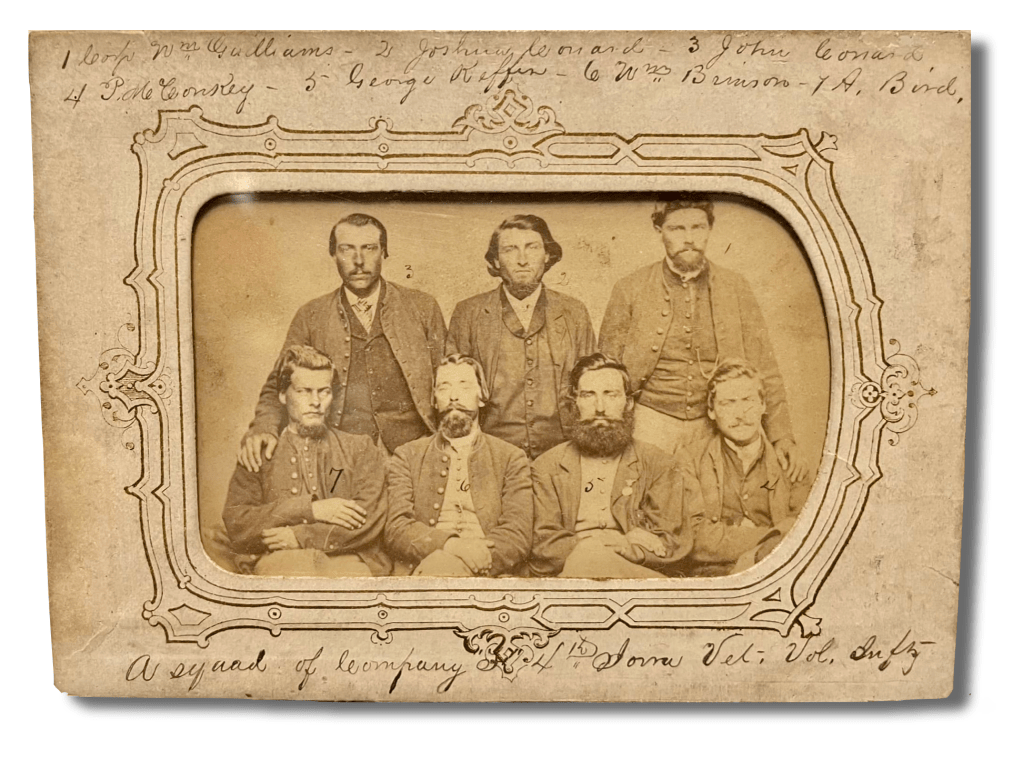
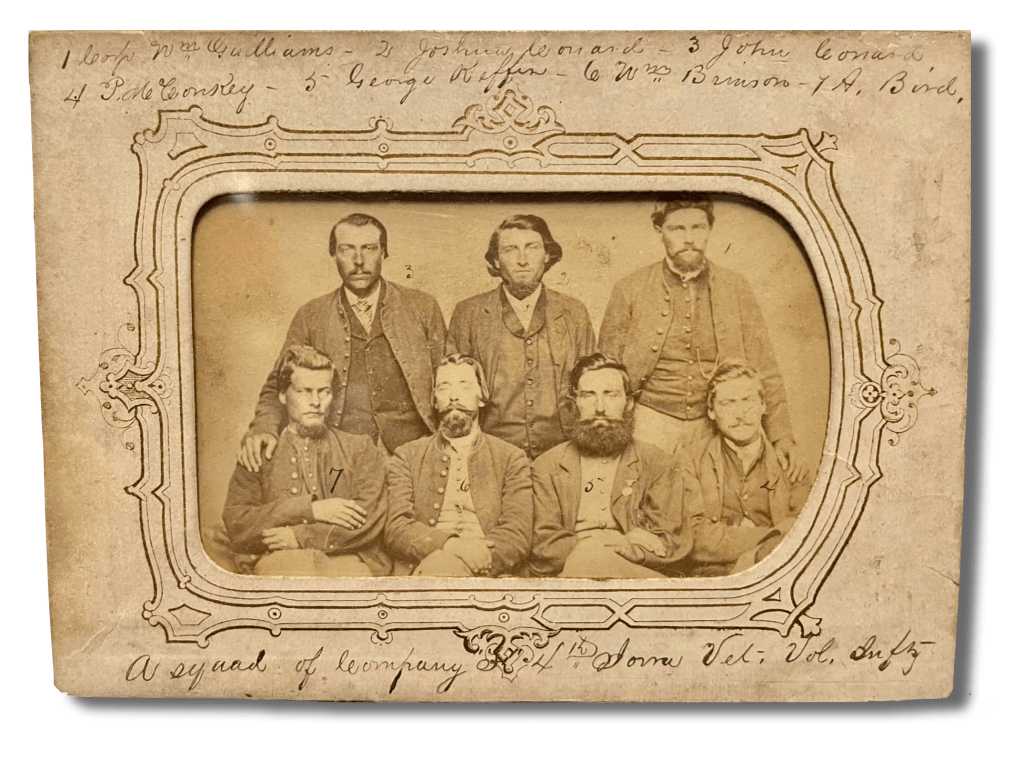
I could not find an image of Rufus but here are seven members of Co. F, 4th Iowa Infantry (Roger Davis Collection)
Transcription
I was a private in Co. B, 4th Iowa Infantry. In January 1862 we were in camp at Rolla, Missouri. Having been there nearly five months, orders came to march on Springfield, Mo., as Gen. Price, Van Dorn, and McCulloch were reported there with 40,000 confederate soldiers. About the 25th of January, we broke camp and started on the march but as most of us were convalescent at this time, we only went 5 to 8 miles a day. We came to Lebanon which I think is within about 40 miles of Springfield. Here we camped ten days and by that time the boys health had improved so fast that we were now alright except I know that a good many of the boys like myself had bought a pair of boots at Rolla thinking thy would be just what we would need to march in, but they were the first pair and the last pair I bought in the army.
We left Lebanon about February 10th and on the 12th the Johnnies had come out to meet us from Springfield. The cavalry had a skirmish with them for a few minutes being a few killed and wounded. It now being dark and in timber, we were deployed as skirmishers on each side of the road for some distance back but as we did not find any of the Johnnies and being within three miles of Springfield, we spent the night on picket duty, all expecting a big battle on the morrow.
The morrow came but the Johnnies had skipped out. We now found out that it was the rear guard of the whole army that came out to meet us the evening before. We were now in Springfield and much elated to think with about 10 or 12 thousand of Yanks, Gen. Price was on the run with his army. It looked like he did not intend to fight if he could help it. We camped here till the next morning which was February 14th (Valentine Day) as I well recollect, and a bitter cold morning it was too. My boots I had taken off the night before and they were frozen still and I had to throw them out by the fire for an half hour to get them on.
The sun came up very bright that morning and the weather moderated very fast. The advance moved out about sunrise and soon we were on the same road that Gen. Price had left on two days before. We were now in good spirits and could march to the quick step. We passed over the battlefield of Wilson Creek that was fought on 10 August 1861 where Gen. Lyon, the Union general in command, was killed. We had been marching all day and were getting tired and asking every cavalryman we saw how far it was to camp Just before sunset we heard those mounted howitzers booming about two miles ahead of us. This put new life into the boys so we made camp about dark. We could now see the camp fires of the Johnnies ahead of us. We made fires and cooked mush for supper as cornmeal was the main thing that was issued from the Quartermaster Commissary.
That night, after supper we laid down on the ground to sleep and got rested as we were told by the officers that we were to be ready to march at sunrise in the morning. We were up early and got breakfast and were in good spirits for the days march as the train had arrived during the night with hardtack and now we were alright. We had stacked our guns the night before in front of where we slept as that was orders, except when we were ordered to lay on our arms, then each man slept with his gun beside him. Just before the company was ordered to fall in, John Reed, a comrade of our company, went to take his gun out of the stack and in doing so, one gun was discharged and shot him through the hand. He was sent back to Springfield and report came back afterwards that he died from the wound.
We got started on the march soon after sunup and the boys struck up to singing the familiar songs of those times. We were a jolly set and by the time we had gone five or six miles, we passed several wagons on the side of the road that the Johnnies had abandoned so it looked like they were doing their best to get out of our way. The advance came up to them just before sunset and we heard those Howitzers booming (we called them bulldogs). We had now marched nearly all day and still the Johnnies were ahead of us so we went into camp for the night. We found a good supply of rails at this place to build our fires. As I had been cook for the mess that I was in which consisted of about twenty of us, it devolved upon me to make the bread for our rations the next day. So I took a rubber blanket, put the flour in it, and poured water on and soon had mixed up to a good stiff dough. The next thing was how to bake it. I concluded there was a poor show in the ashes so I laid fence rails around the big fire and put the dough on them to bake. I got it baked but it was after midnight before I went to bed. But I don’t recollect losing any sleep after that until called up in the morning as we had to be ready to march at sunrise.
The bread was divided among the mess, each one getting his share, as I now recollect that bread was about all the rations we had to depend on for that day’s march, and as I had nothing to put in it to make it rise, you can imagine it made good solid food, as we were able to overtake the Johnnies at an earlier hour in the day than we had done before.
This day we had passed two small towns—Cassville and Keithsville in the southwest corner of Missouri. It was now about 4 o’clock in the afternoon when we crossed the line into Arkansas. The booming of cannon ahead made us think there was a chance to double quick and the road being on the downgrade, we went for about [line cut off]…in line of battle on the ridge beyond Sugar Creek, and as we came up the order was given by companies into line. And by the time the regiment was in line of battle, the Johnnies had lit out so we were disappointed again in having a fight. Then we came back to Sugar Creek and camped for the night. Some of the boys about this time had found a smoke house filled with hams a short distance away. Our mess was well supplied before the guards arrived at the smokehouse which was done as soon as they could be detailed. The hams were salted just right and not smoked but very little and I thought that they were the finest I had ever eaten. I know they tasted the best and better than anything that I have eaten since.
Gen. Curtis in command of the Union forces decided to give up the chase and give the troops a short rest, so the next day we marched only ten miles to Cross Hollow where we went into camp and foraged off of the country and done some target shooting and trying to make ourselves as comfortable as possible under the circumstances as the weather was cold and blustering for we had no tents as they had been left at Rolla or Springfield.
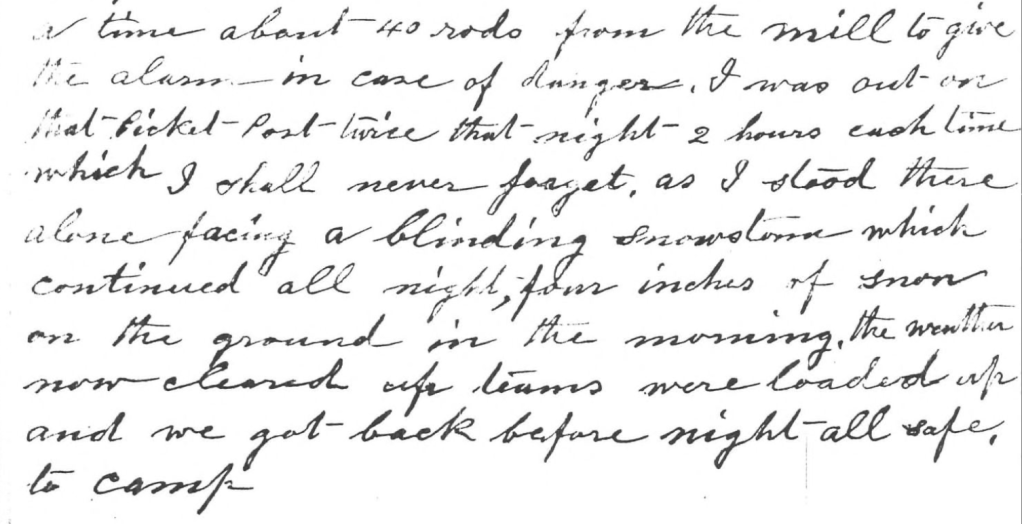
A sample of Merriam’s handwriting
I was detailed to go on a foraging expedition while we were here. We went about four miles mostly through the timber and forded a small creek. The water just come up to the wagon bed so we did [line cut off]…a water mill on the creek for grinding corn. We found no one at home so we took possession and helped ourselves. We found a nice lot of apple butter which was appropriated to our use. and then camped for the night. I picket guard was detailed and I was one of that number. We took shelter in the mill except one that was to stand out two hours at a time about 40 rods from the mill to give the alarm in case of danger. I was out on that picket post twice that night, 2 hours each time, which I shall never forget as I stood there alone facing a blinding snowstorm which continued all night—four inches of snow on the ground in the morning. The weather now cleared up, teams were loaded up, and we got back before night all safe to camp.
The following four letters and an 1863 diary were written by Sheldon C. Treat whose biographical sketch was included with a large collection of his letters that sold at Cowan’s Auctions in 2012. It reads:
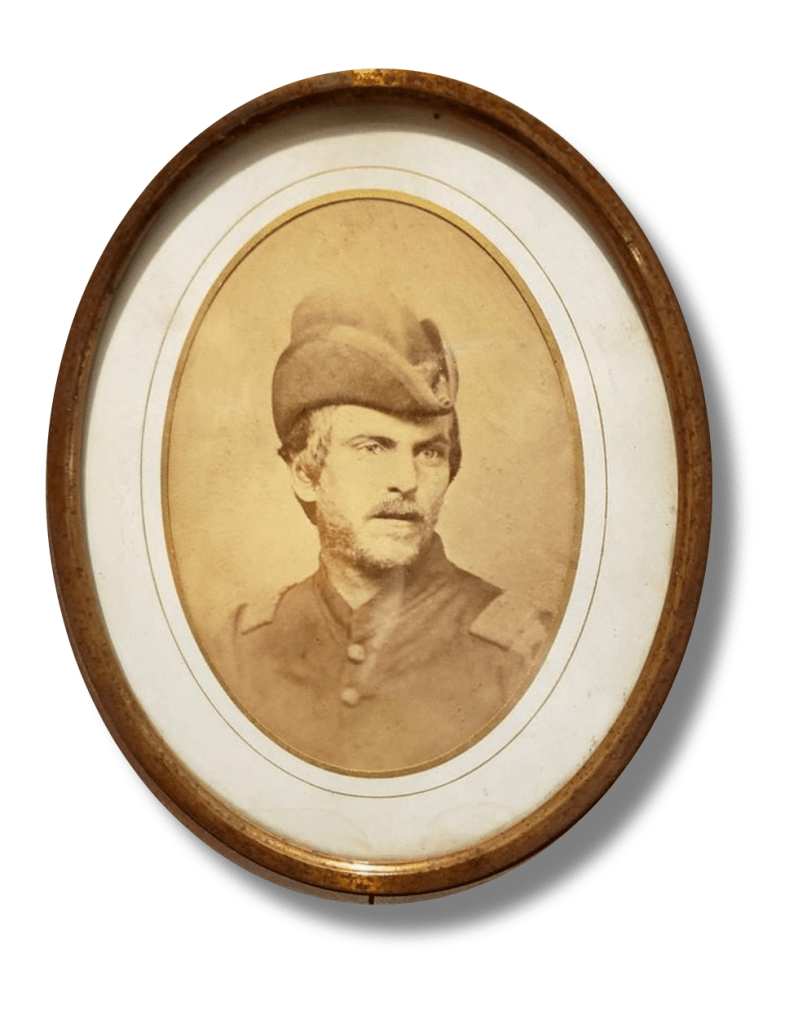
Lt. Sheldon C. Treat
“Born in West Haven, Connecticut, Sheldon Treat emigrated to Missouri in 1859 to find work as a carpenter. Not the best choice. Although he was fully employed, Treat soon found himself on the frontlines of what would become a Civil War. This fine collection documents the transformation of a young easterner looking for work into a Civil War solder.
In some ways, the three pre-war letters are the most interesting of the lot. Written from Forest City, Missouri, a troubled outpost near the Kansas border, the letters provide a glimpse into the drama as war fever rose in an area already engulfed by violence. On 24 January 1861, Treat described an incident with border ruffians: No law of this state could molest them fellows at all for they had got my on the Kansas side and the only way get it was by force. A fellow from Ohio was with me on the river at the time of the fuss. There was 6 of them they all drawed their knives and one his revolver. We had no arms but one knife to defend ourselves with but we got the boat and got back safe. When we got up town 30 men was ready to go after them. Had we had our revolvers there would have been some shooting done.
By March, the scene grew even darker. The young men of this place are having their hair cut short for the spring fights, Treat reported, They commenced election day to fight and have been at it ever since. Under the circumstances, Treat decided to decamp for the north: I shall leave here next week for some spot unknown. I think of going to Fort Desmoine to work. This state will probably go south soon… this state legislator met the 2 of May and elected all of their officers secession. They have threatened to drive out all the free state…Once there, he wasted little time before enlisting in Co. E,4th Iowa Infantry, where he proved himself a capable soldier, earning promotion to 2nd Lieutenant by October 1862 and to 1st Lieutenant in January 1863.
Serving mostly in the western theatre, Treat saw action in 17 battles and took part in Sherman’s March to the Sea, reenlisting after a furlough for the duration. His letters reveal a strong pro-unionist as he became accustomed to military life in Missouri, culminating in his first major battle—Pea Ridge. On 18 August 1862, he wrote home to describe the devastation he experienced during one of the year’s most decisive battles, and the way in which his commitment to the cause was growing stronger as he grew from new recruit into a veteran.
Martha says it almost makes her sick to see them poor fellows in the hospital at New Haven. She ought to go over one battlefield and see the sights. It would make her sick for certain. I should liked to had you seen the field at Pea Ridge for I know it would not made you sick but you would not have forgotten it very soon. Man is a curious thing in a fight. People will say fight for honor and glory but I tell you that they fight because they are mad and because they love to fight. You put a company into action and watch them. The first 2 or 3 rounds, they take it very cool. But soon they begin to fall and this one looses a brother and that one a messmate, and blood runs freely. Then just listen and hear the deep curses of revenge, and then see if they fight because they love it. Yes, every shot is dearer than life to them. They don’t think of honors then. And how different is it with them the next time they come into action. They go at it like a day’s work…
Interestingly, Treat’s support for the war seems not to have been shared by his father, and he writes a passionate letter complaining that his father seems to offer nothing in his letters but sarcastic and discouraging comments: I have here some 80 men to associate with and all are getting letters from home, cheering them on the good work. And although I have proved myself as brave as the bravest, yet I get no encouragement from father…(28 August 1862).
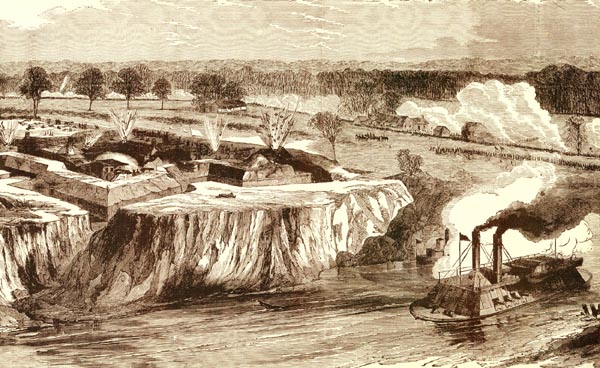
Posted at Helena in latter half of 1862, the 4th Iowa took part in the early maneuvers of the Vicksburg Campaign, and the collection includes a fine description of the fall of Fort Hindman [Arkansas Post], 18 January 1863. Our loss is 500 killed and wounded. Our Regiment lost but 4 men in all. The battle lasted 3 hours when they surrendered the fort to us. They had 1 gun of 100 lbs. and 3 of 68 lbs. all casemated with railroad iron and 6 feet of oak timber… We got 2 field batteries and 2 splendid Parrott guns and 4000 stand of Enfield Rifles, some muskets, plenty of shot guns, revolvers, and pistols of all sorts…
There are also two excellent letters from later in the Vicksburg Campaign, written after the regiment had been circled behind Vicksburg to cut off any possible escape to the east, though at heavy cost to their own ranks. On 24 May 1863, he wrote: We have taken 8000 prisoners and 75 pieces of artillery. Our loss is heavy. My regiment has lost about 50 men. The 9th Iowa lost all but 130. Some regiments have lost all their field officers and some most all their line officers. Jackson—the capital of this state—is burned down. I am in camp on Walnut Hills two miles back of the town. In front is a big fort still in the hands of the rebels… We have got Warenton and Haines Bluffs both with all their guns and have got the rebels where we can tend to them just when it suits us…
A thread running through Treat’s letters is the squabble with his father, and Treat takes every opportunity to lambaste the Copperheads. After the draft riots of 1863, he taunted his father: How much has the Copperheads made by their riots in New York city? I think they will get their fill before long. I rather guess bullets will stop them. It was a pity they used blank cartridges as they had such a nice range for canister in the streets. I guess that Father Abraham who lives in Washington is able to stop such proceedings and if necessary stop some of their winds…After the election later that fall, he poked his father again: The soldiers of the 2nd Brig., 1st. Division fought a bloodless battle yesterday but very decisive victory was gained. Stone the republican candidate for Governor went up, Tuttle and Copperheadism went down. The 4th gave Stone 292 and Tuttle 13…”
[The letters and diary of Sheldon C. Treat published here are from the personal collection of Greg Herr and appear on Spared & Shared by express consent.]
Letter 1
Helena, Arkansas August 15, 1862
Dear Sister,
Your letter of August the 6th has just come to hand and I am glad to hear from home again. I am as well as ever. There is no news of importance here. Our Brigade was reviewed day before yesterday by Gen. Carr. There is some skirmishing around here but it don’t amount to much. The main body of the troops are laying quietly in camp.
You speak of suffering in this army but the worst is for water. On the road from Jacksonport we could not get near water enough to drink and a mud hole where the hogs had wallowed was quite a luxury to all. Provisions is nothing compared to water. You must recollect that we have been in the interior all the while and 200 miles from civilization and could not get provisions. Our suffering are nothing to what we expect to see in times to come if the war lasts.
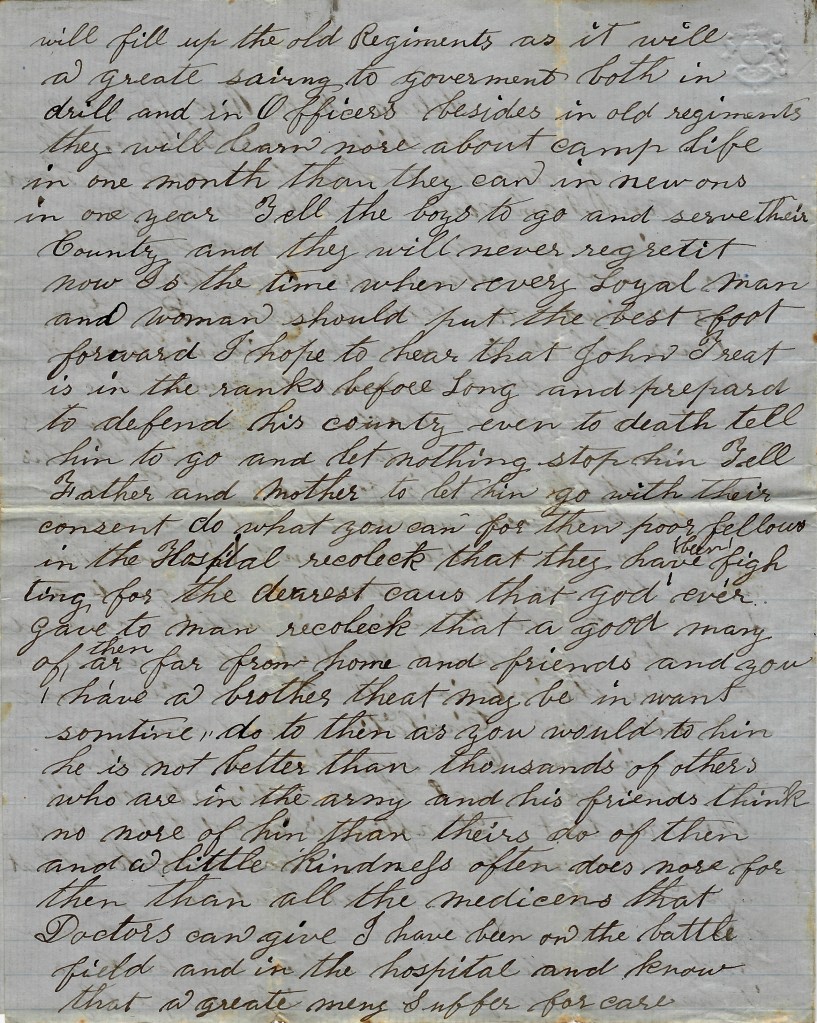
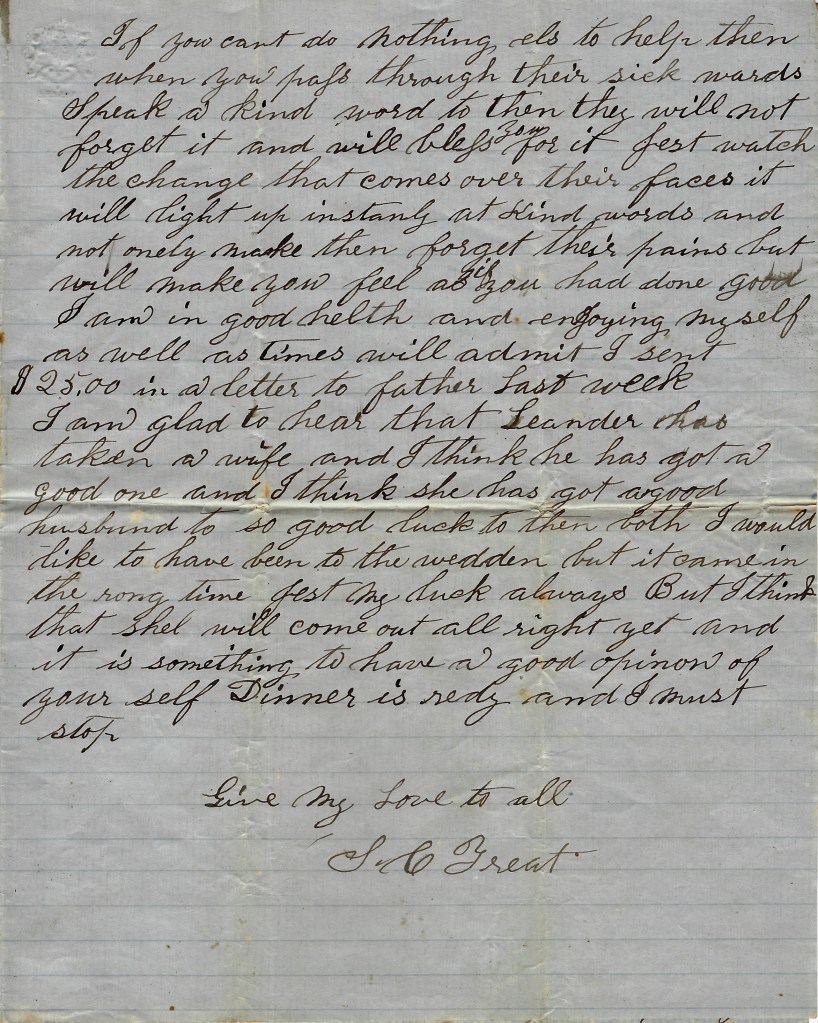
Drafting is a good thing and I was glad our government has adopted that system. Had they gone at that one year ago, the war would have been at end now and that system brings all on the level as it has no respect for a man’s ricjes. I hope they will fill up the old regiments as it will be a great saving to government both in drill and in officers. Besides, in old regiments they will learn more about camp life in one month than they can in a new one in one year. Tell the boys to go and serve their country and they will never regret it. Now is the time when every loyal man and woman should put the best foot forward. I hope to hear that John Treat is in th ranks before long and prepared to defend his country even to death. Tell him to go and let nothing stop him. Tell Father and Mother to let him go with their consent. Do what you can for them poor fellows in the hospital. Recollect that they have been fighting for the dearest cause that God ever gave to man, recollect that a good many of them are far from home and friends and you have a little brother that may be in want sometime. Do to them as you would to him. He is not better than thousands of others who are in the army and his friends think no more of him than their do of them. And a little kindness often does more for them than all the medicines that doctors can give. I have been on the battlefield and in the hospital and know that a great many suffer for care. If you can’t do nothing else to help them when you pass through their sick wards, speak a kind word to them. They will not forget it and will bless you for it. Just watch the change that comes over their faces. It will light up instantly at kind words and not only make them forget their pains, but will make you feel as if you had done good.
I am glad to hear that Leander has taken a wife and I think he has got a good one and I think she has got a good husband too. So good luck to them both. I would like to have been to the wedding but it came in the wrong time. Just my luck, as always. But I think that Shel will come out alright yet and it is something to have a good opinion of yourself.
Dinner is ready and I must stop. Give my love to all, — S. C. Treat
Letter 2
Helena, [Arkansas] November 7, 1862
Dear Sister,
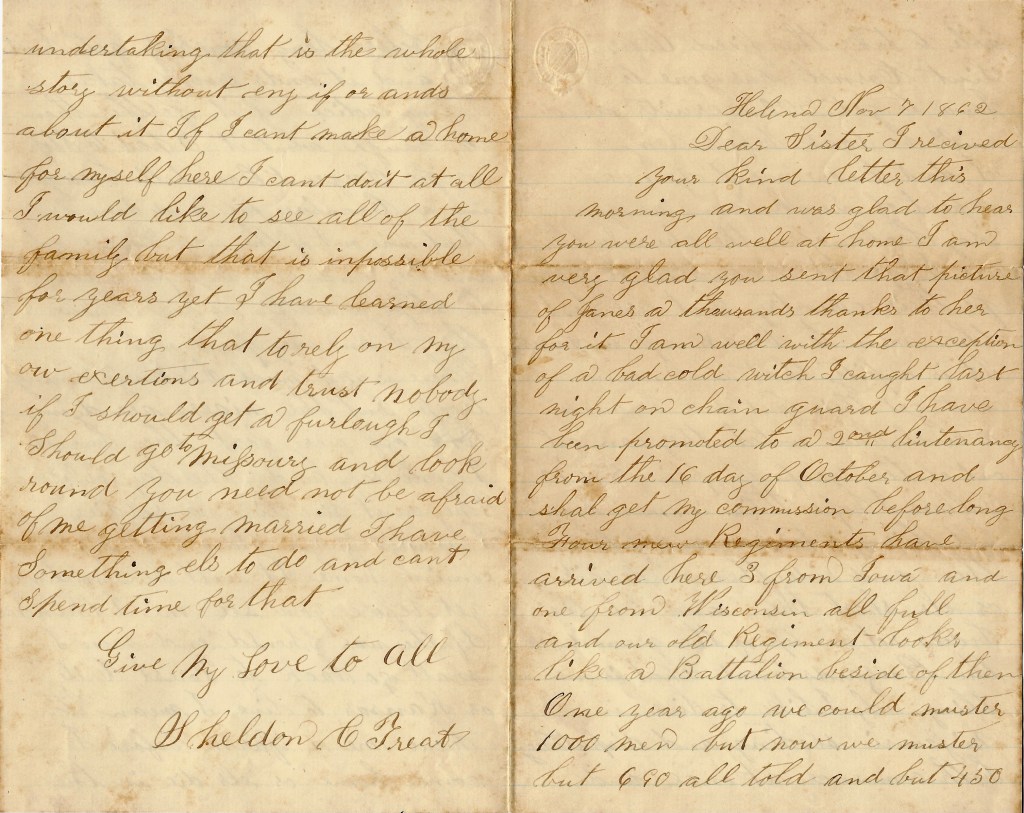
I received your kind letter this morning and was glad to hear you were all well at home. I am very glad you sent that picture of Jane’s. A thousand thanks to her for it. I am well with the exception of a bad cold which I caught last night on chain guard.
I have been promoted to a Second Lieutenancy from the 16th day of October and shall get my commission before long. Four new regiments have arrived here—3 from Iowa and one from Wisconsin—all full, and our old regiment looks like a Battalion beside of them. One year ago we could muster 1000 men but now we muster but 690 all told and but 450 able to take the field. Our Lieut.-Colonel has gone to Iowa to get 300 recruits and will be back before long.
I don’t know what you can expect of such men as you say broke open the church. They are too great a cowards to fight for their country but are just the men to break up a church. It is a pity that such men can’t get their just dues because of a civil law which they can get out of the scrape by paying 5 or 10 dollars. I hope there is men enough left there yet to tar and feather them and ride them on a rail or else shoot them and let their bodies rot on top of the ground for the buzzards to eat. That is one thing why I like to live in Missouri—shooting and disputing both commence at once and before long somebody gets hurt and it ends. Nobody takes any notice of it further than to laugh about it.
I had to stop a[while] for Sergeant Bramhall brought in a cranberry pie and soon as that was out of the way, Houser got another and as I love pie, I had to stop awhile as you know that I am very fond of it.
There is not much of sickness among troops but the niggers are dying off very fast. They buried 9 yesterday and 8 the day before. They can’t live like a soldier.
I wonder if you think of my coming home. It will be sometime yet before you see me. I think if the war should end soon, I shall go back to Forest City [Mo.] or Kansas to live. I mean to have me a farm before I come home or else die in the undertaking. That is the whole story without any if or ands about it, if I can’t do it at all.
I would like to see all of the family but that is impossible for years. Yet I have learned one thing—that [is] to rely on my own exertions and trust nobody. If I should get a furlough, I should go to Missoury and look round. You need not be afraid of me getting married. I have something else to do and can’t spend time for that.
Give my love to all, — Sheldon C. Treat
[insert transcription of 1863 diary here.]
The shelling of Fort Hindman
January 1—Left the Yazoo River on transport John J. Roe. Anchored in the Mississippi 6 miles from the mouth of Yazoo. Sick all day with the ague and fever.
January 2—Got under way at daylight and steamed up the river. Sick.
January 3—Going up the river. Had the ague.
January 4—Received a mail. Got $40 dollars from home. Going up the river.
January 5—Still going upstream. had the ague.
January 6—Lying still for wood and fresh provisions.
January 7—Started up again. Chills and fever still keeps me down.
January 8—Off the mouth of the Arkansas. Steamed up to the cut off from White river. Found the whole fleet here.
January 9—Ran through the cut off into the Arkansas river and up that to the post.
January 10—Landed on the east side of the river 4 miles below the fort [Fort Hindman]. Tried to out flank it but could not cross the bayou. Traveled all night and drove the rebels from their encampment.
January 11—At sunrise found myself asleep on the roof of a log house. Artillery opened on us at 8 a.m. Battle began at 2 and lasted till 4.30 p.m. Camped on the field.
January 12—Our tents got up at 12 noon and we went into camp. Broke up camp at sundown and marched to the lower landing. Rained hard all night.
January 13—Snowing hard this morning. We had no shelter and are taking it harrd. Stormed all day.
January 14—Ordered on board the steamer Hiawatha with the 9th Iowa. Went on board at 12 noon.
January 15—Went down the river to Napoleon, Stopped for mail and provisions.
[January 16-22—no entries]
January 23—Landed near Vicksburg and marched most all night. Camp below the town on the opposite side of the river.
[January 24-February 13—no entries]
February 14—Detailed in the Pioneer Corps of the 3rd Brigade, 1st Division, 15th Army Corps.
February 15—On duty in my company.
February 16—On duty in my company.
February 17—Received orders to organize my corps immediately.
February 18—Getting in my men all day. The 26th Iowa detail not reported yet.
February 19—My detachment all reported for duty. List of non coms, Sergt. Conrad Ditmore, 9th Iowa Sergt. Joseph McQuiston, 26th Iowa Corp. Benjamin Vanasdoll, 4th Iowa [Co. E]
February 20—Awaiting orders.
February 21—Awaiting orders.
February 22—Ordered to report to Capt. Klosterman of the 3rd Mo. I went did so and got some tools. Ordered to build log houses for my men.
February 23—Began my houses today. 1st Detachment cutting logs and one preparing the ground.
February 24—Working at the houses.
February 25—Still at my houses. Had teams from our regiment and 1 from the 9th Iowa.
February 26—The boys have been bringing in shakes for the roof.
February 27—Got two of my houses done today. A party stayed to watch our rations.
February 28—Rained all day hard. Roads impassable for teams.
March 1—Finished our houses up and moved in to them.
March 2—Working at the canal, building runs for barrows.
March 3—Working at the canal.
March 4—Still at the canal.
March 5—Building a carpenter shop.
March 6—Got it done in good shape.
March 7—1 year ago today. Fight at Pea Ridge.
March 8—Still at the canal. 1 year ago today, Price retreated to Van Buren with his army from the battleground at Pea Ridge.
March 9—The dam at the mouth of the canal gave away and the water overflowed the bottoms.
March 10—We will have to get out of our houses before long if the water continues to rise.
March 11—Had to move camp up the river to keep away from the water.
March 12—Got new tents for the boys and I will tent for myself.
March 13—Began the bridge from the levy to boats. Myself and Corp. McQuiston in charge.
March 14—Working at the bridge from the levy to the boats. Sergt. Auterburn and Corp. McQuiston in charge.
March 15—Working at the bridge from the levy to the banks. Sergt. Auterburn in charge.
March 16—Finished up the bridge from the levy to the boats at noon. In quarters all the afternoon.
March 17—Ordered to the canal to bridge the break in the levy. Sergt. [Conrad] Ditmore does the job.
March 18—Lieut. [Benjamin F] Darling from the 9th Iowa took the 2nd Detachment to day in place of [Edgar] Tisdale. Promoted to a QM of the corps.
March 19—Sergt. [Conrad] Ditmore and Corp. [Sterns D.] Pratt at the canal with 15 men.
March 20—Sergt. Ditmore at the canal with 15 men and Corp. Pratt.
March 21—Had a party on the canal. The enemy shelled them all day but done them no harm.
March 22—Went to the canal myself and finished up the bridge. Brought up a boat and turned them over to Capt. Smith on steamer Decta.
March 23—Send one party to open [illegible] railroad. Sergt. Auterburn in charge.
March 24—[purchases]
March 25—Not well today. Sent a party to the canal to repair bridge. Corp. Pratt in charge. 1 p.m., sent one part to the canal to repair [ ]. Sergt. Auterburn in charge.
March 26—At the canal myself all day. Levy nearly gone. Pulled several drifts to pieces and used them for breakwater.
March 27—Sent out 3 parties, two to canal and one for Capt. Jenney to out up stabling. Sergt. Authern, Corp. Pratt, & McQuiston.
March 28—Two parties at the canal. Sergt. Auterburn finished his job. Stood guard for the whole corps, 11 men and Corp. McQuiston.
March 29—Got up 7 o’clock and eat my breakfast. Going up to my regiment today. Had a dreadful storm last night. Had the day to myself.
March 30—Sent 1 part of 8 men to the cotton gin. Corp. McQuiston in charge. Paid out 250 for the mess.
March 31—Sent a detachment to the canal to work there myself. Ordered to put up a flag staff at Headquarters 15th Army Corps. Settled up my account with the mess due me for the past month. 80 cents. Richard Ballou detailed to take George Black’s place from Co. K, 4th Iowa. Reported April the 1st. Absent now sick. Abijah Lancaster, Co. J, 4th Iowa with his company at Young’s Point.
April 1—All fools day. Sent out two parties—one at the canal with Sergt. Ditmore and one with Sergt. Autburn for a pole to make a glag staff.
April 2—Sent out two parties—one to the canal and one for the flag staff. Corp. McQuuiston and corp. Pratt.
April 3—Two parties out. One at the canal and one brought in the flag pole and topmast. Staid in quarters.
April 4—Sergt. Ditmore and 8 men at the canal. Corp. McQuiston and 4 men on flag staff . In quarters all day.
April 5—Sunday. All my squad off duty today.
April 6—Turned out at 2 o’clock this morning to cut the railroad and let the water off canal. Levee broken at the upper end near the old levy.
April 7—Done but little all day.
April 8—Went to the canal with a party to fix the ferry boat.
April 9—Had the rheumatism.
April 10—Been over to shop. Up to camp.
April 11—Pole already to put up but the irons.
April 12—[no entry]
[The remainder of the diary is filled with post war notes.]
Letter 3
Camp on Black River, Mississippi August 25 [1863]
Dear Sister,
It is a very nice cool morning here. Yesterday it was as hot as thunder and this morning overcoats and gloves are in demand. I have not received a letter from home since the 10th of this month and I shall block on this one till I do hear from there. I am a keeping old Bachelor Hall. All the rest have gone home on furloughs. I am the only officer left in the Brigade Corps. My turn will come sometime. It is dreadful lonesome in camp—not much to do—no books to read—nothing a going on to interest a fellow at all but to eat and sleep.
We are getting better rations than this army ever got before and enough of them. It is getting to be quite sickly here. Most everyone has got or had the ague and fever. But a very few die with it.
I hear that the 1st Brigade is losing men by the dysentery—quite a number having died last week. I should like to know whether Doct. is home yet or not and how he had endured the campaign. I don’t think he is tough enough for a soldier. It takes a good constitution to stand this climate. My head is getting gray in the service but my time is short now. I am mustered till 1866 on my last commission but I shall go out with my regiment next July if I live and nothing happens.
It is most dinner time and I am too lazy to write. Give my love to all.
Sheldon C. Treat, 1st Lieut. 4th Iowa Infantry Commanding 3rd Brigade Pioneer Corps
Letter 4
Camp at Black River Bridge September 8, 1863
Dear Sister,
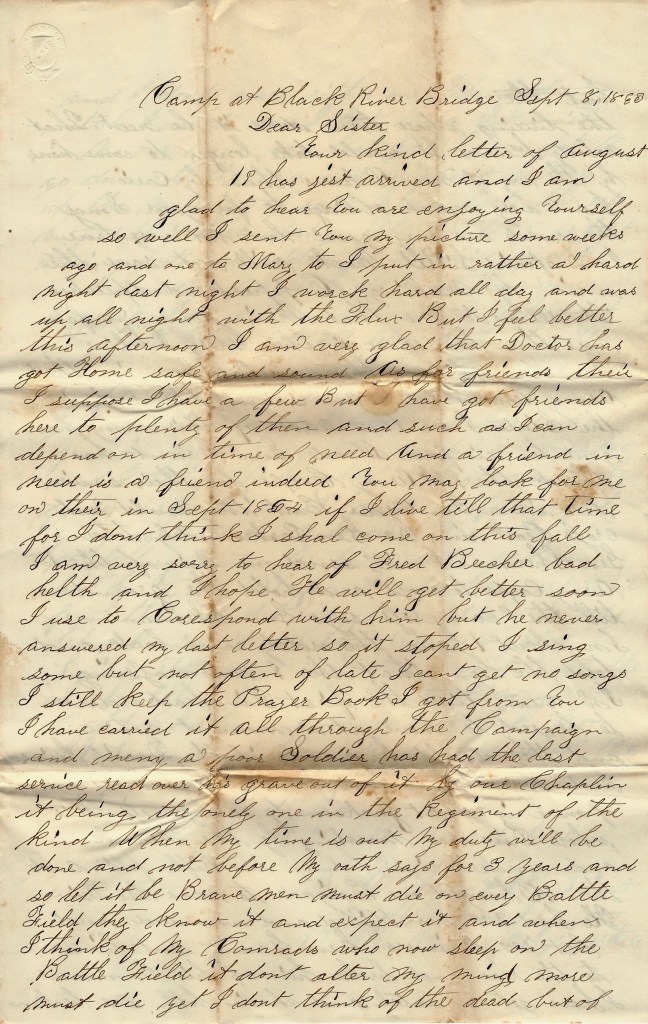
Your kind letter of August 19 has just arrived and I am glad to hear you are enjoying yourself so well. I sent you my picture some weeks ago and one to Mary too. I put in rather a hard night last night. I worked hard all day and was up all night with the Flux but I feel better this afternoon. I am very glad that Doctor has got home safe and sound. As for friends there, I suppose I have a few but have got friends here too—plenty of them—such as I can depend on in time of need. And a friend in need is a friend indeed.
You may look for me there in September 1864 if I live till that time for I don’t think I shall come on this fall. I am very sorry to hear of Fred Beecher’s bad health and I hope he will get better soon. I used to correspond with him but he never answered my last letter so it stopped. I sing some but not often of late. I can’t get no songs. I still keep the prayer book I got from you. I have carried it all through the campaign and many a poor soldier has had the last service read over his grave out of it by our chaplain, it being the only one in the regiment of the kind.
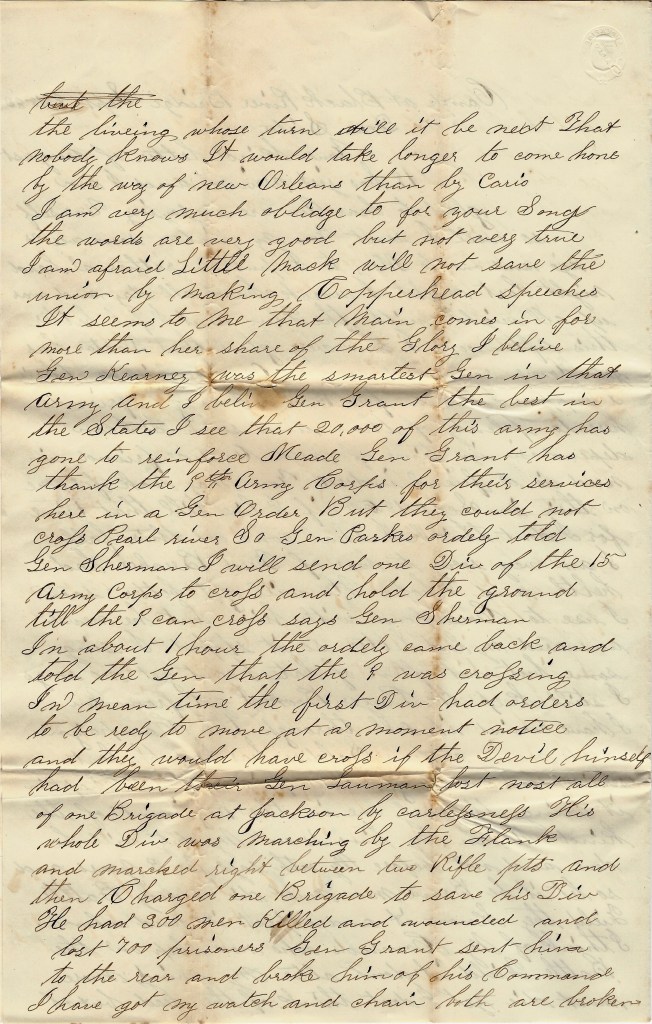
When my time is out, my duty will be done and not before. My oath says for three years and so let it be. Brave men must die on ever battlefield. They know it and expect it and when I think of my comrades who now sleep on the battlefield, it don’t alter my mind. More must die yet. I don’t think of the dead but of the living. Whose turn will it be next? That nobody knows. It would take longer to come home by the way of New Orleans than by Cairo.
I am very much obliged to you for your song. The words are very good but not very true. I am afraid Little Mac [McClellan] will not save the Union by making Copperhead speeches. It seems to me that Maine comes in for more than her share of the flory. I believe Gen. [Philip] Kearny was the smartest general in that army and I believe Gen. Grant the best in the States. I see that 20,000 of this army has gone to reinforce Meade.
Gen. Grant has thanked the 9th Army Corps for their services here in a General Order but they could not cross Pearl river so Gen. Parkes’ orderly told Gen. Sherman I will send one Division of the 15th Army Corps to cross and hold the ground till the 9th can cross, says Gen. Sherman. In about one hour the orderly came back and told the Gen. that the 9th was crossing. In meantime, the First Division had orders to be ready to move at a moment’s notice and they would have cross if the Devil himself had been there. Gen. Lauman lost most all of one Brigade at Jackson by carelessness. His whole Division was marching by the flank and ,arched right between two rifle pits and then charged one Brigade to save his Division. He had 300 men killed and wounded and lost 700 prisoners. Gen. Grant sent him to the rear and broke him of his command.
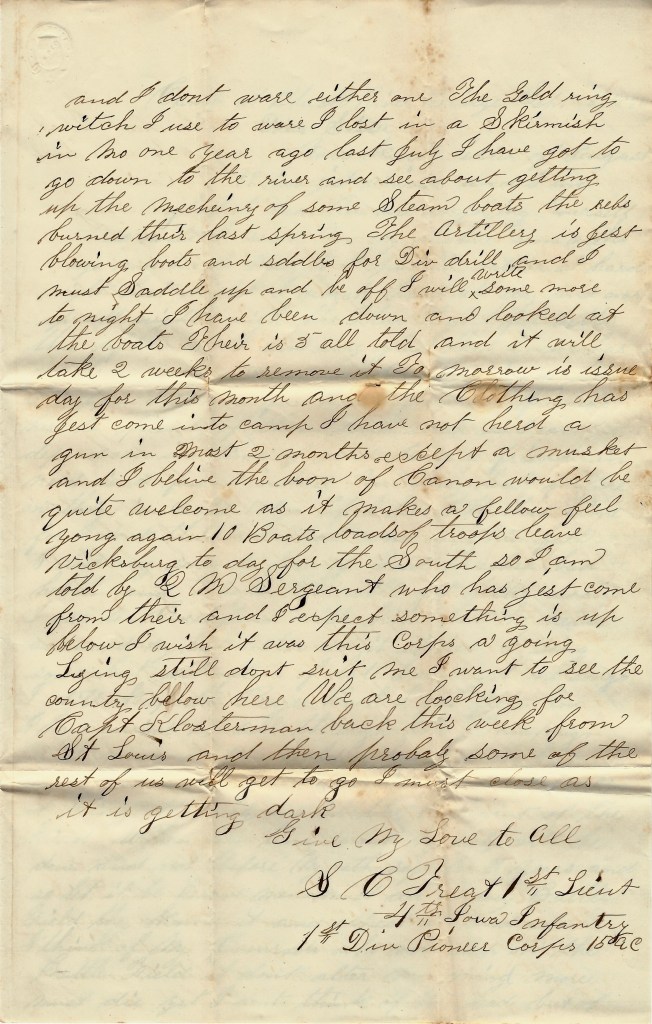
I have got my watch and chain. Both are broken and i don’t wear either one. The gold ring which I used to wear I lost in a skirmish in Missouri one year ago last July. I have got to go down to the river and see about getting up the machinery of some steamboats the rebs burned there last spring.
The artillery is just blowing Boots & Saddles for Division drill and I must saddle up and be off. I will write some more tonight.
[Later]
I have been down and looked at the boats. There is 5 all told and it will take two weeks to remove it. Tomorrow is issue day for the month and the clothing has just come into camp. I have not heard a gun in most two months except a musket and I believe the boom of cannon would be quite welcome as it makes a fellow feel young again. 10 boat loads of troops leave Vicksburg today for the South so I am told by the Quartermaster Sergeant who has just come from there and I expect something is up below. I wish it was this Corps a going. Lying still don’t suit me. I want to see the country below here.
We are looking for Capt. Klosterman back this week from St. Louis and then probably some of the rest of us will get to go. I must close as it is getting dark.
Give my love to all. — S. C. Treat, 1st Lieut., 4th Iowa Infantry, 1st Div. Pioneer Corps, 15th AC
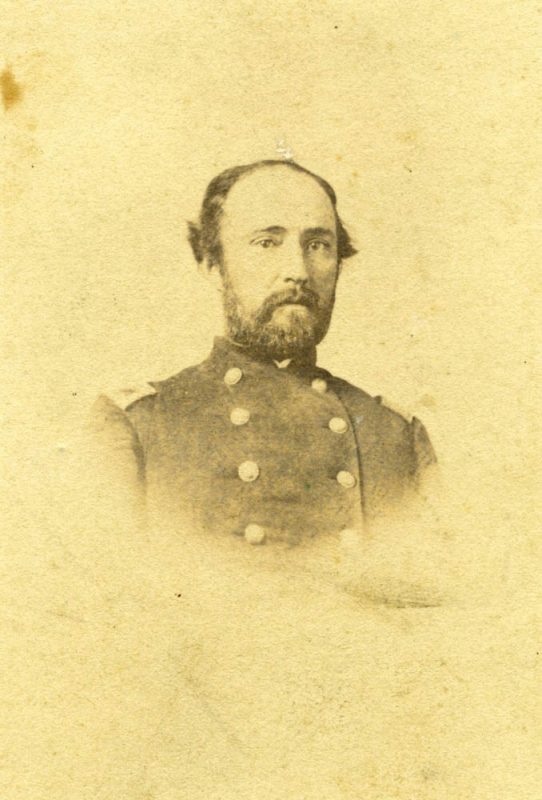
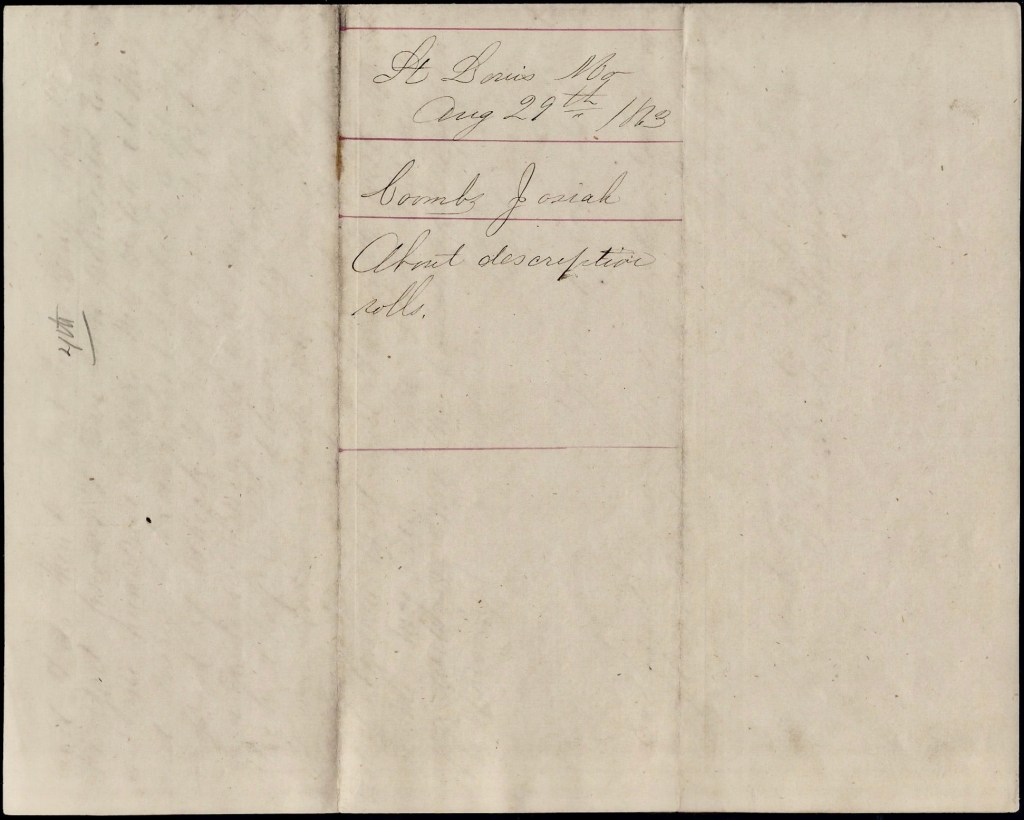
This letter was written by English emigrant Josiah Coombs (1832-1896), of Cass county, who enlisted as a private in Co. B, 4th Iowa Infantry on 10 July 1861. He survived the war and mustered out with his regiment at Louisville as a private on 24 July 1865 [see Josiah Combs]. After the war, Josiah returned to Cass county where he married and worked as a plasterer. Josiah addressed his letter to Nathaniel Bradley Baker who Governor Kirkwood appointed as adjutant-general of Iowa to coordinate Iowa’s response to the Civil War.
I could not find an image of Josiah but here are seven members of Co. F, 4th Iowa Infantry (Roger Davis Collection)
In his letter, Josiah emphatically denies that he was a deserter when he disappeared from the regiment during the Battle of Chickasaw Bluffs in December 1862. Rather, he informs us of his captivity and passage from one “loathsome” Confederate prison to the next until he was finally paroled and returned from New Orleans back to St. Louis by way of the New York. As witness to his remarkable ordeal, Josiah was fortunate to be able to use a high-ranking colonel and a chaplain. I could not find any evidence that either Josiah Coombs or Rev. Arnold Needham wrote any memoirs of their captivity, but Col. Thomas C. Fletcher did.
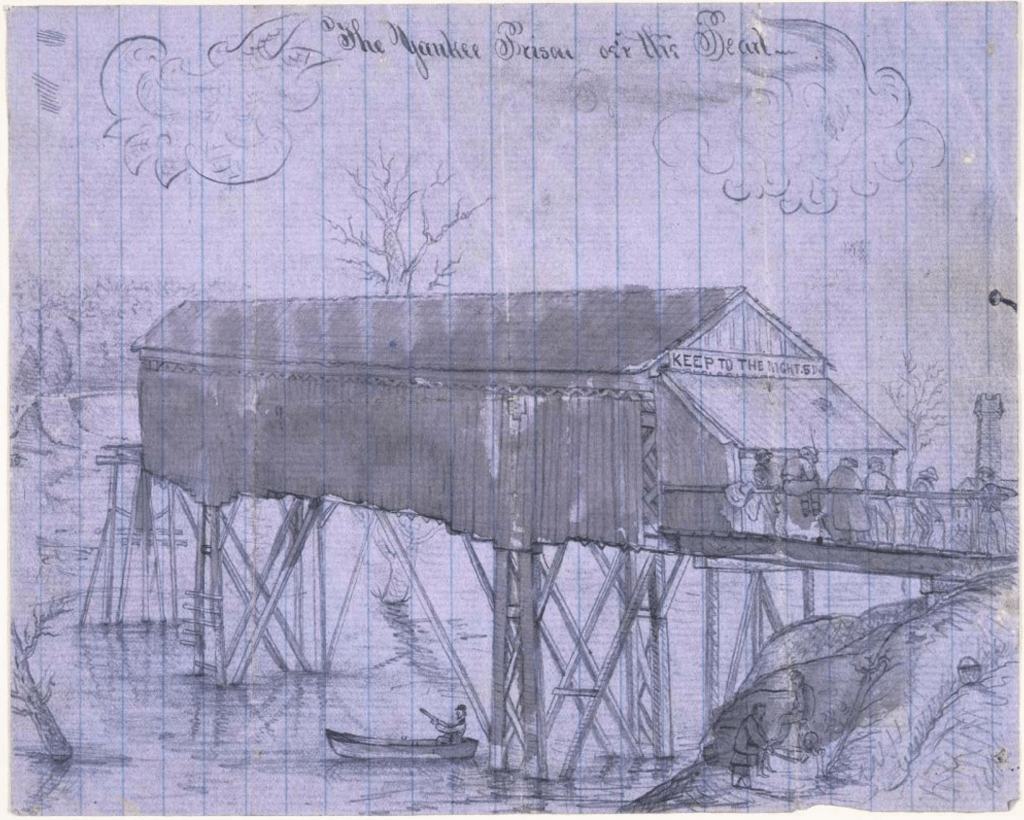
Fletcher was in command of the Missouri Wide Awake Zouaves (31st Missouri Infantry) when he was wounded and captured at Chickasaw Bluffs near Vicksburg. His tale of captivity was published in Harper’s Weekly and states that they “were kept in the loathsome cells [at the Vicksburg jail] and fed upon the worst fare ever meted out to the vilest criminals for one month. They were then removed to Jackson, Mississippi, and thrust into the old rickety ruin of the bridge that was yet standing above water, the remaining part having fallen down. Here they were kept for another month in the coldest season of the year, without beds or bedding; no fires or lights were allowed them. Three hundred and eighty privates, also prisoners, were put into the bridge with them. Almost every day, two or three were carried out dead, and sometimes the dead lay at the entrance of the bridge unburied for four days.” [See “The Prison over the Pearl River at Jackson, Mississippi, where Union prisoners have been confined,” by Chris Mackowski]
The Prison over the Pearl River—a partial former covered bridge—used by Confederates to hold Yankee Prisoners. Drawn by Col. Thomas C. Fletcher who was confined there in February 1863. It was reproduced in Harper’s weekly on 6 June 1863. (Museum of Fine Arts)
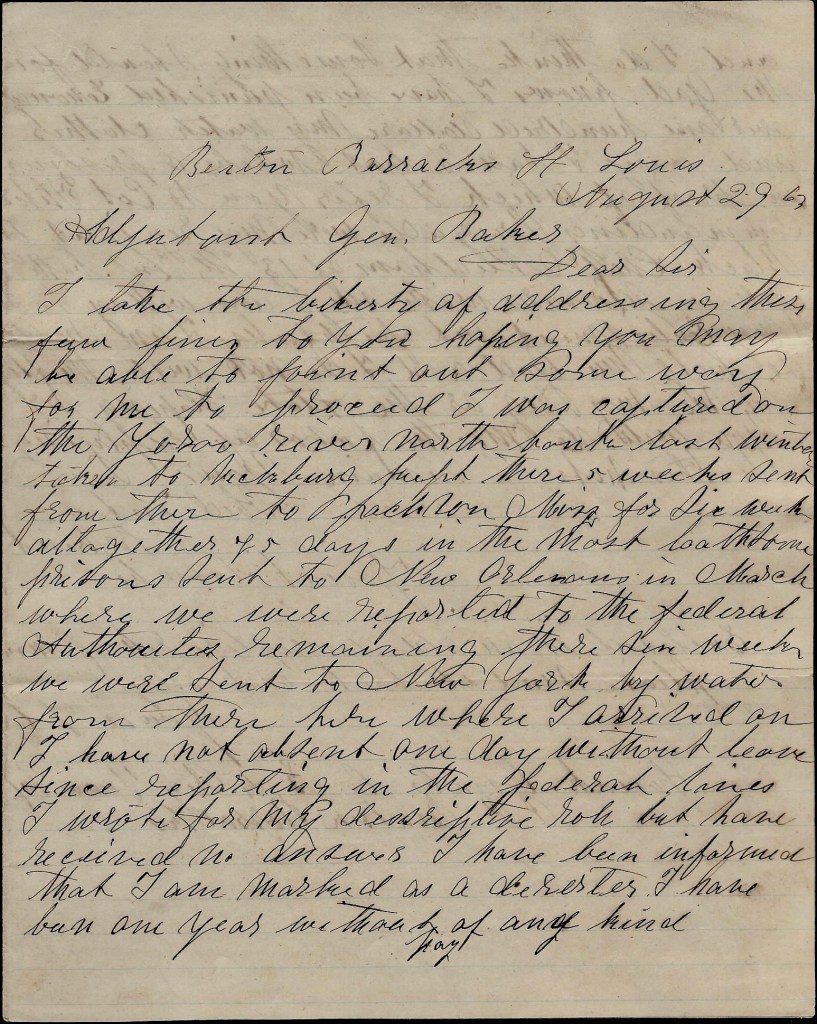
Transcription
Benton Barracks St. Louis, [Missouri] August 29th 1863
Adjutant-General Baker, Dear Sir,
I take the liberty of addressing these few lines to you hoping you may be able to point out some way for me to proceed.
I was captured on the Yazoo River north bank last winter, taken to Vicksburg, kept there 5 weeks, sent there to Jackson, Mississippi, for six weeks—altogether 75 days in the most loathsome prisons, sent to New Orleans in March where we were reported to the Federal Authorities remaining there six weeks. We were then sent to New York by water, from there here, where I arrived on [ ]. I have not [been] absent one day without leave since reporting in the Federal lines.
Col. Thomas C. Fletcher, (Wilson Creek National Battlefield)
I wrote for my descriptive roll but have received no answers. I have been informed that I am marked as a deserter. I have been one year without pay of any kind and I do think that [I’m owed] something for my God knows I have been punished enough over one hundred dollars—my watch, clothes, and everything I had I lost while a prisoner in proof of which I refer you to Col. [Thomas Clement] Fletcher, commanding Brigade where my regiment is at Big Black, [and] Chap[lain Arnold T.] Needham of 13th Illinois Infantry, both fellow prisoners with me.
I am willing to serve my enlistment out faithfully. I am no deserter so help me God and I do not wish the stigma on me, my regiment, or the state. Hoping, sir, you will do me the favor of replying to this note, I remain your obedient servant, — Josiah Coombs
Enclosed is an old descriptive roll of mine. Please send it back and oblige. Yours, — J. C.






 Spared & Shared 23