Category Archives: 4th of July Celebration

1865: Truman Francis Maxim to Jesse and Louisa (Pease) Maxim

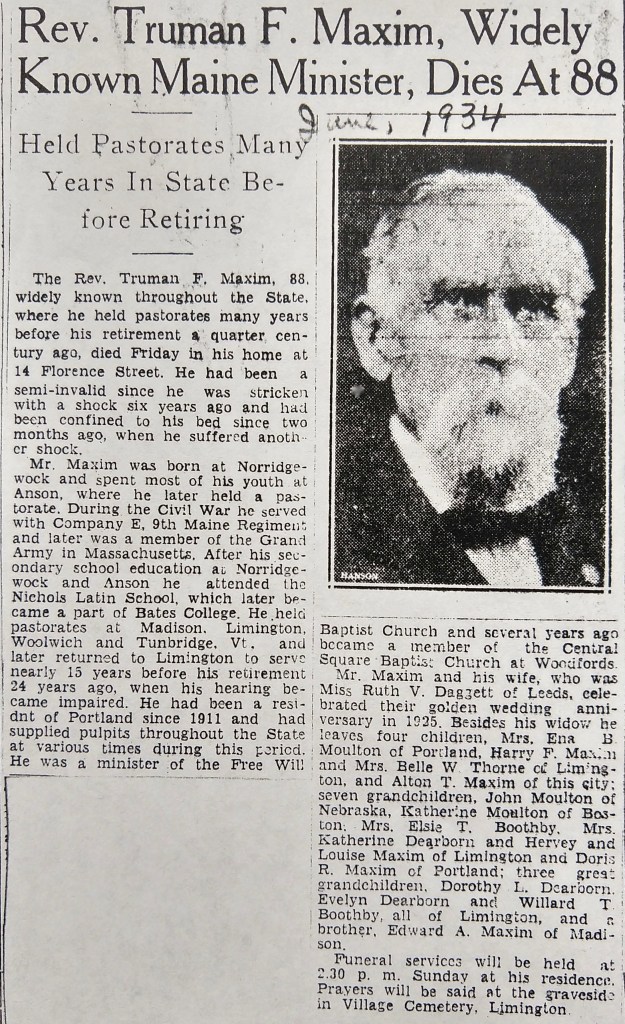
The following letter was written by Truman Francis Maxim (1845-1934), the son of Jesse Maxim and Louisa Pease (1810-1892) of South Norridgewock, Somerset county, Maine. Truman enlisted on 3 October 1864 as a private in Co. E, 9th Maine Infantry, enrolling himself as a substitute. He remained with the regiment until 13 July 1865 when he was mustered out, ten days after writing this letter.

Upon his return to Somerset County, he took up employment as both a blacksmith and a farmer for several years before ultimately becoming a Baptist minister. It is hoped that his perspective on race shifted toward a more positive stance as he adopted the teachings of Christianity. Truman’s description of the 4th of July celebration in 1865 was brief and racially biased: “It was celebrated mostly by the Negroes. The streets were blacker than a thunder cloud.” A more comprehensive description of the celebration can be found in an article based on a story in the NY Times of 14 July 1865. See “Eyewitness Account of the Joyous First 4th of July Celebration in Raleigh NC since Fort Sumter: A Contrast in Black and White.”

T R A N S C R I P T I O N
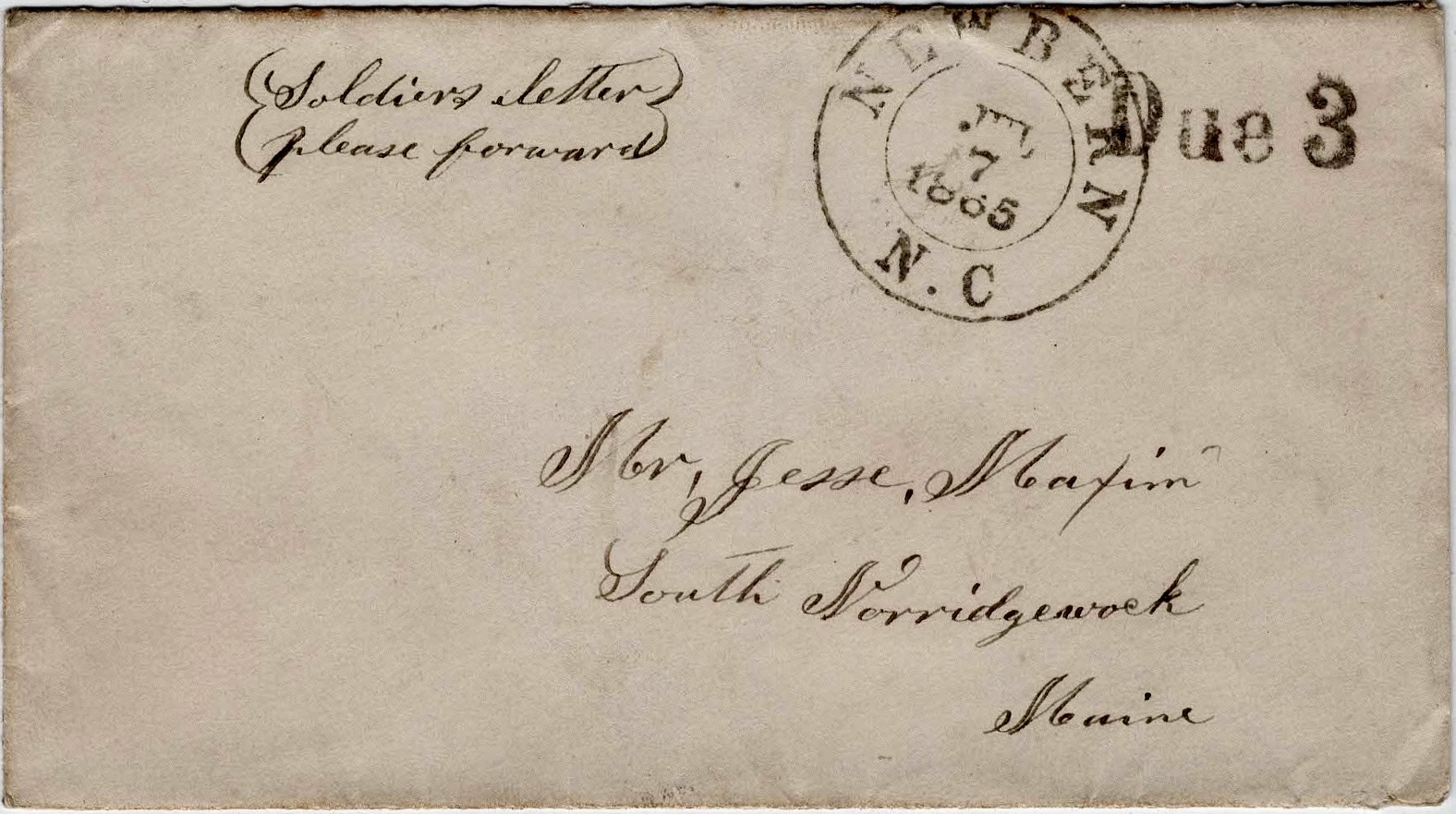
Addressed to Mr. Jesse Maxim, South Norridgewock, Maine

Raleigh, North Carolina
Monday, July 3rd 1865

Dear Parents and Friends

I have just received your kind letter under date of June 25th and was glad to hear from you again and to know that you are all well. I got a letter from Leander today. He was well. The men whose time of service expired before October 1st started for home yesterday. It took near one half of the regiment. It is the talk that there is another order on the way to discharge all men whose term of service expires before the 1st of January next. If so, it will take me. But if they are as long about it as they were about discharging those other men, I shan’t get home much before my year is out for there is only three months more from today. I expect it will be the longest three months for most all of the boys that I was acquainted with have gone home.

Now, about Harrison’s picture, if you can have it painted perfectly, I should for my choice rather have it than to have the monument as long as his remains are not there. Would not you rather have his picture to look at every day if you want to that to have his name carved out in marble a way yonder in the grave yard and when you look at it can neither see his features and then think here is his name but oh, he is not here. No, I should rather have his face to view and then think, thou once wast [here] but have passed away.

I am glad to hear that Sophronia has gone forward in Baptism. I have written to her two times and have ot heard from her yet. I don’t know whether she neglects to write or don’t get my letters. Where does George keep himself and what is he doing? I have not had a letter from him since May 15th. I should write to him if I had some stamps. If you can send me some, I should be glad to have them as I have but three and Leander sent me two of them in his letter that I got today. I should think that Syrena had brought her pigs to a June market but perhaps I am no judge.

I am glad there is a Sabbath School started in neighborhood and hope it will do some good. I don’t think of much more to write. I suppose you will want to know how the Fourth of July is spent here so I will not send this until day after tomorrow.

Wednesday morning, July 5th

I will tell you about the 4th of July. It was celebrated mostly by the Negroes. The streets were blacker than a thunder cloud. They had just such a time as you might suppose that Negroes would get up with the exceptions of a little fire works just to please the negroes. I don’t know but what you will think I am coming down on the negroes pretty hard but I can’t help that. You know that I am one of these kind that speaks just what I think and when a General will issue and order not to allow an enlisted man in town without a pass signed by Brigade commander, I think it is time to talk. And if that is not enough, it is time to shoot. How circumstances will change in one year. One year ago yesterday I was home. This year I was in Raleigh and on patrol, acting sergeant of the day [even though] I am nothing but a private.

It is reported that the order to discharge all men whose term of service expires before the 1st of January has got to regimental headquarters. I don’t want you to make any calculation on my getting home before my time is out nor do I want you to worry about me but write often and I will do the same. I must close so goodbye at present. This from your son, — T. F. Maxim

I shall hve to send this without a stamp as I have but three and have two other letters to write and want to keep one on hand.

1844: William Dare Garrison to Harriet Fithian Garrison

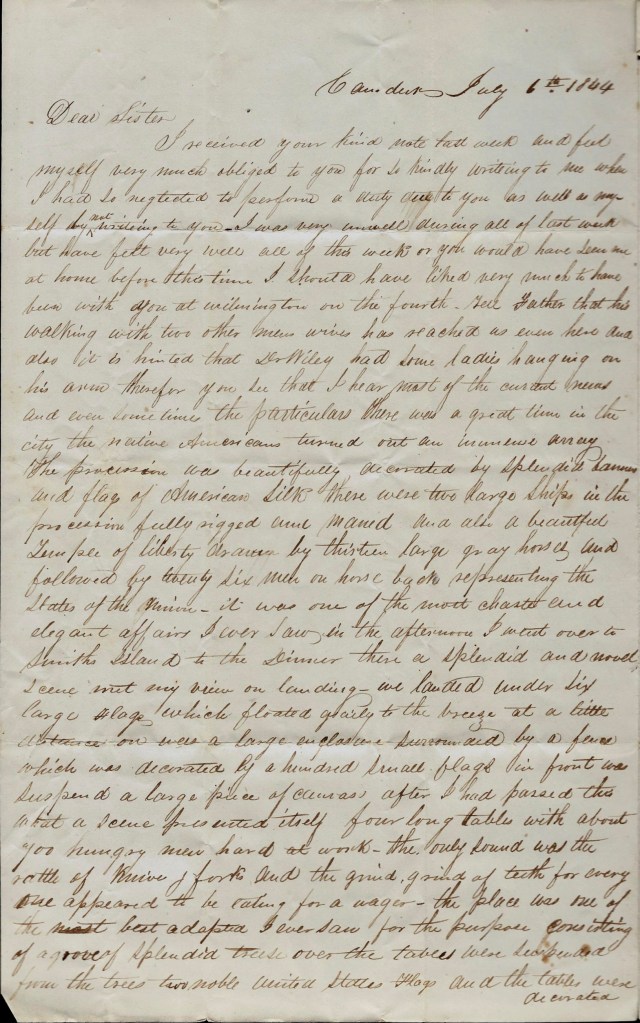
The following letter was written by 18 year-old William (“Will”) Dare Garrison (1826-1847), the eldest child of at least six born to Edmund Fithian Garrison (1802-1858) and Rebecca Dare (1808-1845) of Swedesboro, Gloucester county, New Jersey.

When war was declared on Mexico in May 1846, Will enlisted in Co. D (“Cambria Guards”), 2nd Pennsylvania Volunteers. Although he traveled with the volunteers in 1846 he did not officially enlist until 21 Jan. 1847. William would pass away on 11 July 1847 from illness at the Castle of Perote in Mexico City, aged twenty-one.

In this incredible letter, Will provides us with rich detail of the 4th of July events in Camden, New Jersey, in 1844 which happened to coincide with the Presidential campaign of Whig candidate Henry Clay and his running mate, Theodore Frelinghuysen. We learn that a political barbecue with food and speeches was held in the afternoon of the day’s events on Smith Island, in the middle of the Delaware river between Camden and Philadelphia. The letter was written on 6 July 1844, just one day before a major riot erupted across the river in Philadelphia between the Nativists and Roman Catholics.

A view of Camden from Philadelphia in 1844. Smith’s Island is in the middle of the Delaware river at left where all the trees are shown.

Will wrote the letter to his sister, Harriet Fithian Garrison (1831-1919) who married John W. Kirby (1826-1897) in 1854. That the family admired the statesman Henry Clay seems to be of little doubt as Will had a younger brother named Henry Clay Garrison (1835-1913) who humorously wrote his own epitaph: “Poor old Garry, Here he lies. Nobody laughs, And nobody cries; Where he has gone, Or how he fares, Nobody knows, Nobody cares.”

[Note: to see a map of Lobos Island drawn by Will in April 1847 during the Mexican-American War, see Manuscript Map.]

Transcription

Camden [New Jersey]
July 6th 1844

Dear Sister,

I received your kind note last week and feel myself very much obliged to you for so kindly writing to me when I had neglected to perform a duty due to you as well as myself by not writing to you. I was very unwell during all of last week but have felt very well all of this week or you would have seen me at home before this time. I should have liked very much to have been with you at Wilmington on the fourth. Tell Father that his walking with two other men’s wives has reached us even here and also it is hinted that Dr. Wiley had some ladies hanging on his arm. Therefore, you see that I hear most of the current news and even sometimes the particulars.

There was a great time in the city. The native Americans turned out an immense array. The procession was beautifully decorated by splendid banners and flags of American silk. There were two large ships in the procession fully rigged and manned and also a beautiful Temple of Liberty drawn by thirteen large gray horses and followed by twenty-six men on horseback representing the States of the Union. It was one of the most chaste and elegant affairs I ever saw.

“…what a scene presented itself. Four long tables with about 700 hungry men hard at work—the only sound was the rattle of knife and fork and the grind, grind of teeth for everyone appeared to be eating for a wager.”

— William Dare Garrison, 6 July 1844

In the afternoon, I went over to Smith’s Island to the dinner. There, a splendid and novel scene met my view on landing. We landed under six large flags which floated gaily to the breeze. At a little distance on were a large enclosure surrounded by a fence which was decorated by a hundred small flags. In front was suspended a large piece of canvas. After I had passed this, what a scene presented itself. Four long tables with about 700 hungry men hard at work—the only sound was the rattle of knife and fork and the grind, grind of teeth for everyone appeared to be eating for a wager. The place was one of the best adapted I ever saw for the purpose consisting of a grove of splendid trees. Over the tables were suspended from the trees two noble United States flags and the tables were decorated with numerous small flags bearing the names of Clay and Frelinghuysen. At one end and against the screen was an elevated platform and a table for the officers and speakers. Over them hung a portrait of Henry Clay with U. S. flags festooned over it and two splendid banners hung on either side of it. Opposite to it at the other end of the table, hung a splendid banner surmounted by a gilt eagle festooned with flowers. Upon the side nearest the water was erected a stand for the speakrs, gaily decorated with flags. After dinner we had some toasts and very good speaking interrupted only be cheers and the roar of cannon.

The afternoon concluded with cheers, the firing of cannon, and the bursting of rockets and other fireworks. In the evening there was a splendid display of fireworks.

Give my best respects to all my friends and kiss the family all around for me. There has been a great number of persons over here since the fourth and yesterday there were several fights in the [beer] gardens and a good deal of hard fun. The Dutch [Germans] brought over a band and they danced all the afternoon. Altogether the fourth has gone off with less trouble than was anticipated. I hope that the fourth at Swedesboro went off without any new sprees. Tell Mother that I aim to get up at 5 o’clock after this in order to take exercise and hope by that means to keep from getting sick any more. Give her my love. Tell Father I am looking for him every day in order to make some arrangements. I must now conclude for business calls me to attend to something else. Therefore, I subscribe myself your affectionate brother, — Will D. Garrison

Write back soon.

Burn all my letters for I do not want them kept as monuments of my foolishness and tell John to do the same. — WDG

Programme of Events, Pennsylvania Inquirer, 4 July 1844

1861: Adoniram Judson Clark to Samuel W. Clark

Adoniram Judson Clark

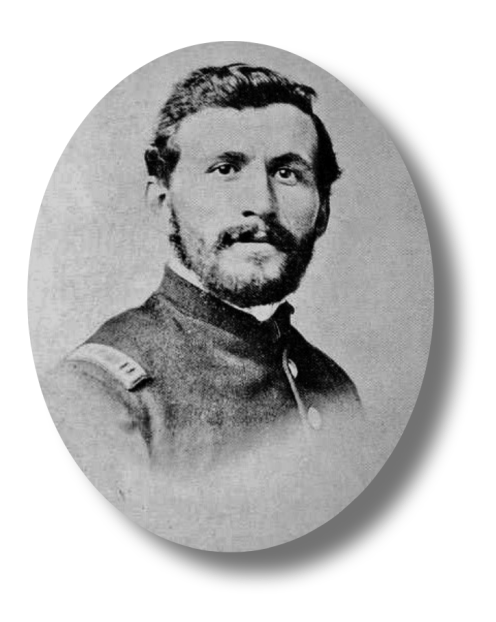
This early war letter was written by Adoniram Judson Clark (1838-1913) who “enlisted in the 1st New Jersey Militia in April 1861, and became a sergeant in Co. F. When the regiment’s three-month enlistment ended, Clark was involved in raising Battery B, 1st New Jersey Light Artillery. It was mustered into service on September 3, 1861, at Camp Olden in Trenton, New Jersey. The battery was assigned to the First New Jersey Brigade under the command of Brigadier General Philip Kearny. Clark became first lieutenant under Capt. John E. Beam, and was then promoted to captain when Beam was killed in the Battle of Malvern Hill on July 1, 1862. Clark commanded the battery to the end of the war.

To read more letters by Capt. Clark while serving later in the 1st New Jersey Battery, go to Spared & Shared 21—1862-64: Adoniram Judson Clark to Samuel W. Clark published on 25 April 2020.

Clark was the son of Samuel Clark (1791-1869) and Livia Drusilla Wellman (1789-1849) of Manlius, Onondaga county, New York. He wrote this letter to his older brother, Samuel W. Clark (1825-1892) of Newark, Essex county, New Jersey—a long time school teacher in Newark and principal of public school No. 3 in 1860. Samuel was married in 1851 to Sarah Mayhew in Newark.

The first four regiments organized in New Jersey, all three-months regiments, were called militia and were brigaded together as the New Jersey Brigade under the command of Theodore Runyon, a Newark lawyer. The New Jersey brigade was one of the best uniformed and equipped organizations to arrive in Washington in early May 1861 and they were greeted with marked enthusiasm. A little over two weeks later, the brigade crossed the Potomac into Virginia and threw up the first fortifications erected by Union troops on Southern soil (Fort Runyon). This letter was written from Camp Trenton on 5 July 1861, just a couple weeks before the Battle of Bull Run. Camp Trenton was located adjacent the tracks of the Alexandria, Loudon and Hampshire Railroad some two or three miles west of Alexandria in a camp formerly occupied briefly by an Ohio regiment. The camp was described by one member of the 1st New Jersey as being on level ground in a grove of cedar trees.

The Jerseymen were not in the fight at Bull Run, but held in reserve and helped to stabilize the panic during the retreat. It has been conjectured that the Jersey troops were placed in the reserve due to the fact that their term of service was about to end.

Transcription

Camp Trenton, L&H Railroad, Virginia
July 5th 1861

Dear Brother Sam,

I have delayed writing till now that I might tell you what was going on here on the “glorious fourth.” First, I got “home” safe and sound. Reached Washington at 6 o’clock Sunday morning in company with J. Haworth & Tom Leffingwell who came down in the same train with me. Ran around a couple of hours with them after the 2nd Regiment & then breakfasted at the Kirkwood House for which I was sated $0.75. The usual high Washington prices are running up now as the time for Congress to sit is near.

Reached camp at 10 o’clock and of course was besieged for new at home. The officers alone expected me home & they did for when some of the boys were making remarks about my hurrying up so, they were shut up with the remark that, “He obeyed orders,” so that it was full as well that I hurried up so. Lieut. [John E.] Beam & the men were very much pleased that I did not forget their messages, the thanks of part of whom belong to you. My basket hangs in the top of the tent & my “pocket pistol” is in my knapsack waiting for orders. I could myself well armed all around now for anything.

You told Mrs. Beam what I spoken to you about, I hope, because I told him you would.

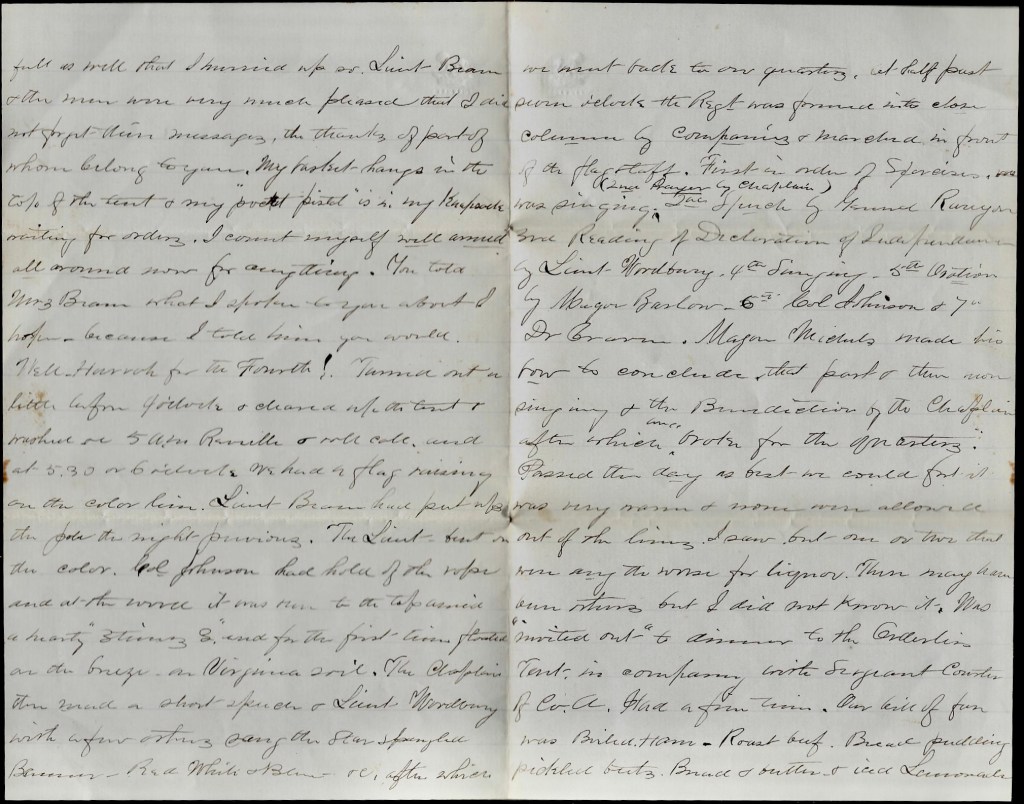
Well, hurrah for the Fourth! Turned out a little before 4 o’clock & cleared up the tent & washed &c. 5 a.m. reveille & roll call, and at 5.30 or 6 o’clock we had a flag raising on the color line. Lieut. Beam had put up the pole the night previous. The lieutenant put on the color. Col. [Adolphus] Johnson had hold of the rope and at the word, it was run to the top amid a hearty “3 times 3” and for the first time floated on the breeze on Virginia soil. The chaplain [A. St. John Chambre] then made a short speech & Lieut. [George T.] Woodbury with a few others sang the Star Spangled Banner, the Red, White, & Blue, &c. after which we went back to our quarters.

Description of 4th of July Celebration at Camp Trenton published in the Newark Daily Advertiser, 31 July 1861

At half past seven o’clock, the regiment was formed into close column by companies & marched in front of the flagstaff. First in order of exercises, was singing, 2nd—prayer by chaplain, 3rd—speech by General [Theodore] Runyon, 4th—Reading of Declaration of Independence by Lieut. [George T.] Woodbury, 5th—Singing, 6th—Oration by Major Barlow, 7th—Col. [Adolphus] Johnson, and 8th—Dr. [Surgeon] Craven. Major Mikels made his bow to conclude that part & then more singing & the benediction by the chaplain after which were broken for the quarters.

Passed the day as best we could for it was very warm & none were allowed out of the lines. I saw but one or two that were any the worse for liquor. There may have been others but I did not know it. Was invited out to dinner to the orderlies tent in company with Sergeant [William C.] Courter of Co. A. Had a fun time. Our bill of fare was boiled ham, roast beef, bread pudding, picked beets, bread & butter, & iced lemonade. And, “after the cloth was removed,”—cigars.

At night there was all sorts of fun. We had new canteens give out during the day and just after night the boys got all the old ones together & divided into two portions & for an hour had a pitched battle & the way the tin canteens flew was a caution! Neither party would give in & I don’t know how long it would have lasted if the officers had not stopped them.

In the eve we had a “fancy” parade and on the parade ground “big” bonfires were burning. Fireworks were not as plenty but we had some show. One of the fine sights was the setting fire of the tall red cedar in front of the parade ground & see the whole tree one mass of flame. In the direction of the Washington Navy Yard we could see rockets of government blue lights &c.

“Time’s up.” Give love to all. We are under marching orders again today & expect to leave either today or tonight towards Fairfax. Ready for fun or fight.

Your affectionate brother, — A. Judson Clark

Direct (in addition to the usual direction) Care of Col. [Adolphus] Johnson, 1st Regt. N. J. M. to ensure safety, — Jud