The following letter was written by John W. Walker (1823-1875) of Pickensville, South Carolina. He was married to Elizabeth Ann Grady (1823-1861) in 1848 in Lumpkin, Georgia.
The letter was addressed to James Earl Hagood (1826-1904), the son of Col. Benjamin Hagood (1788-1865) and Adaline Ambler Hagood (1808-1877). Hagood was a merchant and at the time serving as clerk of the circuit court in Pickens county.
We learn from this letter that the funds for the purchase of a regimental flag for the 4th South Carolina Regiment was raised by subscription by citizens in Pickens county.
T R A N S C R I P T I O N
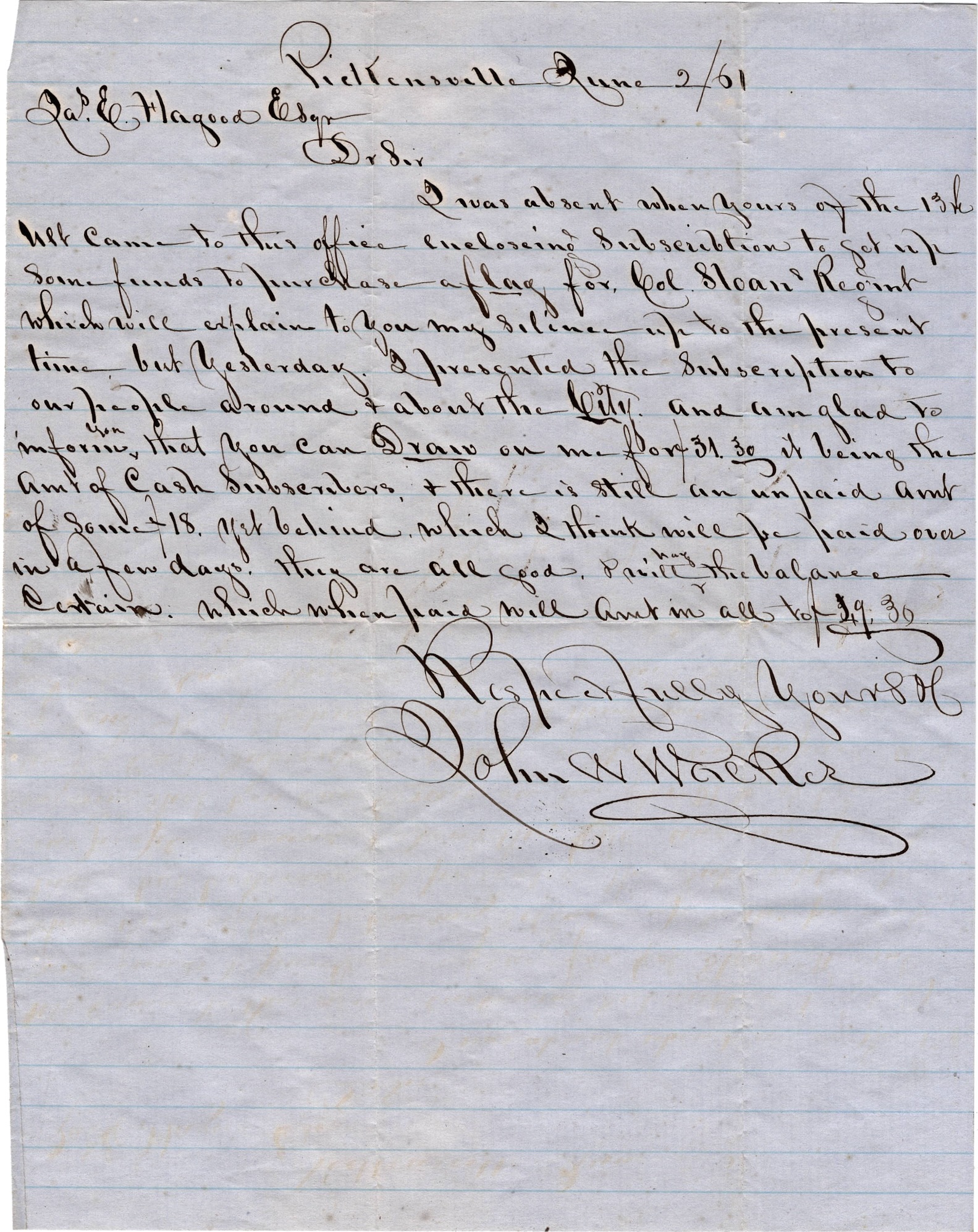
Pickensville, [South Carolina] June 2, 1861
James E. Hagood, Esqr.
Dear sir, I was absent when yours of the 13th ult. came to this office enclosing subscription to set up some funds to purchase a flag for Col. [J. E. B.] Sloan’s [4th South Carolina] Regiment which will explain to you my silence up to the present time. But yesterday I presented the subscription to our people around & about the City and am glad to inform you that you can draw on me for #31.30, it being the amount of cash subscribers, & there is still an unpaid amount of $18 yet behind which I think will be paid over in a few days. They are all good & will pay the balance certain which, when paid, will amount in all to $49.30.
The following letter was written by Stephen Stanley Crittenden (1829-1911), the son of Dr. John Crittenden (an early settler of Greenville, South Carolina) and Sarah Maria Stanley. He was educated in Greenville and at Elizabeth, New Jersey. In 1855, he married Eliza Jane Lynch (1838-1865), of Virginia. After her death, he married Sarah A. Bedell (1839-1911.
Crittenden was a planter. He volunteered at the first call for troops, and was elected 1st Lieutenant of a company [Co. G] that became part of the 4th South Carolina regiment under Col. J. B. E. Sloan, and participated prominently in the first battle of Manassas. This regiment and Wheat’s battalion, forming Evans’ brigade, on the extreme left, “commenced the great battle and held the hosts of the enemy in check for two hours before being reinforced. The regiment suffered severely in killed and wounded. The day after this battle Lieut. Crittenden received the appointment of Adjutant in place of the gallant Samual D. Wilkes, of Anderson, who was killed.”
“In the great battle of Seven Pines, in May, 1862. when many of this gallant regiment were killed, Adjt. Crittenden was wounded by a minié ball in the left breast while in front of his command. During his absence because of this wound, Gov. Pickens appointed him Lieutenant Colonel of the 4th Regiment of Reserves then forming for the defense of the Carolina Coast. At the expiration of this service on the coast he volunteered as a private in Gen. Gary’s mounted regiment, Hampton’s famous legion, for service around Richmond. He also served on the staff of Gen. Gary.
After the war Gen. Crittenden returned to planting, but for ten years served in his State Legislature as Representative and as Senator. He was Postmaster at Greenville four years during Mr. Cleveland’s first ad-ministration.” He committed suicide in 1911. [Source: Confederate Veteran]
Transcription
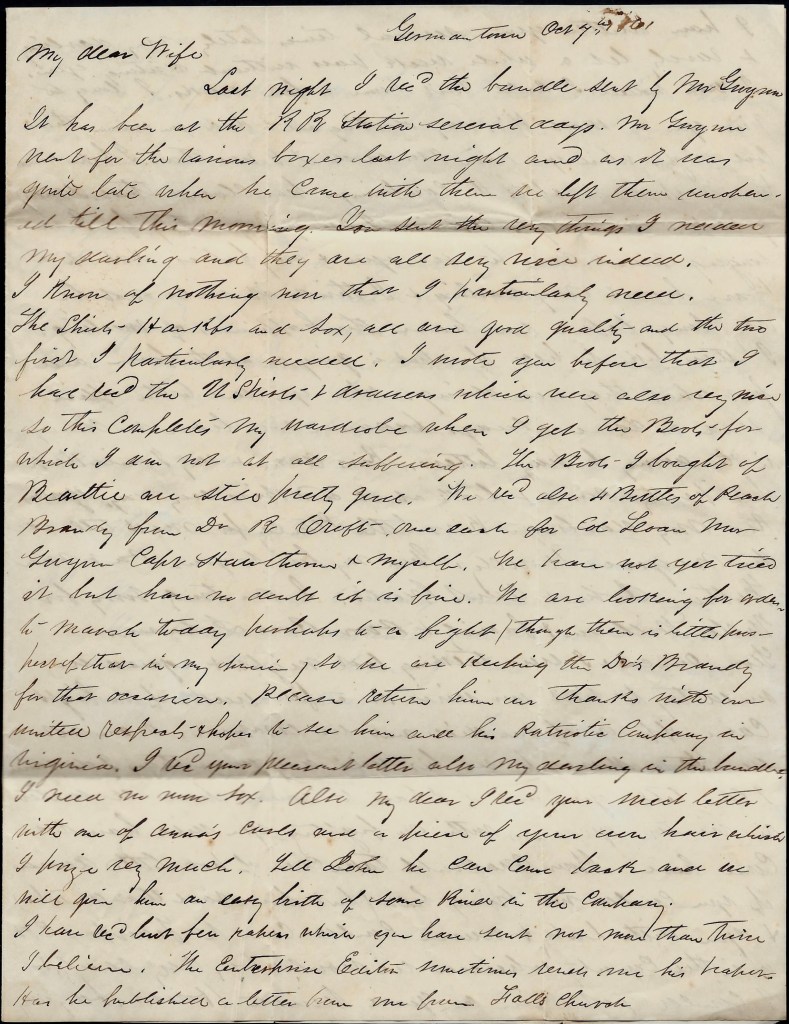
Germantown [Virginia] October 4th 1861
My dear wife,
Last night I received the bundle sent by Mr. Guysen. It has been at the railroad station several days. Mr. Guysen went for the various boxes last night and as it was quite late when he came with them, he left them unopened till this morning. You sent the very things I needed, my darling, and they are all very nice indeed. I know of nothing now that I particularly need. The shirts, handkerchiefs and socks, all are good quality, and the two first I particularly needed. I wrote you before that I had received the undershirts and drawers which were also very nice so this completes my wardrobe when I get the boots for which I am not at all suffering. The boots I bought of Beattie are still pretty good. We received also 4 bottles of peach brandy from Dr. R. Croft, one each for Col. Loan, Mr. Guysen, Capt. Hawthorn, and myself. We have not yet tried it but have no doubt it is fine.
We are looking for orders to march today, perhaps to a fight, though there is little prospect of that in my opinion so we are keeping the Dr.’s brandy for that occasion. Please return him our thanks with our united respects & hopes to see him and his patriotic company in Virginia.
I received your pleasant letter also my darling in the bundle. I need no more socks. Also, my dear, I received your letter with one of Anna’s cards and a piece of your own hair which I prize very much. Tell John he can come back and we will give him an easy berth of some kind in the company. I have received but few papers which you have sent—not more than twice I believe. The Enterprise editor sometimes sends me his papers. Has he published a letter from me from Falls Church?
I have written you several ties lately, my darling, & rarely let a whole week pass without writing you. I wish indeed I could visit home a few weeks. I long to give you a kiss, my darling, and to keep you warm these cool nights which you know I could do if I was there. I hope sometime next month after the campaign has closed that I may get off. One thing is certain, I am going to try for I am longing more & more to see you & my babies. Keep up a brave heart, my darling, and I think it will not be very long before we have the happiness of meeting.
I still like to hear of what is going on at the farm and just what they are doing. When you send to the office, send a dime always because we have no change in the army to pay letters. Kiss Anna & say I will keep her pretty case and look at it and kiss every day. Yours too, my darling. Kiss little Stanley for me & tell all the negroes howdy. Give my love to your Pa & Ma, Father, John and Aunt Curtis. I am truly sorry for Uncle William & family & poor Rosa Johnson.
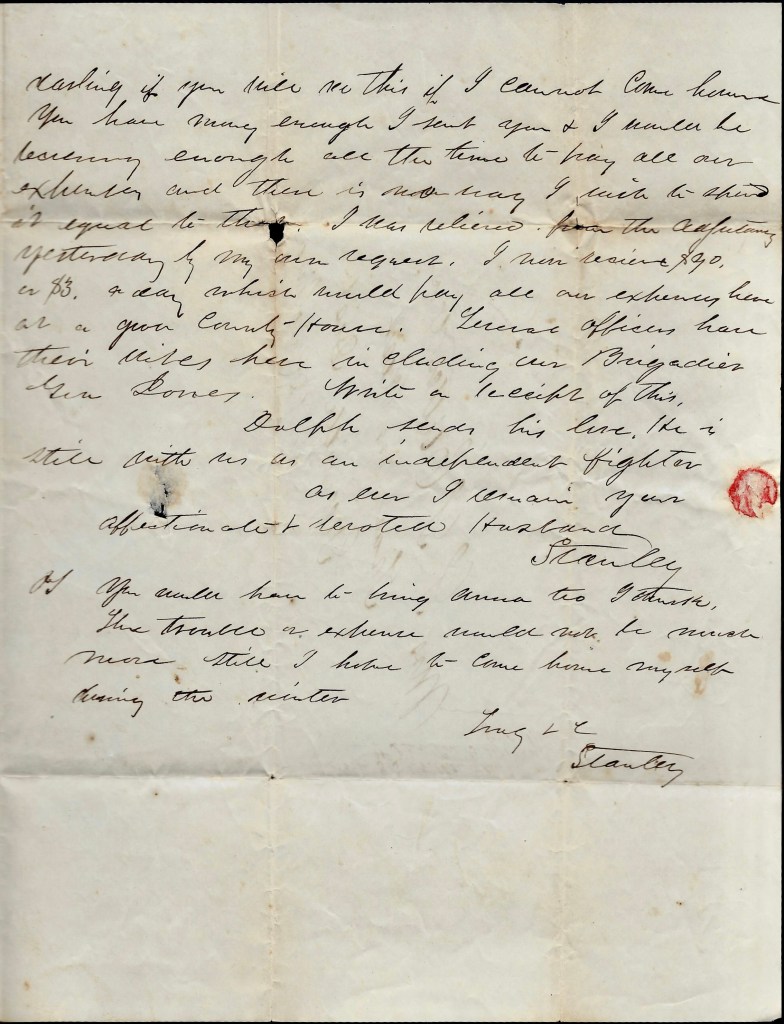
Thomas [W.] Duncan & I were talking last night & agreed we would try to visit our wives in a few weeks if no fight came off or if one did and we escaped. No one, not even Thomas wishes to see his wife any more than I do, I can tell you. and if I have to remain here all winter in winter quarters with no fighting, you will have to come here. Your Ma could take care of poor little Anna if you could not bring her (but how sad that would be) & you with baby & nurse could come to Fairfax Court House or in the county wherever we would be very easily & I could get you a good private house, my darling, if I cannot come home.
You have money enough I sent you & I would be [ ] enough all the time to pay all our expenses and there is no way I wish to spend it equal to this. I was relieved from the adjutancy yesterday by my own request. I now receive $90 or $3 a day which would pay all our expenses here at a good county house. Several officers have their wives here including our Brigadier General Jones. Write on receipt of this.
Dolph sends his love. He is still with us as an independent fighter.
As ever, I remain your affectionate & devoted husband, — Stanley
P.S. You would have to bring Anna too, I think. The trouble or expense would not be much more. Still I hope to come home myself during the winter. — Truly, — Stanley
I could not find an image of Stanley but here is one of 1st Lieutenant Thomas S. Nelson of Co. I, 4th South Carolina Cavalry.
The following letter was written by Stephen Stanley Crittenden (1829-1911) who enlisted on 1 February 1861 at Greenville, South Carolina, and was elected a 1st Lieutenant in the 4th South Carolina Infantry. They fought at 1st Manassas under Shank Evans but when it came to reorganize in April 1862, various companies were consolidated and they became known as either the 4th or 13th South Carolina Battalion. Stanley, the 1st Lieutenant of Co. D, was wounded in the left breast on 1 June 1862 at the Battle of Seven Pines in Virginia. Late in the war he served as a Lt. Colonel in the 3rd South Carolina Reserves.
Stanley wrote the letter to his first wife, Eliza Jane Lynch (1838-1865), with whom he married in 1855. His second wife was Sarah Ann Rou (1839-1911).
Sadly, Crittenden’s life ended tragically. Local papers carried the following death notice: “Col. Stanley S. Crittenden of Greenville, aged 82 years, a writer and former postmaster of Greenville, committed suicide Wednesday morning by shooting himself to death in his bathroom. Death came instantly. Col. Crittenden was lieutenant colonel in the staff of Gen. Mart Gary in the ‘war between the sections.’ He helped the late general and Bishop Ellison Capers organize the South Carolina division of United Confederate Veterans, and himself commanded that division for some time.” Another paper added that the Col. had been “much depressed over the death of his wife several weeks ago, and this, coupled with other troubles, had much to do with his sudden death.”
Transcription
Columbia, South Carolina Sunday, 4 o’clock p.m. [1861?]
My dear wife,
I have picked up an old piece of paper as youy perceive to write you a few lines for tomorrow’s mail. Yours and sister Marcia’s welcome letters were received yesterday and gave me great pleasure. I return Marcia’s for you to read. The box of good things also came in plenty time for supper last night and our whole mess are very much obliged to you. The things are very nice & the butter particularly acceptable. We are living very well—some of us continually getting something from home and buying fish, eggs, &c. in this market. So don’t be afraid about our living.
I never slept sounder or felt better in my life than since I have been here. Still I think of you my darling and the dear babies all the time & wish very much to see you all. Richard Foster got a furlough for 4 or 5 days and went home with his wife. We are liable to be called from here any time to Virginia and if you felt like coming, you could easily stay at Janny’s Hotel a few days & I could be with you all the time. But then my darling, you would feel so badly again when we had to say goodbye.
I volunteered with some 60 of our cavalry & two of the regiments for Virginia if needed. You will see by today’s paper that the Governor considers all the volunteers as liable to be ordered to Virginia without volunteering again, as defending Virginia is defending our own state. We may be ordered there in a few days or we may not be sent there at all.
This Sunday and we have drilled twice. This morning I took the company by invitation to hear Dr. Reynolds of the South Carolina College. He gave us a fine discourse.
The box that you sent only cost 10 cents—the cartage from the depot. The railroad charges nothing for packages I believe to the volunteers. If we stay here long, I may write to you for some of my summer clothes, those and some handkerchiefs & cotton socks being about all I will need. Write me, my darling, all that you are doing. You and your Ma might stay at the farm a good deal if you felt like it.
I said something to Maj. Whitaker I believe about sending the epaulets. I have forgotten what I left the keys there as you know. She & Edward write often Remember me to Oliver, Harriet and all the servants. Tell them to take care of everything—horses, cows, hogs, corn, &c….Tell Oliver to fence in the whole new ground. get all the bark from the oaks & pile it carefully as he gets it, haul it the new way to the tan yard & get the money for it….
With love to your Pa and Ma & to yourself, my darling, & our babies. Your own, — Stanley





 Spared & Shared 23