The following letter was written by James Drury (1837-1919), a native of Limerick, Ireland. In 1860, James was enumerated in the household of 42 year-old Albert Baldwin in Chester, Windsor county, Vermont, where he worked as a farm hand. Living in the same household was his 62 year-old mother, Mary Drury.
It was on 21 September 1861 when James mustered into Co. C, 4th Vermont Infantry as a private. A month later he was promoted to corporal and eventually rose to the rank of sergeant. He was awarded the Congressional Medal of Honor for his bravery in action at The First Battle of Weldon Railroad, Virginia on June 23, 1864. His citation reads “He saved the colors of his regiment when it was surrounded by a much larger force of the enemy, and after the greater part of the regiment had been killed or captured.”
A description of the event was recorded in Deeds of Valor, page 368:
Drury replied: “They will have to kill this Irishman before they get it.”
The officer pointed to a road which seemed to offer some chance as an avenue of escape.
“Go that way and perhaps you may succeed in escaping the rebels,” the officer observed. Drury lost no time in following the advice. Wrapping the flag around the staff, he said to his command: ” Boys, I’m going to save this flag or die in the attempt.”
Privates Brown and Wilson called out: “We’ll be with you, Sergeant.” And then the three started across the open fields. They had not progressed far, however, when the rebels shouted to them: ” Halt, you damned Yankees ! ” but the Yankees did not halt. A shower of bullets was sent after them. Poor Brown fell. To their regret they had to leave the brave fellow behind. Sergeant Drury and his remaining companion, Private Wilson, ran as fast as they could and safely reached the timber. By this time darkness had set in and the fugitives were able to conceal themselves in the woods till daybreak, when they found the Federal pickets, and thus saved the flag from falling into the enemy’s hands.
I’m speculating on the recipient of this letter but presume it was Albert Baldwin for whom he labored and with whom he and his mother lived prior to the James’ enlistment.
The “Picture Gallery” at Camp Griffin where the Vermont Brigade spent the Winter of 1861-62. Langley, Virginia. (LOC)
Transcription
Camp Griffin November 28, 1861
Dear sir,
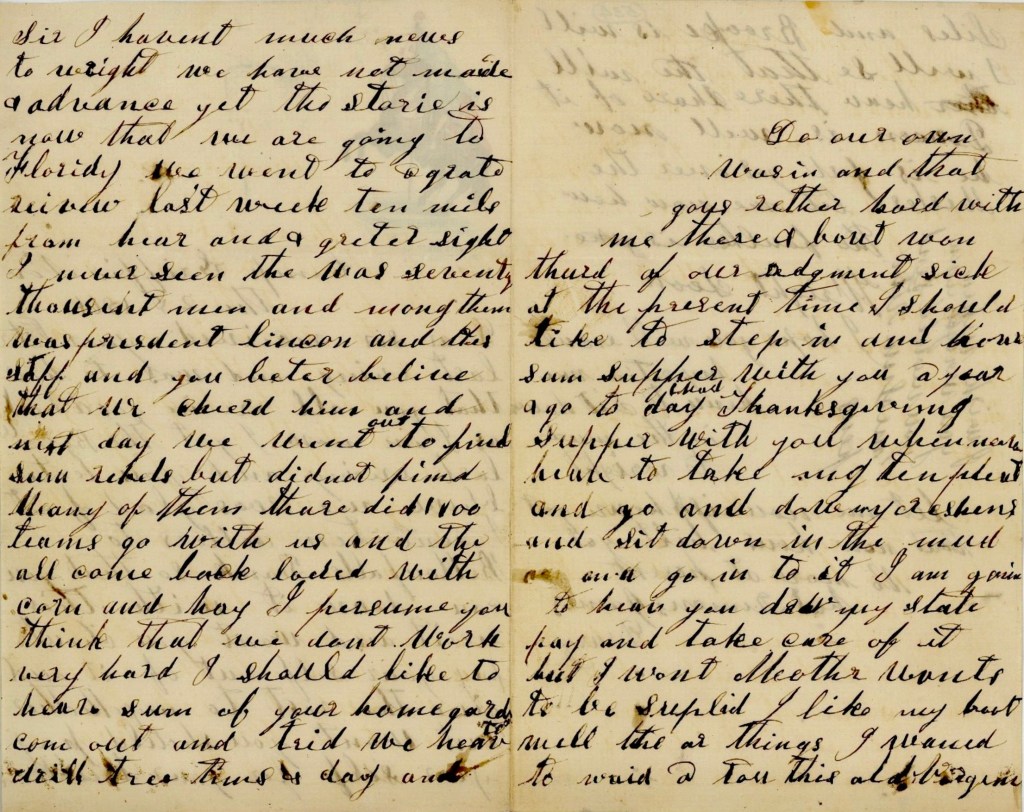
I received your letter last evening and was [glad] to hear that you all are in good health as I am now. I got the box last evening and your letter. Believe me, I was glad of it. I sent ten dollars to Bellow’s Falls Bank so that you can draw it with this receipt and I want you to pay yourself out of it and give the rest to mother. But want you should pay yourself for your trouble.
Sir, I haven’t much news to write. We have not made an advance yet. The story is now that we are going to Florida. We went to a Great Review last week ten miles from here and a greater sight I never seen. There was seventy thousand men and among them was President Lincoln and his staff and you better believe that we cheered him and next day we went out to find some rebels but didn’t find many of them. There did 100 teams go with us and they all came back loaded with corn and hay.
I presume you think that we don’t work very hard. I should like to have seen your home guard come out and try it. We have to drill three times a day and do our own washing and that goes rather hard with me. There [are] about one third of our regiment sick at the present time. I should like to step in and have some supper with you. A year ago today I had Thanksgiving supper with you. Suppose now I’ll have to take my tin plate and go and draw my rations and sit down in the mud and go into it. I am a going to have you draw my state pay and take care of it but I want mother wants to be supplied. I like my boots well and the other things…
Silas and Brook is well. I will see that they will have their share of it. Dansen is well now. He is just got over the measles. Let me know how the folks is. Write soon. I hope you will excuse my writing. We have to sit down in the mud to write. Let me know if [ ] got that new house built yet. No more at present but remain, — James Drury
The following letter was written by 28 year-old Norman Taylor Pike who enlisted in September 1861 as a private in Co. I of the 4th Vermont Infantry. He was taken prisoner at Weldon Railroad south of Petersburg, Virginia, on 23 June 1864 and died a POW at Andersonville. His date of death was recorded as 30 November 1864. His remains are now at the Andersonville National Cemetery, Grave No. 12198.
Norman’s parents were Isaac Newton Pike (1803-18840 and Jane Holt Stiles (1807-1872) of Windham county, Vermont.
The 4th Vermont Infantry at Camp Griffin, Langley, Virginia, 1861
[Note: This letter is from the private collection of Greg Herr and was offered for transcription and publication on Spared & Shared by express consent.]
Transcription
Camp Griffin December 16th 1861
Dear Friend,
I received your very welcome letter and will try to answer it. I am well and hope this letter may find you and all the rest of the folks the same. I have been pretty busy for a week past. I went on picket twice last week and on a foraging party to Vienna one day. This afternoon I have been drilling. We had a Brigade Drill and a first rate good one.
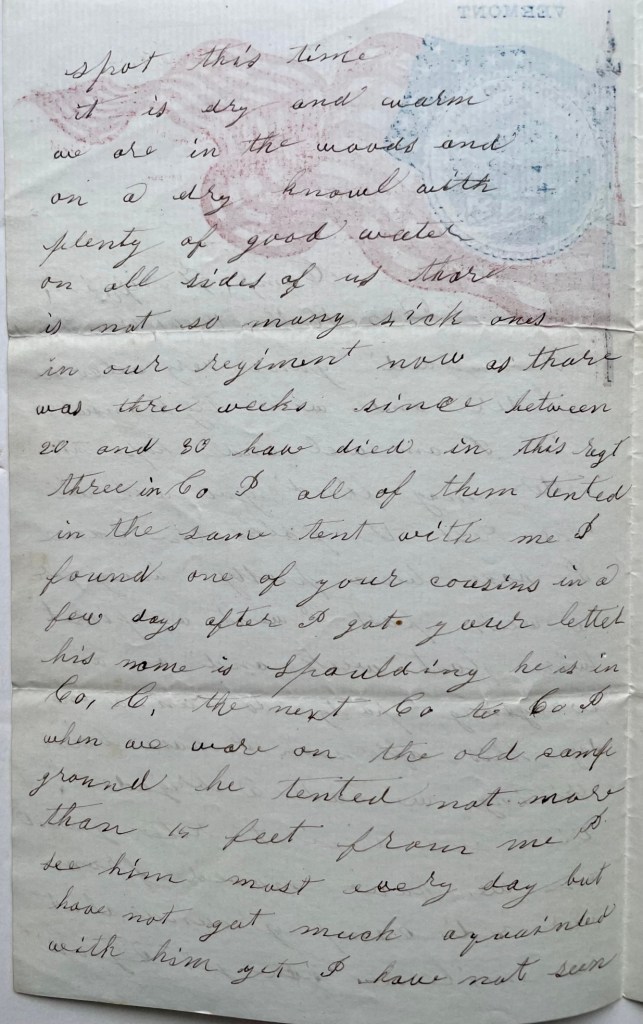
We have moved from our old camp ground about one mile. We have got a good spot this time. It is dry and warm. We are in the woods and on a dry knoll with plenty of good water on all sides of us. There is not so many sick ones in our regiment now as there was three weeks since. Between 20 and 30 have died in this regiment—three in Co. I. All of them tented in the same tent with me. I found one of your cousins in a few days after I got your letter. His name is Spaulding. He is in Co. C, the next company to Co. I. When we were on the old camp ground, he tented not more than 15 feet from me. I see him most every day but have not got much acquainted with him yet.
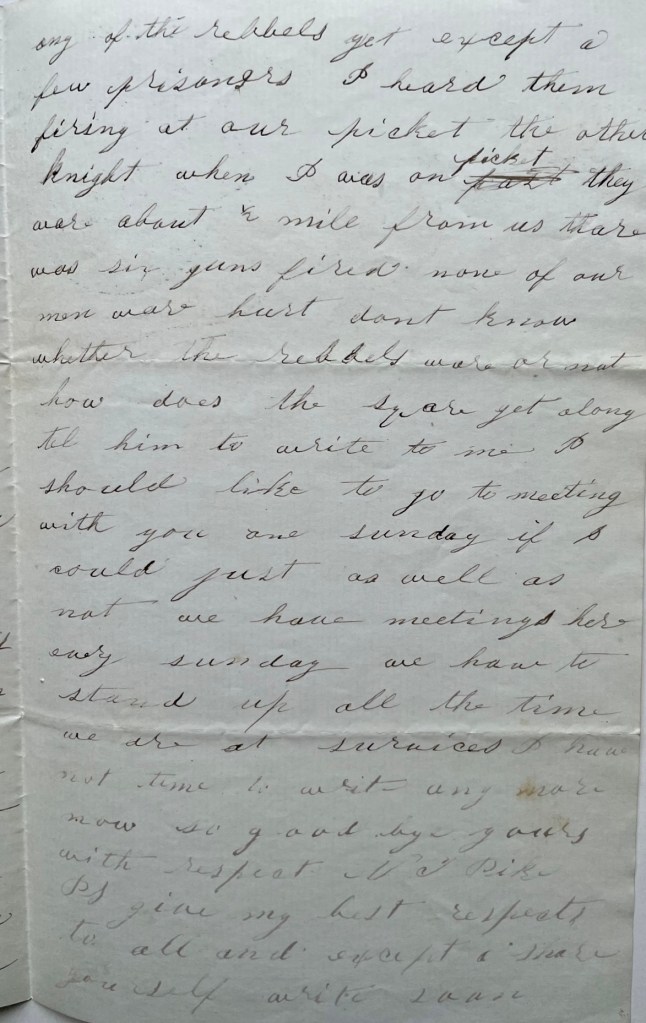
I have not seen any of the rebels yet except a few prisoners. I heard them firing at our picket the other night when I was on picket. There were about half a mile from us. There was six guns fired. None of our men were hurt. Don’t know whether the rebels were or not.
How does the squire get along. Tell him to write to me. I should like to go to meeting with you one Sunday if I would just as well as not. We have meetings here every Sunday. We have to stand up all the time we are at services. I have not time to write any more now so goodbye. Yours with respect, — N. T. Pike
P. S. Give my best respects to all and accept a share yourself. Write soon.
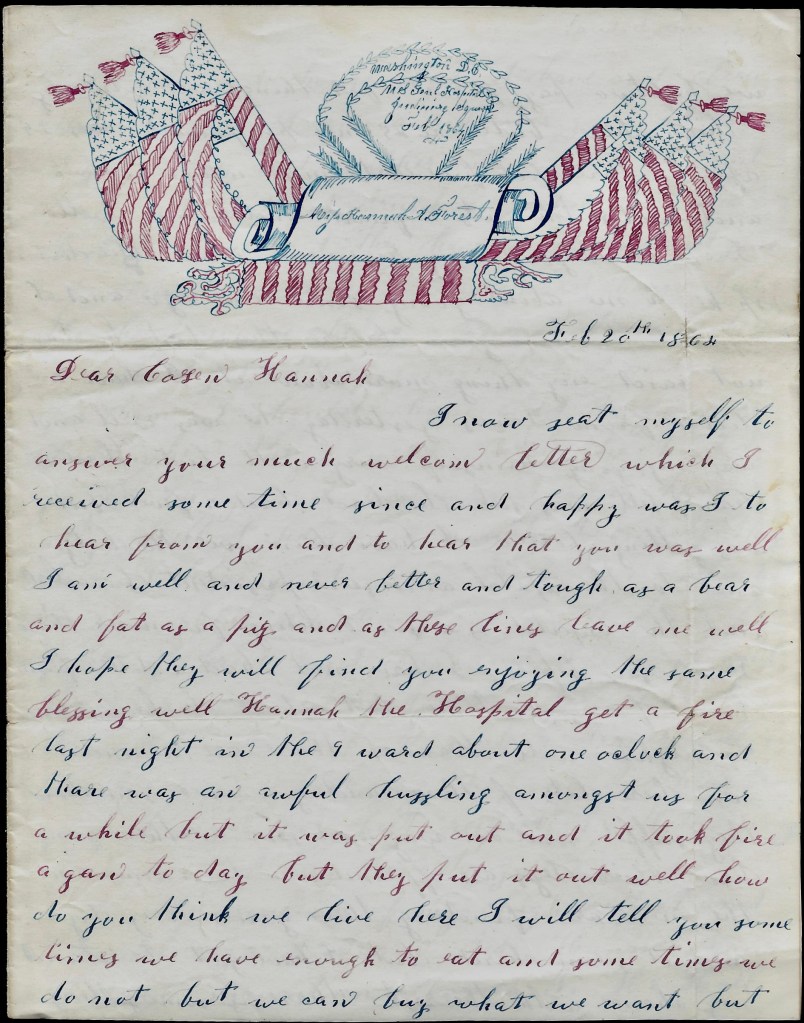
The following letter was written by “T. H. Hall”—a Federal soldier but not otherwise identified and the clues in the letter are limited. We know that he wrote the letter to his cousin whose name was Hannah Forest but there is no envelope to inform us of her location. He mentions receiving a letter from another soldier named Hiram Campbell who may have been a member of his regiment. Pursing that lead, I found a private by that name in Co. E, 4th Vermont Infantry. Looking through that roster, I found a Pvt. Thomas H. Hall in the same company so my hunch is that the author was this comrade of Campbell’s. Company E was raised in Windsor county, Vermont and I found a Hannah Forest (b. 1841) residing in Gaysville, Windsor county, Vermont in 1860 who may have been his cousin. Unfortunately I cannot confirm the soldier’s identity without reviewing regimental or hospital records further.
From the letter we learn that Hall was in the Judiciary Square Hospital in Washington D. C. He does not tell us how long he had been there, whether he had been wounded or sick, though he appears to have recovered and anticipated returning to his regiment. The hospital was designated as the Eye and Ear Hospital from November 5, 1862 to March 9, 1863, when Desmarres Eye and Ear General Hospital opened. Judiciary Square was then designated as a Stump Hospital in April 1864—most of its patients being amputees.
Transcription
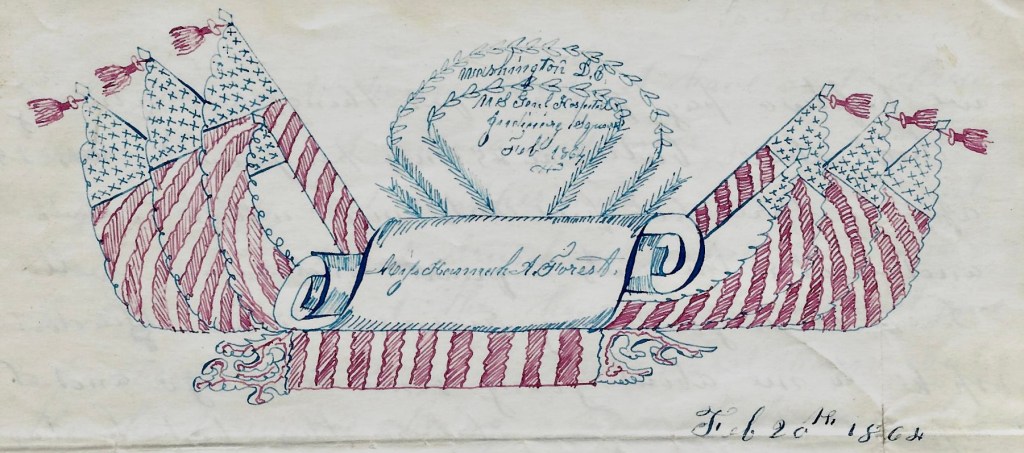
Hand drawn patriotic header on Hall’s letter, 20 February 1864
U. S. Hospital Judiciary Square Washington D. C. February 20th 1864
Dear Cousin Hannah,
I now seat myself to answer your much welcome letter which I received some time since and happy was I to hear from you and to hear that you was well. I am well and never better and tough as a bear and fat as a pig. And as these lines leave me well, I hope they will find you enjoying the same blessing.
Well, Hannah, the hospital get afire last night in the 9th Ward about one o’clock and there was an awful hustling amongst us for a while but it was put out and it took fire again today but they put it out.
Well, how do you think we live here? I will tell you. Sometimes we have enough to eat and sometimes we do not. But we can buy what we want but we have to pay for it for things are extremely high here. Butter is 45 cents per pound, cheese 25, apples three for five cents, milk which is chalk and water ten cents a quart, and so on.
Well, I expect to go to my regiment soon. The doctor spoke to me about going some time ago and I expected to have gone before this but he has not said anything more about it. I had a letter from James yesterday. He was well and was enjoying himself very well. But Hiram Campbell was sick. He had had a fever but was getting better.
I have been over the City and to the Capitol and seen President Lincoln and the Capitol is a nice building—far nicer than I ever saw before. I have not had a letter from home for some time but shall look for one tonight.
Well, Hannah, there are wounded men here—lots of them—and you never saw how they suffer, some [in] one way and some another. Some have their legs are off and some their arms and the men are finding their graves every day and it seems hard. But I have got to stand my chance with the rest. There is some getting into the guard house but I have not been there yet, but I came awful near going there. I got a pass and another man stole it and went out and got drunk and did not come back in time and they have to get in and give up their passes or go to the guard house. But the head nurse, being a friend of mine, helped me and I got rid of going. Had it not been for him, I should have had to gone too but when they caught him, he had to go to the guard house and stay three days.
Well, I have not much to write this time. I have just been to dinner and what do you think we had? One small piece of soft bread and beef and rice soup and the soup we could not eat. Were I at home, I would not look at such a dinner. Well, I must close hoping to hear from you. I send my best respects to all enquiring friends and my love to you.
With the assurance of my high respect and personal regard, I am dear Hannah, your obedient servant and cousin, — T. H. Hall
These letters were written by John S. Halley (1837-1913), the son of John and Jessie (Spital) Halley of Markinch, Fifeshire, Scotland. He wrote the letters to his sister, Mary Arnot Halley (1836-1888).
I could not find an image of John but here is a tintype of Pvt. William W. Heath who also served in Co. H, 4th Vermont Infantry. Health was killed on 5 May 1864 in the Wilderness. (Bruce Hermann Collection)
Their father, John Halley, came to America with his family in 1847, his wife dying enroute in Montreal before he settled in Vermont. John grew up in Orange county, Vermont, and was married there in 1861 to Eveline A. Richardson (1841-1924) before enlisting in late August 1861 as a private in Co. H, 4th Vermont Infantry. He was wounded on 14 September 1862 at Crampton’s Pass, South Mountain, but the wound was not disabling and he continued in the service until mustering out on 30 September 1864. His name appears variously in military records as Holley or Halley.
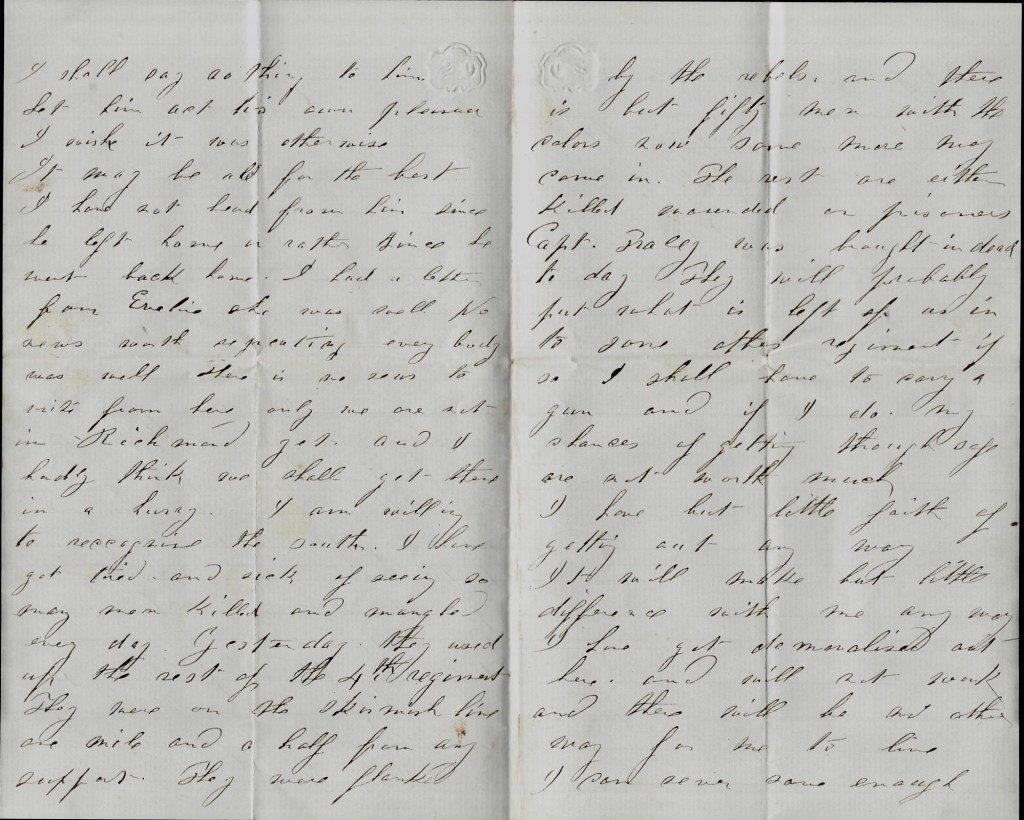
John’s enthusiasm for fighting flagged considerably by the summer of 1864, prompting him to confess to his sister, “I am willing to recognize the South. I have got tired and sick of seeing so man men killed and mangled every day…I have but little faith of getting out [alive] anyway. It will make but little difference with me anyway. I have got demoralized out here.”
After the war he relocated to Lincoln, Black Hawk county, Iowa, where he made his living as a farmer.
Letter 1
Camp Winfield Scott April 29, 1862
Dear Sister,
I received a letter from you day before yesterday. I was very glad to hear from you/ I should have answered it yesterday but lacked time so I will scratch a few lines today. You must not expect much of a letter more than to merely let you know that I am well. I was very much obliged to you for the stamps that you sent me as I was nearly out and was very saving of what I had left as I do not know when we shall get paid off. We have not got our pay for January and February yet. The boys are pretty short. I get along very well. All I need is stationery and I guess I shall get along till we are paid. I have saves some for some stamps.
My health is very good now—as good as it has ever been. I have written to no one but you and my wife for some time but I must write to Lizzie and Willy soon.
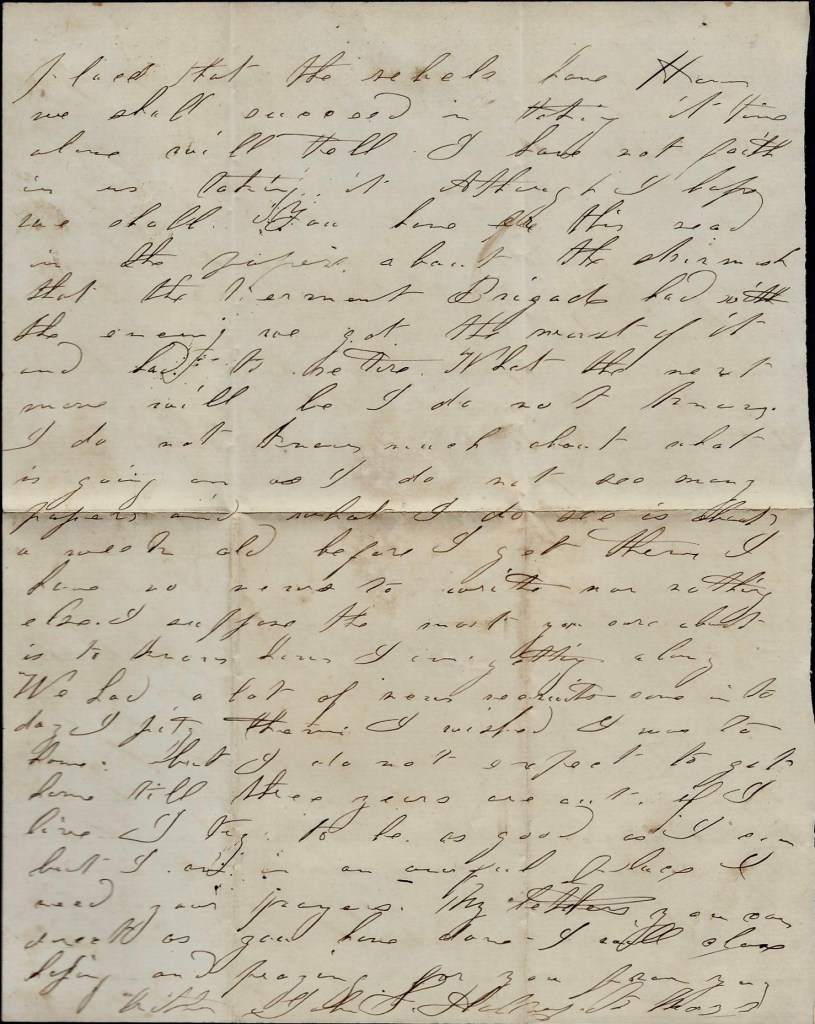
This place in front of us on the Peninsula is probably the strongest fortified place that the rebels have. How we shall succeed in taking it, time along will tell. I have not faith in us taking it although I hope we shall. You have ere this read in the paper about the skirmish that the Vermont Brigade had with the enemy. We got the most of it and had to retire. What the next move will be, I do not know. I do not know much about what is going on as I do not see many papers and what I do see is about a week old before I get them. I have no news to write nor nothing else. I suppose the most you care about is to know how I am getting along.
We had a lot of new recruits come in today. I pity them. I wished I was to home. But I also do not expect to get home till three years are out, if I live. I try to be as good as I can but I am in an awful place. I need your prayers. My letters you can [ ] as you have done. I will close hoping and praying for you, from your brother, — J. S. Holley
Letter 2
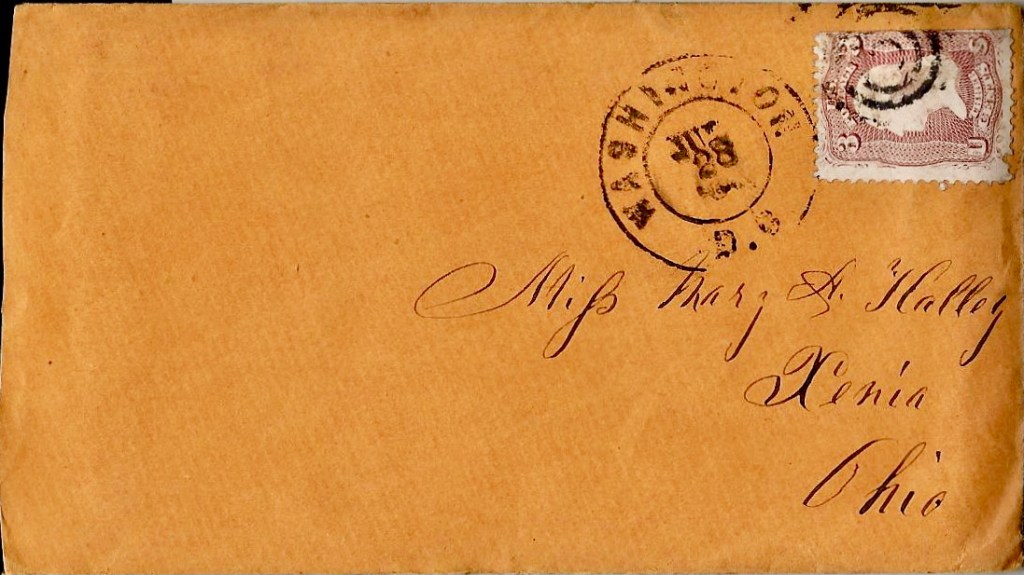
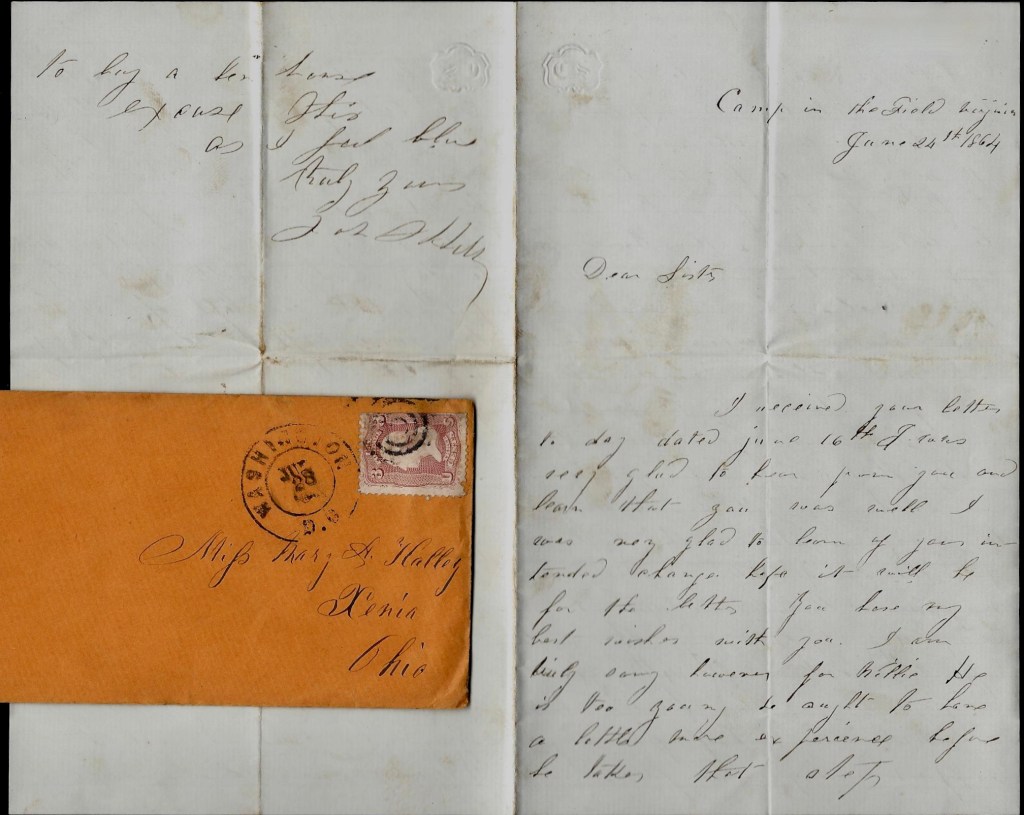
Addressed to Miss Mary A. Halley, Xenia, Ohio
Camp near Hagerstown, Maryland October 5, 1862
Sister Mary,
I received a letter from you the other day. the first that I have got from you for some time. I was very glad to hear that you was well. Did not know but that you was sick and I was glad to learn that you was back in Xenia. I feared that times were so hard that you would shut the school down.
Well, as I said, we have got into comfortable quarters for the present. It is rumored that we are going to move soon. How true it is, I cannot say. I hope not, however, as I want to stay here all winter. I like it here first rate. We are near what is called the White Springs, Maryland. We are near the town of Hagerstown. It is a place of about four thousand inhabitants.
There is nothing here now but our Brigade. I expect the whole Corps will be here soon. I have passed through the campaign of Maryland safe. At the Battle of Antietam, there was a piece of a shell struck me on the shoulder. It just bruised me a little making my arm a little lame for a day or two. If it had struck my shoulder two or three inches lower, it would have shattered my shoulder and probably I should never get better.
I am very thankful that I came off so easy. There is no news to write so I will close for this time. Yours respectfully and sincerely, — John S. Halley
Letter 3
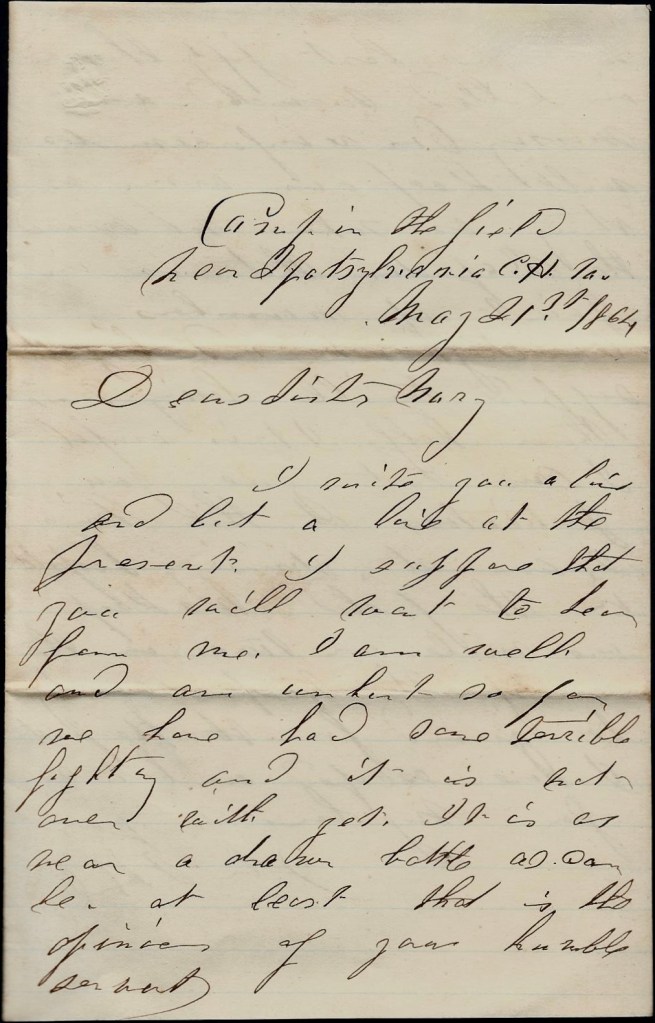
Camp in the field Near Spottsylvania Court House May 21st 1864
Dear Sister Mary,
I write you a line and let a [ ] at the present. I suppose you will want to hear from e. I am well and am unhurt so far for we have had some terrible fighting and it is not over with [us] yet. It is as near a drawn battle as can be—at least that is the opinion of your humble servant.
We have lost fifty thousand in killed, wounded, and missing. Our reinforcements will keep our army as strong as when they crossed the Rapidan—that is, in point of numbers. Our regiment and brigade suffered terrible, losing more than half. It is awful. I can not give you particulars at this time. I am at the division hospital in the field. We keep one mile or two in the rear of the troops according to guard for the hospital. I have escaped unhurt so far.
My love to you, — John S. Halley
Letter 4
Camp in the field, Virginia June 24, 1864
Dear Sister,
I received your letter today dated June 16th. I was very glad to hear from you and learn that you was well. I was very glad to learn of your intended change. Hope it will be for the better. You have my best wishes with you.
I am truly sorry, however, for Willie. He is too young. He ought to have a little more experience before he takes that step. I shall say nothing to him. Let him act his own pleasure. I wish it was otherwise. It may be all for the best. I have not heard from him since he left home or rather since he went back home.
I had a letter from [my wife] Eveline. She was well. No news worth repeating. Everybody was well. There is no news to write from here—only we are not in Richmond yet and hardly think we shall get there in a hurry. I am willing to recognize the South. I have got tired and sick of seeing so man men killed and mangled every day. Yesterday they used up the rest of the 4th [Vermont] Regiment. 1 They were on the skirmish line one mile and a half from any support. They were flanked by the rebels and there is but fifty men with the colors now [though] some more may come in. The rest are either killed, wounded, or prisoners. Capt. Tracey was brought in dead today. They will probably put what is left of us in to some other regiment. If so, I shall have to carry a gun and if I do, my chances of getting through safe are not worth much.
I have but little faith of getting out anyway. It will make but little difference with me anyway. I have got demoralized out here and will not work and there will be no other way for me to live. I can never save enough to but a house.
Excuse this as I feel blue. Truly yours, — J. S. Halley
1 On June 23, 1864, the regiment “suffered the greatest loss of men by capture” it ever experienced. It was engaged with the brigade and the Sixth Corps in a movement against the Weldon Railroad, and was thrown out in front under command of Major Pratt, with a battalion of the eleventh. The enemy broke through the line with a strong force, and surrounded and captured seven officers and 137 men of the Fourth, as well as almost the entire battalion of the Eleventh. The colors of the Fourth were saved by the activity and coolness of the color guard. The officers so captured were Major Pratt, Captains Chapin and Boutin, and Lieutenants Carr, Fisher, Needham and Pierce. Among the killed was Captain William C. Tracy, of Co. G. His dead body was found on the field next day, stripped of arms, watch, money and boots, and surrounded by the muskets of his men, showing that he had rallied his company around him, and that they threw down their arms only when their gallant leader had fallen.”
Capt. Harry Platt, Co. B, 4th Vermont(John Gibson Collection)
This letter was written by James Henry Platt, Jr. (1837-1894), who was raised in Burlington, Vermont. He completed preparatory studies and graduated from the medical department of the University of Vermont at Burlington in 1859 when he was 23. On 23 February 1859 he married Sarah Caroline Foster in Rutland, Vermont. He later married the suffragist and widow Sarah Sophia Chase Decker (1856–1912), who survived him.
“Harry” (as he preferred to be called) enlisted in August 1861 as a Captain in Co. B, 4th Vermont Volunteers. The 4th Vermont was organized at Brattleboro under the young Colonel Edwin Henry Stoughton and spent its first autumn in Virginia with Brooks’ Brigade, primarily tasked with the defense of Washington, DC at Camp Griffin.
While at Camp Griffin, the 4th Vermont was brigaded with several other Vermont regiments and was, therefore, often referred to as the “Vermont Brigade.” The brigade had a storied career and played a part in many important battles of the Army of the Potomac, including the Peninsula Campaign, Antietam, Fredericksburg, Second Battle of Fredericksburg, Gettysburg, Wilderness, Spotsylvania, Cold Harbor, Petersburg, Ft. Stevens, and Winchester.
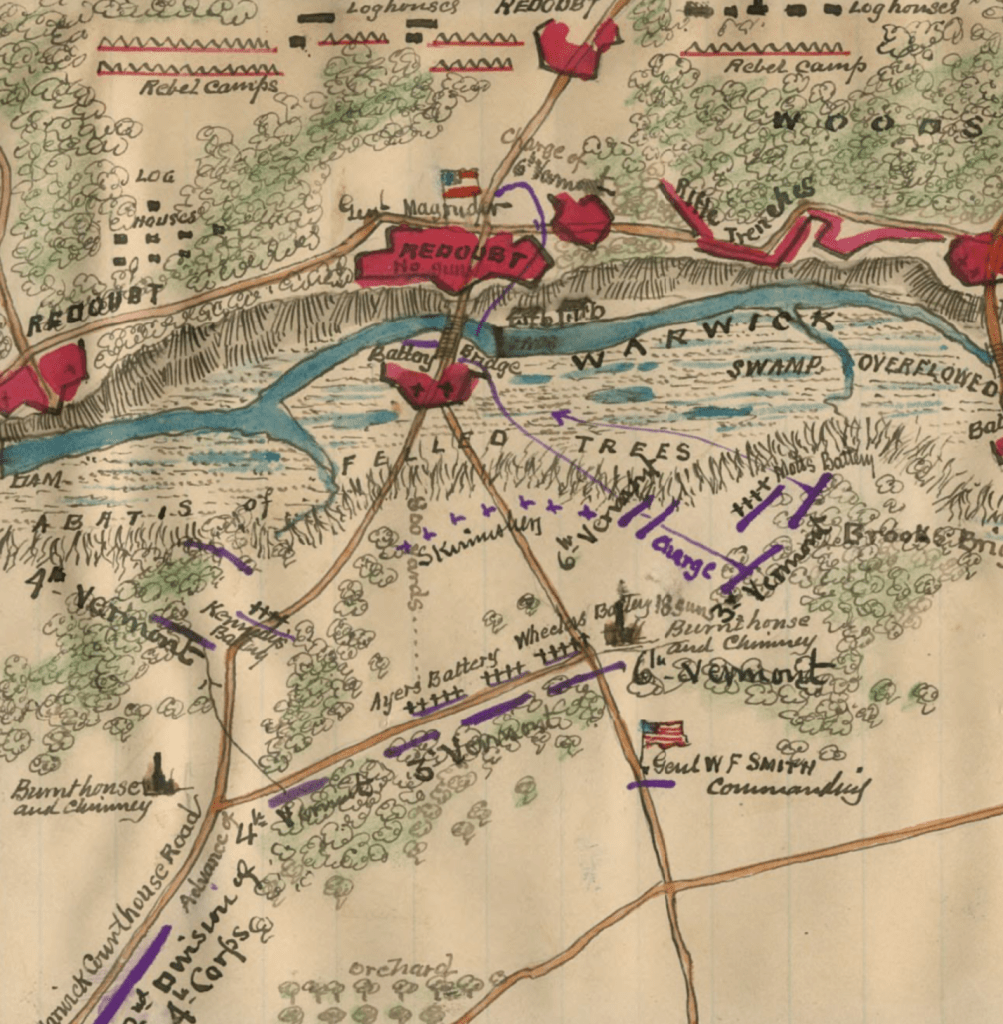
This incredible letter pertains to the first real test of the regiment which took place during McClellan’s Peninsula Campaign. After landing his troops on the tip of the peninsula formed by the James and York rivers, McClellan sent them towards Yorktown. Long before arriving there, however, he found that the Confederates had established a line of defense across the entire peninsula on or near the Warwick river—a formidable barrier by itself but also heavily fortified. On the morning of the 16th of April 1862, Brig. Gen. Baldy Smith sent two Vermont regiments from his 2nd Brigade towards the Confederate position near Lee’s Mill with orders to open fire on any working parties. Though the infantry opened the engagement, it devolved into an artillery duel with both sides suffering losses. No advance was accomplished and McClellan settled on the strategy of a siege. The engagement of 16 April 1862 has been referred to by various names, including the Battle of Lee’s Mill, the Battle of Burnt Chimneys, or the Battle of Dam No. 1.
As a counterpoint to this letter, I have placed a transcript in the footnotes of a letter written by 2Lt Cadmus M. Amoss of Cobb’s Legion who described the assault of the Vermont Brigade from the Confederate perspective.
[This letter is from the private collection of Richard Weiner and is published on Spared & Shared by express consent.]
Transcription
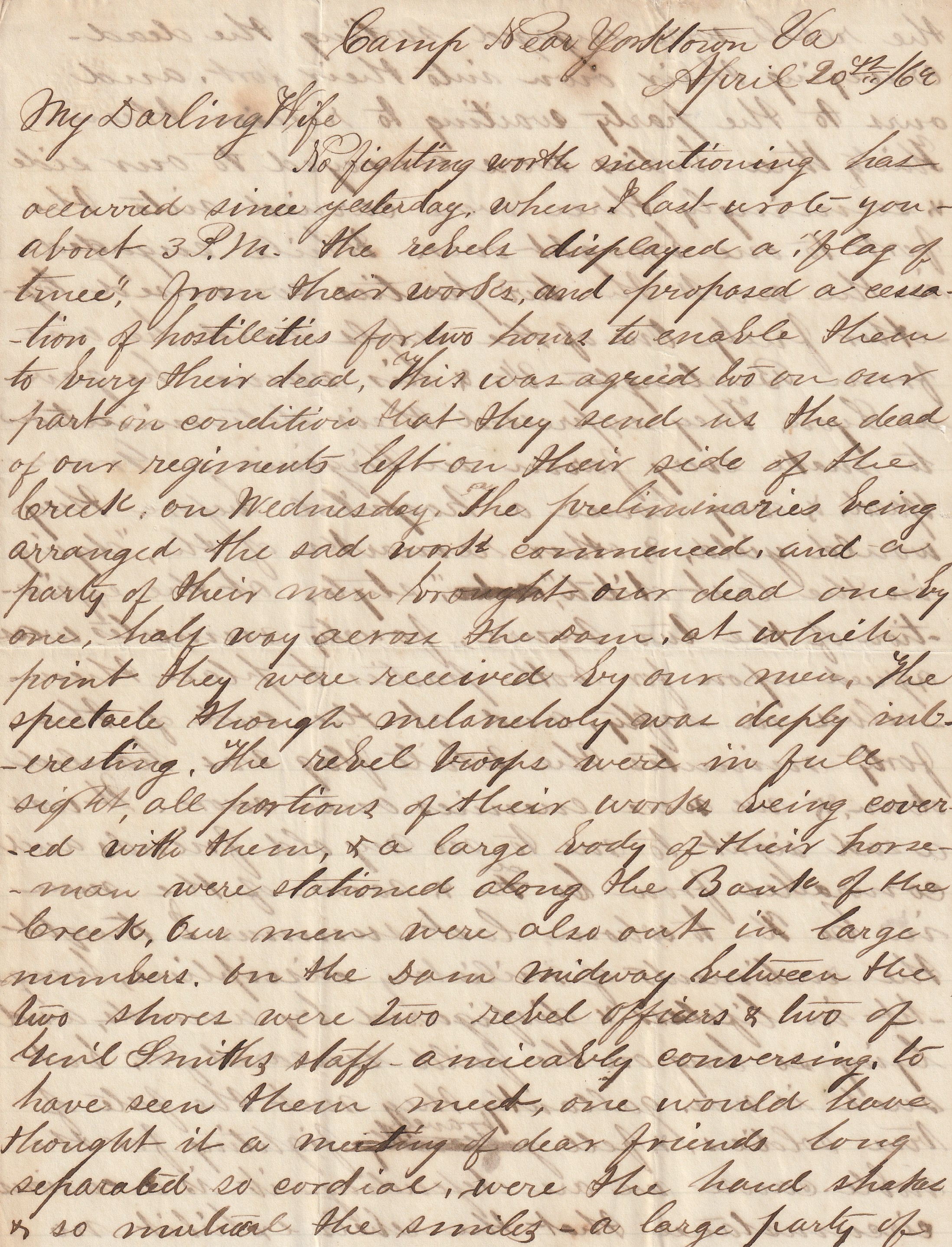
Camp near Yorktown, Virginia April 20th 1862
My Darling Wife,
No fighting worth mentioning has occurred since yesterday when I last wrote you. About 3 p.m., the rebels displayed a “flag of truce” from their works, and proposed a cessation of hostilities for two hours to enable them to bury their dead. This was agreed to on our part on condition that they send us the dead of our regiments left on their side of the creek on Wednesday. The preliminaries being arranged, the sad work commenced and a party of their men brought our dead, one by one, half-way across the dam at which point they were received by our men. The spectacle—though melancholy—was deeply interesting. The rebel troops were in full sight, all portions of their works being covered with them, and a large body of their horsemen were stationed along the bank of the creek. Our men were also out in large numbers. On the dam midway between the two shores were two rebel officers and two of Gen. Smith’s staff amiably conversing. To have seen them meet, one would have thought it a meeting of dear friends long separated so cordial were the handshakes & so mutual the smiles.
“They expressed their determination to make every farm in Virginia a graveyard and every house a hospital before they would yield…”
Capt. Harry Platt, Co. B, 4th Vermont, 20 April 1862
A large party of the rebels were engaged sorting the dead, conveying their own into their fort, and ours to the party waiting to receive them. Thirty-three bodies were conveyed to our side, and seemingly three were carried into the fort to [every] one brought over [to ours]. While engaged in the work, the two parties conversed together freely. One of the rebels said he was from Burlington, Vermont, and his name he gave as Lyon. They expressed their determination to make every farm in Virginia a graveyard and every house a hospital before they would yield and other remarks of the “dying in the last ditch” style.
At the expiration of the two hours, forty minutes was agreed upon for both parties to place themselves in safety and at the end of forty minutes the white flag was hauled down and we were enemies once more. It was a sad sight to me to see my old friends and comrades from Co. F and some of the men in Co. K to whom last summer I taught the rudiments of military discipline, brought in lifeless & disfigured by wounds and lying so long on the field uncared for. But such is war. Gallantly they met the fate of true soldiers & fell bravely fighting for the noble cause we are defending.
It is a curious circumstance that rebels exhibit no flag. The white flag is the only emblem we have seen.
Our dead were buried carefully and tenderly amid the groups of sorrowing comrades who witnessed this last sad office. 1
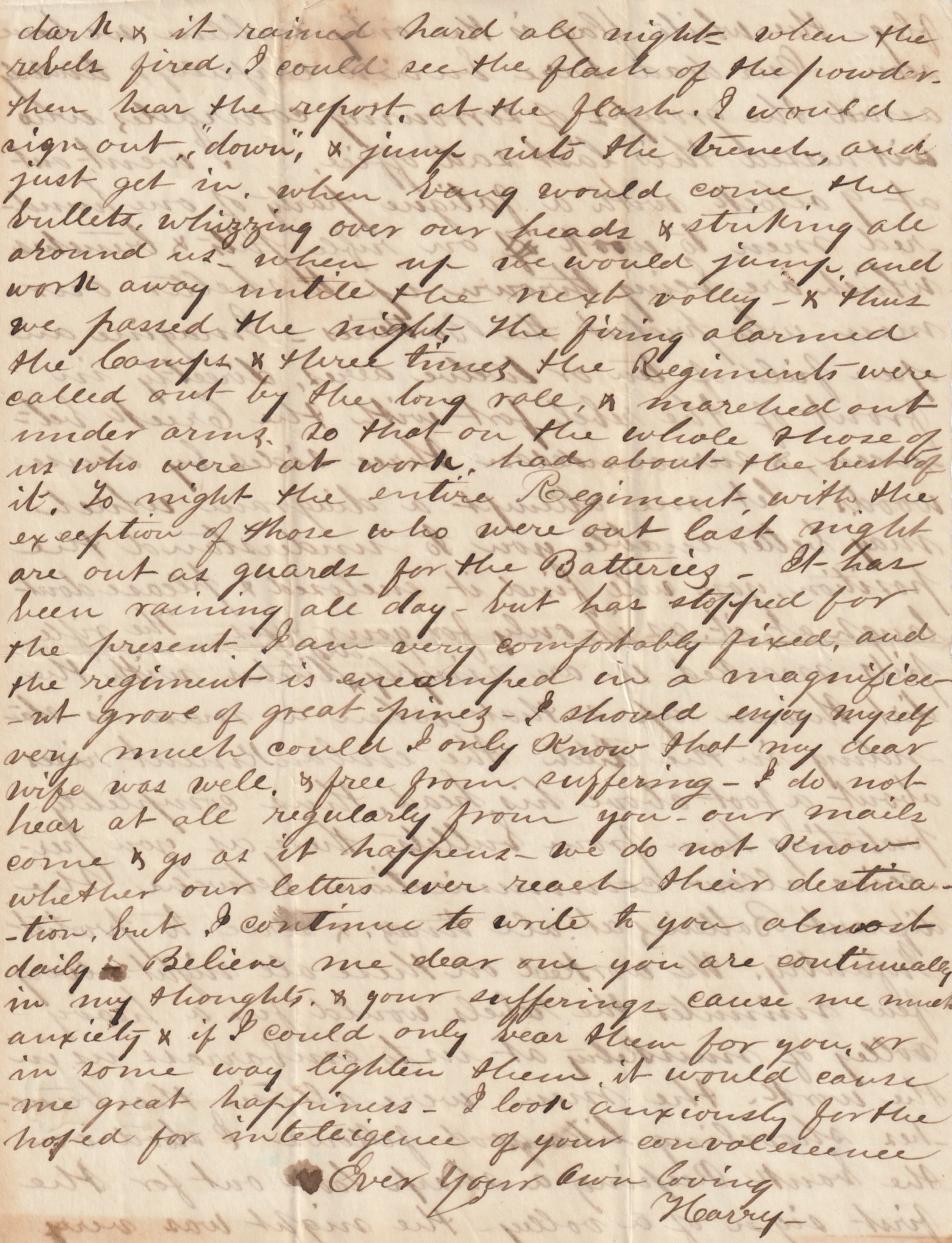
I went out at 9 o’clock with a fatigue party of one hundred men to work on rifle pits & trenches which are being thrown up to shelter our men who protect the batteries. Imagine an open field of ten or twelve acres directly in front of the rebel fort with the creek between and surrounded on three sides by dense woods. Let me attempt a diagram which may better enable you to understand the position. You will find it enclosed & please don’t laugh at it as it’s only for your eyes. The rifle pits marked 10 are simply dry ditches with the dirt thrown up so that when a man is standing in the ditch, the embankment rises about a foot above his head thus completely protecting him from bullets. These, as you perceive, allow communication between the different batteries at all times & serve to protect infantry. We worked on these all night. Every few minutes the rebels would fire a heavy volley of musketry at us to embarrass us in the work. The men were all in the trenches shoveling like good fellows. I stood on the bank keeping a sharp look out for the first sign of a volley. The night was very dark & it rained hard all night. When the rebels fired, I could see the flash of the powder, then hear the report. At the flash, I would sign out “Down!” and jump into the trench and just get in when bang would come the bullets whizzing over our heads & striking all around us, when we would jump and work away until the next volley, & thus we passed the night.
The firing alarmed the camps and three times the regiments were called out by the long roll and marched out under arms so that on the whole, those of us who were at work had about the best of it. Tonight the entire regiment with the exception of those who were out last night are out as guards for the batteries. It has been raining all day but has stopped for the present.
I am very comfortably fixed and the regiment is encamped in a magnificent grove of great pines. I should enjoy myself very much could I only know that my dear wife was well and free from suffering. I do not hear at all regularly from you. Our mails come and go as it happens. We do not know whether our letters ever reach their destination but I continue to write to you almost daily. Believe me dear one, you are continually in my thoughts and your suffering causes me much anxiety and if I could only bear them for you or in some way lighten them, it would cause me great happiness. I look anxiously for the hoped for intelligence of your convalescence.
Ever your own loving, — Harry
Map showing the placement and lines of attack by the Vermont Brigade on 16 April 1862
1 The Union dead came from four companies (totaling 192 men) of the 3rd Vermont Infantry who advanced from the woods toward the Confederate position across the Warwick river. “Wading through the waist-deep river channel below the dam, the ‘Green Mountain Boys’ drove the surprised Confederates from the first line of rifle pits along the water’s edge. The Confederate unit at the center of the attack and taking the brunt of this vigorous attack was the 15th North Carolina whose Colonel William McKinney, was killed while rallying his soldiers. The death of Col. McKinney and an unauthorized order to fall back caused confusion all along the entire line. General Howell Cobb, Commander of the 2nd Brigade, 2nd Division, immediately reorganized and stabilized the line as he rode among the soldiers on horseback. General Cobb then proceeded to launch a brigade-sized counterattack against the four Vermont companies…As the Confederates regrouped and reinforced their line, the Vermonters with their backs to the river were in a desperate situation. They were running out of ammunition and taking severe casualties. With no hope of reinforcements coming, the Vermonters reluctantly withdrew back across the river after holding their position for one hour. A second attack later in the day by the 4th and 6th Vermont was even less successful…Confederate casualties for the day were approximately 75 killed and wounded. Union casualties at Dam No. 1 were 35 dead and 121 wounded. Of this number the 3rd Vermont lost 23 killed and 51 wounded.” [Newport News Park Brochure]
It should be noted that it was generally conceded by most accounts that the Warwick River was between two to four feet deep and 150-200 yards wide at the location of the attack made by the Vermonters on 16 April 1862.It is estimated that the combined force of the second attack composed of men from the 4th and 6th Vermonts could not have exceeded 750 men. It was the 6th Vermont that led the second assault. Four companies of the 4th Vermont were used only to create a diversion which was doomed by Rebel gunfire almost before it began.
It should also be noted that Capt. Platt’s inference that the cessation of hostilities was called by the Confederates is most assuredly false. Not only does the literature support the argument that the union forces called for it, but logic tells us that retrieving bodies from the other side of the Warwick River would be much more difficult for the Union army than the Confederate army, let alone the number of casualties which was tipped in favor of the Federals.
The following letter was written by 2Lt. Cadmus M. Amoss of Cobb’s Legion who described the Battle of Lee’s Mills (Dam No. 1) from the Confederate perspective. The letter was sold recently by Iron Horse Military Antiques. Amoss wrote the letter home to his wife on April 21, 1862, during the federal siege of Yorktown during the Peninsula Campaign. In the letter Amoss discusses the “stirring times we have had,” including the April 16 skirmish at Dam No. 1 on the Warwick River. The dam was one of three ordered built by Confederate General John Magruder in order to create lakes to obstruct the Union Army’s advance. The men of General Howell Cobb’s Brigade had been improving the defenses around Dam No. 1 on April 16 when Union troops of General William F. “Baldy” Smith’s division launched a probing attack.
Camp Near Lee’s Mills, York Co. Virginia April 21st 1862
My Dear Georgia,
This is the only opportunity I have had of writing to you since my last letter and I am glad to have a few moments leisure in which to give you an account of the stirring times we have had. Last Wednesday the enemy commenced shelling our batteries placed at Dam No. 1 about a quarter of a mile above us. The shelling continued without intermission all the morning, doing little or no damage. Our company was stationed behind a breastwork at Dam No. 2. At three o’clock in the afternoon the Yankees sent over three picked companies to charge one of the rifle pits a little below Dam No. 1 at which the 15th N.C. Regiment was at work. This regiment—having no guns to fight with—were driven from the pits by the yankees, who charged over them. The Seventh Georgia was then ordered to charge the Yankees, which they did with a loud shout. The Yankees could not stand before them, but fell precipitously into the pond through which they had waded. Twenty or thirty were killed and a great number wounded. The enemy attacked us at two or three other points, but were repulsed with considerable loss every time. The regiments that bore the brunt of the battle that day was the Seventh, Eighth, and Sixteenth Georgia and Second Louisiana. Our regiment was situated at different points. Our company was fired on several times across the pond about two hundred yards by Yankees behind trees. No one hurt in the Legion. The enemy dismounted one of our largest guns that day. Our entire loss was sixteen killed and about sixty wounded. The enemy’s loss in killed and wounded is estimated at three hundred.
I was perfectly surprised at the noise and uproar made on that day. The whole world would tremble with the roar of artillery and musketry.
Our regiment remained in the breastworks day and night for four days after the battle. We were relieved yesterday morning by another regiment. I am perfectly worn out with loss of rest. I forgot to tell you that the enjoyment lasted four hours. Nearly all the troops that were at Manassas are here. I have seen a great many acquaintances recently. Gus Bacon and John McLendon are here. Reuben Jordan is also here. Yesterday evening I met up with Guss Bull. He is Lieut Col of the 35 Georgia. Virgil Hopson is in the same regiment.
Yesterday evening Gus Bacon and John McLendon came down to see me. They were nearly perished and are here without overcoats or blankets. I gave them plenty of ham and biscuits which they relished amazingly. There is at least twenty thousand Georgians here and if the yankees come over they will meet with a warm reception from them. The yankees sent over a flag of truce to bury their dead day before yesterday. I was up there at the time and saw about thirty of them carried over. They were all well uniformed and had the minnie musket. Nearly all of them were shot through the head. Several letters were found about the persons of the yankees, one of which was from a brother of the one killed who lived at Quebec, Canada. The writer was of the opinion that the South could not be conquered and wished the war would come to a close. The regiment that charged our breastworks was the Third Vermont and the company of which nearly all were killed was [of] the Vermont volunteers. I have no idea when they will attack us again. They are here in great force, but I think we will whip them every time they attempt to cross over the creek.
We hear their brass bands and drums every night. I never heard sweeter music than they have over the creek from us about a half mile.
If they intend doing anything I wish they would commence at once so that we may fight it out and quit. I am exceedingly anxious to hear from you but am afraid your letters cannot reach me. If anyone should come to this point from Atlanta I will try to let you know in time. One of your letters directed to Suffolk was handed me about the first of last week. I was truly glad to learn that you were well up to that time. Since I have been thinking about it there is a chance of getting a letter from you. It may be lost on the way but rather than not hear from you at all I think it would be well to risk writing. At all events write to me and direct your letter to Yorktown as before.
I will write again as soon as an opportunity presents itself. Give my love to all the family and kiss Henry for me.













 Spared & Shared 23