Category Archives: 52nd Illinois Infantry

1864: Oliver Kingsbury to Juliett Kingsbury

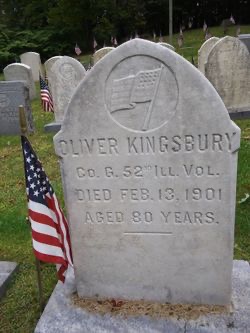
Oliver’s headstone

The following letter was written by Oliver Kingsbury (1821-1901) of St. Charles, Illinois, who married Almira Oratt (1832-Aft1900) in Kane county in 1858. The letter was written to his daughter Juliette who was born in 1848 so she must have been a daughter by a former marriage. In the 1860 US Census, Oliver was employed as an auctioneer.

When Oliver was 40 years old, he enlisted in Co. G, 52nd Illinois Infantry. He remained in the service until 25 November 1864 when he mustered out at Springfield, Illinois. We learn from this letter that he was detached from his regiment and working as a nurse in the soldiers’ hospital at Jeffersonville, Indiana, and prior to that at the one in Paducah, Kentucky. His duties in preparing drugs at the hospitals gave him the experience and qualifications to hold out his shingle as a druggist in Lee Center, Oneida county, New York, after he was discharged from the service. By 1880, however, he had moved on to photography with a studio in Rome, New York.
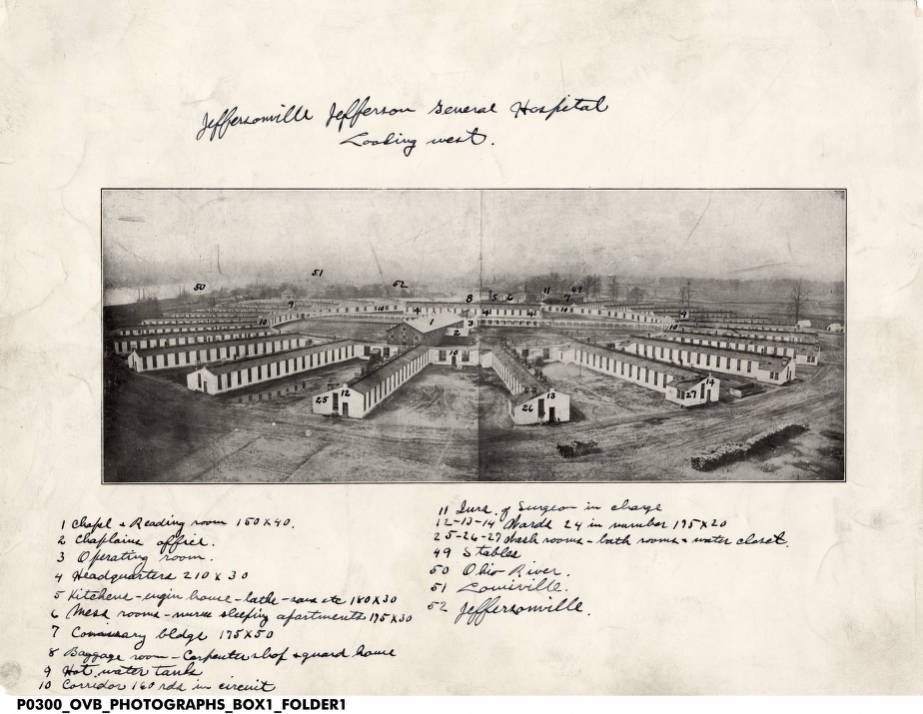
Indiana Historical Society. The first military occupation at Jeffersonville, Indiana during the Civil War was in 1862 when two area regiments established a camp on a farm owned by Blanton Duncan. Lovell Rousseau, the organizer of the regiments, christened the camp “Camp Joe Holt.” The name was retained when it ceased to be a camp and became a hospital, called “Joe Holt Hospital.” Jefferson General Hospital, built to replace the one at Camp Joe Holt, opened 21 February 1864 and closed in December 1866. Located near Jeffersonville on land obtained from U.S. Senator Jesse D. Bright, the acreage reached down to the Ohio River, facilitating patient transfer from riverboats to the hospital. The health facility had 24 wards each radiating out like spokes on a wheel and all connected by a corridor one-half mile in circumference. Each ward was 150 feet long and 22 feet wide, and could accommodate 60 patients. Female nurses and matrons were quartered separately from the men.

Transcription

Joe Holt Hospital
Jeffersonville, Indiana
July 22d 1864

Dear daughter,

I received your kind letter dated the 17th and while I have a little leisure, send a few lines in answer. I do not know what you mean by Almira’s telling all the news concerning you for she seldom says a word about you. I suppose it is because she does not often see you. Sometimes she says she has not heard from you in some time and I do not know of anything she has written of you for perhaps six months—only that you was working this season and one year ago she hinted something about you having a beau by the name of Smith but knew nothing of it as I could find out. But as for information about you or anyone else, there is not much in most of her letters. Once in a while I hear something what is going on in town but I do not hear as much of you as I could wish. You have never said a word whether you was at work or how you get along with your work. I am not aware of anything meddling or out of the way in that time and she has never said anything as though there was any ill feeling between you. You surprised me by saying as you did about news, but it is all right perhaps. I hope you will write often and tell all that is worth telling. Give my respects to Peter and wife.

“We have so many doctors, some know something, and others know but little.”

Oliver Kingsbury, 52nd Illinois, Joe Holt Hospital, 22 July 1864

I have a good time here. I do nothing but make pills, put up powders, bitters, &c. half of the time and most of my leisure is spent studying medicine. There are plenty of books here. We have so many doctors, some know something, and others know but little. One doctor next door has hired a piano and we have plenty of music among us men, and as to women, we do without them as there are but 8 or 10 ill-looking Irish wash women, but they do not even eat when I do, but at the common table. They wash on the bank of the river where I have not been yet, as it is not on my route to bathe or to dinner. Two old maids boss the cooking for the low diet patients—nice women for all any of us know, but they hardly come out of their kitchen. Three or four soldiers help them. I think they are from St. Louis and sent by the sanitary commission. One Dutch [German] doctor has his wife and the doctor I was under at Paducah has his wife here. The balance—over six hundred—are soldiers and perhaps 20 men building and fixing about.

Have you seen the shawl I sent to St. Charles from Paducah? I did not know but you would like to have it, so I told Almira that if you wanted it, to let you have it as it was a relic of the battle of Paducah. She talks of selling it and I did not know whether you had seen it or not.

Your father, — O. Kingsbury

1861: Milo Lewis Sherman to Buel Sherman

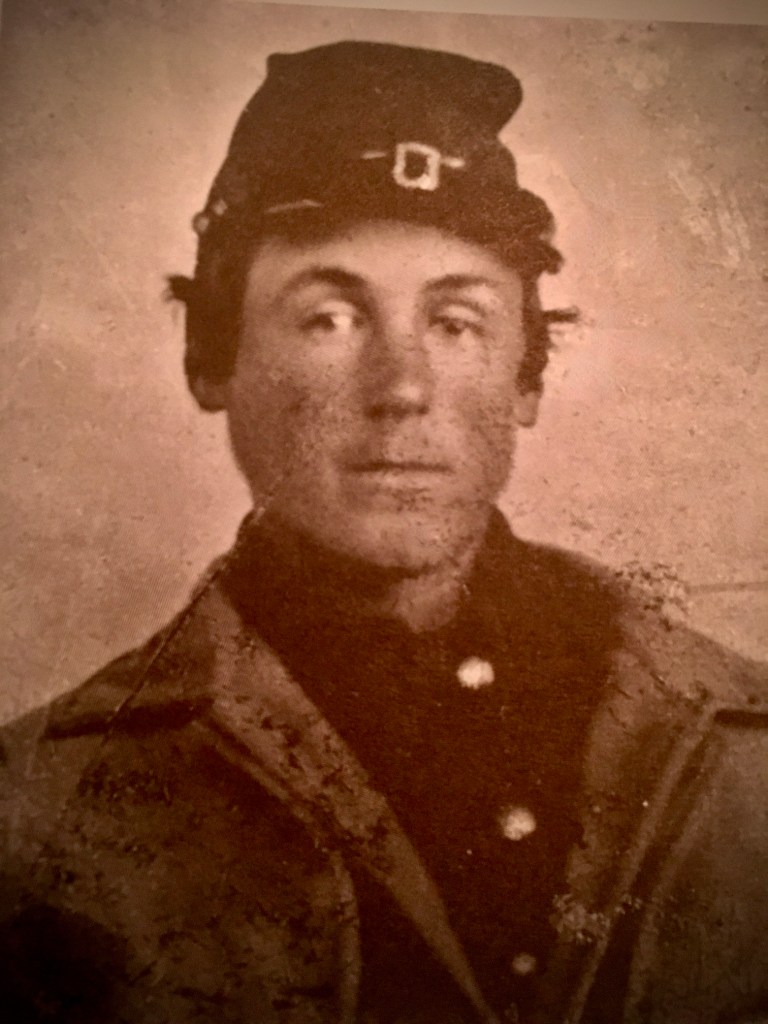
I could not find an image of Milo but here is one of Ira Woodman who served in Co. A, 52nd Illinois Infantry (Ancestry.com)

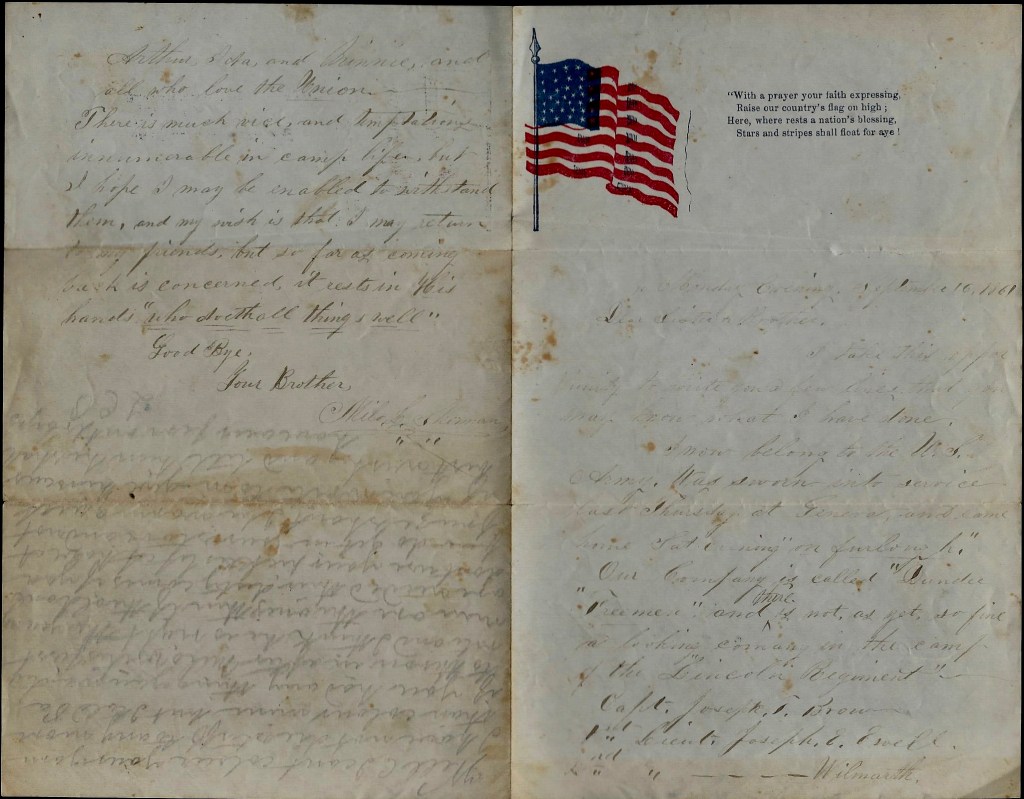
This letter was written by Milo Lewis Sherman (1839-1916) of Dundee, Kane County, Illinois, who enlisted on 11 September 1861 as a private and was mustered into Co. I, 52nd Illinois Infantry on 25 October 1861. He reenlisted on 8 January 1864 and was discharged for disability on 23 May 1865.

Milo was the son of Marshall Alonzo Sherman (1799-1879) and Sarah Wanzer (1806-1867). He wrote the letter to his older brother Buel Sherman (1825-1893) and his sister-in-law Celia Louisa Page (1830-1917) Chickasaw county, Iowa.

Transcription

[Dundee, Kane county, Illinois]
Monday evening, September 16, 1861

Dear Sister and Brother,

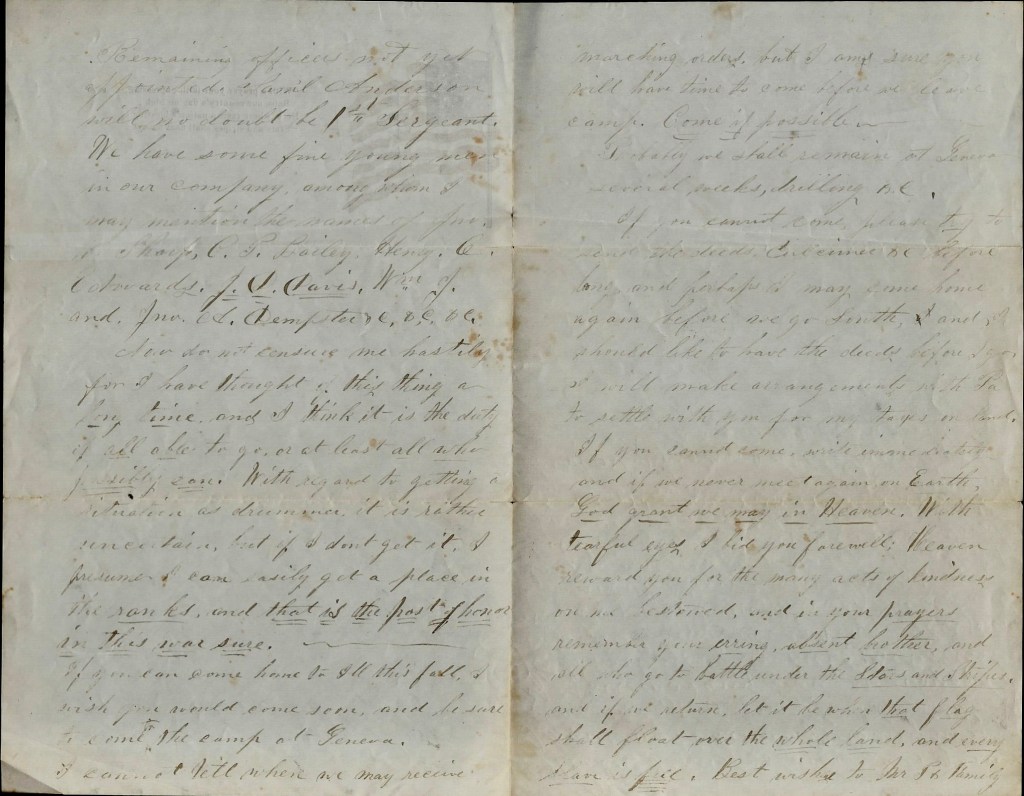
I take this opportunity to write you a few lines that you may know what I have done. I now belong to the U. S. Army. Was sworn into service last Thursday at Geneva and came home Saturday evening “on furlough.” Our company is called “Dundee Freemen” and there is not, as yet, so fine a looking company in the camp of the “Lincoln Regiment.” Capt. Joseph T. Brown, 1st Lieut. Joseph E. Ewell, 2nd Lieut. [Henry G.] Wilmarth. Remaining officers not yet appointed. Samuel Anderson [of Elgin] will no doubt be 1st Sergeant. We have some fine young men in our company, among whom I may mention the names of Jno. W. Sharp, C[yrus] P. Bailey, Henry C. Edwards, J[erome] D. Davis, Wm. J. and Jno. A. Dempster, &c. &c. &c.

Now do not censure me hastily for I have thought of this thing a long time and I think it is the duty of all able to go, or at least all who possibly can. With regard to getting a situation as drummer, it is rather uncertain, but if I don’t get it, I presume I can easily get a place in the ranks and that is the post of honor in this war sure.

If you can come home to Illinois this fall, I wish you would come soon and be sure to come to the camp at Geneva. I cannot tell when we may receive marching orders but I am sure you will have time to come before we leave camp, Come if possible. Probably we shall remain at Geneva several weeks drilling, &c. If you cannot come, please try to send the deeds, dulcimer &c. before long, and perhaps I may come home again before we go South. I should like to have the deeds before I go. I will make arrangements with Pa to settle with you for my taxes on land. If you cannot come, write immediately, and if we never meet again on earth, God grant we may in Heaven. With tearful eyes, I bid you farewell. Heaven reward you for the many acts of kindness on me bestowed and in your prayers, remember your erring, absent brother and all who go to battle under the Stars and Stripes.

Arthur, Ida, and Minnie, and all who love the Union. There is much vice and temptations innumerable in camp life but I hope I may be enabled to withstand them, and my wish is that I may return to my friends. But so far as coming back is concerned, it rests in His hands “who doeth all things well.” Goodbye. Your brother, — Milo L. Sherman