Category Archives: 53rd Massachusetts Infantry

1863: Samuel H. Hastings to Dorinda (Clifford) Hastings

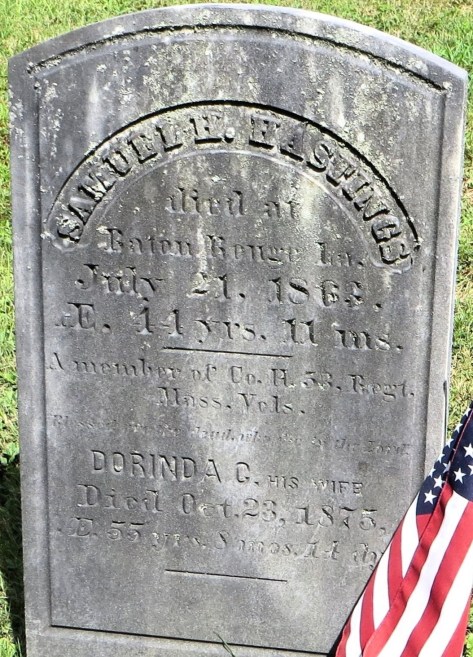
Samuel H. Hastings’ headstone (1818-1863)

This letter was written by Samuel H. Hastings (1818-1863) of Hubbardstown who enlisted as a private for nine months service in Co. H, 53rd Massachusetts Infantry. He claimed to be a carpenter at the time of his enlistment though census records indicate he was a farmer. Unfortunately he did not survive the war. He died of disease in Baton Rouge, Louisiana on 21 July 1863, just five weeks after he wrote this letter to his wife letting her know he expected to be home about the 1st of August—“if spared.” Samuel was married in 1844 to Dorinda Clifford (1820-1875) and they had one child, Lilla Maria Hastings (1853-1893).

After it was organized in the fall of 1862, the 53rd Massachusetts was assigned to the expedition to go to Louisiana and once there, in January 1863, it was placed in Gooding’s 3rd Brigade, Paine’s 3rd Division, 19th Army Corps. After participating on some expeditions into Louisiana, the 53rd found itself in May 1863 at Bayou Sara, bearing down on Port Hudson from the north. 

T R A N S C R I P T I O N

Cook House in the woods in rear of Port Hudson
June 13th 1863

Dear wife,

Don’t you think we were a happy lot of boys last eve. The mail come to us with a large lot of letters. How many do you think I had? There was 8 from you and 6 from others; 14 in all. It took me some time to read them all. One from J. Smith, one from Fitch, 1 from E. W., one from C. H., 1 from Loring, 1 from Hannah, I shan’t have to answer them all. I hardly have time to write all I want to you. After you get this, if you have time, you may write to Hannah. She is atBellows Falls, Vermont. If you don’t have time, let it be. She wrote that she was coming down this summer. E.’s letter you can answer. The letters I received from you were No. 14, (15 I received before). I have all up as high as 22 dated 19th of May so I have all up to that time. I presume there are more on the way. I hope that we shall get our mails now. Those envelopes and stamps come in play now for I was all out of stamps & it is rather hard to get them here at this time.

We remain here yet. Our regiment has not done anything since we came back from Clinton. The cooking is the hardest part of the work now this hot weather. There is a flag of truce up now. I don’t know whether they are going to surrender or what it is for, I hope they are. It is 9 weeks since we first came here. I am nearly a mile and a half from the regiment. Four of us cook for all. We have three colored men to bring our water & cut our wood. That helps a good deal. You spoke about your butter. I think you have done nicely to sell so much. I wish I had some to eat. It would be so nice. I hope I shall get home sometime to eat some of it. I think H. can cut all of the grass for 1/9 of it is as good as it has been years back. It is so handy for him. I must leave off writing now for we are cooking rice for supper.

Sunday morn [14 June]. This day is to be a day of sorrow with some of us. Probably hundreds have been killed ere this. The battle commenced at 3 this morn. I went to the regiment at one this morn with coffee so they might have something warm to drink. I saw [your brother] J[osephus Clifford]. He said he was in hopes to go through. I think he is prepared for the worst. Port Hudson must be ours before noon today. I think there are days enough in the week besides Sunday to fight but most of ours comes on that day. Could I be where I could attend church today, I should rather than to hear the sound of the cannons & muskets & the whizzing of the bullets. But that is all that we can hear this morn. We have beans to cook today. Can’t tell who will be left to eat them or when we can get them to the men.

Do you expect to go to church today? I hope you will have a chance to go with somebody. I don’t think you are able to walk this warm weather. We call it hot out here. I shall not finish this today for I may have some news to write so I will stop now.
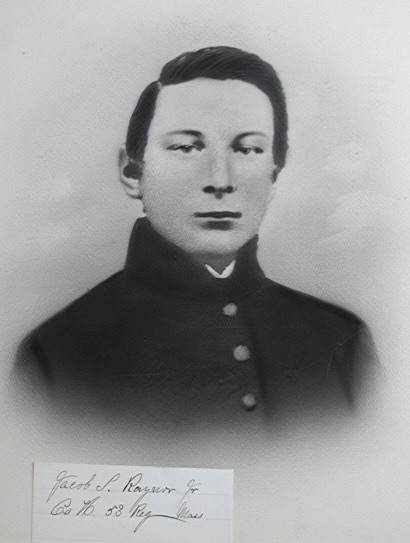
We did not succeed as we thought we should but met with a great loss. Co. H did not have any killed & but one wounded of any account—a young man by the name of [Jacob S.] Raynor from Warwick. Lost one leg. Don’t think he will live. 1 J[osephus] went through safe. I don’t expect to have a chance to send this now any farther than New Orleans. I believe there is no mail goes now. I wish this war was over. How many a sad heart this battle must make. Co. F—the Barre Company—suffered a good deal.

You spoke about our time. I don’t expect we shall get home until the first of August. I shall expect to be at home then if spared. It will take about a year to make 9 months, but never mind. I don’t think I shall go again. If we can get this place soon, I think it will be all we shall do here. But I don’t know as we shall be able to take it. It is harder than it was supposed to take. But she must come some time. It is so hot. It is worse for the men can’t stand what they could in cold weather. My paper is most filled up so I must close this letter. I am as well as I expect to be while I stay in this climate. J. sends love to all. I don’t know as I shall write as often as I have done for I don’t get much time. I hardly get time to rest half as much as I need to. This from your affectionate husband, With much love to all. — S. H. H.


1 Pvt. Jacob S. Raynor was born in Athol on 28 October 1844. He died on 28 June 1863 from a severe leg wound received in the assault on Port Hudson on 14 June 1863.

1863: Levi Lewis Jaquith Field Notes

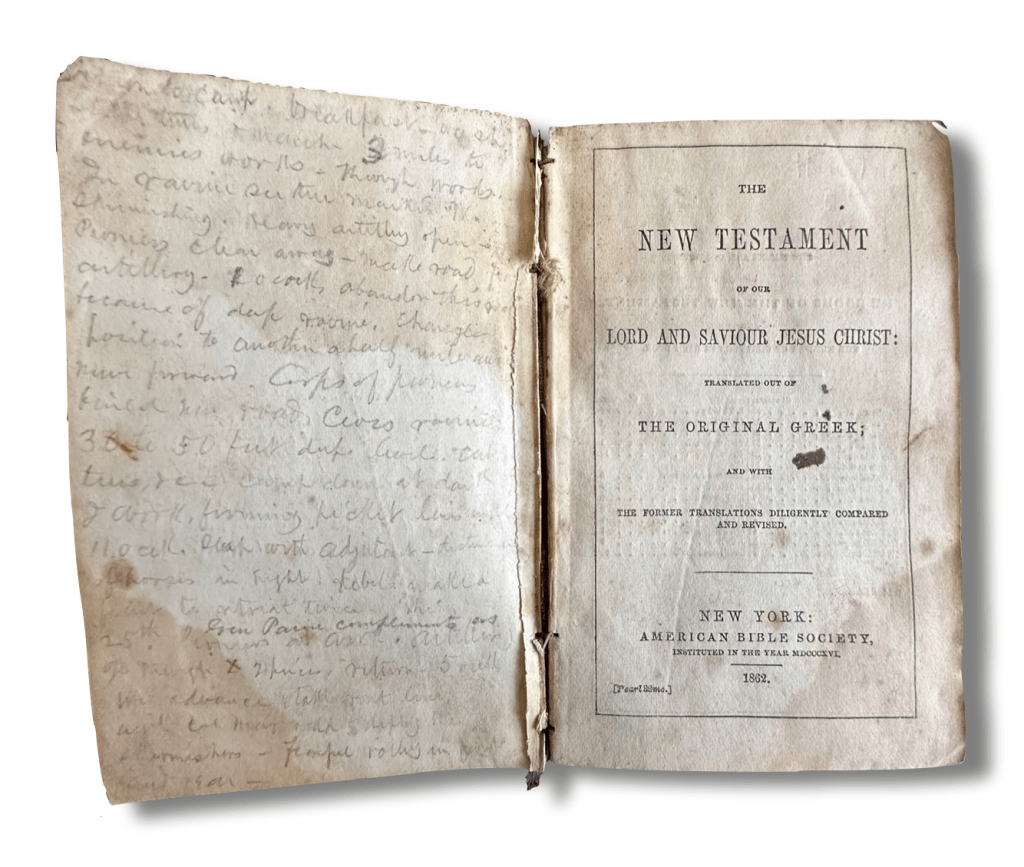
The following handwritten notes were found in an 1862 New Testament that was carried by Levi Lewis Jaquith (1829-1913) while serving as a sergeant in Co. B, 53rd Massachusetts Infantry.

Levi was the son of Seth Jaquith (1804-1866) and Ann Robbins (1805-1878) of Cheshire county, New Hampshire. Levi was first married in 1850 to Sarah Louisa Kingsbury (1833-1892) and later, in 1894 to Orvilla Wilson (1842-1918). At the time of the Civil War, Levi was living in Fitchburg, Worcester county, Massachusetts. Levi was 33 years old when he enlisted on 25 August 1862, giving his occupation as a “chair maker.”

After it was organized in the fall of 1862, the regiment was assigned to the expedition to go to Louisiana and once there, in January 1863, it was assigned to Gooding’s 3rd Brigade, Paine’s 3rd Division, 19th Army Corps. After participating on some expeditions into Louisiana, the 53rd found itself in May 1863 at Bayou Sara, bearing down on Port Hudson from the north. It was here that Levi began taking notes on the flyleaf of the New Testament, distributed by the American Bible Society.

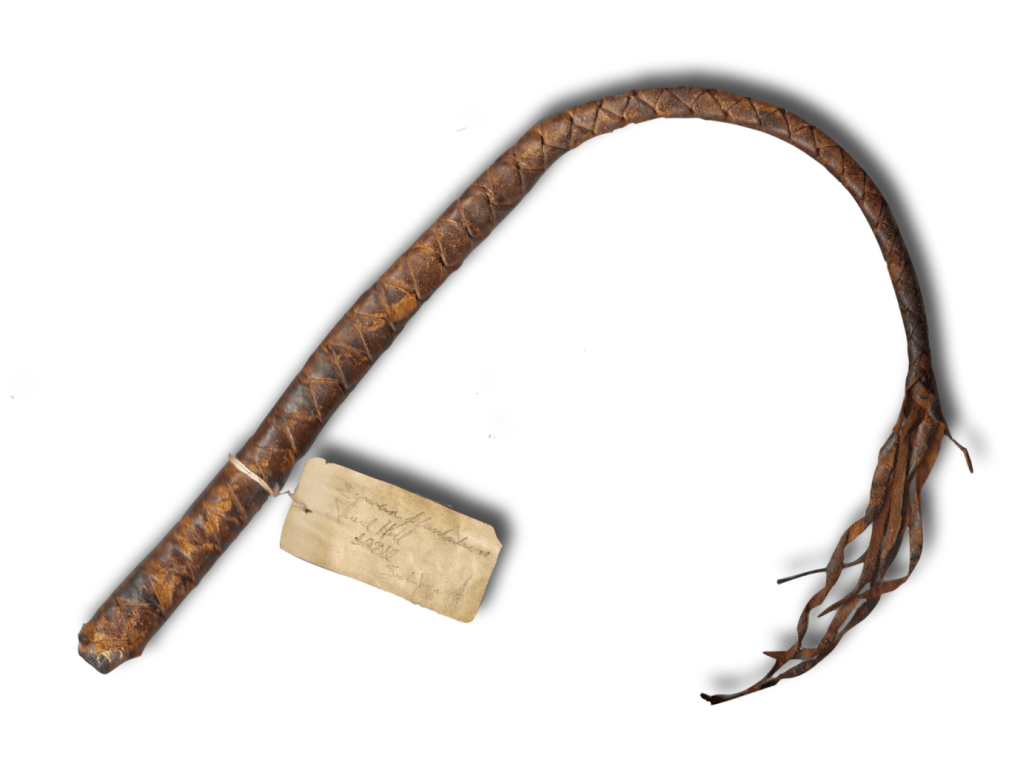
In addition to preserving the New Testament that he carried with him in the service, Levi collected and kept a rather unusual relic of his sojourn into Dixie—a lash that he picked up from a Louisiana plantation. The braided leather lash measures approximately 21 inches in length and bears a contemporary tag, barely discernible, but appears to read, “Lyman Plantation, Laurel Hill, Lash,” and includes Levi’s signature. There was a village named Laurel Hill in West Feliciana Parish through which the troops passed, though I cannot find any mention of a plantation owned by the Lyman family.

Transcription

Arrived at St. Francisville

Handheld New Testament distributed by the American Bible Society

Saturday morn 23rd [May]. Midnight on Mississippi river. Moved from Alexandria to Simsport. Start May 22nd. March 75 miles. 3 days. Morning of 26th, go into city from river. Camp near Lyman Plantation in magnolia grove and cape jasmine. Cross in Laurel Hill [packet sidewheeler]. Change camp. Nearly all the troops gone up river towards Port Hudson. Embark on Laurel Hill. Don’t start up river.

Store houses on the river burned by Butler. Ammunition train. Stop at St. Francisville. No flour, cloth, meal, servants nearly starved. Fine court house and church (new). Most luxuriant country…

March three miles to enemy’s works through woods. In ravine, see the [ ] skirmishing. Heavy artillery open. Pioneers clear away—make road for artillery. 1 o’clock, abandon this road because of deep ravine. Change position to another a half mile away near forward. Corps of Pioneers build new road. Cross ravine 30 to 50 feet deep, cut trees &c. Camp down at dark. I work forming picket lines until 11 o’clock. Sleep with adjutant. Distant sound of horses in night. Rebels make a feint to retreat twice. Fearful volley in front and rear. A few fall back. They volley, take old position. Three or four wounded. One finger shot off (self shot) Capt. [George H.] Bailey. 1

Work until 11 deploying skirmishers. Return to headquarters with reserve. Co. I and F did from 12 to 3. Major waked me and we count on the whole line, examining the position. Adjutant struck with spent ball. One volley at daylight. Rebs retire. Two persons come in Tuesday noon. I retire to rear. [Gen.] Paine with them. Order of Col.—remain all quiet. Returned at 9 o’clock. Retire half a mile to cook and sleep. Remain all day resting. Negro regiments. 22 guns. Bouquet of magnolias.

No firing. A strange calm before the storm. Quiet walk in the evening alone. Sat down but no sleep. Restless, nervous, weary and sleepy. But no sleep. I feel the weight of our position. The awful solemnity. Col. came in at 11. I notify all commander that the grand attack will commence in the morning by the central force. Order that men have two day’s rations, breakfast eaten, blankets rolled, and left under guard, and start at 4:20.

Brig. General William Dwight

Move at 4:30 through the woods. Gen. [William] Dwight leads, having command of us infantry. In one to two hours the rebs are all driven through the woods to a clearing and the artillery comes up. Open a terrible fire. Rebs respond. An awful artilllery duel. 30 lb. fused shells strikes within 2 feet of our line [but] did not explode. Men did not move. The 30 lb. shells strike all about us. Several battery trains cut down. Tree cut entirely in two, falls upon a caisson and 6 horses, crushing them all. Men go by in crowds wounded—officers also. Lots of skedaddlers. “All cut up.”

Gen. Paine comes up and says our forces have taken two rifle pits but are badly cut to pieces. Needs us there. Had regiment [start] for the place he wants but we must support the battery and hold the hill. [ ] the 91st New York and 2nd Louisiana &c. welcomed with “bully for you” over and over. The men have driven the rebs out of a ravine for three-quarter mile. Our regiment sprang to the edge of a cliff and opened fire. The enemy are behind rifle pits 150 yards in front. From 10 till dark our men fire continuously. Reb’s big Columbiad……4 men wounded on our side.

On Thursday, 28th, firing with rifles stopped. We lay all day resting with a watch, ordered to cease firing. After noon the artillery opened and in a few moments dismounted the enemy guns. Flag of truce to bury dead till 7 evening.


1 Capt. Bailey was mortally wounded on May 25th and died on the 27th.