The following letter was penned by Hon. Charles Henry Winfield (1822-1888), an attorney and former district attorney of Orange county, New York who was elected to the US Congress as a democrat in 1863 and served two terms.
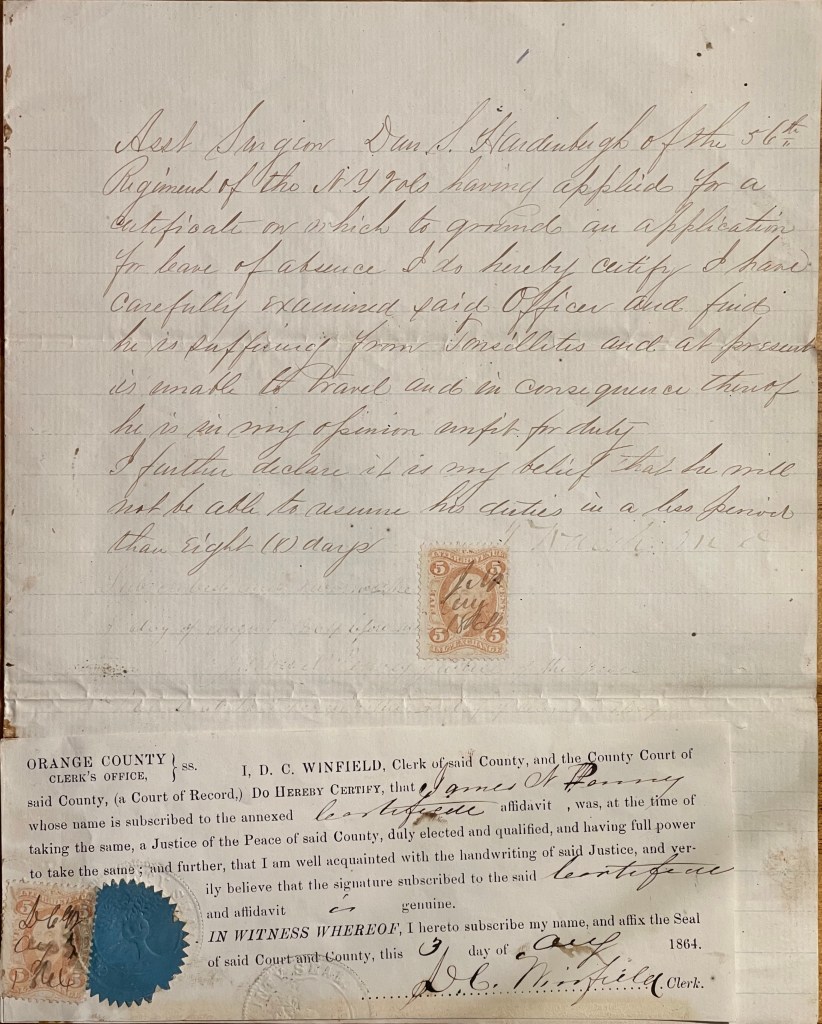
The content of the letter pertains to the appointment of Daniel S. Hardenburg (1840-1908) as an Assistant Surgeon in the 56th New York Infantry. Daniel was the son of Dr. Charles Hardenburgh (1802-1874) and Mary E. Chandler (1815-18xx) of Port Jervis, Orange county, New York. According to military records, Daniel received his appointment on 11 November 1863 and that he participated in the Battle of Honey Hill and all of the battles accompanying Gen. John P. Hatch’s Expedition up Red River and the siege of Charleston, South Carolina. He later became the post surgeon at Georgetown, South Carolina.
[Note: This letter is from the personal collection of Kyle Williams and was made available for transcription and publication on Spared & Shared by express consent.]
Transcription
Addressed to Dr. Daniel S. Hardenburg
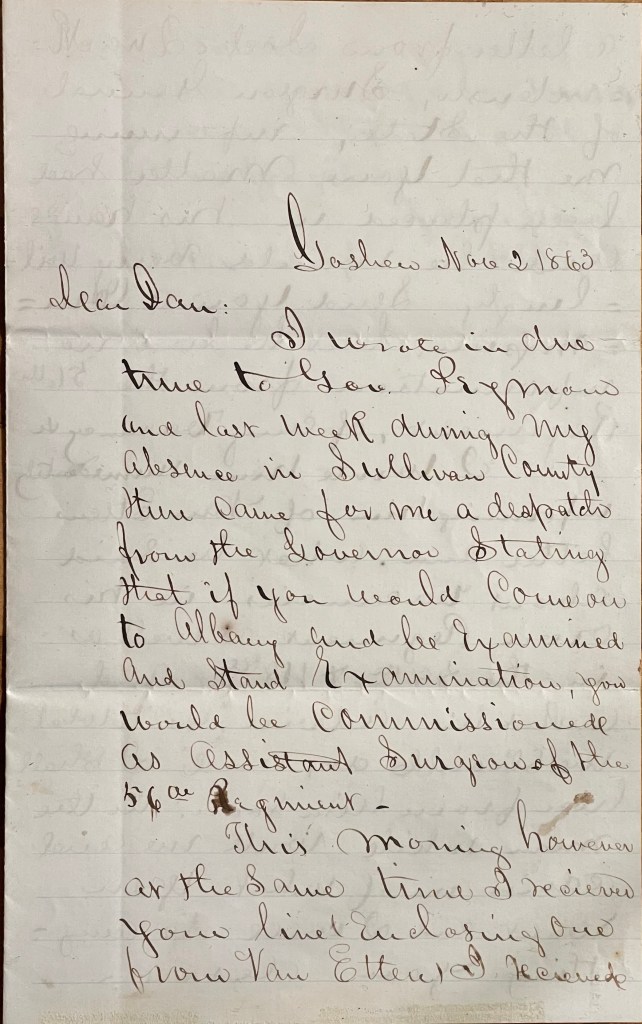
Goshen [Orange county, New York] November 2, 1863
Dear Dan,
I wrote in due time to Gov. [Horatio] Seymour and last week during my absence in Sullivan county, there came for me a dispatch from the Governor stating that if you would come on to Albany and be examined and stand examination, you would be commissioned as Assistant Surgeon of the 56th Regiment.
This morning however at the same time I received your line enclosing one from [Solomon] Van Etten, I received a letter from Doctor [John Van Pelt] Quackenbush, Surgeon General of the State, informing me that your matter had been placed in his hands and he would very willingly send you a commission, but he had no information from the 56th Regiment of any vacancy, &c.
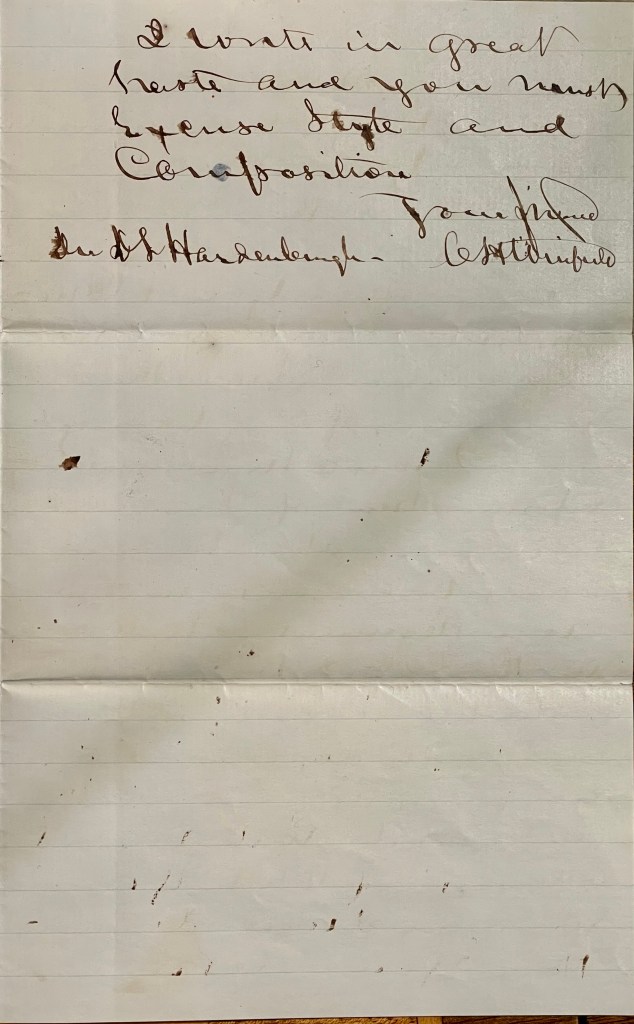
I wrote him immediately informing him of Van Etten’s letter and what he said about vacancies in his own regiment as well as the 48th and 118th and asked his advice as to what we should do, and I shall hear from him soon. In the mean while write me and advise me of what you hear and I will do anything you desire.
I wrote in great haste and you must excuse style and composition. Your friend, — C. H. Winfield
I could not find an image of Milton but here is a cdv of 1st Lt. Henry A. Still of Co. E, 56th New York Infantry (Photo Sleuth)
This letter was written just days before James Henry F. Milton (1832-1910) enlisted in Co. E, 56th New York Infantry. He was mustered in on 29 August as 1st Lieutenant of his company and was promoted to Captain of Co. A on 6 August 1862. He was discharged from the regiment on 31 March 1865.
James was known to his friends as “Dock.” After attending the 1859-60 Medical lectures at the University of Pennsylvania, he began the practice of medicine in Liberty. In the 1860 US Census he was enumerated in the household of Benjamin W. Baker, a grocer in Liberty, where he probably lodged and boarded. After the war, he resumed his profession as a doctor, eventually settling in Philadelphia.
Dock wrote the letter to a friend named “Brigham” who is otherwise unidentified. My hunch is that it was written to Lewis Alexander Brigham (1831-1885)—a contemporary of Dock’s—who was born in New York Mills, New York, and graduated from Hamilton College in Clinton in 1849. He studied to be a lawyer and pass the New York bar in 1855. He then set up a practice in New York City and got into politics. In 1850, after graduating from Hamilton College, Lewis Brigham was a teacher in Sullivan county. I could find no other Brigham’s living in Sullivan county in that period.
[Note: This letter is from the private collection of Kyle A. Williams and was made available for transcription and publication on Spared & Shared by express consent.]
Transcription
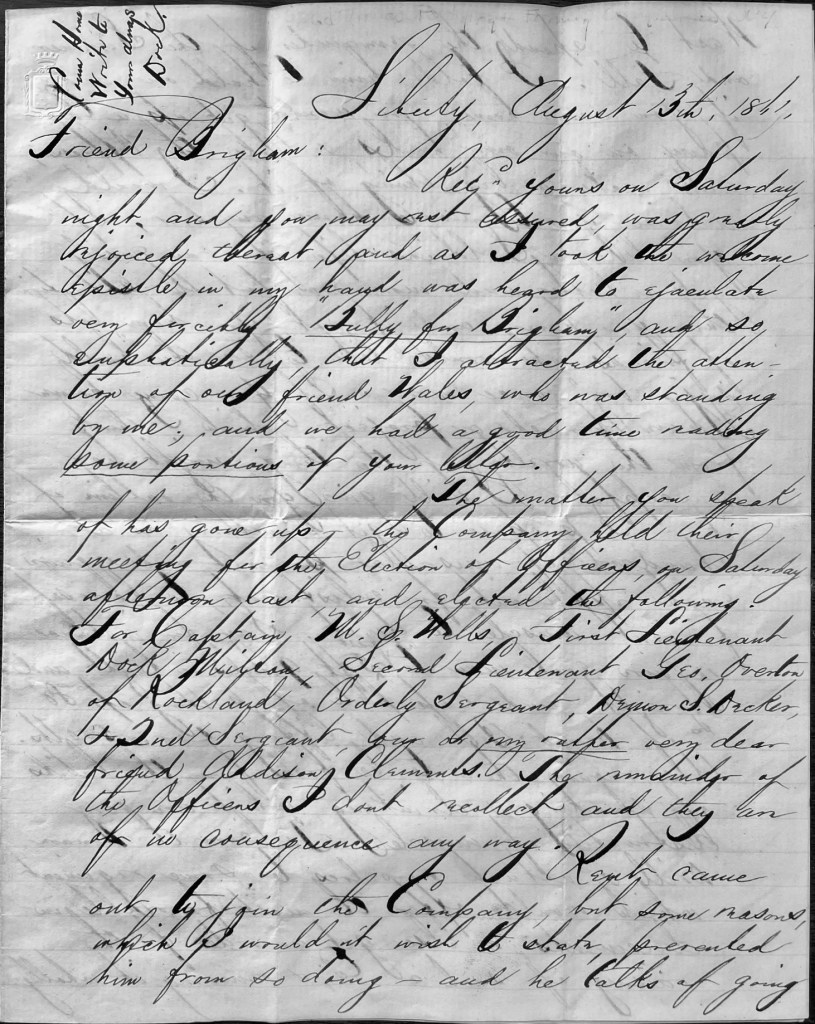
Liberty [Sullivan county, New York] August 13th 1861
Friend Brigham,
Received yours on Saturday night and you may rest assured was greatly rejoiced thereat, and as I took the welcome epistle in my hand was heard to ejaculate every forcibly, “Bully for Brigham” and so emphatically that I attracted the attention of our friend [Reuben] Wales who was standing by me, and we had a good time reading some portions of your letter.
The matter you speak of has gone up—the Company held their meeting for the elections of officers on Saturday afternoon last and elected the following. For Captain, M[elvin] S. Wells; 1st Lieutenant, Dock Milton; Second Lieutenant, George [P.] Overton of Rockland; Orderly Sergeant, Demon S. Decker; & 2nd Sergeant, our, or my, rather very dear friend Addison [J.] Clements. The remainder of the officers I don’t recollect and they are of no consequence any way.
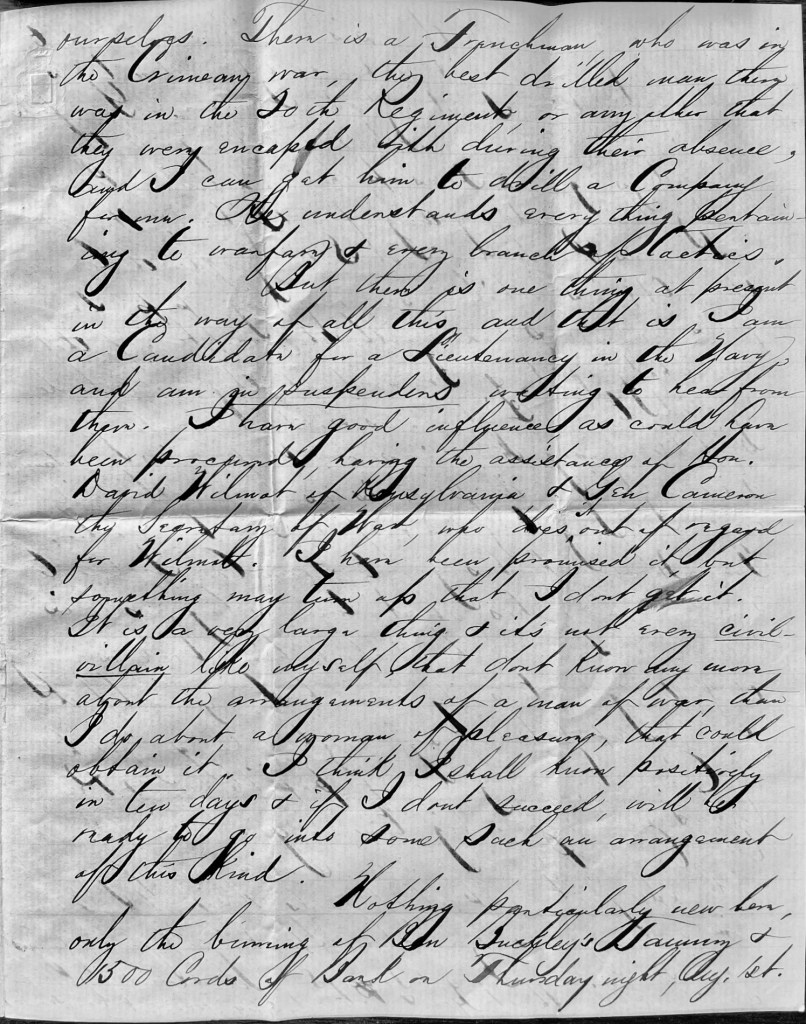
Reub[en Wales] came out to join the company but some masons which I wouldn’t wish to state prevented him from so doing and he talks of going West to spend the remainder of the summer and fall. I told him to hold on and if you came home, we would get up a company on our own hooks, & take the officers and make a big thing of it. I would advise you to come home anyhow. If you like a soldier’s life, you can easily get a better and more comfortable situation that you have and if not, you have lots of friends who would like to see the “bould soger boy” once more.
If you come home, I have formed a project which I think from the novelty of the thing might be successful. I will give you the outline of it. I propose to get something as a standard of muscular power and require each applicant for enlistment to have sufficient muscle to do it. Say for instance require each man to be at least 5 feet, 9 inches in height, and straight, and capable of putting up 80 lb. of dumb bell and lifting 200 or 500 lbs. Also require them to be free from the habits of smoking & drinking, which are very destructive of muscle. To learn the Zouave drills & attach ourselves to some regiment which would offer the most favorable inducements, or else get an order for the raising of such a company & running it wholly ourselves. There is a Frenchman who was in the Crimean War—the best drilled man there was in the 20th Regiment or any other that they were encamped with during their absence, and I can get him to drill a company for me. He understands everything pertaining to warfare & every branch of tactics.
But there is one thing at present in the way of all this and that is I am a candidate for a Lieutenancy in the Navy and am in suspenders waiting to hear form them I have good influence as could have been procured, having the assistance of Hon. David Wilmot of Pennsylvania & Gen. [Simon] Cameron, the Secretary of War, who does out of regard for Wilmot. I have been promised it but something may turn up that I don’t get it. It is a very large thing & it’s not every civil villain like myself that don’t know any more about the arrangements of a man of war than I do about a woman of pleasure, that could obtain it. I think I shall know positively in ten days & if I don’t succeed, will be reay to go into some such arrangement of this kind.
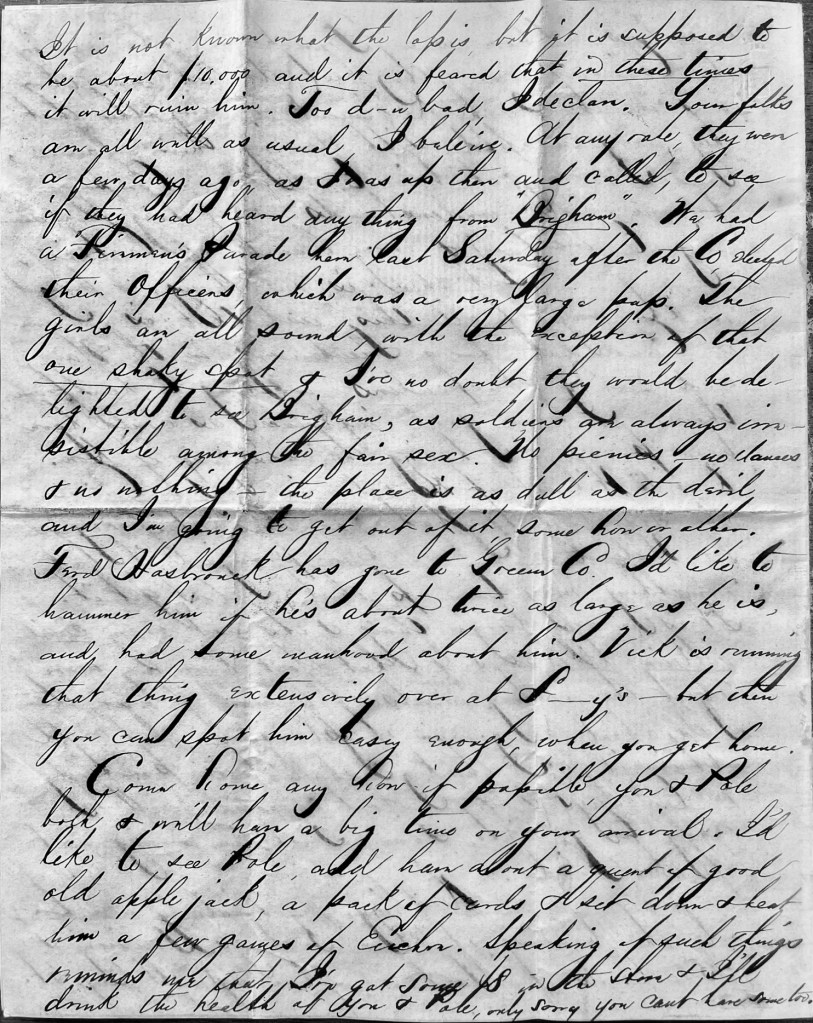
Nothing particularly new here—only the burning of Ben[jamin P.] Buckley’s Tannery & 1500 cords of bark on Thursday night, August 1st. It is not know what the loss is, but it is supposed to be about $10,000 and it is feared that in these times, it will ruin him. To damn bad, I declare.
Your folks are all well as usual, I believe. At any rate, they were a few days ago as I was up there and called to see if they had heard anything from “Brigham.” We had a Fireman’s Parade here last Saturday after the company elected their officers which was a very large pop [?]. The girls are all sound, with the exception of that one shaky spot & I’ve no doubt they would be delighted to see Brigham, as soldiers are always irresistible among the fair sex. No picnics, no dances, and no nothing—the place is as dull as the devil and I’m going to get out of it somehow or other.
Ferd Hasbrouck has gone to Green county. I’d like to hammer him if he’s about as twice as large as he is, and had some manhood about him. Vick is running that thing extensively over at L—-y’s, but then you can spot him easy enough when you get home. Come home anyhow if possible—you and Pole both—and we’ll have a big time on your arrival. I’d like to see Pole and have about a quart of good old applejack, a pack of cards, & sit down and beat him a few games of Euchre. Speaking of such things reminds me that I’ve got some $ in the store & I’ll drink the health of you & Pole, only sorry you can’t have some too. Come home. Write to yours always, — Dock
The following letter was written by Springstead B. Owen (1838-1912) of Newburgh, Orange county, New York, who enlisted on 14 July 1861 at the age of 22 to serve three years in Co. A, 56th New York Infantry. Springstead survived the war and mustered out on 16 August 1864. (On the company roster, his surname was recorded as “Owens.”) The 56th New York consisted of eleven companies of infantry, two light batteries, and two troops of cavalry, the whole being known as the “10th Legion.”
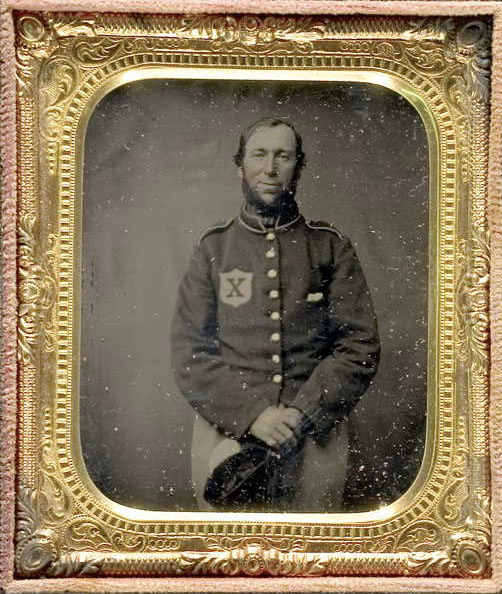
I could not find an image of Springstead but here is an unidentified member of the 56th New York readily identifiable by the “10th (roman numeral X) Legion” crest on his New York jacket.
Like so many other letters written home by soldiers in the Civil War, Springstead conveys the sad details of a comrade’s death to the deceased loved ones at home. In this case, Springstead describes the final days of Cornbury Merritt (1839-1862) who died of typhoid fever on 30 May 1862 near Bottom’s Bridge, Virginia. Cornbury’s younger brother, Seneca Merritt, was also in the same company but asked Springstead to write the “particulars” of Cornbury’s death since he was with him the entire time of his sickness. Most of these types of letters are eerily similar in content and expressions. It was customary to comfort the grieving family with news that their loved one died peacefully and with the hope of eternal salvation.
Cornbury Merritt was the son of Gilbert Merritt (1808-1873) and Fanny Eighmey (Amey) of Blooming Grove, Orange county, New York.
At the time that Springstead wrote this letter the regiment was assigned to the 1st Brigade, Casey’s Division, and deeply engaged in the Peninsula Campaign. Mention is made of an impending battle which would most likely have been the Battle of Fair Oaks (Seven Pines) which was fought on May 31-June 1, 1862.
Transcription
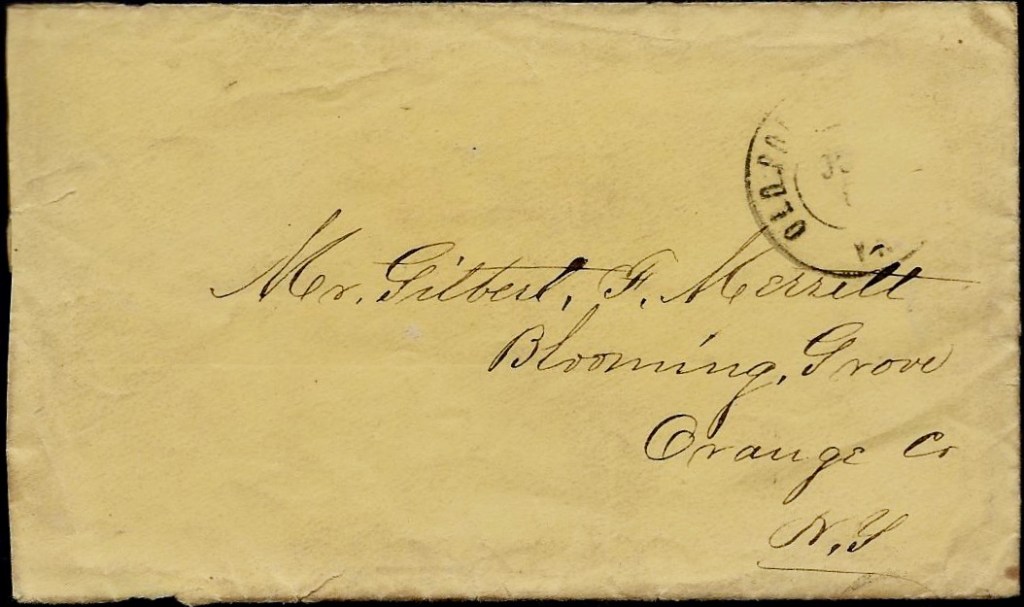
Addressed to Mr. Gilbert F. Merritt, Blooming Grove, Orange county, New York
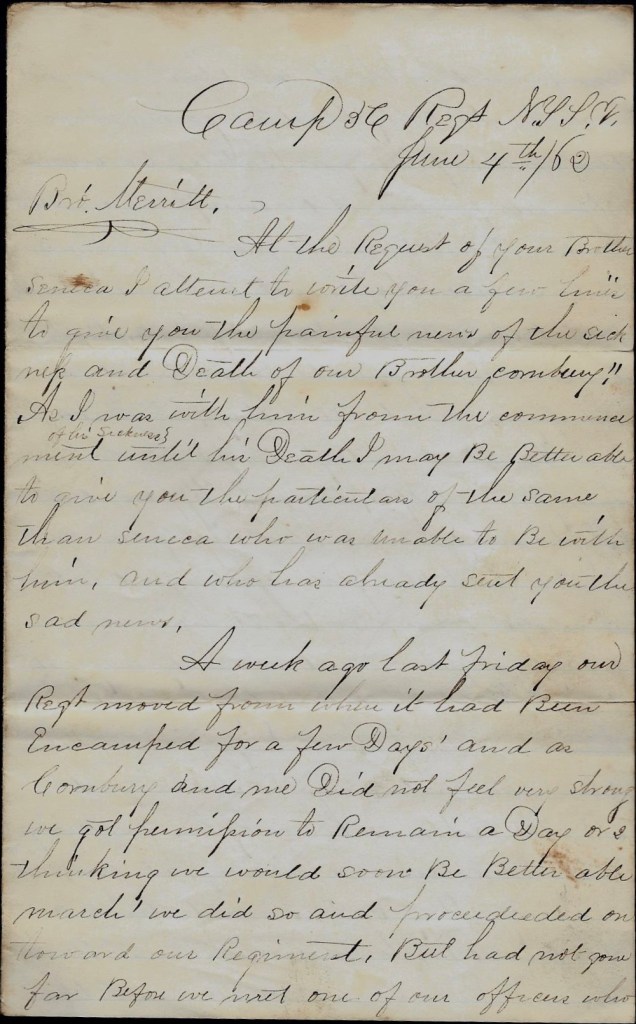
Camp 56th Regt. N. Y. S. V. June 4, 1862
Bro. Merritt,
At the request of your brother Seneca I attempt to write you a few lines to give you the painful news of the sickness and death of our Brother Cornbury. As I was with him from the commencement of the sickness until his death, I may be better able to give you the particulars of the same than Seneca who was unable to be with him, and who has already sent you the sad news.
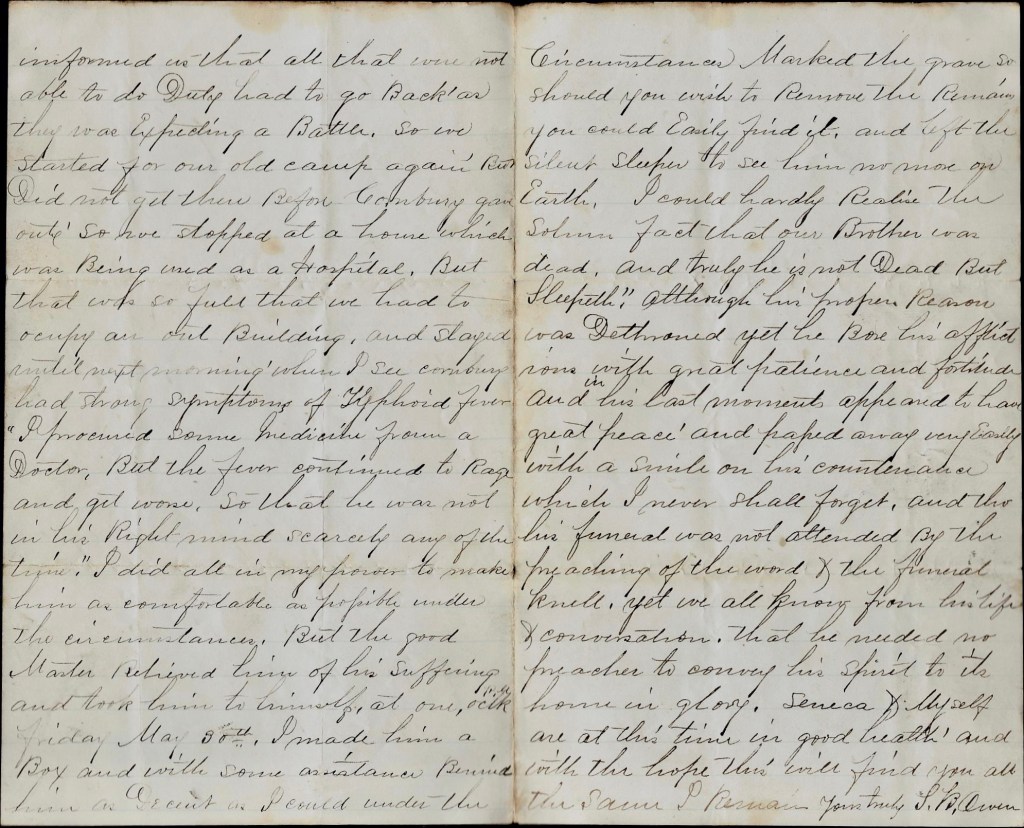
A week ago last Friday our regiment moved from where it had been encamped for a few days and as Cornbury and me did not feel very strong, we got permission to remain a day or two thinking we would soon be better able to march, We did so, proceeded on toward our regiment, but had not gone far before we met one of our officers who informed us that all that were not able to do duty had to go back as they were expecting a battle. So we started for our old camp again but did not get there before Cornbury gave out so we stopped at a home which was being used as a hospital. But that was so full that we had to occupy an out building and stayed until next morning when I see Cornbury had strong symptoms of Typhoid fever.
I procured some medicine from a doctor but the fever continued to rage and get worse so that he was not in his right mind scarcely any of the time. I did all in my power to make him as comfortable as possible under the circumstances but the good Master relieved him of his suffering and took him to Himself at one o’clock p.m. Friday, May 30th.
I made him a box and with some assistance buried him as decent as I could under the circumstances, marked the grave so should you wish to remove the remain you could easily find it, and left the silent sleeper to see him no more on earth. I could hardly realize the solemn fact that our brother was dead and truly he is not dead but sleepeth. Although his proper reason was dethroned, yet he bore his affliction with great patience and fortitude and in his last moments appeared to have great peace and passed away very easily with a smile on his countenance which I never shall forget. And though his funeral was not attended by the preaching of the word & the funeral knell, yet we all know from his life & conversation that he needed no preacher to convey his spirit to its home in glory.
Seneca and myself are at this time in good health and with the hope this will find you all the same, I remain yours truly, — S. B. Owen






 Spared & Shared 23