The following letter was written by Edwin Denison Noyes (1838-1911), the son of William Franklin Noyes (1813-1901) and Julia Elizabeth King (1815-1898) of Mystic, New London, Connecticut. Edwin was working in New Haven as a carpenter when he enlisted as a private on 9 July 1861 in Co. B, 5th Connecticut Infantry. He was mustered out of the regiment for disability on 11 January 1864.
T R A N S C R I P T I O N
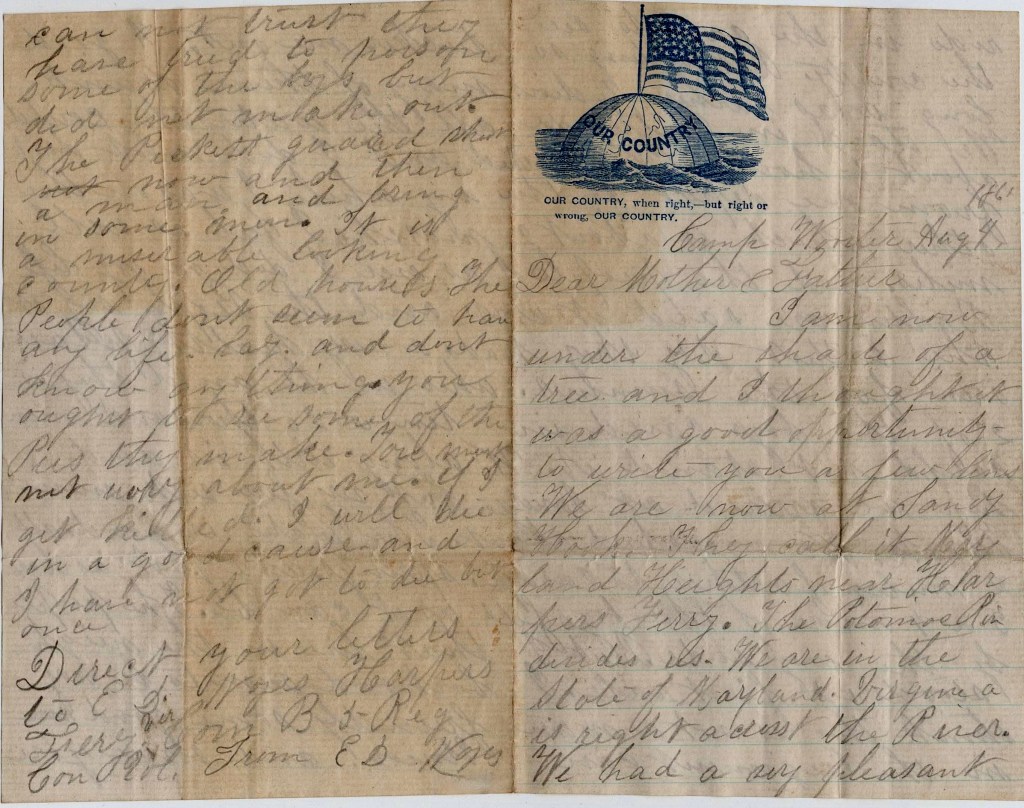
Camp Wooster August 4th 1861
Dear Mother and Father,
I am now under the shade of a tree and I thought it was a good opportunity to write you a few lines. We are now at Sandy Hook. They call it Maryland Heights near Harpers Ferry. The Potomac River divides us. We are in the State of Maryland. Virginia is right across the river.
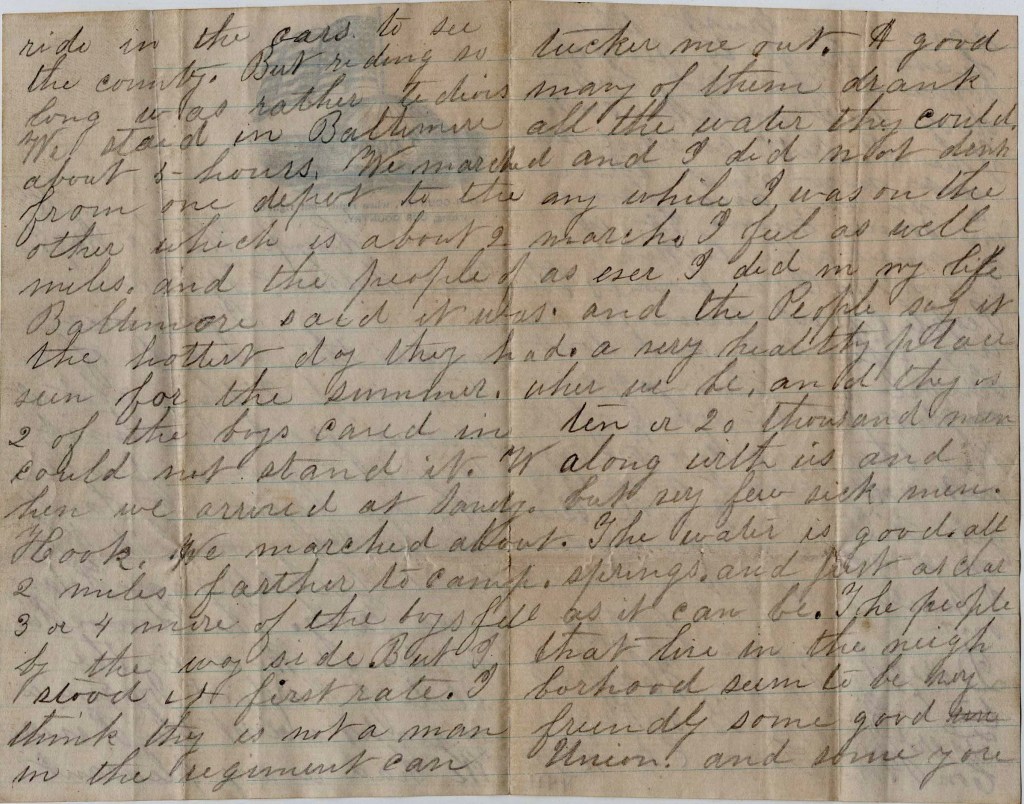
We had a very pleasant ride in the cars to see the country. But riding so long was rather tedious. 1 We stayed in Baltimore about 5 hours. We marched from one depot to the other which is about two miles and the people of Baltimore said it was the hottest day that had seen for the summer. Two of the boys caved in—could not stand it. When we arrived at Sandy Hook, we marched about two miles farther to camp. Three or four more of the boys fell by the wayside. But I stood it first rate. I think there is not a man in the regiment can tucker me out.
A good many of them drank all the water they could and I did not drink any while I was on the march. I feel as well as ever I did in my life and the people say it is a very healthy place where we be. And there is ten or 20 thousand men along with us and but very few sick men. The water is good—all springs—and just as clear as it can be.
The people that live in the neighborhood seem to be very friendly—some good Union, and some you cannot trust. They have tried to poison some of the boys but did not make out.
The picket guards shoot now and then a man and bring in some men. It is a miserable looking country. Old houses. The people don’t seem to have any life, lazy, and don’t know anything. You ought to see some of the Pus [?] they make.
You must not worry about me. If I get killed, I will die in a good cause and I have not got to die but once.
Direct your letters to E. D. Noyes, Harpers Ferry, Virginia. Company B, 5th Regt. Connecticut Volunteers.
From E. D. Noyes
1The ride in the railroad cars was described in the Regimental history: “The weather was excessively hot, sultry and muggy and sticky, the cars were crowded, with no room to lie down or sit up without coming in contact with others, and the damp of the weather and the grime of the tobacco users, and the steam of the crowds of pent up humanity, made those little box cars almost as foul as pig styes, and made us very miserable. We were dead played out, and we could no longer entertain each other with thrice told yarns; indeed, we were cross and irascible; we wanted to sleep, but we could not even do that.” [Page 33]
The following letter was written by Albert L. Henry (18xx-1863) of Scotland, Windham county, Connecticut, who served in Co. B, 5th Connecticut Volunteers. Albert enlisted on 29 June 1861 and died of disease on 25 March 1863 while in the service.
In his letter, Albert speaks of the First Battle of Kernstown (23 March 1862) and the carnage witnessed following the battle. It was just the opening act of Stonewall Jackson’s 1862 Valley Campaign.
“We have got them Started. Come On! Come On!” The Union breakthrough at First Kernstown. Artwork by Keith Rocco
T R A N S C R I P T I O N
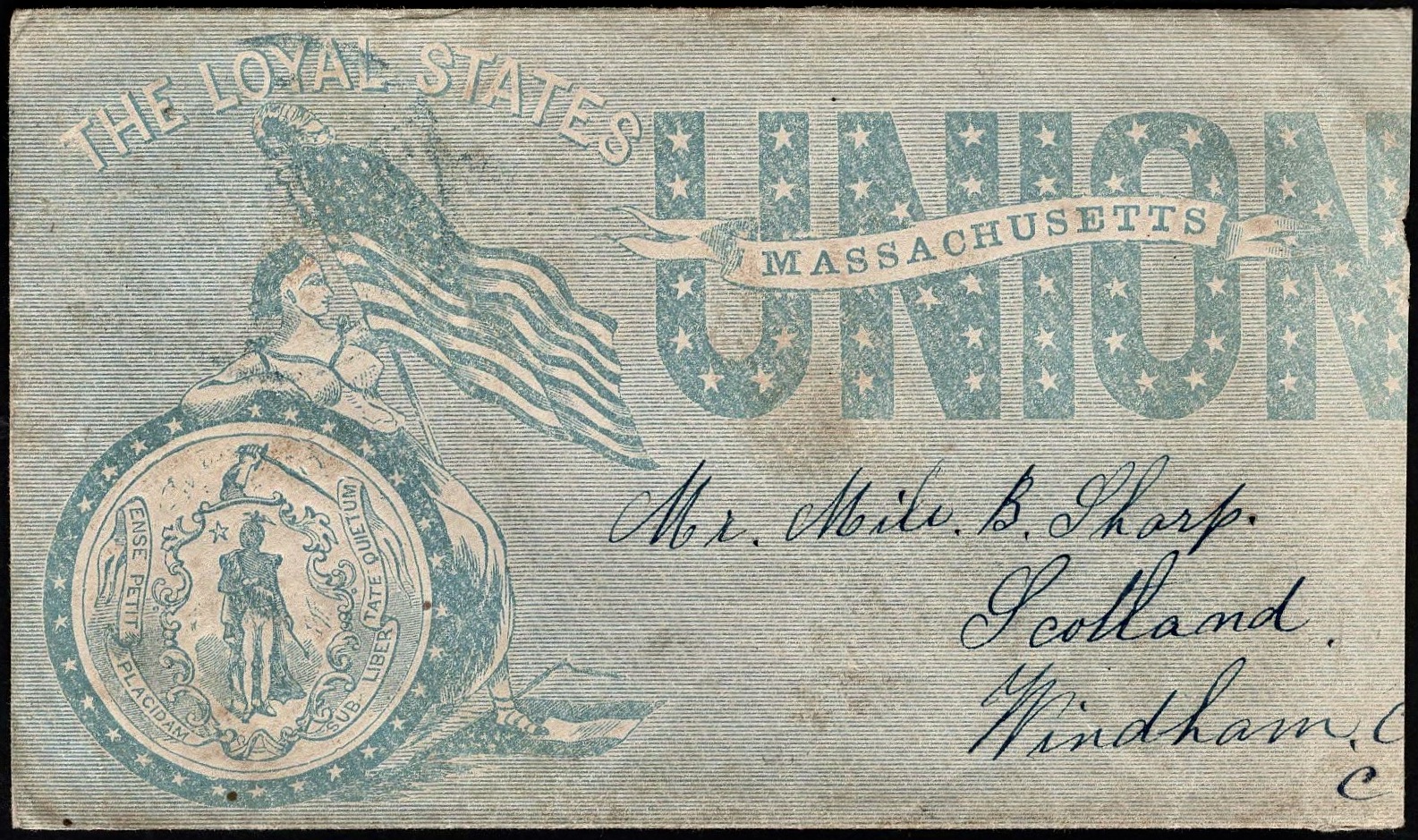
Addressed to Mr. Milo B. Sharp, Scotland, Windham county, Connecticut
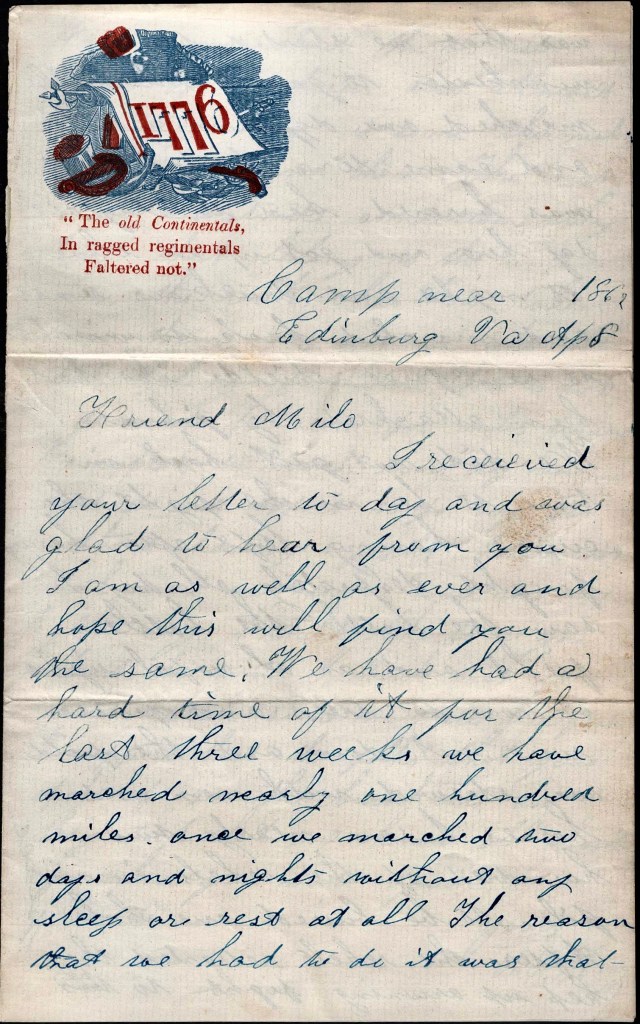
Camp near Edinburg, Va. April 8, 1862
Friend Milo,
I received your letter today and was glad to hear from you. I am as well as ever and hope this will find you the same.
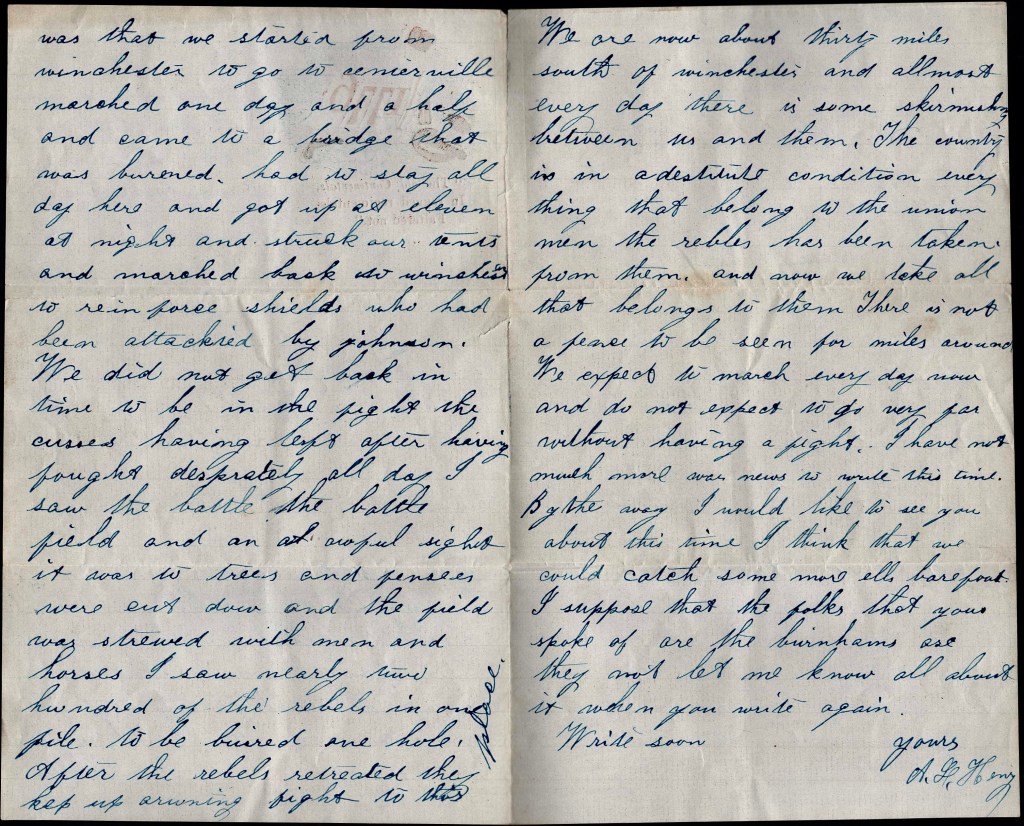
We have had a hard time of it for the last three weeks. We have marched nearly one hundred miles. Once we marched two days and nights without any sleep or rest at all. The reason that we had to do it was that we started from Winchester to go to Centerville, marched one day and a half, and came to a bridge that was burned. Had to stay all day here and got up at eleven at night and struck our tents and marched back to Winchester to reinforce Shields who had been attacked by Johnson [Jackson]. We did not get back in time to be in the fight, the cusses having left after having fought desperately all day. I saw the battlefield and an awful sight it was too. Trees and fences were cut down and the field was strewed with men and horses. I saw nearly two hundred of the rebels in one pile to be buried in one hole. After the rebels retreated, they kept up a running fight to this place.
We are now about thirty miles south of Winchester and almost every day there is some skirmishing between us and them. The country is in a destitute condition. Everything that belong to the Union men, the rebels has been taken from them. And now we take all that belongs to them. There is not a fence to be seen for miles around. We expect to march every day now and do not expect to go very far without having a fight.
I have not much more war news to write this time. By the way, I would like to see you about this time. I think that we could catch some more ells barefoot. I suppose that the folks that you spoke of are the Burnhams, are they not? Let me know all about it when you. write again. Write soon. Yours, — A. L. Henry
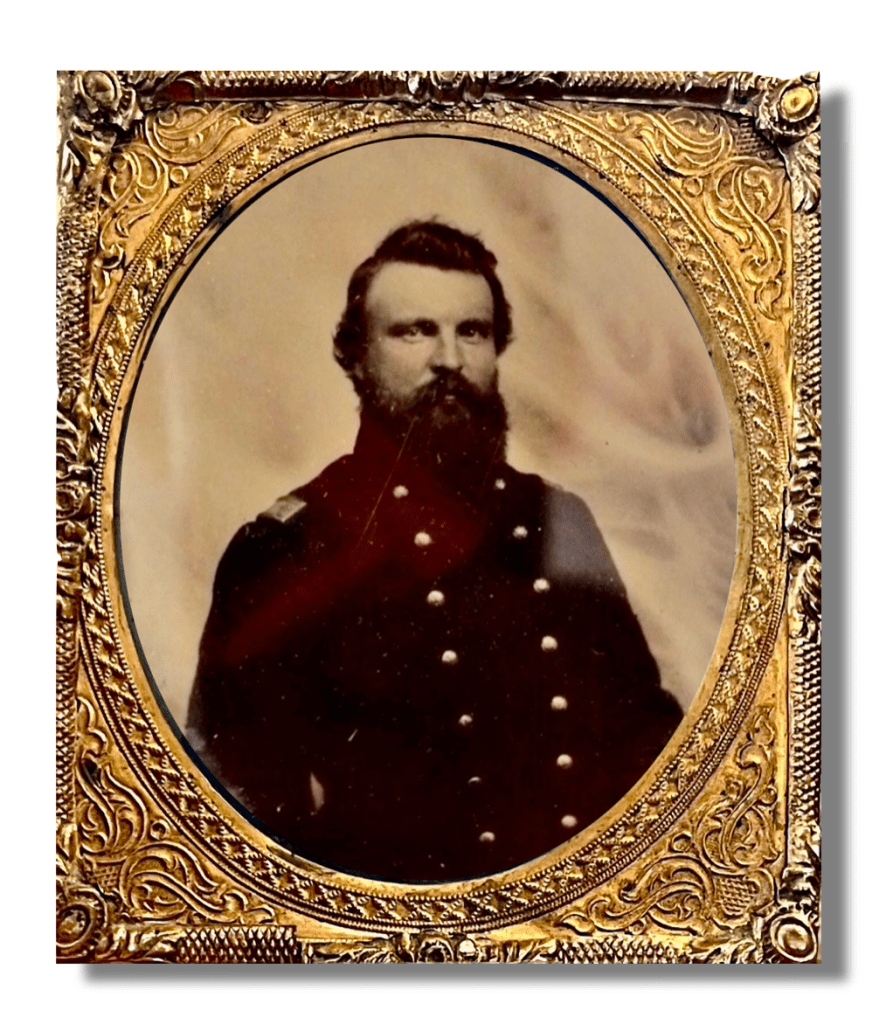
Lt. Col. Henry Burton Stone of the 5th Connecticut Infantry
My friend John Banks sent me the following message recently and asked if I would be willing to share it on Spared & Shared.
“I recently received from a family member a remarkable cache of photos and letters pertaining to Lt. Col. Henry Burton Stone (1827-1863) of the 5th Connecticut who suffered a severe thigh wound at Cedar Mountain on Aug. 9, 1862, and died months later in captivity in Charlottesville, Va. Stone was initially buried there and then removed for final burial in Culpeper National Cemetery, presumably after the war.
In addition to a letter from Stone to his wife while he lay in captivity, there are two remarkable letters from Confederate surgeon John S. Davis to friends of Stone back in Connecticut. They detail the care for Stone, his final days, etc.—heartrending stuff. I wrote a short story on Stone in my second book, but to my knowledge the letters have never appeared anywhere in their entirety. I also wrote a short article on Lt. Col. Henry B. Stone on my Civil War Blog entitled, “Wounded at Cedar Mountain, officer ‘sleeps on the enemy’s soil.'”
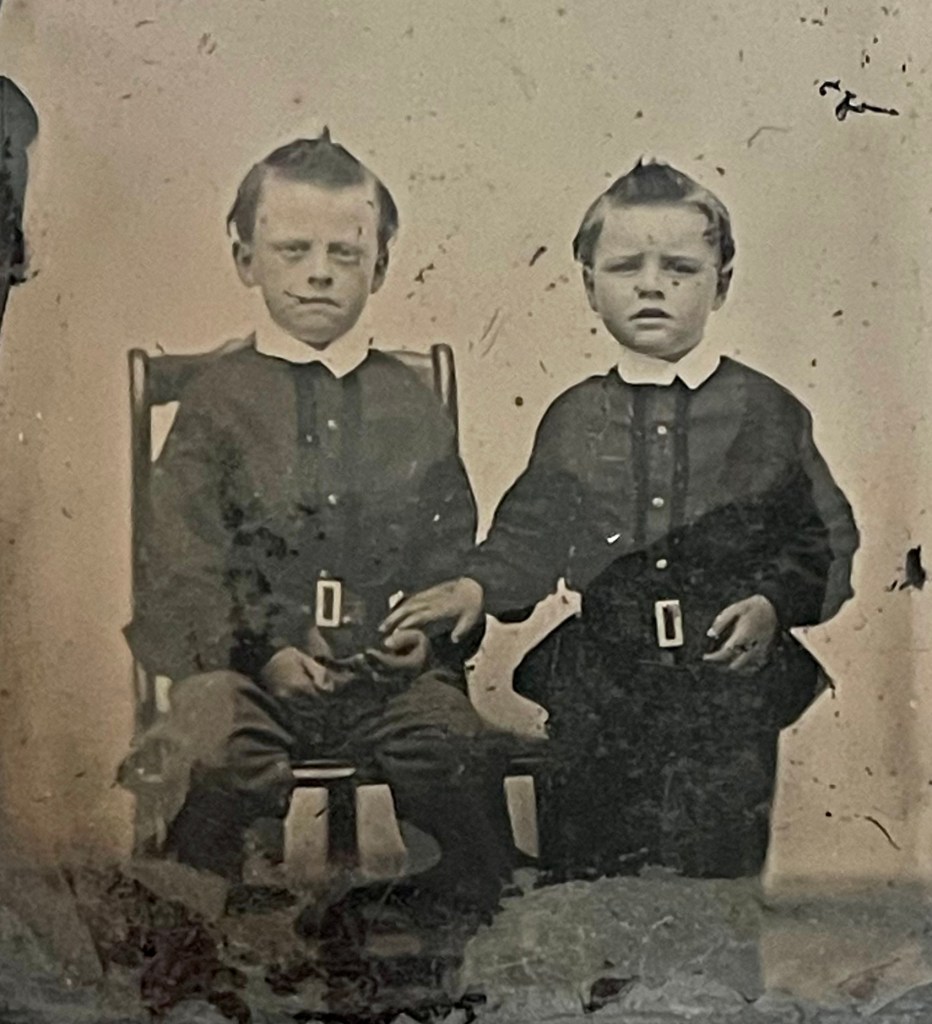
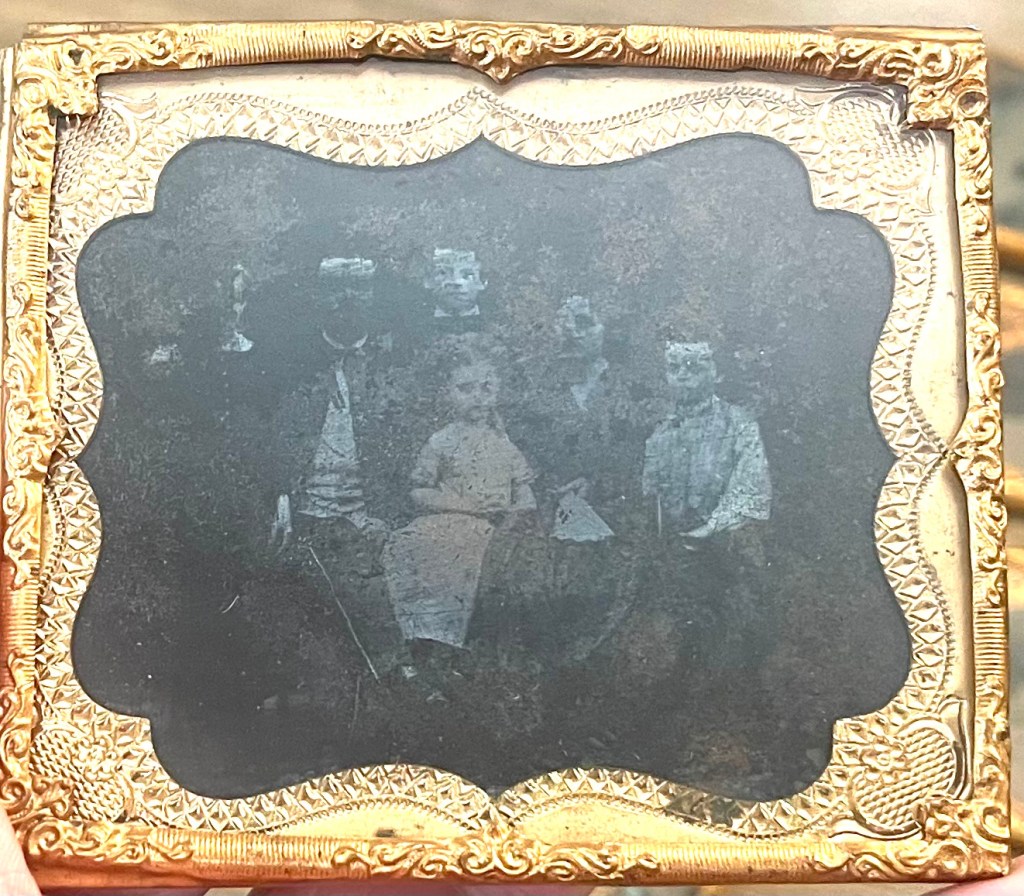
The small collection includes a sixth-plate ruby ambrotype of Stone in uniform, a pre-war image of Stone; two images of his sons, Melville and Theodore; two letters from the Confederate surgeon, John S. Davis, who treated him while in captivity until his death; and a letter from Stone to wife while he lay in captivity. There is also a family image that is poor.”
Letter 1
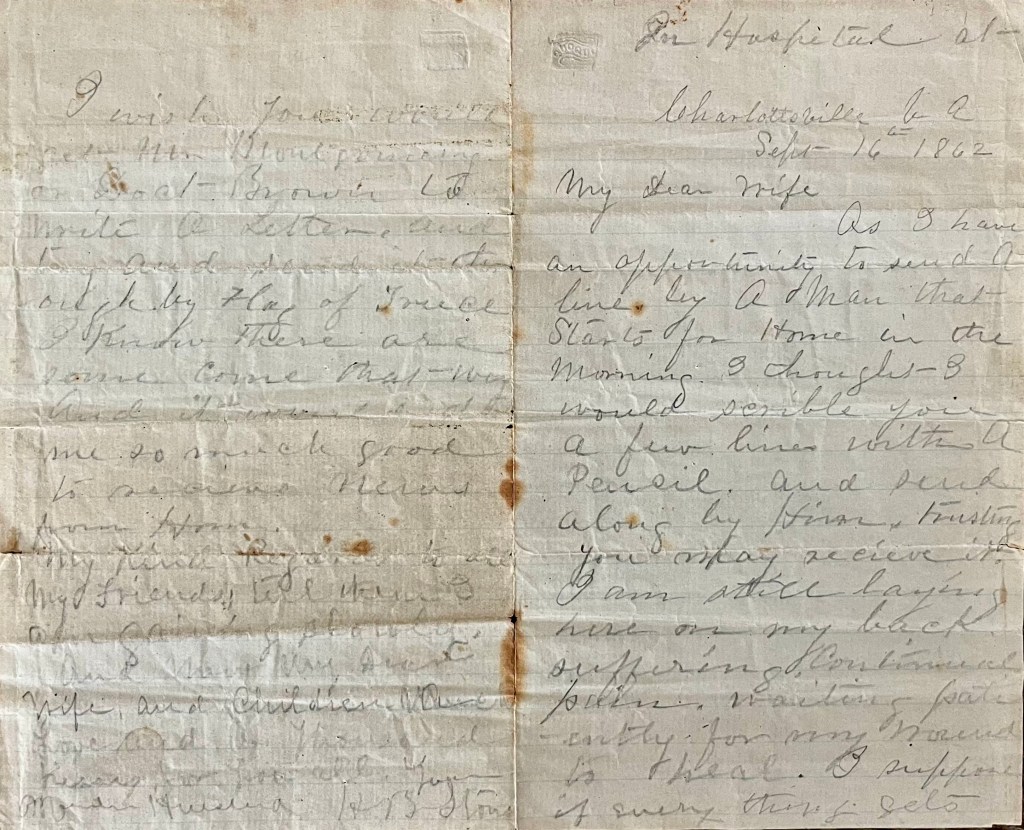
In Hospital at Charlottesville, Va. September 16, 1862
My Dear Wife,
As I have an opportunity to send a line by a man that starts for home in the morning, I thought I would scribble you a few lines with a pencil and send along by him, trusting you may receive it.
I am still laying here on my back suffering continual pain waiting patiently for my wound to heal. I suppose if everything gets along as well as usual, I shall have to lay here in this position about 4 weeks longer when they will take it out of the splint and allow me to move about more in bed. I hope in two or three months to be able to hobble about on crutches if no other disease takes hold of me.
How anxious I am to hear from some of you and about the regiment. How many were killed and wounded? I know nothing about it—only what I saw before I was shot. I am anxious to know if my horses and trunk and baggage were saved and sent home. The loss of them would be the loss of 6 or 7 hundred dollars or more. Doct. Bennett promised to look after them if occasion should require, and probably did, if not killed or wounded.
How anxious I am to get able to be paroled (if they parole officers now). But I must wait patiently and so must you. I wish you would get. Mr. Montgomery or Doct. Brown to write a letter and try and send it through by Flag of Truce. I know there are some come that way and it would do me so much good to receive news from home.
My kind regards to all my friends. Tell them I am gaining slowly and send my dear wife and children love and a thousand kisses for you all. Your husband, — H. B. Stone
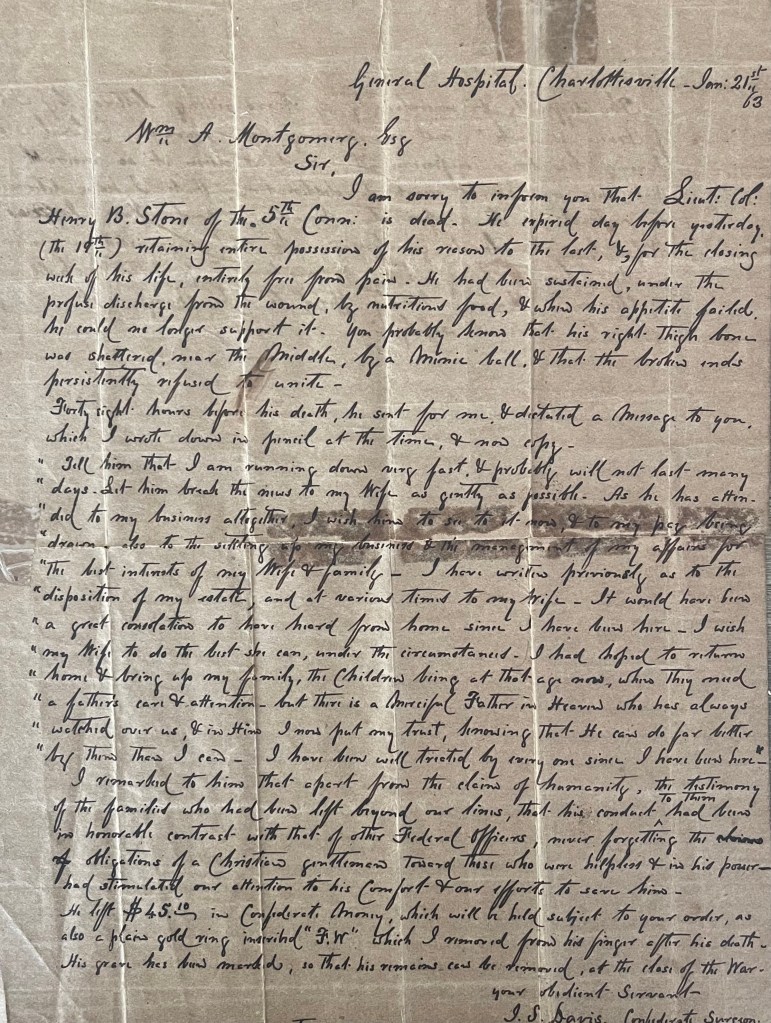
General Hospital Charlottesville [Virginia] January 21st 1863
Wm. A. Montgomery, Esq.,
Sir, I am sorry to inform you that Lieut. Colonel Henry B. Stone of the 5th Connecticut is dead. He expired day before yesterday (the 19th) retaining entire possession of his reason to the last, &, for the closing week of his life, entirely free from pain. He had been sustained under the profuse discharge from the wound, by nutritious food, & when his appetite failed, he could no longer support it. You probably know that his right thigh bone was shattered near the middle by a minié ball & that the broken ends persistently refused to unite.
Forty-eight hours before his death, he sent for me & dictated a message to you which I wrote down in pencil at the time and now copy.
“Tell him that I am running down very fast and probably will not last many day. Let him break the news to my wife as gently as possible. As he has attended to my business altogether, I wish him to see to it now, & to my pay being drawn. Also to the settling up my business & the management of my affairs for the best interests of my wife and family. I have written previously as to the disposition of my estate, and at various times to my wife. It would have been a great consolation to have heard from home since I have been here. I wish my wife to do the best she can under the circumstances. I had hoped to return home & bring up my family, the children being at that age now when they need a father’s care and attention, but there is a merciful Father in Heaven who has always watched over us and in Him I now put my trust, knowing that He can do far better by them than I can. I have been well treated by everyone since I have been here.”
I remarked to him that apart from the claim of humanity, the testimony of the families who had been left beyond our lines, that his conduct to them had been in honorable contrast with that of other Federal officers, never forgetting the obligations of a Christian gentleman toward those who were helpless & in his power had stimulated our attention to his comfort & our efforts to save him. He left $45.10 in Confederate money which will be held subject to your order, as also a plain gold ring inscribed “F. W.” which I removed from his finger after his death. His grave has been marked so that his remains can be removed at the close of the war.
Your obedient servant, — J. S. Davis, Confederate Surgeon
The difficulty & uncertainty of transmitting letters by Flag of Truce us such (not one having ever reached Colonel Stone during his long confinement) and I deem it so desirable that this one should reach its destination that I have determined to entrust it to a private hand and Mrs. Jeff [smudged], the wife of a Maryland gentleman who had manifested and interest in the Colonel, being about to visit her parents and child in Baltimore, having kindly offered to take charge of it. I hope you will receive it safely.
Letter 3
General Hospital Charlottesville [Virginia] February 21, 1863
Dr. E. A. Brown,
Dear sir, your letter of the 4th inst., inquiring the condition of Lieut. Col. Stone, has just reached me. I am sorry to inform you that he died here on the 20th of January. Immediately after, I wrote at some length to Mr. Montgomery of Danburg, communicating such facts as I thought might interest the friends of the deceased & conveying certain messages which he entrusted to me when he saw that his death was approaching. Feeling more than usual anxiety that the letter should reach its destination, & having learned by experience that the “Flag of Truce” is uncertain, I gave it to a Maryland lady whose husband had been very kind to the Colonel, and who, having been long separated from her child in Baltimore, was about to attempt her return. She promised to mail it as soon as she passed the Federal lines, & but for her detention it would long since have been received. I am hopeful that it may arrive soon.
Overwhelmed with business, I fear that my memory will not enable me to reproduce its contents. I recollect he requested “Mr. Montgomery” to settle up his affairs, to draw his arrears of pay from the government, and to manage his estate for the benefit of his widow and children. He expressed entire resignation to his fate, & cheerfully entrusted to the covenant care of his God the interests of those whom he left in sorrow. Throughout his long confinement he had received the same care and attention that we bestow on Confederate soldiers and strenuous efforts were made to stimulate the failing appetite which hastened, if it did not occasion, the fatal result.
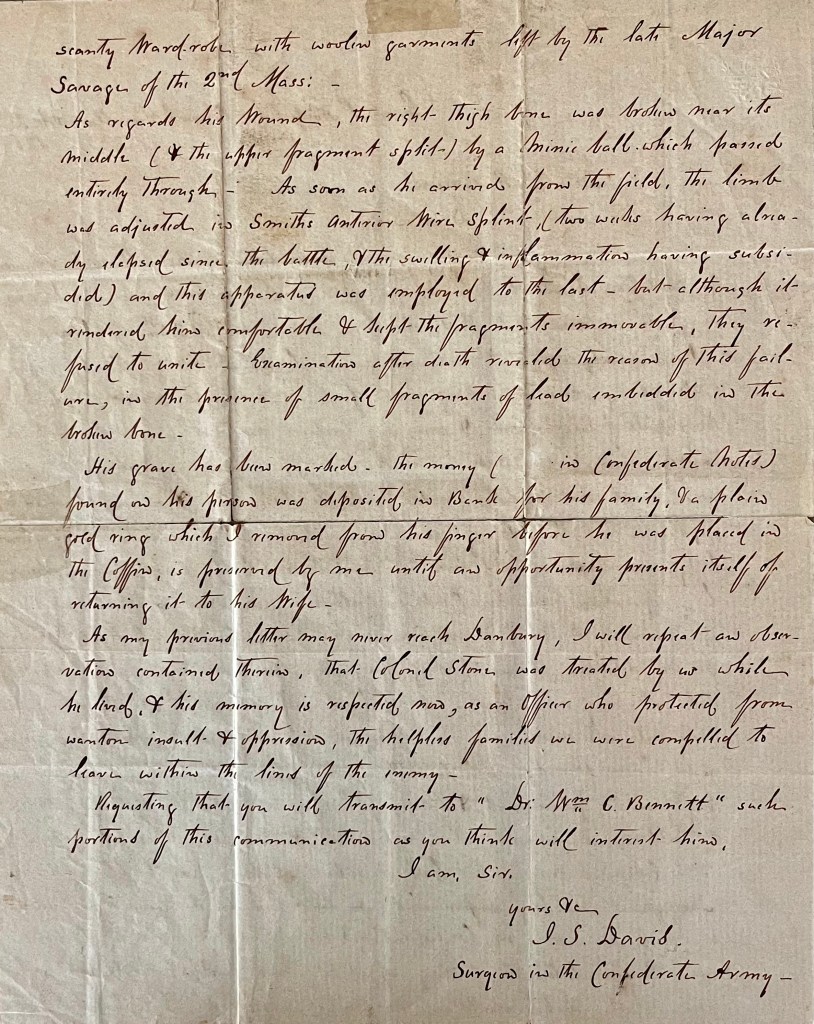
As winter approached, I replenished his scanty wardrobe with woolen garments left by the late Major Savage of the 2nd Massachusetts.
As regards his wound, the right thigh bone was broken near its middle (and the upper fragment split) by a minié ball which passed entirely through. As soon as he arrived from the field, the limb was adjusted in Smith’s Anterior Wire Splint (two weeks having already elapsed since the battle & the swelling & inflammation having subsided) and this apparatus was employed to the last—but although it rendered him comfortable & kept the fragments immovable, they refused to unite. Examination after death revealed the reason of this failure in the presence of small fragments of led embedded in the broken bone.
His grave has been marked. The money in Confederate notes found on his person was deposited in bank for his family & a plain gold ring which I removed from his finger before he was placed in the coffin is preserved by me until an opportunity presents itself of returning it to his wife.
As my previous letter may never reach Danbury, I will repeat an observation contained therein—that Col. Stone was treated by us while he lived & his memory is respected now as an officer who protected from wanton insult and oppression the helpless families we were compelled to leave within the lines of the enemy.
Requesting that you will transmit to “Dr. Wm. C. Bennett” such portions of this communication as you think will interest him, I am, Sir, yours &c. — J. S. Davis, Surgeon in the Confederate Army
This letter was written by William Fuller (1837-1877), the son of Richard and Maria (Parrott) Fuller of Vermont. He wrote the letter to his friend (later wife) Mary Ellen Leavenworth (1846-1930). After the couple were married in 1863, they resided in West Haven, Connecticut, where William worked as a carriage maker. He died young on 28 June 1877 and was buried in the town of Roxbury, Litchfield county, Connecticut.
Twenty-four year-old William Fuller enlisted in the 5th Connecticut Infantry on 22 July 1861 and was made first sergeant of Co. D. He served under Captain David F. Lane of Hartford. According to a history of the regiment by E. E. Marvin (1889), William was taken prisoner on 25 May 1862 at Winchester. A family biography states that he spent four months in Libby Prison. He was exchanged on 15 September 1862 and discharged for disability in mid-February 1863.
In this letter, William mentions the “bad managed affair” at Ball’s Bluff and Edward’s Ferry on 21-22 October 1862 and reassures his friend that, “They will soon receive a blow from us that they will long remember and will make them feel the power of [our] noble Union army. I think the war will be short and decisive.”
[Note: This letter is from the private collection of Greg Herr and was transcribed and published on Spared & Shared by express consent.]
Transcription
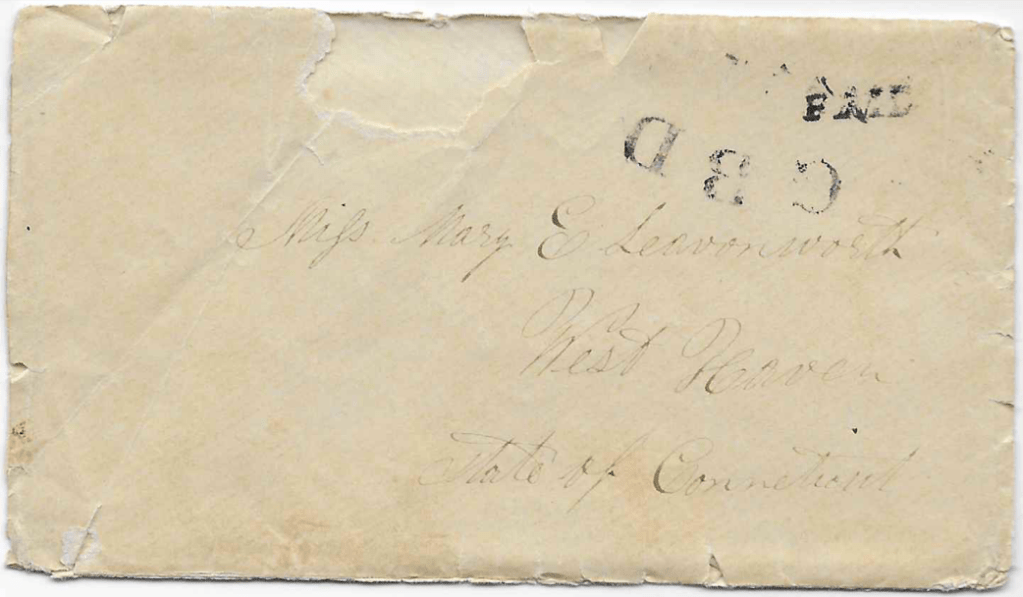
Addressed to Miss Mary E. Leavenworth, West Haven, State of Connecticut
Camp near Muddy Branch November 12th 1861
Dear Friend,
Yes, I am fully convinced that you are a friend to me in every respect and you can be well assured that I am the same to you. I remember a few lines that a friend of mine wrote in the back part of my writing book that made a lasting impression on my mind. they were as follows:
“A constant friend is harder to find and if you find one that is true, change not an old one for a new.”
I received your last on the 18th. The reason of my letters being so long getting to you is our mails do not go regular. If it storms very much, they are delayed. The storm you spoke of reached us here. It raged for 24 hours most terrifically blowing and raining without ceasing. It makes it very unpleasant for the soldiers. We have to be out nearly as much in stormy weather as in pleasant.
There is no mistake that our troops suffered very much at the affair of Edward Ferry. It was a very bad managed affair. Our men were led to a complete trap and scattered like cattle without a chance for their lives. I am very glad our regiment was not there. They will soon receive a blow from us that they will long remember and will make them feel the power of [our] noble Union army. I think the war will be short and decisive.
This is a very pleasant morning for this season of the year. I ave just come in from usual morning work and take these few leisure moments to write to you thinking that I cannot put them to a better purpose. My duties are not quite as arduous as they were when I was in Hartford although I am busy most of the time. I have a good deal of care on my mind which keeps me busy thinking and writing when I am not otherwise engaged.
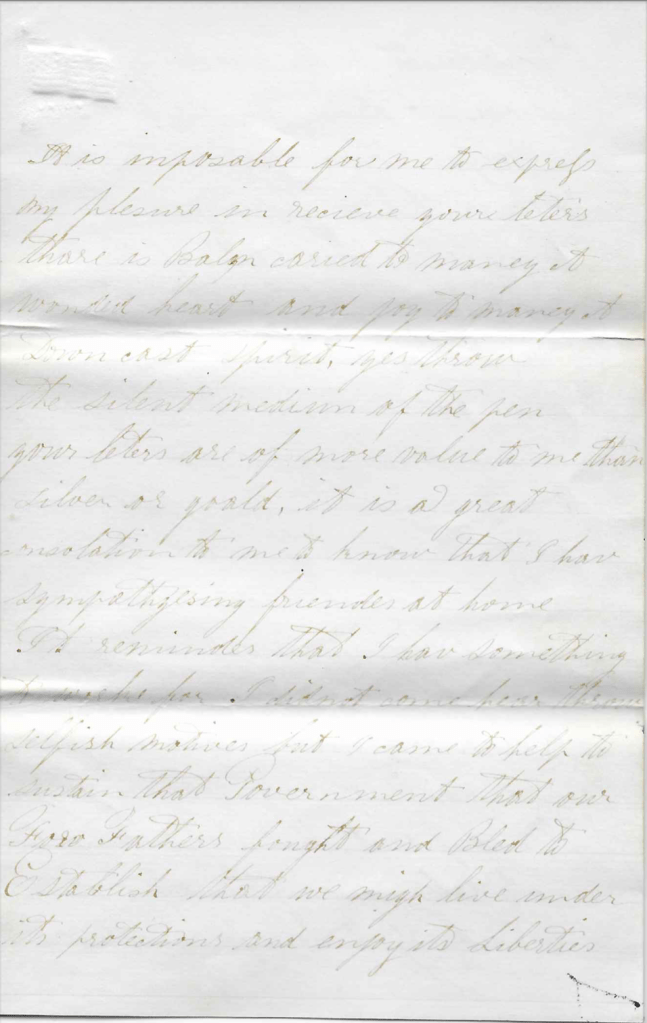
It is impossible for me to express my pleasure in receiving your letter—they are balm carried to many a wounded heart and joy to many a downcast spirit. Yes, through the silent medium of the pen, your letters are of more value to me than silver or gold. It is a great consolation to me to know that I have sympathizing friends at home. It reminds [me] that I have something to work for. I didn’t come here through selfish motives but i came to help to sustain that government that our fore fathers fought and bled to establish that we might live under the protections and enjoy its liberties.
If you could see the works of the secession soldier, it would make you weep. They ravish the country where ere they go. They pay no regards to the most sacred rights of the homes and firesides of private citizens. They rob the widow of her sole dependence—her sons, and impress them into their infamous armies and grossly insult and even murder the aged parent and innocent maiden. These are the kinds of beasts we are contending against. God grant that they may never set their unhallowed feet one inch farther north than they now do to pollute the sacred soil of our noble, loyal states. I feel confident that they never will. I could relate many incidents of their barbarity to hard for my part to describe. It is the other way with us. we place guards over houses that are likely to be intruded upon by any ill disposed one.
I received letters from two of my sisters since I write to you. My mother is as well as usual. I don’t know how long we will stay in this place. I think it will not be long. You need—or I hope you will not—let your mind be so uneasy. Let fond hope cheer your lonely hours. Let us both look forward to the time when we shall meet again and when we [will] be blessed with peace in our land.
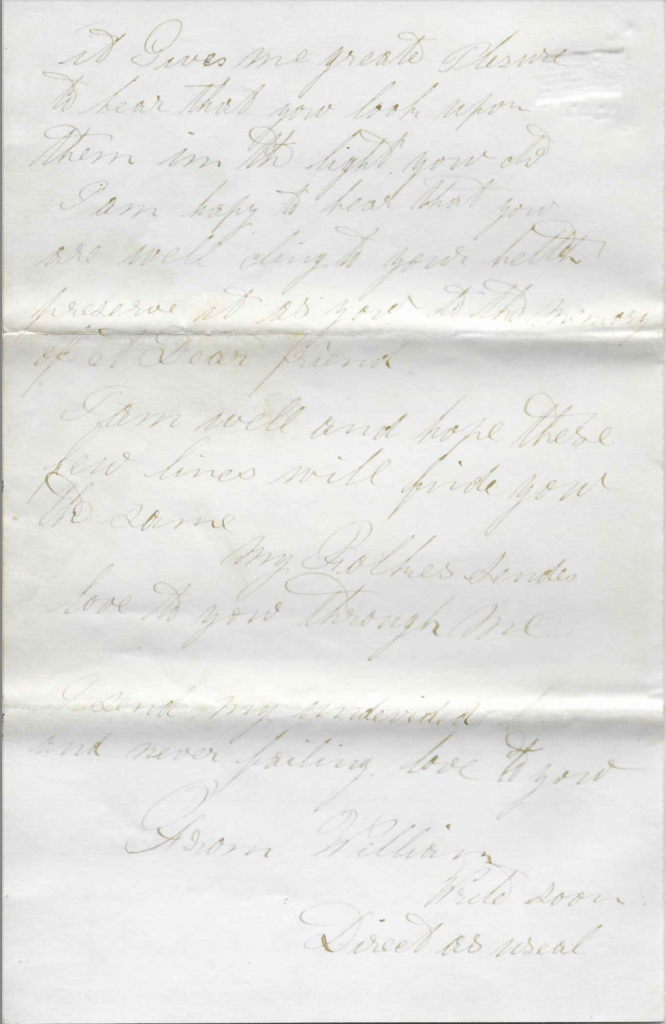
Yes, Mary, I know just what kind of a set you are surrounded by. Keep yourself, or keep them to a respectable distance. They would lead you astray. It gives me great pleasure to hear that you look upon them in the light you do. I am happy to hear that you are well. Cling to your health. Preserve it as you do the memory of a dear friend. I am well and hope these few lines will find you the same. My folks send love to you through me.
I send my undivided and never failing love to you. From William. Write soon. Direct as usual.
This letter was written by a soldier named Henry who served in the 5th Connecticut Infantry. This regiment fought with the Army of Virginia in the East until the fall of 1863 when they were transferred to the Army of the Cumberland and assigned to the 1st Brigade, 1st Division, 20th Army Corps.
Henry Cornwall Clark, possible author of letter
The soldier did not sign his last name but he mentions being transported to his regiment in Stevenson, Alabama, where the regiment was sent in the fall of 1863. Most likely he was either a wounded or sick soldier held in the hospital on Bedloe’s Island (where the Statue of Liberty sits today in New York Harbor) and was being transported along with recruits or draftees to Alabama in time to participate in Sherman’s Atlanta Campaign. He mentions only one traveling companion, Bob Warner, who was a private in Co. B, 5th Connecticut. Bob had been wound in in 1863 and was most likely hospitalized with Henry. Bob had been transferred to the Veteran Reserve Corps but then transferred back, presumably thinking he could endure the two months he had left to serve with his regiment. Henry writes of being plagued by pains that he feels certain will enable him to get his discharge once properly examined by a physician after getting back to his regiment. One possibility is that the author might be Henry Cornwall Clark (1836-1912) of Granville, Massachusetts, who also served in Co. B, 5th Connecticut. Henry and his wife, Lauretta Moore, were married on 21 April 1863—only a year previous. I cannot prove he was the author, however.
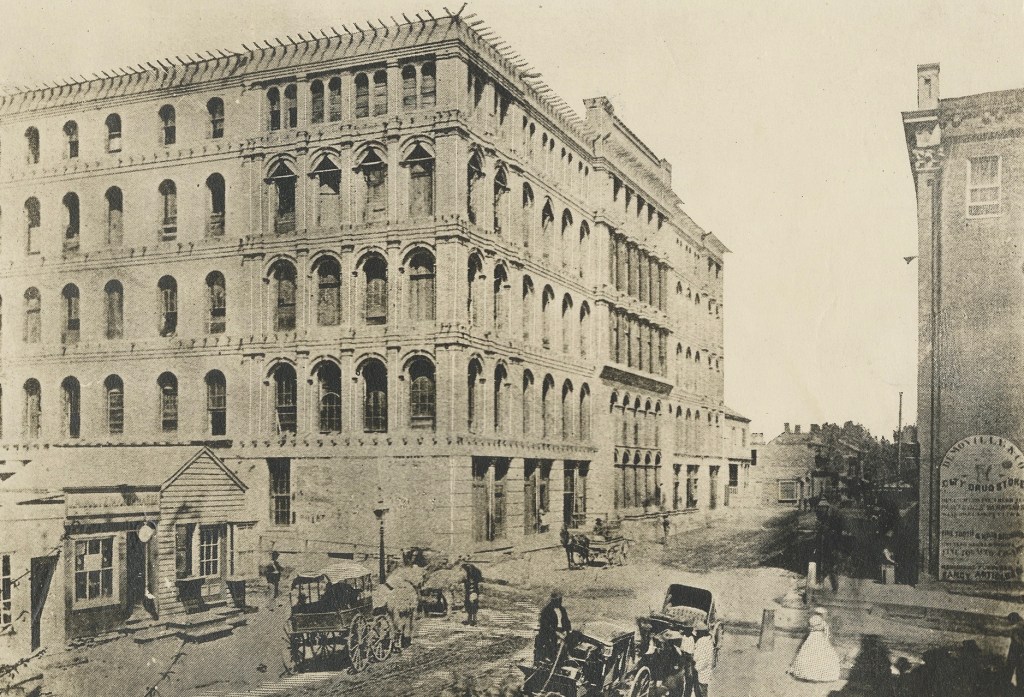
The Zollicoffer House in Nashville, only partially constructed when the Civil War began, was used extensively as a prison for Confederate POWs. Many of them were housed there on temporary floors that had been constructed as makeshift barracks inside the structure, and many of them were killed or mangled when the flooring collapsed on 29 September 1863. By the time Henry and his traveling companions were quartered there, there was still no roof and the upper floors were partially collapsed. After the war, a 1st Wisconsin Cavalry Quartermaster Sergeant named James Waterman remembered the Zollicoffer House as being “more like a prison than a barracks for civilized beings, and was a disgrace to the service.”
Fort Harker just outside of Stevenson, Alabama
Transcription
Stevenson, Alabama May 11, 1864
My Darling & Beloved Wife,
I take this opportunity of writing you a few lines to let you know where I am and how I am getting along. I don’t feel any better than I have felt. My back and side troubles me considerable but I could not get any examination anywhere on the road. But if the regiment is stationed in the same place, I shall ask for my discharge as soon as I get there and I will get it.
Zollicoffer House in Nashville during the war
But I hope these few lines will find my darling enjoying first rate health. I hope that you received the letter that I wrote from Louisville the 8th of this month in which I told you about our treatment from Bedloe’s Island to Cincinnati. But from Cincinnati to this place we was treated a little better. But when we was in Nashville we put up at the largest hotel in the City. It was called the Zollicoffer House but it was not half finished. There was no covering on the roof and when it rained, it came right down through on to the ground floor. We arrived there about half past five in the afternoon and stayed until the next morning about 11 o’clock when we took the cars for this place and just outside of Nashville I saw a great many new made graves. And for about 4 or 5 miles you could see graves and entrenchments where there had been engagements.
And when we got to Murfreesboro, there was very strong entrenchments which encircled the whole town so the rebs would have a hard time getting in there. There was one place we came through called Wartrace and it was rightly named for it showed traces of a war party and as our train came thundering into the depot, there was quite a tumult such as the ringing of bells and gongs which one could hear above the noise of the train.
We arrived here about half past 4 in the morning and had to stand around about an hour before we could find out where we was going to put up but at last we found a place and Bob Warner 1 and two other men belonging to the Fifth and myself went into quarters together.
I have borrowed about 75 cents of Bob to get some paper and stamps so that I could write to you but I don’t expect to hear from you until I get somewhere to stay a spell and then I will want to have you write for it would only be a waste of paper and stamps. But I have not got much more to write so I will draw to a close for this time. So give my best respects to all and keep all of my love to yourself with 50 million kisses.
So good day hoping to see you before long, I remain your ever loving and affectionate husband, — Henry
To his darling little [ ]. You need not write until you hear from me again. So good day, darling pet.
1 Robert (“Bob”) Warner of Hartford, was a private in Co. B, 5th Connecticut Infantry. He was wounded on 8 August 1862 at Cedar Mountain, Virginia, and again on 23 November 1863 (place unknown). He was transferred to Co. G, 20th Veteran Reserve Corps on 11 January 1864 and re-transferred to the 5th Connecticut on 26 March 1864. He was discharged on 22 July 1864 when his term expired.

















 Spared & Shared 23