The following letter was written by Joel Slate (1800-1874). He was married to Mary Hale (1803-1874) in 1822 at Bernardson, Massachusetts. In 1860, they were enumerated in South English, Keokuk county, Iowa, where he farmed.
I could not find an image of Orra Slate but here is a great cdv of William T. Crozier of Co. K, 5th Iowa Infantry. (Iowa Civil War Images)
Joel’s letter conveys the sad intelligence of two son’s deaths in the service. The eldest son, Israel Bernard Slate (1827-1862) was a private in the 2nd Iowa Light Artillery. He died of disease on 18 September 1862 at Corinth, Mississippi. He was married to Mary E. Voorhies (b. 1830), had two young children named William and Amelia, and was enumerated in Adel, Dallas county, Iowa as a farmer in the 1860 US Census.
The other son was Orra Slate (1841-1862) who joined Co. F, 5th Iowa Infantry in July 1862. He was wounded at Iuka on 19 September 1862 and died on 5 October at Jackson, Tennessee.
Also mentioned is another son named Lorenzo D. Slate (1835-1923) who served in Co. H, 33rd Iowa Infantry, and a son-in-law, William H. Gore (1832-1906) who was a 2nd Lieutenant (later Captain) in Co. H, 33rd Iowa.
Joel also conveys the news that a nephew, son of of his brother Gideon Hurlbert Slate (1792-Aft1850), Lionel L. Slate (1837-1862) also died on 13 September 1862 at Jefferson Barracks in St. Louis. He was also on Co. F, 5th Iowa Infantry. Lionel’s brother Charley would also die some two weeks after this letter was written.
T R A N S C R I P T I O N
South English [Keokuk county, Iowa] November 11th 1862
Dear Brother & Sister,
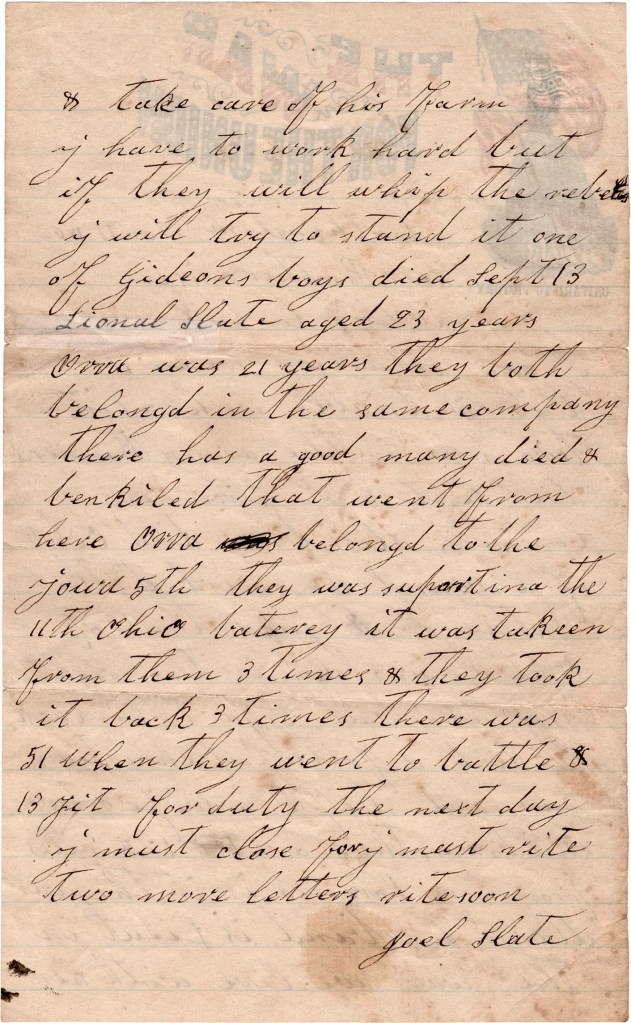
I sit down to inform you of our situation. We are well but in trouble. We have lost two sons in the army. Bernard died September 15th of fever near Corinth, Mississippi. Orra died October 5th of a wound he received at the Battle of Iuka the 19th of September. He was shot in the right lung. The ball lodged in his back. He died a faithful Christian. Bernard left a wife & two children. They are 125 miles from here.
Lorenzo is in the war. Mary’s husband [William H. Gore] is Lieutenant in the war. We live here and take care of his farm. I have to work hard but if they will whip the rebels, I will try to stand it. One of Gideon’s boys died September 13th—Lionel Slate, aged 23 years.
Orra was 21 years. They both belonged in the same company. There has a good many died and been killed that went from here. Orra belonged to the Iowa 5th. They was supporting the 11th Ohio Battery. It was taken from them three times and they took it back three times. There was 51 when they went to battle & 13 fit for duty the next day. 1
I must close for I must write two more letters. Write soon. — Joel Slate
Cyrus Miner, Co. K, 5th Iowa Infantry (John Wernick Collection)
The following letter was written by Cyrus Miner (1822-1888) of Co. K, 5th Iowa infantry who enlisted as a musician (drummer) on 15 July 1861. He wrote the letter to his wife, Sarah (Fay) Miner (1822-1889) and his four children. In the 1860 US Census, Cyrus and his family were enumerated in Linton, Allamakee county, Iowa, where Cyrus was employed as a carpenter. Ten years earlier, the family resided in Jones county, Iowa.
Cyrus began his service in Co. K but was later transferred to the regimental band and then transferred out on 1 October 1864.
The letter is particularly noteworthy for its great description of Camp Warren which was located outside of Burlington, Iowa, in July 1861. It’s comparable to another letter by William Codling, a private in Co. E of the 5th Iowa who wrote to his friend ten days earlier saying that Camp Warren was “on the Burlington Fairground two miles from town. There we are about 2300 men of us penned up on about thirty acres of ground with a high board fence and guarded on all ends and sides. We are allowed to go to town to the river twice a week to bathe but then under the command of an officer.” [See William Codling]
[Note: This letter is from the personal collection of John Wernick and was transcribed and published on Spared & Shared by express consent. He also owns the image of Cyrus Miner.]
Transcription
Camp Warren July 28, 1861
Dear Wife and Children,
It is with pleasure that I take my pen in hand to write a few lines to you. I am well and hope these few lines will find you blessed with the same blessing.
Our trip down the river was without any accident. There was 6 companies on board before we got to Burlington, about 500 in all, besides the boat’s crew.
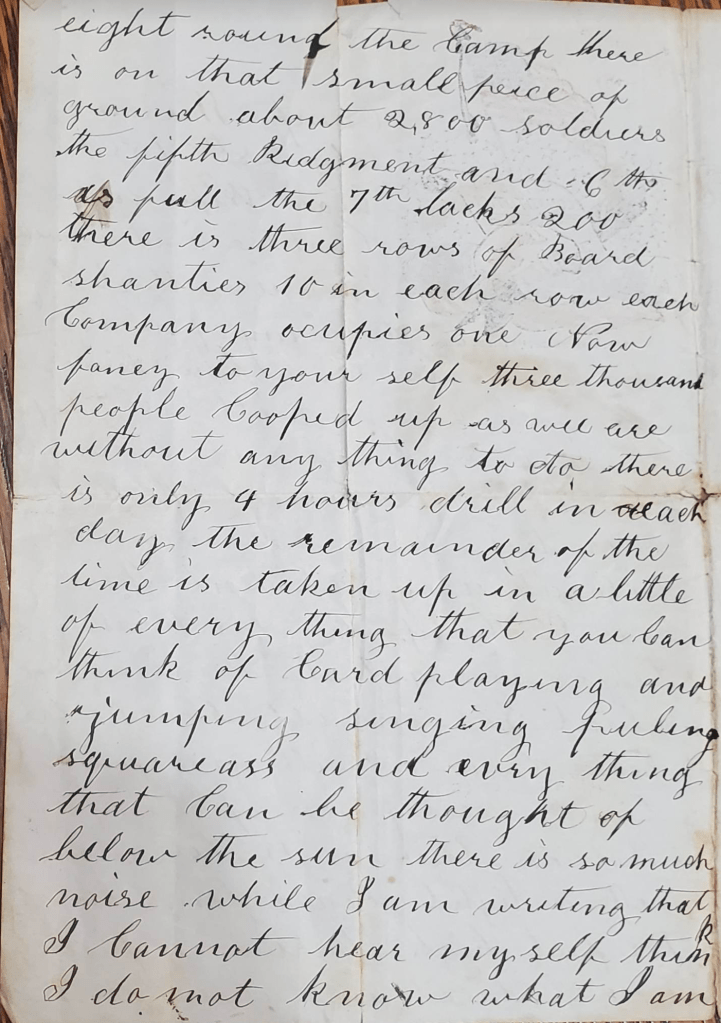
I will give you a faint description of Camp Warren. There is 15 acres enclosed with a tight board fence about 7 and and half feet high. There is picket guard placed one about every eight round the camp. There is on that small piece of ground 2800 soldiers. The 5th Regiment and 6th are full. The 7th lacks 200. There is three rows of board shanties, 10 in each row. Each company occupies one.
Now, fancy to yourself three thousand people copped up as we are without anything to do. There is only four hours drill in each day. The remainder of the time is taken up in a little of everything that you can think of—card playing and jumping, singing, pulling squares, and everything that can be thought of below the sun. There is so much noise while I am writing that I cannot hear myself think. I do not know what I am writing or what I want to write. Damn the confusion.
Now a little about our grub. Each man is entitled to 18 ounces of bread, 20 ounces of beef, or 12 of pork, 2 ounces of coffee, 2 ounces sugar, salt and vinegar. Pepper as much as we want to use per day. No potatoes yet.
There is some sickness in the camp but not as much as I expected. There is only about 20 out of 2800—that is, 20 in the hospital, but there is one half in camp got the shits. I am blessed. I never felt better. I beat reveille 5 in the morning, retreat at sunset, tattoo at 9 in the evening. The taps at 9:30. Then every candle is blown out. Then everyone that is out after that is walked off to the guard house and kept there until morning. Then they are put on guard the next 24 hours or put to cleaning out the quarters or some mean work such as cleaning back house. There is no use in getting under guard.
It is two weeks today since we got in camp and I have not missed one call. I can go out every day after guard mounting—that is a nine in the morning. Then I have nothing to do until sundown. Farewell for this time. Direct to Camp Warren, Burlington, Iowa
I could not find an image of Robert McClenahan but here is one of Jerome Hollenbeck who served in Co. K, 5th Iowa Infantry, loaded down for a tramp. (Iowa Civil War Images)
The following three letters addressed to “Isabella” were only signed by her brother “Robert” but I was able to eventually attribute them to Robert McClenahan (1840-1883)of Co. F, 5th Iowa Infantry. Robert was born in Stark county, Illinois, the son of Elijah McClenahan (1811-1886) and Sarah Elizabeth Emery (1815-1855). After his mother died in 1855, his father married Elizabeth Wilson (1831-1911). Both letters were addressed to his younger sister Isabella (1846-1921) who married Silas Webster Reynolds (1840-1898) in 1867. The McClenahan family relocated from Illinois to Iowa in 1854.
According to his obituary, Robert was working on his father’s farm until he enlisted in the 5th Iowa Infantry in July 1861. His service included the battles of New Madrid & Island # 10, Siege of Corinth (Apr 2-May 30,1862), and the Battle of Iuka on 19 September 1862 where regiment won high honors by holding its ground against four times its numbers, making 3 charges with bayonet when all ammunition was exhausted. Out of 480 engaged, the 5th lost 220 killed and wounded. It was during the Battle of Iuka that Robert was severely wounded in the shoulder and was discharged for disability on 2 October 1862 at Jackson, Mississippi.
After returning home from the war, Robert found employment in Sigourney as a marble cutter until he married Matilda Hoover (1840-1910) in 1868. Not long after, he was appointed the postmaster of Sigourney and served in that capacity for 14 years until his death in 1883. Like so any veterans of the Civil War, Robert committed suicide by shooting himself in the head with a pistol.
A key to learning Robert’s identity was the mention in both letters of “Seth” who I correctly deduced was his brother-in-law. Seth Enos Hall (1831-1914) was married to Sarah J. McClenahan (1838-1914) shortly after the family’s arrival in Iowa in 1854. Seth entered the service as a sergeant in Co. F, 8th Iowa Infantry, and mustered out as a 1st Sergeant in April 1865. After the war, he returned to his mercantile business in Sigourney.
Letter 1
The patriotic stationery of Robert’s first letter
Syracuse [Missouri] November 19, 1861
Dear Sister Isabella,
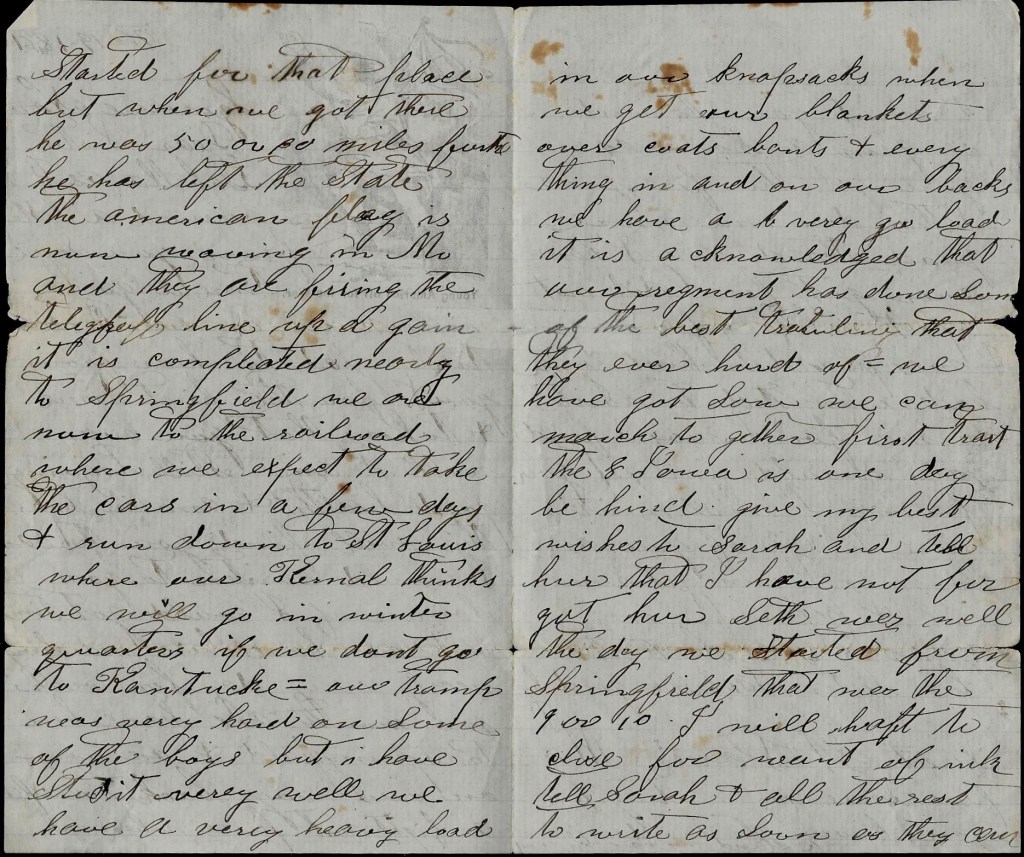
I received a letter from you some time ago. I will now answer. I was truly glad to hear from you for the first time & to hear that you was well. I am still enjoying hood health & am in hopes this will find you the same. I would [have] written to you sooner if I could [have] got time but we have been marching nearly every day for over one month. We have been to Springfield & we now on our way way. We expected a fight with Price when we started for that place, but when we got there, he was 50 or 60 miles further. He has left the State. The American flag is now waving in Missouri and they are fixing the telegraph line up again. It is completed nearly to Springfield. We are now to the railroad where we expect to take the cars in a few days & run down to St. Louis where our colonel thinks we will go in[to] winter quarters if we don’t go to Kentucky.
Ezekiel Silas Sampson served as the Captain of Co. F, 5th Iowa Infantry until 23 May 1862 when he was promoted to Lt. Colonel. (Iowa Civil War Images)
Our tramp was very hard on some of the boys but I have stood it very well. We have a very heavy load in our knapsacks. When we get our blankets, overcoats, boots, & everything in and on our backs, we have a very good load. It is acknowledged that our regiment has done some of the best traveling that they ever heard of. We have got so we can march together first rate. The 8th Iowa is one day behind.
Give my best wishes to Sarah [J. (McLanahan) Hall] and tell her that I have not forgot her. [Her husband,] Seth [Enos Hall was well the day we started from Springfield. That was the 9th or 10th. I will have to close for want of ink. Tell Sarah and all the rest to write as soon as they can. I want you to write again as soon as you get this for your letter done me more good than any I have ever got for I did not expect a letter from you. I was pleased to think you had attempted to write to me for I was a feared you would for get your promise. I will write more to all of you as soon as I can get some ink & paper.
From your brother Robert
To his sister, Isabella. Goodbye.
Direct to St. Louis, Mo. Please excuse my writing for you know the kind of a stand we have in camp.
Letter 2
[Note: This letter is from the personal collection of Greg Herr and was transcribed and published on Spared & Shared by express consent.]
Syracuse, Missouri December 1, 1861
Dear Sister Isabella,
I must write and let you know that I just received yours and father’s letter of November 25th. I was truly glad to hear from you both but was very sorry to hear that father had the rheumatism. But I am in hopes will be better soon. Tell him the I would liked to been there to help him gather his corn. But that privilege was not granted. But I consider that I was absent in na good cause, for our government must be preserved although it costs blood.
I am still well and enjoying myself well. I got a letter from James yesterday. He is well. They are in Benton Barracks at St. Louis. We are still camped close to Syracuse. I can get a letter from James every day. The cars run up and down daily. I haven’t heard from Seth lately. They are about 20 miles above here at the end of the railroad. We have 5 large Fremont tents to the company where we are very comfortable. we build a fireplace of mud where we sit around & joke and laugh and enjoy ourselves very ell. But after all this, I never lay down at night but what I think of home & how I would like to see you all. I feel in hopes I will be spared to see you all once more. I feel in hopes we will go down to St. Louis so I can get James in here with me.
It is very cold and disagreeable & very windy so I won’t write much this time. The paymaster came in today. I will answer gather’s letter soon. Tell him that I would like for him to send me some postage stamps for there is such a call for them here, it is impossible to get them and we have to pay the postage 5 cents every time. Please write soon. — Robert
[added in pencil]
Father, there have been a great many letters that I have written you that you have never got. I won’t send you any money until I hear from you again. I have just received your letter of October 30th. The boys are very busy shoveling the snow from around our tents. We will close up & have a snow ball [fight] after we get through. We have learned how to flank on them. — Robert McClenahan
Letter 3
Halleck’s Army on the march to Corinth, Mississippi, May 1862
Camp near Corinth, Mississippi May 7th 1862
Dear sister Isabella,
I received your very kind and welcome letter of April 27th about two hours ago and was most assuredly glad to hear from you & to hear that you was all well. My health is still good & I hope the few lines that I write will find you all well. I haven’t saw James nor Seth for over one week. I suppose we are 6 or 7 miles apart. We have moved our camp 2 or 3 times since I wrote the 29th. We moved 4 miles today. We are now [with]in 8 miles of Corinth. We are going way around on the extreme right which makes it much further.
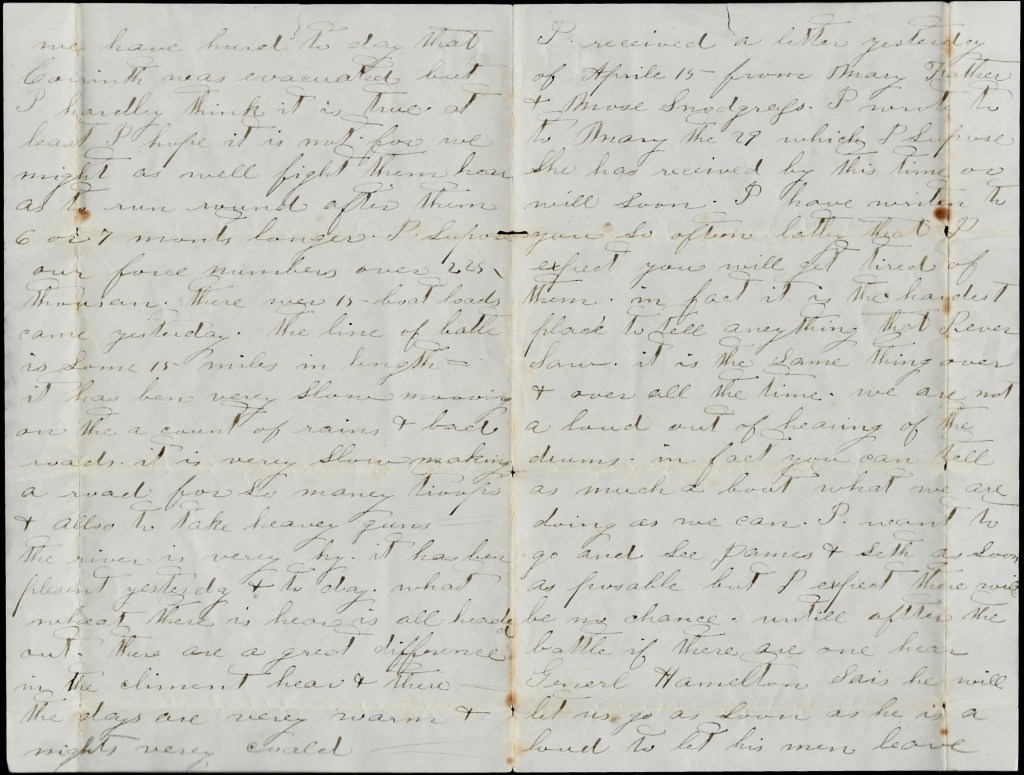
We have heard today that Corinth was evacuated but I hardly think it is true—at least I hope it is not for we might as well fight them here as to run round after them 6 or 7 months longer. I suppose our force numbers over 225 [120] thousand. There were 15 boat loads came yesterday. The line of battle is some 15 miles in length. It has been very slow moving on the account of rains & bad roads. It is very slow making a road for so many troops and also to take heavy guns. The river is very high. It has been pleasant yesterday & today. What wheat there is here is all headed out. There are a great difference in the climate here and there. The days are very warm & nights very cold.
I received a letter yesterday of April 15th from Mary, Father, & Mose Snodgrass. I wrote to Mary the 29th which I suppose she has received by this tie or will soon. I have written to you so often lately that I expect you will get tired of them. In fact, it is the hardest place to tell anything that I ever saw. It is the same thing over & over all the time. We are not allowed out of hearing of the drums. In fact, you can tell as much about what we are doing as we can.
Brig. General Schuyler Hamilton—“a kind an affectionate man to his men”
I want to go and see James & Seth as soon as possible but I expect there will be no chance until after the battle if there are one here. [Brigadier] General [Schuyler] Hamilton says he will let us go as soon as he is allowed to let his men leave. General Hamilton is a kind and affectionate man to his men as I ever saw.
It is now nearly sundown. We are on a very nice knoll. Our wagons haven’t come up yet and it’s likely they will not be up tonight as the train is so long & roads so bad that it is impossible. The health of the company is good at present. I will write to some of you about once a week if it is but to tell you that I am well. I will give the postage stamp you sent a chance to travel the road again. The reason I put a stamp on the letter, Rayburn wasn’t certain that he would go home & if he did not, he allowed to mail it for me. I had a chance to get postage stamps enough to do me some time as we came past Cairo.
I close with my best wishes to Father, Mother, and all. the rest. Goodbye from your affectionate brother, — Robert
To his remembered sister Isabella. Write soon. Direct as before.









 Spared & Shared 23