
The following letters were written by Luther Hurd (1842-1881) who first served in Co. H of the 16th Maine Infantry from August 1862 until shortly after he was wounded at the Battle of Fredericksburg, after which he returned to his home in Sanford, Maine. He wrote these letters during the 100 days service he signed up for with the 5th Massachusetts Volunteer Militia in the summer of 1864. The regiment left the state for Baltimore on 28 July 1864 and were assigned to garrison Forts McHenry, Marshall, Carroll, and other points in and around the Baltimore Harbor. They mustered out in early November 1864.
Luther was the son of Deacon James Hurd (1796-1876) and Abigail Wadilla (1798-1848) of Sanford, York county, Maine. He wrote the letter to his older sister, Adeline (“Addie”) M. Hurd (1834-1911) who married Samuel C. Marshall (1818-1903) and had a 3 year-old daughter named Emma L. Marshall (“Little Emma”) mentioned in this letter. He does not mention him but Luther also had a brother named Bradford A. Hurd (1832-1863) who served in Co. B, 4th New Hampshire Infantry. Bradford was mortally wounded by an enemy shell on Folly Island in June 1863. See 1861: Bradford A. Hurd to Luther Hurd.
Letter 1
Fort Marshall, Baltimore, Maryland
August 29, 1864
From this southern clime my thoughts wend their way to my dear New England home where fancy pictures to my mind the many dear & kind friends whom I have left far, far behind me. Many is the time that I turn my weary eye to you eastern sky where the loved ones are, and my mind wanders over hill and dale to your pleasant home. Then it seems to me that I am nearer to you than at any other time. I love to think on the past as I bring to my mind the many happy hours I have spent with my brothers and sisters, now dearer to me than ever. The days of my soldiering will quickly pass away. Already one month has slipped by. A little more than two months more & you will see me wending my way back again to the North.
I do not wish to go home until them for we are so pleasantly situated here that it would be silly to even think of such a thing. We are still in the same place that we were when I last wrote you. I will give you a description of this place as I cannot think of anything else to write, which will be of interest to you.

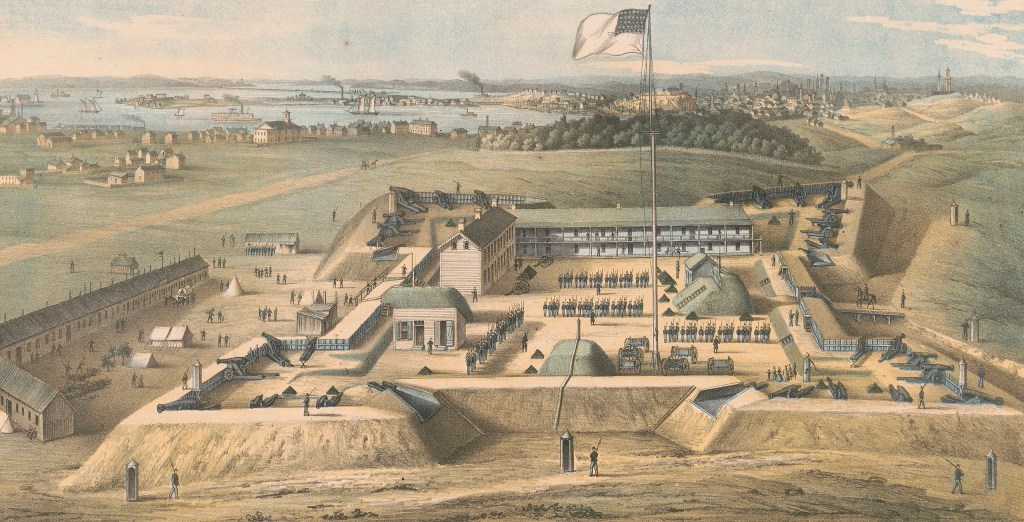
Fort Marshall is situated on a high elevation of ground one mile from & overlooking the City of Baltimore. The city lies to the west of us, while to the north and east are seen beautiful farms and farm houses. Little white cottages rise up in the distance. The landscape is intersected here and there with beautiful trees. To the south, no less beautiful, runs the Patapsco River at the mouth of which stands Fort McHenry, plain to view. The whole scenery around is very beautiful.
The fort is built of dirt thrown up very high. On the parapets are mounted some 35 large guns which will sweep the country for miles around. The place is very strong. It would take a very large force to capture it. It was built by the 7th Maine Regiment some two years since. For that reason, it seems dearer to me. I feel proud of the old Pine Tree State. Her sons have fought gallantly during this rebellion. Within the fort are two long, two-story buildings, The first is used by us as barracks to sleep in. The upper story is occupied by the two companies that came here with us while the lower part of the building is occupied by our company & three cook rooms. The bunks that we sleep in are placed up against the wall like the berths in the cabin of a steamboat. They are very nice. I tell you, it seems homelike to have a good house to live in. Much better than those tents.
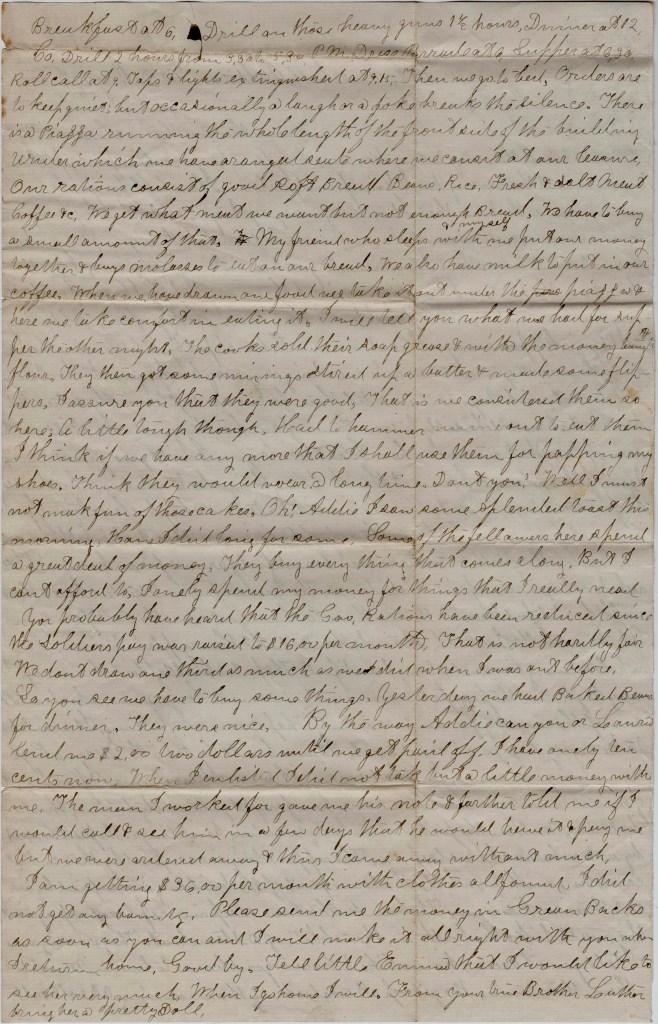
We get up at 5 o’clock in the morning at roll call, breakfast at 6, drill on those heavy guns one and a half hours, dinner at 12, company drill two hours from 3:30 to 5:30 p.m., Dress Parade at 6, supper at 6:30, roll call at 9, Taps & lights extinguished at 9:15. Then we go to bed. Orders are to keep quiet but occasionally a laugh or a joke breaks the silence. There is a piazza running the whole length of the front side of the building under which we have arranged seats where we can sit at our leisure.
Our rations consist of government soft bread, beans, rice, fresh & salt meat, coffee, &c. We get what meat we want but not enough bread. We have to buy a small amount of that. My friend—who sleeps with me—and myself put our money together and buy molasses to eat on our bread. We also have milk to put in our coffee. When we have drawn our food, we take it out under the piazza & here we take comfort in eating it. I will tell you what we had for supper the other night. The cooks sold their soup grease & with the money bought flour. They then got some [ ], stirred up a batter and made some flippers. I assure you that they were good—that is, we considered them so here. A little tough though. Had to hammer mine out to cut them. I think if we have any more that I shall use them for popping my shoes. Think they would wear a long time, don’t you? Well I must not make fun of those cakes.
Oh! Addie, I saw some splendid toast this morning. How I did long for some. Some of the fellows here spend a great deal of money. They buy everything that comes along. But I can’t afford to. I only spend my money for things that I really need. You probably have heard that the government rations have been reduced since the soldiers pay was raised to $16 per month. That is not hardly fair. We don’t draw one third as much as we did when I was out before. So you see we have to buy some things. Yesterday we had baked beans for dinner. They were nice.
By the way, Addie, can you or Laura lend me $2 until we get paid off? I have only ten cents now. When I enlisted I did not take but a little money with me. The man I worked for gave me his note & further told me if I would call and see him in a few days that he would have it & pay me but we were ordered away & thus I came away without much. I am getting $36 per month with clothes all found. I did not get any bounty. Please send me the money in green backs as soon as you can and I will make it all right with you when I return home. Goodbye. Tell little Emma that I would like to see her very much. When I go home, I will bring her a pretty doll. From your brother, — Luther
Direct to Luther Hurd, Co. B, 5th Regt. Massachusetts Vol. Militia, Fort Marshall, Baltimore, MD

Letter 2
Fort Marshall, Baltimore, Maryland
September 6th 1864
My dear Sister,
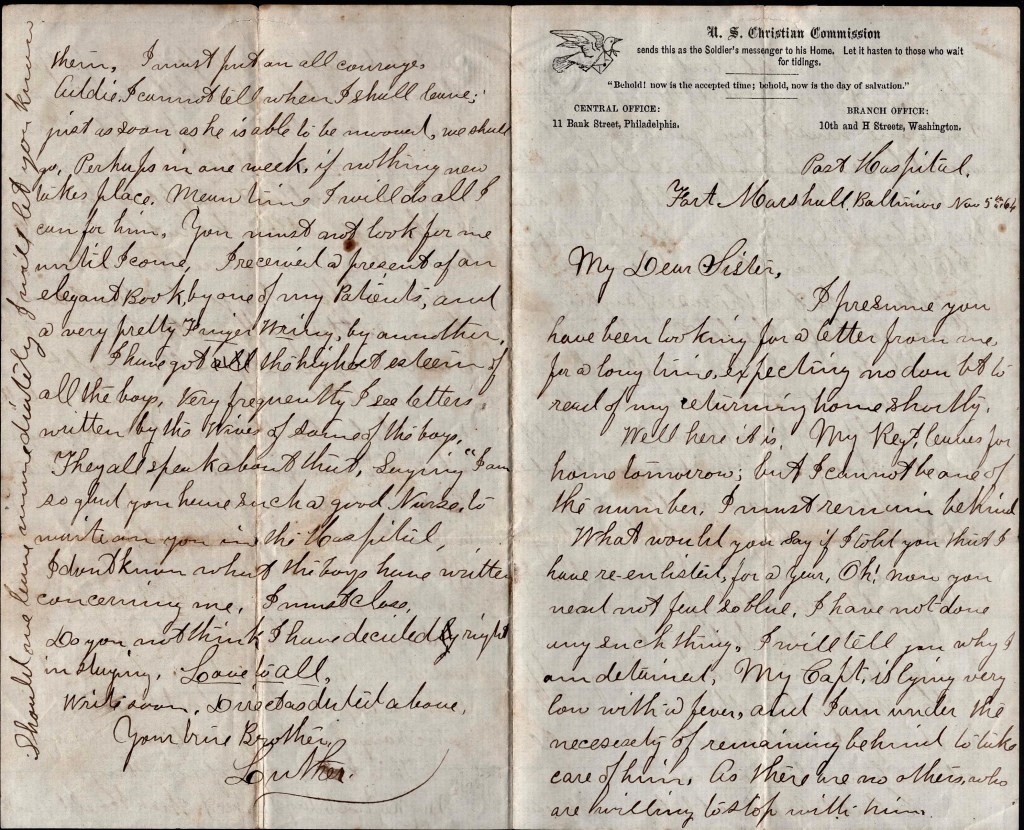
I received your kind letter yesterday afternoon; also the money that you sent me. Was very thankful that you sent it. I was entirely out of money. You could not have sent it in a better time. The officers say that we shall be paid off by the 15th of this month. I guess the boys will be glad of their pay, for a great many of them have not a cent. The most part of our boys in the company have parents who are wealthy and they have always had a good supply of spending money, and I tell you it comes rather hard on them to go around with minus gold in their pockets. But when I get any money, I generally am pretty saving of it and don’t purchase anything unless I really need it.
We are still in the same old fort. Nothing of any great importance has transpired since I last wrote you. Things remain the same as day after day rolls away. We are getting a little tired and lonesome here with no excitement going on. A few weeks have passed away very pleasantly because the place was new to us; but now it has got to be an old story. Still it is a good place for us—we are so comfortably situated and we would prefer to remain here unless the officers could place us in a fort where there are accommodations as good as these.
I told you that the scenery around is beautiful. Well it is. From the fort we can see the green fields and pleasant farm houses. We see the lofty trees, the distant hills and vales; but we are not allowed to go outside the fortifications because there is a guard to prevent us. If this was not the case, our curiosities would be likely to lead us out into the open fields and we should spend many pleasant hours traversing the country around. But you know there are some who if they once got this liberty would go around to the different farm yards and rob hen roosts and anything else that they might chance to lay their hands on. So you see that they have to be strict with us.
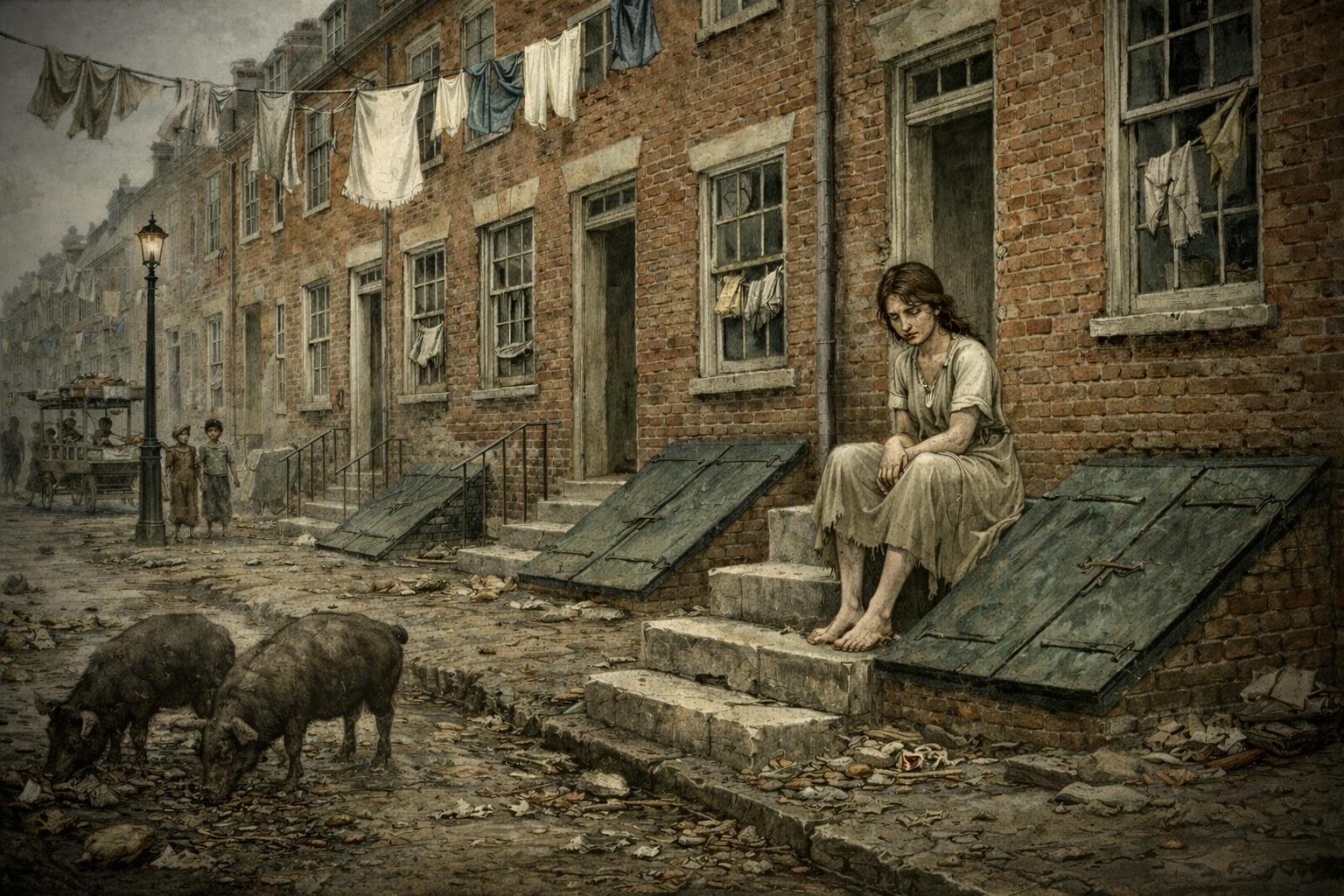
We occasionally go down to the river to bathe a short distance off and on our way pass through the village of Canton—a place noted for its hogs, dirty women and children. There I have seen some of the dirtiest, filthiest looking women that I ever saw. In passing along, every now and then, you will run against a hog. You will find a plenty of them running in the streets and other public places. What would you say to see women, barefooted and ragged, sitting down on the door steps with their feet as black as the stove? Would you not be tempted to throw a pail of water on them? People here are very different from the New Englanders. I have not seen a pretty girl since I have been out here, so you need not be afraid of my bring[ing] home a Southern bride. I think I should prefer one from the North.
We had a little excitement in the fort a few nights since. When the rebels are coming, they immediately give the alarm to the different forts around by throwing up sky rockets. This night in particular I was on guard when we saw quite a number of these. These were succeeded by the firing of guns. Then the soldiers all gathered up on the parapets to watch for the rebs whom they thought were coming. A squad of soldiers were sent out to ascertain what was in the wind. They soon returned stating that the firing proceeded from a drunken row down in Canton. I did not feel any alarm for I had seen too much to get scared at such a little thing as that.
Well, Addie, I congratulate you with your little treasure (your little son). Hope the frail bud will be free from sickness. I presume you feel very proud of him. I like the name you have given him very much. I think it is very pretty. Have you given him a middle name? If not, I would like to give him one. No doubt Emma is very proud of her little baby brother. Yesterday it was cloudy all day. At night, it set in dark and stormy, wind blowing a gale from northeast. It rained hard all night. The boys were very thankful that we were in such good quarters. We all slept warm and comfortable except those who were on guard. They did not fare very well. Got some wet. Thank Providence it was not my lot to be on guard on such a rainy night. Today we do not have any drill so we, or rather the rest of the boys, are fixing up the barracks. Some panes of glass have gone out of the windows and they are repairing them. Others are looking after stoves to place in the room. It is a gloomy day without, and a little lonely inside. I would like to be in your city sitting room today and have a nice dinner of meat, potatoes, and a good apple pudding. But I must close. Please send me a paper now and then. I want to hear the news. Your respected brother, — Luther


 Spared & Shared 23