
The following letters were written by a semi-literate English emigrant named Samual Durant (1819-1862) who enlisted at Fulton, Oswego county, New York, on 13 September 1861 as a private in Co. C, 81st New York Infantry. He was transferred to Co. G on 6 February 1862. He died of chronic diarrhea on 20 September 1862 at Philadelphia. He’s buried in the National Cemetery at Philadelphia, Section B, Site 406.
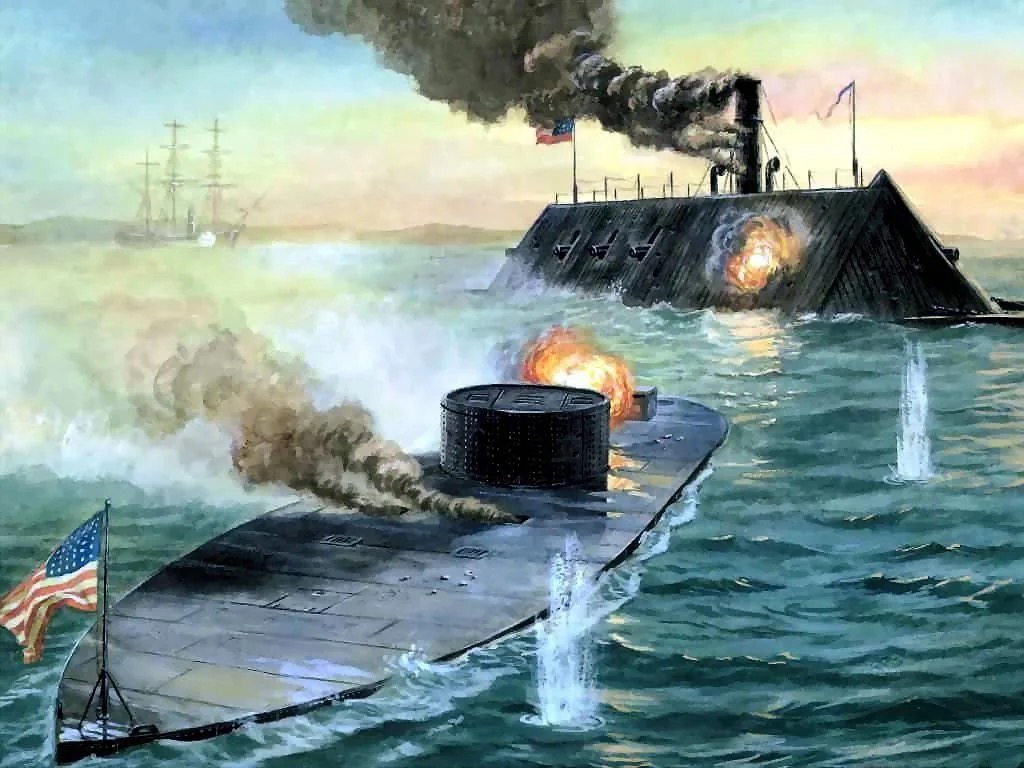
On the 21st of February the regiment was ordered to New York City, and then proceeded on the 5th of March to Washington, D. C. There the men remained in camp twenty days, and on the 28th of March, marched to Alexandria Va., where they embarked for Fortress Monroe, arriving on the 1st of April—just three weeks after the famous battle between the ironclads that captured the imagination of the public. Samuel’s description of the USS Monitor is classic: “She looks like a mud turtle with a barrel on his back. I can’t see nothing but her hump stick up out of the water. She is wicked. They are all afraid of her…”
From their landing at Newport News until May 31st the regiment was on the march or in camp, acting as reserve at the battle of Williamsburg Va., and reaching Seven Pines on the 28th, where they remained until the bloody engagement of the 31st was fought. In this battle the 81st was assigned to the left of Casey’s Division, unsupported in an open field. The regiment here underwent its baptism of fire and stood the ordeal heroically.
To read letters by other members of the 81st New York Infantry that I’ve transcribed and published on Spared & Shared, see: Horace Benjamin Ensworth, Co. B, 81st New York (1 Letter); Horace Benjamin Ensworth, Co. B, 81st New York (4 Letters); Marshall S. Moses, Co. E, 81st New York (1 Letter); Franklin Darius Sizer, Co. I, 81st New York (1 Letter); and
Dexter Samson, Co. K, 81st New York (1 Letter).
Letter 1
Headquarters, Camp Dutton
81st Regiment, Company G, NYV.
April 14, 1862
Dear daughter,
I take [this] opportunity to write to you. [I] take it from Albany. We march in the night to New York by railway in the morning & daylight. Laid there two days, then went on to Staten Island. Laid there 8 days, then [at] 4 o’clock in the afternoon, took a boat 25 miles and then took railway to the Delaware river, crossed that and a steamer to Philadelphia and a loyal place that was too. [The] saloon was a Cooper’s Shop. It was so large that we had a 11 hundred men all eat at one long table and we had everything the good. All regiments [that] pass through [Philadelphia] is fed by the corporation and all took pleasant good talk to boys.
Away we go for Baltimore and a fine country it was too, houses and other buildings painted white. The grass by the side of the road was on fire more than a 100 times. We come to a place called Mule City by ingen [?] I should think. They said there was 14 hundred mules and such—a sight you never saw, Great homely wagons, 6 mules make a team, one line on the leader and a saddle on the pull mull. The man sits this [ ] and [ ] is all I can make out. I tell you, he looked like a monkey on a hand organ. I wish you uncle James Harmon was here to see them. I tell you, we would have a laugh about it. I saw a team run away across the corn stubble. The wagon went bump, bump, bump. The boys all a laughing.
I have been down to the river and saw the Cumberland lay there sunk by the Merrimack. She is a iron-cladded rebel steamer. We have got the Monitor up there and she looks like a mud turtle with a barrel on his back. I can’t see nothing but her hump stick up out of the water. She is wicked. They are all afraid of her and [ ] battery that go by steam and [ ] chisels. And then we have got the Vanderbilt. If they attack us now they will smell powder. They keep playing round. I saw where they had two cut one [ ] off, killed two men and never touched them—the air knocked them dead. We had 11,000 men in one Division. I tell you, that made a show, and there was five thousand at that camp [which] is called Newport News.
All round us the fences are all burnt. I saw a wheat stubble and stacks of wheat knocked down, corn stubble and stalks and stacks of corn stalks but this is the pleasantest country I ever saw in my life. It is a good country for grain and potatoes. We [ ] cows nor hogs. We have two darkies follow us from [ ]. We keep them along with us. They cut wood, carry water. They are smart. We have tents now. The boys [ ] then about 3 miles and [ ]. I got up at light and take a black brand [?], named it Fort Spencer, Harpers ferry brew. Put on the Orderly….
Please send me particulars about your trade and where you [ ]. Excuse my writing and spelling. I must close my letter. Give my love to all my friends. I remain yours, — Samuel Durant


Letter 2
May 11th 1862
Dear daughter,
I take the pleasure to write to you to let you know I got back to my regiment last Saturday. I was very tired. The fever was leaving Robert on Saturday morning. I left him about 5 o’clock. I got to the regiment at 3 o’clock. The cannons was roaring all night. I didn’t sleep at all. The balloon went up in the night. They han’t got no light in camp so early.
The Sunday morning we started for the forts [at Yorktown], they had all left. As we were going along, I heard a report like a cannon. I thought [maybe] they was not gone, but when I got a little farther, I saw a man laying there badly wounded. There was one killed and 7 badly wounded. They had buried bomb shells in the road and all along where they thought we would go. As soon as you touch one of them, off they go. I say, “G. Van Pattan, what’s the matter?” [He said,” “see them shells buried, mind you [don’t] step on them. We had to be very careful.
Well, we traveled all day through forts and rifle pits until night and then laid down until 3 o’clock and then went back 8 miles in the rain. It rained all day and about all night. I was wet to my skin and my coat was so wet that I could barely carry it. I had to go in the dar, to a tree, chop some wood to be warm. There was firing all day just ahead of us. In the morning we marched round to get on the east side of them but they was just one day too fast. They had to fight like the devil to win. They did fight too, I tell you.
McClellan was up in the balloon. He see the Louisiana tigers come out of the woods put down the balloon. Our army is whipped. When he got there they had [ ] them all to pieces. The officer gave up his sword and said you have whipped the best regiment in the Confederate army. It is a very large field, I should think 1,000 acres. I should think and a 100 acres of wheat and corn. I don’t know but their five forts, ditches round 15 feet deep they got in there. Our boys got on one shoulder and the gun in the other hand and away they run, throwed the rails across the ditch [and] over they went [ ] them out. They took some prisoners but how many I don’t know. I saw 150 wounded rebels in one barn & shed. The doctors cutting off legs and arms, some screaming all night. That was on Wednesday night. I couldn’t sleep.
Next morning I got up and went off to south and west of the field. I come to a [ ] and then I come to a horse shot down, three or four in a mud hole with the harnesses on. They was the muddiest lot of horses and men I ever saw in my life. I saw the Michigan 5th, I think it was, all shot to pieces and bayonet[ed]. They was too fast. Had their knapsacks on all in the rain and mud. They was all muddy. 1
I just now read your letter. I felt glad to hear from you. I heard from Robert just before. He is better. I wish we get our pay so he could have some to get some things. I left all I could spared with Ed and I tell you that we are to march on the road to Richmond. They are not far ahead of us. Our boys are dragging [?] out all the time. We can’t get half enough to eat. The teams can’t get along with it. I would rather have seen wheat. I have seen the last 500 dollars but I have seen hard times. I received a letter from E. Carrier. He has received 35 dollars. From S. Durant
1 “The next major battle that the Fifth Michigan took part in was the battle of Williamsburg. The Union general wanted to attack the center of the Confederate line, which was heavily fortified by Fort Magruder. This proved to be too much for them and they were forced to turn back. This gave the Confederates a clear advantage and they decided to do a countercharge. The Confederates were able to capture a Union battery and fire upon the retreating Union soldiers. This is where the “Fighting Fifth” first earned its nickname. Once the Fifth saw what was happening, they fired upon the Confederates at the Union battery, then charged them. This shocked the rebels, resulting in them fleeing the battery. After which the Fifth started taking fire and many casualties from Confederates. To overcome this, another charge was called for, and the Fifth ended up in the rebel trenches, taking prisoners and displacing the Confederates. If it was not for their valor, the outcome of the battle would have been very different. It is reported that after the second charge they held their position for six or seven waves of attacks, incurring up to fifty percent casualties. This is the reason why the Fighting Fifth is such a notable regiment. Within their first battle, they showed gallantry and guts to overtake the Confederates with not only one, but two charges against the odds. Not only did they prove themselves at Williamsburg, but they did so too during other battles as well.” [See The 5th Michigan Volunteer Infantry Regiment during the Civil War.]


 Spared & Shared 23