Category Archives: 5th New Hampshire Infantry

1862: Adin V. Cole to his Parents

The following letter was written by Adin V. Cole (1844-1862), the son of Kimball Cole (1810-1902) and Mary Stockwell (1819-1909) of Whitefield, Coos county, New Hampshire. He mentions a younger brother, Martin Marshall Cole (1849-1925) in the letter.

Anxious to fight for the Union, Adin enlisted when he was 18 in Co. C, 5th New Hampshire Infantry on 26 September 1861, but did not live long enough to see his first battle. He died on 8 March 1862—just two month after this letter was penned. He lies buried in the US Soldiers’ and Airmen’s Home National Cemetery in Washington D. C. (Site B 2031)

The author has placed a black arrow in the general area where Camp California was located.  The map is an 1861 map of the Defenses of Washington reprinted in the “Atlas to Accompany The Official Records of the Union and confederate Armies.”  Camp California was under the shelter of nearby Fort Worth (misspelled as Ft Wohth on this map).  Referring to Fort Worth, one Irish Brigade soldier wrote home that “in our front there is a very strong fort that would send very destructive messengers to any approaching enemy if they were to come within range of its long and heavy guns.”  General Sumner reportedly camped in a Sibley tent near Mr. Watkins’ home. [Source: Civil War Washington D. C.]

T R A N S C R I P T I O N

Camp California
January 5th 1862

Dear Parents,

I now answer your letter which I received last Thursday and was very glad to hear from you for it had been three weeks almost since I had heard from you. There is about an inch of snow on the ground this morning but it won’t stay long for it is coming off warm. I went out to drill this morning and I felt a little sick so I went to the Captain and asked him if he would excuse me and he said yes. It is the first time I have been excused from duty since my ankle got well. It has got so well that I can’t tell where it was hurt. It is as sound as the other now.

I will now answer some of your questions. First, about Oscar, tell Mr. Huntoon’s folks that he is doing first rate and is faithful to his duty. He has to be or else he must look out for himself. The best way is to be faithful and do your duty in good earnest and you will get along well enough. I have not had one bit of trouble with an officer nor anyone else since I enlisted, nor I don’t mean to have.

Ezra is getting along nicely. He does not have any trouble at all. His Captain like him first rate and as long as he keeps on the right side of his Captain, he will get along well enough. Those boots—I lost one of them when we moved from Concord to Washington and the other is most worn out. I shall have to get me a new pair of pants. Lately they are made of good cloth and I guess they will wear well. The rest of our clothing is good yet.

We sleep warm nights for it is not very cold here yet. You wrote that if three was anything I wanted you would send it to me. I don’t want anything now but shall by and by. Tell Martin I shall write to him before long.

One of our men got three of his four fingers on his right hand shot off the other night while on guard. I guess you have heard it was two but it was three fingers. His name you have heard before this I presume. If you hain’t, you will before long. Write as soon as you get this and put on the time you wrote the letter before and then I can tell if I get them all.

I must close so goodbye. From your son, — Adin V. Cole

To K. & M. S. Cole

1864: Benjamin Howe to Edward Warner

The following letter was written by Canadian-born Benjamin Howe of Acworth, New Hampshire, who enlisted at the age of 24 in August 1862 to serve as a private in Co. E, 5th New Hampshire Infantry. He was transferred from Co. E to Co. H in December 1864 with his promotion to 1st Sergeant. The regiment served under the able leadership of Col. Edward E. Cross until he was cut down at Gettysburg. It sustained such considerable loses (over 1,000 men in killed and wounded) that it was only a shadow of its former self after the Battle of Gettysburg. Those that were left in the regiment were no longer a formidable fighting force and were assigned duty to guard prisoners at Point Lookout, Maryland until they could fill up their ranks once again.

This letter was written from Point Lookout and the rebels who were making the “curiosities” that Benjamin sent home to his friend were Confederate prisoners of war. The “niggers” as Benjamin called them whom he “knocked down” for sport were either contraband or, more likely, US Colored Troops (USCT) who were also on duty at Point Lookout serving as prison guards. Whether military or civilian, the blacks were sorely abused by the white soldiers of both the Union and Confederate armies.

Confederate POW’s laughing at a USCT soldier who accidentally killed his fellow sentry at Point Lookout, Maryland. This scene was one of many sketches made by Confederate POW Jack Omenhausser.

Transcription

Addressed to Mr. Edward Warner, Acworth, New Hampshire

Point Lookout, Maryland
January 31, 1864

Friend Ed,

I received your letter and was glad to hear that you was well and I am glad to hear that you are having a good time this winter.

Dan is well and just as wild as ever. He is getting to be a first rate bugler and a good fellow as a general thing himself.

You wanted me to send you some curiosities. Well, I have got two rings made and I will send them to you. The rebels made them and they make lots of funny things. If the rings suits you and you want any more curiosities, I will furnish you with pleasure. I will keep an eye out for them and get a good many things. Tell Frank if she would like a fan that the rebs made, I will send her one. They make some of the prettiest that I ever saw and they cut little bibles out of stone and color them and they look real nice, and they make tooth picks and most everything that you could imagine.

Well, Ed, as I am in a hurry, I will come to a halt. As for myself, I am well at present and enjoying myself as well as possible under the circumstances. I get lonesome sometimes and go out of camp and knock down three or four niggers and come back satisfied. Give my best pair of specks [respects] to all enquiring friends and vote Democrat ticket.

If you want any more things, I will have them by the time you will let me know. I have got a rebel 50 cents scrip and it is a genuine one in their country. I will send it to you. Well, Ed, goodbye. Write often and I will answer them promptly and with pleasure.

From your friend, — Corp. Benjamin Howe

Direct to Co. E, 5th New Hampshire Volunteers, Washington D. C.

1862: Daniel Wilson George to Edward Warner

The following letter was written by Daniel W. George (1843-1876), the son of Roswell and Julia George. He wrote the letter to his cousin, Edward Warner in Acworth, New Hampshire.

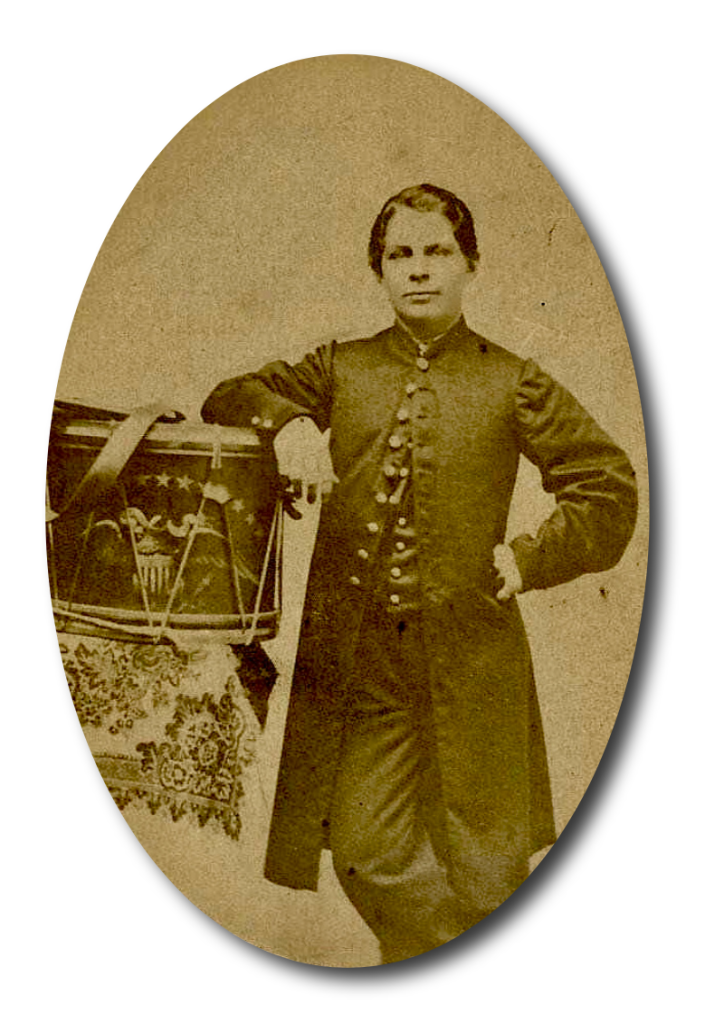
I could not find an image of Daniel but here is Joseph H. Whitehouse, a drummer boy who served in Co. D, 5th New Hampshire Infantry (Ancestry)

Daniel named Acworth as his birthplace at the time of his first enlistment as a private in Co, D, 1st New Hampshire Infantry on 24 May 1861. He mustered out three months later on 9 August 1861. Later, in September 1861, he reenlisted in Co. E, 5th New Hampshire Infantry, in which regiment he was serving at the time he wrote this letter from Falmouth, Virginia, just after the Battle of Fredericksburg in which they participated and suffered heavy casualties. Daniel survived the war, mustering out on 28 October 1864, and later (1867) married Sarah C. Russell in Ashburnham, Massachusetts.

The 5th New Hampshire, sometimes called “the Fighting Fifth,” sustained more battle deaths than any other regiment—nearly 300 killed or mortally wounded in their four years of service. They were ably led by Colonel Edward E. Cross until he was mortally wounded himself at Gettysburg. At the Battle of Fredericksburg, the regiment entered the fray on the heels of the Irish Brigade where they immediately fell under heavy fire of shell, grape and canister. When the Irish Brigade stumbled, the 5th continued their ascent on the enemy works but were also cut down. “My brave boys never faltered,” Col. Cross later wrote of the attack.

Transcription

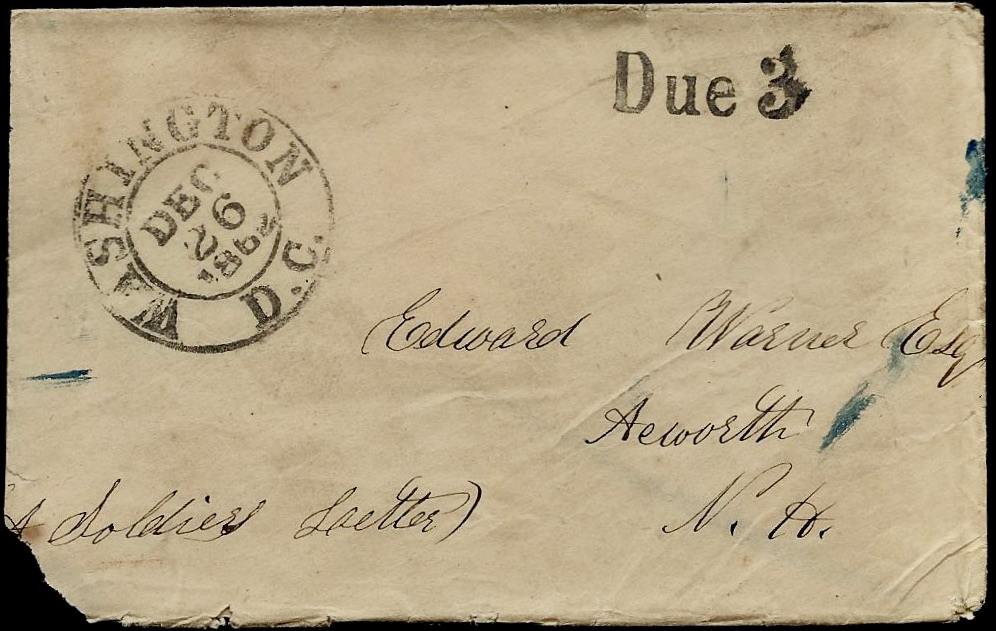
Addressed to Edward Warner, Esq., Acworth, New Hampshire

Camp near Falmouth, Va.
December 19, 1862

Dear Cousin,

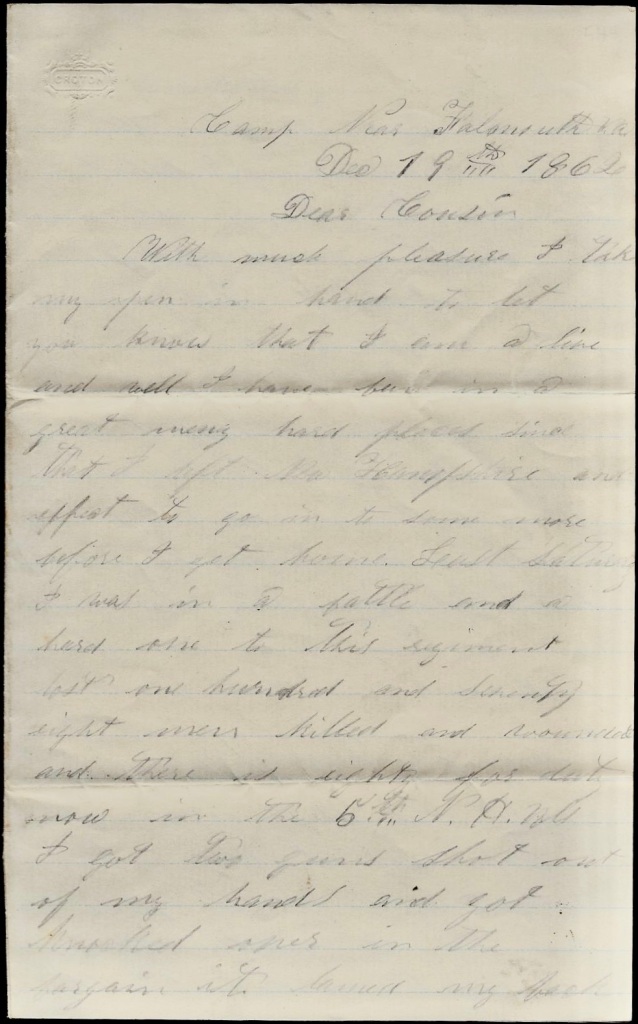
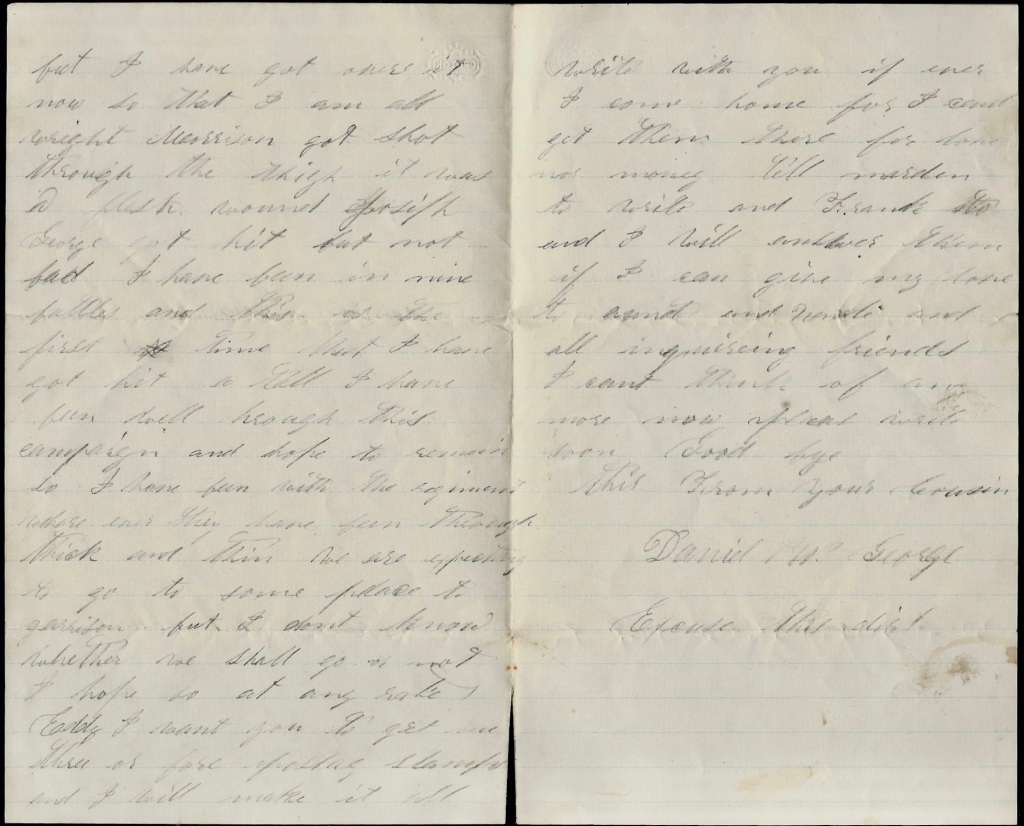
With much pleasure I take my pen in hand to let you know that I am alive and well. I have been in a great many hard places since that I left New Hampshire and expect to go into some more before I get home. Last Saturday I was in a battle and a hard one too. This regiment lost one hundred and seventy-eight men killed and wounded and there is eight for duty now in the 5th New Hampshire Vols. I got two guns shot out of my hands and got knocked over in the bargain, lamed my back but I have got over it now so that I am alright. Morrison [George] 1 got shot through the thigh. It was a flesh wound. Joseph George 2 got hit but not bad.

I have been in nine battles and this is the first time that I have got hit atall. I have been well through this campaign and hope to remain so. I have been with the regiment wherever they have been—through thick and thin.

We are expecting to go to some place to garrison but I don’t know whether we shall go or not. I hope so at any rate.

Eddy, I want you to get me three or four postage tamps and I will make it all right with you if ever I come home for I can’t get them here for love or money. Tell Marden to write and Frank too and I will answer them if I can. Give my love to Aunt and Uncle and all inquiring friends. I can’t think of any more now. Please write soon. Goodbye.

This from your cousin, — Daniel W. George

Excuse this dirt.


1 Morrison A. George was a resident of Acworth and served in Co. E, 5th New Hampshire Infantry. He was 21 when he enlisted in September 1861 and was wounded on 1 June 1862 at Fair Oaks, on 13 December 1862 at Fredericksburg, and then promoted to corporal in November 1863. He mustered out in October 1864.

2 Joseph E. George was a resident of Acworth and was 25 when he enlisted in Co. E, 5th New Hampshire Infantry on 12 August 1862. He was discharged in May 1865.