Category Archives: 5th New York Cavalry

1862: Seymore Orlando Drake to Ann Eliza Drake

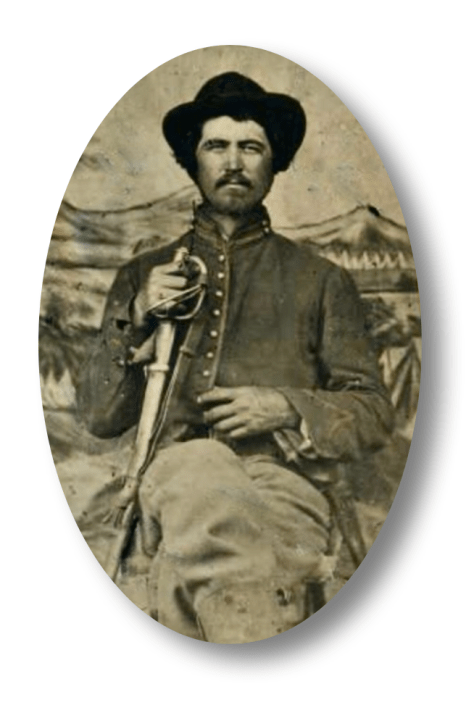
I could not find an image of Seymour but here is one of Loren F. Packard who served in Co. E of the 5th New York Cavalry (Photo Sleuth)

The following letter was written by Seymour Orlando Drake (1841-1863) who enlisted at Crown Point, New York, to serve three years in Co. H, 5th New York Cavalry—sometimes referred to as the First Ira Harris Guard. The regiment left the State on November 18, 1861, and served in the Department of Annapolis, Md., from November, 1861 until they were reassigned to the 5th Corps and Department of the Shenandoah in March, 1862.
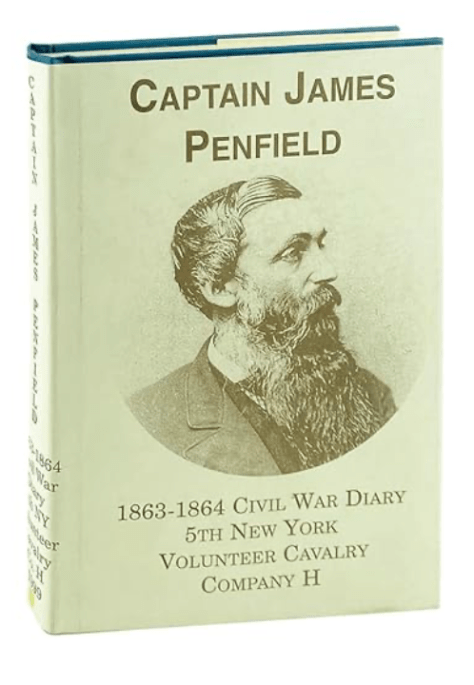
Capt. James Penfield’s 1863-1864 Diary describes the death of Corp. Drake on 30 May 1863.

Corporal Drake did not survive the war. He was one among the twenty troopers who volunteered to charge on a Rebel battery in Mosby’s command that was attacking a Federal locomotive on the orange & Alexandria Railroad near Greenwich, Virginia, on 30 May 1863. The troopers were within about ten yards of the cannon when it opened on them with grape and canister killing or wounding all but seven. Drake was killed instantly with a grape shot through the head.

Seymour’s parents were Amos Begelow Drake (1812-1891) and Lucinda Chellis (1812-1890). He wrote the letter to his sister, Ann Eliza (“Lide”) Drake (1843-1927). He refers to his older brother Harvey B. Drake (1834-1922) and his sister in law, Martha J. (Crawford) Drake (1835-1876).

Transcription

The patriotic stationery used; “The result of Uncle Sam’s Government—Peace, Plenty, and Prosperity.”

Camp Harris, Annapolis
Co. H
Saturday afternoon, February 8th 1862

I am in a tent alone. Got to thinking about you. I thought I would write you a few lines. I don’t think I can improve my time any better. I received a letter from you day before yesterday and one the day before that and answered it. I like to get letters from home and like to hear that you are all well. I have been a looking for a letter from Harvey and Martha but it is in vain.

I am enjoying good health at present and I hope that these few lines will find you enjoying the same blessing.

Our company was inspected closer than they have ever been before by a doctor from Washington. Every man was stripped and they was three men throwed out of the company. John Oakley 1 was one of them. Henry Griffin 2 was one—the man that bet Mr. Benedict—and a man by the name of Woodward from Port Henry, so they will come home in a few days.

Sunday, eleven o’clock. Just got in from drill. I call it a drill but the Captain calls it an inspection. Well, this is a nice day here. The ground is as bare as June. It han’t much like Schroon. Still we have a good deal of rough weather here. Rain one day, snow the next, and then good weather a few days.

Well, Lide, I got a letter from Renda this morning and a short line from you. Was glad to get them. I will answer them both today if I can and to Harvey too for John Lamb is going home tomorrow and I can send them by him right home. Well, I will close this letter and try to write another one today. I will try to get my picture taken on my horse and send it to you by John Oakley.

Much love to all. Write soon as you get this. So goodbye for this time. From Seymour O. Drake

To Lide Drake


1 Rejected physically in 1862, John J. Oakley (1839-1864) of Schroon, Essex county, New York, later enlisted in August 1863 to serve in Co. D, 2nd New York Cavalry. He served as a teamster until he died on 4 July 1864 at Morganzia, Louisiana.

2 Probably Henry Griffin (b. 1830) of Ticonderoga, Essex county, New York.

1861: Abijah Spafford to his Cousin

Pvt. Daniel Wright, Co. F, 5th New York Cavalry (NYSMM)

The following letter was written by Abijah S. Spafford (1840-1882) who enlisted in 9 September1861 as a private in Co. G, 5th New York Cavalry. He reenlisted on 11 February 1864 as a 1st Sergeant and mustered out on 19 July 1865 at Winchester, Virginia. The muster rolls inform us that he stood 5 foot 10.5 inches tall, had grey eyes, brown hair, and a light complexion.

The 5th New York Cavalry Regiment, also known as the 5th Regiment New York Volunteer Cavalry, and nicknamed the “1st Ira Harris Guards“, had a good fighting reputation, and had important roles in the Battle of Hanover and the Battle of the Wilderness. It was present at nearly 175 battles and skirmishes, including Gettysburg, Opequon, and Cedar Creek. A majority of its fighting was in Virginia. The regiment was originally called the Ira Harris Guard in honor of the senator from Albany, New York. It was named 5th New York Cavalry on November 14, 1861. The regiment’s battle flag was blue with “painted inscriptions and a semi-elliptical red shield in the center” inscribed with “5th.”

Abijah was the son of Milton R. Spafford (1811-1873) and Lucy Sheldon (1810-1888) of Middletown, Susquehanna county, Pennsylvania. His name was spelled variously as Spafford or Spofford but his family headstone reads, “Spafford.”

Transcription

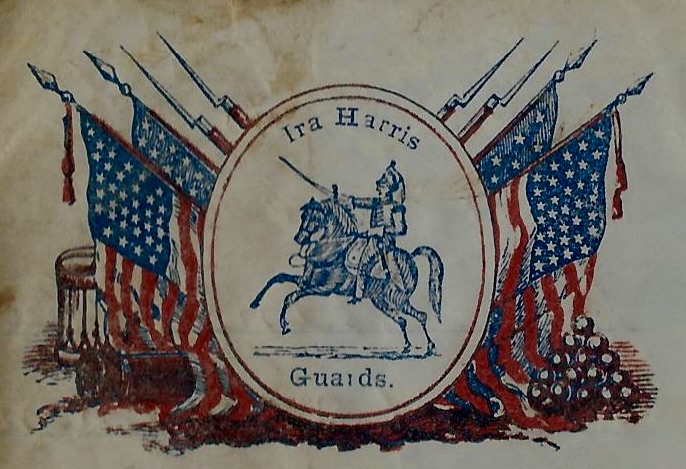
Patriotic Letterhead, “Ira Harris Guards.”

Camp Scott, Staten Island, [New York]
October 26, [1861]

Dear Cousin,

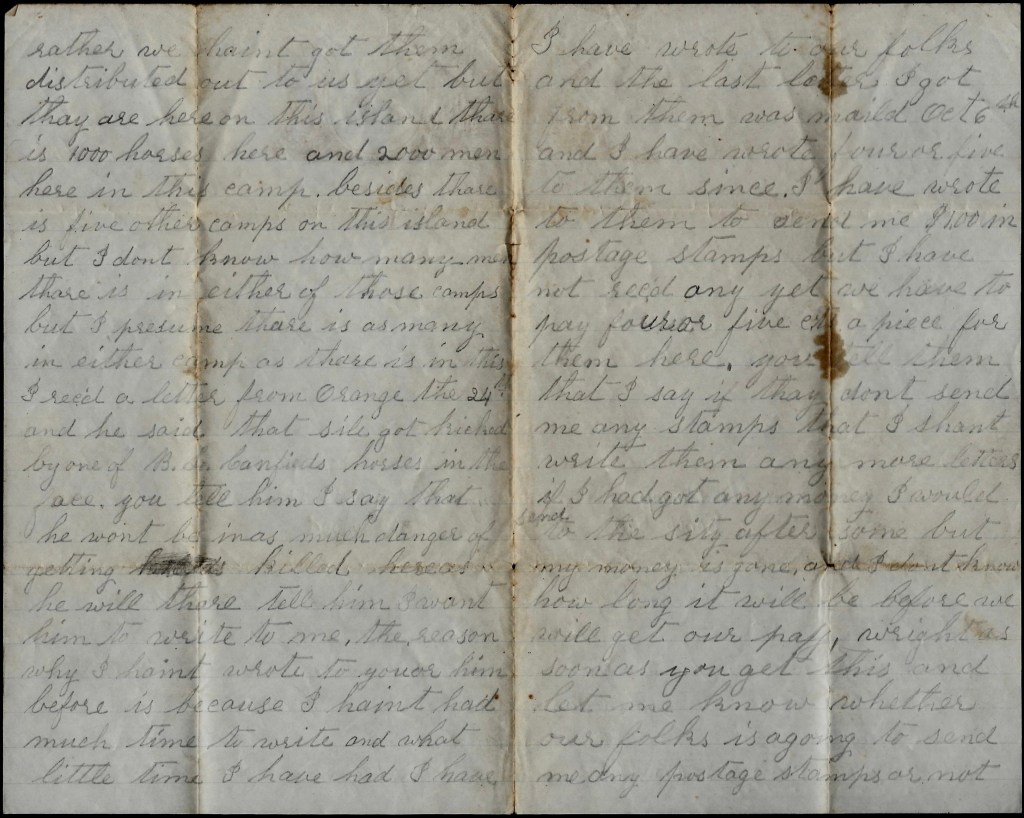
I sit myself down this pleasant Sabbath morning to write a few lines to you to let you know how I am getting along. I am well at present and enjoying myself first rate and I hope this will find you the same. I am getting so fat that I can’t hardly see out of my eyes. I have gained about 25 pounds since I left home and I never enjoyed myself better nor enjoyed better health for the same length of time in my life. I wish you and Sile was here and I know you would enjoy yourselves better than you ever did in Pennsylvania. We have got all of our uniform except overcoats and we are to have them tomorrow. We hain’t got our horses yet or rather we hain’t got them distributed out to us yet but they are here on this island. There is 1,000 horses here and 2,000 men here in this camp besides. There is five other camps on this island but I don’t know how many men there is in either of those camps but I presume there is as many in either camp as there is in this.

I received a letter from Orange the 24th and he said that Sile got kicked by one of B. L. Canfield’s horses in the face. You tell him I say that he won’t be in as much danger of getting killed here as he will there. Tell him I want him to write to me. The reason why I hain’t wrote to you or him before is because I hain’t had much time to write and what little time I have had I have to write to our folks and the last letter I got from them was mailed October 6th and I have wrote four or five to them since. I have wrote to them to send me $1 in postage stamps but I have not received any yet. We have to pay four or five cents a piece for them here. You tell them that I say if they don’t send me any stamps that I shan’t write them anymore letters if I had got any money. I would send to the city after some but my money is gone and I don’t know how long it will be before we will get our pay.

Write as soon as you get this and let me know whether our folks is going to send me any postage stamps or not. Write and let me know…

— Abijah Spafford

Direct to Camp Scott. Write as soon as you get this. Give my love to all enquiring friends.

1865: David Gardner to James Emslie

The following letter was written by David Gardner (b. 1842) who enlisted on 8 April 1863 at New York City to serve three years in Co. I, 5th New York Cavalry. He was taken prisoner on 17 June 1864 at Ely’s Ford on the Rapidan river in Virginia and taken to Andersonville. Unlike most of his fellow prisoners, David survived the confinement and was paroled in January 1865.

I could not find an image of David Gardner but here is an ambrotype of a cavalryman from the collection of my friend, Megan Kemble, who thinks he was in either the 5th or 6th New York Cavalry.

The letter is addressed to “Dear Sir” and my assumption is that it was sent to James Emslie, the father of William H. Emslie (1842-1864) who enlisted on 12 August 1861 at the age of 18 in Co. G, 2nd New York Cavalry. William was captured at Ellis Ford on 17 January 1864 and died of chronic diarrhea at Andersonville Prison on 25 June 1864. William’s parents were James and Jane (Weston) Emslie of Cornwall, Orange county, New York. We learn from the letter that David and William were tent mates at Andersonville. William was buried at Andersonville.

Also mentioned in the letter are two other names. The first is Henry J. Brewer (1841-1864) who served with William in Co. G, 2nd New York Cavalry. Henry was taken prisoner on 22 August 1863 at U. S. Ford on the Rappahannock River in Virginia and was also sent to Andersonville. He died there on 31 October 1864. This letter informs us that he was suffering from scurvy.

The other soldier mentioned was Frank Wood (1842-1864) who served in Co. I, 5th New York Cavalry with David Gardner. He was taken prisoner on 1 March 1864 near Richmond and died at Andersonville Prison on 19 July 1864.

A burial trench outside Andersonville Prison

Transcription

Winchester, Virginia
February 10th 1865

Dear Sir,

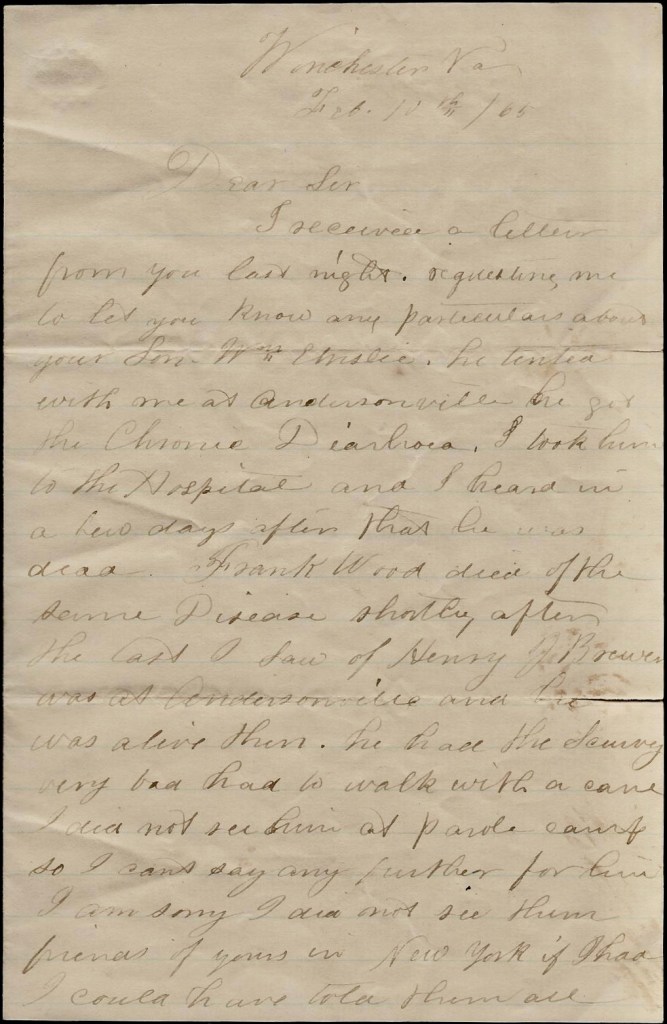
I received a letter from you last night requesting me to let you know any particulars about your son, Wm. Emslie. He tented with me at Andersonville. He got the chronic diarrhea. I took him to the hospital and I heard in a few days after that he was dead. Frank Wood died of the same disease shortly after. The last I saw of Henry J. Brewer was at Andersonville and he was alive then. He had the scurvy very bad—had to walk with a cane. I did not see him at parole camp so I can’t say any further for him. I am sorry I did not see them friends of yours in New York. If I had, I could have told them all about it.

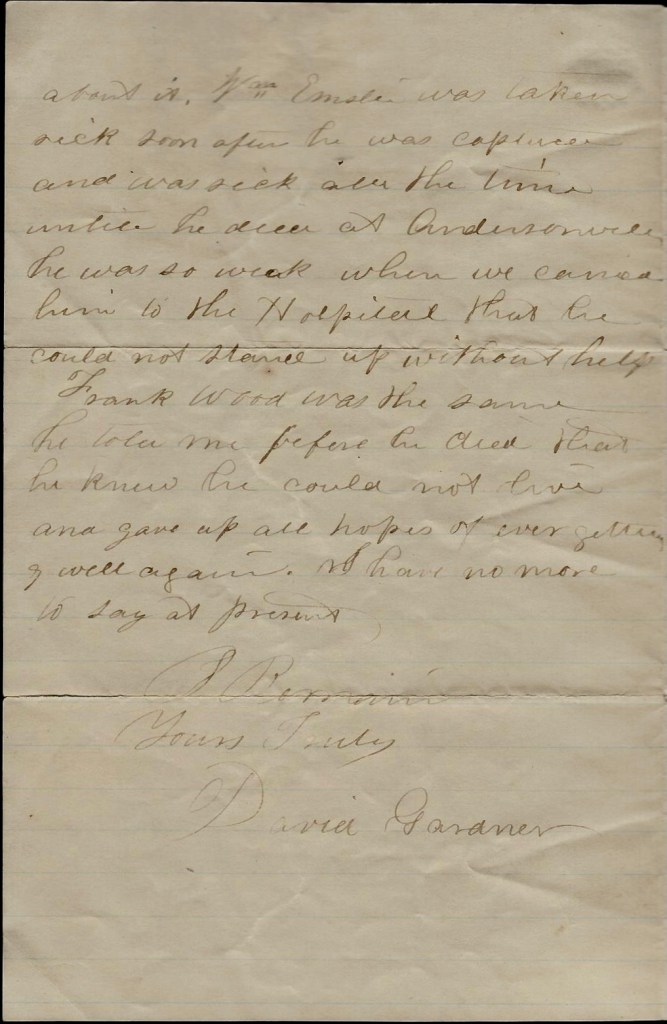
Wm. Emslie was taken sick soon after he was captured and was sick all the time until he died at Andersonville. He was so weak when we carried him to the hospital that he could not stand up without help. Frank Wood was the same. He told me before he died that he knew he could not live and gave up all hopes of ever getting well again. I have no more to say at present.

I remain, yours truly, — David Gardner